Showing posts with label Washington DC. Show all posts

Tuesday, May 7, 2019

Exciting POMS Conference in DC with Great Talks and Social Events

The 30th Production and Operations Management (POMS) Conference has now come to an end. It was a wonderful experience with over 2,000 conferees converging on Washington DC for the conference.

It started with some drama, because of the weather on Thursday, May 2, with big storms and temps in the 90s in DC. This resulted in flight delays for some including one of my doctoral students, Deniz Besik, who had a 4 hour delay from Bradley Airport to Reagan National Airport. The next morning, we had the first of a series of papers to present, beginning in the 8AM session. She made it to her hotel past 1AM and managed to register and to show up on time - clearly a sign of grit and success.  Some of us had taken earlier flights so we were spared delays. Also, Deniz was selected for and took part in the POMS Doctoral Colloquium on Saturday. Special congratulations to her since on Thursday afternoon, she was recognized by the Isenberg School of Management with the 2019 Outstanding Doctoral Student Researcher Award - quite the accomplishment, since our school has 7 different departments. I am very proud of her and very happy for her. Below is a photo that was shared on Twitter of Deniz with the award and with PhD friends: Rodrigo Mercado, Pritha Dutta, and Destenie Nock. Both Pritha and Destenie are receiving their PhDs at UMass Amherst ceremonies later this week and are off to academic careers. I am sure that they will be amazing professors at Pace University in NYC and at Carnegie Mellon University in Pittsburgh, respectively!

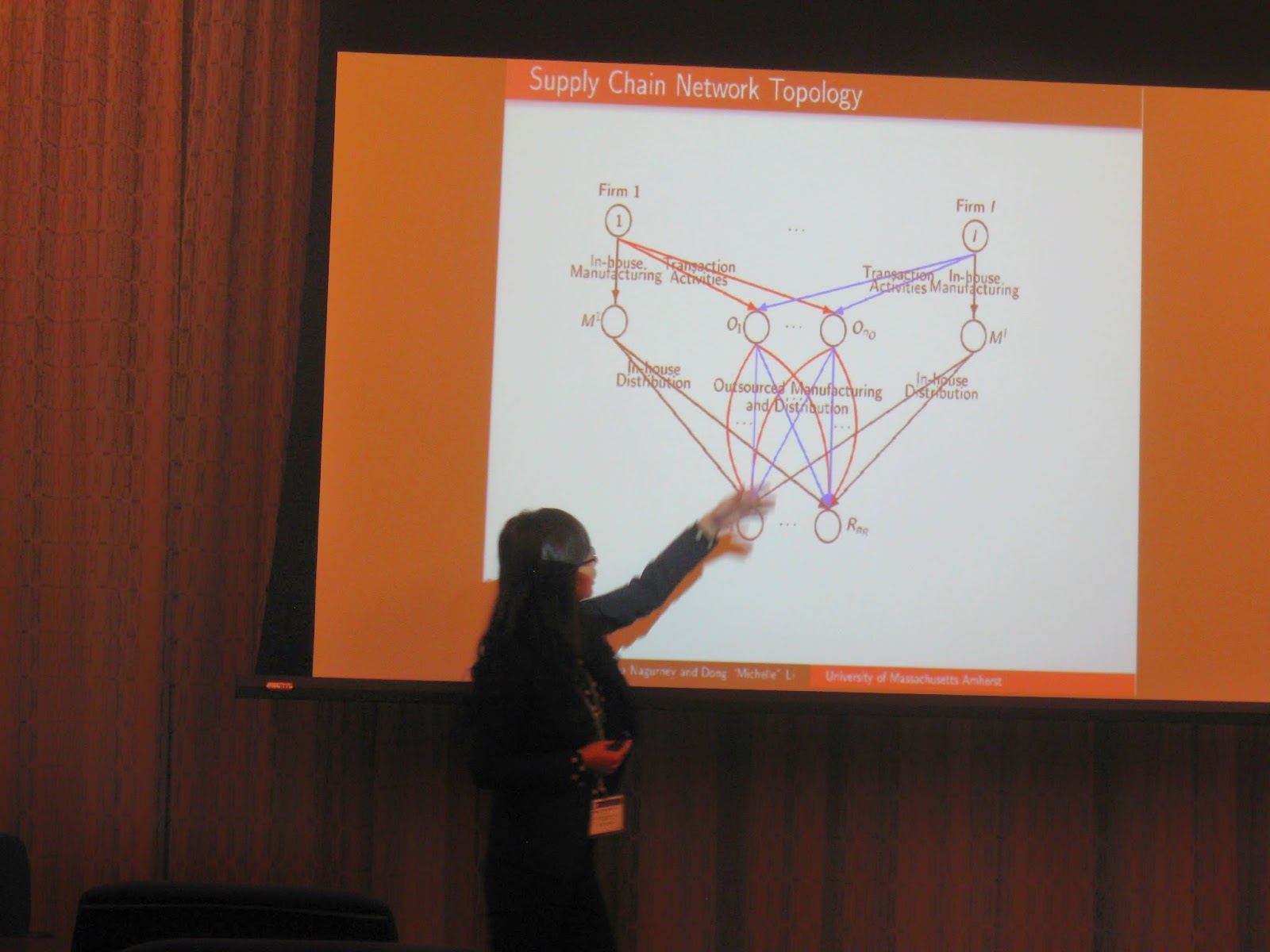
Our papers at POMS were presented in sessions on economics and operations management; healthcare, and humanitarian operations. The second and third presentations below were based on papers recently published in the journals Omega and the International Journal of Production Economics, respectively.

We have posted our presentations on the Supernetwork Center website.

The quality of the presentations in all sessions that I attended was excellent (generating many ideas and even possible new collaborations). It was a delight to see colleagues from Canada, Turkey, the UK, and across the US. Because of the location and also timing of the conference, it was a draw for many first timers and also quite a few INFORMS members, which was great. As a memento, we had photos taken of the speakers at the first session and then of even the audience as well as speakers of the third.
It is truly fabulous to see the interest in a spectrum of highly relevant topics for both research and practice!

In the below photo I am standing with Pritha Dutta, who is my 21st PhD student. She has done fundamental work on game theory and blood supply chains.
Socializing and networking are important components of any conference, as is reconnecting, and I love the serendipity of encountering colleagues and friends.
Plus, is is always thrilling to see the great Springer editors and, in this case, Matt Amboy, at the exhibits.

Of course, what would a conference in DC be without some exploring from Georgetown to the fabulous art museums. Luckily, Saturday's weather was ideal for walking.

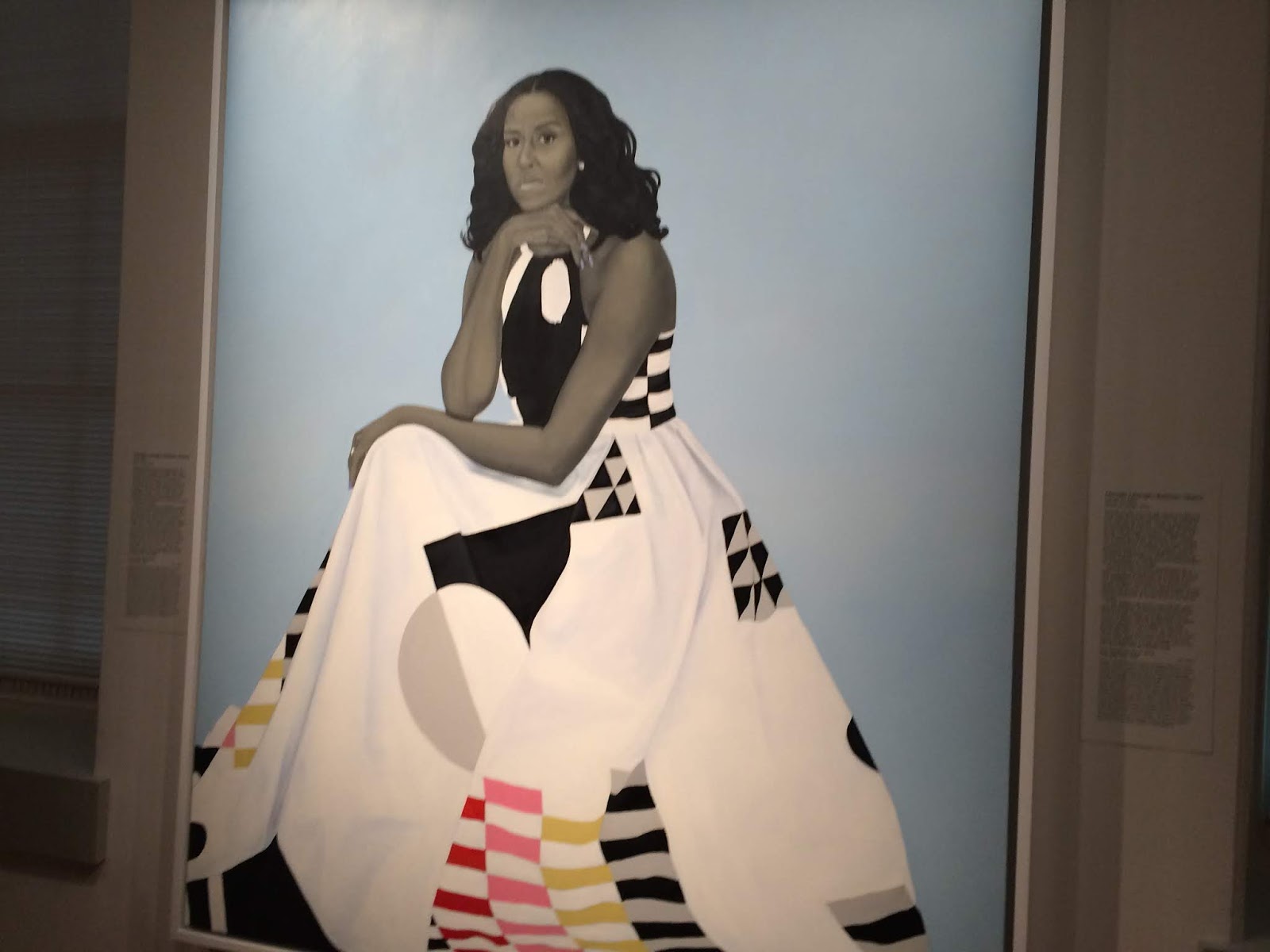
It was a delight to see Renoirs, Van Goghs, and Monets, as well as the portraits of President Obama and Michelle Obama. I was captivated by the audience viewing the latter - so many women!
My tradition at almost any conference is to treat a group that includes Supernetwork Center Associates, some of whom were my former doctoral students at the Isenberg School of Management, and friends to a dinner. On Saturday evening we enjoyed a scrumptious dinner at La Tomate, in proximity to the Hilton, which was the conference hotel. The food was magnificent and the company event better! We had an area just for us, which was very cozy.
After desserts, we took a group photo.
It is so rewarding to see my former PhD students, now professors at wonderful universities and colleges, thriving both professionally and personally.

And on a very rainy Sunday, the conferees and guests convened for a lavish awards luncheon and service was very prompt - extraordinarily efficient, but, then again, it was a POMS conference.
A special thanks to the "other" Professor Nagurney, for not only being a co-author of our first paper presentation at POMS, but for also helping me with the luggage and logistics.
Congratulations to the organizers of the 30th POMS Conference on its success!

Tuesday, May 12, 2015

Photos from POMS Conference in DC

In a previous post, I provided links to our presentations at the Production and Operations Management Society (POMS) Conference, which took place recently in Washington DC.

The photos below are of my present doctoral students, Sara Saberi and Shivani Shukla, along with my most recent PhD student at the Isenberg School, Dong "Michelle" Li, who successfully defended her PhD dissertation on May 4,  plus my former PhD student, Professor Min Yu of the Pamplin School of Business at the University of Portland in Oregon.

Nice to see members of the Supernetwork Team supporting one another professionally and personally.


Great job, present and future female academics, and thanks for forwarding the photos!

Tuesday, August 23, 2011

Where Were You When the Earth Moved?

As many of you are probably hearing (or have even experienced it), there was an earthquake registered at 5.9 that hit the Virginia area today in mid-afternoon.

I was busy (as I have been for the past days) working on my lectures for my Transportation & Logistics course that I will be teaching this Fall at the Isenberg School. This is one of my absolutely favorite courses to teach and, given all the news in this sector, I was enjoying incorporating new material into my lectures and course handouts.

Some of the materials included facts about recent disasters since I am very interested in transportation and critical infrastructure network robustness and resiliency.

Then, I felt my chair "moving" and I thought, at first, that maybe it was just electric signals pulsing through my body since I had been typing and editing lectures since 4AM this morning (OK, with one break for lunch and another one for a long walk, since I do some of my best thinking while moving). I thought that my muscles were just suffering from typing fatigue.

I felt somewhat unsettled and actually needed to stretch, so I went out for another walk only to be told by a colleague of mine, Professor Don De Groot, who is a Professor of Civil Engineering and an expert on structures, who happened to be bicycling by, of the big news -- that the Washington DC area had been hit by an earthquake! The tremors had even reached Massachusetts.

According to The Washington Post, the White House, the Pentagon, and Union Station shook and had to be evacuated!

Amazing that it could be felt all the way in Amherst, Massachusetts! I wonder whether President Obama and his family felt the tremors on the Vineyard in eastern Massachusetts, where they are now vacationing.

I have been to Japan several times to speak at conferences and there I got used to my hotel bed moving at night from minor quakes.

With the tornado that hit Massachusetts on June 1, 2011
, the summer has certainly given us some unusual experiences.

In 2011, there have been nine $1 billion weather disasters in the US.


Thursday, January 27, 2011

Thundersnow, Traffic Anarchy, and the Disaster Recovery and Mitigation Planning and Resilience Panel at TRB

I caught the 3PM flight out of Reagan National Airport yesterday as many of the later flights were being canceled. I had the pleasure of having our congressmen, Richard Neal and John Olver, being on the same flight so I figured that we would make it to Bradley airport on time and we did (Thanks to Republic Air / USAIRWAYS)! I had flown to DC for the Transportation Research Board (TRB) meeting to speak on a panel (appropriate title, I might add -- see below).

This TRB annual meeting had attracted 10,000 transportation professionals from around the globe. This past Wednesday I arrived to no snow and 45 degree temperature with joggers in shorts! What a difference a day made! Thundersnow arrived yesterday shortly after our plane took off and paralyzed DC after 4PM! The Washington Post is reporting that it took some commuters 13 hours to make it home! People were stuck for hours on the parkway with The Post calling the gridlock -- traffic anarchy! And less than 24 hours before, President Obama had given his State of the Union speech in DC!

According to The Post: In the District, at the intersection of Connecticut Avenue and Albemarle Street NW in Van Ness, buses and cars were tangled in every direction, blocking the intersection for hours. One bus blocked three lanes of Connecticut Avenue for more than two hours. A pair of Metrobus drivers - who declined to identify themselves because they said they were not authorized to speak to reporters - called it the worst travel conditions they have seen in the city during their combined 23 years behind the wheel. (I stayed in a fabulous hotel -- the Normandy Hotel -- just off of Connecticut Avenue and had checked out only hours before. I told the reservations desk clerks that if my flight was canceled I would be back.)

Event Number:700
Event Title:Disaster Recovery and Mitigation Planning and Resilience
Event Date:Jan 26 2011 10:15AM- 12:00PM
Event Location:Hilton, Lincoln West
Presiding Officers: Murray-Tuite, Pamela - Virginia Polytechnic Institute and State University
Sponsored By: Policy and Organization (AB000)
Critical Transportation Infrastructure Protection (ABE40)
Planning and Environment (AD000)

Event Description:Transportation systems throughout the world are greatly affected by natural disasters and human-created events. These systems are critical for daily activities and the economy. The magnitude of the U.S. transportation infrastructure makes protecting it extremely challenging and costly. This special session highlights innovative approaches to disaster recovery planning and assesses improving transportation infrastructure resilience to extreme events.


Presentations:
Update on TRB Activities (P11-1419)
Western, Jeffrey L. - Western Management and Consulting, LLC
Building Resilience into Fragile Transportation Networks in an Era of Increasing Disaster (P11-1394)
Nagurney, Anna - University of Massachusetts
Infrastructure: Critical Link and Cutting Edge for Disaster Recovery and Mitigation (P11-1397)
Zimmerman, Rae - New York University
Learning from the Haiti Reconstruction Efforts (P11-1399)
Lissade, Herby - California Department of Transportation
U.K. Perspective (P11-1464)
Kollamthodi, Sujith - AEA Group, United Kingdom

The panel and discussions were fantastic and I took copious notes. As the panelists noted, one never knows when the next disaster will strike (with the snowstorm unveiling before our eyes shortly thereafter). The interconnectedness of our critical infrastructure systems was also emphasized (and 422,000 lost power yesterday on the DC area because of the snowstorm)! We are truly in the era of supernetworks!

Since I have had requests, I have posted my presentation on this link. And, yes, I mentioned the price of anarchy for traffic in my talk and how it is related to the indices that we have developed in our research to identify the most critical nodes and links in various network systems from transportation ones to the Internet, electric power networks, and even financial ones.

I wish all the TRB conferees safe travels back to their homes! It was great to see so many wonderful colleagues from throughout the US and abroad in DC!


Monday, January 24, 2011

Designing Transportation Infrastructure for Wildlife at TRB and Amherst


The Transportation Research Board Annual Meeting has now begun in Washington DC and I am very pleased to see coverage in The New York Times. Today, it is reporting on the finalists and the winner of a design competition to help animals in crossing a road in Colorado. According to the article: At a picturesque spot in the mountains near the ski resorts of Vail and Breckenridge, Colo., two streams of traffic converge: people driving east and west on Interstate 70, and animals — black bears, cougars, bobcats, elk and deer — headed north and south to feed and mate. When they collide, the animal is almost always killed and the vehicle badly damaged, even if the driver is lucky enough to escape injury.

This is an example of multimodal/multiclass transportation and I will definitely bring it to the attention of my students since transportation need not just be about moving people and products!

The winner of the animal design crossing is Michael Van Valkenburgh & Associates, a landscape architecture firm with offices in New York City and Cambridge, MA. The design team, associated with the national construction firm HNTB, submitted a proposal for a bridge made of lightweight precast concrete panels that are snapped into place and covered with foliage.

The award is for $40,000.

In Amherst, the "wildlife" crossing design is in the form of tunnels and this initiative (without any financial incentives, I might add) was initiated decades ago, to assist salamanders crossing Henry Street so that they could mate. The New York Times reported on this crossing, with human intervention, back in 1988.

Who knows if the winning animal bridge design will actually be implemented in Colorado. In Amherst, the town actually built two tunnels decades ago and the salamander crossing has become an annual town event! What our town did is even reported on the U.S. Department of Transportation Federal Highway Administration website, complete with photos of salamanders! The tunnels were made possible through the efforts of the Amherst Department of Public Works, UMass Amherst, the MA Audubon Society, the Hitchcock Center (where my daughter and many others volunteer), and local residents.

See the photo above of the salamander crossing sign, which is a short walk from our home.


Tuesday, January 18, 2011

Disaster Recovery and Mitigation Planning and Resilience Panel at TRB in DC

I have been busy preparing my panel presentation, entitled, Building Resilience into Fragile Transportation Networks in an Era of Increasing Disasters. This presentation will be given next week in Washington DC as part of the Transportation Research Board (TRB) meeting in Washington DC, at which upwards of 10,000 transportation researchers and practitioners from around the globe are expected to attend. Let's hope that the weather cooperates so folks can make it!

My presentation is part of the Disaster Recovery and Mitigation Planning and Resilience panel.

Joining me on this panel are: Jeffrey L. Western, of Western Management and Consulting, LLC, who will provide an update on TRB activities, Rae Zimmerman of NYU, who will be speaking on Infrastructure Critical Link and Cutting Edge for Disaster Recovery and Mitigation, Herby Lissade of the California Department of Transportation, who will present, Learning from the Haiti Reconstruction Efforts, and Sujith Kollamthodi, of the AEA Group in the United Kingdom who will speak on the U.K. Perspective. Pamela Murray-Tuite of Virginia Tech will be presiding at the panel.

There will be time for questions (and answers) and I am sure that the discussions will be timely and fascinating!

Please join us, if you can.

UMass Amherst has an article on this panel in this week's In the Loop.

Tuesday, October 26, 2010

The Serendipity of Travel

One of the best parts of travel is the people that one meets.

In my previous blogpost, I wrote that I was off to Washington DC to serve on a proposal review panel.

When I approached my gate at Bradley airport, this past Sunday, I was greeted by a hello from one of my colleagues, Professor Lisa Masteralexis, who is the chair of the sports management department at the Isenberg School, and her husband. They are both experts in sports law and were returning from a wedding in New Jersey, which they said had been lovely.

On my flight from Bradley to Reagan National, I had the distinct privilege and pleasure of being seated next to one of the top lawyers in the country who is a senior partner of an international law firm based in NYC. Coincidentally, he had just been to a board of trustees meeting of the school in western Massachusetts that my daughter attends and that he and his daughter are alums of. He was flying to DC to give two presentations on corporate governance.

We spoke of mutual friends, what is special about the school that he is on the board of, and about Harvard since he is an alum twice over and I told him about my experiences as a Radcliffe Fellow the year that the then Dean, Dr. Drew Gilpin Faust, became the new President of Harvard.

Our flight arrived 20 minutes early so we had to wait on the tarmac before our gate was available which gave us just enough time to close the conversation on a really pleasant note. Another common point was the enjoyment of taking the train from Westchester to NYC, which is his commute now to work and which was a special treat for me while growing up in Yonkers.

The panel in DC was a success and I got to see some colleagues and make new acquaintances. Plus, the weather in DC was simply glorious and I take full credit for bringing it back with me to Amherst. But the highlight of the trip was meeting the fascinating lawyer on my flight down.

Sunday, October 24, 2010

Off to Washington DC!

As an academic, my busy professional life is filled with research, teaching, and professional service activities. I often write on this blog about research and about teaching -- this post is about service.

The service activities that an academic may be involved in (let's say some do not engage in much service) take on numerous forms -- from internal service, that is, departmental, school-wide, and university service -- to professional service, which may require travel. The latter involves reviewing journal articles, serving on editorial boards, serving on society committees, on conference organizing committees, and other activities. I receive, on the average, requests to review 3 papers a week and professional service alone could keep me with a full workload if I were to accept everything that came my way.

(Note: much of the service that we do as faculty is "pro bono" and we do not get paid extra for it but it is essential to maintaining the integrity and sustainability of our disciplines and their growth and sustenance.)

Service also involves taking part in peer-review panels and in evaluating different proposals for funding. I have reviewed proposals for scientific agencies in Canada, Sweden, Hong Kong, New Zealand, Denmark, and Ireland, to name just a few. Also, I review proposals for scientific agencies in the U.S.

I will be out of town shortly to serve on a scientific review panel. Preparation entails reading thoroughly and carefully a pile of proposals and writing drafts of the evaluations. This takes place even before the face-to-face meeting and discussions with other panelists. Getting together in the DC area, where many of the major funding agencies (the National Science Foundation, the National Institutes of Health, the Department of Energy, etc.) are located and where the panels are convened, to see colleagues and to meet new ones, is always enriching intellectually. There are times of the year (Fall, late Spring and early Summer) during which the Washington DC area is quite beautiful; plus, several times during my flights to/from DC I have sat next to Congressmen, which always makes for stimulating conversations.

My suitcase is packed, my briefcase filled with proposals and my reviews, and I am looking forward to another trip to Washington DC!

Of course, my classes are covered, and when I return, I will be grading piles of midterm exams!

Sunday, January 10, 2010

Photos from CUTC Awards Banquet in DC


The awards banquet that was sponsored by the Council of University Transportation Centers last evening at the Omni Shoreham hotel in Washington DC was a great success. Above are several photos taken at the event at which Dr. Patrick Qiang received the Charles V. Wootan Award. His mother was visiting from China and was able to attend. Dr. Qiang received his PhD last May from the University of Massachusetts Amherst. His concentration was in Management Science at the Isenberg School of Management. Patrick was my 14th doctoral student to received the PhD. All of us who have had the privilege to work with Patrick at the Virtual Center for Supernetworks congratulate him on his national dissertation award! He has now completed his first term as an Assistant Professor at the School of Graduate Professional Studies at the Pennsylvania State University Great Valley campus.