Showing posts with label math models. Show all posts

Tuesday, March 31, 2015

Great PhD Student Research in Supply Chains, Transportation and Logistics

This week has been off to a great start and the theme is clearly that of great doctoral student research!


Yesterday morning, we heard that our paper, Supply Chain Network Competition in Price and Quality with Multiple Manufacturers and Freight Service Providers, Anna Nagurney, Sara Saberi, Shivani Shukla, and Jonas Floden, was published in the journal,  Transportation Research E 77: (2015) pp 248-267. 

Both Sara Saberi and Shivani Shukla are two of my doctoral students in Management Science at the Isenberg School. And, coincidentally, or, propitiously, Sara was discussing this very same paper in our doctoral seminar that afternoon so the work was really hot off the press! The publication of this paper is quite exciting, since it is Shivani's first refereed journal article as a doctoral student, and our collaborator is Professor Jonas Floden of the School of Business, Economics and Law at the University of Gothenburg in beautiful Sweden. Professor Floden has become a wonderful collaborator of our supernetwork team since I am also a Visiting Professor there and the Swedes are excellent in transportation, including freight transportation, in both research and practice!

And, speaking of Gothenburg, today I heard from Dr. Niklas Arvidsson, who defended his PhD dissertation last year. I was a co-supervisor of his dissertation, with my colleague there, Professor Johan Woxenius, and enjoyed Skyping in for Niklas' dissertation defense.  Niklas did a wonderful dissertation, including a chapter on the milk run paradox, that I had even blogged about, and which was published in the journal Transportation Research A.  The great news that he shared with me today is the following: He received the message:   

I am very pleased to let you know that the committee decided that you are the winner of the first NECTAR PhD Award with your thesis “Essays on operational freight transport efficiency and sustainability”. You have written an excellent thesis, of an original nature and you have published various parts in high-quality journals. Congratulations!
 
Karst Geurs
Professor of Transport Planning
Chair of NECTAR - Network on European Communications and Transport Activities Research - www.nectar-eu.org


Plus, just recently, my doctoral student, Dong "Michelle" Li, had her co-authored paper, A Supply Chain Network Game Theory Model with Product Differentiation, Outsourcing of Production and Distribution, and Quality and Price Competition, Anna Nagurney and Dong Li, appear in the  Annals of Operations Research 228(1), (2015) pp 479-503.

Michelle will be defending her doctoral dissertation proposal in early May  and Sara Saberi will be defending her  dissertation proposal in April.

So, I am a very proud academic Mom. and to make this even a more perfect week, on Friday, the great UMass Amherst INFORMS Student Chapter and I are hosting an event on the Academic Job Process. Coming back to campus will be Dr. Amir H. Masoumi, who was my doctoral student and is now an Assistant Professor at Manhattan College in NYC, and Dr. Davit Khachatryan, who took several courses from me, and is now an Assistant Professor at Babson (after several years in consulting for PriceWaterhouseCoopers). Dr. Masoumi did an outstanding (alright, I am a bit biased) dissertation on perishable product supply chains in healthcare, and, together, with two other co-authors, including my great former doctoral student, Dr. Min Yu, now of the University of Portland, we wrote the book, "Networks Against Time: Supply Chain Analytics for Perishable Products."


Friday, March 15, 2013

Sustainable Cities Via Sustainable Supply Chains

Did you know that over one half of the world's population now resides in cities?

Which is your favorite city?

Might it be Boston?

or New York City?

perhaps Miami:
 

or Buenos Aires:

or Paris:

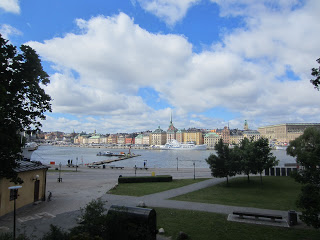
Stockholm:
Vienna:

or Shanghai?
I took all the above photos during speaking engagement trips over the past several years, except for the Shanghai one, which was taken by a former doctoral student of mine at the World Expo there.

When cities work well those who live in them can flourish in terms of mobility, health and welfare, accessibility, and innovation.


In the paper, "Design of Sustainable Supply Chains for Sustainable Cities," which is now accepted for publication in the journal, Environment & Planning B,  I emphasized  that cities, as dynamic complex networks, are the systems and the economic engines for commerce, research and development, education, healthcare, and even culture. They have evolved over space and time on built infrastructure from transportation networks to telecommunication and electric power networks.

At the same time, cities are the centers of resource usage from electricity and other forms of energy and fuel, to food, water, and a plethora of other products. Hence, they also are the repositories and generators of waste output and other environmental pollutants, such as carbon and other emissions, sewage, noise, etc. The term Sustainable Cities has come into increasing use in the past two decades, with a focus of making cities more livable, with an eye not only on the present generation but towards future ones, as well.

Our world is becoming a network of interconnected cities or a supernetwork of cities with  urbanization is one of the most pressing and complex challenges of the 21st century, with the citizenry characterized by a growing awareness of a threat to the sustainability of the earth’s natural environment, coupled with the increase in the number of people moving into and living in cities.

Cities are supplied by a complex array of supply chains servicing an immense spectrum of economic activities from food stores and restaurants, office supplies and high tech equipment, apparel, construction materials, as well as raw materials, to name just a few. The sustainability of supply chains is, hence, a precursor to the sustainability of our cities.

According to a Business for Social Responsibility (2009) paper, it is now widely acknowledged that making significant progress on mitigating the impact of climate change depends on reducing the negative environmental impacts of supply chains through their redesign and enhanced management (see also McKinsey Quarterly, 2008). Furthermore, as noted by Capgemini in its 2008 report: 2016: Future Supply Chain, “Preserving energy and raw materials and other resources like water will become a crucial aspect in future supply chains, as costs will likely remain volatile and supplies will continue to dwindle.”
These conditions may well create substantial pressure on current supply chain models.

In this paper, I constructed a new computable mathematical model,  that is network-based, for the design of sustainable supply chains with a focus on cities that captures the frequency of network link operations, which is especially relevant to cities due to frequent freight deliveries. An algorithm was then proposed, along with convergence results, and implemented for the computation of several numerical examples.


One of the goals in the paper was to demonstrate how, through the proper design (and operation) of these complex networks, waste can be reduced, along with the environmental impacts, while minimizing operational and frequency costs, and meeting demand.

For a presentation, with the same name, which also includes intellectual foundations inspired by Professor Martin Beckmann, the co-author of the classic book, Studies in the Economics of Transportation click here.