Friday, June 10, 2016

Great Academic Experiences in London

I returned from London, which was extra busy in preparation for the Queen's 90th birthday celebrations this weekend,  to Oxford via train in the late afternoon today.

We had left for London on Wednesday afternoon since I was to give the presentation: Supply Chain Networks Against Time: From Food to Pharma, at the Centre for Transport Studies at Imperial College on Thursday afternoon. I was invited to speak by Dr Panagiotis Angeloudis, Senior Lecturer in Engineering Systems and Logistics and the Director, Port Operations Research & Technology Centre. Professor Angeloudis has done fascinating work on critical infrastructure resilience, construction logistics, as well as maritime transport, including a recent game theory model which was just published in Transportation Research B. He is supervising 9 PhD students and has 3 postdocs working for him - very impressive - and is a computer geek with a lot of skills in data visualization.

When I arrived in London, I checked my email messages, and found a message from a reporter from Waterloo, Canada, Jeff Outhit, requesting an interview with me on ransomware and cyberattacks. He needed a response quickly and we managed to correspond and the great article that he wrote was published. The title is: "Cyber ransoms are ‘fastest-growing threat,’ expert warns." Outhit had seen that I gave a keynote talk at the University of Waterloo on cybercrime and cybersecurity on April 15, 2016 on Analytics Day. That great conference was organized by my INFORMS colleague, Dr. Fatma Gzara, whom I thank in my presentation, which Outhit even linked to in his article.

Since the hotel I was staying at was close to Hyde Park the morning of my presentation I had to take a walk there since I just love the green spaces.
I was treated to a delicious lunch in a beautiful building before my talk with both Professor Angeloudis and Professor Washington Y. Ochieng, the Head of the Centre for Transport Studies, who is very dynamic and a great intellectual force and leader, whom I enjoyed speaking with very much. 

The audience for my talk, which was on June 9, 2016, consisted of students, postdocs, and also representatives from industry, including from data science, which was very neat. 
I also had a great surprise: Professor Ben Heydecker, a transportation professor from the University of College London, whom I had not seen for a long time, but with whom I have very pleasant memories, which included even conversations with my dissertation advisor at Brown University, Professor Stella Dafermos, at various conferences, came to my talk. 
Of course, we had to talk about the book by such dear colleagues as Professors David E, Boyce and Huw Williams,  Forecasting Urban Travel, whose book launch I was a panelist at last Fall at Northwestern University.

I enjoyed giving my presentation very much since the audience was very attentive and afterwards they also asked great questions. We continued the discussions for about an hour after my presentation, which was delightful.

The conversations with Professor Panagiotis Angeloudis were also much too short - from drones for disaster relief and delivery of medicines to ancient Roman supply chains - this is a must to explore  research and tools by an archeologist at Stanford, which I could very much relate to because, as a Visiting Fellow now at All Souls College at Oxford University, I interact not only with economists, mathematicians, and scientists but also with humanists and archeologists!

And, yesterday evening, after a very pleasant seminar and discussions - Professor Panagiotis' group reminds me of the United Nations - with students from different countries working so well together - my family and I were hosted by Dr. Stavros Siokos, a former doctoral student of mine, with whom I wrote the Financial Networks book. Dr. Siokos is a financier based in London and has a PhD in Industrial Engineering from UMass Amherst and I was his dissertation advisor. He is also a Center Associate of the Virtual Center for Supernetworks at the Isenberg School of Management, which I founded almost 15 years ago!

Stavros took us to an exclusive club for dinner - the Royal Automobile Club (RAC), where the ambience was extraordinary as was the food and service, but, best of all, were the conversations with a former student of mine, who has achieved great success in industry. We discussed even the possibility of Brexit, that is, England leaving the European Union, with the vote taking place on June 23, 2016. This would be disastrous for numerous reasons, including for research and science, which is not even much written about.  The possibility of Brexit as well as Trump are major topics of conversation among the Fellows at All Souls College at Oxford University.

It is quite the experience living in England during this very historic time.

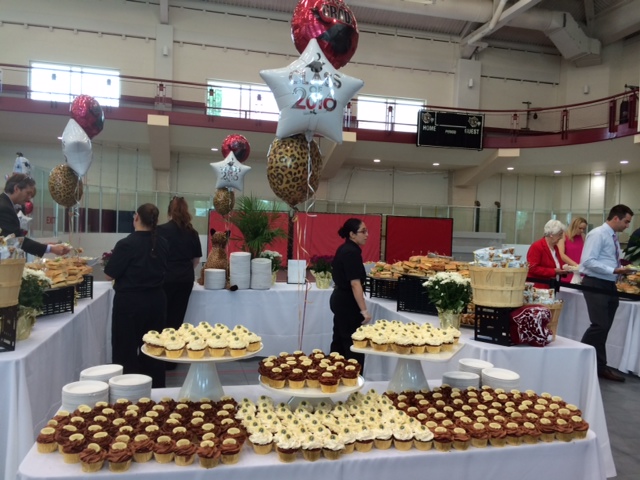
Below are some photos, including several of the desserts eaten at the exquisite dinner, last night.

Thanks to both Professor Panagiotis Andeloudis and to Dr. Stavros Siokos for such fabulous experiences in London!

We ended the evening with a walk to Stavros' office which had been Eisenhower's office when he planned D-Day, got to see the home of the richest man in England, and saw St. James Park, as well.

Saturday, June 4, 2016

Looking Forward to Speaking on Perishable Product Supply Chains at Imperial College and on Disaster Relief at Lancaster University in England

The news has spread that I am now a Visiting Fellow at All Souls College at Oxford University in England and, as a consequence, I have been honored with two great speaking engagements.

This coming week, on June 9, I will be speaking at the Centre for Transport Studies at Imperial College in London.

The title of my presentation at Imperial College is: "Supply Chain Networks: From Food to Pharma."

Imperial College prepared the nice notice below for my talk.

I had previously spoken at Imperial College on April 24, 2007 but then my topic was Critical Infrastructure Networks and Supernetworks,  

Since, my project at All Souls College as a Visiting Fellow is on supply chain network competition and quality, the seminar is very topical for me and I am very much looking forward to presenting on a variety of perishable product supply chains.

And, on June 28, I will be traveling from Oxford to present a seminar at the Department of Management Science at Lancaster University. The title of my presentation there, which I am in the processing of polishing is: "Disaster Relief Supply Chains: Network Models, Algorithm, and Case Studies
I received the invitation to speak at Lancaster University back in March 2016. The department is one of the largest Management Science departments  in the United Kingdom, with strong OR & OM groups interested in transportation, logistics, supply chains and other topics (http://www.lancaster.ac.uk/lums/management-science/people/). . Lancaster University if located 50 miles north of Manchester/Liverpool (towards the Lake District), 2.5 hours away from London on the train.

In my seminar presentation, I will speak on the Nagurney-Qiang network performance / efficiency measure and link and node importance identification and ranking, which is valuable for disaster planning as well as management. I will also describe a model developed in the paper, "A Mean-Variance Disaster Relief Supply Chain Network Model for Risk Reduction with Stochastic Link Costs, Time Targets, and Demand Uncertainty," Anna Nagurney and Ladimer S. Nagurney, to appear in Dynamics of Disasters, I.S. Kotsireas, A. Nagurney, and P.M. Pardalos, Eds., Springer International Publishing Switzerland. I will discuss then the model's application to a case study of hurricanes hitting Mexico. Finally, I plan on presenting some of our latest game theory results for post-disaster humanitarian relief using a Generalized Nash Equilibrium (GNE) model, which was developed with one of my former Isenberg School of Management honors students, Emilio Alvarez-Flores, who graduated in May 2016, and Professor Ceren Soylu  of the Department of Economics at UMass Amherst. I will also present a case study of Hurricane Katrina of our framework and compare the results obtained under the GNE solution concept to that for the  Nash Equilibrium version.  The results are quite fascinating and have major implications for policy makers.

Thursday, June 2, 2016

Inspiring Discussion with Kofi Annan, Former Secretary General of the United Nations, at Oxford University

Some of the wonderful aspects of being a Visiting Fellow at All Souls College at Oxford University is the amazing people that I have met, the great speakers that I have heard, and the special events that I have attended.

Today, we were greatly honored to have Kofi Annan, the former Secretary General of the United Nations, and also Nobel Peace Prize recipient, come to Oxford, specifically, the beautiful Blavatnik Building of Government, for a discussion of the United Nations in the 21st Century. The moderator was Professor Wood. I was thrilled to hear him acknowledge Ed Mortimer in the audience, whom I have had lunch with at All Souls College since he is a Fellow, and we had a fabulous conversation on how he used to write speeches for Annan when he worked for the United Nations.
Kofi Annan was brilliant and just the other day I read in my International New York Times here as to how charismatic, charming, and successful of a leader he had been of the United Nations for almost a decade. He is now 78 years of age and his charm, sense of humor, dedication to saving lives were vividly apparent during today's discussion. He held what is considered one of the toughest jobs in the world.

After being introduced by Professor Wood, he told a delightful story how, after stepping down from the United Nations, he went with his wife to Italy for 3 months and wanted essentially no communication with the outside world and that included no newspapers. Venturing out to Como (a place I have come to love during my two stays at the Rockefeller Foundation's Bellagio Center there) he thought he may have been recognized only to be told that he was the actor, Morgan Freeman. I must admit there is some resemblance!

Since stepping down from the United Nations, he has been very active with his Kofi Annan Foundation and is regularly called upon to assist in international affairs and mediation, including serving as a special envoy to Syria. This he eventually stepped down from because he said the parties would not stop fighting one another. He said it is hard for him to say no if he can save one life of a child or of a woman. His sincerity  and great intelligence were apparent throughout the event today.

He emphasized what matters to him: finding peace and stability, sustainable development, the rule of law, and respect for human rights.

He said that when he looks at inequality, at hunger in the world, he sees a lack of trust in leadership and politicians building on anger of the people.

He told the many students in the audience to not only go into government and law but also into the private sector since much can be accomplished for good from this sector.

He emphasized the concept of the responsibility to protect and some crimes are too horrible to ignore so interventions are needed.  He said that there is a list of questions that must be answered before military intervention.

After Kofi Annan's remarks, it was time to open up questions from the audience with students' questions being first answered.

As to how to manage migration effectively and the crisis now in Europe, Annan noted that if the countries had worked together from the onset that there would not be such division now. He emphasized that compassion is needed and although politicians tend to chase votes, people are not stupid. He also said that 40% of founders of Fortune 500 companies were immigrants.

After a student brought up a recent OpEd in The New York Times written by a former UN employee who said that the inefficiency there was extremely problematic (and which I had read), Annan agreed that the UN needs more efficiency and reforms but that it is also up to the member states.

Something that he said that resonated very much with me was that holding many discussions over issues was like scientists testing different hypotheses and, ultimately, you may have a breakthrough, so it is important to keep those discussions going.

His advice to students and those who may want to work for the United Nations was to, once you got an assignment, to analyze it, and determine what you can contribute to it and how long it will take you, and then follow through. He has always used such ideas in his career, which has been brilliant.

He also mentioned that if you are creative you can get others to move with you.

He said that he would get impossible mandates from the Security Council, but that he would break down the task into manageable components.

Sadly, he said that he does not see any movement towards peace between Israel and Palestine.

Professor Wood emphasized the brilliance of the discussion and I concur! And, when he noted the importance of delivery of humanitarian relief supplies, I thought of the course on Humanitarian Logistics and Healthcare that I teach at the Isenberg School each spring and could not help but be inspired.

At the end, Professor Wood announced a special partnership with Africa, including Nigeria and Ghana, the country where Annan was born, to bring scholars to Oxford, and also to support a Visiting Fellow which is terrific.


Monday, May 30, 2016

First Month as a Visiting Fellow at Oxford University in England

I have now officially been a Visiting Fellow at All Souls College at Oxford University in England for one month (with a sojourn back for 3 days to the US for my daughter's college graduation).
The buildings at All Souls College are magnificent.
Below is a photo of my office door and a photo of the black gown that I wear to dinners at All Souls College. Seeing these upon my arrival made me feel immediately welcome.
The view from my office continues to inspire and I work to the sounds of the fountain in the garden outside of it.
I have been blogging about the experience but thought it made sense to take stock of what the first month has meant to me. Plus, I am often asked at the delicious fellowship meals (lunches and dinners) as to how my work is going and how am I doing. I am researching supply chains while a Visiting Fellow and, specifically, focusing on capturing quality and its preservation/degradation under competition in networks with applications including food.  Given the wonderful fellowship here and community, which includes the delicious meals and conversations as well as tea and coffee that follow the topic is quite timely, I must say. I have enjoyed eating fish and chips with economics Fellows and Professor Glenn Loury of my alma mater, Brown University.
I've also enjoyed conversations including with Professor Ted Sider who is a Visiting Fellow with me and a notable UMass Amherst PhD alum (he is a philosopher). Pleasantly, Dr. Su Fang Ng, who is from the University of Oklahoma, and was a Radcliffe Institute for Advanced Study Fellow at Harvard University with me, in 2005-2006, is also a Visiting Fellow now at All Souls College.
The ambience of the tea room, as well as the dining halls, adds to the beauty and uniqueness of this truly special experience.


Since arriving at All Souls College, I have revised a paper on disaster relief, and resubmitted it to a journal, and have accepted an invitation to speak on the topic to the Management Science group at Lancaster University on June 28. I will also be speaking at the Centre for Transport Studies at Imperial College in London on June 9 on perishable product supply chains, which I am very much looking forward to. That evening I will be dining with one of my former doctoral students, and co-author of the Financial Networks book, Dr. Stavros Siokos, who is a very successful financier and a UMass Amherst alum. In July, I will be flying from England to speak at the EURO conference in Poznan, Poland, which should be fantastic and there we will be presenting also our latest cybersecurity research and also work on the Braess paradox and electronic circuits. Yes, applications of operations research are fascinating and widespread!


While at Oxford University, I am delighted that the Dynamics of Disasters volume, that I co-edited with Professors Ilias Kotsireas and Panos M. Pardalos, has been completed with a very nice Introduction. It contains 18 chapters. The volume has been shipped to our publisher, Springer.


I also had a chance to attend the Responsible Business conference at the Said School of Business that I blogged about.


In addition, I have been working on a paper on supply chain quality with application to food supply chains and am looking forward to the publication of the book, "Competing on Supply Chain Quality," co-authored with Dong Li, also to be published by Springer. In it, Oxford University is acknowledged and it is also acknowledged in the Dynamics of Disasters book.


Of course, while at Oxford, I have continued to monitor the progress of my doctoral students in Management Science at the Isenberg School of Management at UMass Amherst and am looking forward to Sara Saberi defending her dissertation later this summer.


The support provided by All Souls College plus the warmth of its staff surrounds us with a positive energy which challenges us to do our best work.


The beauty of the green spaces of Oxford and its various colleges also provide us with time to think as we walk and explore.


I am sure that the next month will bring all sorts of new experiences.

Friday, May 27, 2016

Reflection on John Forbes Nash Jr. and Connections

The past week or so I have been delighted, every time that I logon from my office at All Souls College at Oxford University, where I am now a Visiting Fellow,  to see the beautiful photo of Sir Andrew Wiles receiving the 2016 Abel Prize in Oslo, Norway from Crown Price Hakon. The Abel prize  is the most prestigious international prize awarded in mathematics.  Sir Wiles proved Fermat's Last Theorem, an achievement which has brought him great and much-deserved renown. The interview itself is an inspiration and speaks of his years of studying the problem before all the pieces for the proof fit together.

I could not help thinking back to one year ago and recalling that, one of my scholarly giants, whom I cite in numerous papers (probably about 100), John F. Nash Jr.,  was awarded the Abel Prize in May 2015. He was awarded it with Louis Nirenberg.

My husband brought me the latest issue of the Notices of the AMS to my daughter's graduation last weekend saying that I had to bring the issue back with me to Oxford, and I did. On the cover was a photo of John Forbes Nash Jr. and in the issue were both tributes and a fascinating interview with Nash, his last.
This morning I had a chance to read the interview conducted by Professors Martin Raussen and Christian Skau with Nash on May 18, 2015, one day before the Abel Prize ceremony in Oslo, Norway and only 5 days before he died tragically with his wife following a return flight and being driven in a taxi from the Newark Airport.

I had been at that airport both last Thursday and Sunday, flying in from Heathrow London to attend my daughter's college graduation from Lafayette College. My experiences with drivers to and from Newark Airport merits a separate blogpost.

John Nash received his PhD from Princeton University at age 21 and his dissertation was on Noncooperative Games. His contributions included results for manifolds and even partial differential equations and for decades he suffered from mental illness but in the 1990s became well enough and was awarded the Nobel Prize in Economic Sciences in 1994. Interestingly, his advisor at Princeton was Al Tucker (of course of Kuhn-Tucker nonlinear programming fame) and he actually shortened his dissertation. Nash had had some results on cooperative game theory at that point as well. All Tucker's son, Al Tucker Jr., had interviewed me for a tenure track faculty position at SUNY Stony Brook and I had gotten an offer while I was on the job market while finishing my PhD, but I chose to come to UMass Amherst.

I have utilized Nash's results in game theory for modeling a plethora of competitive supply chain network problems from those arising in food applications to even fast fashion (some Fellows at dinner last night were asking me about what is fast fashion and there are both H&M and Zara outlets 2 blocks away). It was a fun discussion. And the Fellow who raised the question is a Harvard-educated economic historian who after speaking with me said - "You are an Operations Researcher!"

I have also with students and collaborators been doing alot of work on cybersecurity and cybercrime and, again, Nash's results on Nash Equilibria are crucial to my model formulation and subsequent analysis and computations. 

This past year we have been tackling some very challenging problems. These have required extensions of Nash Equilibrium to Generalized Nash Equilibrium in the case of a disaster relief model that we developed with a brilliant undergraduate at the Isenberg School of Management, and now alum, and an Economics Professor, as well as the development and solution of Nash Bargaining models from cooperative game theory for information sharing among firms that are subject to cyberattacks with applications to financial service firms, retailers, and energy companies.

And speaking of other connections, our paper: A Supply Chain Game Theory Framework for Cybersecurity Investments Under Network Vulnerability, Anna Nagurney, Ladimer S. Nagurney, and Shivani Shukla, in Computation, Cryptography, and Network Security, N.J. Daras and M.T. Rassias, Editors, Springer International Publishing Switzerland (2015) pp 381-398, which was co-edited as you can see by Michael T. Rassias, is mentioned in the last paragraph of the Nash interview. The paragraph reads:  After the end of the interview proper, there was an informal chat about John Nash’s main current interests. He mentioned again his reflections about cosmology. Concerning publications, Nash told us about a book entitled “Open Problems in Mathematics” that he was editing with the young Greek mathematician Michael Th. Rassias, who was conducting postdoctoral research at Princeton University during that academic year.

This book is scheduled to be published by Springer sometime this summer.

And I know Rassias's father, who is another brilliant mathematician. He co-edited with my great colleague Panos Pardalos the volume that another paper of ours appears in: A Dynamic Network Economic Model of a Service-Oriented Internet with Price and Quality Competition, Anna Nagurney, Dong Li, Sara Saberi, and Tilman Wolf, in Network Models in Economics and Finance, V.A. Kalyagin, P.M. Pardalos, and T. M. Rassias, Editors, Springer International Publishing Switzerland (2014) pp 239-264. That volume was based on a conference in Athens, Greece, and I posted some photos from it on my blog.

Monday, May 23, 2016

The Best College Graduation Ever - My Daughter's

Last Thursday, I flew from London Heathrow to Newark to attend my daughter's college graduation and today I returned back to Oxford, England, where I am a Visiting Fellow at All Souls College for the trinity term.

This was a whirlwind trip but truly special - your child graduates college only once (although she may acquire additional degrees).

I have blogged about my daughter's graduation from Deerfield Academy as well as from The Bement School and, since many of my colleagues from around the world know Alexandra and are asking for highlights of her college graduation, I am writing this blogpost. She went to her first INFORMS conference in Boston when she was only 3 months old and one of her favorite conferences was when we were in Iceland. She has followed me on various academic appointments whether in Austria or in Sweden and soon will be joining me in England.

Her now alma mater is Lafayette College, which has a beautiful campus, very successful graduates,  and is one hour away from NYC; about an hour from Philadelphia, and about 2 hours from DC. Hence, there are many opportunities for great educational class field trips as well as internships.

The college was named after General Lafayette.


Although the graduation ceremony from Lafayette College in Easton, Pennsylvania, was on Saturday, May 21, 2016, already on Friday, May 20, we had many events to attend, beginning with a very special ceremony in the Department of Geology and Environmental Geosciences, from which Alexandra received a BS summa cum laude and graduated with honors in geology and environmental geosciences.
 The faculty that Alexandra has had at Lafayette College were mentors, supporters, and some, I believe, also became friends. She traveled with geology faculty to Hawaii, did a field trip to Wyoming and many more local ones to her college, and was a TA on the second Wyoming field trip. She also had an externship in Oklahoma. Her honors thesis was on Iceland and I Skyped in recently from England for her oral defense.

At the geology ceremony, each senior major received a gift and also a professor or two spoke about what made the student unique. This was very moving event and took place in the beautiful geology building. Dr. Kira Lawrence, the Chair of the Department, who received her PhD from Brown University, was the officiator.

Professor Larry Malinconico, Alexandra's advisor, and Professor Tamara Carley, her honors thesis supervisor, both spoke about Alexandra. I personally had to thank Professor Hovis, a Harvard PhD for his mentorship of Alexandra as well. Dr. Malinconico is a Dartmouth PhD and also a former member of the crew team there.

My husband and I are very grateful for the nurturing that Lafayette College provided in terms of STEM (Science, Technology, Engineering, and Mathematics) education within a liberal arts college education. Her faculty also supported her when she submitted applications to various summer programs and graduate school. After her sophomore year, Alexandra did summer research on the environmental impact of fracking at the University of Colorado Boulder under an NSF REU (Research Experiences for Undergraduates)  program, and, after her junior year, she was a summer intern at the Lunar and Planetary Institute in Houston, Texas, working on moon rocks in a very competitive international program.


In August,  she will begin a PhD program in geology.

On Friday, there was also an honors convocation in which the first page of each thesis presentation was displayed in a slide show and each student recognized. My cousin, Andrew Yarosh, a fellow Brown University grad, traveled from Colorado to join us in the celebrations.
There were numerous receptions to attend, which were very festive and, luckily, the rain held off, so the graduation ceremony could take place outdoors.
It was great to see a fellow Deerfield Academy graduate, class of 2012, Brad Marshall, who also hails from western Massachusetts, receive a degree in engineering from Lafayette College.
After graduation, it was time for the Lafayette College crew barbecue which the senior crew team members organized for the families. Alexandra has been both a VP and President of the crew team and, together this amazing group of student athletes,  journeyed together to competitions in the Northeast, including the Head of the Charles regatta in Cambridge and the Dad Vails in Philadelphia, trained during every spring break in Florida, and numerous mornings on the river around 6AM.  My daughter was the cox for the men's 4s and 8s boats and the camaraderie of this team is extraordinary. Special thanks to the coach, Rick Kelliher. They even planned and organized a banquet each year, which President Alison Byerly attended once, raised lots of money for the team, and even hosted an Olympian gold medalist at one of the banquets. President Byerly has been an outstanding President of Lafayette College.

Thanks to Lafayette College for providing my daughter with both transformative educational experiences (even a trip to Costa Rica), nurturing her love of science and research, her love of history and art history, with great classes in environmental sciences, advanced calculus, economics, and statistics.

As an academic, I have been to many wonderful college and graduation ceremonies, not only in the US, such as at the University of Massachusetts Amherst, where I teach, at Brown University and at Harvard University, but also abroad in Sweden, but when your daughter graduates, that will always be a very special one!

More photos from Lafayette's 181st commencement are available on the college's website. And, by the way, my husband, Alexandra's father, is also a Lafayette College grad and a very loyal alum. He still stays in touch with one of his former physics professors. Those are the special ties that bind.

Congratulations to the Class of 2016!