Sunday, November 6, 2016

Game Theory for Security Conference in NYC Attracts Speakers from Around the Globe

We returned yesterday evening from NYC from the fabulous Decision and Game Theory for Security Conference, GameSec2016, which took place November 2-4 at the New York University (NYU) Tandon School of Engineering,  located in Brooklyn. The view below is from our hotel room on the 18th floor of the Marriott. Since the venue was close to one of my absolutely favorite structures, the Brooklyn Bridge, I had to walk it.

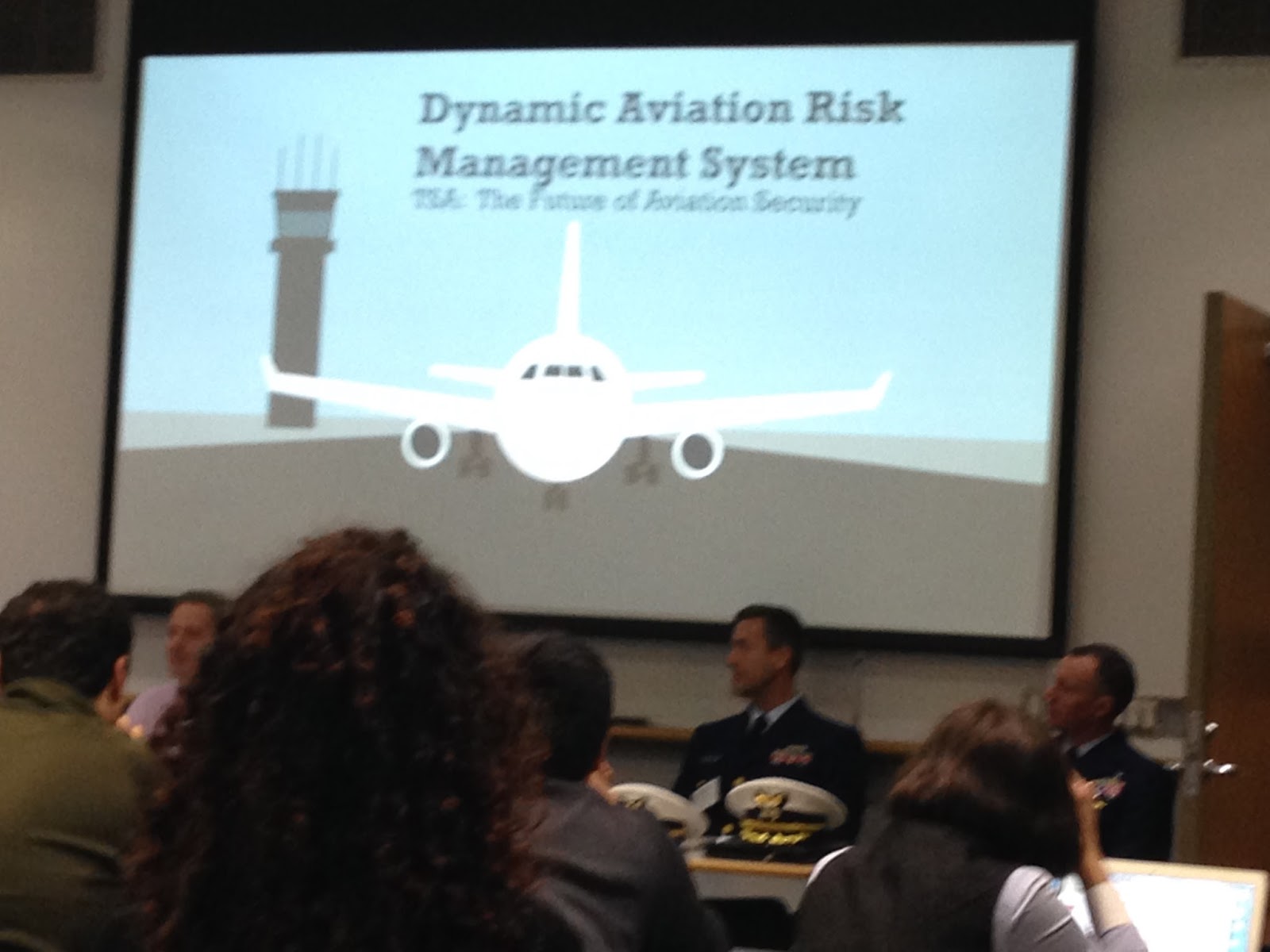
The General Chair of the conference was Quanyan Zhu of NYU and he deserves a big congratulations on the success of the conference as do the steering board and all the organizers. This focused conference, with the elegantly produced conference proceedings, had a single stream of presentations,  a panel with experts from the Coast Guard, the Transportation Security Agency, industry and academic reps, and two plenary talks given by George Cybenko of Dartmouth and me.

The special session on validating models and the panel were alone worth coming to the conference!
 Panel Discussion - Panelists Include:

  • Capt. Tom Morkan (US Coast Guard)
  • CDR Brian Murphy (US Coast Guard)
  • Nathaniel Gleicer (Illumio; Former Director for Cybersecurity Policy for the National Security Council)
  • Dr. Pratyusa Manhadatta (HP Labs)
  • Ron Sartini (Transportation Security Administration) 


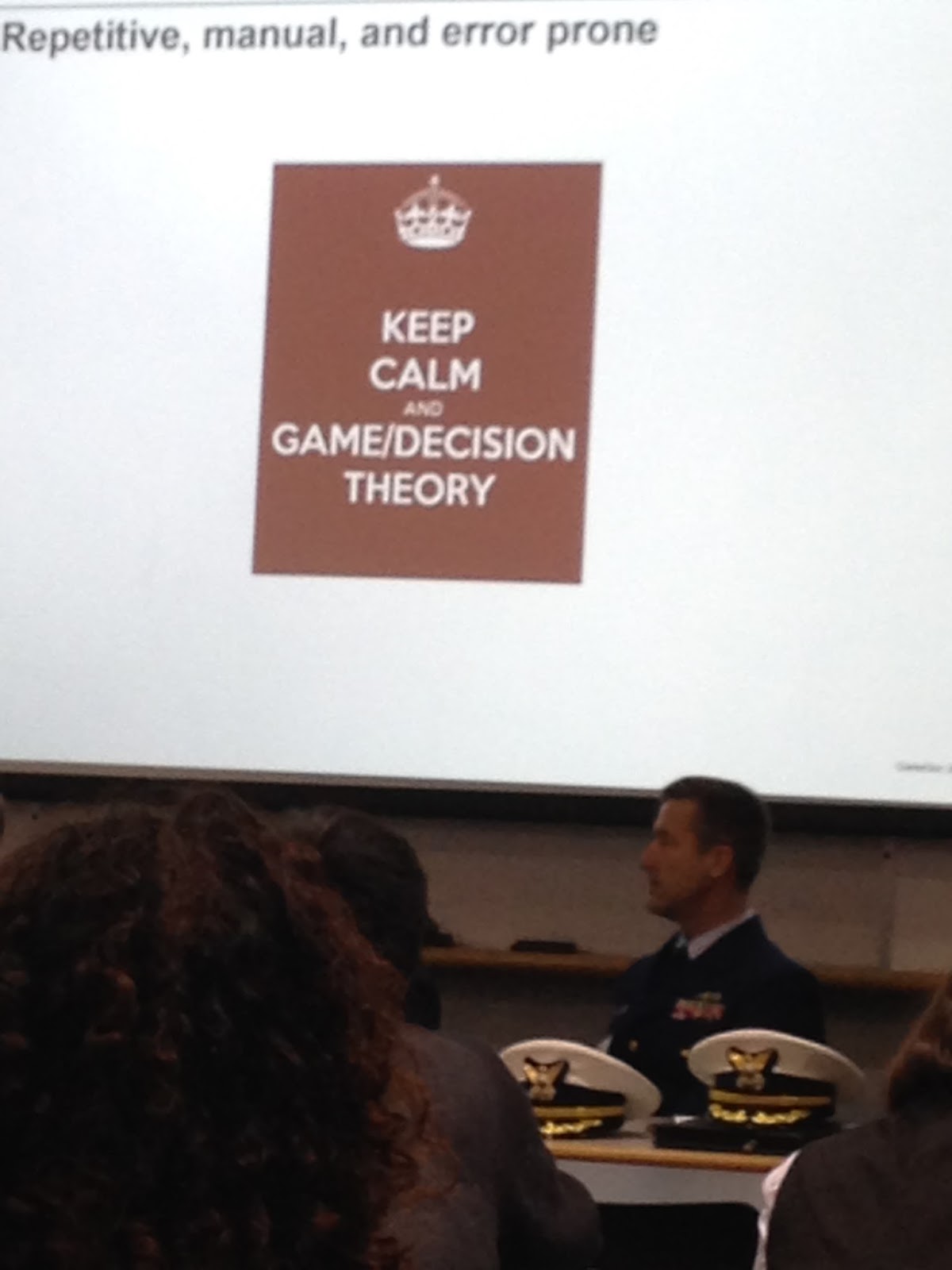
It was outstanding to hear from the expert panelists how game theory is essential to their decision-making in practice and that includes such major tasks as protecting the Port Authority of New York & New Jersey and the port of Boston. Hearing how research that one engages in can make a difference is very inspiring, motivating, and energizing, and I will be sharing some of the insights when I teach my class on Tuesday at the Isenberg School of Management! 

Below are additional photos taken at the conference.


Lunches were provided, as well as snacks during the conference breaks.
On Thursday evening we were treated to a sumptious banquet at NYU's Torch Club in Manhattan.  It was great fun to travel together on the NY subway.

 
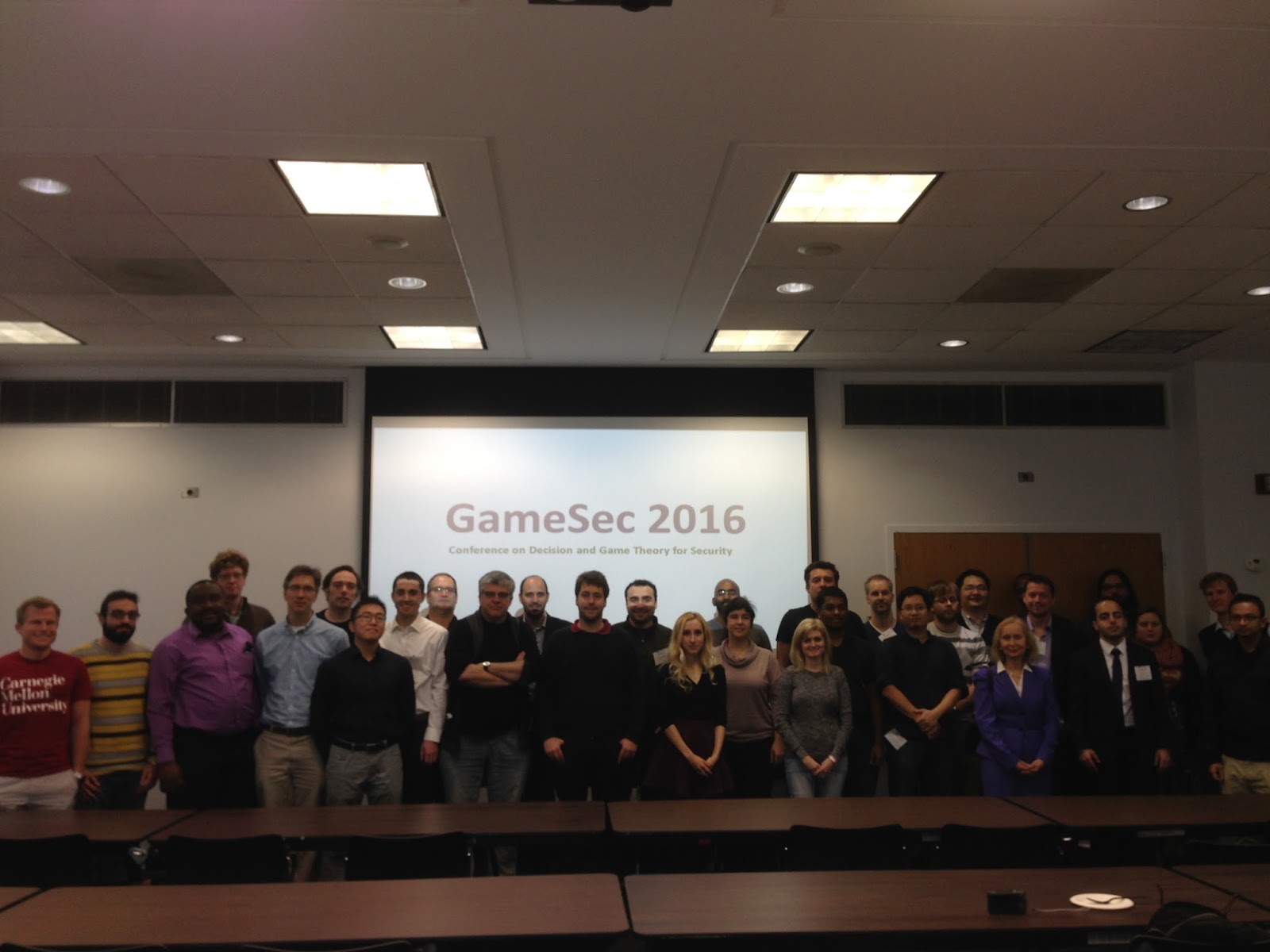
Below is a group photo of many of the participants, which was taken on Friday.
As can be seen from the conference program, the talks described many creative theoretical frameworks that add to our understanding of the strengths of game theory in a wide range of security settings, including: cybercrime and cybersecurity, cyber-physical systems, auditing elections, Internet of Things (IoT), denial of service attacks, strategic cybersecurity investments, voting systems, compliance, denial of service attacks (DOS), and more! I know that I will be reading the proceedings edited by Quanyan Zhu, Tansu Alpcan, Emmanouil Panaousis, Milind Tambe, and William Casey, from cover to cover, and will be citing the papers in this very valuable volume.
What very much impressed me about the participants and their talks and this speaks to the caliber of this conference, which was started in 2010, was the global participation, with speakers from, besides the US (including California), France, Austria, England, Australia,  Greece, Poland, Czechoslovakia, Switzerland, and other countries. The quality of the research and science was inspiring and the conversations and discussions throughout the conference made for very enjoyable networking as well  as scientific exchanges.

I was so honored to be introduced by Tamer Basar of the University of Illinois, whom I last saw at the great NETGCOOP conference in Paris, France. Professor Basar is a member of the National Academy of Engineering and his work on game theory and security is truly innovative and, if I may say, beautiful.

My friend, Rae Zimmerman of NYU also stopped by to say hello before flying out to speak at a conference in Portland. Below is a photo of Quanyan Zhu with Rae and me after my plenary talk. My plenary talk slides can be downloaded here.

Another highlight was to see the Springer booth with books on security, including a book in which my husband, my doctoral student, Shivani Shukla, and I have a book chapter: A Supply Chain Game Theory Framework for Cybersecurity Investments Under Network Vulnerability, Anna Nagurney, Ladimer S. Nagurney, and Shivani Shukla, in Computation, Cryptography, and Network Security, N.J. Daras and M.T. Rassias, Editors, Springer International Publishing Switzerland (2015) pp 381-398.

 And, on Friday, several of us, coincidentally, just happened to be wearing the NYU school color of purple, so I had to have the photos below taken as mementos.
To add to the excitement of the conference was that the NYC marathon is taking place today, November 6, 2016, so we also saw the planning for this mega race with about 50,000 participants taking part and with the finish line in Central Park and with a mini international race taking place in NYC in Manhattan yesterday morning. Since my fist language is Ukrainian I was delighted to see the Ukrainian flag in Central Park.

Thanks to Quanyan Zhu and the conference organizers for such a memorable, exciting, and very informative conference!

Saturday, October 29, 2016

The UMass Amherst INFORMS Student Chapter Recognized by INFORMS 11 Years in a Row

The message arrived this past Thursday morning and it said:

Congratulations! The INFORMS Chapters/Fora Committee is delighted to notify you that the University of Massachusetts Amherst INFORMS Chapter has been selected as a winner of the INFORMS 2016 Student Chapter Annual Award at Cum Laude level. All awardees are listed below. The purpose of these awards is to recognize the achievements of student chapters. The award will be presented at the Student Awards Ceremony at the upcoming INFORMS Annual Meeting in Nashville, Tennessee. If you are at the meeting, we hope you will join us and be recognized at this event. The Student Awards Ceremony will be held on November 14, 2016 at 7:30 pm in the Omni – Broadway EF, 2nd Floor.  Please try to arrive at least 15 minutes early.   If you cannot attend, we will mail the award to you so please let us know if you are planning to attend.  There will be a reception immediately following the ceremony with refreshments which we hope you will stay for as well.

Thank you for your commitment to INFORMS student chapters!

Best regards,

cid:image001.jpg@01D23022.A40BE530
Michael Johnson
VP for Chapters/Fora   

Michael Johnson is a Professor at UMass Boston, and, coincidentally, we had hosted him in our Speaker Series last spring and I wrote a blogpost on his great visit to the Isenberg School of Management. The message came to Zana Cranmer, who had been last year's UMass Amherst INFORMS Chapter President. 

The UMass Amherst INFORMS Student Chapter we established back in 2004 and I have been its Faculty Advisor since then. The members include primarily doctoral students from the Isenberg School of Management at the College of Engineering. However, we sometimes also have undergraduate and Master's students joining us as well as students from other departments at UMass Amherst. The Chapter has, every year since INFORMS (Institute for Operations Research and the Management Sciences) started recognizing student chapters, beginning in 2006, received an award from INFORMS. This year marks our 11th award in as many years. The total award tally: 3 Summa Cum Laude awards (one of these we got last year), 6 Magna Cum Laude Awards, and now 2 Cum Laude Awards.

The student chapters at Carnegie Mellon University and at Northwestern University are this year's Summa Cum Laude award recipient, so congratulations to the chapters, their student members and officers, and their Faculty Advisors!

In the photo below are this year's officers in my Supernetworks Lab at the Isenberg School of Management standing in front of some of the award plaques. Other award plaques grace the Isenberg School's beautiful atrium.
The below three photos were taken at the chapter award ceremony at the INFORMS conference last October in Philadelphia, when the chapter received the top award. Also, that evening, a former President of the chapter, Michael Prokle, was honored with the INFORMS Judith Liebman award. Kayse Maass of the University of Michigan also received the Liebman award last year. Other UMass Amherst Student Chapter Presidents who have received this award (I nominated all of these extraordinary students)  are: Amir H. Masoumi, Patrick Qiang, and Tina Wakolbinger, who is now a Full Professor! The latter 3 were my PhD students.  This year Pritha Dutta assumed the leadership position of President of the student chapter.

It was extra special last year to have the INFORMS President the one and only Ed Kaplan of Yale University recognize the students along with Dave Hunt the then VP for Chapters/Fora.

Given the wonderful experiences that the operations research and management science students have with this chapter in hosting speakers, organizing special events and tours, hosting parties and social events, and supporting one another in numerous ways, many UMass Amherst alums and former chapter members come to celebrate with us at the INFORMS award ceremonies.

We are looking forward to the INFORMS conference in Nashville next month! Congratulations to all the award-winning student chapters and continue your great work and support of your members and officers.  

Tuesday, October 25, 2016

Broadening Your Horizons - How a Female Operations Researcher Did It

After receiving my PhD in Applied Mathematics, with a specialty in Operations Research, from Brown University, and evaluating offers from both academia and industry, I accepted the offer of  a tenure track faculty position in Management Science, a STEM field, at the business school at the University of Massachusetts Amherst, now the Isenberg School of Management. Since arriving on campus in 1983, I have managed to make “herstory” by becoming the first female Full Professor at the Isenberg School and the first female named chair professor in the UMass system.

Although UMass Amherst is my home and has provided me with the right environment in which I could pursue my research and teach courses on subjects on a variety of network themes including humanitarian logistics and healthcare, I have always felt that to thrive one needs new academic experiences and to challenge oneself by broadening one's horizons.  Such experiences enrich your scholarship as well as teaching.

In 1988, shortly after receiving promotion and tenure, I received a National Science Foundation Visiting Professorship for Women (NSF-VPW) award. I was off to MIT's Civil and Environmental  Engineering Department for a year as a Visiting Professor in the Center for Transportation. At that time,I was the only female faculty member in the department. While there, I taught a transportation network course  and also organized a speaker series focusing on Females in Operations Research at the Operations Research Center. It was a time when MIT Management Professor Lotte Bailyn organized get-togethers for female faculty. I remember them fondly and was able to meet and be inspired by such renowned female scientists as Mildred Dresselhaus. While at MIT I received a UMass Faculty Fellowship, which allowed me to spend another year at MIT, this time at the Sloan School.

In 1996, I was invited to be a Distinguished University Visiting Professor at the Royal Institute of Technology (KTH) in Stockholm, Sweden. The goal of this professorship was to broaden the visibility of female Full Professors at the KTH since, at the time, there were only two.  With my husband, who also managed to get a Visiting Professorship there as well, and our 2 year old daughter, we embarked on a 7 month adventure during which I taught a class on optimization, met with many colleagues there and students, and managed to co-author the book, Financial Networks. Picking up my daughter, who was enrolled in daycare in Stockholm, then known as daghis, was always interesting because sometimes I would have to find her in a local park with her group where she was learning to climb trees and rocks. She was well-nourished there with a team of cooks preparing lunches consisting of salmon, potatoes, and carrots, with crunchy bread and fish egg spreads for snacks for the children between ages 2 and 7. We lived in the Wenner Gren Center with 150 other visiting academic families. It was a joy to see groups of children with no common language playing together. We ended up returning to Stockholm for multiple months in 1998 and again in 2001, when I co-authored Supernetworks: Decision-Making for the Information Age.

In 2002, I received a Distinguished Fulbright Visiting Professorship at the SOWI School of Business at the University of Innsbruck in Austria, so with my now 8 year old daughter and husband we were off to live in a villa in the Alps while I taught a series of courses on networks, while our daughter attended school (2nd grade), which was only in the morning, and learned her multiplication tables in German. If the students did well on math questions they got to stand on their desks and be applauded. The teacher also taught the children to rollerblade. Culturally, it is expected that Oma and Opa (grandparents) will take care of children once school is over, which we did not have the advantage of, so there was always juggling. Again, the mountains inspired, and no wonder my daughter ended up majoring in geology and is soon off for her PhD in this field. We have returned to beautiful Innsbruck because of the friendships made and once when we did, a colleague was wearing the Isenberg School t-shirt I had given him. Even the waiters remembered our orders in our favorite restaurants there.

In 2005-2006, I had the terrific honor of being one of twelve Science Fellows in a group of about  fifty Fellows at the Radcliffe Institute for Advanced Study at Harvard University. This fellowship in a community of writers, scholars from different disciplines, who listened to one another's guest lectures, and enjoyed lunches and great esprit de corps, cemented my thrust to continue placing myself in new environments. While at Radcliffe, I collaborated with female colleagues that Radcliffe helped to support  and completed my book: Supply Chain Network Economics. It was the year that Larry Summers resigned and the Dean of Radcliffe, Drew Gilpin Faust, became the first female president of Harvard.

Over the years 2011-2015, I held a Visiting Professorship at the School of Business, Economics and Law at the University of Gothenburg in Sweden, with a commitment of 44 days a year, which was very manageable. Living again in that marvelous country I have come to appreciate my male colleagues serious about their parental leaves, the celebrations associated with having a paper or book published, complete with coffee and cakes, and a quality of life with great transportation systems  and a focus on the environment that I wish I could bring back to the US with me.  My family has continued to travel with me as their commitments allow.

Last July, I returned from being a Visiting Fellow at All Souls College at Oxford University, where I spent the Trinity Term,  and was provided with an office overlooking a garden and fountain, and an apartment, with delicious lunches and formal dinners, so that I could just think, reflect, and write. Although scientists are the minority among both Visiting Fellows and Fellows of All Souls College, the conversations with a naval historian, medieval historian, archeologist, classicist,  Sanskrit expert, along with the mathematicians, physicists, and, of course, economists, I will never forget.  And I managed to complete the co-editing of the Dynamics of Disasters book and my Competing on Supply Chain Quality book was published with acknowledgment of Oxford, which I presented to the Codrington library. On June 22, 2016, Encaenia took place at Oxford University, during which 9 were awarded honorary degrees, including Mildred Dresselhaus of MIT. I had the special privilege of speaking with her and reminiscing about MIT at a reception and luncheon at All Souls College following the ceremony. Serendipitously, Louise Richardson, who was the Executive Dean at the Radcliffe Institute. when I was a Science Fellow there, is now the first female Vice Chancellor at Oxford University. On June 23, Britain voted to leave the European Union, with major ramifications for the economy as well as for research funding, and with shock waves permeating globally. And on June 24, 2016, we celebrated at All Souls College the 50th anniversary of this magnificent program with a full day of events, despite Brexit.

While a visitor at different universities, I have attracted students to our graduate program at UMass. I have also used the knowledge of the various universities to help advise UMass students on their future. I believe that my research was only propelled by my time away and am looking forward to the next opportunity.

Saturday, October 22, 2016

News from the Supernetwork Center at the Isenberg School of Management

It has been an amazing start to the Fall semester and I am delighted to share with you the latest news of the activities at the Virtual Center for Supernetworks at the Isenberg School of Management.

The Fall 2016 edition of the Center's newsletter, which is published in three editions annually is now out and it is the 40th newsletter that we have produced, which is quite a milestone. It can be downloaded, in pdf format here.

All issues of The Supernetwork Sentinel can be viewed on this page.

The Center was established in 2001 and this year we are marking its 15th anniversary.
In this newsletter, you can find information on our new, edited book: Dynamics of Disasters: Key Concepts, Models, Algorithms, and Insights, which I co-edited with Professor Illias S. Kotsireas of Wilfrid University in Canada and Professor Panos M. Pardalos of the University of Florida. The volume, to be published soon by Springer International Publishing Switzerland, consists of a preface and 18 refereed book chapters. Also, the newsletter contains a section on how the Supernetwork Center research is making a difference and highlights some of our research on topics ranging from supply chains and sustainability to cybersecurity as well as humanitarian logistics and disaster relief.

As always, this issue also contains information on various professional activities of Center Associates and accolades received as well as recent publications.

Wednesday, October 19, 2016

My Upcoming Plenary Talk in New York City on Cybersecurity, Game Theory, and Operations Research

When the invitation arrived a few months ago from Professor Quanyan Zhu of New York University asking me whether I would be interested in giving a plenary talk at a conference in New York City, I did not hesitate. The conference, SecGames 2016, Decision and Game Theory for Security, will take place November 2-4, 2016.

First, the theme of the conference meshes perfectly with one of my major research themes; secondly, the venue is one of my favorite cities (I grew up in neighboring Yonkers), plus the season - mid-Fall is also perfect, and I had collaborated with Professor Zhu on another initiative.

Also, I do believe in the importance of having female plenary speakers at technical conferences, so it is important, when invited, and it is feasible (I am not on another continent speaking elsewhere), to accept the invitation.

The conference has a great organizing committee and the technical program committee consists of leaders in game theory and cybersecurity.

I have started working on my presentation, which is on: Game Theory Models of Cybercrime and Cybersecurity Investments Under Network Vulnerability. I am having a terrific time preparing my presentation. In my presentation I will focus on research that I have done both independently and with collaborators which integrates game theory and operations research.
As a plenary speaker, one has to generate and sustain interest among the audience members, so, of course, it is important to have great content and a topic that one is very excited to be speaking on.

I am one of two plenary speakers - with the other one being Dr. George Cybenko of Dartmouth.

UMass Amherst has an announcement for my plenary talk at this conference.

I have had some wonderful speaking engagements in NYC, some not very typical. In fact, just yesterday, while teaching my Transportation and Logistics class about the Braess paradox, I showed my students a segment of a videoclip of the World Science Festival panel in NYC on Traffic that I was part of in 2009, which was an extraordinary experience.
 Also, in 2013, I was on the Transportation panel, along with Dr. Janette Sadik-Khan, at the New York Times Energy for Tomorrow conference in NYC. The panel was moderated by the Times columnist Joe Nocera. You can view the video here.

In November 2008 I was a plenary speaker at the North American Regional Science Association in Brooklyn and my presentation can be downloaded here.
I remember walking fondly over the Brooklyn Bridge, which is a favorite bridge of mine, and I hope to do that again next month in NYC!


Monday, October 17, 2016

Academic Promotion Letter Writing Season

This morning I sent off my 6th (and final) letter of the season evaluating a promotion case. In my dreams I had been ruminating about it throughout the night and, when I woke up, the language just flowed. It was a promotion to Full Professor case. A Full Professor is the highest rank in academia, outside of a Distinguished Professor or Chaired Professor rank, which are tops (I hold a Chaired Professorship and am very honored by this recognition).

I already received an acknowledgment that my letter was received  so I have a sense of accomplishment and I hope that the case goes positive up the academic hierarchy.

For my readers who are not in academia, typically, in the mid to late Summer and early Fall letter writers are solicited by Department Chairs or, sometimes, Deans, from academics outside of the candidate's home college or university. When its is a matter of promotion from Assistant Professor to Associate Professor with tenure (which means, essentially, job security for life), there may be as many as a dozen letters required to evaluate the candidate's accomplishments in research, teaching, and service, with the exact number depending on the college or university and, sometimes, even the candidate's department. Usually a candidate provides a list of names and the academic leadership identifies others; not all names on the list may be invited. Normally, the candidate is not informed who has been invited to evaluate his/her case.

Most universities have explicit rules (arms length rules), that state that the letter writer should not be a collaborator, have the same dissertation advisor as the candidate, or have some other close professional association.  

For promotion from Associate Professor to Full Professor, I know that, in my very own case, 13 letters were received. Sometimes more invitations are sent out since some invitations to write are declined. It is an important task, time-consuming, and comes without any compensation. Although, I must admit, that, last year, for a "habilitation" case in France, for which the candidate had requested a letter from me and I had accepted to write one, I received a cake in the mail, which was delicious (and he did get his habilitation, which is actually like a higher elevation than a PhD and is valued in several countries). I also wrote a letter for him last month for his Full Professorship and his promotion was already approved.


The request for a letter of evaluation, once accepted, usually comes with a file of the candidate's cv (a resume in academia), the candidate's personal statement, and copies of several publications.

As a Chaired Full Professor,  I get my share of requests to do promotion evaluations and have done them for faculty candidates in Business Schools, Engineering Schools but also in Math or Math Science Departments. Although my primary appointment is in a business school, I hold courtesy appointments in two engineering departments at UMass Amherst and my PhD is in Applied Math, with a concentration in Operations Research.

What I find rather surprising lately, is that, in several cases, I was asked to provide a letter of evaluation in less than a month. In previous years, usually a 2 month time window would be standard.

The past few weeks, I have evaluated 4 Full Professor cases, 1 promotion and tenure case, and 1 promotion to Distinguished Professor case in England.

Once the evaluation letters are received, depending on the university, there are usually multiple levels of voting that take place by Personnel Committees at the department, school (such as business or engineering school, depending where the faculty member's home base is), by the Dean, and the university level, by the Provost, and upwards to the President and/or Board of Trustees. Faculty who are up for promotion and tenure are necessarily anxious because there have been cases where the case went positive through the Dean's level, only to be overturned at the Provost's level. Faculty may then appeal but not often are appeals successful. Essentially, if denied tenure, one may get a year's reprieve but then must find another job. In the case of a denial of a promotion to Full Professor, once can try again (and again, if need be). To achieve a Full Professorship within 10 years of receiving one's PhD is considered excellent.

It is very interesting to see that certain universities in requesting a letter of evaluation will spell out in detail what a candidate should be evaluated on; some even note citations on Google Scholar as being important and major awards and recognitions received, whereas other don't provide much guidance.

A few years ago I received a telephone call from a Department Chairman saying that a letter writer was hospitalized and could I take over, which, I did, since I knew the candidate and could write a solid letter.

I presently serve on the Personnel Committee of the Isenberg School of Management, and have also served on this committee in the past and it is interesting to see letters evaluating candidates in different areas of business and management, from my own area of Operations Management and Management Science, to Finance, Accounting, and Marketing, and even Organizational Behavior and Strategy, and Hospitality and Tourism Management as well as Sports Management. Of course, the representative from the candidate's department is the one that has to argue the case before us because of familiarity with the area.

And when you hear that a strong positive letter that you wrote had the desired outcome, congratulations are in order!

Luckily, I have done all of my external case evaluations for tis promotions season but, the "letter writing" does not end for a faculty member, since we also write letters of recommendation for our students who are seeking excellent jobs - our undergraduates and MBAs in industry and our PhD students, primarily, in academia. And then there are those letters of nomination for colleagues and students for various awards and recognitions!  I am glad that I had such fabulous English teachers both in elementary school and in high school and, I must admit, I do love to write!

Saturday, October 15, 2016

The Awe of A Beautiful Fall Day in Amherst

Last Sunday, you may have seen the cover article in Parade magazine, along with the Sunday newspaper, on Awe. I thought that it was a very pleasant read and agree that having feelings of awe and wonder certainly add to happiness.

As an academic I experience feelings of awe especially while traveling and exploring new places but also sometimes, as the article emphasizes, you can get the sense of wonder even from your own neighborhood. Of course, as an academic, I also experience awe when I figure out a tough research problem, get a paper accepted, have a book published, receive a special recognition, and see my students succeed.

I had returned last night around 11PM from Washington DC where I had served on a panel. I had the serendipity the day before of seeing Professor Larry Samuelson and his wife at Bradley airport in Hartford while waiting for my flight to Reagan National. Samuelson is an economist at Yale University and he and I were Visiting Fellows at All Souls College at Oxford University this past spring and part of the summer and we lived at Beechwood Circle and had offices in the same beautiful building. We had always said that we would probably meet at that airport. On my return last night I was seated next to a colleague from the Computer Science department at UMass, which was also quite cool. You can see a photo of Larry and me and other Visiting Fellows at All Souls College  on my blogpost here.

Having spent a lot of time in DC yesterday indoors on business and with today, being such a beautiful Fall day, a nice hike was in order and it did not disappoint.

One of the best aspects of living in Amherst is the beauty of the natural environment and I hike throughout the year in every season when I am here.

The photos below were taken today during a hike around Puffer's Pond, which is an Amherst natural wonder. Not only is the beauty of the season revealed through the landscape and colors of the foliage but I must also say that the smells were also delightful from the pine trees to some fall flowers.

Reinvigorated and refreshed it's now time to go back to working on a paper with collaborators on supply chain networks with freight transportation and sustainability.