Showing posts with label Braess paradox. Show all posts

Friday, May 22, 2026

Honored to Have Reached Over 25,000 Citations on Google Scholar

I was my PhD Dissertation Advisor's  (Stella Dafermos's) first PhD student at Brown University. She was a trailblazer and left an incredible scholarly legacy although she passed away at the age of 49.

Somehow, with effort, luck, passion, and serendipity, I have managed to build a wonderful collaboration network with students (past and present) as well as researchers around the globe. For all my collaborators, I am deeply grateful.

And, as a female scholar, I think it is meaningful to have reached the milestone of over 25,000 citations to my work on Google Scholar. The full list of my publications, as well as my collaborators over the years,  can be found on my Google Scholar page: 

https://scholar.google.com/citations?user=ecFsBp0AAAAJ&hl=e


It is interesting that my two most highly cited publications are the first two books that I wrote, one with a former PhD student of mine, now Professor at SUNY Oswego, Dr. Ding Zhang. And, my most highly cited journal paper, published in Transportation Science, is a translation from German to English of the famous Braess (1968) paradox paper. That paper was co-authored with Professor Dietrich Braess and my former PhD student, now Professor Tina Wakolbinger of the Vienna University of Economics and Business. And, in 2002,  along with Professor Ding Zhang, and his wife (also a former PhD student of mine),  SUNY Oswego Professor June Dong, we published the paper, "A supply chain network equilibrium model," in Transportation Research E, which is my 4th most highly cited work.

Many thanks to all the researchers and scholars who cite our work!

Doing research (and having it make some impact) is the greatest reward but it is nice also to have the work acknowledged, read, and cited.

Monday, September 29, 2025

Our Spatial Price Network Equilibrium Paradox Paper is Published

It was thrilling to see our paper, "A Spatial Price Network Equilibrium Paradox," published this past week in the Springer journal Optimization Letters!

The paper I co-authored with Ladimer S. Nagurney and Ismael Pour, who is one of my PhD students at the Isenberg School of Management. The work builds on the famous Braess Paradox and reveals through numerous examples that: the addition of a new route from a supply market to a demand market may result in the supply price being lowered; the route costs being increased, and the demand price (the price that the consumers pay) also being increased relative to their values prior to the route addition. This result shows that there could be negative effects for both producers and for consumers and is especially relevant to the case of agricultural commodities. Hence, farmers may suffer in terms of lower prices for their products, and consumers in terms of higher prices that they pay! It is, hence, critical to investigate the impacts of the supply chain network topology, from a network design perspective, that includes the route topology.

This paper was first presented at the conference in Halkidiki in honor of Professor Panos M. Pardalos: 

https://annanagurney.blogspot.com/2024/06/the-outstanding-pardalos-70-conference.html


Ismael also presented the paper at the INFORMS Annual Meeting in Seattle last Fall and the slide deck can be downloaded here: https://supernet.isenberg.umass.edu/visuals/INFORMS2024-Presentation-NPS.pdf

The paper went through two revisions and can be accessed through the Springer journal website:

https://link.springer.com/article/10.1007/s11590-025-02244-y

We have done a lot of research on the Braess Paradox and even hosted the visit of Professor Dietrich Braess when I was a Science Fellow at the Radcliffe Institute for Advanced Study at Harvard University. More info on the paradox on the Supernetwork Center website: https://supernet.isenberg.umass.edu/braess/braess-new.html

Thursday, January 23, 2025

Our In Memoriam for Dr. Marguerite Frank Is Now Published and Open Access!

The daughters of Dr. Marguerite Straus Frank informed me over the recent holiday season that she had passed away at the age of 97 on December 11, 2024 in Palo Alto.

I quickly notified Professor Immanuel M. Bomze, the Editor in Chief of the EURO Journal on Computational Optimization (EJCO), of this sad news and he then asked me to partner with him in composing an In Memoriam for Marguerite for EJCO.

Marguerite had been a friend and I even had a photo of her in my presentation on the panel, "What Our Past Can Tell Us About Our Future," that took place at the INFORMS Seattle meeting in October, and that I had written about; see https://annanagurney.blogspot.com/2024/11/many-thanks-to-informs-history.html

Despite it being the holiday period, Immanuel and I managed to write the In Memoriam and it did take a lot of research to ensure accuracy. We were in communications with her daughters: Dr. Claudine Frank and Dr. Isabelle Frank. Since Marguerite and I shared some common research interests, writing the In Memoriam brought back many memories, including when she visited me at the Isenberg School and when I hosted her talk at MIT, when I held an NSF Visiting Professorship for Women there. 

We completed the In Memoriam, but the publisher had "technical difficulty," and it took almost 3 weeks to receive the galleys.  Luckily, it was quickly published online. Plus, the In Memoriam is open access.

You may read and download it here: https://www.sciencedirect.com/science/article/pii/S2192440625000012?via%3Dihub

We shared the In Memoriam with the daughters and they were very appreciative.

Marguerite is best known for being the co-developer of the Frank-Wolfe (1956) algorithm. She faced challenges as a female in STEM but left a lasting legacy. I enjoyed our discussions on the Braess Paradox, which was even a theme in my doctoral dissertation at Brown University.

I am also very grateful to Immanuel Bomze for spearheading an annual paper prize in his journal named after Marguerite. As he wrote to her daughters: "We will keep the memory alive, also with the help of the annual EJCO Award."  More info can be found in the In Memoriam.

Saturday, October 7, 2023

Traffic Paradoxes Continue to Fascinate

I have been reading the paper, "Bibliometric analysis and systematic literature review of the traffic paradoxes (1968–2022),"  co-authored by Jia Yao, Ziyi Cheng, and Anthony Chen, published recently in the journal Transportation Research B, 177 (2023) 102832.  It contains a very thorough, exhaustive compendium and analysis of a plethora of traffic paradoxes, beginning with the classical Braess Paradox (1968) paper. I had the honor of translating the 1968 paper from German to English, along with Dietrich Braess and my then PhD student Tina Wakolbinger. The translation, "On a paradox of traffic planning was published in Transportation Science in 2005, along with a preface that I wrote with David Boyce.

Below is a photo taken with Professor Dietrich Braess and Tina Wakolbinger, when we hosted him at the Isenberg School of Management after our translation was published in 2006.


2005-2006 was a very busy year for me since I was then a Science Fellow at the Radcliffe Institute for Advanced Study at Harvard University.

The Braess Paradox has inspired many researchers from different disciplines and, over the years, I have written several papers on this paradox and others, which I have co-authored with both PhD students and other collaborators. 

In the study by Yao, Cheng, and Chen, I was thrilled and humbled to see that I am the "top leading author with a minimum of five publications" on traffic paradoxes and that I am in some amazing scholarly company.

I have had the pleasure of working on paradoxes and the authors of this Transportation Research B bibliometric study have listed the top 50 cited papers, which include not only the translation paper of ours but also my work with my PhD advisor (now deceased) Stella Dafermos, Ding Zhang, and Qiang "Patrick" Qiang.

Below is a list of the 50 most cited papers that the authors compiled.

I'd like to commend Yao, Cheng, and Chen on their paper, which is an incredibly valuable resource, which, I am sure, will generate much additional research.


Below is a list of some of the papers that I have referred to either explicitly or implicitly in this post.

References

Braess, D., 1968. Über ein paradoxon aus der verkehrsplanung. Unternehmensforschung 12 (1), 258–268.

Braess, D., Nagurney, A., Wakolbinger, T., 2005. On a paradox of traffic planning. Transportation Science 39 (4), 446–450.

Dafermos, S., Nagurney, A., 1984a. On some traffic equilibrium theory paradoxes. Transportation Research  B 18 (2), 101–110.

Dafermos, S., Nagurney, A., 1984b. Sensitivity analysis for the asymmetric network equilibrium problem. Mathematical Programming 28 (2), 174–184.

Nagurney, A., 2000. Congested urban transportation networks and emission paradoxes. Transportation Research D 5 (2), 145–151.

Nagurney, A., 2010. The negation of the Braess paradox as demand increases: the wisdom of crowds in transportation networks. EPL (Europhysics Letters) 91 (4), 48002.

Nagurney, A., Qiang, Q., 2007a. A network efficiency measure for congested networks. EPL 79 (3), 38005.

Nagurney, A., Qiang, Q., 2007b. Robustness of transportation networks subject to degradable links. EPL  (Europhysics Letters) 80 (6), 68001.

Nagurney, A., Qiang, Q., 2008a. An efficiency measure for dynamic networks modeled as evolutionary variational inequalities with application to the internet and vulnerability analysis. Netnomics 9 (1), 1–20.

Nagurney, A., Qiang, Q., 2008b. A network efficiency measure with application to critical infrastructure networks. Journal of  Global Optimization 40 (1–3), 261–275.

Nagurney, A., Zhang, D., 1997. Projected dynamical systems in the formulation, stability analysis, and computation of fixed-demand traffic network equilibria. Transportation Science 31, 147–158.

Nagurney, L.S., Nagurney, A., 2016. Physical proof of the occurrence of the Braess paradox in electrical circuits. EPL (Europhysics Letters) 115, 28004.

And, in 2007, a paper that I co-authored with Patrizia Daniele, who was supported by Radcliffe as my collaborator, and with David Parkes (now Dean of SEAS at Harvard) was published! Full citation:

Nagurney, A.,  Parkes, D.C.,  Daniele, P. 2007. The Internet, evolutionary variational inequalities, and the time-dependent Braess paradox. Computational Management Science 4(4): 355-375.


Thursday, November 8, 2018

Thoroughly Enjoyed Giving the Omega Rho Plenary Lecture - Networks to Save the World: Operations Research (OR) in Action

Professor Tim Anderson, the President of the Omega Rho Society, with an illustrious board, had reached out to me many months ago and shared with me that it was being  recommended that I be the 2018 Omega Rho Distinguished Lecturer. This would involve giving a plenary address at the INFORMS 2018 meeting in Phoenix, November 4-7. I was greatly honored and delighted and was subsequently officially notified (after further approvals) by the conference organizing committee and the plenary and keynote chairs. The general chair of this year's conference was Dr. Young-Jun Son, Professor and Head of the Systems and Industrial Engineering Department at the University of Arizona, who deserves kudos!

The list of previous Omega Rho plenary speakers can be viewed here and it is truly a list of luminaries. I have had the pleasure of being at several of these distinguished lectures over the years.

I would be standing on the "shoulders of giants" so I wanted to deliver a talk that would be inspiring, from the heart, very informative; one that I would enjoy giving and that the audience would enjoy as well! The title that I selected was: Networks to Save the World: OR in Action. This was an exceptional INFORMS conference for numerous reasons, including  the number of female plenary and keynote speakers.

I had worked on my presentation over many weeks, giving it a lot of thought and effort and was very excited for the opportunity to share experiences and insights with operations research and analytics colleagues from around the globe, from students to very senior colleagues.

After a full day of travel on Saturday, I was very "pumped" for my talk at 3:10PM (my body clock said it was 6:10PM). It was extra special to see so many of our UMass Amherst Isenberg School of Management PhD alumni and also College of Engineering alumni showing up early to welcome me in the big ballroom. It was also great to have two of my present doctoral students, Deniz Besik and Pritha Dutta, come with backups of my talk and they also served as photographers.
 Professor Tim Anderson gave a very warm introduction and then it was time for my lecture!
I had to acknowledge the work of my dissertation advisor at Brown University, Professor Stella Dafermos, depicted in the above slide. I also included in my talk the awesome academic pedigree that I am part of - thanks to the Mathematics academic genealogy project with the outstanding scientists: Maxwell, going back to Newton, and even Galileo, being part of my academic genealogy.


In my talk, I discussed many application of networks from transportation and the Braess paradox to perishable product supply chains from food to healthcare to disaster relief and even our project on Future Internet Architecture, known as ChoiceNet.
After my presentation, I had many questions, and it was thrilling to have members of the audience come up to chat. I can't thank everyone personally, but I do want to say that I am extremely appreciative. I am also very grateful for the thoughtful gift presented to me after my lecture by Professor Tim Anderson and INFORMS! Special thanks to the INFORMS staff who came to my plenary talk and for their kind comments that they enjoyed it very much.
As promised, I have posted the slides from my Omega Rho plenary talk on the Supernetwork Center website.

A big thanks to Zulqarnain Haider for writing a blogpost on my plenary on the conference website.

After the plenary, it was time for an editorial board meeting and then I wrapped up a perfect day by hosting my doctoral students (both past and present) who had made it to the conference by Sunday (others were coming on subsequent days) for dinner.
In the above photo are: Dr. Jose Cruz, Dr. Shivani Shukla, Dr. Min Yu, Dr. Amir Masoumi, Deniz Besik, Pritha Dutta, Dr. Dmytro Matsypura, who traveled all the way from Sydney, Australia, and even brought his doctoral student, Jessica. It was her first INFORMS conference and her first scholarly presentation.

The past, present, and future of OR are a powerful network of scholarship and community! I am so lucky to be part of INFORMS and this fabulous profession.

Wednesday, October 19, 2016

My Upcoming Plenary Talk in New York City on Cybersecurity, Game Theory, and Operations Research

When the invitation arrived a few months ago from Professor Quanyan Zhu of New York University asking me whether I would be interested in giving a plenary talk at a conference in New York City, I did not hesitate. The conference, SecGames 2016, Decision and Game Theory for Security, will take place November 2-4, 2016.

First, the theme of the conference meshes perfectly with one of my major research themes; secondly, the venue is one of my favorite cities (I grew up in neighboring Yonkers), plus the season - mid-Fall is also perfect, and I had collaborated with Professor Zhu on another initiative.

Also, I do believe in the importance of having female plenary speakers at technical conferences, so it is important, when invited, and it is feasible (I am not on another continent speaking elsewhere), to accept the invitation.

The conference has a great organizing committee and the technical program committee consists of leaders in game theory and cybersecurity.

I have started working on my presentation, which is on: Game Theory Models of Cybercrime and Cybersecurity Investments Under Network Vulnerability. I am having a terrific time preparing my presentation. In my presentation I will focus on research that I have done both independently and with collaborators which integrates game theory and operations research.
As a plenary speaker, one has to generate and sustain interest among the audience members, so, of course, it is important to have great content and a topic that one is very excited to be speaking on.

I am one of two plenary speakers - with the other one being Dr. George Cybenko of Dartmouth.

UMass Amherst has an announcement for my plenary talk at this conference.

I have had some wonderful speaking engagements in NYC, some not very typical. In fact, just yesterday, while teaching my Transportation and Logistics class about the Braess paradox, I showed my students a segment of a videoclip of the World Science Festival panel in NYC on Traffic that I was part of in 2009, which was an extraordinary experience.
 Also, in 2013, I was on the Transportation panel, along with Dr. Janette Sadik-Khan, at the New York Times Energy for Tomorrow conference in NYC. The panel was moderated by the Times columnist Joe Nocera. You can view the video here.

In November 2008 I was a plenary speaker at the North American Regional Science Association in Brooklyn and my presentation can be downloaded here.
I remember walking fondly over the Brooklyn Bridge, which is a favorite bridge of mine, and I hope to do that again next month in NYC!


Wednesday, September 14, 2016

Game Theory and the Nash Equilibrium -- Giving Credit to Braess for His Paradox

I am a huge fan of the magazine The Economist and have been a subscriber for many years. If I have an upcoming long flight then I store up and hoard several issues because I know that I will be engaged reading them and also sometimes educated, but not always.

I have also written Letters to the Editor to The Economist. One was published in 2008 and it had to do with traffic and drivers' behavior in choosing routes.

Over the past few weeks I have especially enjoyed a series in The Economist, which is in 6 parts, entitled: Six big economic ideas.

The fifth column in this series, however, piqued me sufficiently to compose a letter. The column was on:  Game theory: Prison breakthrough - The fifth of our series on seminal economic ideas looks at the Nash equilibrium.

The paragraph that bothered me I have taken a photo of and it is the top one below:
Specifically,  the sentences in it that needed proper acknowledgment are: "Self-interested drivers opting for the quickest route do not take into account the effect of lengthening others' journey times, and so can gum up a new shortcut. A study published in 2008 found seven road links in London and 12 in New York where closure could boost traffic flows."

Hence, I composed a Letter to the Editor, which I emailed on August 25.  Since enough time has elapsed I assume that it will not be published so I am reprising it below:

I was delighted to read your fifth brief in the series on seminal economic ideas which featured the contributions of John Nash, whose work, notably, the Nash equilibrium, as you mention, has informed a wide spectrum of fascinating applications, and has fostered additional research. However, I believe in giving credit where credit is due:  although I was pleased to see you mention transportation networks and what is, in effect, user-optimized behavior, in that drivers selfishly choose their cost-minimizing routes of travel from origins to destinations without considering the impact on society, your article fails to acknowledge the (in)famous Braess paradox paper, which was published in 1968 (much before the study in 2008 that you allude to). Braess, in his paper, which was published originally in German, demonstrated that the addition of a new route can make all travelers in a transportation network worse-off. Because of the fascination with this phenomenon, which also can occur in other decentralized networks, Dietrich Braess, Tina Wakolbinger, and I translated the article from German to English and the translation (with a foreword as to how he made this discovery) was published in Transportation Science in 2005 and is now freely available for download:http://homepage.rub.de/Dietrich.Braess/Paradox-BNW.pdf

And, in honor of both John Nash, whom I have cited in probably close to 100 of my papers, and also to Dietrich Braess, another brilliant mind, below I include photos of them. With me and Braess is Dr. Tina Wakolbinger, who was my PhD student at the Isenberg School of Management, and is now a Full Professor at the Vienna University of Economics and Business in Austria.

And for those of you interested in new developments on the Braess paradox, we have now obtained physical proof of its occurrence in electrical circuits: 

Monday, August 1, 2016

Physical Proof of the Occurrence of the Braess Paradox in Electrical Circuits

This morning we heard the good news - our paper, "Physical Proof of the Occurrence of the Braess Paradox in Electrical Circuits," had been accepted for publication in the journal Europhysics Letters (EPL). 

This paper we had worked on for over a year and had submitted it to the journal shortly before I left for England to begin my Visiting Fellowship at All Souls College at Oxford University at the end of April.

When we received the 2 reviews on this paper in July with one reviewer saying that the paper should be published in its present form and that the results were important, my co-author, who is also my husband, Professor Ladimer S. Nagurney, and I were quite pleased and felt very positive. We revised the paper to satisfy the other reviewer, which was a minor revision.

The paper we believe is very cool since, for the first time, it has been shown the electrons behave in a user-optimized manner, as has been postulated for drivers in a congested urban transportation network. Moreover, the addition of a new link can make the voltage, which is like the user path cost, or travel time in a transportation network,  increase. These findings were not only dome mathematically but actually using built circuits. This allows for experiments to be conducted in a laboratory setting and is yet another application in which the Braess paradox occurs, which, in its original form, demonstrated that the addition of a new link, which results in a new path for travellers, can actually make everyone worse off in the transportation network in terms of travel time. Hence, it can take you longer to get to work (or back home) if there are more routes than fewer ones even of the demand does not increase.

I have researched the Braess paradox since my PhD at Brown University and have also blogged about it.

There is a page on the paradox on the Supernetwork Center site: https://supernet.isenberg.umass.edu/braess/braess-new.html, where you can also find the translation of the original Braess (1968) article from German to English that I did with Professor Braess and my former doctoral student at the Isenberg School, Tina Wakolbinger, who is now a Professor at the Vienna University of Economics and Business in Austria.

Also, this paper we presented at the recent EURO conference in Poznan, Poland, which was a fantastic conference. Our presentation can be downloaded and viewed here. 


Almost 50 years since the publication of the Braess paradox paper, this phenomenon continues to fascinate and now we have additional physical evidence.

Wednesday, June 22, 2016

Excited About Our 4 Talks on Food Supply Chains, Disaster Relief, Cybersecurity, and Even the Braess Paradox at EURO in Poland

While a Visiting Fellow at All Souls College during this Trinity term I have been very busy and have been having a fabulous time, making new friends, dining at delicious meals with Fellows, exploring Oxford and its beautiful university, doing research, giving invited talks, and now preparing presentations for the 28th European Conference on Operational Research (Euro 2016) to be held in Poznan, Poland, July 3-6, 2016.

Tis will be my first time in Poland and since I am of Ukrainian heritage this conference will be extra special.

Technically, one is only supposed to present no more than one paper at this conference but I have been very lucky in that I will be presenting three and a co-author will present another paper of ours.

The topics of our presentations are very exciting, I believe, and the talks are almost completed.

The first paper that I will present is, "Competitive Food Supply Chain Networks with Application to Fresh Produce," which was co-authored with Professor Min Yu, a former doctoral student of mine at the Isenberg School, and a wonderful collaborator.  This paper is an invited paper in a special session: Meet the Editors of EJOR. The Editors of the European Journal of Operational Research (EJOR) will discuss the journal and our paper was one of two selected as being impactful and highly cited. The paper can be accessed at: Competitive Food Supply Chain Networks with Application to Fresh Produce, Min Yu and Anna Nagurney, European Journal of Operational Research 224(2): (2013) pp 273-282. I will also discuss how our model is related to several other perishable product (and other) supply chain network models.

 On Tuesday,  which is July 4, I was to chair a session and have two papers in parallel sessions! The latter has also happened to me at INFORMS conferences but we will manage, since my collaborator and husband, Professor Ladimer S. Nagurney, will take my place and give the presentation below, while I am speaking on cybersecurity in another session. Our Braess paradox paper will be presented in a Graphs and Networks session.  As we state in the abstract for our paper, "Physical Proof of the Occurrence of the Braess Paradox in Electrical Circuits:" While primarily identified with tra ffic networks, the Braess Paradox has also been observed in telecommunications networks and in mechanical spring, fluid flow and nanoscale networks. The purpose of this work is to show that the Braess Paradox can be observed in macroscopic electric networks consisting of resistors and diodes. We first identify the electrical quantities that correspond to the flow and the cost on the network and illustrate the mapping of the cost functions to ideal electrical components. By writing Kirchoff's Law nodal equations for the electrical network, we illustrate how, by appropriate choice of component values, the Braess Paradox can be observed in the network. We show how the classic Braess Paradox examples can be cast into a form where they can be implemented as real electric circuits.


While my husband is speaking on our work on the Braess Paradox, I will be presenting the paper, "A Supply Chain Network Game Theory Model of Cybersecurity Investments with Nonlinear Budget Constraints," co-authored with Professor Patrizia Daniele and my doctoral student, Shivani Shukls. Professor Patrizia Daniele of the University of Catania in Italy organized the session: Recent Advances in Dynamics of Variational Inequalities and Equilibrium Problems 1. She is also a Center Associate of the Virtual Center for Supernetworks at the Isenberg School of Management, that I founded almost 15 years ago! This paper, we are thrilled to announce has been accepted for publication and it can be downloaded from: A Supply Chain Network Game Theory Model of Cybersecurity Investments with Nonlinear Budget Constraints, Anna Nagurney, Patrizia Daniele, and Shivani Shukla, in press in Annals of Operations Research.

Professor Daniele also organized the session Recent Advances in Dynamics of Variational Inequalities and Equilibrium Problems 2. Although I was not originally scheduled to present in this session, a speaker cancelled and I was asked by Professor Daniele and the conference organizers whether I could present another paper. Of course, I responded positively. I will be presenting the following paper, which is now in press with Springer in the Dynamics of Disasters volume that I co-edited with Professors Ilias Kotsireas and Panos M. Pardalos. The volume contains 18 rigorously refereed papers and we are very pleased with the volume.  My paper can be accessed at: Freight Service Provision for Disaster Relief: A Competitive Network Model with Computations, Anna Nagurney, to appear in Dynamics of Disasters, I.S. Kotsireas, A. Nagurney, and P.M. Pardalos, Eds., Springer International Publishing Switzerland.

Looking forward to seeing many operations research colleagues from around the globe at EURO in Poznan, Poland, soon!

Thursday, January 16, 2014

The Braess Paradox is Back and in New Scientist

This week I received a message from none other than Professor Dietrich Braess after whom the (in)famous paradox is named -- wherein adding a route to a transportation network can make the commute for all travelers longer! (Or, removing a road can get you to work faster!)

I am a big fan of Professor Braess' work and his paradox paper, which was written in German and published in 1968. I not only wrote about it in my doctoral dissertation, but have enjoyed building upon it  since.

Plus, I had the distinct honor, along with my doctoral students and the UMass Amherst INFORMS Student Chapter, of hosting Professor Braess' first visit to the U.S., back in April 2006, to speak specifically on his paradox.  In addition, we were celebrating the translation of his paper from German to English, which Braess and I did, along with my doctoral student from Austria, Tina Wakolbinger, who is now a Full Professor in Vienna. The translation was published in the INFORMS journal, Transportation Science, along with a preface, written by Professor David E. Boyce and me. 


The photos of Braess below were taken at the Isenberg School and at the University Club.
 
The photo immediately above was taken in my Supernetworks Lab at the Isenberg School. Professor Braess, Tina, and I are holding our translation in Transportation Science. Additional photos as well as a link to Professor Braess' presentation can be found on this page.


Professor Braess wrote me that New Scientist was writing a story on the paradox, which has just appeared and is by Justin Mullins. It is entitled: "42nd St paradox: Cull the best to make things better" and a preview is here.  I managed to access a copy, although the official publication date is not until January 18, 2014.  The article also notes Skinner's work vis a vis basketball and the Braess paradox, which I spoke about in the PBS America Revealed segment Gridlock (a great experience to be interviewed by the winner of Survivor in 2006, Yul Kwon!) and have written about on this blogNew Scientist also mentioned Professor Adilson Motter of Northwestern University, who led the recent Network Frontiers Workshop in December that I spoke at on Envisioning a Future Internet.Architecture.

Motter is quoted in  the New Scientist article on his ecology work (networks are everywhere!):  In certain circumstances,  the early removal of a species that would otherwise eventually go extinct anyway can prevent all secondary extinctions and improve the entire system's viability. That's an analogue of Braess's paradox, says Motter. 

The New Scientist article also talks about Professor Dirk Witthaut's work on the electric grid and concludes:  It is very early days in our understanding of biological networks. But if Motter, Witthaut and others have their way, counter-intuitive network effects may have a much more significant role to play in future. It may even be the key that helps the Knicks to another NBA play-off, and perhaps even reunites them with the championship trophy that has long eluded them.

And speaking of the Braess paradox, I have posted below a link to the video captured at the great UMASS Amherst TEDx event at which I spoke on The Traffic Circle of Life and, of course, the Braess paradox!


Anna Nagurney from TEDxUMassAmherst on Vimeo.

The lecture slides can be downloaded here.

Wednesday, May 8, 2013

The Milk Run Load Paradox -- Beware of Bad Environmental Policies

Who is not fascinated by paradoxes!

As a researcher and educator in networks, I have done a lot of work on the Braess paradox, and even had the honor of translating, along with him and Tina Wakolbinger, the classic 1968 article by Braess (from German to English). Tina, at that time was my doctoral student  (and is now a Full Professor). Below is a photo of the three of us taken in my Supernetworks Lab in 2006 at the Isenberg School at UMass Amherst, after our translation was published in 2005 in Transportation Science. Professor Braess traveled from Germany to visit us. That year I was on sabbatical as a Science Fellow at the Radcliffe Institute for Advanced Studies at Harvard.

This intriguing paradox, which shows that how humans interact with infrastructure (transportation in the original version), matters in that the addition of a new road/route may make travelers all worse off in terms of an increase in travel time (under user-optimizing behavior).

I have spoken on this paradox and examples in the real world at the World Science Festival in NYC (great fun), and was interviewed on the topic for the PBS America Revealed video on gridlock by the winner of Survivor (2006), Yul Kwon (tons of fun). I have also written invited OpEds on the topic, including one for Resources for the Future.

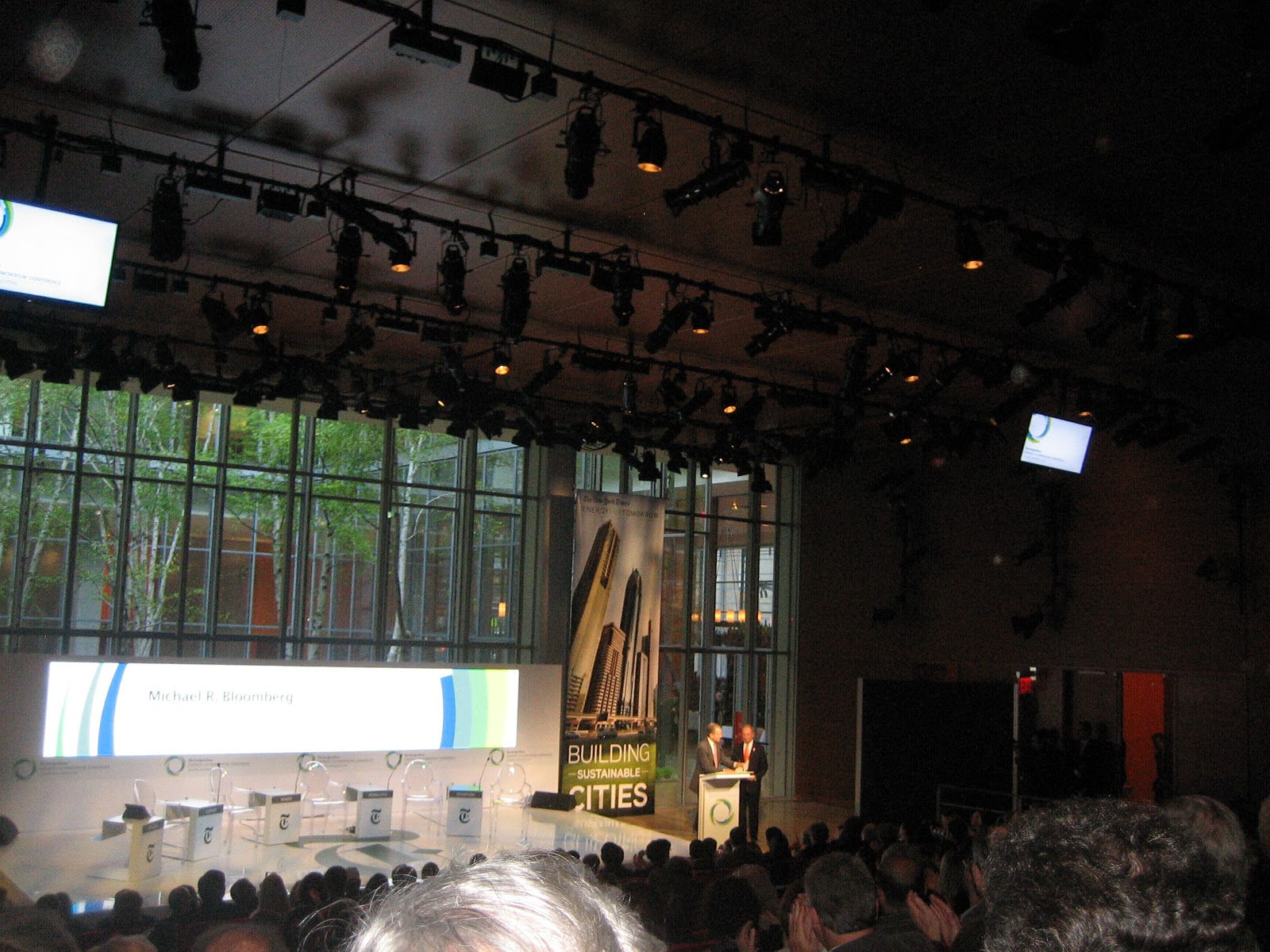
Recently, I had the honor of being a panelist on Traffic and Transport at The New York Times Energy for Tomorrow conference with the theme of Building Sustainable Cities (a true intellectual feast with great panelists and discussions that continue to this day in blogs and through emails and phone conversations). Some quotes were captured in this nice post from the IEEE Spectrum EnergyWise blog (thanks)!

Joe Nocera of The New York Times, who needs no introduction, was our panel moderator and I noted transport policies, dating to ancient Roman times, the Braess paradox, and also highlighted the importance of freight to cities' sustainability. I mentioned my experiences of living in Gothenburg, Sweden, as a Visiting Professor, and the discovery there by a doctoral student, Niklas Arvidsson, of the milk run load paradox.

Today, I heard from Niklas, who shared with me that his paper was published in Transportation Research A and he provided me with a reprint. The paper, "The milk run revisited: A load factor paradox with economic and environmental implications for urban freight transport," shows that how you route a truck on a milk run (think of sequential deliveries as a milk truck would do in a bygone era) matters environmentally. Certain governmental policies internationally have focused on increasing throughput of freight but actually having a higher load over a longer distance may add to the environmental emissions so, contrary to certain policies,  it may be better to take the route where you can offload your cargo (milk) as soon as possible.

Today I also received a copy of Niklas Arvidsson's dissertation from the School of Business, Economics and Law at the University of Gothenburg. His supervisor is Professor Johan Woxenius and I am the co-supervisor. It is such an honor to be visiting this great group of researchers in transport and logistics who also have terrific practical insights.

Research discoveries illuminate and intrigue and make you stop and think -- Wow! congrats to Mr. Arvidsson on such an important and exciting result and on the publication of his paper in Transportation Research A!

I'll be back in Sweden soon for the defense and to celebrate.

And, coincidentally, paradoxes must be "in the air," since my fellow INFORMS member and WORMS President, Professor Laura McLay, just today posted on the Braess paradox -- thanks for the acknowledgment.

Saturday, April 27, 2013

Sustainability is Sustainable and Good for Business, Our Health, Our World

I returned a short while ago from NYC where yesterday I took part in an extraordinary conference -- The New York Times 2013 Energy for Tomorrow Conference.

The full agenda of the conference can be accessed directly here.

It was an intellectual feast that brought together mayors, an Academy Award winner, thought leaders, scientists, environmentalists, investors, policy makers, and decision-makers, corporate employees from IBM to Google, as well as a farmer/former NBA player/MacArthur Fellow -- and these were just some of the speakers. In the audience, I met a colleague from Cornell (now retired), a diplomat from the Chinese embassy in DC, a Georgia Tech professor, numerous journalists from as far as Singapore, affordable housing advocates, urban planners, students, a researcher at MIT, head of the electric vehicle taxi program for NYC, and a financier in private equity, to single out just a few.

The conference began with a stimulating breakfast session (the food was good, too) on smart vehicles, but time was too short for me to be able to ask the question that I had -- what about cybersecurity issues in this product domain? I was thrilled that even operations research was mentioned -- indeed, where would transport studies be without OR?!

Mayor Michael Bloomberg of NYC, who needs no introduction, was introduced by Arthur Sulzberger Jr., the publisher of The New York Times, and both were absolutely brilliant.

With the paralysis in Washington (Congress) regarding environmental action, mayors and cities are leading the way.  This is the first truly urban century and cities have to (and many are) taking action. We must unlock human creativity and take actions to mitigate risk. Mayor Bloomberg chairs the C40 group, which actually consists of 60 cities.

Mayor Bloomberg had 4 major points with the first one being that one must develop a plan with goals and metrics -- you have to be able to measure. He has done much to improve air quality and water quality and, along with the Sierra Club, has been instrumental in retiring many coal-fired power plants.

750,000 trees have been planted in NYC with a goal of planting 1 million and he gave credit also to Bette Midler.

He noted how sustainability provides good economic value -- being environmentally friendly improves your brand and helps in recruiting -- vibrant, smart employees want to work in places where they can breathe clean air!

He mentioned how he, with Al Gore (former VP and of the An Inconvenient Truth fame), climbed up on a rooftop and painted it white -- with white rooftops reducing energy costs by 20% -- a quick payback.

He also emphasized private-public partnerships -- closing roads to traffic -- something I have written about, spoken about, and even been interviewed on, and how we should be stealing the best ideas in terms of transport and sustainability from around the world.

What really intrigued me is when he said that China will become a leading environmentalist in the next 10 years  He, as several others yesterday, emphasized resiliency and that we must prepare for extreme events. Hurricane Sandy was noted several times during the conference.

The next panel was the Mayors panel and the panelists were engaging, and very  entertaining with one of my favorite quotes being "cars are the next cigarettes."  The theme that people will vote with their feet (want to live and work in a sustainable location) continued.

We were then treated to a conversation between Andrew Revkin and Jeremy Irons, who has garnered not only an Academy Award, but numerous other awards for his acting. His passion for the environment resonated as did his eloquence. The night before the conference, the movie Trashed, which he was the Executive Producer of, was screened, and more info on what is being done to our globe because of garbage can be found here.  He noted that he is using the actor's power to address important problems and even emphasized electronic recycling and packaging -- his knowledge impressed me. He noted that a film can inject a feeling of purpose. He also emphasized that it is about education and that industry should prove that what it is making is 100% safe. Since my research group does a lot of work on sustainable supply chains his message was near and very dear to me. Coincidentally, Revkin is a fellow Brown University grad and I heard him deliver the Daffodil Lecture at UMass a while back.

Thomas L. Friedman of The New York Times then led a panel on renewable energy with experts from the US and abroad, including the CEO of ConEd, Kevin Burke. Joe Nocera, also of The New York Times, followed with a panel on the role of technology and innovation and I was especially moved by Stephen Kennedy Smith, who spoke on agribusiness and urban food supply. I managed to talk with him later and mentioned that when I got my PhD from Brown his nephew, John F. Kennedy Jr., received his undergraduate degree. There are also other school ties which I noted.

During lunch, we ate (a very healthy spread) and discussed the urban food supply and since one of my most recent papers was on competitive food supply chains (with Min Yu), which was published in the European Journal of Operational Research, this topic was mesmerizing. Will Allen, the Renaissance man -- farmer and MacArthur Fellow, regaled us with his work in inner cities and urban farms.

I had to then take off since it was time to get ready for the Transport and Traffic panel that I was speaking at, which was moderated by Joe Nocera, and I had terrific company!

Below are several of my fellow panelists as we get ready in the "Green" room which actually had a red door.

The day concluded with breakout sessions in which we brainstormed and a closing session Dealbook: Investing in the city of tomorrow -- provocative and timely.

Prior to that we also got to hear Bill Keller of The Times in conversation with Carol Browner -- the former energy czar. She also spoke about resilience and noted the importance of physical infrastructure, nature, and communities -- simply fabulous

The conference was videostreamed and you can access the videos of the various panels on the conference website.  The Transport and Traffic panel that I was part of can be accessed directly here.
I had to bring in the Braess paradox into the conversation as well as congestion charging and transport congestion policies dating back to Roman times -- when chariots were the problem!

And I could not resist posting photos below taken of me with Professor Richard Schuler, professor emeritus of Cornell, and of  Dr. Yajun Fang of MIT taken at the reception at the end of a very exciting day. Professor Schuler is the academic father of Professor Ben Hobbs of Hopkins, an INFORMS Fellow.


New York City was as vibrant, exciting, and stunning as always and I share with you the additional photos that I took while walking as a very happy pedestrian in NYC!


And, on the way back to Massachusetts, via Amtrak on the Vermonter, as I strolled back to the dining car for a cup of tea I heard a greeting --"Hello, Anna!" and it was one of my favorite Isenberg School of Management colleagues, Professor Glenn Wong, of sports law and sports management fame.