Showing posts with label Amherst College. Show all posts

Tuesday, March 5, 2019

Information Security at a Research University

Last Thursday, the students in my Humanitarian Logistics and Healthcare class and I had the honor of hearing Chris Misra, the Interim Vice Chancellor for Information Technology and CIO at UMass Amherst, deliver a guest lecture. 

We had had a joint project on cybersecurity with my Isenberg School colleagues, Senay Solak and Mila Sherman, and Wayne Burleson of the College of Engineering at UMass that was funded by the Advanced Cyber Security Center (ACSC) . You can read more about our project and see a presentation here, thanks to INFORMS. Cybersecurity is also a topic that my Supernetwork Team has been conducting research on and we have a stream of papers of the subject, with more to come.

Given  that information security is essential to enterprises, both profit and nonprofit ones, I thought that having Chris Misra speak on Information Security at a University would be very timely and fascinating and, indeed, his lecture was! I had communicated with him early that morning around 6AM, and told him that I would be waiting for him in the Isenberg School atrium. When I did not see him shortly before the class was to start, I emailed him and found out that he was waiting for me in the atrium of our new $62 million addition! Ironically (and the first time this semester), there were some issues with the technology in my classroom, but soon those were addressed, thanks to our TSS staff! Luckily, also, the university did not have a delayed start time, given the snow forecast.

Mr. Misra began his lecture with an overview of how Amherst College, a neighboring elite, very well-endowed liberal arts college, recently experienced a "technical mishap that left the campus without access to online services -- for five days".  Faculty, students, and staff at Amherst College were without access to Wi-Fi, email, and a variety of student support and other services; in effect, any content hosted by the college's website was not accessible. The cause was ultimately attributed to a network outage (and not a cyberattack)  and I heard from Chris Misra that Cisco came to the rescue.

Running an enterprise network for a university of the size of UMass Amherst is a major operation/ endeavor with both network engineering and network operations being essential and with the former also involving switches, routers, and even long haul networks to the other UMass campuses. Misra emphasized that there is a lot of complexity that you don't see, including the copper and fiber cabling. There is builtin redundancy to mitigate risk and there is a separate control domain from transport with 50,000-70,000 devices. Clearly, a very complex system to manage and to maintain.
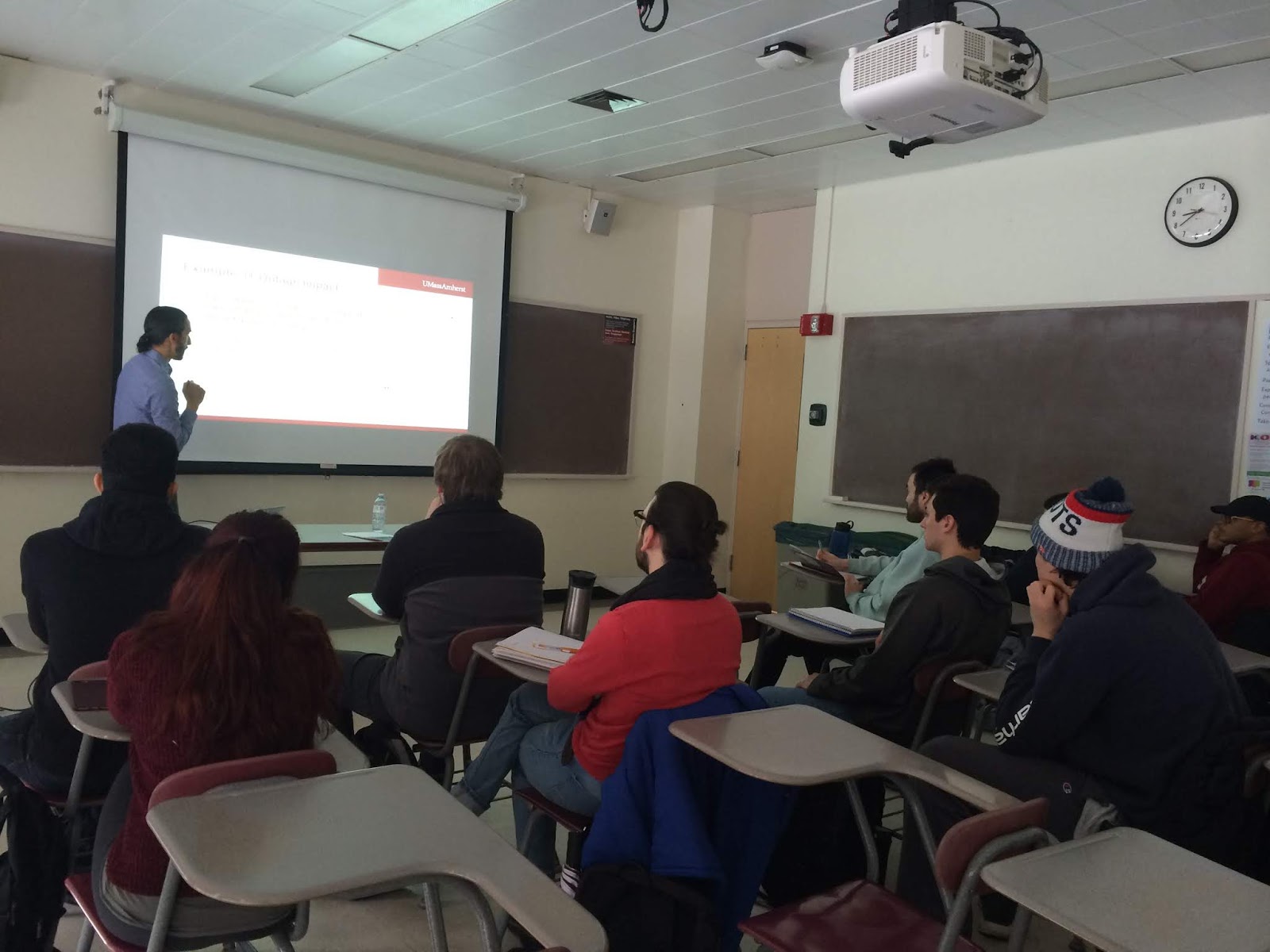
I was so impressed that Chris Misra had even looked at the course syllabus and remarked that the course looked so interesting (yes, I love teaching this course because of the dynamism of the subject). 

He noted that "security is a negative deliverable - you don't know when you have it - only when you lose it." Clearly, similar to critical infrastructure. And, when it comes to information security, the three primitives are: confidentiality, integrity, and the availability of information, which I think the students very much appreciated. Regarding confidentiality, you want the information concealed across transmission, storage, and processing. As for integrity, one cares about the trustworthiness of the information or resources, and availability ensures the ability to access the information - extremely important in a university environment.
Chris highlighted security measures of training and education, policy and practice, and also technology. He even mentioned budgeting in the context of how much should a university spend to achieve a desired level of risk management (bringing down risk to an acceptable risk) since IT resources are critical assets. It was great to hear how the IT governance at UMass Amherst emphasizes transparent decision-making and priority setting and taking action.

Information security  also involves environmental controls, physical and logical access management, and "technical" change management. Every user holds some responsibility for information security. 

Mr. Misra also discussed disaster recovery under various scenarios and hazard events and noted that the planning for outages could include: loss of connectivity, loss of email functions, teaching/learning technology unavailable, student payroll, billing, etc. unavailable, and research grant processing disrupted. Also, UMass Amherst IT is responsible for our IT at the University Health Services, adding another layer of critical assets and private medical information.

We had some time after the fabulous lecture for Q&A, which my students always prepare very well for.

Absolutely stunning was the evolution of the types of actors engaged in cyber attacks against the university over the past decade! We could have discussed for hours the topic of information security at a research university!

We presented Mr. Misra with a gift from Isenberg and I took a group photo, followed by a formal  thank you letter, which I copied to top level administrators. He was an amazing Professor for a Day and we are lucky at UMass Amherst to have someone with such expertise and skills at the helm of IT!


Thursday, March 12, 2015

From Presidencies of Liberal Arts Colleges to Leading Iconic NYC Cultural Institutions - Those School Ties

I was absolutely delighted to hear the announcement yesterday in The New York Times that the former President of Lafayette College (my husband's undergraduate alma mater), Dr. Dan Weiss, who is an art historian, with an MBA from Yale, was selected to be the next President of the Metropolitan Museum of Art in NYC.

Dr. Weiss had served as Lafayette's President from 2005 - 2013 and I had the pleasure of meeting him and his wife at the college at a lovely event hosted by them in the Fall of 2012 at Lafayette. It was a pleasure to chat with them. They were so personable and pleasant and the conversations just flowed. The new college arts theater will be named after him and his wife, Sandra.

Weiss has been the President of Haverford College, another liberal arts college in Pennsylvania, since 2013,  and will be leaving after less than 2 years to become President of the Met, probably the top job for an art historian on our planet, so congratulations are in order!

In addition, the NYC Public Library is headed by Dr. Tony Marx, the former President of Amherst College, located  in the town that I live in. I last saw Dr. Marx when he gave the commencement speech at the Deerfield Academy graduation on May 27, 2012. Both his son and my daughter graduated Deerfield that day and the ceremonies were truly special and elegant.  Dr. Marx was part of the carpool on our block - impressive. And he did the driving when he was President of Amherst College, one of the top liberal arts colleges in the country!

Both the Metropolitan Museum of Art and the NYC Public Library, two iconic NYC institutions, are located on 5th Avenue about 40 blocks apart.

As Weiss said in The New York Times interview, he began going to the Metropolitan Museum of Art when he was a teenager and fell in love with it and so did I. The same holds for the NYC Public Library where I spent many a winter break from Brown University doing research and writing papers, as an undergraduate.

And, speaking of Lafayette, it has been quite the year for not only arts but also sports with the 150th anniversary football game played against Lehigh University at Yankee Stadium (Lafayette won) plus Lafayette's win last night in men's basketball against American University so now they are off to the big dance of the NCAA and garnered the Patriot League Championship. Congratulations!

Tuesday, January 31, 2012

New Female Amherst College President Tweets

Lately, there have been articles on leaders, including the CEO, Rupert Murdoch, who are now tweeting and how their personas, and, perhaps, leadership styles, are coming through. The New York Times had such a column on Murdoch yesterday.

Now, the Chronicle of Higher Education (CHE) has an article on the new President of Amherst College, Dr. "Biddy" Martin, who took over the Presidency from Anthony "Tony" Marx this past Fall (he is now head of the New York Public Library).

The article begins in a wonderful way, speaking about Amherst, the town that I live in, as being idyllic.

It also discusses the challenges that Dr. Martin faced in her former leadership position at the University of Wisconsin and asks why she left there to assume the Presidency of a small, outstanding liberal arts college (that actually is more diverse than many institutions).

The CHE article also has some inside information that I was not aware of -- of how Amherst College is essentially run by a "Committee of Six" with weekly 3 hour Monday meetings.

It quotes Dr. Martin as saying: "Everyone warned me about it," she says of the power of Amherst's faculty. "Someone just recently told me that a former president of Dartmouth is alleged to have said: 'Being president at Williams is a fun job. Being president at Dartmouth is a hard job. And being president of Amherst is an impossible job.' There's a reputation of faculty being ­really hard on presidents."

It also notes the anti-professionalism credo at this liberal arts college (and I can personally attest to this since I have had Amherst College students in my office trying to figure out how they can take courses at the Isenberg School of Management and the College of Engineering with the Amherst College restrictions). Yes, we are part of the Five College system but that does not mean that students from Amherst College (as I have found out) can take any course that they are interested in at UMass Amherst.

I do wish Dr. "Biddy" Martin all the best in her new leadership role. I think that she will be outstanding. Students are starting to notice already.

You can follow President Martin on Twitter.

The article from the Chronicle of Higher Education.


Tuesday, June 14, 2011

New President of Amherst College is Dr. Carolyn A. Martin

As some of you know, Dr. Anthony "Tony" Marx, has left the Presidency of Amherst College, to become the President of the New York Public Library. His son goes to school with my daughter.

It has just been announced that Dr. Carolyn A. Martin, who is the Chancellor of the University of Wisconsin Madison, will be the new President of Amherst College. She spent 25 years at Cornell. She will be the first female President of Amherst College, which began admitting females only in 1975.

Interestingly, The New York Times noted that she is a scholar of German literature, which is exactly the area that the UMass Amherst Chancellor, Dr. Robert Holub, is an expert on (and he also received his PhD from Wisconsin).

Sunday, May 22, 2011

Christine Lagarde, Favored to Head the IMF, was to be in Amherst this Weekend

Christine Lagarde, who is favored to be the new head of the International Monetary Fund (IMF), was to be in Amherst this weekend to receive an honorary degree from Amherst College, but had to cancel.

This is clearly a disappointment, but as the Minister of Finance and Industry in France, she has to be available after the scandal preceding the arrest and resignation of the former head of the IMF, known as "DSK," who was expected to run for the presidency of France.

Kudos to Amherst College for having the foresight to award her an honorary degree and to invite her to Amherst, which I have called the center of the universe.

The New York Times is very positive on Lagarde and she will make history/herstory should she become the first female leader of the IMF!

Wednesday, January 5, 2011

Life Lessons from a Chaired Professor

With a new year come new resolutions, reflections, and a fresh start.

I recently finished reading the book, "Composing a Life," by Mary Catherine Bateson, which I had purchased in my favorite bookstore at the Harvard Coop in Cambridge. In the book, Bateson, the daughter of the renowned anthropologist, Margaret Mead, writes about the creative potential of the complex lives that we live today through the prism of her own experiences, and those of four of her friends: Johnnetta Cole (a scholar and administrator), Joan Erikson (a dancer), Alice d'Entremont (an engineer), and Ellen Bassuk (a medical doctor). Interestingly, three of these women (Cole, Bassuk, and Bateson) had been Fellows of the Bunting Institute at Radcliffe, which is now the Radcliffe Institute for Advanced Study at Harvard (I was a Fellow there from 2005-2006).

Both Bateson and Johnnetta Cole (who after being at UMass Amherst assumed the presidency of Spelman College) lived for a time in Amherst and even on the same street. Bateson was a faculty member at Amherst College and then became Dean of Faculty (but only for a relatively short time). In the book, Bateson mentions quite a few people that I know and speaks very highly of Esther Terry, who was a long-time faculty member at UMass, and even Barbara Osborne, a renowned biologist with whom I have served on several committees.

What is remarkable about the book, is not only the insights into achievement, especially of females, who, inevitably, must deal with various life interruptions, but also observations on academia at large and the climate for females. Frankly, it seems to me that we are at a turning point. Despite more integration of females into academia (as well as minorities) I am seeing a decrease in diversity when it comes to administration at various institutions, including my own (although I do celebrate the female presidencies at such Ivy league universities as Harvard, Princeton, Brown, and UPenn, and even MIT, and, more recently, at UConn).

Some direct quotes from the book are below (I will not editorialize and to find many more you will just have to read it):

(p.86): The academic world is notorious for the nastiness of the power games it plays, sometimes for such very small stakes. But in general, it is every man for himself -- unless the issue is one that threatens their common dominance.

(p.98): A quote from Johnnetta Cole in discussing a general ed requirement that was the result of educational reform at UMass that she led: But by that time I think I had a pretty fair understanding of how things work in the academy. Some of the stuff was incredibly nasty, with all the things you know about and went through at Amherst -- distinguished colleagues grinning in your face and going behind your back and stabbing the hell out of you.

So my advice as a chaired professor and one who continues to be amazed by what she continues to observe and experience:

Academic bullies, sadly, exist, and they may even be administrators who practice such tactics as exclusion, not sharing of information, hoarding of resources and picking the best of the crop (in terms of courses and remuneration for themselves). Realize that the academic world is not just your department. Noone gets "known" by just sitting in one's office (although at the beginning of your career you should definitely be seen a lot at your institution).

Meet the top researchers in your field at conferences and at professional meetings. They have risen to the top not just because of their intellects but also because of their integrity. People invite those whom they trust both intellectually and professionally (and who are likable).

Become involved in professional societies, agree to referee papers and to serve on journal editorial boards and conference organizing committees.

Seek out successful "peers" that you can relate to (both within your institution and outside) and support one another.

Balance your work life with family and friends and include some special interests in the mix (from exercise to art and music -- travel is a reward for success in your profession and will naturally come if you work hard).

Keep your sense of wonder -- in the questions that students raise -- in the smiles that are shared and in the discoveries that you make and that you read about.

Advocate for those that you see being discriminated against and, if you are one of them, speak out and document what is being done to you. Some universities have faculty unions and many have an ombudsperson.

Be a mentor to students and junior faculty, who will most likely sense any negativity or unfairness. Students are much wiser than some faculty recognize.

Congratulate those who have achieved -- kind words and acknowledgment can make a big difference.

Recognize that academic envy can pollute collegiality and an organization's effectiveness and esprit de corps. Nurture other talents within yourself rather than engage in craving (rather than celebrating) other's achievements. They worked hard for them and deserve recognition.

Each day is a new beginning with new people to meet, new papers (and books) to read and write, and new opportunities that fall into your lap -- take advantage of them, but do so wisely, remembering that we all have a limited time budget and need to allocate our resources wisely.

And remember that even the Nobel Laureate in Economics, Sir Richard Stone, was marginalized by many of his colleagues before he received the Nobel Prize.

So, do the best work that you possibly can -- in teaching -- in research, and in service and make sure that your conscience is clear and that you retain your integrity.

Those that make the best leaders lead by generosity of spirit, integrity, reciprocity, and inclusion.