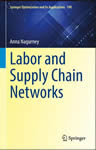
Our paper, "Supply Chain Network Design for Critical Needs with Outsourcing," has now been made available online by the publisher, John Wiley & Sons, in the journal Papers in Regional Science.
With the number of disasters growing over the past decade as well as the number of people affected by disasters, the design of supply chain networks for critical needs products, such as water, food, and medicines, is of paramount importance. Such problems are uniquely challenging since the needs of the affected population should be met as closely as possible with the undersupply of food, water, and medicines, leading to loss of life. At the same time, the oversupply of products may also carry costs, due to unnecessary waste and even, possibly, environmental damage.
In fact, the United Nations is reporting in today's New York Times that the horrific floods in Pakistan are resulting in severe shortages of such critical needs supplies as food and water.
In our paper, we developed a mathematical model that allows for the optimal design of such supply chain networks at minimal total cost and with the satisfaction of the product demands at the demand points, as closely as possible.
Research on which this paper was based, which was conducted also by Professor Patrick Qiang and my doctoral student, Min Yu, was inspired by the Humanitarian Logistics: Networks for Africa Conference that I organized at the Rockefeller Foundation's Bellagio Center on Lake Como. The Rockefeller Foundation and this workshop are acknowledged in the paper. We also thank Professor Manfred Fischer of the Vienna University of Business and Economics for his support. Professor Fischer was my host in Vienna in March 2009 when I delivered the lecture, "Synergies and Vulnerabilities of Supply Chain Networks in a Global Economy."
Showing posts with label Wiley. Show all posts
Showing posts with label Wiley. Show all posts
Wednesday, August 18, 2010
Monday, June 15, 2009
Discover magazine, Infrastructure, The New York Times, and the Fragile Networks book
I am back from the World Science Festival (WSF) in NYC, which concluded yesterday with a science street fair. Photos from the numerous events have been posted on flickr.
There are also photos from the Traffic panel that I took part in last Friday evening.
The World Science Festival, which took place June 10-14, 2009, transformed NYC into a science mecca in which scientific research and exploration were recognized and celebrated. The atmosphere at the events, from the gala to yesterday's science fair, can only be described as electric -- the seats were filled at the various panels and events and I believe that many of those that participated will be looking at the world around us in new ways.
Megan Talkington, a journalist with Discover magazine, wrote a very nice article on the Traffic panel.
Now, it's time to reconnoiter and being on the Traffic panel at the World Science Festival has been the perfect segue for my new book with Patrick Qiang: Fragile Networks: Identifying Vulnerabilities and Synergies in an Uncertain World. Wiley, the book's publisher, has informed us that the book will be "released" this Friday, June 19, with worldwide distribution set for July 2009. Wiley issued a press release on the book in conjunction with my participation in the World Science Festival. The publication of this book is especially timely, given the interest surrounding infrastructure from transportation networks to the Internet and even electric power generation and distribution networks, plus financial networks. Indeed, the New York Times devoted yesterday its entire Sunday magazine to infrastructure. Plus, there have been recent OpEd pieces and major newspapers in the US highlighting the importance of complex networks and infrastructure. Our book provides an original synthesis of infrastructure networks and focuses on unique perspectives and solutions. The beauty and elegance of the book's approaches lie in a systematic analysis of networks, their resilience and robustness, as well as their vulnerability and the associated systemic risk. Fragile Networks identifies how to determine which nodes and links truly matter from economic and engineering perspectives. The book even formalizes mergers and acquisitions in a network framework!
There are also photos from the Traffic panel that I took part in last Friday evening.
The World Science Festival, which took place June 10-14, 2009, transformed NYC into a science mecca in which scientific research and exploration were recognized and celebrated. The atmosphere at the events, from the gala to yesterday's science fair, can only be described as electric -- the seats were filled at the various panels and events and I believe that many of those that participated will be looking at the world around us in new ways.
Megan Talkington, a journalist with Discover magazine, wrote a very nice article on the Traffic panel.
Now, it's time to reconnoiter and being on the Traffic panel at the World Science Festival has been the perfect segue for my new book with Patrick Qiang: Fragile Networks: Identifying Vulnerabilities and Synergies in an Uncertain World. Wiley, the book's publisher, has informed us that the book will be "released" this Friday, June 19, with worldwide distribution set for July 2009. Wiley issued a press release on the book in conjunction with my participation in the World Science Festival. The publication of this book is especially timely, given the interest surrounding infrastructure from transportation networks to the Internet and even electric power generation and distribution networks, plus financial networks. Indeed, the New York Times devoted yesterday its entire Sunday magazine to infrastructure. Plus, there have been recent OpEd pieces and major newspapers in the US highlighting the importance of complex networks and infrastructure. Our book provides an original synthesis of infrastructure networks and focuses on unique perspectives and solutions. The beauty and elegance of the book's approaches lie in a systematic analysis of networks, their resilience and robustness, as well as their vulnerability and the associated systemic risk. Fragile Networks identifies how to determine which nodes and links truly matter from economic and engineering perspectives. The book even formalizes mergers and acquisitions in a network framework!


Saturday, May 16, 2009
The Back Cover of the Fragile Networks book and the World Science Festival
 I decided to share with you the back cover of our book Fragile Networks: Identifying Vulnerabilities and Synergies in an Uncertain World, which has just been made available by our publisher Wiley. We are expecting that the book will be out in time for the World Science Festival in NYC in June. I have begun preparing graphics for my presentation on Traffic at this festival. The list of speakers ranges from Nobel laureates to musicians to movie stars to academic researchers and scholars who are passionate about science. Our UMass Amherst Chancellor, Dr. Robert Holub, asked me the other day at one of the banquets that we are partaking in at the end of the academic year whether I will be also dancing and singing at this festival. Network researchers engage in such activities but not necessarily in public. I will stick to what I know and love best -- and that is networks and transportation!
Thursday, May 7, 2009
The Fragile Networks Book Cover (and Finding Happiness According to the Kingdom of Bhutan with Reminiscences about Professor George Dantzig)

Patrick Qiang and I are delighted that Wiley has now provided us with the cover of our book which I am sharing with you. The cover should be posted on online marketing websites in a week or so, we have been told. After canvasing colleagues, students, staff, and neighbors, we provided Wiley with feedback on earlier three options and Wiley's graphic design team came up with the final cover design above. I think that the images provide good visuals for some of the themes which are explored in the book and some of the applications, which range from congested transportation networks and supply chains to financial networks and the Internet plus electric power generation and distribution networks.
Completing this book has been a time-consuming but wonderful experience! The next step is the send-off to the printers, which we are hearing should be happening this week, with copies of the book being made available sometime in mid-June.
Completing the writing of a book generates some satisfaction and, dare one even say, happiness?! Well, the kingdon of Bhutan, a mountanous country in Asia, has developed a gross national happiness index. The New York Times had a feature article on the index today and it reminds me of a conversation that I had with Professor George Dantzig, one of the founders of the field of operations research, before he passed away at the age of 90. Professor Dantzig was a giant in terms of his scholarship and kindness. He made a mark on so many students, academics, and practitioners, through his work, publications, and warm personality. He is missed tremendously. Professor Dantzig told me that he had been working on, among other projects, constructing appropriate utility functions for the United States. Here is an interview with Professor Dantzig by Peter Horner and the article includes a photo of Professor Dantzig hugging me.
Lo and behold, in a sense, the government of Bhutan has constructed utility functions, with weights for different criteria, to enable the measurement of "gross national happiness." It is worth spending some time on the website above, which even discusses the length of time to achieve of PhD and the impact on happiness! The article in the NYTimes was most refreshing and fun to read. The government of Bhutan even "gets it" that time spent on activities such as work and sleep matters as does time spent in cultural and social pursuits.
Friday, April 10, 2009
Fragile Networks -- Our Book is Off to the Publisher!

Today, we shipped our book, "Fragile Networks: Identifying Vulnerabilities and Synergies in an Uncertain World," to John Wiley & Sons, Inc. The book is about 350 pages in length and we submitted it in camera-ready form. Qiang "Patrick" Qiang and I have been working on this book for the past year and it is based on many years of research. Wiley has already begun to publicize/market the book, which should be out in late Spring/early Summer. We were asked to choose the cover for the book out of three that Wiley had designed for us. I canvased faculty, administrators, staff members, graduate and undergraduate students, as well as friends and neighbors as to their favorite. Interestingly, the cover that undergrads uniformly liked was different from the cover that doctoral students all unanimously picked. We provided feedback to Wiley and will see what the ultimate cover design will be.
For now, I have been busy starting to disseminate the great news that the book will be out soon and have noted its upcoming publication in talks that I have given this year in Dallas, Vienna, and Ithaca. Next week, I will be giving a big talk in Minnesota and will also mention our new book.
Subscribe to:
Posts (Atom)

 Posts
Posts