Showing posts with label refugees. Show all posts

Tuesday, June 20, 2023

A Conference that Ended in a Standing Ovation, Thanks to WPI!

How often have you experienced a standing ovation at the end of a conference?

I must admit that I had, for the first time, such an experience on June 2, 2023, at the outstanding Innovations in Immigration Analytics Conference at the Worcester Polytechnic Institute (WPI) in Worcester, Massachusetts. Kudos to the conference organizers: Dr. Geri Dimas (who will be an Assistant Professor at Bryant University, starting this Fall), and WPI Professors Andrew Trapp and Daniel Reichman.

The program, which can be viewed here, brought together faculty, practitioners, as well as students, who are very much engaged in issues of migration and immigration.

The format, consisting of individual presentations, lightning talks, as well as a panel, was excellent, and with coffee breaks and a delicious buffet lunch provided. And there were no registration fees!

The conference opened up with remarks by the WPI Provost Winston "Wole" Soboyejo, who set the stage for the importance of the issues and challenges that we discussed at the conference including: refugee resettlement, dynamic migrant flows and operational responses, matching refugees to employment opportunities, strategic border resource deployment challenges, and even the modeling of US immigration courts using discrete-event simulation.

My presentation was entitled, "Refugee Migration Networks with Regulations," and it has been posted on the Supernetwork Center site at the Isenberg School of Management, UMass Amherst. 

The presentation was based on a paper published in the Springer Nature Journal of Global Optimization and was co-authored by Professor Patrizia Daniele of the University of Catania and Professor Ladimer S. Nagurney of the University of Hartford. 

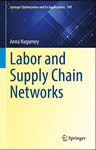
I also spoke in my presentation on recent work on investing in immigration to alleviate labor shortages in supply chains and coalition formation among countries to address migrant issues. The former topic is a chapter in my latest book, "Labor and Supply Chain Networks," with info on the book here.

The latter topic was explored in a recently published paper that I co-authored with Professors Passacantando and Raciti and is available open access!

It was terrific to meet conferees with the passion and focus to address one of the greatest challenges of our time with 103 million people around the world having been forced to leave their homes. I was deeply touched to hear, time and time again, Ukraine mentioned at this conference and the impacts of Russia's war on it, including by Dean Debora Jackson of the WPI Business School in her brilliant closing remarks. Research matters and making it accessible to organizations, nonprofits, and governments can create positive change and truly benefit humanity. 

Below, I have posted a collage of photos from the conference. 


Many thanks to the organizers: Dr. Geri Dimas and Professors Andrew Trapp and Daniel Reichman for bringing us together in such a warm and engaging event. Much work remains to be done but, together, we can accomplish much good and we will.

And for those who are interested in additional work of ours on human migration networks, a topic that we have been researching for several decades, have a look at my post.


Monday, September 30, 2019

Fabulous Talk on Refugee Resettlement Optimization in Our UMass Amherst INFORMS Speaker Series

This past Friday, we had the pleasure of kicking off our academic year with the first talk in our UMass Amherst INFORMS Speaker Series. We were absolutely delighted to have Professor Andrew Trapp of the Foisie School of Business at WPI give the talk, "Placement Optimization in Refugee Resettlement."

The award-winning UMass Amherst INFORMS Student Chapter helps me to organize this speaker series and this is the 31st consecutive semester of it!

I welcomed the audience and Professor Trapp and announced upcoming talks in our series this semester. Then, my doctoral student, Mojtaba Salarpour, who was elected this year's Chapter President, did a more formal introduction. 
Professor Trapp captivated us with facts, on a topic drawn from the news headlines, along with an elegant mathematical model, coupled with machine learning, that he has developed, in conjunction with collaborators at Oxford University in England and Lund University in Sweden, and with his doctoral student, who is pursing a PhD in data science at WPI, and who was in the audience! The model has been implemented and is being utilized in practice by an NGO, HIAS.

He emphasized how there are now 1.428 million in dire need and how the initial place really matters for refugee resettlement. Hence, it is very important to get the initial match right. Their software is called Annie MOORE, after Anna Moore, which, according to the nice press release, was an Irish woman who was the first recorded immigrant processed at Ellis Island in the late 1800s. Professor Trapp's research on this topic is funded by a major NSF grant. 

At present, noone asks refugees what they would like, and it has been largely a manual matching process in the US.  Case by case processing  excludes benefits for all refugees simultaneously. He even gave us a demonstration of the software, which was fascinating. It allows a lot of flexibility for practitioners. My most recent paper is on international human migration networks under regulations, so I was personally very interested in his talk! Moreover, I had the pleasure of speaking at Foisie last year, and we have hosted both Professor Renata Konrad and Professor Joe Sarkis of WPI in our Speaker Series. Plus, one of my former PhD students, Dr. Sara Saberi, is a colleague of theirs at Foisie.

It was very gratifying to have faculty and students (even undergraduates) from the Isenberg School of Management, from the College of Engineering, the College of information and Computer Sciences, as well as the Department of Mathematics/Statistics at UMass Amherst in the audience!

The audience was very engaged, asking questions both during the lecture and afterwards. I took the group photo below as a memento.

We spend a lot of time identifying excellent speakers on timely topics and Professor Trapp was truly fabulous!  After his mesmerizing talk, we had the pleasure of dining with him at the University Club, and we continued the discussions. 
Then it was time to conduct an interview with Professor Trapp, which he graciously agreed to, and which will be posted eventually on the chapter's youtube channel: https://www.youtube.com/channel/UClVaXgOJ6wO6xRUMmcJ2_RQ/featured, where interviews with other speakers over the past 2 years can be found (and the advice provided therein is excellent!).

We also presented Professor Trapp with a gift, courtesy of the Isenberg School, and, with deep appreciation, I followed up with a formal thank you letter that I also copied to top administrators at WPI. Although it was late in the day on Friday, I was impressed by the acknowledgments of receipt that I received.  Special thanks are also extended to the Chapter's wonderful webmaster and blogger, Haris Csipetas, who is a PhD student in Transportation at UMass Amherst; have a look at: https://blogs.umass.edu/umassinf/2019/09/27/umass-informs-speaker-series-a-talk-by-dr-andrew-c-trapp/