Congratulations to the 2011 newly elected National Academy of Sciences members!
The National Academy of Sciences (NAS) just released the list and I am very pleased to see that the list includes Professor Stuart Geman of the Applied Mathematics Department at Brown University (I have 3 degrees from that department and know Professor Geman as well as his brother, Professor Don Geman) and Professor Jon Kleinberg of the Computer Science Department at Cornell (who I recently invited to give a keynote at our SBP 2011 conference but he had to graciously decline).
There are 72 new members and 18 foreign associates from 15 countries who were elected by a vote at the NAS conference that just finished today in recognition of their distinguished and continuing achievements in original research. There are quite a few biologists, chemists, and physicists on the list.
Tuesday, May 3, 2011
Monday, May 2, 2011
The POMS Conference in Reno, Nevada a Big Success!


The 2011 POMS Conference took place in Reno, Nevada, April 29-May 2 with the theme Operations Management -- The Enabling Link.
As one of my doctoral students, who attended the conference, said: We had a great time at the POMS conference. Thank you very much for providing us with this precious opportunity. The doctoral student consortium was amazing and informative. Most of the participants (>30 out of 40) are third year PhD students. I met students from other universities, such as from UT Dallas, the Rensselaer Polytechnic Institute, Syracuse University, and the University of Alabama, etc. Four panelists introduced their experiences in the job market, and we learned how to balance research, teaching, and service. We were told that the link to the slides of their presentations will be sent to us soon.
Conferences are so valuable for exchanging the latest research, for making new connections, and for networking! It is especially important for students to have opportunities to present their research at conferences so that they appreciate the atmosphere of scholarly exchanges and interactions.
The photos above were provided by two pf my doctoral students who spoke at the POMS Conference in a healthcare session. In the photos are even several of our UMass Amherst PhDs who are now professors! It's wonderful to see how their network is growing and how the friendships made during their doctoral studies provide them with linkages during their professional careers.
Congrats to the organizers of the POMS Conference in Reno!


UMass Amherst INFORMS Student Chapter Hosts Spring 2011 Party!

I am delighted to announce that the UMass Amherst INFORMS Student Chapter will be hosting its end of the semester party this coming Wednesday at the Isenberg School. The students have designed the flyer above and the invitation below went out to several e-lists. We will be honoring our hard-working Student Chapter officers at this event as well.
Please join us if you can and don't forget the First Northeast Regional INFORMS Conference that is taking place at UMass Amherst, May 6-7, 2011! The UMass Amherst INFORMS Student Chapter is helping out with this conference, as well.
Dear Professors, Staff, Members and Students:
In appreciation of your support of the UMASS Amherst Student Chapter of INFORMS, we cordially invite you to the Spring End of Semester Party to be held at the Isenberg School of Management.
Date: Wednesday, May 4th, 2011
Time: 5:00PM - 7:00PM
Place: Isenberg School of Management Room 112
The party will give us the opportunity to show our appreciation and to conclude the semester with great food and lively conversations. Again, we would like to thank the staff, faculty and administrators who have supported us.
We hope to see you there!
UMASS Amherst Student Chapter of INFORMS
INFORMS Student Chapter website:
http://student.som.umass.edu/informs/
Sunday, May 1, 2011
Supply Chain Risk, Mergers and Acquisitions, and Synergy
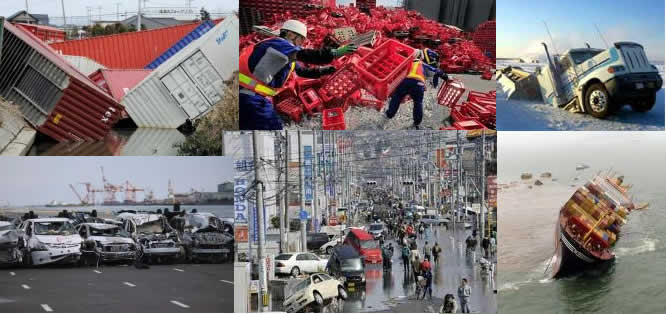 Risk in the context of supply chains may be associated with the production/procurement processes, the transportation/shipment of the goods, and/or the demand markets. Such supply chain risks are directly reflected in firms' financial performances, and priced in the financial market. For example, it has been estimated that the average stock price reaction to supply-demand mismatch announcements was approximately -6.8%. In addition, supply chain disruptions can cause firms' equity risks to increase by 13.50% on average after the disruption announcements.
So how should we measure risk with uncertainties today associated with exchange rates, production disruption frequencies, and/or material and energy prices?
We take a mean-variance (MV) approach to the measurement of risk, which dates to the work of the Nobel laureate Markowtiz (1952, 1959) and which even today, according to my finance colleagues, Schneeweis, Crowder, and Kazemi (2010), remains a fundamental approach to minimizing volatility. The MV approach has been increasingly used in the supply chain management literature to study decision-making under risk and uncertainty.
In a recent study of ours, "Risk Reduction and Cost Synergy in Mergers and Acquisitions via Supply Chain Network Integration," Dr. Zugang Liu and I developed supply chain network models that allow decision-makers to minimize both total expected costs and risks associated with their supply chain network activities both prior to and post a merger or acquisition. In addition, we developed three synergy metrics to assess a potential merger or acquisition (M&A) a priori. These measures capture, respectively, the expected total cost synergy, the absolute risk synergy, and the relative risk synergy.
We focused on supply chain network models since it has been estimated that 80% of a firm's expenses is due to operations.
Since we can expect additional M&As in emerging countries as well as in the developed ones, especially in the healthcare, high tech, and energy sectors, such metrics can be valuable.
Our study has been accepted in the Journal of Financial Decision Making and we will be presenting it next Friday at the First Northeast Regional INFORMS Conference at UMass Amherst in an invited session on Risk Management: Interfaces Between Finance and Operations.
The numerical simulations in our study reveal interesting managerial insights for executives who are faced with M&A decisions. Our first set of examples showed that if the expected total costs and the risks of the merger are negligible, both the total cost and the total risk would be reduced through the merger. In addition, the risk reduction achieved through the merger was more prominent when the uncertainty of link costs was higher.
Our second set of examples showed that the cost and the risk of merger could have a significant impact on the total cost and the total risk of the post-merger firm, and should be carefully evaluated. Our examples also demonstrated that whether a merger makes sense economically may depend on the priority concerns of the decision-makers, and on the measures used to evaluate the gains. For instance, a merger that could not lower the expected total cost might still be able to reduce the total risk, and, hence, be considered beneficial to the firms' stakeholders.
Saturday, April 30, 2011
A Network of Radars and the Science of Forecasting Tornadoes
The devastation in the South, and especially in Alabama, following the tornadoes this past week is horrifying.
The media had been reporting that it was difficult to forecast such major weather events and I was thinking about the research that is being conducted by the NSF Engineering Research Center known as CASA, which is headed by UMass Amherst. CASA (which means "home" in Spanish) stands for the Collaborative Adaptive Sensing of the Atmosphere and this center is involved in the designing of technology, specifically, radars, and their placement in networks, to forecast major weather events, including tornadoes.
CASA's Director at UMass Amherst is Professor David McLaughlin (who is also now the Associate Dean of Engineering) and, would you believe, that almost on the same date (but a few years before the recent tornadoes in Alabama and 5 other states), McLaughlin spoke in our UMass Amherst INFORMS Speaker Series?! His talk, Chasing Interdisciplinarity while Chasing Tornadoes: An Overview of the CASA Engineering Research Center was fantastic (and you can see his abstract and find more info here).
Lo and behold, now The New York Times is reporting on the research of CASA, which is funded by the National Science Foundation (NSF) in a ten year project. The article notes how CASA is a collaboration among several universities with expertise in radars, weather forecasting, and focuses also on emergency preparedness and management. The other universities, in addition to UMass Amherst, are: the University of Oklahoma, Colorado State, and the University of Puerto Rico, Mayaguez.
Specifically, this group works on designing and building radars (my husband spent his sabbatical at CASA plus the researchers there I consider as colleagues) and setting them up as a network in order to predict weather more locally and quicker. Every year a group from UMass travels to the tornado-ridden areas to, literally, gather data while chasing tornadoes. The group includes students who drive the trucks with the radar gear in back, and, believe me, you should hear their "war" stories.
Of course, it is important to be able to produce the necessary radars in a cost efficient way so that they could be deployed on a scale to help.
Indeed, as The Times stated in the article:
Emergency managers said the radar network would provide more detailed pictures of smaller areas, and could have applications for traffic control and fire protection.
You can read more about chasing tornadoes in the VORTEX2 project here.
What a critical time now to get such radars deployed! Just imagine if the huge losses in terms of lives and property could have been avoided!
According to CNN.com: By early this morning, emergency management officials tallied 252 deaths in Alabama, 34 in Tennessee, 33 in Mississippi, 15 in Georgia, 5 in Virginia and 1 in Arkansas. Since 1680, there has been only one other date in U.S. history on which more people died during a severe weather outbreak, according to weather experts, when on March 18, 1925, a severe storm system swept across seven states killing 747 people, according to the National Weather Service.
Immediately when I heard the news this past week, I contacted colleagues at the University of Alabama in Tuscaloosa (the tornado hit 5 miles from their home) and colleagues at the University of Alabama in Birmingham (they are OK, too). I was personally affected, even though located miles away, since my flights were cancelled on Thursday and I missed a memorial service and symposium at Cornell.The media had been reporting that it was difficult to forecast such major weather events and I was thinking about the research that is being conducted by the NSF Engineering Research Center known as CASA, which is headed by UMass Amherst. CASA (which means "home" in Spanish) stands for the Collaborative Adaptive Sensing of the Atmosphere and this center is involved in the designing of technology, specifically, radars, and their placement in networks, to forecast major weather events, including tornadoes.
CASA's Director at UMass Amherst is Professor David McLaughlin (who is also now the Associate Dean of Engineering) and, would you believe, that almost on the same date (but a few years before the recent tornadoes in Alabama and 5 other states), McLaughlin spoke in our UMass Amherst INFORMS Speaker Series?! His talk, Chasing Interdisciplinarity while Chasing Tornadoes: An Overview of the CASA Engineering Research Center was fantastic (and you can see his abstract and find more info here).
Lo and behold, now The New York Times is reporting on the research of CASA, which is funded by the National Science Foundation (NSF) in a ten year project. The article notes how CASA is a collaboration among several universities with expertise in radars, weather forecasting, and focuses also on emergency preparedness and management. The other universities, in addition to UMass Amherst, are: the University of Oklahoma, Colorado State, and the University of Puerto Rico, Mayaguez.
Specifically, this group works on designing and building radars (my husband spent his sabbatical at CASA plus the researchers there I consider as colleagues) and setting them up as a network in order to predict weather more locally and quicker. Every year a group from UMass travels to the tornado-ridden areas to, literally, gather data while chasing tornadoes. The group includes students who drive the trucks with the radar gear in back, and, believe me, you should hear their "war" stories.
Of course, it is important to be able to produce the necessary radars in a cost efficient way so that they could be deployed on a scale to help.
Indeed, as The Times stated in the article:
Emergency managers said the radar network would provide more detailed pictures of smaller areas, and could have applications for traffic control and fire protection.
You can read more about chasing tornadoes in the VORTEX2 project here.
What a critical time now to get such radars deployed! Just imagine if the huge losses in terms of lives and property could have been avoided!
Friday, April 29, 2011
Travel Disrupted but Talk Will Take Place
 Yesterday, the East Coast was feeling the aftereffects of the horrific tornadoes and storms that struck the South, especially Alabama, with estimates of as many as 300 deaths.
I was at Bradley airport, waiting for my flight to Philly, with a connection to Ithaca, where I was to attend and speak at the Walter Isard Symposium. Then the notice went up that my flight was delayed, but the estimated time for departure made it still feasible for me to catch my connecting flight. You can guess what happened -- after several hours at the airport my flight was cancelled (and the flight from Philly to Ithaca later that day, which I had been told was sold out, was also). Flights were being cancelled to Dulles, DC, Chicago, Newark, Philly, etc. and the gate agent told me of planes that were hours behind schedule. He said that traveling would not be a pleasant experience given all the storms even if you could get on a flight (which I couldn't).
I felt like Steve Martin in "Planes, Trains, and Automobiles."
I was terribly disappointed since I so much wanted to pay tribute to the founder of regional science and to see colleagues and friends who were coming for the memorial service and symposium.Professor Isard died last Fall at the age of 91.
Times like these call for resiliency. I contacted Professor June Dong, my collaborator, who was going to the symposium and who lives only about an hour away by car from Cornell and she agreed to give my presentation -- so the talk will go on. Appropriately, she is even in a photo that I had put into the presentation in which she is seated right next to Professor Isard, who came to the talk that I gave at Cornell on April 1, 2009.
I have been told that both the memorial service and the symposium will be videotaped, and posted, which is wonderful.
As Professor David Boyce emailed me this morning, "The weather has been a major problem for this event."
As for two of my doctoral students, they made it to the POMS conference in Reno, Nevada, and are giving their presentations now.
Thursday, April 28, 2011
Congratulations Are in Order!
My suitcase is packed and I will soon be off to Cornell University.
Yesterday, was one of those wonderful "academic" days.
My doctoral student, Min Yu, successfully defended her dissertation proposal, ANALYSIS, DESIGN, AND MANAGEMENT OF SUPPLY CHAIN NETWORKS WITH APPLICATIONS TO TIME-SENSITIVE PRODUCTS. Her major is Management Science and her minor is Resource Economics. She has a terrific dissertation committee. So many of her fellow students showed up to her defense to support her -- very professional and wonderful!
Min has also been selected to receive the 2011 Outstanding Doctoral Student Researcher Award, which she will receive in ceremonies at the Isenberg School next month. She is one of two recipients of the award this year.
Plus, a former doctoral student of mine, who received her PhD in 2010, Dr. Trisha "Woolley" Anderson, emailed me that she received, this past Tuesday, the John Maddux, Jr. Faculty Award from Texas Wesleyan University, where she teaches at its Business School. The award consists of an elegant glass "trophy" with $1500. It is named after the Chair of the Board of Trustees at Texas Wesleyan.
Stated on the award, "In recognition for playing a supportive, motivational, and inspirational role in the lives of students at Texas Wesleyan University."
Dr. Woolley and Min Yu are two of the Center Associates of the Virtual Center for Supernetworks that I direct.
And, while at Cornell, not only will I see many of my colleagues who are flying in to pay tribute to the legacy of Professor Walter Isard, but joining me will be Professor June Dong of the School of Business at SUNY Oswego, who is not only a former student of mine, but also an award-winning Full Professor and Center Associate!
Next week is the end of classes in the academic year, and we will be hosting our end of the year UMass Amherst INFORMS Student Chapter party and will also be very busy with the First Northeast Regional INFORMS Conference at UMass Amherst; see the nice article in the UMass "In the Loop."
Yesterday, was one of those wonderful "academic" days.
My doctoral student, Min Yu, successfully defended her dissertation proposal, ANALYSIS, DESIGN, AND MANAGEMENT OF SUPPLY CHAIN NETWORKS WITH APPLICATIONS TO TIME-SENSITIVE PRODUCTS. Her major is Management Science and her minor is Resource Economics. She has a terrific dissertation committee. So many of her fellow students showed up to her defense to support her -- very professional and wonderful!
Min has also been selected to receive the 2011 Outstanding Doctoral Student Researcher Award, which she will receive in ceremonies at the Isenberg School next month. She is one of two recipients of the award this year.
Plus, a former doctoral student of mine, who received her PhD in 2010, Dr. Trisha "Woolley" Anderson, emailed me that she received, this past Tuesday, the John Maddux, Jr. Faculty Award from Texas Wesleyan University, where she teaches at its Business School. The award consists of an elegant glass "trophy" with $1500. It is named after the Chair of the Board of Trustees at Texas Wesleyan.
Stated on the award, "In recognition for playing a supportive, motivational, and inspirational role in the lives of students at Texas Wesleyan University."
Dr. Woolley and Min Yu are two of the Center Associates of the Virtual Center for Supernetworks that I direct.
And, while at Cornell, not only will I see many of my colleagues who are flying in to pay tribute to the legacy of Professor Walter Isard, but joining me will be Professor June Dong of the School of Business at SUNY Oswego, who is not only a former student of mine, but also an award-winning Full Professor and Center Associate!
Next week is the end of classes in the academic year, and we will be hosting our end of the year UMass Amherst INFORMS Student Chapter party and will also be very busy with the First Northeast Regional INFORMS Conference at UMass Amherst; see the nice article in the UMass "In the Loop."
Subscribe to:
Posts (Atom)

 Posts
Posts