Now is that time of the year when we reflect on the past and look forward to a New Year!
Every year, at this time, at the Virtual Center for Supernetworks at the Isenberg School of Management, we publish highlights of the achievements of the Supernetwork Center Associates, several of whom received their PhDs at the Isenberg School of Management with a concentration in Management Science. The Center Associates include academics, leaders in industry, notably in high tech and finance, as well as doctoral students.
2014 was an outstanding year for the Supernetwork Center and its Associates with teaching and research awards received by several of our faculty and doctoral student members, numerous publications in journals and books, high visibility invited talks, and even recognition with another Student Chapter Award from INFORMS for the UMass Amherst INFORMS Student Chapter (which all Doctoral Student Center Associates have been very active officers of),
The highlights of 2014 can be found in the latest Congratulations and Kudos! page on the Supernetwork Center website.
As the Director of the Virtual Center for Supernetworks, I marvel at and treasure the network and community that we have built that supports teamwork and collaboration and, as importantly, friendships.
We celebrate the challenging work that we do together, whether it is on complex supply chain networks, from issues ranging from quality competition to sustainability, on Future Internet Architectures, notably, ChoiceNet, or on humanitarian logistics and disaster relief.
And wherever we meet, whether at UMass Amherst, or at numerous conferences around the globe, or seminar venues, the supernetwork team has become a family in the best sense of the word!
Wednesday, December 3, 2014
Tuesday, December 2, 2014
Brilliant Distinguished Faculty Lecture on Smart Therapy: The Search for Better Targeted Delivery Systems in Disease Treatment
Imagine if one could construct drug delivery systems that would, for example, in the case of cancer, target tumors precisely - traveling through the bloodstream and releasing life-saving drugs precisely where they were needed. Thus, healthy cells would not be negatively affected as in today's chemotherapy but only cancerous tumors.
Today, I had the pleasure, after a busy day of teaching, holding office hours, and even reviewing a paper, to listen to Dr. S. “Thai” Thayumanavan, Professor of Chemistry, deliver a Distinguished Faculty Lecture. Professor Thai is a neighbor of mine and not only was I fascinated by the topic of his talk but I also wanted to support him.
This is the 40th year that UMass Amherst has been hosting the Distinguished Faculty Lecture Series at which UMass faculty are recognized for exceptional scholarship and, after their lectures, are awarded the Chancellor's Medal.
Our new Provost, Dr. Katherine Newman introduced Professor Thai since our Chancellor was at the cybersecurity event in Boston.
I had the honor of being a Distinguished Faculty Lecturer in 2000 and the topic of my presentation was "Networks for Fun and Profit." I had some competition that day because the Nobel laureate in literature Seamus Heaney was speaking at the same time.
After the lecture there is a reception and then a dinner in honor of the recipient for family member and invited guests with also some top administrators resent.
The Bernie Dallas Room of the Goodell building was packed for Professor Thai's lecture, which was very clear and captivating. He began with images of his sons, his students, and colleagues and talked about what does it mean for a material to be "smart." He emphasized the importance of "sense and respond" in various systems especially in nature. He noted that these concepts are also important in business models and in neural networks (I was very happy to see an image of networks in his presentation) and spoke about the macro to the molecular level emphasizing the different time scales involved and how imperative it is to bridge them.

Professor Thai has graduated 25 PhD students and is presently supervising 25 doctoral students. He holds 12 patents and is the recipient of many major awards. He is an organic chemist and noted that he himself has never built a polymer but his students certainly have!
He also noted the relevance of connecting inputs to outputs and structure to function.
His visualizations and animations of polymers being constructed and drugs being enveloped in nanogels for smart delivery were beautifully done. His approach is not to attach a drug to an antibody because it then has to be released but, rather, to encase it in an antibody.
He posted the constraints that researchers are up against to develop an ideal drug delivery system, which includes that it should be non-toxic; easy to make, and doesn't dissolve prematurely. The drugs must be able t differentiate tumors from healthy cells.

He also spoke about the frontiers of drug delivery systems over the next ten years and, interestingly, he said that big pharma is not pursuing these questions - sensing and exploiting imbalances in proteins.
Lucky are we in academia, who are "always in school," and can learn from such colleagues and Professor Thai, a true trailblazer in scientific research.
 In the above photo, our Provost is presenting the Chancellor's medal.
Today, I had the pleasure, after a busy day of teaching, holding office hours, and even reviewing a paper, to listen to Dr. S. “Thai” Thayumanavan, Professor of Chemistry, deliver a Distinguished Faculty Lecture. Professor Thai is a neighbor of mine and not only was I fascinated by the topic of his talk but I also wanted to support him.
This is the 40th year that UMass Amherst has been hosting the Distinguished Faculty Lecture Series at which UMass faculty are recognized for exceptional scholarship and, after their lectures, are awarded the Chancellor's Medal.
Our new Provost, Dr. Katherine Newman introduced Professor Thai since our Chancellor was at the cybersecurity event in Boston.
I had the honor of being a Distinguished Faculty Lecturer in 2000 and the topic of my presentation was "Networks for Fun and Profit." I had some competition that day because the Nobel laureate in literature Seamus Heaney was speaking at the same time.
After the lecture there is a reception and then a dinner in honor of the recipient for family member and invited guests with also some top administrators resent.
The Bernie Dallas Room of the Goodell building was packed for Professor Thai's lecture, which was very clear and captivating. He began with images of his sons, his students, and colleagues and talked about what does it mean for a material to be "smart." He emphasized the importance of "sense and respond" in various systems especially in nature. He noted that these concepts are also important in business models and in neural networks (I was very happy to see an image of networks in his presentation) and spoke about the macro to the molecular level emphasizing the different time scales involved and how imperative it is to bridge them.
Professor Thai has graduated 25 PhD students and is presently supervising 25 doctoral students. He holds 12 patents and is the recipient of many major awards. He is an organic chemist and noted that he himself has never built a polymer but his students certainly have!
He also noted the relevance of connecting inputs to outputs and structure to function.
His visualizations and animations of polymers being constructed and drugs being enveloped in nanogels for smart delivery were beautifully done. His approach is not to attach a drug to an antibody because it then has to be released but, rather, to encase it in an antibody.
He posted the constraints that researchers are up against to develop an ideal drug delivery system, which includes that it should be non-toxic; easy to make, and doesn't dissolve prematurely. The drugs must be able t differentiate tumors from healthy cells.
He also spoke about the frontiers of drug delivery systems over the next ten years and, interestingly, he said that big pharma is not pursuing these questions - sensing and exploiting imbalances in proteins.
Lucky are we in academia, who are "always in school," and can learn from such colleagues and Professor Thai, a true trailblazer in scientific research.


Friday, November 28, 2014
Offering More Choices on the Internet Through Duration-Based Contracts
We, as consumers, are locked into contracts with Internet Service Providers (ISPs) over time durations that are too rigid, over periods of yesrs, typically.
Wouldn't it be wonderful if consumers could be offered more choices, with choices including having contracts for Internet services for the time period that you actually want and need? Perhaps you just want to catch up on the news or view a video or movie.
This is one of the characteristics of a Future Internet Architecture (FIA) that we have been working on as part of our multiuniversity National Science Foundation (FIA) project: Network Innovation Through Choice. Specifically, we have been researching both theoretically and in terms of implementation an architecture which we are calling ChoiceNet with the goal being of introducing an Economy Plane for the Internet. The three principles of ChoiceNet are depicted graphically below.
 In one of our fundamental conceptual papers, written by all the investigators on this project, we note that: These three principles interact in a cyclic process that results in increased competition, a faster pace of innovation, and better information for consumers, making it possible for users to make more informed decisions. We expect this “virtuous cycle” to be repeated over and over, on much smaller time scales than is possible in today’s Internet, where customers are locked into their local provider and rely on the latter for everything. Furthermore, we note that omitting any element of the cycle destroys the effectiveness of the others.
In order to investigate duration-based contracts for the Internet, we developed a game theory model for a differentiated service-oriented Internet with duration-based contracts. The model uses variational inequality theory for the formulation of the equilibrium in service usage rates, quality, and contract durations and projected dynamical systems theory for the underlying competitive dynamics. This paper we will be presenting at the 2015 INFORMS Computing Society Conference in Richmond,, VA in mid-January. The paper will also be published in the conference proceedings. My co-authors on this paper are: Professor Tilman Wolf, who is the Lead PI on our NSF project, Sara Saberi, one of my doctoral students in Management Science at the Isenberg School, who this year received the prestigious 2014 Isenberg Scholar Award, and also Professor Ladimer S. Nagurney, whose university posted a writeup on our paper.
And for those of you who can make it, next Friday, Professor Tilman Wolf will be delivering a talk on ChoiceNet at the Isenberg School of Management in our great UMass Amherst INFORMS Speaker Series. I hope that you can join us!

Wouldn't it be wonderful if consumers could be offered more choices, with choices including having contracts for Internet services for the time period that you actually want and need? Perhaps you just want to catch up on the news or view a video or movie.
This is one of the characteristics of a Future Internet Architecture (FIA) that we have been working on as part of our multiuniversity National Science Foundation (FIA) project: Network Innovation Through Choice. Specifically, we have been researching both theoretically and in terms of implementation an architecture which we are calling ChoiceNet with the goal being of introducing an Economy Plane for the Internet. The three principles of ChoiceNet are depicted graphically below.
In order to investigate duration-based contracts for the Internet, we developed a game theory model for a differentiated service-oriented Internet with duration-based contracts. The model uses variational inequality theory for the formulation of the equilibrium in service usage rates, quality, and contract durations and projected dynamical systems theory for the underlying competitive dynamics. This paper we will be presenting at the 2015 INFORMS Computing Society Conference in Richmond,, VA in mid-January. The paper will also be published in the conference proceedings. My co-authors on this paper are: Professor Tilman Wolf, who is the Lead PI on our NSF project, Sara Saberi, one of my doctoral students in Management Science at the Isenberg School, who this year received the prestigious 2014 Isenberg Scholar Award, and also Professor Ladimer S. Nagurney, whose university posted a writeup on our paper.
And for those of you who can make it, next Friday, Professor Tilman Wolf will be delivering a talk on ChoiceNet at the Isenberg School of Management in our great UMass Amherst INFORMS Speaker Series. I hope that you can join us!

Thursday, November 27, 2014
A Happy White Thanksgiving and Operations Research
For many in the US, Thanksgiving is a favorite holiday during which we celebrate history, give thanks, surrounded by family and friends and nourished by delicious food from the turkey and all the trimmings to sumptious desserts.
The 2014 Thanksgiving in the northeastern US will be especially memorable due to the snowstorm that hit with travel disrupted from planes to road travel and with many in our area of western Massachusetts and beyond without electric power.
I took the photos below this morning because the sun was shining and I had to venture out to see the white landscape that was beckoning to me.


 Thanksgiving, with all the planning, the travel, the cooking, and even the seating of the guests, not to mention what do to with leftovers, if there are any, is the "optimal" holiday for operations researchers at which we get to put all of our analytical tools into practice. For example, as the students in my Transportation & Logistics class know, one has to try an determine an optimal time for departure for the trip home given forecasts for traffic and associated delays. This past Tuesday there was a 60 mile backup on the MA turnpike from Logan Airport to Sturbridge as the Google map below shows (luckily, most of my students were headed east).
 As for the plane flight cancellations and delays, the scenario was right out of one of my favorite Steve Martin movies, Planes, Trains, & Automobiles.
The planning and execution of the cooking of the big Thanksgiving meal is a perfect exercise in project planning, with the network tool of Critical Path analysis being especially useful. One needs to identify all the activities, construct the network project model, and then identify the time (longest path) for the completion of all the activities. This is so useful! Of course, the goal is to make sure that everything is completed just in time for the arrival of the guests!
Moreover, one of my former colleagues, rest his soul, Professor Joe Balintfy was an expert in food management science and menu planning, and his parties left a standard that I aspire to.
One previous Thanksgiving, at which we hosted a group of my Management Science doctoral students at the Isenberg School and their families, the weather was so warm, that after indulging in all the food we went out to play outside to burn off some of the calories!


With best wishes to everyone for a wonderful Thanksgiving!
In New England we are resilient and, as readers of my blog know, we have endured a once in a 500 years flood, a freaky Halloween snowstorm, and more!
The 2014 Thanksgiving in the northeastern US will be especially memorable due to the snowstorm that hit with travel disrupted from planes to road travel and with many in our area of western Massachusetts and beyond without electric power.
I took the photos below this morning because the sun was shining and I had to venture out to see the white landscape that was beckoning to me.
The planning and execution of the cooking of the big Thanksgiving meal is a perfect exercise in project planning, with the network tool of Critical Path analysis being especially useful. One needs to identify all the activities, construct the network project model, and then identify the time (longest path) for the completion of all the activities. This is so useful! Of course, the goal is to make sure that everything is completed just in time for the arrival of the guests!
Moreover, one of my former colleagues, rest his soul, Professor Joe Balintfy was an expert in food management science and menu planning, and his parties left a standard that I aspire to.
One previous Thanksgiving, at which we hosted a group of my Management Science doctoral students at the Isenberg School and their families, the weather was so warm, that after indulging in all the food we went out to play outside to burn off some of the calories!
With best wishes to everyone for a wonderful Thanksgiving!
In New England we are resilient and, as readers of my blog know, we have endured a once in a 500 years flood, a freaky Halloween snowstorm, and more!
Tuesday, November 25, 2014
A Great Transportation Class Field Trip to the Arbella Human Performance Lab and Driving Simulator
Today the students in my Transportation & Logistics class and I had the pleasure of taking part in our second field trip of the semester and just in time before they all headed away from campus for the Thanksgiving holiday. Tomorrow UMass Amherst is closed because of the pending snowstorm, which should make for some interesting travel experiences so do be extra cautious!
The field trip was to the Arbella Human Performance Lab in the Engineering 1 building at UMass Amherst, which is way across campus from the Isenberg School of Management. The weather was perfect and the temps in the 60s so we had a pleasant walk.
The Human Performance Lab is directed by Professor Don Fisher, who is also the Chair of the Department of Mechanical and Industrial Engineering. He has done seminal research on distracted driving and his research team utilizes the latest in eye-tracking technology to study driver's eye movements and the impacts thereof. Dr. Fisher is a psychologist by training and an expert in human factors. He also is a Faculty Fellow at the Volpe National Transportation Systems Center in Cambridge, MA. His research has attracted over $10 million in funding including an NSF grant to study driverless cars.
In his lab is a $500,000 black car, which is utilized to do some of the testing and experimentation with the use of human subjects as drivers. It has had about another $500,000 put into it for experiments and upgrades. One of the undergraduates was a willing volunteer. and drove the driving simulator.

It was fascinating to hear Professor Fisher speak about hazard mitigation, the types of conditions that lead to distracted driving from inside the vehicle to outside the vehicle plus the differences between experienced drivers and young inexperienced ones as well as younger vs. older ones.
He showed the famous video of counting basketball passes and then asked how many saw the gorilla in the video. The video demonstrates selective attention.
His research has led to new training programs with great positive effects and even to new signage, flashing yellow lights and pedestrian signs, removal of parking spots, etc., in Amherst and beyond. His team was even involved in studying the effects of the Big Dig and traveller behavior especially with respect to signs in the tunnel.


I am a huge fan of Professor Fisher's and the important work that he has been doing for decades. He has spoken in our UMass Amherst INFORMS Speakers Series (in fact, he was our very first speaker) and last April he received an award from the Phi Kappa Phi Chapter at UMass, which I blogged about. I also had the pleasure of giving the speech at the ceremony.
We all left the lab with valuable information and I am sure that everyone drove more carefully today and will continue to do so.
Many thanks to Professor Fisher, to his lab manager, Tracy, and his research assistant, Akhilesh, for such a great educational experience today.
 Happy Thanksgiving to all and safe driving!
The field trip was to the Arbella Human Performance Lab in the Engineering 1 building at UMass Amherst, which is way across campus from the Isenberg School of Management. The weather was perfect and the temps in the 60s so we had a pleasant walk.
The Human Performance Lab is directed by Professor Don Fisher, who is also the Chair of the Department of Mechanical and Industrial Engineering. He has done seminal research on distracted driving and his research team utilizes the latest in eye-tracking technology to study driver's eye movements and the impacts thereof. Dr. Fisher is a psychologist by training and an expert in human factors. He also is a Faculty Fellow at the Volpe National Transportation Systems Center in Cambridge, MA. His research has attracted over $10 million in funding including an NSF grant to study driverless cars.
In his lab is a $500,000 black car, which is utilized to do some of the testing and experimentation with the use of human subjects as drivers. It has had about another $500,000 put into it for experiments and upgrades. One of the undergraduates was a willing volunteer. and drove the driving simulator.
It was fascinating to hear Professor Fisher speak about hazard mitigation, the types of conditions that lead to distracted driving from inside the vehicle to outside the vehicle plus the differences between experienced drivers and young inexperienced ones as well as younger vs. older ones.
He showed the famous video of counting basketball passes and then asked how many saw the gorilla in the video. The video demonstrates selective attention.
His research has led to new training programs with great positive effects and even to new signage, flashing yellow lights and pedestrian signs, removal of parking spots, etc., in Amherst and beyond. His team was even involved in studying the effects of the Big Dig and traveller behavior especially with respect to signs in the tunnel.
I am a huge fan of Professor Fisher's and the important work that he has been doing for decades. He has spoken in our UMass Amherst INFORMS Speakers Series (in fact, he was our very first speaker) and last April he received an award from the Phi Kappa Phi Chapter at UMass, which I blogged about. I also had the pleasure of giving the speech at the ceremony.
We all left the lab with valuable information and I am sure that everyone drove more carefully today and will continue to do so.
Many thanks to Professor Fisher, to his lab manager, Tracy, and his research assistant, Akhilesh, for such a great educational experience today.
Monday, November 24, 2014
Historic College Rivalry Takes Over NYC
There are many college rivalries - you probably have your favorite - from Harvard vs. Yale, Army vs. Navy, Amherst College vs. Williams College, or USC vs. UCLA, but I will be writing about another one - a truly historic one and, yes, indeed, it has been played out in sports, especially football.
The past 3 days I spent in NYC taking part in the iconic #rivalry150 events surrounding the 150th meeting of Lafayette College and Lehigh University in a football game in none other than Yankee Stadium to a sold out audience on Saturday of over 48,200 ticket holders!
I admit my husband is a very loyal Lafayette College alum. He received his undergrad degree in physics there before moving on to his graduate degrees, including the PhD, from Brown University. I am a Brown U. alum (4 times over) and a Harvard one as well since I was a Science Fellow at Radcliffe.
Very often one's loyalties lie with one's undergraduate alma mater since the undergraduate years provide such formative experiences.
Lafayette and Lehigh are part of the Patriot League, a Division 1 athletics league. Both schools also have outstanding academic reputations and I especially respect their excellence in STEM fields.
The New York Times had great coverage of this rivalry with the first meeting of the two football teams in 1884. Both schools had worked very hard to generate interest and the activities in NYC were tremendous. Spoiler alert for those who have not heard - Lafayette "routed" (New York Times' choice of words) Lehigh with a score of 27-7 and this they accomplished with a third string quarterback, Zach Zweizig, whose name will go down in his college's history.
Zach has overcome injuries plus the death of his father and it was only last week that he was called on by his coach to take on the incredible challenge of playing quarterback at Yankee Stadium!
We took the MetroNorth train from New Haven and, in walking to our favorite hotel in NYC, The Excelsior, on 81st Street, through Central Park, on Friday, we heard a band playing, so with our suitcases we investigated and it was the Lehigh band practicing along with cheerleaders.

 That morning there was coverage of the rivalry on both the Today Show and GMA.
The Presidents of the two academic institutions, President Alison Byerly of Lafayette College and President Kevin J. Clayton of Lehigh, got to ring the closing bell at the New York Stock Exchange on Friday with the college mascots of a lepoard and a mountain hawk to accompany them.

Friday evening we were treated to a gala event with scrumptious desserts at the Museum of Natural History, and I felt as though I was in the movie Night at the Museum.

 On Saturday morning, before going to the game, we saw several Lafayette College students walking on Broadway in leopard prints, of course!
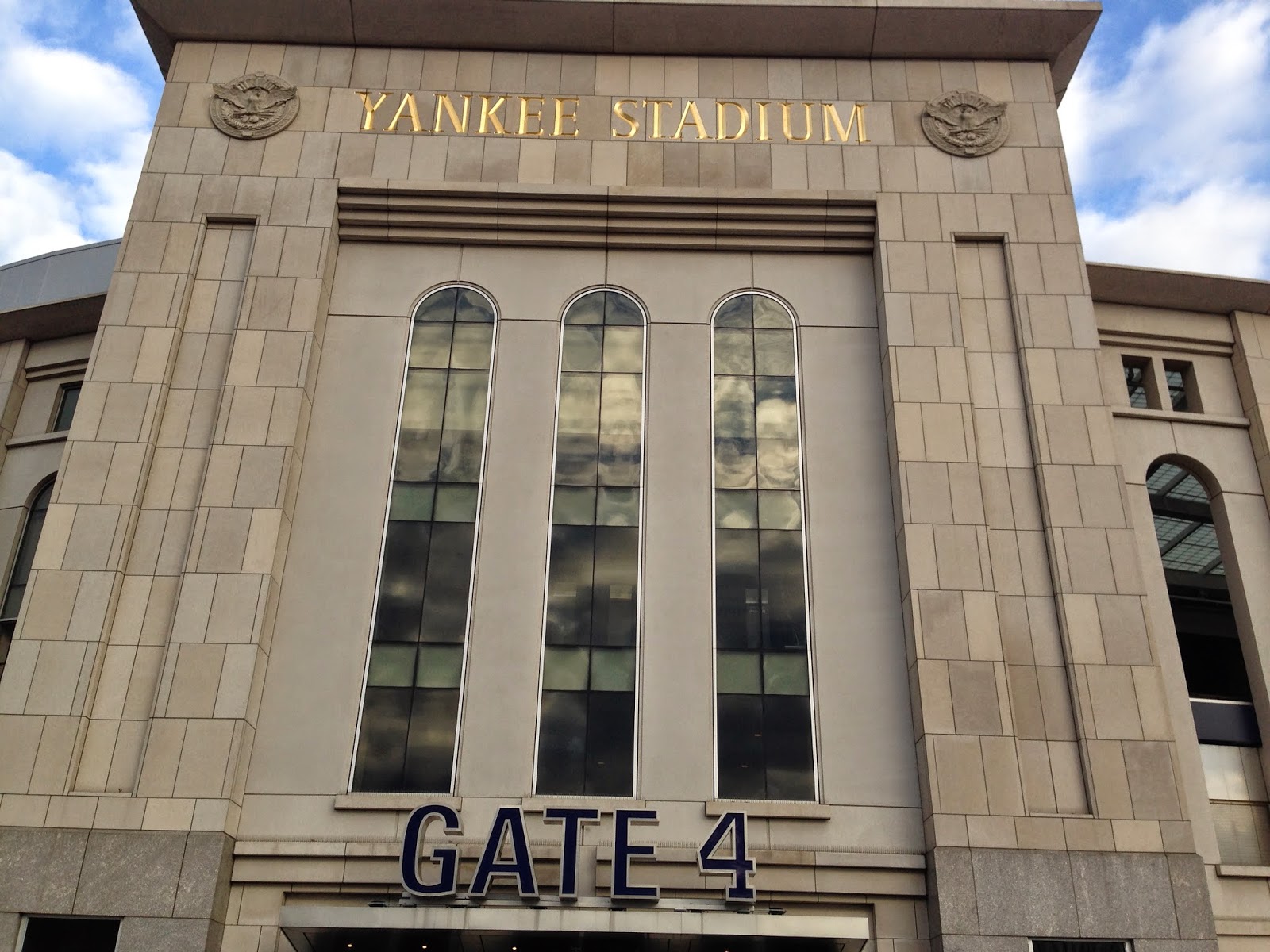
 The below photos were taken at the football game at Yankee Stadium. It was great to see the two college bands perform together at halftime!


 And, as the sun was setting, the Empire State building was lit up in the rival school colors, maroon and white, and brown and white!
 And, no wonder why we all love NYC, after the game on Saturday at Yankee Stadium, because of the crowds trying to get on the subway, everyone was allowed to just pass through!
More great coverage of the game and events from USAToday to NPR can be found here.
The terrific memories are what build great school spirit!
The past 3 days I spent in NYC taking part in the iconic #rivalry150 events surrounding the 150th meeting of Lafayette College and Lehigh University in a football game in none other than Yankee Stadium to a sold out audience on Saturday of over 48,200 ticket holders!
I admit my husband is a very loyal Lafayette College alum. He received his undergrad degree in physics there before moving on to his graduate degrees, including the PhD, from Brown University. I am a Brown U. alum (4 times over) and a Harvard one as well since I was a Science Fellow at Radcliffe.
Very often one's loyalties lie with one's undergraduate alma mater since the undergraduate years provide such formative experiences.
Lafayette and Lehigh are part of the Patriot League, a Division 1 athletics league. Both schools also have outstanding academic reputations and I especially respect their excellence in STEM fields.
The New York Times had great coverage of this rivalry with the first meeting of the two football teams in 1884. Both schools had worked very hard to generate interest and the activities in NYC were tremendous. Spoiler alert for those who have not heard - Lafayette "routed" (New York Times' choice of words) Lehigh with a score of 27-7 and this they accomplished with a third string quarterback, Zach Zweizig, whose name will go down in his college's history.
Zach has overcome injuries plus the death of his father and it was only last week that he was called on by his coach to take on the incredible challenge of playing quarterback at Yankee Stadium!
We took the MetroNorth train from New Haven and, in walking to our favorite hotel in NYC, The Excelsior, on 81st Street, through Central Park, on Friday, we heard a band playing, so with our suitcases we investigated and it was the Lehigh band practicing along with cheerleaders.
The Presidents of the two academic institutions, President Alison Byerly of Lafayette College and President Kevin J. Clayton of Lehigh, got to ring the closing bell at the New York Stock Exchange on Friday with the college mascots of a lepoard and a mountain hawk to accompany them.
Courtesy of the Associated Press
Friday evening we were treated to a gala event with scrumptious desserts at the Museum of Natural History, and I felt as though I was in the movie Night at the Museum.
More great coverage of the game and events from USAToday to NPR can be found here.
The terrific memories are what build great school spirit!
Cybersecurity Research and the Isenberg School of Management
There is tremendous interest in cybersecurity issues at UMass as well as at the Isenberg School of Management.
For example, on December 2, 2014, there will be a Cybersecurity Network Workforce Summit taking place at UMass Boston with participation from the UMass system President Dr. Robert Caret and the UMass Amherst Chancellor Dr. Kumble Subbaswamy.
And, just this past September, along with my Isenberg School of Management colleagues, Professor Mila Sherman of Finance and Professor Senay Solak of my Operations and Information Management Department, we, together with Professor Wayne Burleson of ECE, organized, with help from Professor Andrew Lo of the Sloan School, a very successful cybersecurity workshop at MIT. This workshop was supported by the second grant that we had received from the Advanced Cuber Security Center (ACSC).
I have posted all the presentations from our Workshop here.
Since our workshop at MIT, my OIM colleague, Professor Ryan Wright, received an NSF grant, joint with his University of Oklahoma colleagues, entitled, Building the Human Firewall. Plus, we heard that one of our Management Science doctoral students, Yueran Zhuo, who is being supervised by Solak, had her poster, titled "Optimizing Cybersecurity Investments with Risk: Insights for Resource Allocation" tie for second place as voted by ACSC Annual Conference attendees as a Best Cyber Security Solution for 2014. The $1,000 prize will be shared with the other second place winner "Authentication Using Embedded Logical Queries."
There is a lot of excitement on the UMass Amherst campus surrounding the possibility of a Cybersecurity Institute that would be across colleges and schools, which is terrific.
My interests and research in cybersecurity center around the network economics of cyber crime and cybersecurity with additional foci on risk management, information asymmetry, information sharing and security investments, Internet vulnerability and resilience, as well as supply chain aspects of security and vulnerability due, for example, to outsourcing. My latest paper on the theme is A Multiproduct Network Economic Model of Cybercrime in Financial Services.
A video of my presentation on cybercrime and financial service organizations filmed at the INNFORMS Minnepolis conference can be viewed here.
For example, on December 2, 2014, there will be a Cybersecurity Network Workforce Summit taking place at UMass Boston with participation from the UMass system President Dr. Robert Caret and the UMass Amherst Chancellor Dr. Kumble Subbaswamy.
And, just this past September, along with my Isenberg School of Management colleagues, Professor Mila Sherman of Finance and Professor Senay Solak of my Operations and Information Management Department, we, together with Professor Wayne Burleson of ECE, organized, with help from Professor Andrew Lo of the Sloan School, a very successful cybersecurity workshop at MIT. This workshop was supported by the second grant that we had received from the Advanced Cuber Security Center (ACSC).
I have posted all the presentations from our Workshop here.
Since our workshop at MIT, my OIM colleague, Professor Ryan Wright, received an NSF grant, joint with his University of Oklahoma colleagues, entitled, Building the Human Firewall. Plus, we heard that one of our Management Science doctoral students, Yueran Zhuo, who is being supervised by Solak, had her poster, titled "Optimizing Cybersecurity Investments with Risk: Insights for Resource Allocation" tie for second place as voted by ACSC Annual Conference attendees as a Best Cyber Security Solution for 2014. The $1,000 prize will be shared with the other second place winner "Authentication Using Embedded Logical Queries."
There is a lot of excitement on the UMass Amherst campus surrounding the possibility of a Cybersecurity Institute that would be across colleges and schools, which is terrific.
My interests and research in cybersecurity center around the network economics of cyber crime and cybersecurity with additional foci on risk management, information asymmetry, information sharing and security investments, Internet vulnerability and resilience, as well as supply chain aspects of security and vulnerability due, for example, to outsourcing. My latest paper on the theme is A Multiproduct Network Economic Model of Cybercrime in Financial Services.
A video of my presentation on cybercrime and financial service organizations filmed at the INNFORMS Minnepolis conference can be viewed here.
Subscribe to:
Posts (Atom)

 Posts
Posts