Sunday, July 9, 2017

Highlights from Fascinating Dynamics of Disasters 2017 Conference in Greece

The 2017 Dynamics of Disasters conference has now come to an end. The Elite Resort Hotel in Kalamata, Greece was the location of the conference.

The conference attracted speakers and participants from 4 different continents: North America, South America, Europe, and even Australia! Kalamata, Greece  is a bit remote (but that is also part of the allure), so this level of international representation is quite impressive.

The caliber of scientific presentations delivered by the speakers with the breadth and depth of both methodologies and applications was excellent. I am sure that new research will be generated from the presentations, warm discussions, and new collaborations formed.

I especially would like to acknowledge my fellow co-organizers of this conference: Professor Fuad Aleskerov of  the Higher School of Economics in Moscow, Russia, Professor Ilias S. Kotsireas of the Wilfrid Laurier University in Waterloo, Canada, and Professor Panos M. Pardalos of the University of Florida Gainesville.

Below is a photo of  Professor Kotsireas at the registration desk with nice Isenberg School of Management folders for the conference program.

Below is a photo of the conference group taken on the balcony of the conference venue.  The location has magnificent mountains, proximity to the Mediterranean (and beaches), as well as lovely flowers and vegetation.
 

The conference program can be downloaded here. As always happens in any international conference, there were a few last minute changes.

Professor Panos M. Pardalos opened up the conference with a few words also from Professor Ilias S. Kotsireas.
The audience had many opportunities for questions and additional discussions.

 
Speaking of papers reflecting the breadth of applications, there was a presentation on disaster communications by the "other" Professor Nagurney (Ladimer S. of the University of Hartford),  one on food security and relationships to conflicts by Professor Fuad Aleskerov, who also presented on the modeling of oil spills, and two on freight issues in humanitarian logistics. One of the latter talks was given by Timo Gossler on joint work with his Professor, Dr. Tina Wakolbinger of the Vienna University of Economics and Business, who organized the EURO HOpe conference in Vienna just last week, at which I also spoke at and blogged about. I presented a paper on game theory and multitiered freight service provision for humanitarian disaster relief.

 
Timo Gossler also delivered another excellent presentation on cash transfers in the humanitarian sector  for a colleague at the Vienna University of Economics and Business, Ioanna Falagara Sigala, on joint work of hers with Professor Fuminori Toyasaki of York University on Toronto.


The Imperial College group in London led by Professor Panagiotis Angeloudis had two outstanding talks, one on network flows and interdependent infrastructure systems after disruptions with a case study, appropriately, on London's public transportation network and electric power (given by Nils Goldbeck), and the other on unmanned aerial vehicles (UAVs) and medical deliveries using trajectory optimization, given by Jose Escribano. Not only were important applications presented but also rigorous methodologies.

I had the pleasure of having two of the three coauthors on our latest game theory network model that integrates logistics and financial funds present at the conference: Professor Patrizia Daniele of the University of Catania in Italy and Emilio Alvarez Flores, who is an Isenberg School of Management, alumnus, and who now is at Cisco. We presented on a General Nash Equilibrium model that integrates both logistical aspects of disaster relief as well as financial funds and extends a paper of min with Emilio and Ceren Soylu that was published in Transportation Research E.

Sofia Papadaki, on work with Professor Folinas, and other coauthors, gave a very interesting talk on refugees and associated humanitarian logistics of providing relief. She also presented on work of her professor on International Mine Action Standards and quality issues.

Professor Soumia Ichoua of  Embry-Riddle University in Florida spoke on the prepositioning of emergency supplies to support disaster relief over a planning horizon using a stochastic programming approach, along with a case study to North Carolina using a large dataset. Her work was with several co-authors. 

Roberta Messalli  presented a paper with Professor Lina Mallozzi of the University of Naples on equilibrium analysis for common pool resources, which I also enjoyed very much and was delighted to see citations to the Mobel laureate in economics - Dr. Elinor Ostrom (who remains to-date the only female recipient of this prize and sadly passed a way a short time ago) and also to Dr. Daron Acemoglu. Both these outstanding researchers I had the chance to hear speak (and the latter even host) at the University of Massachusetts Amherst.

It was very interesting to see applications driving advances in modeling and theory and it is clear that the researchers' passion for a topic often has some personal resonance. We were privileged to hear the talk of Professor Dmytro Matsypura, who traveled all the way from the University of Sydney in Australia, and who spoke on his joint work with Professor Oleg Prokopyev of the University of Pittsburgh. Matsypura presented a paper on wildfire management through the use of network-based models and optimization of prescribed burning. The paper has been accepted for publication in the European Journal of Operational Research. Wildfires are an international issue and there was also a very interesting talk by a group from Chile: Gabriela Alfaro, Pablo Escalona, and Monica Lopez-Campos on the use of coverage models for the allocation of mobile units for forest fire extinguishing with a case study on Valparaiso.

In addition to the scientific sessions there were also social events including an excursion to the Diros underground caves as well as a conference banquet. At the Diros caves, a true natural wonder, the group git to see breathtaking stalactites and stalagmites while being propelled by a tour guide in boats and when told to "duck", you had better do so.
Photos of the conferees getting ready for the conference excursion to the Diros caves are below.
 

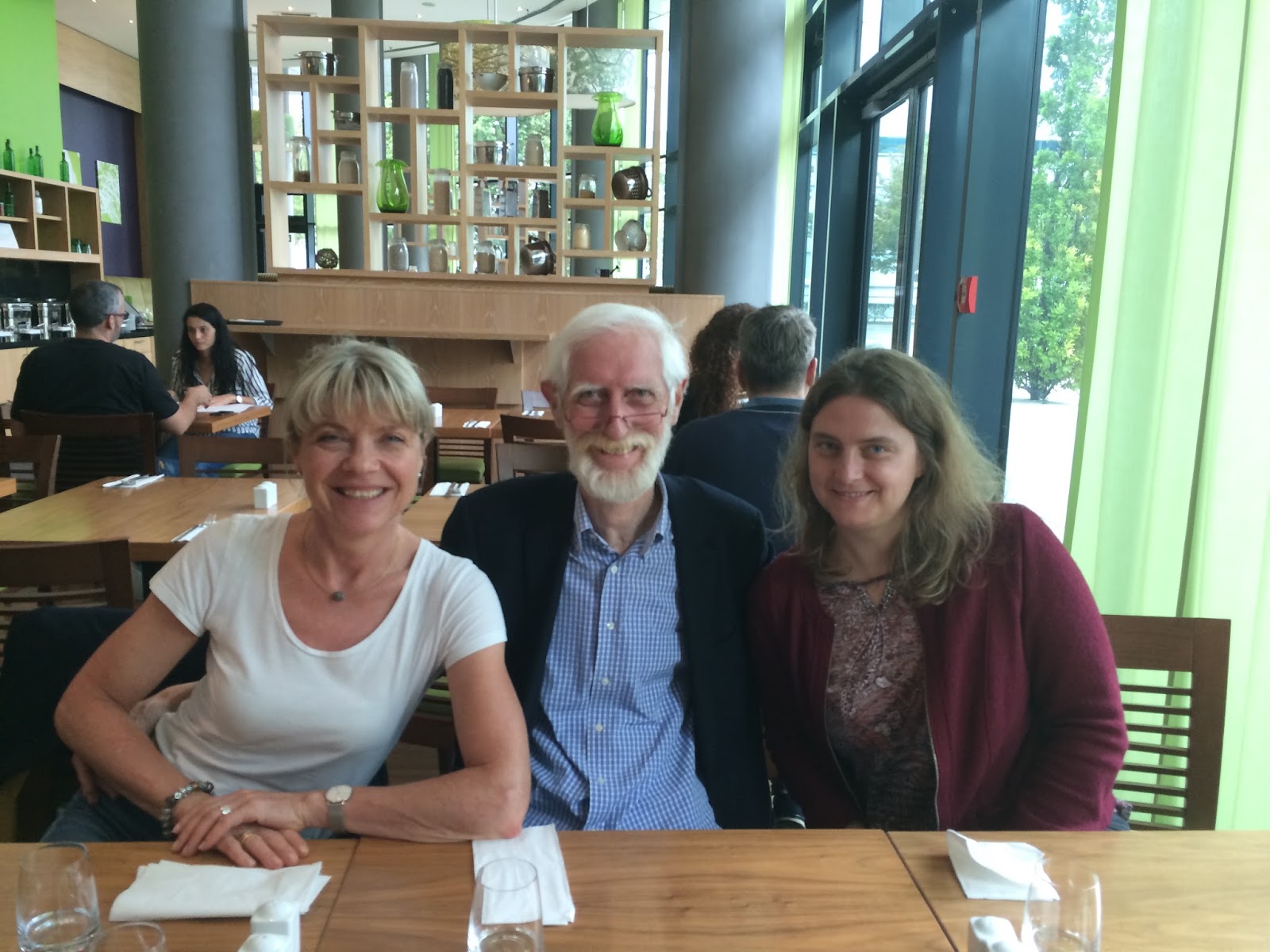
 Of course, there were other opportunities to enjoy breakfasts, lunches, breaks, and even the scenery together. Several conferees even managed to make it to the beach.


 In addition to the amazing company, the food was delicious!


Many thanks to my fellow conference co-organizers and to the speakers who traveled to share their research on topics of great relevance to the dynamics of disasters. I leave you with a photo of a sunset in beautiful Kalamata.

Monday, July 3, 2017

Fabulous Visit to the Vienna University of Economics and Business

After the fascinating EURO HOpe conference, which took place last Thursday and Friday at the Vienna University of Economics and Business (WU) that I had blogged about, I was looking forward to meeting with WU colleagues today. It was a perfect transition between two conferences, since tomorrow I fly to Kalamata, Greece, where the Dynamics of Disasters conference that I coorganized will be taking place.

Professor Tina Wakolbinger, who was my PhD student at the Isenberg School of Management, and graduated in 2007, organized the EURO HOpe conference, which focused on Humanitarian Operations. Today, I had a chance to meet with her and two Professors: Manfred Fischer and Petra Staufer-Steinnocher. Professor Fischer is renowned in regional science and the recipient of numerous international awards. Professor Staufer-Steinnocher I had the pleasure of meeting when she was one of my hosts during my course at WU.

We began the day with a delicious lunch, which started with a cold borshcht, and I could not resist taking the photo below.
Then we took a group photo after the lunch as a memento.
WU has an amazing new campus. I had visited the previous one and very much enjoyed teaching a course on Humanitarian Logistics there. The new campus has a learning center, which was the venue for the EURO HOpe conference, and which was designed by the award-winning female architect (who died much too young) Zaha Hadid, and is featured below.
My colleagues gave me  a personal tour of the campus and several of the buildings.


Professor Tina Wakolbinger is the Head of the Research Institute for Supply Chain Management at WU and has been at WU as a Full Professor since arriving in 2011. After receiving her PhD, she had been an Assistant Professor at the University of Memphis. Tina and I have published a series of papers together on supply chains and, given our many mutual interests, it was terrific to spend the better part of the day discussing research. Several of her doctoral students' research will be presented at our Dynamics of Disasters conference later this week.

I had nominated Tina for the INFORMS Judith Liebman Award, which she received, and it was delightful to see it gracing a shelf in her beautiful corner office.
It is very special to see a former PhD student, whose doctoral dissertation committee I chaired, so successful in academia and enjoying an extraordinary professional career.
Thanks for a fabulous visit to the Vienna University of Economics and Business today! And I bring back with me some souvenirs from the conference, including honey made at WU.

Saturday, July 1, 2017

Excellent EURO Humanitarian Operations Conference in Beautiful Vienna, Austria

The past two days I had the pleasure of taking part in the EURO HOpe (Humanitarian Operations) Conference in lovely Vienna, Austria.  The conference was organized by Professor Tina Wakolbinger of the Vienna University of Economics and Business (WU), who was my PhD student at the Isenberg School of Management and received her PhD in 2007. She  is now Director of the Research Institute for Supply Chain  Management at WU and is a Full Professor. Assisting her with organizing this fascinating conference were her doctoral students, including Christian Burkart (who took my humanitarian logistics class when I taught it at WU a few years ago).

The venue was the new campus of WU, which is futuristic, and the conference took place in a building which resembles a cruise ship.

The first day of the conference focused on cross-sector cooperation in disaster operations while the second had as its theme: the ongoing refugee movement. The full program for the conference can be downloaded here. 

In addition to the conference presentations and discussions, there were delightful snack breaks, a lunch, and an incredible conference banquet with many Viennese delicacies.

I very much enjoyed seeing colleagues from numerous countries, including several from the US, Canada, Austria, Germany, Finland, Turkey (which was especially well-represented), England, Holland, Cyprus, and even Ghana!  It was great to see colleagues from the University of Michigan, from Taxes Austin, and also from the Kelley School at Indiana University.

Below are photos of several presenters and session chairs as well as panelists.

 
I was very pleased at the number of females that spoke and took part in this conference.

My presentation can be downloaded here.  I spoke on game theory and disaster relief. The organizers will also be posting the conference presentations, we have been told, where permission is granted.

Some of the takeaways included: the different methodologies and perspectives to problem solving in humanitarian operations; the need for a consistent taxonomy; recognizing interdisciplinarity as to research in this area, the importance of working with practitioners and including them in collaborations and conferences, as well as discussions as to the role of special journal issues on humanitarian issues, since several have been recently produced.

It was wonderful to see Dr. Burcu Balcik again and to meet Dr. Sibel Salman, with me in the photo below.
It was also lovely to meet Dr. Maria Besiou, Dr. Tina Comes, Dr. Marion Rauner (with whom I spoke about our wonderful OR/MS colleagues: Dr. Ed Kaplan and Dr. Jonathan Caulkins, both of whom hosted me at talks I gave at Yale and at CMU last year, respectively), and to meet my Twitter contact Dr. Afshin Mansouri. Seeing Dr. Luk Van Wassenhove, Dr. Gerald Reiner, Dr. Sebastian Kummer, and Dr. Bahar Yetis Kara was also marvelous! It is so impressive what the operations research community has accomplished in terms of humanitarian operations and humanitarian logistics. The passion for the subject is palpable and sustained.

I would be remiss not to include photos from the wonderful banquet in the middle of Vienna's major park and playground. We walked together to the banquet location.


The desserts were especially incredible, including megadumplings filled with apricots (which we shared).
Below is a photo of Dr. Tina Wakolbinger and me. It was also nice to see her husband, who also was my PhD student at the Isenberg School at UMass Amherst, Dr. Fuminori Toyasaki.

And, when taking the subway from the conference back to our hotel, I could not resist the poster below. I am a very proud Academic MOM who loves seeing former doctoral students, such as Professor Wakolbinger and Professor Toyasaki, thriving in their academic research and lives!