Showing posts with label Nash equilibrium. Show all posts

Tuesday, July 10, 2018

From Disaster Relief to Freight Sustainability - Our Talks at EURO in Valencia, Spain

This summer I am again spending at the Radcliffe Institute for Advanced Study at Harvard University where I am a Summer Fellow. I have been busy working on a project on perishable product supply chains from food to blood.

Last summer I was also at Harvard as a Summer Fellow but spent a considerable amount of time flying to conferences, including one I co-organized on the Dynamics of Disasters, which took place in Kalamata, Greece.

Since I will have a heavy set of speaking engagements this Fall and I also wanted to fully take advantage of my time at the incredible Radcliffe Institute for Advanced Study, I have had co-authors present our latest work at the EURO Conference in Valencia, Spain.

I am delighted to report that our three presentations, two on disaster relief, and one on sustainable freight, have now been presented!

These presentations can be downloaded in their entirety here.

The first paper above is in press in the new Dynamic of Disasters: Algorithmic Approaches and Applications volume that I co-edited with Professors Ilias Kotsireas and Panos M. Pardalos.  The published is Springer. The last paper above was published in the European Journal of Operational Research very recently and was co-authored with Professor Sara Saberi (also a former doctoral student of mine) and her colleague at WPI, Professor Joe Sarkis.  The second paper above has three generations of scholars as authors: besides myself - Professor Tina Wakolbinger and her doctoral student, Timo Gossler, in addition to our collaborator Professor Patrizia Daniele.

Below I have posted a few photos from the conference, thanks to my wonderful co-author from Italy, Professor Patrizia Daniele. What is truly special is that three of my former PhD students from the Isenberg School, Professor Jose M. Cruz of UCONN's School of Business, Professor Tina Wakolbinger of the Vienna University of Economics and Business, and Professor Dmytro Matsypura of the University of Sydney in Australia, were all at the conference, and both Jose and Tina, as well as Patrizia, spoke on our joint research. They all continue as Supernetwork Center Associates and
it is fabulous to see how synergistic our research has been over the years and how beautifully the friendships established in our doctoral program have continued!
A big thank you to the organizers of the terrific EURO 2018 Conference in Valencia, Spain, for a fabulous conference for the exchange of the latest in scientific accomplishments n Operations Research and Analytics!

Saturday, March 10, 2018

Impressions of and Photos from the Fabulous Variational Inequalities and Nash Equilibrium Conference in a Castle in Italy

As academics, we sometimes journey to conferences that take place in quite remote locations. And, what never fails to surprise me, is how doing so is so worth it! I believe that academics, driven by intellectual curiosity, always want to exchange ideas and to engage in discussions and, if you can do so in locations that are unique, then the inspirations drawn and experiences as well as the  memories can be exceptionally rewarding.

Today, I will be journeying to England, where I will be conducting a master class in Network Equilibrium at Lancaster University next week but, before I head to the airport, I thought it appropriate to prepare and share this blogpost.

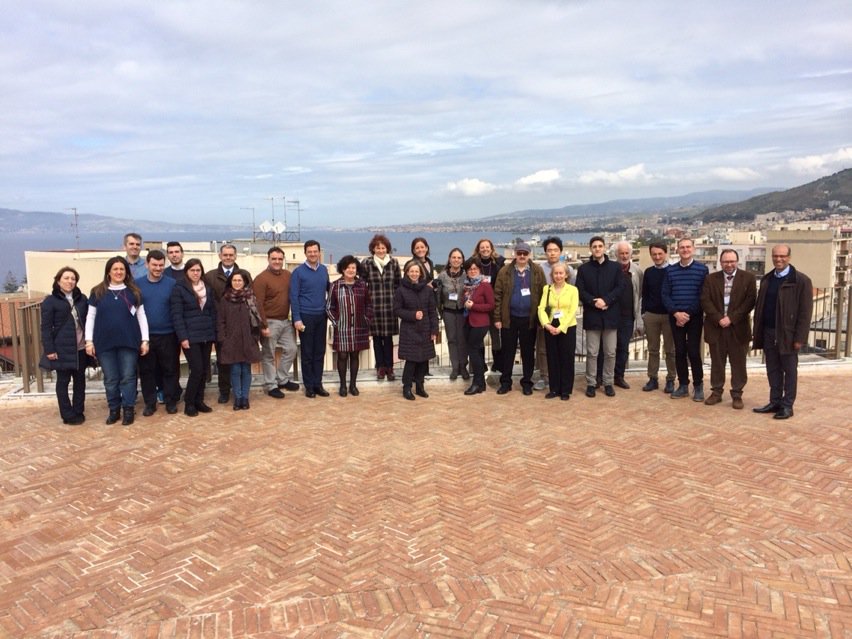
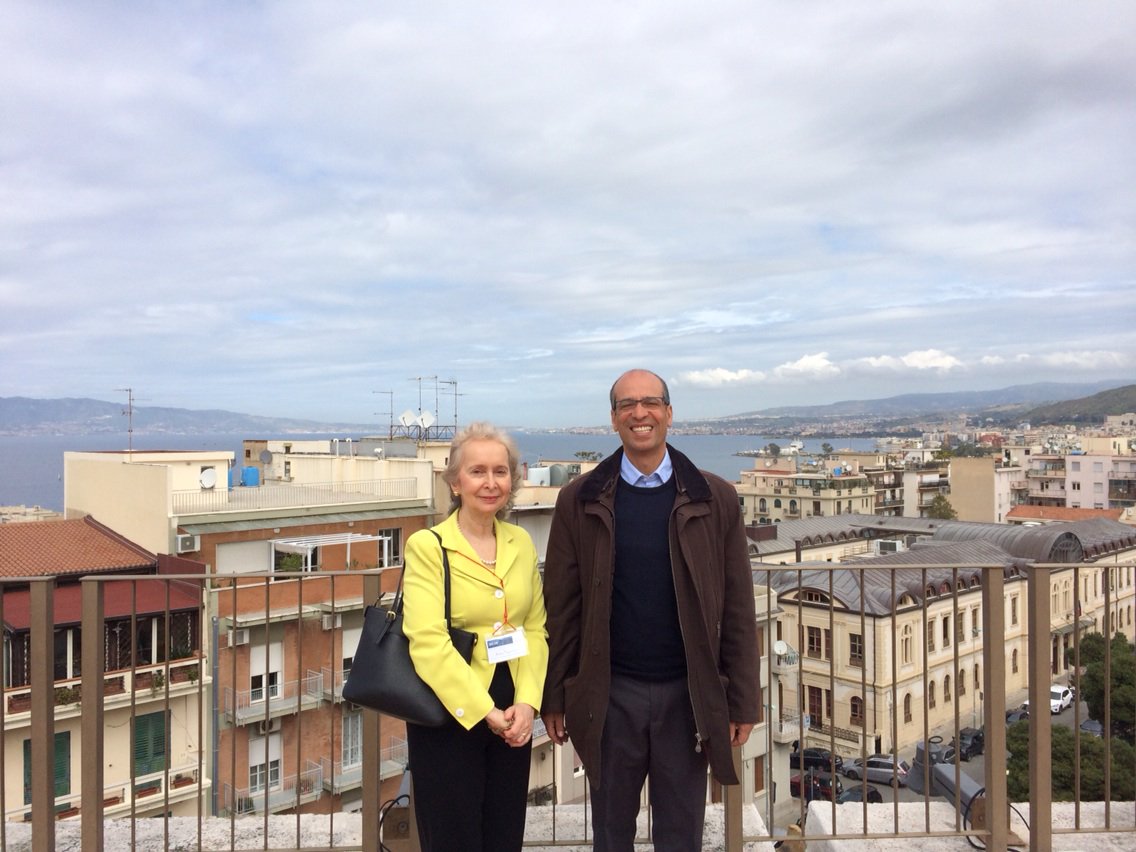
First, I would like to express my sincerest appreciation to the organizers of the fantastic VINEPA (Variational Inequalities, Nash Equilibrium Problems and Applications) 2018 conference, which took place the past two days in Reggio Calabria, Italy. The venue was a castle and the views from the top of the castle are spectacular. One can see Sicily across part of the Mediterranean Ocean.

 
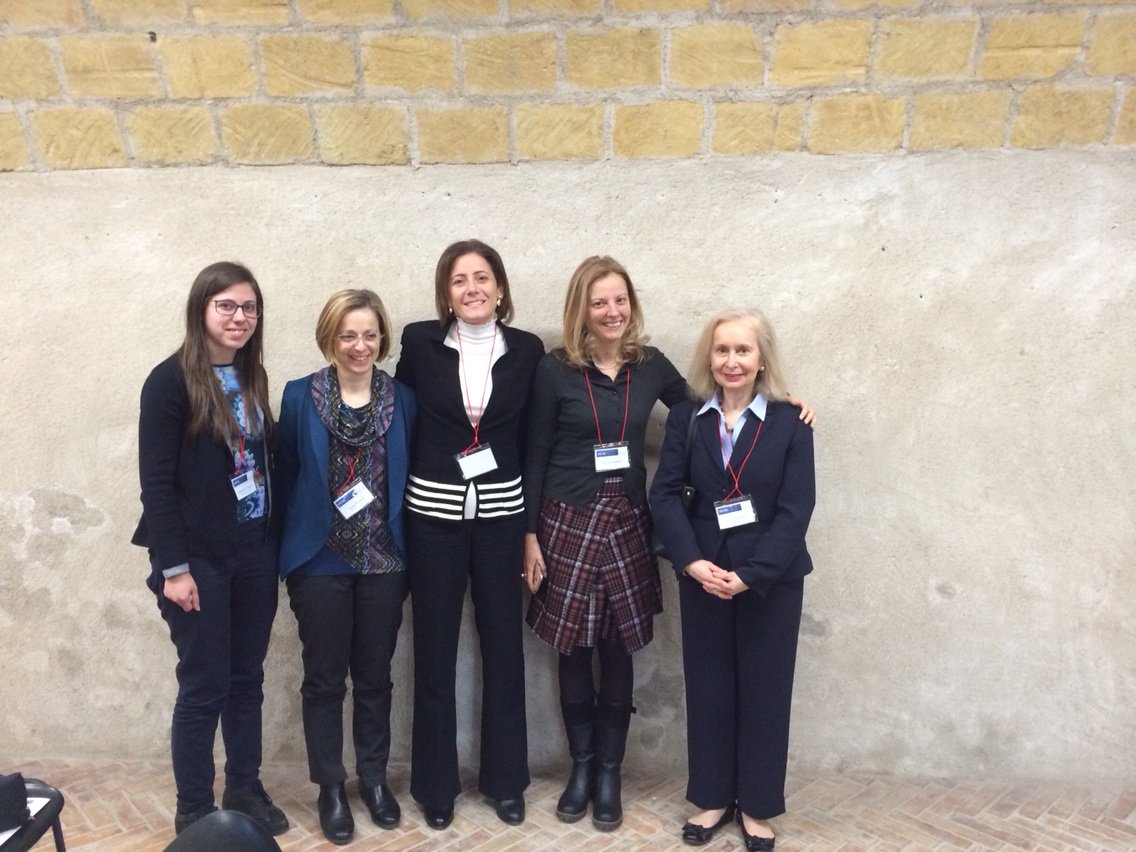
The organizers, who deserve a medal for this exceptional conference, were: Professors Sofia Giuffre', Patrizia Daniele, and Laura Scrimali. How appropriate that they are all females, given that the conference also coincided with International Women's Day!
I was invited to give a keynote at this conference and, since the theme of the conference is so perfect for my research, I had to accept.


The photo above is of the organizers and of a doctoral student of Professor Patrizia Daniele's, Gabriela Colojanni. We even have a joint paper now on cybersecurity, which is in press.

I enjoyed giving my keynote very much and in hearing all the great talks and discussions. The discussions were especially stimulating since the conference convened operations researchers, applied mathematicians, computer scientists, and even those working in areas of economics and engineering. Conferees came from Italy (of course), Denmark, Norway, Russia, Mexico, France, and the USA! Some journeyed for almost 40 hours to get to Reggio Calabria, which is in the "toe" part of the boot that is the shape of Italy.
 

Dr. Igor Konnov, in the photo above, presented me with his book.

The attention to detail by the organizers was outstanding, with delicious lunches, coffee breaks, a tour of the castle, and a multicourse banquet. Of course, I could not resist having a cannoli!

 
I am carrying back not only great research ideas but gifts from the organizers and several participants!
And, we all have new friendships and have renewed friendships!


Saturday, July 1, 2017

Excellent EURO Humanitarian Operations Conference in Beautiful Vienna, Austria

The past two days I had the pleasure of taking part in the EURO HOpe (Humanitarian Operations) Conference in lovely Vienna, Austria.  The conference was organized by Professor Tina Wakolbinger of the Vienna University of Economics and Business (WU), who was my PhD student at the Isenberg School of Management and received her PhD in 2007. She  is now Director of the Research Institute for Supply Chain  Management at WU and is a Full Professor. Assisting her with organizing this fascinating conference were her doctoral students, including Christian Burkart (who took my humanitarian logistics class when I taught it at WU a few years ago).

The venue was the new campus of WU, which is futuristic, and the conference took place in a building which resembles a cruise ship.

The first day of the conference focused on cross-sector cooperation in disaster operations while the second had as its theme: the ongoing refugee movement. The full program for the conference can be downloaded here. 

In addition to the conference presentations and discussions, there were delightful snack breaks, a lunch, and an incredible conference banquet with many Viennese delicacies.

I very much enjoyed seeing colleagues from numerous countries, including several from the US, Canada, Austria, Germany, Finland, Turkey (which was especially well-represented), England, Holland, Cyprus, and even Ghana!  It was great to see colleagues from the University of Michigan, from Taxes Austin, and also from the Kelley School at Indiana University.

Below are photos of several presenters and session chairs as well as panelists.

 
I was very pleased at the number of females that spoke and took part in this conference.

My presentation can be downloaded here.  I spoke on game theory and disaster relief. The organizers will also be posting the conference presentations, we have been told, where permission is granted.

Some of the takeaways included: the different methodologies and perspectives to problem solving in humanitarian operations; the need for a consistent taxonomy; recognizing interdisciplinarity as to research in this area, the importance of working with practitioners and including them in collaborations and conferences, as well as discussions as to the role of special journal issues on humanitarian issues, since several have been recently produced.

It was wonderful to see Dr. Burcu Balcik again and to meet Dr. Sibel Salman, with me in the photo below.
It was also lovely to meet Dr. Maria Besiou, Dr. Tina Comes, Dr. Marion Rauner (with whom I spoke about our wonderful OR/MS colleagues: Dr. Ed Kaplan and Dr. Jonathan Caulkins, both of whom hosted me at talks I gave at Yale and at CMU last year, respectively), and to meet my Twitter contact Dr. Afshin Mansouri. Seeing Dr. Luk Van Wassenhove, Dr. Gerald Reiner, Dr. Sebastian Kummer, and Dr. Bahar Yetis Kara was also marvelous! It is so impressive what the operations research community has accomplished in terms of humanitarian operations and humanitarian logistics. The passion for the subject is palpable and sustained.

I would be remiss not to include photos from the wonderful banquet in the middle of Vienna's major park and playground. We walked together to the banquet location.


The desserts were especially incredible, including megadumplings filled with apricots (which we shared).
Below is a photo of Dr. Tina Wakolbinger and me. It was also nice to see her husband, who also was my PhD student at the Isenberg School at UMass Amherst, Dr. Fuminori Toyasaki.

And, when taking the subway from the conference back to our hotel, I could not resist the poster below. I am a very proud Academic MOM who loves seeing former doctoral students, such as Professor Wakolbinger and Professor Toyasaki, thriving in their academic research and lives!

Wednesday, September 14, 2016

Game Theory and the Nash Equilibrium -- Giving Credit to Braess for His Paradox

I am a huge fan of the magazine The Economist and have been a subscriber for many years. If I have an upcoming long flight then I store up and hoard several issues because I know that I will be engaged reading them and also sometimes educated, but not always.

I have also written Letters to the Editor to The Economist. One was published in 2008 and it had to do with traffic and drivers' behavior in choosing routes.

Over the past few weeks I have especially enjoyed a series in The Economist, which is in 6 parts, entitled: Six big economic ideas.

The fifth column in this series, however, piqued me sufficiently to compose a letter. The column was on:  Game theory: Prison breakthrough - The fifth of our series on seminal economic ideas looks at the Nash equilibrium.

The paragraph that bothered me I have taken a photo of and it is the top one below:
Specifically,  the sentences in it that needed proper acknowledgment are: "Self-interested drivers opting for the quickest route do not take into account the effect of lengthening others' journey times, and so can gum up a new shortcut. A study published in 2008 found seven road links in London and 12 in New York where closure could boost traffic flows."

Hence, I composed a Letter to the Editor, which I emailed on August 25.  Since enough time has elapsed I assume that it will not be published so I am reprising it below:

I was delighted to read your fifth brief in the series on seminal economic ideas which featured the contributions of John Nash, whose work, notably, the Nash equilibrium, as you mention, has informed a wide spectrum of fascinating applications, and has fostered additional research. However, I believe in giving credit where credit is due:  although I was pleased to see you mention transportation networks and what is, in effect, user-optimized behavior, in that drivers selfishly choose their cost-minimizing routes of travel from origins to destinations without considering the impact on society, your article fails to acknowledge the (in)famous Braess paradox paper, which was published in 1968 (much before the study in 2008 that you allude to). Braess, in his paper, which was published originally in German, demonstrated that the addition of a new route can make all travelers in a transportation network worse-off. Because of the fascination with this phenomenon, which also can occur in other decentralized networks, Dietrich Braess, Tina Wakolbinger, and I translated the article from German to English and the translation (with a foreword as to how he made this discovery) was published in Transportation Science in 2005 and is now freely available for download:http://homepage.rub.de/Dietrich.Braess/Paradox-BNW.pdf

And, in honor of both John Nash, whom I have cited in probably close to 100 of my papers, and also to Dietrich Braess, another brilliant mind, below I include photos of them. With me and Braess is Dr. Tina Wakolbinger, who was my PhD student at the Isenberg School of Management, and is now a Full Professor at the Vienna University of Economics and Business in Austria.

And for those of you interested in new developments on the Braess paradox, we have now obtained physical proof of its occurrence in electrical circuits: 

Tuesday, September 6, 2016

Super First Day of Classes at the Isenberg School of Management

There is something special about the month of September, when the new school year begins. The nights are cooler in the northeast, some of the leaves have started to change colors, and there is an air of anticipation.

I am sure that you remember many "first days" of classes, from elementary school onward through high school and college, and perhaps graduate school or a professional school.

I never get tired of the start of the new academic year and last night I was so excited, that I could hardly sleep.  Today, was the first day of the new academic year at the University of Massachusetts Amherst and, in the Fall, I always very much enjoy teaching my Logistics and Transportation class, which is an elective in the Operations and Information Management Department.  Also, if the classroom size permits, I allow interested students, especially from Industrial Engineering, into the course, who have some background in operations and modeling.

Faculty members, as some students do, too, I expect, take the time to decide what outfit to wear on the "first day of school." One of my Marketing colleagues always wears a red tie and recommends something bright and cheery and for those of you who follow Alex Pentland's work (we have hosted him at the Isenberg School through our great UMass Amherst INFORMS Speaker Series), you will know that first impressions - which may be only seconds or minutes long - do matter! Pentland is from MIT and is a member of the National Academy of Engineering, a well-deserved honor.

Today, after having breakfast, I checked my email messages and there was good news, and a perfect start to this special day.

Our paper, which I have blogged about, A Generalized Nash Equilibrium network model for post-disaster relief, and which was co-authored with one of my former undergraduate students, Emilio Alvarez Flores, who received a degree from the Isenberg School in May 2016, and a colleague from economics, Professor Ceren Soylu,  is the lead article in the November issue of Transportation Research E. I received a nice preprint today before my class.
Having such news before your first class is clearly energizing plus synergistic.

During class I asked the students to share a fun fact about themselves having to do with Logistics and Transportation, and these were so interesting and so much fun - from stories about commuting close to two hours each way for their summer internships, to riding mopeds as a mean of transport in Thailand and without a helmet, to driving over 3,000 miles this summer to help a family member move, to flight delays and travails, to working on yachts in Boston, and also fear of flying. It should be a very interesting semester.  One student mentioned that her favorite mode of transport was Uber!
Coincidentally, last night I read the latest issue of The Economist and guess what was the cover story?! It will be fascinating to see what happens with autonomous vehicles, in general, and the impact on Uber, which has no hard assets, for example, one of the issues explored in this issue.

And then, during office hours - I was not sure whether anyone would show up since I do not assign homework on the very first day - a student who was also in my Humanitarian Logistics and Healthcare class stopped by and we brainstormed for 90 minutes (it felt like 10 minutes) about possible topics for her honors thesis. (Emilio's honors thesis I co-supervised last year.) But, mostly, we just talked about healthcare and hospitals and improving the quality of care and our personal experiences.

Catching up with colleagues at the Isenberg School was also a lot of fun today and  hearing about how they spent their summers.

Then it was time for our weekly NSF project teleconference on our EAGER grant (which are high risk but potentially high return projects). Along with Associate Dean of the College of Engineering at UMass Amherst, Dr. Tilman Wolf, I am working with colleagues from the University of Kentucky, who are computer scientists: Dr. Ken Calvert and Dr. Jim Griffioen. Together we had also had, with NCState and RENCI, a multiyear NSF Future Internet Architecture (FIA) grant and we worked on ChoiceNet. Our work is getting a lot of citations which is gratifying.

And, as part of the discussion, Ken mentioned that he had listened to a very interesting podcast in the NPR Freakonomics radio series: http://www.npr.org/podcasts/452538045/freakonomics-radio, the July 213, 2016 edition, entitled: Is the Internet Being Ruined? He mentioned that Dr. David Clark of MIT was interviewed in this segment, so I had to listen. David Clark is one of the brains behind the Internet and an absolutely delightful individual. Two years ago, on September 20, 2014, I had the pleasure, with my wonderful colleagues: Professor Mila Sherman of Finance, Professor Senay Solak of my department, and Professor Wayne Burleson of Electrical and Computer Engineering, of organizing a workshop at the Sloan School at MIT on Cybersecurity Risk Analysis for Enterprise Security (a mouthful). This was made possible through a grant that we received from the Advanced Cyber Security Center in eastern Massachusetts and also with support from Mila's dissertation advisor at MIT, the renowned Dr. Andrew Lo, who also gave a keynote speech.  Dr. David Clark, a visionary and thought leader, was also a keynote speaker and I still remember the research assignment that he had given me. You can see photos in my post on the link above.

I hope that your first day of the new academic year was enjoyable and rewarding!