Showing posts with label Haiti. Show all posts

Thursday, April 6, 2017

Dr. Pierre Rouzier on What Shapes Your Life? Lessons from a Truly Inspiring Physician

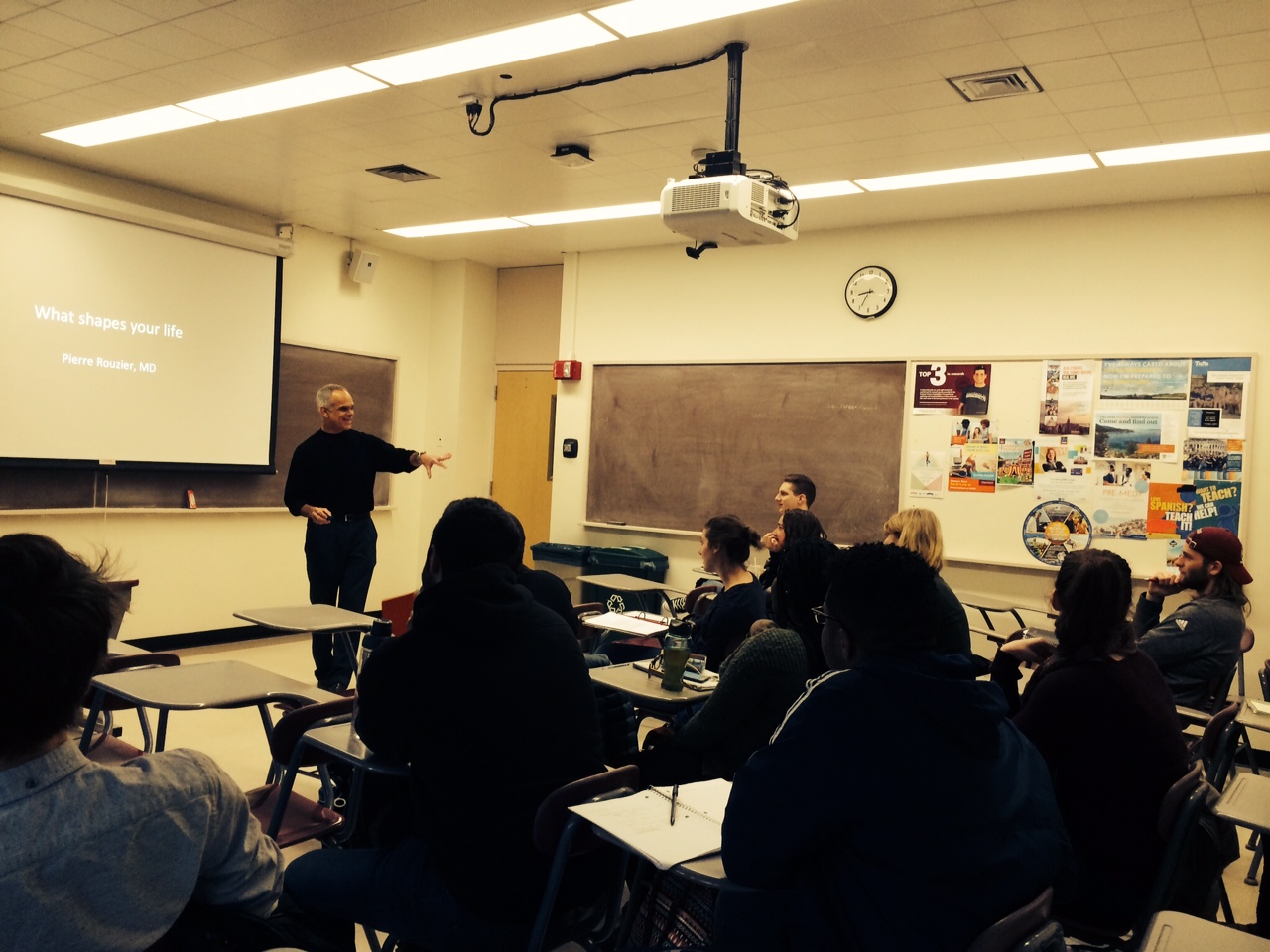
This morning, my students and I were mesmerized by the brilliant lecture of Dr. Pierre Rouzier, who spoke in my Humanitarian Logistics and Healthcare class at the Isenberg School.

Dr. Rouzier is the team physician at UMass Amherst and a doctor at our University Health Services. He is also a published author and a great humanitarian.

For many years he has also assisted in triage at the Boston Marathon, and was there at the bombing in 2013.

Dr. Rouzier's lecture was on "What Shapes Your Life?"  and he spoke on life shaping events, inspiring people to move (more on this), and also finding greatness in every day.

Last summer, he with a friend, Roger Grette, bicycled across the US, while disseminating the news on his children's book, Henry Gets Moving. It was published in 2012.

He covered 4,100 miles from Oregon through Massachusetts.  It took them 10 weeks to accomplish this feat and he said to us that "he had a life-changing summer and doesn't know if he even needed his life to change." Along the way he spoke to children and to adults publicizing his book, which focuses, in a warm-hearted way, on why children need to move more and to eat right. He showed us wonderful video clips of children, farmers, cowboys, and others along the way that were swept by his energy, openness, and passion for helping people and would chant: Ride, Henry, Ride!   He noted that, in 1980, 7% of children ages 6 to 11 were obese and in 2008, 20% were. Clearly, children eat what is provided. He stated that the obesification of America is a big problem.

Dr. Rouzier said that he is now in the last quarter of his life and wanted to take on the challenge of biking across the US and had done a lot of reading of experiences of others who had succeeded at this challenge. During his journey, he had many instances of the sense of wonder of meeting new people, serendipitous encounters with UMass connections, praying that the sun would shine and it did and then it snowed, and finding new friends along the journey.  The motto "Endure or Enjoy" from the book, "From the Atlantic to the Pacific on Two Wheels," by Alex Alvarez, served him well and continues to.
Dr. Rouzier also spoke about getting accepted at Stanford U. for his undergraduate studies but decided to go to UC Davis, due to the cost, and then went on to med school at USC because they had 13 weeks of vacation (rather than 6 as at UC Irvine) and he had fallen in love with travel (and also had a scholarship to med school). He had been a kinesiology major and had spent his junior year abroad in Edinburgh and loved it. He shared with us some of his hitchhiking stories in Europe, which were hysterical. He likes to travel OPM using "other people's money," which makes a lot of sense. While in med school he traveled to Australia, New Zealand, and Papua New Guinea, where he spent some time helping out at a healthcare facility. There he met 2 UMass Medical School Worcester graduates and ended up having his residency there. He has been at UMass Amherst since 1997 and are we lucky!

He has worked at Native American healthcare facilities, and spent 5 years in Colorado where he wrote a book, "The Sports Medicine Patient Advisor," which was inspired by a farmer who had hurt himself lifting bales of hay and could not take the time to drive a distance for physical therapy and asked him to just write the instructions down and he would follow them. Indeed, as his friend Bruce Bynum says: "The right book will set you free!"

Two of the life-changing events that he spoke about were the Haiti earthquake, which struck on January 12,  2010, and the Boston Marathon bombing, which took place April 15, 2013. We have talked about these two disasters in the Humanitarian Logistics and Healthcare class. Dr. Rouzier's father is from Haiti and he was in Haiti 9 weeks after the earthquake and was engaged in "despair medicine." At that point, many were suffering from illnesses brought about by the shock and ensuing stress. He even met a relative who lived on a hill and was one of the lucky ones.

Since Dr. Rouzier is not only an athlete, and former teacher and coach, but also a sports medicine expert, he also, for many years, has assisted in triage at the Boston Marathon. He was there during the bombing and shared with us that there was blood everywhere, the smell of burning flesh, and a surreal scene. He had been accompanied by a friend, Chad, who had recently had a child. He used a belt as a tourniquet and a fence post for a splint for a broken leg. He treated a female who said: I am going to die here and noone will know where I am." He said that he did not get her name and that it bothered him and it was very hard to get closure. The marathon bicycle journey across the US last summer, I believe, helped him tremendously, and he said that while en route he received a text from one of the victims thanking him.

The healing process was assisted also by people reaching out to him, even on Facebook, and especially UMass students doing so. He said: "people like you saved me."  His heroism and selflessness were so apparent throughout his brilliant lecture and we are so indebted to Dr. Pierre Rouzier for showing us what constitutes a life well lived. His nonprofit Team Henry is even helping out an orphanage in Tanzania. And, next week, Dr. Rouzier will again be assisting at the Boston Marathon.

Towards the end of his lecture today, Dr. Rouzier emphasized the power of positive thinking. He said that: "when you change the way you look at things, the things you look at change."

He told us that we need to look in the eyes of others and be nice - this is a choice that you can make. He said that "a stranger is a friend you have not yet met" and that "in every day there is something great about it."

We did not have much time for questions and answers but I wish that we had.

I presented Dr. Rouzier with a gift from the Isenberg School and also a certificate thanking him for being a terrific Professor for a Day! I then snapped a group photo of students with him as a memento of a truly inspirational and very wise lecture, with numerous life lessons.


Monday, January 10, 2011

Humanitarian Logistics -- Working on the Tough Stuff

As the world marks the first anniversary of the Haiti earthquake that struck on January 12, 2010, with more than one million people there still living in tents and under tarps, I thought it important to write on how we can all learn from such catastrophic natural events and the ensuing response and reconstruction.

As an academic, I conduct research, teach, and do (tons of) professional service.

Since my general area of research is network systems, many of my topics stem from timely real-world events. Such an approach brings an immediacy to my work and also a dynamism to the classroom.

Other research topics are generated through collaborations, including those with graduate students, whose dissertations I am supervising.

Humanitarian logistics and the related theme of healthcare are two areas that I have been drawn to, beginning with the Rockefeller Foundation Conference on Humanitarian Logistics that I organized at its Bellagio Center on Lake Como in Italy.

On the website that was created for this conference, I periodically upload additional studies of ours that may be relevant and of interest to this community.

Below are some recent ones of ours.

Additional References

Supply Chain Network Design for Critical Needs with Outsourcing, Anna Nagurney, Min Yu, and Qiang Qiang, Papers in Regional Science, in press.

Sustainable Supply Chain Network Design: A Multicriteria Perspective
Anna Nagurney and Ladimer S. Nagurney, International Journal of Sustainable Engineering 3: (2010) pp 189-197.

Multiproduct Supply Chain Network Design with Applications to Healthcare
Anna Nagurney, Min Yu, and Qiang Qiang

Optimal Supply Chain Network Design and Redesign at Minimal Total Cost and with Demand Satisfaction
Anna Nagurney, International Journal of Production Economics 128: (2010), pp 200-208.

Fragile Networks: Identifying Vulnerabilities and Synergies in an Uncertain Age
Anna Nagurney and Qiang Qiang, International Transactions in Operational Research, in press.

We have also completed the paper:

Supply Chain Network Operations Management of a Blood Banking System with Cost and Risk Minimization, joint with two of my doctoral students, Amir Masoumi and Min Yu, which is presently under review.

This latest paper is an outgrowth of specific interests of Amir Masoumi. It was particularly challenging because of the complexity of the network model, which had to capture the perishability of this time-sensitive, but life-saving, "product." This paper we plan on presenting at the POMS Conference in Reno, Nevada and at the Northeast Regional INFORMS Conference in Amherst!

As for our critical needs supply chain network design paper with outsourcing, the Isenberg School has issued a press release on it, which may be accessed here.

Thursday, July 8, 2010

Haiti 6 Months After -- Unblock the Roads and Fragile Networks

One year ago, our book, Fragile Networks: Identifying Vulnerabilities and Synergies in an Uncertain World, was published and was recently noted by the Library Journal to be a top selling book in technology and engineering.

6 months ago, on January 12, 2010, a huge earthquake hit Haiti and awakened the world to the wrought devastation.

I wrote regularly in this blog about the earthquake, the resulting human suffering and loss of lives, and the loss of critical infrastructure from the roads to telecommunications, plus hospitals and even schools, which only added to the suffering of the survivors. I also called for better coordination among the stakeholders and especially the humanitarian organizations for the provision of necessary supplies and decent logistics.

Today, The New York Times has an OpEd piece written by my colleagues at Georgia Tech, which is right on target, and which speaks to one of the major themes of our Fragile Networks book: that the identification of the critical network links before (and after) their degradation and even ultimate devastation is essential.

According to the OpEd piece, Haiti's External Weight, by Professors Desroches, Ergun, and Swann, 6 months after the earthquake: twenty million to 25 million cubic yards of debris fill the streets, yards, sidewalks and canals of Port-au-Prince — enough to fill five Louisiana Superdomes.

Debris is one of the most significant issues keeping Haitians from rebuilding Port-au-Prince and resuming normal lives. Much of the stuff has been left in place or simply moved to the center or the sides of roads. Some streets with especially large piles of refuse are impassable. As a result, it can take hours to travel just a few miles. Meanwhile, schools, hospitals, businesses and homes remain blocked.

Amazingly, only about 5% of the original debris has been properly disposed of and there are serious concerns about the ultimate impact of the debris on the environment, as well.

Clearly, the efficiency and performance of the transportation and logistical networks in Haiti have been severely affected and degraded without a timely debris removal. Since such networks provide the infrastructure for the movement of people and goods, how can Haiti's economy and its citizens move forward?!

In May, 2008, I had the privilege of convening a workshop: Humanitarian Logistics: Networks for Africa at the Rockefeller Foundation's Bellagio Center on Lake Como. It was apparent to us then, as it is now, that with the increasing number of disasters documented globally more attention to education, to research, and to policy analysis regarding humanitarian logistics and sustainable operations is sorely needed.

Crises don't end once the media attention dissipates.

Monday, April 5, 2010

Crisis Mapping, Crowd Sourcing, Ushahidi and Helping Haiti

Crisis mapping has emerged as a powerful social networking tool that helps both emergency assistance providers as well as those affected by disasters. Ushahidi is one such platform, whose design was led by the Kenyan, David Kobia. Its growing applications have attracted worldwide attention. It takes advantage of crowd sourcing in obtaining data in crisis and disaster situations.

Most recently, a group at the Tufts University Flectcher School of Law and Diplomacy, led by Patrick Meier, developed Ushahidi-Haiti to assist rescue and recovery efforts post the devastating earthquake that hit Haiti on January 12, 2010. Hundreds of students at the Fletcher School assisted in this project at its peak.

The Boston Globe has a wonderful article on the Ushahidi-Haiti initiative, led by Meier.

According to the Globe article: Aid workers quickly saw the value of Meier’s creation. “This really helped us get the aid exactly where it was needed,’’ said Craig Clarke, a civilian intelligence analyst for the Marine Corps. “What they did was beyond valuable. It was gold.’’

According to Clarke: he had no doubt that the crisis-mapping operation helped to save lives and get crucial aid to thousands of Haitians in the weeks after the quake.

Ushahidi (which means "testimony" in Swahili) uses GPS data so that crisis managers and humanitarian organizations are able to locate who needs what during and post a crisis.

Now Ushahidi-Haiti is being used for the recovery and rebuilding of Haiti. I am certain that it will become an essential tool for disaster relief and humanitarian operations around the world.

Wednesday, February 10, 2010

ITU of the United Nations Leads the Communications Rebuilding of Haiti

The Intemational Telecommunications Union (ITU), the oldest organization in the United Nations, is leading the efforts to rebuild the communications infrastructure in Haiti post the devastating earthquake. This effort is being led by Dr. Cosmas Zavazava of the ITU, who was a speaker at the Humanitarian Logistics conference that I organized under the auspices of the Rockefeller Foundation's Bellagio Center program. Above is a photo, taken at the conference at the Bellagio Center in Italy, of me with Dr. Cosmas Zavazava and Professor Panos Pardalos with several conferees who have become dear friends and colleagues and who are from the African continent.

This article discusses how the UN is making plans for Haiti's future with the building of a strong communications infrastructure as it continues to play a pivotal role in supporting humanitarian and relief efforts in Haiti. Dr. Zavazava is quoted as saying: Our aim is to help Haiti mobilize and deploy different kinds of technologies to mitigate the impacts of disasters. Reliable telecommunication systems can be complemented with remote sensing and GIS [geographic information systems] technology. In disaster management, a hybrid of these technologies is important.

In addition, Dr. Zavazava believes that: Haiti needs a lot of assistance. Even before the earthquake, it was one of the least developed countries in the world. It will need a strong infrastructure to run e-business, e-agriculture, e-environment, e-education, and e-health efficiently. E-applications and e-services are a critical ingredient to today’s results-based business model.

I salute the extraordinary efforts of Dr. Zavazava and his colleagues from the ITU!

Tuesday, February 2, 2010

The Pooling of Resources for Humanitarian Operations

The New York Times has a very interesting, provocative article on the pooling of resources for humanitarian operations and, in particular, as applied to Haiti, but the topic is broader and relevant in other disaster and humanitarian relief contexts. The article is focused on the pooling of financial resources and notes that the Red Cross, although it did not have a large presence in Haiti prior to the earthquake, because of its brand name recognition, has received many more financial donations than has Partners in Health, which has had a large presence in Haiti, even before the earthquake struck on January 12, 2010.

The issue of financial donations to relief organizations and providing stakeholders with proper accounting of donations is an important one and two of my former doctoral students, who are now professors, Dr. Tina Wakolbinger and Dr. Fuminori Toyasaki, are actively researching this topic.

I would argue that cooperation among humanitarian organizations in relief operations is critical and I have written on this topic earlier in this blog. In particular, as was evident in Haiti, there were numerous demand points (and there still are) for such products as water, food, medicines, and tents and the networks of different organizations were not working together in a synergistic manner. Some of the issues were obviously ones of lack of communication and coordination. Nevertheless, when it comes to the pooling of resources, including financial ones, by being able to represent the various activities of the humanitarian organizations as networks, one can actually quantify the synergistic gains from cooperation.

In joint work with Dr. Trisha Woolley and Dr. Patrick Qiang, we have developed a synergy measure that can be used to assess the benefits of cooperation by sharing of network resources. The work is documented in a study entitled, "Multiproduct Supply Chain Horizontal Network Integration: Models, Theory, and Computational Results," which is in press in the journal International Transactions in Operational Research. I presented this work earlier at the humanitarian logistics conference that I had organized, under the auspices of the Rockefeller Foundation, that took place at its Bellagio Center.

Friday, January 22, 2010

Conundrum -- Satellite Communication Resiliency, Haiti, and the Last Mile

The issues of communications, and associated coordination, along with logistics and the bottlenecks, have permeated the post-earthquake humanitarian relief efforts in Haiti. Ironically, and, in a strange way, propitiously, it turns out that Haiti's Internet connectivity is robust precisely because its telecommunications infrastructure is so underdeveloped. Specifically, as reported in the IEEE Spectrum Tech Talk, most Haitian ISPs connect to the Internet via satellite and are not dependent on the country's lone undersea fiber optic cable link, which was knocked out the during the quake. The challenge for engineers now is the proverbial last mile--getting local connections to satellites restored so NGOs can get online. What is needed, from a communication hardware perspective, is that additional capacity, in the form of bandwidth, be added for satellite communications.

As I had written in this blog early on during this crisis, the International Telecommunications Union (ITU), a branch of the United Nations, located in Geneva, Switzerland, is providing additional satellite communication capacity (as it has done in numerous disasters prior). Dr. Cosmas Zavazava, the Head of Emergency Communications at the ITU, spoke at the humanitarian logistics conference that I organized, under the auspices of the Rockefeller Foundation. You can find his presentation here, along with many others, or access it directly below.


Our book, Fragile Networks: Identifying Vulnerabilities and Synergies in an Uncertain World, discusses how to identify the most important nodes and links in networks from telecommunications networks to transportation, logistical (including humanitarian ones), and even financial networks.

The United States and western Europe depend heavily on their copper and fiber optic interconnections (which are physical) for phone, Internet, and cable TV. There may be a very ironic lesson here and a critically important one in terms of the resiliency and robustness of telecoomunication infrastructure.

Tuesday, January 19, 2010

The Human Component in Humanitarian Supply Chains and Haiti

As the humanitarian operations in Haiti post its devastating earthquake are evolving in time, it is essential to recognize the human element in the critical needs supply chains. As we read and watch the events unfold, we, as researchers, educators, and practitioners, need to recognize the pivotal role that humans are playing in the dissemination of the food, clean water, medicines, and services.

The essential supplies are being delivered through a combination of organizations from the UN, the various humanitarian NGOs, as well as the military from the US, with the US and numerous countries from around the globe airlifting the essentials. Ultimately, it is humans helping humans, through the creation of real-time, agile, and adaptive supply chains, for product and service distribution. It is people, working together, who are physically constructing and becoming parts of the chains to ferry and ferret supplies to the Haitians, whether from the trucks, or the helicopters, or the boats, or from the hospitals that have been set up. The other networks from financial ones to information ones are further supporting the humanitarian efforts and helping to reinforce the fragile supernetwork for recovery.

All those who are physically lending a hand, from the medical professionals, to the logisticians, to the engineers, and the governmental units, deserve our support and deepest thanks.

Monday, January 18, 2010

I had a Dream -- Celebrating Martin Luther King Day

Last night I had a nightmare. In my dream I was back in high school, which was not my alma mater, Yonkers High School, but, rather, the high school that my daughter attends now, Deerfield Academy. There I was, back in high school, but with a PhD in Applied Math (specialty in operations research), and with a Phi Beta Kappa key from Brown University. In the dream, I was completely evaluating the direction my life journey had taken me and I was being given a chance to take high school courses and, in a sense, to start over again. However, I could not relate to the teachers and just could not fit in. Yes, my daughter was also at the same school in my dream, which she adores in reality, and tells me that she would not change a single thing about Deerfield Academy. The nightmare was so real that I woke up this morning by literally jumping out of bed.

Then I realized it was Martin Luther King Jr. Day, a day in which we recognize and remember the journey of this great man. To commemorate this day, I listened to his "I Have a Dream" speech, while my daughter at her school is having a full day of special memorial activities.

I am an immigrant, having been born in Canada, and with my first language being Ukrainian. My nightmare cannot compare with the earthquake devastation and post-aftermath in Haiti. An article in a Canadian newspaper (yes, I still love Canada) traces some of the history of the island of Hispaniola, which is home to both Haiti and the Dominican Republic. It attempts to explain how the environment and various policies over centuries have resulted in such different national histories.

As for the resolution of the nightmare, I am most glad that I am not back in any high school, although Yonkers High School was a fantastic amalgamation of students, diversity, and outstanding teachers and led me to Brown University, whose President is the amazing Dr. Ruth Simmons, one of 11 children, whose parents were sharecroppers in Mississippi.

Let's continue to live the dreams and to help the less fortunate!

Sunday, January 17, 2010

Aid Gridlock in Haiti, Being WISE, and What Should a Mother Do?

The airport in Port-au-Prince at which many of the relief (and military) planes are landing, is gridlocked, with supplies not being disseminated in a coordinated and effective manner to the victims of the earthquake in Haiti. This article shows the huge frustration experienced even by the relief workers who are lacking trucks, and in many cases, even fuel, to disseminate the needed water and food. Coincidentally, this past term, I have had several meetings with the coordinator of FlexNet, Mr. Matthew Bader, who works in providing trucks for supply deliveries in humanitarian operations.

Doctors are working with primitive supplies, searching for antiseptics, alcohol, in most any form, as well as clean water, in order to do the necessary surgical procedures and to try to save lives. The medical situation is so dire -- heroic medical professionals are working in settings like Gettysburg, the Civil War battle that took place in the middle of the 19th century. Hospitals in Haiti, even pre-earthquake, were not sufficiently stocked.

There is a better picture now in terms of the coordination of relief activities, which is, nevertheless, still lacking in numerous respects. I spoke with Dr. Jose Holguin-Veras of RPI, who gave a brilliant lecture in our Speaker Series this past term on Emergency Logistics and the Response to Hurricane Katrina. He is a native of the Dominican Republic (DR), the country which shares the island with Haiti. He told me that he is now advising the Dominican Republic on logistics, since that country and its airport are a major logistics relief staging area for Haiti. He told me that, once the supplies arrive at the border with Haiti, the United Nations is taking over, because of the extraordinarily challenging situation in Haiti now in terms also of safety. I have tried to reach Dr. Denise Sumpf, who works for the UN, and who also spoke in our series and who is an expert in transportation, but I have not had success. Since several dozen UN peacekeepers in Haiti perished in the earthquake, the coordination of the relief efforts has suffered, as a consequence of the lack of command and control, early on.

My daughter, last year, at precisely this time, was packing up supplies to take to an orphanage in San Cristobal in the DR, to begin a week's community service there with her 9th grade class at the Bement School.

This orphanage is west of the Santo Domingo airport in the DR, to which many relief planes have also been landing. The supplies are then transported over roads to the Haitian border and onwards in treacherous conditions.

This year's 9th grade at Bement is to be journeying to help out in the same orphanage in less than two weeks. Last year, I had the usual concerns about allowing a child to take on this special trip. This year, there is the Haiti earthquake and its aftermath to contend with. I hear that this community service trip is still on. It signifies that one should do whatever one can and is capable of to help the less fortunate. As an educator, I have been trying to do my best in conducting research and in disseminating knowledge about logistics and transportation and the importance of networks and infrastructure to societies and economies.

I hope that more students will assume careers in humanitarian logistics. There is a very thoughtful writeup on humanitarian logistics and WISE (Women's Institute for Supply Chain Excellence), in which Ms. Melanie Miller, of Accenture's Supply Chain Management Practice, includes a quote by me. With the number of disasters, and their severity growing, we, as educators, can inspire others.

Saturday, January 16, 2010

Coordination and Collaboration, Logistics in Disaster Response, Business Schools

Although the New York Times has assembled a group of experts to comment on the Haiti disaster response, rescue, and recovery, the group has no logistics and operations research experts. However, it is precisely the latter type of experts that can assess what can be done in such crisis humanitarian operations and, interestingly, they can be found in business schools.

INSEAD, considered one of the top business schools in the world, has now released a video interview with Mr. Rolando Tomasini and Dr. Luk van Wassenhove, which provides a very knowledgable and balanced perspective of the crisis. Mr. Tomasini was one of the speakers at the humanitarian logistics conference that I organized and that was hosted by the Rockefeller Foundation. At the conference, he spoke on his joint work in the field with Professor van Wassenhove. Information on their book, Humanitarian Logistics, and our Fragile Networks book, can be found on the above conference website. You can also reference these books and several other ones on the topic of humanitarian supply chains here on Amazon.com.

I have been writing about the crisis in Haiti and the lack of coordination and collaboration. What was/is needed (and as the above two researchers emphasize in their videocast) is centralization of the logistics operations as well as more careful scheduling and delivery of the critical needs supplies. Indeed, having the proper command and control in place, which, in this case, necessarily has to be by an outside body (politics aside) due to the destruction of many of the government bodies in Haiti, may have assisted in the delivery of the food, water, medicines, along with the personnel in a timely and more logical manner.

We are reading about doctors and medical personnel who are waiting for hours at the airport in Haiti for the medical supplies to arrive as well as for the vehicles to transport them to the wounded. The field of operations research, as a discipline, dates to World War II, and it has evolved into a knowledge base renowned for expertise in transportation, logistics, humanitarian operations included, and numerous many other applications. We need the command and control (and communications, of course) structure to succeed in a humanitarian operation and recovery on a massive scale. Then the additional hard work begins -- the reconstruction and development, which must be done with careful and well thought out, rigorous planning.

Friday, January 15, 2010

A Logistics Nightmare in Haiti Post the Earthquake and the Price of Anarchy

The New York Times is reporting today on the logistical nightmare faced by relief workers in trying to get the critical needs supplies to the victims of the earthquake in Haiti. Airplanes have had to circle from 2 to 3 hours before landing; there is no central control of distribution of supplies even after the planes land, plus many of the roads (which were not in good shape even prior to the quake) are now severely damaged if not littered with debris, and the principal port and equipment for unloading supplies have also been seriously affected. The relief workers are trying to determine alternative routes so that they can deliver the clean water, medical supplies, and food. At the same time, congestion is becoming an issue (sometimes referred to as convergence in humanitarian logistics parlance) since vehicles and supplies do not have sufficient warehousing capacity in which to offload and from which to distribute.

The situation in Haiti brings to mind a measure in network analysis, notably, in transportation and telecommunications, called the price of anarchy, which is the ratio of the total cost under user-optimizing (decentralized) behavior to the total cost under system-optimizing (centralized) behavior. We recently published a paper on transportation network robustness in the presence of degradable links in the International Transactions in Operational Research and related our new measures to the price of anarchy. Had Haiti had a more resilient and robust network infrastructure, the losses may not have been so severe.

As this article in the Times and others in the press have stated, this is a disaster of monumental proportions. What will happen in the next few hours and days will determine also how many of those who have survived will be able to go on in such horrendous circumstances.

What will transpire in the next couple of weeks and months in Haiti will be a serious case study on the interplay of development, reconstruction, and humanitarianism.

Thursday, January 14, 2010

Humanitarian Logistics, Fragile Networks, and the Crisis in Haiti

The calamitous earthquake in Haiti is now resulting in a humanitarian emergency of immense proportions. Those of us who work and conduct research in logistics are eyeing the evolving events in real-time. Many of the frustrations lie in not being able to apply best practices when already fragile networks are further disrupted because of chaotic events.

As academics, we can do much regarding capturing the state-of-the-art of humanitarian logistics knowledge so that when crises occur, even of monumental proportions, they can be put to use. For example, collaboration amongst organizations is key, which we are not seeing (yet) in Haiti. Also, centralization is essential for assessment and information capture and dissemination. In Port-au-Prince, the network infrastructure has been decimated from the roads and electric power lines to the hospitals, schools, homes, and even government offices. The problems now are ones of transportation and logistics and in supplying the victims with their critical need products from food, clean water, to medicine.

What we can also offer is a readily-accessible forum and venue that contains collections of lessons learned from past disasters, including Katrina. Towards that end, I am providing related links to talks on Hurricane Katrina, Fragile Networks, and other related topics here.

In addition, a website devoted to humanitarian logistics, which contains numerous presentations and documentation can be found on the Rockefeller Foundation Bellagio Center Humanitarian Logistics site that I developed for the conference that I organized at the center. There you will also find information on our Fragile Networks book, which contains information on supply chains in humanitarian operations and the synergies associated with collaboration. In addition, Dr. Cosmas Zavazava, one of the participants in this conference, who is Chief of the Division of Emergency Communications, at the International Telecommunication Union (ITU) in Geneva, Switzerland, is helping to coordinate the communications in Haiti. He had previously coordinated the telecommunications after Cyclone Nargis hit Myanmar/Burma. His presentation on the critical importance of telecommunications during and post disasters is also posted on the link above.

Today, we completed a paper on the evaluation of supply chain network performance under a spectrum of disruptions as are occurring in Haiti. If we cannot physically be there to help, we, nevertheless, have to assist in whichever way that we can.

Our Fragile Networks book (in a rather freaky coincidence) has been listed as an interesting new book by MCEER, a center which focuses on earthquake engineering to extreme events.

Wednesday, January 13, 2010

Earthquake in Haiti and Critical Needs

The worst earthquake in two centuries hit Haiti, the poorest country in the western hemisphere, yesterday. The pain, suffering, and devastation are horrific. This natural disaster is creating havoc for humanitarian operations because of the destruction of much of the infrastructure, such as roads and hospitals, in the capital, which was the hardest hit. Interestingly, the World Food Program had stockpiled food supplies in Haiti in preparation for disasters, with hurricanes, being the most expected ones. It is now also airlifting food supplies. Haiti is on an island which is also home to the Dominican Republic.

Exactly one year ago, my daughter and her classmates at the Bement School in Deerfield, Massachusetts were packing up to go on their trip to the Dominican Republic to help out in an orphanage. This year's 9th grade class at Bement is also scheduled in early February to travel there. The airport in Santo Domingo in the Dominican Republic is now being utilized to assist in Haiti's recovery. Last year, with excitement and nervous anticipation, I let my daughter travel there on a community service mission, which deeply affected all those who took part. I wonder whether this year's trip will take place given the extreme seriousness of the disaster in Haiti. She had, this past weekend, completed a huge photo montage of memories from last year's trip to the Dominican Republic that a teacher was going to deliver to the orphanage. I, in the meantime, was busy working on a research paper with a co-author on the assessment of supply chain performance in the case of disasters (an ironically timely topic) for submission to a special issue of a journal on transportation network vulnerability.

Our hearts and prayers go out to all those affected by this earthquake.