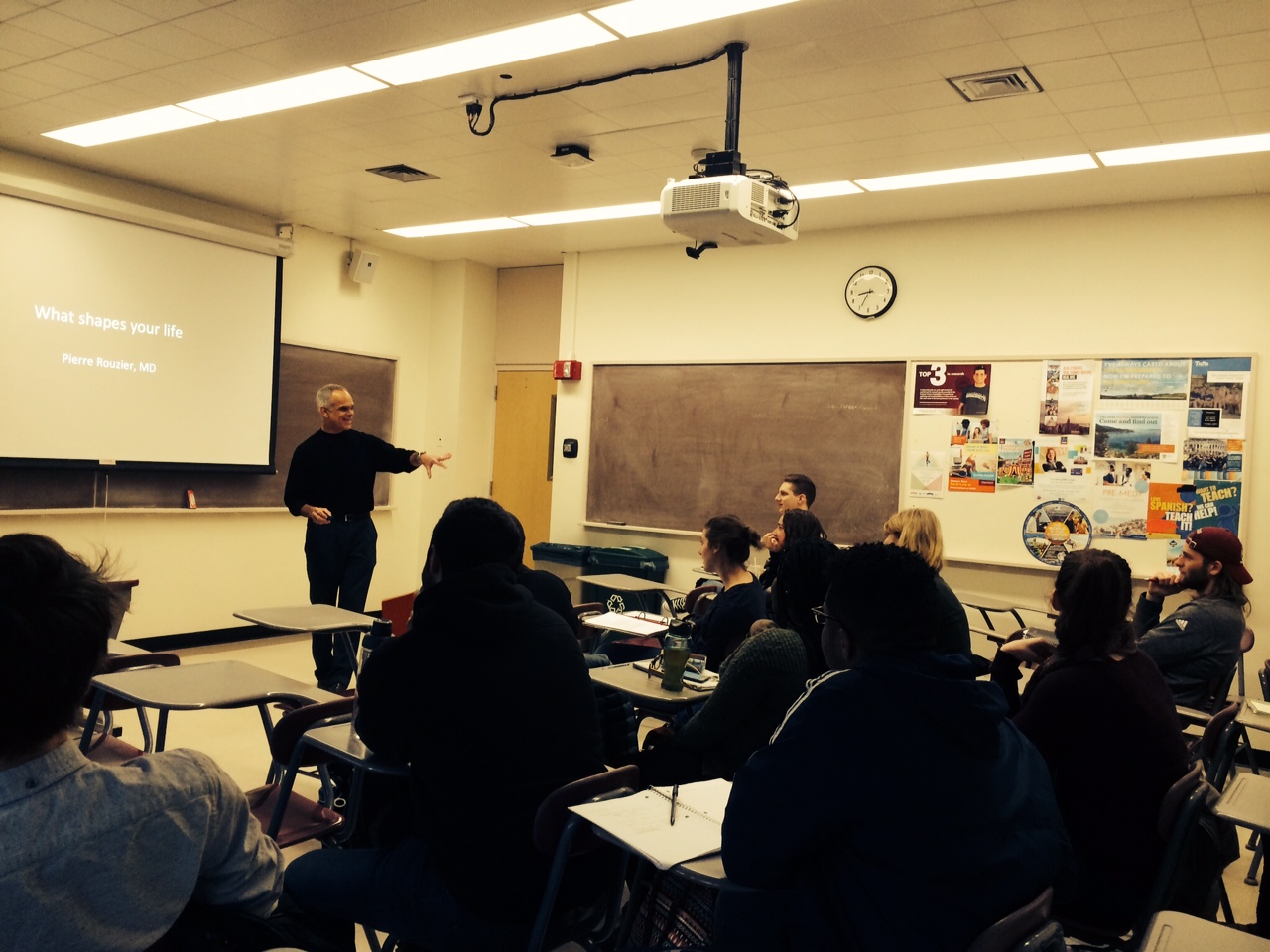
This morning, my students and I were mesmerized by the brilliant lecture of Dr. Pierre Rouzier, who spoke in my Humanitarian Logistics and Healthcare class at the Isenberg School.
Dr. Rouzier is the team physician at UMass Amherst and a doctor at our University Health Services. He is also a published author and a great humanitarian.
For many years he has also assisted in triage at the Boston Marathon, and was there at the bombing in 2013.
Dr. Rouzier's lecture was on "What Shapes Your Life?" and he spoke on life shaping events, inspiring people to move (more on this), and also finding greatness in every day.
Last summer, he with a friend, Roger Grette, bicycled across the US, while disseminating the news on his children's book, Henry Gets Moving. It was published in 2012.
He covered 4,100 miles from Oregon through Massachusetts. It took them 10 weeks to accomplish this feat and he said to us that "he had a life-changing summer and doesn't know if he even needed his life to change." Along the way he spoke to children and to adults publicizing his book, which focuses, in a warm-hearted way, on why children need to move more and to eat right. He showed us wonderful video clips of children, farmers, cowboys, and others along the way that were swept by his energy, openness, and passion for helping people and would chant: Ride, Henry, Ride! He noted that, in 1980, 7% of children ages 6 to 11 were obese and in 2008, 20% were. Clearly, children eat what is provided. He stated that the obesification of America is a big problem.
Dr. Rouzier said that he is now in the last quarter of his life and wanted to take on the challenge of biking across the US and had done a lot of reading of experiences of others who had succeeded at this challenge. During his journey, he had many instances of the sense of wonder of meeting new people, serendipitous encounters with UMass connections, praying that the sun would shine and it did and then it snowed, and finding new friends along the journey. The motto "Endure or Enjoy" from the book, "From the Atlantic to the Pacific on Two Wheels," by Alex Alvarez, served him well and continues to.
Dr. Rouzier also spoke about getting accepted at Stanford U. for his undergraduate studies but decided to go to UC Davis, due to the cost, and then went on to med school at USC because they had 13 weeks of vacation (rather than 6 as at UC Irvine) and he had fallen in love with travel (and also had a scholarship to med school). He had been a kinesiology major and had spent his junior year abroad in Edinburgh and loved it. He shared with us some of his hitchhiking stories in Europe, which were hysterical. He likes to travel OPM using "other people's money," which makes a lot of sense. While in med school he traveled to Australia, New Zealand, and Papua New Guinea, where he spent some time helping out at a healthcare facility. There he met 2 UMass Medical School Worcester graduates and ended up having his residency there. He has been at UMass Amherst since 1997 and are we lucky!
He has worked at Native American healthcare facilities, and spent 5 years in Colorado where he wrote a book, "The Sports Medicine Patient Advisor," which was inspired by a farmer who had hurt himself lifting bales of hay and could not take the time to drive a distance for physical therapy and asked him to just write the instructions down and he would follow them. Indeed, as his friend Bruce Bynum says: "The right book will set you free!"
Two of the life-changing events that he spoke about were the Haiti earthquake, which struck on January 12, 2010, and the Boston Marathon bombing, which took place April 15, 2013. We have talked about these two disasters in the Humanitarian Logistics and Healthcare class. Dr. Rouzier's father is from Haiti and he was in Haiti 9 weeks after the earthquake and was engaged in "despair medicine." At that point, many were suffering from illnesses brought about by the shock and ensuing stress. He even met a relative who lived on a hill and was one of the lucky ones.
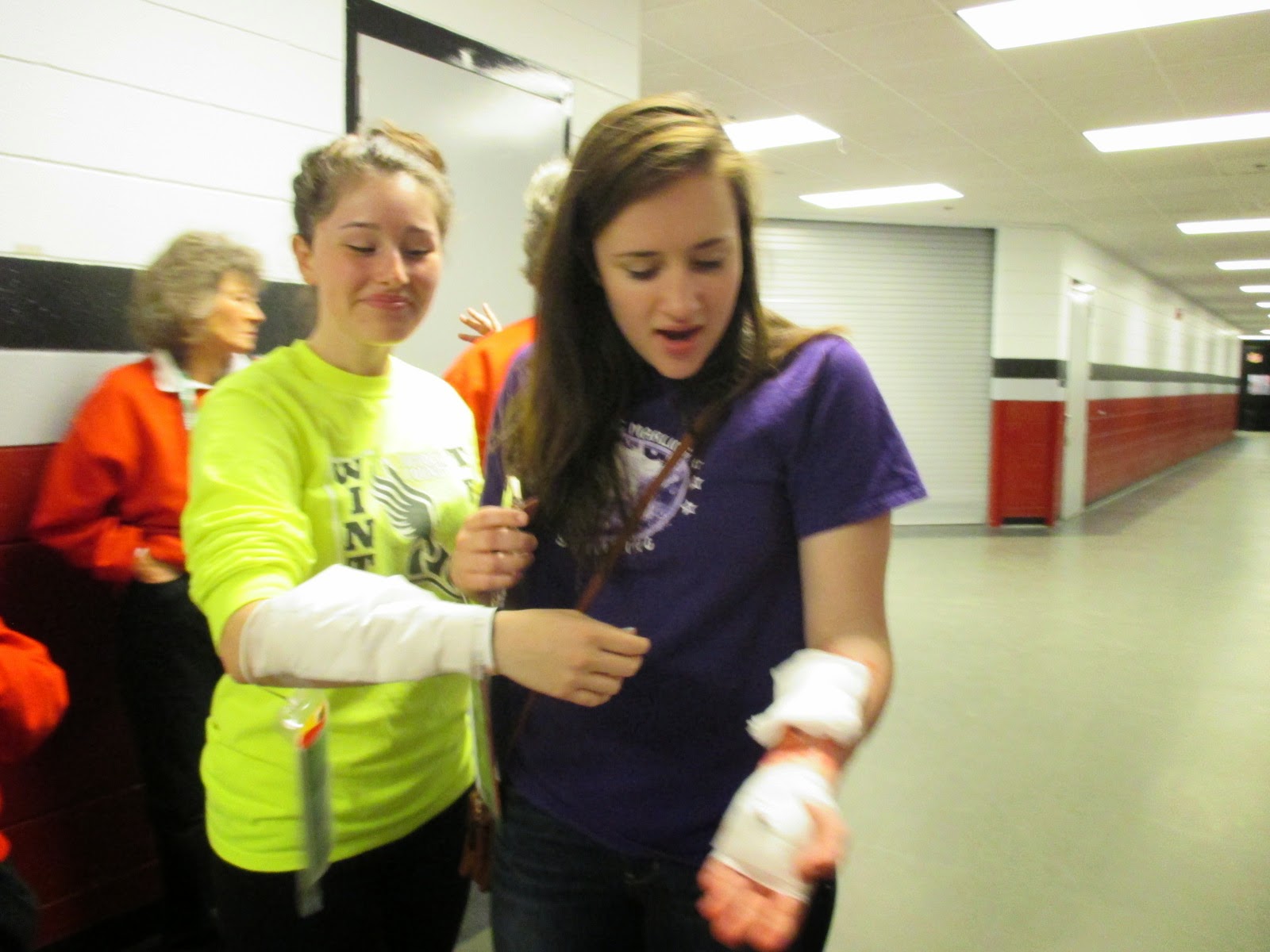
Since Dr. Rouzier is not only an athlete, and former teacher and coach, but also a sports medicine expert, he also, for many years, has assisted in triage at the Boston Marathon. He was there during the bombing and shared with us that there was blood everywhere, the smell of burning flesh, and a surreal scene. He had been accompanied by a friend, Chad, who had recently had a child. He used a belt as a tourniquet and a fence post for a splint for a broken leg. He treated a female who said: I am going to die here and noone will know where I am." He said that he did not get her name and that it bothered him and it was very hard to get closure. The marathon bicycle journey across the US last summer, I believe, helped him tremendously, and he said that while en route he received a text from one of the victims thanking him.
The healing process was assisted also by people reaching out to him, even on Facebook, and especially UMass students doing so. He said: "people like you saved me." His heroism and selflessness were so apparent throughout his brilliant lecture and we are so indebted to Dr. Pierre Rouzier for showing us what constitutes a life well lived. His nonprofit Team Henry is even helping out an orphanage in Tanzania. And, next week, Dr. Rouzier will again be assisting at the Boston Marathon.
Towards the end of his lecture today, Dr. Rouzier emphasized the power of positive thinking. He said that: "when you change the way you look at things, the things you look at change."
He told us that we need to look in the eyes of others and be nice - this is a choice that you can make. He said that "a stranger is a friend you have not yet met" and that "in every day there is something great about it."
We did not have much time for questions and answers but I wish that we had.
I presented Dr. Rouzier with a gift from the Isenberg School and also a certificate thanking him for being a terrific Professor for a Day! I then snapped a group photo of students with him as a memento of a truly inspirational and very wise lecture, with numerous life lessons.
Showing posts with label UMass. Show all posts
Thursday, April 6, 2017
Friday, March 4, 2016
Looking Forward to Speaking at MITRE on Cybersecurity
On March 14, 2016, a day that is known as "Pi Day," I will be speaking at the MITRE Corporation in Bedford, Massachusetts. The invitation came from Dr. Les Servi, who not only is an INFORMS Fellow, but he and I both received undergrad and graduate degrees in Applied Math at Brown University. I stayed on for my PhD there and Les went to Harvard for his.
The title of my talk, which I have been hard at work on, and enjoying preparing very much, is: "From Cybercrime in Financial Services to Cybersecurity Investments and Network Vulnerability."
I now have a stream of papers in cybersecurity, beginning with the paper: A Multiproduct Network Economic Model of Cybercrime in Financial Services, Anna Nagurney, Service Science 7(1): (2015) pp 70-81. The paper: A Supply Chain Game Theory Framework for Cybersecurity Investments Under Network Vulnerability, Anna Nagurney, Ladimer S. Nagurney, and Shivani Shukla, in Computation, Cryptography, and Network Security, N.J. Daras and M.T. Rassias, Editors, Springer International Publishing Switzerland (2015) pp 381-398 is our first paper examining cyber network vulnerability in a supply chain context and extends our paper, A Game Theory Model of Cybersecurity Investments with Information Asymmetry, Anna Nagurney and Ladimer S. Nagurney, Netnomics 16(1-2): (2015) pp 127-148.
Since then, we have introduced nonlinear budget constraints on cyber security investments in the paper: A Supply Chain Network Game Theory Model of Cybersecurity Investments with Nonlinear Budget Constraints, Anna Nagurney, Patrizia Daniele, and Shivani Shukla, and, with my collaborators in Italy, Professors Patrizia Daniele and Antonino Maugeri, we have co-authored the paper, Cybersecurity Investments with Nonlinear Budget Constraints: Analysis of the Marginal Expected Utilities, which is an invited paper for the volume: Operations Research, Engineering and Cyber Security: Trends in Applied Mathematics and Technology, T.M. Rassias and N.J. Daras, Editors, Springer International Publishing Switzerland.
Along with one of my doctoral students, Shivani Shukla, we have also recently revised and resubmitted a rather expansive paper: Multifirm Models of Cybersecurity Investment Competition vs. Cooperation and Network Vulnerability, in which we explore distinct concepts of Nash Equilibrium, Nash Bargaining, and System-Optimization for cybersecurity investments, and describe three case studies to the retail, financial services, and energy sectors, respectively.
In my MITRE presentation, I will focus on both the Service Science paper, and our most recent work, but will also highlight results for our supply chain game theory and cybersecurity investments models.
And, speaking of reciprocity, I am delighted that Dr. Les Servi will be speaking at the Isenberg School of Management on March 25 and the topic will also be cuybersecurity. The wonderful UMass Amherst INFORMS Student Chapter President and students prepared the nice poster announcement for his talk below.
This month will certainly be an exciting one!
The title of my talk, which I have been hard at work on, and enjoying preparing very much, is: "From Cybercrime in Financial Services to Cybersecurity Investments and Network Vulnerability."
I now have a stream of papers in cybersecurity, beginning with the paper: A Multiproduct Network Economic Model of Cybercrime in Financial Services, Anna Nagurney, Service Science 7(1): (2015) pp 70-81. The paper: A Supply Chain Game Theory Framework for Cybersecurity Investments Under Network Vulnerability, Anna Nagurney, Ladimer S. Nagurney, and Shivani Shukla, in Computation, Cryptography, and Network Security, N.J. Daras and M.T. Rassias, Editors, Springer International Publishing Switzerland (2015) pp 381-398 is our first paper examining cyber network vulnerability in a supply chain context and extends our paper, A Game Theory Model of Cybersecurity Investments with Information Asymmetry, Anna Nagurney and Ladimer S. Nagurney, Netnomics 16(1-2): (2015) pp 127-148.
Since then, we have introduced nonlinear budget constraints on cyber security investments in the paper: A Supply Chain Network Game Theory Model of Cybersecurity Investments with Nonlinear Budget Constraints, Anna Nagurney, Patrizia Daniele, and Shivani Shukla, and, with my collaborators in Italy, Professors Patrizia Daniele and Antonino Maugeri, we have co-authored the paper, Cybersecurity Investments with Nonlinear Budget Constraints: Analysis of the Marginal Expected Utilities, which is an invited paper for the volume: Operations Research, Engineering and Cyber Security: Trends in Applied Mathematics and Technology, T.M. Rassias and N.J. Daras, Editors, Springer International Publishing Switzerland.
Along with one of my doctoral students, Shivani Shukla, we have also recently revised and resubmitted a rather expansive paper: Multifirm Models of Cybersecurity Investment Competition vs. Cooperation and Network Vulnerability, in which we explore distinct concepts of Nash Equilibrium, Nash Bargaining, and System-Optimization for cybersecurity investments, and describe three case studies to the retail, financial services, and energy sectors, respectively.
In my MITRE presentation, I will focus on both the Service Science paper, and our most recent work, but will also highlight results for our supply chain game theory and cybersecurity investments models.
And, speaking of reciprocity, I am delighted that Dr. Les Servi will be speaking at the Isenberg School of Management on March 25 and the topic will also be cuybersecurity. The wonderful UMass Amherst INFORMS Student Chapter President and students prepared the nice poster announcement for his talk below.
Thursday, February 25, 2016
A Big Thank You to the Amherst Fire Department for Great Tour for My Humanitarian Logistics Class
This blogpost is being written to publicly thank the Amherst Fire Department and especially Chief Tim Nelson and Captain Jeff Olmstead and the EMTs for the wonderful tour of the North Amherst Fire Station this past Tuesday for my Humanitarian Logistics and Healthcare class. Our beautiful town of Amherst has two fire stations, one aging one downtown, and a newer one, but still decades old that is located on the corner of East Pleasant Street and Eastman Lane, a short trip down a hill to UMass Amherst, which is the one that we toured.
In teaching this class I host guest speakers since students need to hear from top practitioners. Having a field trip was extra special and kudos to the students who showed up bright and early at 8:30AM for the tour. Amazingly, during the 75 minute session there were no fire or ambulance calls!
Citizens turn to them in the case of flooded basements, burst pipes, power outages, illnesses, and even having cats rescued from trees (which our neighbors did and that was a day to remember), not to mention ambulance calls and, of course, fires, which happen in our community and at UMass. I remember fires caused by lit candles in a dormitory just a few years ago, for example. Our neighborhood has seen its share of ambulance runs as well.
The Amherst Fire Department also assists in calls and emergencies in several neighboring towns and is responsible for an area of about 125 square miles, if you include ambulance service. They work in 24 hour shifts with one day off, one day on, and then five days off.
The esprit de corps and camaraderie that they have for one another was evident. One of the EMTs was saying how they make dinner in a crockpot so the team members can eat when they can. They work closely with the UMass Amherst and town police and were busy even last Monday when Bernie Sanders had a rally at the Mullins Center. We even got to hear about disaster communications and that if you call 911 on a cell phone, you will reach a dispatcher in Northampton. If you call via a landline phone and use Verizon you will get the Amherst dispatcher who is, of course, better informed about locations in the community, terms, etc. When one says "campus pond" in Amherst it is the UMass pond and when one hears of the Notch, which they have to rescue hikers from who get lost or enjoyed regularly, then the local dispatcher knows this location south of downtown Amherst.
We were told that the fire department plans "for the unplanned" and are engaging more in analytics. We got to meet the "Numbers Guy," who provided us with multiple tables and facts. UMass Amherst relies on them for preparing for a spectrum of special events, which can include anything from rock concerts to major student spring parties.
The fire department team members truly care about the citizens of our town and students and are responsible for saving lives every single day.
I thank them for the tremendous work that they do and for their selflessness. Many have to work an additional 33% to cover the needs because of staff shortages.Their emphasis on having multiple skills and being efficient and responding to events and calls quickly resonated with the students and me since this is an Operations Management course. The Fire Chief has sometimes taken the fire truck for safety checks, just in case the fire truck would be needed for a call. It would be quicker to have the firetruck available than to have to drive back to the station and get it.
The Amherst Fire Department members are true Hometown Heroes and deserve more resources and support.
I am so grateful to Fire Chief Tim Nelson and to Captain Jeff Olmstead for taking the time out of their incredibly busy schedules to provide such valuable educational lessons for my students.
Plus, we even got to see the firetrucks - ladders only go up to about 7 stories and we do have some very tall buildings, especially our Tower Library at UMass. Sprinklers are essential and lifesavers we were told in such and many other buildings.
In teaching this class I host guest speakers since students need to hear from top practitioners. Having a field trip was extra special and kudos to the students who showed up bright and early at 8:30AM for the tour. Amazingly, during the 75 minute session there were no fire or ambulance calls!
We had an overview from the Chief and Captain with inputs from the EMTs.
The nearest hospital is in Northampton which is a good 20 minute drive from UMass over a bridge. Technology has expedited the ambulance driving time since the EMTs can change the traffic lights but sometimes the sensors do not work correctly because of wind or snow. The amazing work that our fire department does should be lauded. They have had only one new hire since 1976, but with a threefold increase in terms of annual calls, they clearly should be provided with more staff/support!

Citizens turn to them in the case of flooded basements, burst pipes, power outages, illnesses, and even having cats rescued from trees (which our neighbors did and that was a day to remember), not to mention ambulance calls and, of course, fires, which happen in our community and at UMass. I remember fires caused by lit candles in a dormitory just a few years ago, for example. Our neighborhood has seen its share of ambulance runs as well.
The Amherst Fire Department also assists in calls and emergencies in several neighboring towns and is responsible for an area of about 125 square miles, if you include ambulance service. They work in 24 hour shifts with one day off, one day on, and then five days off.
The esprit de corps and camaraderie that they have for one another was evident. One of the EMTs was saying how they make dinner in a crockpot so the team members can eat when they can. They work closely with the UMass Amherst and town police and were busy even last Monday when Bernie Sanders had a rally at the Mullins Center. We even got to hear about disaster communications and that if you call 911 on a cell phone, you will reach a dispatcher in Northampton. If you call via a landline phone and use Verizon you will get the Amherst dispatcher who is, of course, better informed about locations in the community, terms, etc. When one says "campus pond" in Amherst it is the UMass pond and when one hears of the Notch, which they have to rescue hikers from who get lost or enjoyed regularly, then the local dispatcher knows this location south of downtown Amherst.
We were told that the fire department plans "for the unplanned" and are engaging more in analytics. We got to meet the "Numbers Guy," who provided us with multiple tables and facts. UMass Amherst relies on them for preparing for a spectrum of special events, which can include anything from rock concerts to major student spring parties.
The fire department team members truly care about the citizens of our town and students and are responsible for saving lives every single day.
I thank them for the tremendous work that they do and for their selflessness. Many have to work an additional 33% to cover the needs because of staff shortages.Their emphasis on having multiple skills and being efficient and responding to events and calls quickly resonated with the students and me since this is an Operations Management course. The Fire Chief has sometimes taken the fire truck for safety checks, just in case the fire truck would be needed for a call. It would be quicker to have the firetruck available than to have to drive back to the station and get it.
The Amherst Fire Department members are true Hometown Heroes and deserve more resources and support.
I am so grateful to Fire Chief Tim Nelson and to Captain Jeff Olmstead for taking the time out of their incredibly busy schedules to provide such valuable educational lessons for my students.
Plus, we even got to see the firetrucks - ladders only go up to about 7 stories and we do have some very tall buildings, especially our Tower Library at UMass. Sprinklers are essential and lifesavers we were told in such and many other buildings.
Sunday, June 22, 2014
Delay Tolerant Networks - When Transportation Trumps the Internet
It has been fabulous to be back in Sweden where I am continuing my third year appointment as a Visiting Professor at the School of Business, Economics and Law at the University of Gothenburg. I arrived in Europe on May 11.
Being based in Europe for a couple of glorious weeks allows for some great conference chaining which I have been doing and have also been highlighting on this blog in several previous posts.
There has also been a North South theme to this visit since I have given talks at workshops and conferences, since my arrival, in Erice, Sicily (south), came back to Sweden (north), then ventured to Taormina, Sicily and Catania, also in Sicily (south) and onwards to Chalkidiki, Greece (south). Back in the north now in Gothenburg.
As a researcher and a very frequent flier, who also works on networks and their numerous and fascinating applications, including transportation and communications, practical, real-world experiences reinforce my research and vice versa! Plus, you acquire great stories to share with your students in classes.
Before flying to Europe, we were finishing up a paper on Delay Tolerant Networks, and, in the meantime, we have also completed another one. This is a collaboration initiated by a doctoral student in engineering, who is from Colombia, and who is visiting my Co-PI on our National Science Foundation project, Network Innovation Through Choice, Professor Tilman Wolf of the College of Engineering at UMass Amherst. The doctoral student is Luis Marentes and he sat in on my SOM 825 course this past semester on Variational Inequalities, Networks, and Game Theory.
In the beautiful parts of southern Europe - I can't resist sharing some photos of Sicily and Greece where I spoke at below, there, nevertheless, were major issues with the Internet! Even when it was up it might take as long as an hour to access an email message and, as for tweeting 140 characters, sometimes we waited for 24 hours, and the tweet was still not transferred. But we were patient and the beauty and the caliber of the conferences and people made up for the technology shortcomings. I will share a story at the end of this post.
Our work on Delay Tolerant Networks, is inspired, in part, by that of Dr. Alex "Sandy" Pentland of MIT, whom we have hosted at the Isenberg School of Management at UMass in our INFORMS Speaker Series, and whom I have interacted with on other occasions. I am a huge fan of Sandy's and was thrilled when he was ecleted to the National Academy of Engineering this year.
Pentland's paper, DakNet: Rethinking Connectivity in Developing Nations, published in Computer in 2004, speaks of connecting remote villages in India and Cambodia through a combination of wireless and asynchronous means.
When I tell people that there are parts of the globe in which residents desperately need information that we take for granted and that which we access through the Internet but they lack digital connectivity because of market and pricing forces (including poverty) and can benefit from using transportation modes (from busses to mules - I am not kidding) to secure the information, I receive expressions of shock!
In our first paper, "Overcoming Economic Challenges of Internet Operators in Low Income Regions Through a Delay Tolerant Architecture with Mechanic Backhauls," Luis Marentes, Tilman Wolf, Anna Nagurney, Yezid Donosoa, and Harold Castro, we study the following. Regions with low population densities and low income, which may be rural, are far behind in Internet access as compared to their urban counterparts. Economic unsustainable deployments have been suggested as one of the factors with high negative impact. Researchers using the Delay Tolerant Network Architecture (DTN) have established a less expensive alternative, but they do not provide guidelines on how to price the new possible services nor any indication as to operators’ profitability. These two points are the contributions of this paper. Based on a continuous pricing model, we show that projects using the DTN architecture have a positive net present value using real demand data.
In this paper, we also explore how far the use of this technology is going to help in attaining profitable deployments with real and delay tolerant services. Our findings indicate that although it is not possible to support the investment reported in a previous actual deployment, a great portion of the investment is actually covered by the predicted gross profit of our model. We hypothesize that the remaining value is affordable if service differentiation is enabled by means of a new architecture. Three components to test the hypothesis are introduced: (1) the pricing elements to form service level agreements, (2) a general overview of the architecture requirements, and (3) a novel pricing model. In this regard, our results show a positive effect of service differentiation which improves profits by 10% without any customer additional payment.
In our second paper, "Towards Pricing Mechanisms for Delay Tolerant Services," Luis Marentes, Tilman Wolf, Anna Nagurney, and Yezid Donoso, we again note that one of the applications of the Delay Tolerant Architecture (DTN) is rural networks. For this application researchers have argued benefits on lowering costs and overcoming challenging conditions under which, for instance, protocols such as TCP/IP cannot work because their underlying requisites are not satisfied. New responses are required in order to understand the true adoption opportunities of this technology. Constraints in service level agreements and viable alternative pricing schemes are some of the new issues that arise as a consequence of the particular operation mode.
In this paper, we propose a novel model for pricing delay tolerant services, which adjusts prices to demand variability subject to constraints imposed by the DTN operation. With this model we also show how important parameters such as channel rental costs, cycle times of providers, and market sensitivities affect business opportunities of operators.
In both of these papers, the consumers respond to the average time of the delivery of the services, which could consist of a combination of communication and transport modes!
As for our journeys in southern Europe, we ended up, in Chalkidiki, Greece taking the ferry to the neighboring town of Marmara (transport) and back to seek a decent WiFi connection.
And we were successful. Decent WiFi was found at a restaurant at which we also had a fabulous meal - it was so good that I blew kisses to the cooks and then they surprised us with a tray of fresh cherries and exotic, delicious Greek desserts!
We then, the next day, explored another mode of transport to access the Internet - we walked rather than taking the ferry to Marmara and it took us about the same amount of time - plus the beach views were glorious. And for those news junkies there, we even found a small shop where we purchased the same day edition of The International New York Times, which was printed in Greece. The owner is British.
Being based in Europe for a couple of glorious weeks allows for some great conference chaining which I have been doing and have also been highlighting on this blog in several previous posts.
There has also been a North South theme to this visit since I have given talks at workshops and conferences, since my arrival, in Erice, Sicily (south), came back to Sweden (north), then ventured to Taormina, Sicily and Catania, also in Sicily (south) and onwards to Chalkidiki, Greece (south). Back in the north now in Gothenburg.
As a researcher and a very frequent flier, who also works on networks and their numerous and fascinating applications, including transportation and communications, practical, real-world experiences reinforce my research and vice versa! Plus, you acquire great stories to share with your students in classes.
Before flying to Europe, we were finishing up a paper on Delay Tolerant Networks, and, in the meantime, we have also completed another one. This is a collaboration initiated by a doctoral student in engineering, who is from Colombia, and who is visiting my Co-PI on our National Science Foundation project, Network Innovation Through Choice, Professor Tilman Wolf of the College of Engineering at UMass Amherst. The doctoral student is Luis Marentes and he sat in on my SOM 825 course this past semester on Variational Inequalities, Networks, and Game Theory.
In the beautiful parts of southern Europe - I can't resist sharing some photos of Sicily and Greece where I spoke at below, there, nevertheless, were major issues with the Internet! Even when it was up it might take as long as an hour to access an email message and, as for tweeting 140 characters, sometimes we waited for 24 hours, and the tweet was still not transferred. But we were patient and the beauty and the caliber of the conferences and people made up for the technology shortcomings. I will share a story at the end of this post.
Our work on Delay Tolerant Networks, is inspired, in part, by that of Dr. Alex "Sandy" Pentland of MIT, whom we have hosted at the Isenberg School of Management at UMass in our INFORMS Speaker Series, and whom I have interacted with on other occasions. I am a huge fan of Sandy's and was thrilled when he was ecleted to the National Academy of Engineering this year.
Pentland's paper, DakNet: Rethinking Connectivity in Developing Nations, published in Computer in 2004, speaks of connecting remote villages in India and Cambodia through a combination of wireless and asynchronous means.
When I tell people that there are parts of the globe in which residents desperately need information that we take for granted and that which we access through the Internet but they lack digital connectivity because of market and pricing forces (including poverty) and can benefit from using transportation modes (from busses to mules - I am not kidding) to secure the information, I receive expressions of shock!
In our first paper, "Overcoming Economic Challenges of Internet Operators in Low Income Regions Through a Delay Tolerant Architecture with Mechanic Backhauls," Luis Marentes, Tilman Wolf, Anna Nagurney, Yezid Donosoa, and Harold Castro, we study the following. Regions with low population densities and low income, which may be rural, are far behind in Internet access as compared to their urban counterparts. Economic unsustainable deployments have been suggested as one of the factors with high negative impact. Researchers using the Delay Tolerant Network Architecture (DTN) have established a less expensive alternative, but they do not provide guidelines on how to price the new possible services nor any indication as to operators’ profitability. These two points are the contributions of this paper. Based on a continuous pricing model, we show that projects using the DTN architecture have a positive net present value using real demand data.
In this paper, we also explore how far the use of this technology is going to help in attaining profitable deployments with real and delay tolerant services. Our findings indicate that although it is not possible to support the investment reported in a previous actual deployment, a great portion of the investment is actually covered by the predicted gross profit of our model. We hypothesize that the remaining value is affordable if service differentiation is enabled by means of a new architecture. Three components to test the hypothesis are introduced: (1) the pricing elements to form service level agreements, (2) a general overview of the architecture requirements, and (3) a novel pricing model. In this regard, our results show a positive effect of service differentiation which improves profits by 10% without any customer additional payment.
In our second paper, "Towards Pricing Mechanisms for Delay Tolerant Services," Luis Marentes, Tilman Wolf, Anna Nagurney, and Yezid Donoso, we again note that one of the applications of the Delay Tolerant Architecture (DTN) is rural networks. For this application researchers have argued benefits on lowering costs and overcoming challenging conditions under which, for instance, protocols such as TCP/IP cannot work because their underlying requisites are not satisfied. New responses are required in order to understand the true adoption opportunities of this technology. Constraints in service level agreements and viable alternative pricing schemes are some of the new issues that arise as a consequence of the particular operation mode.
In this paper, we propose a novel model for pricing delay tolerant services, which adjusts prices to demand variability subject to constraints imposed by the DTN operation. With this model we also show how important parameters such as channel rental costs, cycle times of providers, and market sensitivities affect business opportunities of operators.
In both of these papers, the consumers respond to the average time of the delivery of the services, which could consist of a combination of communication and transport modes!
As for our journeys in southern Europe, we ended up, in Chalkidiki, Greece taking the ferry to the neighboring town of Marmara (transport) and back to seek a decent WiFi connection.
And we were successful. Decent WiFi was found at a restaurant at which we also had a fabulous meal - it was so good that I blew kisses to the cooks and then they surprised us with a tray of fresh cherries and exotic, delicious Greek desserts!
We then, the next day, explored another mode of transport to access the Internet - we walked rather than taking the ferry to Marmara and it took us about the same amount of time - plus the beach views were glorious. And for those news junkies there, we even found a small shop where we purchased the same day edition of The International New York Times, which was printed in Greece. The owner is British.
Labels:
DakNet,
game theory,
Greece,
Internet,
Internet problems,
Isenberg School of Management,
Network Innovation Through Choice,
networks,
NSF,
pricing,
rural regions,
Sandy Pentland,
Sicily,
transportation,
UMass
Friday, April 11, 2014
Photos from Emergency Sheltering Exercise and the Best of Town and Gown
Yesterday, several students from the Isenberg School of Management spent the late afternoon with me at the Mullins Center in Amherst where an emergency sheltering exercise was being conducted involving hundreds of volunteers, including many students (kudos to nursing and others), and multiple organizations such as UMass Amherst and the Medical Reserve Corps of Hampshire County.
Some of my students are overnighting there on cots to learn from the experience and since they work as interns in emergency preparedness or have been fire fighters. We were especially interested in this well-timed major emergency preparedness exercise since I am teaching a course this semester at the Isenberg School on Humanitarian Logistics and Healthcare. Mr. Jeff Hescock, who was one of five guest lecturers in my class, and who is the Director of UMass Emergency Management and Business Continuity was one of the leaders of this fascinating sheltering exercise.
The Mullins Center is usually the venue for basketball and hockey games as well as major entertainment events and to see it transformed into a shelter that could serve as a refuge after a natural disaster, such as a tornado or winter storm (and we have had our share of these as I have written about many times on this blog and in various OpEds).
Two of my students and I, along with town officials, such as our Town Manager, John Musante, and our Fire Chief (it was great to see them both and my students were impressed), received a grand tour from an Amherst Public health official who was wonderful.
The photos that I took at this special community event that I have posted here illustrate the scope of planning involved. The setup began at 1PM with the shelter opening at 3PM to simulate a real-life sheltering response to a natural disaster. Since those who are being sheltered become a society for a time period safety and rules are important.
There were registration desks upon entry and those who had volunteered to be "victims" had tags given to them describing their injuries which were made to look quite authentic.
The Mullins Center had an area with cots, an area for dining, and the menu looked quite great.
Since showers are located there, it is an excellent facility for an emergency shelter and it has such a large space. There were rooms for additional medical treatment and for emotional support. We also saw an ambulance inside with a very realistic victim lying on a stretcher which added to us seeing the scale and magnitude of sheltering (and planning involved),
This emergency sheltering exercise involved not only adults but also children as well as animals and the attention to detail was truly remarkable. Children had their own area which was supplied with books, activities, and toys.
Cats were separated from dogs, who were in crates and there was an exercise area for the latter and a radio was playing for the former. We were escorted by Ms. Carol Hepburn, who is Amherst's Animal Control Officer and a legend. She used to visit our neighborhood quite often back in the day.
There was also an area for exotic animals including the dragon in the above photo. An exercise area for animals was constructed outside of the Mullins Center featured in the photo below.
We spoke with a variety of the volunteers from organizations such as the Red Cross and the Medical Reserve Corps as well as the animal care individuals who came with their trucks from central MA and from the Berkshire area.
There were even dogs to assist those who needed emotional assistance and reassurance. The adorable, huge Newfoundlander came with his owner and handler from Rhode Island.
I look forward to hearing from a student later today on how the overnight experience went. He had packed up a big sleeping bag with a pillow and snacks and was prepared. The Medical Reserve Corps also had, for distribution, backpacks with First Aid kits, flashlights and a formd in a folder on which one could write critical information to keep handy.
I congratulate all involved on this very important exercise which demonstrates the best of town and gown cooperation!
Some of my students are overnighting there on cots to learn from the experience and since they work as interns in emergency preparedness or have been fire fighters. We were especially interested in this well-timed major emergency preparedness exercise since I am teaching a course this semester at the Isenberg School on Humanitarian Logistics and Healthcare. Mr. Jeff Hescock, who was one of five guest lecturers in my class, and who is the Director of UMass Emergency Management and Business Continuity was one of the leaders of this fascinating sheltering exercise.
The Mullins Center is usually the venue for basketball and hockey games as well as major entertainment events and to see it transformed into a shelter that could serve as a refuge after a natural disaster, such as a tornado or winter storm (and we have had our share of these as I have written about many times on this blog and in various OpEds).
Two of my students and I, along with town officials, such as our Town Manager, John Musante, and our Fire Chief (it was great to see them both and my students were impressed), received a grand tour from an Amherst Public health official who was wonderful.
The photos that I took at this special community event that I have posted here illustrate the scope of planning involved. The setup began at 1PM with the shelter opening at 3PM to simulate a real-life sheltering response to a natural disaster. Since those who are being sheltered become a society for a time period safety and rules are important.
There were registration desks upon entry and those who had volunteered to be "victims" had tags given to them describing their injuries which were made to look quite authentic.
The Mullins Center had an area with cots, an area for dining, and the menu looked quite great.
Since showers are located there, it is an excellent facility for an emergency shelter and it has such a large space. There were rooms for additional medical treatment and for emotional support. We also saw an ambulance inside with a very realistic victim lying on a stretcher which added to us seeing the scale and magnitude of sheltering (and planning involved),
This emergency sheltering exercise involved not only adults but also children as well as animals and the attention to detail was truly remarkable. Children had their own area which was supplied with books, activities, and toys.
Cats were separated from dogs, who were in crates and there was an exercise area for the latter and a radio was playing for the former. We were escorted by Ms. Carol Hepburn, who is Amherst's Animal Control Officer and a legend. She used to visit our neighborhood quite often back in the day.
There was also an area for exotic animals including the dragon in the above photo. An exercise area for animals was constructed outside of the Mullins Center featured in the photo below.
We spoke with a variety of the volunteers from organizations such as the Red Cross and the Medical Reserve Corps as well as the animal care individuals who came with their trucks from central MA and from the Berkshire area.
There were even dogs to assist those who needed emotional assistance and reassurance. The adorable, huge Newfoundlander came with his owner and handler from Rhode Island.
I look forward to hearing from a student later today on how the overnight experience went. He had packed up a big sleeping bag with a pillow and snacks and was prepared. The Medical Reserve Corps also had, for distribution, backpacks with First Aid kits, flashlights and a formd in a folder on which one could write critical information to keep handy.
I congratulate all involved on this very important exercise which demonstrates the best of town and gown cooperation!
Wednesday, March 5, 2014
UMass Amherst INFORMS Student Chapter Presents Panel on Teaching
This semester I have been very busy teaching my course on Humanitarian Logistics and Healthcare and a Management Science seminar on Variational Inequalities, Networks, and Game Theory. Both of these courses are interdisciplinary with students from the Isenberg School of Management, the College of Engineering, the School of Public Health, and the Computer Science Department.
In a recent exchange with the President and CEO of the America Red Cross, Ms. Gail McGovern (we were communicating about the great guest lecture of Mr. Rick Lee in my course), she said many things that resonated with me but the below was especially beautiful:
Having come straight from teaching MBAs to the Red Cross, I know firsthand that yours is such a noble profession. I still keep in touch with many of my students, and I'm proud of every one of their accomplishments. It's truly the gift that keeps on giving.
How very true!
And, this Friday, our great UMass Amherst INFORMS Student Chapter will be hosting a special panel on teaching in which our very own PhD students in Management Science will be sharing their experiences with a lot of exciting Q&A and discussions I am sure.
Refreshments are at 11:00AM with the panel and discussion from 11:30-12:30 in Isenberg Room 128.
Please join us if you can.
The students prepared the poster below. In this day and age, we need to all also be graphic artists.
Some very valuable teaching also takes place outside of the classroom!
In a recent exchange with the President and CEO of the America Red Cross, Ms. Gail McGovern (we were communicating about the great guest lecture of Mr. Rick Lee in my course), she said many things that resonated with me but the below was especially beautiful:
Having come straight from teaching MBAs to the Red Cross, I know firsthand that yours is such a noble profession. I still keep in touch with many of my students, and I'm proud of every one of their accomplishments. It's truly the gift that keeps on giving.
How very true!
And, this Friday, our great UMass Amherst INFORMS Student Chapter will be hosting a special panel on teaching in which our very own PhD students in Management Science will be sharing their experiences with a lot of exciting Q&A and discussions I am sure.
Refreshments are at 11:00AM with the panel and discussion from 11:30-12:30 in Isenberg Room 128.
Please join us if you can.
The students prepared the poster below. In this day and age, we need to all also be graphic artists.
Some very valuable teaching also takes place outside of the classroom!
Friday, February 21, 2014
A Truly Inspiring Lecture by Mr. Rick Lee of the Red Cross at the Isenberg School
Yesterday, we had the distinct honor and privilege of hearing from Mr. Rick Lee, the Executive Director of the American Red Cross, Pioneer Valley Chapter. He was a guest lecturer in the Humanitarian Logistics and Healthcare course that I am teaching this semester at the Isenberg School of Management.
Mr. Lee oversees 38 employees and 1,000 volunteers and was instrumental in the development of the Service to the Armed Forces (SAF) program with a focus on communications.
We heard about Henri Dunant, the Swiss businessman, who led what became the international Red Cross movement in the mid 1800s, received a Nobel Peace Prize, but then lost his business and died as a penniless hermit in Switzerland. Mr. Lee spoke about the Geneva Convention and how it is imperative to inject humanity in the inhumane act of war. He also spoke about the amazing Clara Barton, all 5 feet and 90 pounds of her, who, after a trip to Switzerland, realized what needed to be done and, through her incredible leadership abilities, founded the American Red Cross. She did so in 1881 at age 60 and continued to lead it for 23 years!
The foundation of the Red Cross is trust and ethics and contact with donors and volunteers. The provisioning of food, shelter, evaluation of how bad it is, and communications to the public, are all aspects of Red Cross activities in disaster relief. Mr. Lee also emphasized that disaster relief is "a team sport." Interestingly, he also said that there is emphasis now on mitigation, as well.
We heard of the lessons learned from Hurricane Katrina and the need to understand different community groups and their roles as well as the great importance of communications with stakeholders.
We were very surprised to learn that since the Red Cross depends on financial donations, that if these were to stop, the Red Cross would shut down in only 180 days! My former doctoral students, who are now very successful international professors, Dr. Tina Wakolbinger and Dr. Fuminori Toyasaki, have done research on the modeling of financial flow of funds for disaster relief and the earmarking of donations.
We also heard about the tremendous role that the Red Cross played in sheltering and feeding hundreds of people for a month after the tornado hit Springfield, MA on June 1, 2011. He also emphasized how helpful private organizations are and can be in disaster relief by providing discounts for much-needed supplies, warehousing between disasters, and helping with deliveries. He singled out Walmart and Big-Y supermarkets and even noted hotels and motels who provide discounts for sheltering purposes.
He also emphasized the importance of buying locally and the importance of building relationships over time so that, when disasters strike, one is ready. He even told us of free mobile apps for first aid and emergency preparedness offered by the Red Cross, including earthquake and tornado warning apps.
What is the power of one person? Clara Barton changed the world and over a century before the Internet. her impact continues to this day.
Mr. Lee, your presentation changed all of us. Thank you for being the heart and soul of our American Red Cross and our Hometown Hero!
Mr. Lee oversees 38 employees and 1,000 volunteers and was instrumental in the development of the Service to the Armed Forces (SAF) program with a focus on communications.
We heard about Henri Dunant, the Swiss businessman, who led what became the international Red Cross movement in the mid 1800s, received a Nobel Peace Prize, but then lost his business and died as a penniless hermit in Switzerland. Mr. Lee spoke about the Geneva Convention and how it is imperative to inject humanity in the inhumane act of war. He also spoke about the amazing Clara Barton, all 5 feet and 90 pounds of her, who, after a trip to Switzerland, realized what needed to be done and, through her incredible leadership abilities, founded the American Red Cross. She did so in 1881 at age 60 and continued to lead it for 23 years!
The foundation of the Red Cross is trust and ethics and contact with donors and volunteers. The provisioning of food, shelter, evaluation of how bad it is, and communications to the public, are all aspects of Red Cross activities in disaster relief. Mr. Lee also emphasized that disaster relief is "a team sport." Interestingly, he also said that there is emphasis now on mitigation, as well.
We heard of the lessons learned from Hurricane Katrina and the need to understand different community groups and their roles as well as the great importance of communications with stakeholders.
We were very surprised to learn that since the Red Cross depends on financial donations, that if these were to stop, the Red Cross would shut down in only 180 days! My former doctoral students, who are now very successful international professors, Dr. Tina Wakolbinger and Dr. Fuminori Toyasaki, have done research on the modeling of financial flow of funds for disaster relief and the earmarking of donations.
We also heard about the tremendous role that the Red Cross played in sheltering and feeding hundreds of people for a month after the tornado hit Springfield, MA on June 1, 2011. He also emphasized how helpful private organizations are and can be in disaster relief by providing discounts for much-needed supplies, warehousing between disasters, and helping with deliveries. He singled out Walmart and Big-Y supermarkets and even noted hotels and motels who provide discounts for sheltering purposes.
He also emphasized the importance of buying locally and the importance of building relationships over time so that, when disasters strike, one is ready. He even told us of free mobile apps for first aid and emergency preparedness offered by the Red Cross, including earthquake and tornado warning apps.
What is the power of one person? Clara Barton changed the world and over a century before the Internet. her impact continues to this day.
Mr. Lee, your presentation changed all of us. Thank you for being the heart and soul of our American Red Cross and our Hometown Hero!
Wednesday, January 29, 2014
Logistics Behind Scheduling Speakers for My Humanitarian Logistics Class
Having speakers come to campus is always a highlight and I have written a blogpost on "Tips for Organizing a Successful Speaker Series," which is one of my most popular ones.
Guest speakers also add tremendous value to a course!
This semester, I am offering, for the second time at UMass Amherst, a course on Humanitarian Logistics and Healthcare, with the syllabus available here. The course has attracted students from the Isenberg School of Management, the School of Public Health, and the College of Engineering. One of the highlights of the course is the speakers that come to share their experiences with our students.
But, of course, scheduling speakers is a logistical exercise, because not only is it important to have them come when it makes sense in the course curriculum, but also practitioners in the space of disaster preparedness and emergency response are very busy people!
I am absolutely delighted that, in February, the students in my class will have the opportunity to hear from 4 experts: the new Director of Emergency Preparedness and Business Continuity at UMass Amherst, the Executive Director of the Red Cross of the Pioneer Valley, a renowned doctor from the University Health Services who has done relief work in Haiti, post the devastating earthquake, and also saved lives at the Boston Marathon bombing on April 15, 2013, as well as a top TV anchor from western Massachusetts!
The positive response to my invitations has been overwhelming and the speakers have agreed, despite scheduled surgeries, and other professional and personal obligations, to share their knowledge and wisdom with students.
One of my greatest challenges in terms of bringing speakers together (all at the same time) was the Humanitarian Logistics: Networks for Africa Workshop that I organized on behalf of the Rockefeller Foundation's Bellagio Center program back in May 2008. This workshop, which took place at the Rockefeller Foundation's Bellagio Center on Lake Como in Italy, was (unplanned) situated between two major disasters: Cyclone Nargis that hit Myanmar/Burma and the Sichuan earthquake in China.
This workshop was one of the most stimulating workshops that I have had the honor to be part of with experts from academia (from 3 continents), practitioners from the UN and CSIRO, and humanitarian logisticians with amazing experiences from the field! My final report on the workshop to the Rockefeller Foundation is available here.
I will be sharing what we learn from the outstanding speakers in my Humanitarian Logistics and Healthcare class. At this point, I want to acknowledge them and to thank them for taking the time out of their extremely busy schedules to come to the Isenberg School to share their vast knowledge and experiences on various aspects of emergency preparedness and response.
I asked my students yesterday the question: "Whom Have You Helped?" and told them that one of the themes of the professional society INFORMS (Institute for Operations Research and the Management Sciences) that I belong to and have benefited from greatly is Doing Good with Good O.R. (Operations Research).
A great question to answer and live by every day: "Whom Have You Helped?"
Guest speakers also add tremendous value to a course!
This semester, I am offering, for the second time at UMass Amherst, a course on Humanitarian Logistics and Healthcare, with the syllabus available here. The course has attracted students from the Isenberg School of Management, the School of Public Health, and the College of Engineering. One of the highlights of the course is the speakers that come to share their experiences with our students.
But, of course, scheduling speakers is a logistical exercise, because not only is it important to have them come when it makes sense in the course curriculum, but also practitioners in the space of disaster preparedness and emergency response are very busy people!
I am absolutely delighted that, in February, the students in my class will have the opportunity to hear from 4 experts: the new Director of Emergency Preparedness and Business Continuity at UMass Amherst, the Executive Director of the Red Cross of the Pioneer Valley, a renowned doctor from the University Health Services who has done relief work in Haiti, post the devastating earthquake, and also saved lives at the Boston Marathon bombing on April 15, 2013, as well as a top TV anchor from western Massachusetts!
The positive response to my invitations has been overwhelming and the speakers have agreed, despite scheduled surgeries, and other professional and personal obligations, to share their knowledge and wisdom with students.
One of my greatest challenges in terms of bringing speakers together (all at the same time) was the Humanitarian Logistics: Networks for Africa Workshop that I organized on behalf of the Rockefeller Foundation's Bellagio Center program back in May 2008. This workshop, which took place at the Rockefeller Foundation's Bellagio Center on Lake Como in Italy, was (unplanned) situated between two major disasters: Cyclone Nargis that hit Myanmar/Burma and the Sichuan earthquake in China.
This workshop was one of the most stimulating workshops that I have had the honor to be part of with experts from academia (from 3 continents), practitioners from the UN and CSIRO, and humanitarian logisticians with amazing experiences from the field! My final report on the workshop to the Rockefeller Foundation is available here.
I will be sharing what we learn from the outstanding speakers in my Humanitarian Logistics and Healthcare class. At this point, I want to acknowledge them and to thank them for taking the time out of their extremely busy schedules to come to the Isenberg School to share their vast knowledge and experiences on various aspects of emergency preparedness and response.
I asked my students yesterday the question: "Whom Have You Helped?" and told them that one of the themes of the professional society INFORMS (Institute for Operations Research and the Management Sciences) that I belong to and have benefited from greatly is Doing Good with Good O.R. (Operations Research).
A great question to answer and live by every day: "Whom Have You Helped?"
Sunday, November 4, 2012
UMass to Celebrate 150 Years and President Caret's Great OpEd on Its Mission
One needs to write and to communicate by speaking out.
As a professor and educator, I try to do my part by writing journal articles, books, and even OpEd pieces to reach a broader audience.
I also blog because many students and colleagues urged me to do so over three years ago.
And when the opportunity presents itself, and, I am available, I enjoy talking with the media.
It is important to recognize what is going well, what needs improvement, and to celebrate when there are achievements and to propose solutions and take actions, where and when these are needed.
Books, as we know, can change the world, and will live longer than any of us -- the same holds for great discoveries and works of art and music.
Dr. Robert Caret, the relatively new President of the UMass system, wrote a wonderful OpEd,
Viewpoint: UMass remains on mission 150 years later, in which he states: Here in Massachusetts, the passage of the Morrill Land Grant Act led to the founding of the Massachusetts Agricultural College in 1863. The college, established on the principle that science and research could be used to improve the overall quality of life, was built around a curriculum of farming, science, technical courses and liberal arts.
Robert L. Caret (masslive.com)
What would become the University of Massachusetts has grown, but its original mission of transformation remains unchanged.
He goes on to note some of our recent successes, 150 years after, with the Permaculture Garden, which was recognized even by President Obama, to our Green High-Performance Computing Center.
He also emphasized accessibility and affordability and, given the international competition of college admissions today and the student debt crisis, I could not agree more!
President Caret has traveled on a bus throughout our state of Massachusetts, meeting with many stakeholders.
Recently, I was interviewed by our new Vice Chancellor for University Relations, John Kennedy, about my experiences as a UMass Amherst chaired professor, the John F. Smith Memorial Professor. The videographers traveled from Boston for the videotaping and one of them was a UMass Amherst grad. I must admit, though, that I thought it rather funny when one of them kept on powdering my face, which I had never had happen in either TV shoots or other videotaping sessions. I guess that day I glowed too much (or was it because I had just flown back from Sweden 2 days prior where I had spent a month as part of my sabbatical). I was excited to talk about UMass Amherst and my experiences. I spoke about how many multiple generations of UMass graduates there are and how many of my students tell me that they were happiest when they were students at UMass Amherst -- and, amongst these I include, several top-level executives.
Of course, I also talked about what makes the Isenberg School of Management great.
I also noted Jack Smith, a former CEO of General Motors, who had endowed the chaired professorship that I hold in honor of his father who was also a UMass Amherst alum, from the Stockbridge School of Agriculture. Jack Smith Jr. had received a degree in Operations Management from my business school and is an outstanding example of the difference that UMass Amherst grads have made in the corporate arena.
Thank you, President Caret, for speaking out about the heritage of UMass, which is alive today, and noting that: One hundred fifty years ago, during the darkest days of the Civil War, a single piece of legislation forever changed the landscape of higher education in the United States. Introduced by Vermont Congressman Justin Smith Morrill, it sought to create a national system of public higher education to ensure that a college degree would be available to many and not just be the province of a few.
Here in Massachusetts, the passage of the Morrill Land Grant Act led to the founding of the Massachusetts Agricultural College in 1863.
And, indeed, science and research should be used and is being used to improve the overall quality of life!
As a professor and educator, I try to do my part by writing journal articles, books, and even OpEd pieces to reach a broader audience.
I also blog because many students and colleagues urged me to do so over three years ago.
And when the opportunity presents itself, and, I am available, I enjoy talking with the media.
It is important to recognize what is going well, what needs improvement, and to celebrate when there are achievements and to propose solutions and take actions, where and when these are needed.
Books, as we know, can change the world, and will live longer than any of us -- the same holds for great discoveries and works of art and music.
Dr. Robert Caret, the relatively new President of the UMass system, wrote a wonderful OpEd,
Viewpoint: UMass remains on mission 150 years later, in which he states: Here in Massachusetts, the passage of the Morrill Land Grant Act led to the founding of the Massachusetts Agricultural College in 1863. The college, established on the principle that science and research could be used to improve the overall quality of life, was built around a curriculum of farming, science, technical courses and liberal arts.
Robert L. Caret (masslive.com)
He goes on to note some of our recent successes, 150 years after, with the Permaculture Garden, which was recognized even by President Obama, to our Green High-Performance Computing Center.
He also emphasized accessibility and affordability and, given the international competition of college admissions today and the student debt crisis, I could not agree more!
President Caret has traveled on a bus throughout our state of Massachusetts, meeting with many stakeholders.
Recently, I was interviewed by our new Vice Chancellor for University Relations, John Kennedy, about my experiences as a UMass Amherst chaired professor, the John F. Smith Memorial Professor. The videographers traveled from Boston for the videotaping and one of them was a UMass Amherst grad. I must admit, though, that I thought it rather funny when one of them kept on powdering my face, which I had never had happen in either TV shoots or other videotaping sessions. I guess that day I glowed too much (or was it because I had just flown back from Sweden 2 days prior where I had spent a month as part of my sabbatical). I was excited to talk about UMass Amherst and my experiences. I spoke about how many multiple generations of UMass graduates there are and how many of my students tell me that they were happiest when they were students at UMass Amherst -- and, amongst these I include, several top-level executives.
Of course, I also talked about what makes the Isenberg School of Management great.
I also noted Jack Smith, a former CEO of General Motors, who had endowed the chaired professorship that I hold in honor of his father who was also a UMass Amherst alum, from the Stockbridge School of Agriculture. Jack Smith Jr. had received a degree in Operations Management from my business school and is an outstanding example of the difference that UMass Amherst grads have made in the corporate arena.
Thank you, President Caret, for speaking out about the heritage of UMass, which is alive today, and noting that: One hundred fifty years ago, during the darkest days of the Civil War, a single piece of legislation forever changed the landscape of higher education in the United States. Introduced by Vermont Congressman Justin Smith Morrill, it sought to create a national system of public higher education to ensure that a college degree would be available to many and not just be the province of a few.
Here in Massachusetts, the passage of the Morrill Land Grant Act led to the founding of the Massachusetts Agricultural College in 1863.
And, indeed, science and research should be used and is being used to improve the overall quality of life!
Subscribe to:
Posts (Atom)