Showing posts with label Transportation and Logistics. Show all posts

Tuesday, October 11, 2016

Those Wonderful Thank You Notes from Students

It has been a very busy new Fall semester with exciting events, teaching my Transportation & Logistics class, and also finishing up 4 research papers that we have submitted on topics as varied as auction mechanisms for an affordable Internet, supply chain network capacity competition with outsourcing, consumer learning of product quality with time delays, and even short supply chains in the form of farmers' markets. Plus, I have been busy revising a paper on cybersecurity. Interestingly, all the above papers have been co-authored with my present or former doctoral students, including a present doctoral student whose committee I am on who is in Colombia,  and also faculty colleagues.

There is something very special about the Fall in New England, which marks the beginning of our academic calendar and I suspect that some former students, from undergraduates and even MBAs and doctoral students,  are reminiscing about their time at the Isenberg School and at the University of Massachusetts Amherst. At least it certainly feels like that to me given the wonderful messages I have been receiving from former students. Some have come through email whereas others have sent me actual hand-written Thank You cards, which I very much appreciate. I am a big fan of Thank You cards and below I have included a photo of some of them which I enjoyed reading through this afternoon while waiting for a co-author to get back to me. I have also received cards from doctoral students when I was a Visiting Professor in Sweden at the University of Gothenburg over a period of 4 years, which is very sweet.
It has been especially pleasant to receive messages from students that I taught 3 decades ago!

Below is a sample of the messages that warm my heart and make me smile. The first two were received since September.


Back in 1986 I was lucky enough to take one of your first classes, while I forget the name (logistics) and the number (I can find it in a box up in the attic) I will never forget how you changed my prospective on so many things.  It is amazing, other than you and Prof. Whitman (taxes), I do not remember another class or Professor like I remember you.  I know I have said it before, but thank you…for molding me for the world.  You are an amazing educator!


Professor,
 
I was a student of yours way back in 1985 or so, and I am just sending this to give you a shout out for what you taught me.  For years I worked in operations and accounting of various small businesses, and now I am finally at a company that is doing some high-level academic research, Abt Associates in Cambridge.  Mostly I will still be handling the numbers behind the scene but working on a couple of projects that have real-world, life saving implications sure feels better than maximizing profit at a garage door company.
 
Thank you for teaching me about the problems with user-optimized systems, I have used that thought many times in my life to date.  And all of the rest too.


And the following messages came a few weeks ago. The second one below was from a student that Professor Ceren Soylu and I co-chaired his dissertation.


Dear Professor Nagurney,

I am very excited to report that I just received a letter from the Penn
State President, informing me that I have obtained my tenure and have been
promoted to the rank of associate professor.  I would like to take this
opportunity to thank you for your support and endless care all these
years, without which I could not have been where I am now. Thank you!!!


Dear Professors Nagurney and Soylu,

To to honest, I don't know how best to start this letter. Part of me wants to begin describing a destination, but another with a reflection on the path that led to it. Ultimately, I think I gravitate towards the latter.

Not too long ago, when I first started reflecting about topics for my thesis, I knew two things: that I wanted it to be at the intersection between game theory and operations research, and that I wanted the research to have the potential to do good. With your guidance, I was fortunate to find a topic that was not only interesting and that met my academic goals, but one that impassions me and that I strongly believe will give me the opportunity to fulfill my lifelong dream of helping those in need. And even beyond that, I feel very lucky to have found advisors who are as passionate, supportive, and engaged with their students as you.

About a month ago, I decided to apply for a scholarship in the CHC that recognizes 10 students the quality of their theses. I am very excited to let you know that, mostly due to your dedication and support, our work was selected among them. To be honest, I don't know what the best words are to thank you for your guidance, for your willingness to brainstorm with me, and for your commitment to help me overcome barriers as the arose. In a strange way, the more I try to think of the "best" adjectives to describe what I want to say, the more I feel that the phrases are trite. And so it may be best to leave it at a more simple, but heart-felt, "thank you for everything you have done for me along the way".

I've also been putting some thought into what to do with the award. I've come to the conclusion that, given the nature of the research, I want to donate the funds to a charity - and would love to include both of you in the process of selecting one.

Thank you again for all your support.


Finally, I end this blogpost with two handwritten messages in two of the Thank You cards in the photo above.

Professor Nagurney,

I just want to thank you for all the support you have given me this year. You are a passionate and inspirational teacher who cares deeply for your students. Personally you had a big impact on my experience at UMass. I'm grateful to have had the opportunity to get to know you.


Professor Nagurney,

You were instrumental in starting and sustaining the UMass Amherst INFORMS Student Chapter. Without you we would not have come together for this wonderful organization.

Thank You...and we would never be able to thank you enough.

We are highly appreciative and filled with gratitude for your guidance and support.


Being an educator at the university level is truly the best job in the world. No two days are ever alike and sometimes we actually make a difference! Now it is my turn to thank: Thank you to all my students - you challenge me, energize me, and together we address problems in the hope of making the world a better place.

Sunday, May 24, 2015

Why I Love Being A Visiting Professor in Sweden

One might wonder why, once the academic year is over, a faculty member would travel thousands of miles to be a Visiting Professor on another continent?

This is something I have been doing now for 5 years.  Come mid-May I am off to the School of Business, Economics and Law at the University of Gothenburg in Sweden where I hold a Visiting Professorship in Operations Management.

I have had an affinity for Sweden, going over many years, and it may be because I am of Ukrainian heritage and I would not be surprised if I had some good Viking blood in me. I always feel completely comfortable when I land in Sweden.

My colleagues at the University of Gothenburg are always so warm and welcoming.  I enjoy the research that we have done together, especially with Professor Jonas Floden, on various supply chain, freight, and sustainability themes, and the many conversations that I have had with faculty in the Transportation and Logistics group as well as in Finance and even in Energy Economics. I look forward to  research that we will be doing.

I also very much enjoy my interaction with students here on various transportation and logistics themes, including shipping and urban freight, as well as on financial topics.

I have been here, this time around, only 10 days and already have had so many rich experiences. Below are some photos taken just during this past week.

Nice to have the sign below on my office door and today the school was flying the Swedish flag.

Celebrating last Thursday with Dr. Niklas Arvidsson and his wife, Alla,  Niklas's dissertation prize with delicious Swedish food, of course at Hus Pelle, a restaurant with the same owner for 30 years.
Celebrating Zoi Nikopoulou's recent wedding with colleagues, students,  and staff as is a tradition every Thursday during our afternoon cake and coffee sessions
 Enjoying the beauty of nature and architecture in the city of Gothenburg
Sampling the treats, some only visually


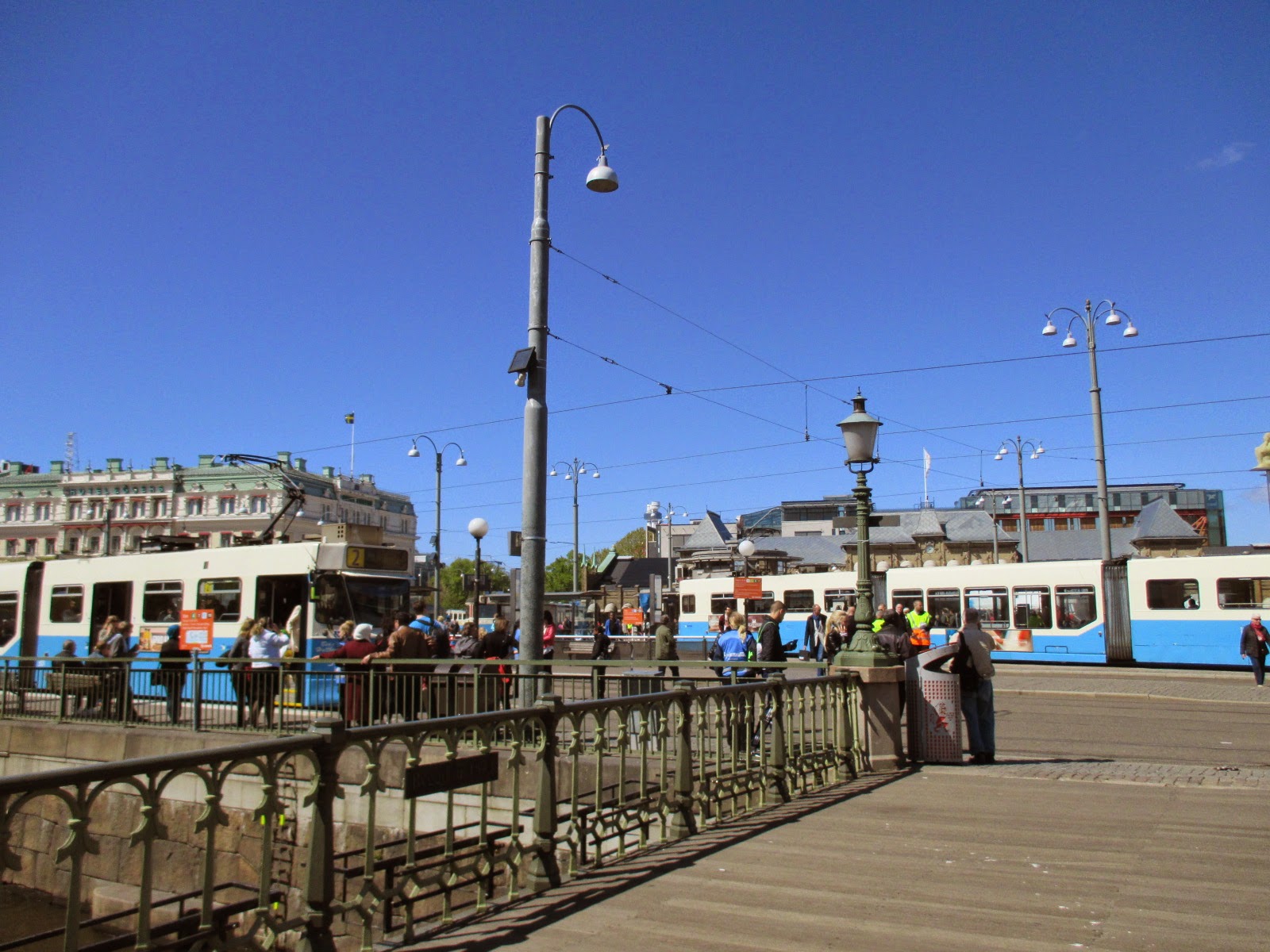
Loving the experiences of riding the trams in this very green city, some of which even fly the Ukrainian flag!
Plus, how can you not love a place which hosts the biggest half marathon in the world, which took place yesterday, with over 64,000 runners from 64 different countries. The logistics behind the organization were tremendous, including the rerouting of several trams plus even having free boats to ferry passengers over the canals and under bridges downtown towards the Central Station - a great experience of intermodal transport!


Working and living in a port city that is so forward in terms of transportation and policies is truly inspiring. I thank the University of Gothenburg and especially the School of Business, Economics and Law for such exceptional opportunities.


Friday, July 27, 2012

Best of Luck to the Olympians and What They Teach Us

The day has arrived and the opening ceremonies for the 2012 Summer Olympic Games will be taking place tonight in London, England. I hope to catch the parade, although I will be watching from the US and not from Europe.

The excitement is palpable not only because of the venue but the scale of these games.

What fascinates me, besides the athletes, their hard work, and the support from their coaches, family members, and friends (plus all the individual stories and journeys taken to reach this point), is the logistics behind the games and the transportation impacts.


I purchased the above official 2012 Summer Olympic t-shirt, which I am displaying in honor of all the athletes, in London Heathrow Airport, when I was waiting for my connecting flight back to Boston last March, after my stay at the University of Gothenburg in Sweden. 

I also spent the full month of June in Gothenburg, and met another Visiting Professor, Dr. Michael Browne, who is from the United Kingdom. He is a transportation and logistics expert, and was involved in transportation planning for these Olympic Games! How exciting is this?! There has been a lot of discussion in the news about the possible impacts on transportation and congestion (and I don't just mean the lost bus-driver who took Olympic athletes on an extended bus journey because he could not find his way to the Olympic Village).

What I especially appreciate about the athletes is their focus, hard work and dedication, plus that they follow their dreams. In times of impatience, restlessness, numerous distractions,  and pressure from all sorts of different constituents, we can all learn from these Olympic athletes.

And for those who almost made their country's Olympic team, but, not quite (as one of my neighbors in Amherst almost did, but got injured during the diving  finals), you are already great successes.

Now, for a nice writeup on our sports management program at the Isenberg School of Management at UMass Amherst and our graduates who are contributing to the games, in auxiliary ways, see this article.

And, thanks to my fellow blogger, Dr. Laura McLay, for even identifying an Olympic athlete with a degree in Operations Research!

For photos of the 2010 Winter Olympic Games in Vancouver, Canada, provided by our friends, the Wassermans, whom we met while we were living in Stockholm, Sweden,  see this blogpost.


Monday, January 16, 2012

Three Years of Blogging and Post Number 767

This week, I mark the third birthday or "anniversary" of this blog, which I began on January 19, 2009.

When I first started this blog, I never imagined that I would learn so much from the experience -- from my fellow bloggers, especially those in Operations Research, as well as from my readers (and I continue to be surprised when former students, locals, and those from thousands of miles away let me know that they appreciate what I write about).

The focus of this blog has been to highlight research, education, and networks, and it has featured quite a few amazing individuals, from Kings to Presidents (of universities, as well), to individuals who are making a difference and these have also included children (the trips of students and alums from The Bement School to the Dominican Republic to help out in a boys orphanage, for example).

The research that I have highlighted on this blog has ranged from humanitarian logistics and healthcare to a variety of advances in supply chains, transportation, electric power, and financial networks.

I have also included numerous photographs from conferences, and from celebratory events (graduations from high school, from universities, awards and grants received, and even sports achievements, from the World Cup to figure skating) as well as from my world-wide travels. Such posts continue to be some of my most accessed posts (who is not fascinated by Argentina, New Zealand, Iceland, Ukraine, China, or Italy)?

I've also tried to voice what it is like to be a female academic, who loves math and science; who teaches in a business school, who does a lot of research, writes journal articles and books, and who also is a mother and wife. The challenges never end and resiliency matters.

I write to get good news out when it happens and to recognize unfairness and inequities. I also try to comment from an analytical angle (as I do in the classes that I teach) on what is happening in the world.

This is post 767, which (I can't help but love numbers) reminds me of the Boeing 767 aircraft, and, given the amount of time that I spend on airplanes and at airports, this suits me fine. If your area of expertise is transportation, logistics, and networks, you need to be out there.

Wednesday, November 16, 2011

Congratulations to Dr. Nathan Gartner, the Recipient of the Robert Herman Lifetime Achievement Award in Transportation

Dr. Nathan Gartner standing next to me before receiving his award
Dr. Gartner being recognized with the Robert Herman Lifetime Achievement Award in Transportation Science

At the Society for Transportation Science and Logistics meeting at the INFORMS Conference in Charlotte this past Monday evening the 2011 Robert Herman Lifetime Achievement Award in Transportation Science was given.

This award is given every two years and previous recipients are listed on this link.

I have served on this award selection committee and have even chaired it and it is a distinct honor to be recognized in this way. Professor Martin Beckmann, who received this award after Robert Herman (the award is named after him now) was on my doctoral dissertation at Brown University committee. Other recipients include Professor David E. Boyce (whom I had just seen a few days prior at the regional science conference in Miami) and Professors Michael Smith and Michael Florian (I have cited almost all of the recipients in my work).

Although I did not serve on this award selection committee this year (and the awardee's name is kept, more or less, in secret, until the official announcement is made) as soon as I saw Dr. Nathan Gartner from UMass Lowell enter the big room where our business meeting was taking place I knew.

I went up to him to tell him that I had mentioned his name to my students last week in the transportation & logistics class that I am teaching this term since we were covering the elastic demand transportation network equilibrium model and its reformulation using the excess overflow reformulation into a fixed demand model pioneered by him in an article in Transportation Science. He then kindly introduced me to his wife (so I immediately knew that he would be getting the award).

This recognition is also very exciting since Professor Gartner is a Professor at UMass Lowell in the Department of Civil Engineering and he has done so much work over the past 4 decades in transportation -- from traffic flow models to signal setting models and even work, as noted above, on transportation network equilibria.

Above are photos taken of Dr. Gartner this past Monday that I could not resist posting.

I will share this great news with my students tomorrow morning (unless some get a preview by reading this post).

Friday, October 21, 2011

Congrats to Dr. Tina Wakolbinger -- Another Isenberg School PhD Success Story!

Nothing makes a professor happier than when one's students succeed.

Since I teach both undergraduate as well as graduate students, including doctoral students, each year I look forward to their graduations and placements, whether in jobs or in academia.

Also, as Director of the Virtual Center for Supernetworks, I get to know the students that serve as Center Associates especially well and we continue our associations and collaborations.

One of my former doctoral students, Tina Wakolbinger, who received her PhD in 2007 with a concentration in Management Science, and who served as the first President of our revived UMass Amherst INFORMS Student Chapter, and went on to receive the Judith Liebman award from INFORMS, has had a meteoric career. After receiving her PhD, she became an Assistant Professor at the Fogelman College of Business and Economics at the University of Memphis.

Less than 4 years after receiving her PhD, on May 15, 2011, she became a Full Professor, specifically, the Full Professor of Supply Chain Services and Networks at the Vienna University of Economics and Business and last week she received two other major appointments.

Dr. Wakolbinger is now the Head of the Research Institute for Supply Chain Management at the Vienna University of Economics and Business.

Also, she became the Deputy Head of the Institute for Transport and Logistics Management there.


I first met Tina when she was a student in the courses that I taught at the University of Innsbruck in Austria as a Distinguished Chaired Professor under the Fulbright program. After her graduation from that university, she worked for one year in industry in Austria. She then matriculated into our doctoral program at the Isenberg School at UMass Amherst.

Tina and I, along with Professor Dietrich Braess, translated his Braess paradox paper from German to English in an article published in Transportation Science.

She continues to serve as a Center Associate of the Virtual Center for Supernetworks.

Nice to see our supernetwork networking the continents!

Saturday, July 16, 2011

Where is the Traffic Jam -- Carmageddon

Who would think that a potential traffic jam, which is being called Carmageddon, would be getting so much attention nationally?

Since I teach transportation & logistics, among other subjects, traffic fascinates me (as it does my students).

Carmageddon was to take place (and still might over the weekend) in Los Angeles, where a ten mile stretch of Route 405, which carries about 500,000 vehicles a day is closed to traffic for a 53 hour stretch, beginning last night at midnight. The reason for the closure is a road improvement project, which includes the demolition of a bridge. This event, which has begun smoothly, is being covered even by The New York Times, in an article written by Adam Nagourney (can't help but like the name) and Ian Lovett. I have been following what has been happening on the Los Angeles Times website.

Clearly, the government provided sufficient warnings (over three months) about this closure and construction. Moreover, since it is taking place over the weekend, people have more flexibility and many can elect not to travel (in transportation, we would say that this is an elastic demand problem, as opposed to a fixed demand problem).

I am curious to see what will happen tonight when there are many events in LA as well as early Monday morning, if the project does not get completed, and when people have to go to work.

An update to this story on Monday -- the work got finished a day ahead of time -- thanks to the public listening and all the warnings and good planning; see this article.

Who can forget the biggest traffic jam ever that took place last year, outside of Beijing, on the Beijing-Tibet "Expressway." That was a 60 mile, 9 day traffic jam -- just imagine having this experience!

One group of my terrific students last Fall, who have since graduated, did a project on that traffic jam, possible reasons for it happening, and possible solutions for the future.

You can access the slides of their presentation here.

Sunday, December 12, 2010

From High Speed Rail in the US to the Beijing Traffic Jam to the Chunnel and Rotaries

One of my favorite parts of my semester took place last week, when the students in my Transportation & Logistics class gave their team project presentations.

The team projects this year were on: High Speed Rail in America, The Chunnel, The Beijing Traffic Jam, Dublin Transportation, Nightlife Involving College Transit Systems, and Rotaries.

Many of these terrific team presentations can be accessed and downloaded here.


I was very impressed by the project teams' professional deliveries, their deep and thoughtful analyses, their elegant and very effective visuals, and by how much these undergraduate students enjoyed working with one another on their projects. I invited several graduate students to listen to the presentations and they were also very impressed by these terrific Operations Management students. The students selected their topics, which reflected both their interests and the timeliness and relevance of the topics to the course and to what is happening in the real world.

The group that studied high speed rail in the US brought the latest political issues to bear on this subject (post the recent elections) and emphasized how the US is losing in terms of technological know-how and application in this area. Frankly, I wish that we had had some politicians in the audience, but I hope they do learn from the wisdom of these students (and benefit from their project presentation, which I have posted).

The chunnel group provided a fascinating historical perspective on this relatively new link that connects mainland Europe with England and also discussed recent disruptions (from the Icelandic volcanic eruption to the cold and snow of last winter) as well as the cost tradeoffs associated with using the chunnel as compared to different modes of transportation (such as ferries or air). This project team presented engineering design aspects of the chunnel and the challenges faced in its construction.

The traffic jam group researched the possible causes (and future solutions) to what has been considered the longest traffic jam ever -- on the Beijing-Tibet "expressway." The presentation even included a video of the straddling bus! I very much appreciated how the students noted the mixing of freight with private cars on this expressway with the freight being primarily in the form of trucks shuttling coal. They even noted that if the power generation stations were closer to the coal mining operations, then traffic would be reduced. I mentioned that if there was a greater focus on renewables for electric power generation in China and a greater emphasis on the design of sustainable supply chain networks then some of the congestion (and pollution) could be greatly reduced.

The Dublin transportation group team included one student who has lived in Dublin, so a personal perspective was also provided and a wonderful presentation with multiple levels of transit layers showing in a graphical way the transit network topologies (and which regions are accessible and connects and which are not).

The rotary project was also so very interesting and something we who live in Amherst could very much relate to since not only at UMass was there a rotary completed just recently (which took about a year to construct) but there are several other rotaries under construction in our town and another one completed in Northampton. The students even provided estimates for user link cost functions in a rotary and contrasted the travel time with a typical intersection (even with traffic lights). They also discussed the differences between roundabouts and rotaries and the advantages of rotaries, which are more popular in England than in the US (and after the presentation, it was clear to everyone in the audience as to why rotaries are safer).

The college night life and alternative transportation modes project provided possible solutions to a transportation problem for college students in Boston with a focus of those who attend and/or live close to Northeastern University. With many of the "attractive" night life student destinations being located a distance away (in the Government Center area) and with public transit stopping operation for the night an hour before many of these social outlets close, how should students make it back? This group analyzed different options (including walking) and discussed time/cost/safety issues. They even provided an overview of the evolution of public transit in Boston, beginning with carriage drawn horses which ran on "schedules."

The students will still be handing in papers on their presentations.

Corporations and other organizations are seeking employees who possess problem-solving skills, who can communicate well, and who can work well in teams. The students in my Transportation & Logistics class are role models.

Sunday, October 31, 2010

Freight as the Weakest Link in the Chain

I travel a lot by plane, train, automobile, and/or bus and frequently write on this blog about my travel experiences. In my writings I have also commented on my air travel experiences and lack of security at distant airports. In my research, I assess network systems, in particular, those in transportation and logistics, including supply chains, from their efficiency to their vulnerability. A recent study of ours: "Fragile Networks; Identifying Vulnerabilities and Synergies in an Uncertain Age" highlights the system-wide aspects of network performance and the negative impact of disruptions as well as total link failures.

The events over the past couple of days in which cargo shipments, originating in Yemen, were found to contain explosive devices, which could have brought down airplanes, have further highlighted the importance of checking cargo.

As reported in the article, Mail Bombs Highlight Flaws in Systems for Screening Air Freight, in today's Boston Globe: "If you talk to anybody senior at airports, they will tell you freight is the weak link in the chain." This quote by Chris Yates, an aviation security specialist, is literally on target.

As for the facts reported in the article:

  • Approximately 60 percent of all cargo coming into the United States is on passenger planes with the remainder of about 40 percent arriving on cargo planes.
  • About 50,000 tons of cargo is shipped by air within the United States every day, with approximately 25 percent of that shipped by passenger airlines.

One particular vulnerability in the system: Trusted companies that regularly do business with freight shippers are allowed to ship parcels as “secure’’ cargo that is not automatically subjected to further checks.

Some countries such as England already have heightened and thorough cargo security checks which delay shipments up to 24 hours but offer safety and piece of mind. Here we see multicriteria decision-making in action -- counterbalancing cost vs. time vs. safety/security.

Read the terrific article in the Boston Globe by Gregory Katz and ponder what else besides the passengers and crew may be on that plane with you as you circle the globe.

Friday, August 27, 2010

The Worst Traffic Jam Ever -- 10 Days and 60 Miles!


I am getting ready to teach two courses this Fall, including my Transportation & Logistics course, to which I always bring material and news items from the real-world.

Just in time for my first class, is the news, as both The Guardian and The New York Times report, of what is being reported as the worst traffic jam ever, which occurred on a highway west of Beijing, which is part of the Beijing-Tibet highway, and lasted 10 days and 60 miles! The drivers behaved quite well during this logjam and you can view some of the photos of the gridlock here.

One of the reasons for this surreal traffic jam was that construction had started on this major thoroughfare, thus reducing its capacity. Plus, this is a major highway for the transportation not only of passenger vehicles but also of trucks carrying freight and especially coal.

Room for Debate in The New York Times has interesting takes on this mega traffic jam, with one debater stating that such a monumental traffic jam would never happen in the US. Interestingly, as well, many of the truck drivers in order to avoid tolls (and being weighed) would rather choose a longer route, as happened in this case, in China. Tolls in which there is the money vs. time issue is another topic that I will be teaching in my course.

In our Fragile Networks book we discuss how the transportation network design and the reduction of capacity can affect traffic flows, both major issues in the worst traffic jam ever. Also, we quantify the effects of enhancements of network capacity, such as the increase in road capacity. Clearly, to have effective transportation and logistics systems, one must construct the appropriate critical infrastructure, in the form of roads, bridges, and even rails, sea and air routes, to support the flows!

The subject of Transportation & Logistics is always fascinating!

Thursday, August 26, 2010

News on the Supernetworks Center at the Isenberg School

With Fall around the corner, and students starting to arrive at colleges around the country, the 2010-2011 academic year will soon begin. There is always a lot of excitement and anticipation from the new and returning students, their families, as well as from the professors who will be teaching the courses that the students will be taking.

A new academic year brings new challenges, opportunities, experiences and adventures, friendships, and discoveries.

As Director of the Virtual Center for Supernetworks at the Isenberg School of Management at UMass Amherst, I edit the Supernetwork Sentinel, which is our newsletter, and which gets published in Fall, Spring, and Summer editions.

The Fall 2010 Supernetwork Sentinel is now online and I hope that you enjoy reading about our professional activities that, this past summer alone, took us to Argentina, China, Austria, and Ukraine! The research that the Center Associates are involved in include such timely topics as supply chain network design of critical needs products from pharmaceuticals to vaccines to sustainable supply chains and even fashion supply chain management (in which time vs. cost is also a big issue)!

We study network fragility and vulnerability in transportation, logistics (including humanitarian operations), the Internet, electric power and energy networks, and even in finance and model how human behavior affects such systems. We also construct metrics that can assess the performance of networks and identify potential synergies with applications as varied as corporate mergers and acquisitions and the teaming of organizations for disaster relief. We quantify, through advanced analytics, cooperative vs. competitive behavior and identify and explain where paradoxes such as the Braess paradox can (and cannot) occur.

Since supernetworks are networks of networks, their applications are very exciting and vast!

The methodologies that our researchers use to capture essential components of complex networks include: game theory, network optimization, nonlinear programming, multicriteria decision-making, risk management, variational inequalities, and projected dynamical systems.

We have been very busy this summer and are looking forward to a very special, productive, and fascinating new academic year!

All of our newsletters can be accessed here.

Saturday, May 1, 2010

A Thank You from a Student

The surprise gift and Thank You card were left in my office mailbox. These unexpected acknowledgments that I received yesterday came from an excellent, and very hard-working, undergraduate student that had taken my Transportation & Logistics class last semester. She is majoring in Operations Management and will be graduating later this month from the Isenberg School of Management at UMass Amherst. I have enjoyed the conversations that we shared very much.

The kindness and thoughtfulness of this student filled me with a very special warmth.

In the Thank You note that accompanied the beribboned box of Lindt chocolates, the student had written:

Professor Nagurney, You are one of the very few women role models that I have had in my life. You are very motivated and successful and inspire me. Thank you for giving me the opportunity to be your student. I got the job as a *********** and that is due to your partial contribution from your referral and your inspiration. Thank you so much! I wish you well.

**************
Fall 09 Student


Last night I wrote back to this student that I will always treasure the Thank You note that she sent me and that I know that she will be very successful both personally and professionally.

Teaching is not easy but the rewards of connecting with students, mentoring them, and seeing them begin to realize their dreams are some of the best acknowledgments that a professor can ever receive.

Friday, December 11, 2009

Massachusetts Board of Higher Education Report and the Isenberg School of Management


This week, the Massachusetts Board of Higher Education released a report by the Commissioner's Advisory Group on Undergraduate Education, which was charged with developing a cogent list of essential cross-cutting knowledge areas and skills that all students, regardless of major, should acquire during their undergraduate careers. Special emphasis in the months that preceded this report was placed on paying attention to the voices of employers and the citizenry. One of the 14 members of the group that prepared the report was Ray Stata, the Co-Founder and Chairman of the Board of the high tech company, Analog Devices. The report has excellent recommendations and, given that the end of an incredibly busy (but very satisfying academic semester) is now approaching, I thought that it would be appropriate to highlight some of the recommendations. The focus is on public higher education but the recommendations are universal, in my opinion.

Also, I think that we are doing some things very right in the Isenberg School of Management, which includes the Operations Management undergrad program that I am closely affiliated with.

The report noted that, first and foremost, college graduates must master both disciplinary and interdisciplinary content and intellectual skills and identified three categories of student learning outcomes: college level fundamentals, integrative thinking, and civic, organizational, and career competencies.

In the first category, written and oral communication is stressed (wonderful), quantitative skills (way to go!), technological/information science facility (fantastic), and knowledge of the physical and natural worlds, human cultures, and knowledge integration across disciplines (terrific!).

In the second category, the following skills are identified: critical thinking and informed decision-making (sounds like my field of operations research / management science), creativity and innovation (I always try to stimulate research questions and ideas from my students), problem solving (this is what I and my students do while we are awake), and another true passion of mine -- systems thinking!

As for the third category, I highlight the noted skills: personal responsibility, civic and social responsibility, and teamwork/collaboration skills. These are all experiences that we try to have our students obtain in their course projects (as well as in their numerous extracurricular activities) at the Isenberg School of Managememt.

I congratulate this Advisory Group for an outstanding report! I suspect that having a technology leader such as Ray Stata in this group helped to produce this truly excellent report.

As promised in an earlier blog post, I leave you with a link to some of the student project presentations that my students in the undergrad transportation & logistics class gave this past week, including last Wednesday during a major snowfall -- all the presenters showed up in the morning, despite the snow (with some being trapped on a bus until the plows came through, with numerous accidents en route, etc.). Look at the project presentations, learn, and rejoice. I applaud the students.

As for the Stata name, I gave a talk at a workshop at MIT a year ago in the Stata building, which is an architectural wonder and is featured above, and last spring I sat in a middle seat en route to Frankfurt via Lufthansa, with a VP from Analog Devices on one side of me and an administrator from Harvard's executive education programs on the other side -- perfect seat-mates!

Wednesday, November 18, 2009

A Letter from Al Gore and Trains for Warren Buffett


Teaching my transportation & logistics class is always an incredible experience! Today, I shared with my students the New York Times OpEd piece by Bob Herbert, What the Future May Hold, in which he writes: We're trundling along in the infrastructure equivalent of a jalopy, with bridges rotting and falling down, while other nations, our competitors in the global economy, are building efficient, high-speed, high-performance infrastructure platforms to power their 21st-century economies. Herbert then proceeds to imagine an America with rebuilt and healthy metropolitan areas, efficient rail and electric power networks, coupled with world-class public schools. He cites both a Brookings study and Rohatyn's recent book, Bold Endeavors, with the opening sentence: The nation is falling apart -- literally.

The themes of our Fragile Networks book focus not only on identifying the vulnerabilities of our infrastructure through the prism of transportation and logistical networks but also how to identify potential synergies through cooperation, through teaming and wise sharing of resources, and even through mergers and acquisitions. Patrick Qiang and I show in our book how to also compute a priori potential environmental synergies by capturing the underlying network structure of firms involved in mergers and/or acquisitions.

Today's New York Times also has an article on the environmental costs associated with air travel (which I also shared with my students) in which is stated that the average British commuter while commuting by rail, bus, or car in a full year would emit LESS than a single air traveler flying from London to Los Angeles! Research is now being conducted (and some terrific work is being done right here at UMass Amherst) to develop alternative fuels even using algae, that would drastically reduce the carbon imprint of air travel. The article emphasizes that the effect of carbon offsets at the present prices on emission-reduction is esssentially null (but travelers' guilt might be reduced and that is about it).

Mr. Dickenson, of the nonprofit Carbon Disclosure Project, says that he is now taking trains, flying less, and trying to conduct more meetings via phone or teleconference. The article ends with a comment about Warren Buffett's recent investment in the Burlington Northern Santa Fe Corporation. Indeed, what does it say when the world's most successful investor, Warren Buffett, is now purchasing more railroad companies?!

As Buffett has joked, This is all happening because my father didn't buy me a train as a kid. Buffett gets the importance of trains for the movement of goods in the United States of America and how environmental impacts can be reduced through mode switching from trucks to trains. By the way, as I told my students today, CSX has a very cool carbon emission calculator for determining the environmental costs associated with moving freight from different origins to destinations via rail.

In honor of Warren Buffett's vision, I have featured a photo above of some trains (toy, obviously) from my husband's collection.

I have also included a photo of the letter that I received from then Vice-President Al Gore commenting on my book, Sustainable Transportation Networks, and thanking me for it, when it was published. The letter is hanging in my Isenberg School of Management office for my students to see.

Monday, October 26, 2009

Where's the Beef and the Tolls? Teaching Transportation and Logistics is Never Dull

Teaching my undergraduate transportation and logistics class is NEVER dull. Today, I began my day with a lecture in this class on tolls, unbeknowest to me, that a huge accident had taken place earlier in Weston, Massachusetts at the toll plaza. Several tractor trailers crashed into one another, including one carrying over 46,000 pounds of beef (and that is the one that overturned). A car was also involved in the chain reaction accident. Beef was all over the road (quite frankly, not a pleasant sight)!!!

As our Boston press reported, the "bad" news was that the accident occurred and that the beef was lost to human consumption (let's hope). The "good" news was that for 3 hours, the police just waved through the vehicles and no tolls were collected for them. The Massachusetts turnpike authority had gotten so much flack for horrendous delays on the Pike last Easter that a new rule had been passed and to minimize further delays the traffic is just waved through until the incident is declared cleared up.

Now the state officials are worried about the loss of income due to the tolls that were not paid and are hoping to get compensation through insurance.

Interestingly, I had shared with my students this morning some horror MA tollbooth stories, including one that resulted in the death of a friend's mother.

Indeed, teaching this transportation and logistics class is never dull. Just this week, my students also got to hear about the Northwest flight from San Diego that overshot its destination of Minneapolis by 150 miles (still no complete story as to what exactly transpired in the cockpit during the 90 minutes that no traffic controller could reach them). Even the President was notified as to this very suspicious activity. Interestingly, one week prior many of our colleagues were flying back from the INFORMS conference in San Diego!

Last year, one of the hot topics in the news was the pirates affecting maritime transport off the coast of Africa; now we have wandering pilots and beef spillages at toll booths.

Wednesday, September 23, 2009

Healthcare and System-Optimization Flow Management

Students in my Transportation & Logistics class at UMass Amherst do an end of the semester project and the projects have been as varied as studying pedestrian crosswalks and safety, bicycle transportation, PVTA bus scheduling and routing, pizza delivery routes, congestion management at large entertainment venues, and even paper flow management in university administration, traffic management in New Delhi, and flow management in a local hospital. The students are asked to apply concepts learned in the course to topics of interest to them.

The hospital flow management model project was done by a student who is also a nurse and involved data collection at the Cooley Dickinson Hospital in Northampton. She constructed a system-optimization model, which we had learned about in the class, and which had been used for years in transportation planning. Consider a transportation problem, for example, in which there is a central controller (think freight routing) of the network as opposed to user-optimization (in which individual agents act selfishly to determine their own best choices). She included the various links in the network and the corresponding activities associated with patient preparation, surgeries, etc.

Interestingly, I was reading recently in the Boston Globe about the work of Professor Eugene Litvak, who works in healthcare operations management at Boston University and who has been applying flow management successfully to optimizing hospital operations. His greatest success, to-date, is the savings incurred at Childrens Hospital, which has been estimated at $100 million (since 100 hospital beds did not need to be built due to more efficient allocation of flows given the capacities). You can read the full article: Boston.com

The article also notes that Professor Litvak is from the former Soviet Union. He worked in Kiev, Ukraine before coming to the US in 1988. Hence, his emphasis and appreciation of central control and efficiency may be more natural to him. I recall that while I was at the World Science Festival on the Traffic panel, our moderator, Robert Krulwich of ABC and NPR, teased us and said whether we were Communist in promoting system-optimization.

Clearly, as in the case of hospital operations, when the system is at stake (and peoples' well-being) if one can optimize flows, lives can be saved.

What could be more rewarding in education than seeing that research and education can be put into outstanding practice!