Showing posts with label shipping. Show all posts

Sunday, May 24, 2015

Why I Love Being A Visiting Professor in Sweden

One might wonder why, once the academic year is over, a faculty member would travel thousands of miles to be a Visiting Professor on another continent?

This is something I have been doing now for 5 years.  Come mid-May I am off to the School of Business, Economics and Law at the University of Gothenburg in Sweden where I hold a Visiting Professorship in Operations Management.

I have had an affinity for Sweden, going over many years, and it may be because I am of Ukrainian heritage and I would not be surprised if I had some good Viking blood in me. I always feel completely comfortable when I land in Sweden.

My colleagues at the University of Gothenburg are always so warm and welcoming.  I enjoy the research that we have done together, especially with Professor Jonas Floden, on various supply chain, freight, and sustainability themes, and the many conversations that I have had with faculty in the Transportation and Logistics group as well as in Finance and even in Energy Economics. I look forward to  research that we will be doing.

I also very much enjoy my interaction with students here on various transportation and logistics themes, including shipping and urban freight, as well as on financial topics.

I have been here, this time around, only 10 days and already have had so many rich experiences. Below are some photos taken just during this past week.

Nice to have the sign below on my office door and today the school was flying the Swedish flag.

Celebrating last Thursday with Dr. Niklas Arvidsson and his wife, Alla,  Niklas's dissertation prize with delicious Swedish food, of course at Hus Pelle, a restaurant with the same owner for 30 years.
Celebrating Zoi Nikopoulou's recent wedding with colleagues, students,  and staff as is a tradition every Thursday during our afternoon cake and coffee sessions
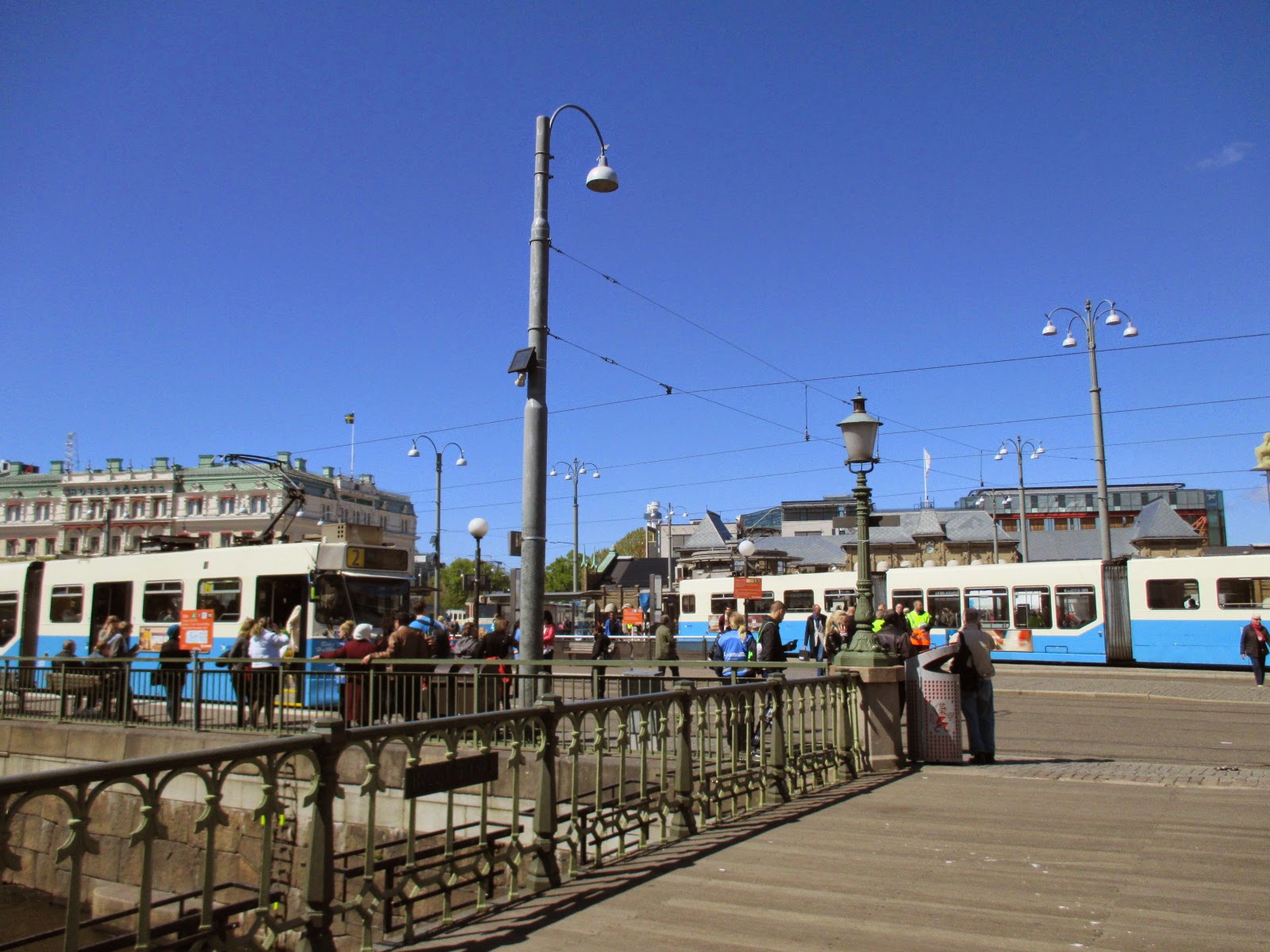
 Enjoying the beauty of nature and architecture in the city of Gothenburg
Sampling the treats, some only visually


Loving the experiences of riding the trams in this very green city, some of which even fly the Ukrainian flag!
Plus, how can you not love a place which hosts the biggest half marathon in the world, which took place yesterday, with over 64,000 runners from 64 different countries. The logistics behind the organization were tremendous, including the rerouting of several trams plus even having free boats to ferry passengers over the canals and under bridges downtown towards the Central Station - a great experience of intermodal transport!


Working and living in a port city that is so forward in terms of transportation and policies is truly inspiring. I thank the University of Gothenburg and especially the School of Business, Economics and Law for such exceptional opportunities.


Thursday, June 6, 2013

Final Thoughts and Photos from the NOFOMA Logistics Conference in Sweden

Yesterday was the last day of the NOFOMA Conference in Gothenburg, Sweden, which I have been blogging about.

The high point (for me) was the plenary talk given by Professor Kevin Cullinane of the Edinburgh Napier University. Professor Cullinane is also a Visiting Professor (as I am) at the School of Business, Economics and Law at the University of Gothenburg.

His plenary talk was entitled: Emission Control Areas and Their Impact in Global Transport Chains. It was fascinating -- he spoke about what the International Maritime Organization is doing in regards to shipping and regulations -- especially those that have to do with sulfur oxide, which ships emit, and which are contributing to heavy pollution around ports (since the ships don't shut of their engines in ports). The health impacts are also huge. How ships will reduce their sulfur dioxide emissions (a problem with the fuel that they use) will be interesting and challenging -- from the use of scrubbers to switching and retrofitting ships to natural gas or even methane (with associated costs). We can expect many changes on the horizon in global transport and supply chains because of the impacts on the maritime and shipping industries.

The conference was terrific and I especially enjoyed meeting so many highly motivated doctoral students from the Nordic countries, Germany, Czechoslovakia, Iran,
and even the US. 

I leave you with some photos from NOFOMA 2013. Additional ones are available on my earlier blogspost here as well as here, where tips on how to do research and to review papers can also be found.


The next conference will be held next June in Copenhagen, Denmark.

Thursday, February 18, 2010

Taking the Slow Boat to China and Reducing Emissions

Maersk, the Danish shipping company, has greatly reduced its long distance ship speeds (including on trips from Germany to China) in order to reduce emissions. At the same time, even with greater employee costs that such trips entail, it has reduced its total costs.

This fascinating article in The New York Times discusses how Maersk, as a corporation, considers the strategy of speed reduction to be a win-win situation and this in a world of rush-rush and faster and faster. The article reports that:

Slowing down from high speeds reduces emissions because it reduces drag and friction as ships plow through the water.

That principle holds true in the air and on land. Planes could easily reduce emissions by slowing down 10 percent, for example, adding just five or six minutes to a flight between New York and Boston or Copenhagen and Brussels.

Maersk should be commended for having the guts to go against the grain as a company and for being so proactive in helping the environment.

My research team has been investigating environmental issues that firms are faced with from how to create cost and environmental synergies in mergers and acquisitions, to the evaluation of cap and trade schemes and carbon taxes, to the effects of the deterioration of roads on emissions, to the optimal design of sustainable supply chain networks (something which an expert in the same article implies is hard to do), among just a few topics.

You may find some of our latest research on the website of the Virtual Center for Supernetworks.

In the meantime, it makes sense to, literally, take the slow boat (and plane) to China.