The message came from Mary Magrogan, the INFORMS Director of Membership, Subdivisions, and International Programs, in mid-September, asking me whether I would be able to speak at the University of Alabama sometime in November. A request had come from the INFORMS Student Chapter there through the INFORMS Speakers Program, which I am a huge fan of (and we, at UMass Amherst, have also availed ourselves of this wonderful program). INFORMS covers the cost of travel (if needed) and the host covers on-site expenses, including overnight lodging, if necessary,
Even though I am more than the usual "busy," since I am also chairing a faculty search in my department, I very quickly agreed to this kind invitation and the date for scheduled talk was this past Friday, November 17. This would be my first time in Alabama, and the Department of Information Systems, Statistics and Management Science at the Culverhouse of Commerce has such distinguished faculty, that I was very excited about this speaking engagement and visit. Plus, I am a huge proponent of INFORMS Student Chapters, and wanted to support the University of Alabama one.
My amazing host was Dr. Karthik Murali, who is now the Faculty Advisor to this INFORMS Student Chapter. Dr. Burcu Keskin had served previously in this capacity for 10 years. Dr. Murali not only drove me from Birmingham to Tuscaloosa and then back to the airport but also arranged for a very rich visit and experience.
Below is a photo of Dr. Murali with the Alabama INFORMS Student Chapter officers.
I had the pleasure of having breakfast with Dr. Murali Friday morning at the Hyatt Regency in Birmingham, which I highly recommend.
My schedule included meetings with faculty and another highlight was a one hour meeting with several officers of the University of Alabama Student Chapter. I very much enjoyed hearing from the students the kind of research that they are doing and to answer their question, which ranged from selection of research topics to time management. I loved their enthusiasm and energy!
Then it was time for my talk and, amazingly, some of the students had anticipated what I might mention in my presentation.
I have posted my slides here. Usually, when I am asked to give a presentation I will provide a list of topics and ask the host to select one; cybercrime and cybersecurity was the winner! The audience had fabulous questions, which will lead to more research on this very timely topic.
Then it was time for lunch and, would you believe, while it was cold and rainy back in Amherst, Massachusetts, we got to dine al fresco at The River Restaurant with a great view and even better food!
The lunch with Dr. Burcu Keskin, Dr. Sharif Melouk, and Dr. Mesut Yavuz was simply fabulous!
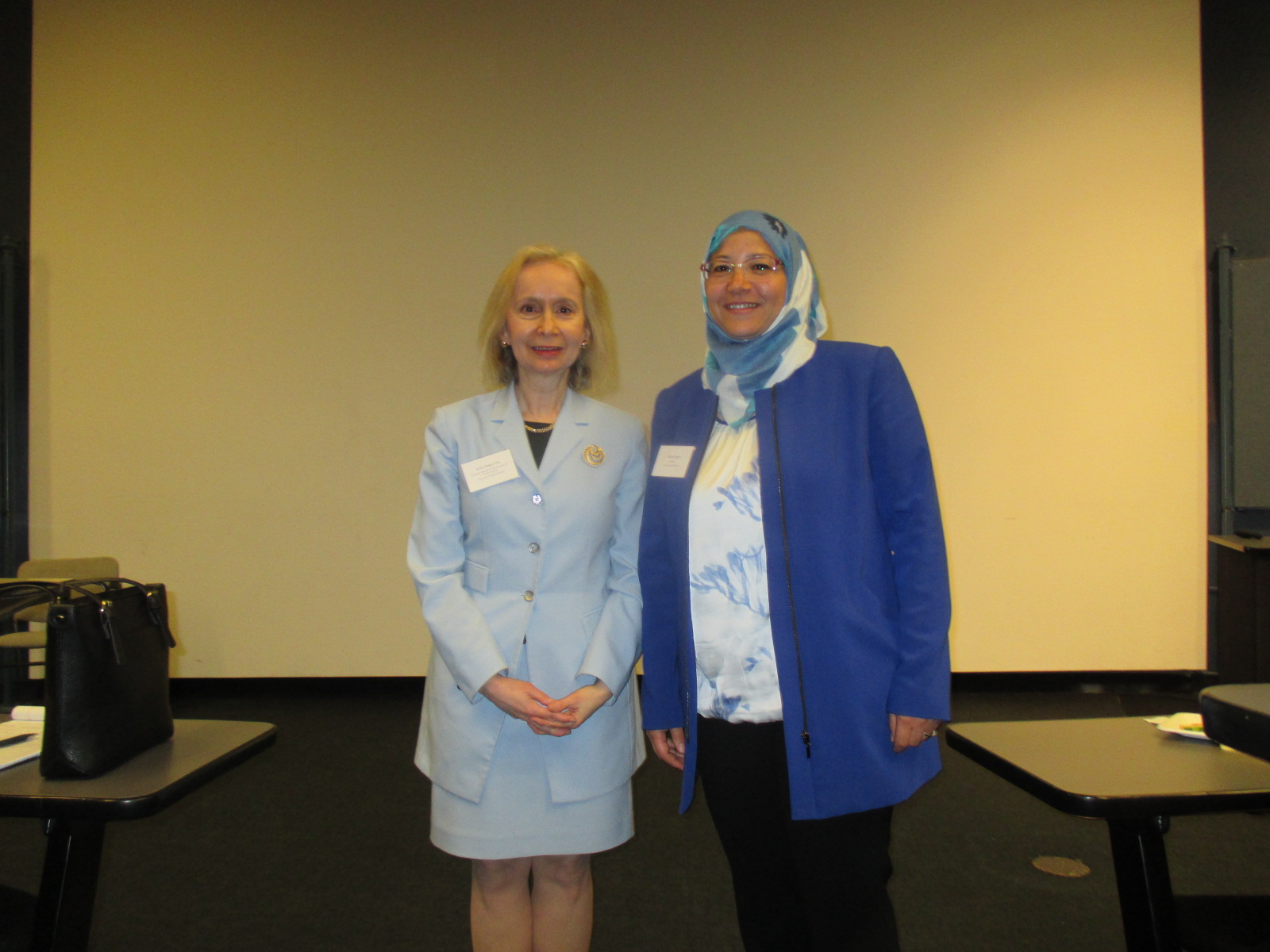
Afterwards, I could not resist being photographed against a backdrop of red roses with Dr. Keskin.
I have known Dr. Keskin for quite a while now, since she is a contemporary of my former doctoral student, Dr. Tina Wakolbinger, and both of them received the INFORMS Judith Liebman Award! In fact, they wrote the document on how to run a successful student chapter. They are true leaders in the profession now.
There was no time for a tour (and the U. of Alabama was getting ready for another football game) but I did get to see the Dean's boardroom and room next door, both of which were so elegant.
I give many talks but believe that this is the first time I have seen multiple chandeliers in a Business School!
A big shoutout also to the MIS faculty, some of whom are in the photo above, for taking the time to speak with me on their multiple exciting initiatives in cybersecurity! And, of course, it was special to hear them mention some of my MIS colleagues at the Isenberg School.
Although I did not get a chance to see Dr. Jim Cochran (who is now an Associate Dean) and was recently elected an INFORMS Fellow, as well as Dr. Emmett Lodree, who was out of town, I felt that they were there with me "in spirit."
Many thanks also to Dr. Mesut Yavuz, Dr. Nick Freeman, and Dr. John Mittenthal (who is the academic grandson of the one and only Professor George Dantzig, and his advisor at the U. of Michigan was Dr. John Birge, the new Editor of Operations Research) for taking the time out of their very busy schedules to meet with me individually. This department is interviewing candidates for 7 faculty positions and they also, like UMass Amherst, have this week off as a Thanksgiving holiday break.
The journey to the airport took a while because of the traffic. It was interesting to see the Charlotte airport at 10PM packed with travelers (my connection from Birmingham) and I arrived back in Amherst at 1:30AM Saturday morning.
A BIG thanks to Dr. Karthik Murali, to his colleagues, to the University of Alabama INFORMS Student Chapter, and to the INFORMS Speakers Program for such a delightful visit and speaking engagement.
And, I leave you with a photo that I took early Friday morning of the Galleria Mall that was attached to the hotel, complete with a festive carousel and holiday decorations.
Happy Thanksgiving, everyone, and safe and enjoyable travels!
And, one day, I may blog on a fascinating international businesswoman from Alabama that I sat next to on my flight from Charlotte to Birmingham. We had such an amazing conversation that we exchanged hugs upon departure.
Showing posts with label cybercrime. Show all posts
Sunday, November 19, 2017
Saturday, April 16, 2016
Fabulous Analytics Day at the University of Waterloo in Canada
This past Thursday, I flew (after a two hour delay) on Air Canada from Bradley Airport to Toronto since I was to speak at Analytics Day at the University of Waterloo. The conference was organized by Dr. Fatma Gzara, who is a faculty member in the Department of Management Sciences there and who had also hosted me almost exactly 5 years ago for a seminar!
I accepted the invitation to be a plenary speaker at this conference and the experience was tremendous plus I always enjoy not the flight delays but the serendipity of whom you may meet while traveling.
I was put up in the stunning Delta hotel, which opened about two yeas ago, and not only was I staying at the hotel but Dr. John McCarthy, who is the Graduate Dean at UMass Amherst and a Vice Provost, was also there. I found this out while talking to two academics in the elevator and went to see him at a breakfast. I had seen John only two days prior at the UMass Honors banquet. He was in Waterloo for the annual meeting of the Northeastern Association of Graduate Schools!
And there was another luminary staying at the same hotel, whom I had seen Thursday evening on the Canadian news - none other than Prime Minister Justin Trudeau. I had thought that all the nicely dressed men were actually hotel staff but they were security guards. I saw Trudeau not only yesterday morning as I was getting picked up to go to the conference but also when I returned to the hotel. I took the photo of him entering the limo below. Since I was born in Canada, this was extra special.
My plenary talk was on: Predictive and Prescriptive Models of Cybercrime an Cybersecurity Investments Under Network Vulnerability. The conference was well-advertised and attracted practitioners as well as academics from numerous universities in the Toronto area. Dr. Gzara runs the Waterloo Analytics and Optimization Lab. She had taken part in the recent INFORMS Analytics conference in Orlando and in her presentation included the following slide which was generated by a text mining program of all the abstracts at the INFORMS conference.
Great to see Optimization Models prominent in the text cloud along with Big Data and Supply Chains!
There were opening remarks by the Associate Dean of Engineering at Waterloo. The full conference schedule can be viewed here.
Dr. Gzara did a wonderful job of introducing each speaker and had a slide prepared on each.
I very much enjoyed the talk Optimizing Supply Chains with Advancd Analytics presented by Pete Devenyi and Scott Wahl of Dematic North America.
The Detamic presentation was on electronic commerce and grocery distribution centers. Dematic is a global software engineering firm with 6,500 employees and $70 million spent on R&D a year (I assume that is in Canadian dollars). Their clients include Tim Hortons, Amazon, and Walmart, so I enjoyed speaking with them about my experiences last October at Amazon's first Supply Chain Optimization Conference in Seattle. They talked about predictive analytics to get items to customers in 1/2 a day and placing warehouses closer to customers. I very much enjoyed their presentation which had videos and was very dynamic. They noted that "warehouses" in the future will be truck.
Since there were both industry and academic talks the discussions were great and the day flew by much too quickly. The Dematic presenters stated that they are trying to solve the problem "of the tyranny of now". Customers when ordering online want their orders to be delivered asap. Without the right analytics firms don't have visibility, which is critical in e-commerce. Dematic also uses descriptive analytics to figure out bottlenecks and is looking towards work force optimization and item storage optimization. Visualization analytics can reveal where there are bottlenecks in terms of processes in a grocery distribution center, for example. Grocery distribution centers are completely different from e-commerce ones, since grocery orders are placed every day. It may cost $100 million to automate a grocery DC. There is even pallet optimization that needs to be done.
The third presentation was by Chad Elkadri, Reza Farahani, and Hany Kashif of SOTI.
As you can see from the photo below, the audience was very attentive and interested in the talks.
SOTI develops software for enterprises and was founded in Canada 20 years ago. It, through its Research and Innovation Lab, has been working on the Internet of Things. Specifically, the company focuses on managing devices including connected devices in the enterprise. I was also very interested in this presentation because only 10 days ago, my collaborator, Professor Tilman Wolf, presented our latest work on the Internet of Things at the IEEE Berlin conference.
SOTI builds partnerships with OEMs and is in 170 countries. Partners include device manufacturers and also operating system companies such as Google, Apple, and Microsoft.
SOTI speakers noted how sensors are paving the way for Big Data and it is essential to recognize the varying levels of the importance of data. Also, there is "demand for new analytical models." SOTI is building a performance-aware engine, which was the topic of the presentation. Also, one of the noted challenges is how to extract data without changing the behavior of the system. They also presented a model, which I liked, which had a parameter that captured the value of a data element at a point in time, and I asked a question about this. Performance-aware analytics must take constraints into consideration. Such constraints can include QoS (Quality of Service) constraints. The case study that was presented was on connected cars.
Then it was time for lunch which included all sorts of wrap sandwiches - I chose the salmon one as well as salads and fresh fruits plus a tray of sweets.
After lunch, an academic talk was given by Joe Naoum Sawaya of the Ivey School at the University of Western Ontario. His title was: Optimization in the Age of Modern Analytics and Internet-of-Things. Saway discussed: descriptive, predictive, and prescriptive analytics and emphasized that now algorithms need to be intuitive, distributed, scalable, and have a niche or application. He talked about sensors for Smart Cities since he had worked for IBM for 5 years. He focused on the automotive industry. He presented a nice model focusing on SPONGE, which is an energy matching supply and demand framework but that ensures privacy since the central authority does not now the individuals' utility functions. He noted that because of the Internet of Things, we no longer can assume centralized decision-making.
The second presentation after the lunch was by the Deloitte Consulting Canada group. The speakers were: Snehar Patel and Niraj Dalmia and a consultant. Since I have had one of my former students work for Deloitte (Christina Calvaneso) I also was looking forward to this talk.
They spoke on use cases including one in the oil and gas sector, in which there has been tremendous economic upheaval. Hence, figuring out where costs can be reduced is imperative. They talked about system dynamics approaches (top down) and also agent-based modeling (bottom up). They noted that "analytics is an opportunity." One example was a mine in Chile in which they use predictive analytics to prepare for possible disruptions.
Another example, which they spoke on, which reminded of a project that some of my Opertaions Management students did a while back in my Transportation and Logistics class at the Isenberg School and that was on modeling patient flow from an emergency room in a hospital. Deloitte is taking data from clients and then building models and this is the direction that consulting is going in they told the audience.
Dr. Gzara, the organizer, was the last speaker of the day and gave an excellent talk on working with one of her industry partners - Dematic. She spoke on her group's work on using data from a client's warehouse (and the data is by no means complete) to do diagnostics and to evaluate bottlenecks and where the system processes might be improved. She presented a series of innovative models and also spoke on how descriptive analytics showed them that there is a high variability in orders and some orders have as many as 31 products in them.She discussed network flow models and also a model that I very much liked - using community detection to also graphical depict orders as a network. How can one use community detection and network learning to identify which products are co-ordered. She also stated the need to do predictive dynamic analytics for product order groupings over time.
I made sure that a photo was taken of me with Fatma for a keepsake of an intellectually rich and very stimulating day.
My trip via a shuttle to the Toronto airport was pleasant and there was not so much traffic although it was rush hour. And, would you believe, I took Route 401 both to and from the Toronto airport to the Delta hotel in Waterloo and the shuttle driver then informed me that the route, Route 401, is the busiest freeway in North America! I also saw signs of $10,000 penalties if a driver exceeds the speed limit by 50 kilometers (which is 30 miles) and the car also gets confiscated by the police for 7 days. This is to prevent drag racing but, given the congestion, drag racing would be a challenge in itself.
And, as one would expect, I had a delay on Air Canada on my flight back to Hartford. So I took a photo at the airport of one of the national foods of Canada and that is the Tim Hortons donuts.
For the flight back I purchased the last copy of The New York Times and in it was an OpEd piece co-authored by my Provost at UMass Amherst, Dr. Katherine Newman! My day began with a UMass administrator and in a sense ended with one. The academic network is global and far-reaching and wonderful, I must day.
Many thanks to Dr. Fatma Gzara for a fabulous Analytics Day!
I accepted the invitation to be a plenary speaker at this conference and the experience was tremendous plus I always enjoy not the flight delays but the serendipity of whom you may meet while traveling.
I was put up in the stunning Delta hotel, which opened about two yeas ago, and not only was I staying at the hotel but Dr. John McCarthy, who is the Graduate Dean at UMass Amherst and a Vice Provost, was also there. I found this out while talking to two academics in the elevator and went to see him at a breakfast. I had seen John only two days prior at the UMass Honors banquet. He was in Waterloo for the annual meeting of the Northeastern Association of Graduate Schools!
And there was another luminary staying at the same hotel, whom I had seen Thursday evening on the Canadian news - none other than Prime Minister Justin Trudeau. I had thought that all the nicely dressed men were actually hotel staff but they were security guards. I saw Trudeau not only yesterday morning as I was getting picked up to go to the conference but also when I returned to the hotel. I took the photo of him entering the limo below. Since I was born in Canada, this was extra special.
My plenary talk was on: Predictive and Prescriptive Models of Cybercrime an Cybersecurity Investments Under Network Vulnerability. The conference was well-advertised and attracted practitioners as well as academics from numerous universities in the Toronto area. Dr. Gzara runs the Waterloo Analytics and Optimization Lab. She had taken part in the recent INFORMS Analytics conference in Orlando and in her presentation included the following slide which was generated by a text mining program of all the abstracts at the INFORMS conference.
Great to see Optimization Models prominent in the text cloud along with Big Data and Supply Chains!
There were opening remarks by the Associate Dean of Engineering at Waterloo. The full conference schedule can be viewed here.
Dr. Gzara did a wonderful job of introducing each speaker and had a slide prepared on each.
I very much enjoyed the talk Optimizing Supply Chains with Advancd Analytics presented by Pete Devenyi and Scott Wahl of Dematic North America.
The Detamic presentation was on electronic commerce and grocery distribution centers. Dematic is a global software engineering firm with 6,500 employees and $70 million spent on R&D a year (I assume that is in Canadian dollars). Their clients include Tim Hortons, Amazon, and Walmart, so I enjoyed speaking with them about my experiences last October at Amazon's first Supply Chain Optimization Conference in Seattle. They talked about predictive analytics to get items to customers in 1/2 a day and placing warehouses closer to customers. I very much enjoyed their presentation which had videos and was very dynamic. They noted that "warehouses" in the future will be truck.
Since there were both industry and academic talks the discussions were great and the day flew by much too quickly. The Dematic presenters stated that they are trying to solve the problem "of the tyranny of now". Customers when ordering online want their orders to be delivered asap. Without the right analytics firms don't have visibility, which is critical in e-commerce. Dematic also uses descriptive analytics to figure out bottlenecks and is looking towards work force optimization and item storage optimization. Visualization analytics can reveal where there are bottlenecks in terms of processes in a grocery distribution center, for example. Grocery distribution centers are completely different from e-commerce ones, since grocery orders are placed every day. It may cost $100 million to automate a grocery DC. There is even pallet optimization that needs to be done.
The third presentation was by Chad Elkadri, Reza Farahani, and Hany Kashif of SOTI.
As you can see from the photo below, the audience was very attentive and interested in the talks.
SOTI develops software for enterprises and was founded in Canada 20 years ago. It, through its Research and Innovation Lab, has been working on the Internet of Things. Specifically, the company focuses on managing devices including connected devices in the enterprise. I was also very interested in this presentation because only 10 days ago, my collaborator, Professor Tilman Wolf, presented our latest work on the Internet of Things at the IEEE Berlin conference.
SOTI builds partnerships with OEMs and is in 170 countries. Partners include device manufacturers and also operating system companies such as Google, Apple, and Microsoft.
SOTI speakers noted how sensors are paving the way for Big Data and it is essential to recognize the varying levels of the importance of data. Also, there is "demand for new analytical models." SOTI is building a performance-aware engine, which was the topic of the presentation. Also, one of the noted challenges is how to extract data without changing the behavior of the system. They also presented a model, which I liked, which had a parameter that captured the value of a data element at a point in time, and I asked a question about this. Performance-aware analytics must take constraints into consideration. Such constraints can include QoS (Quality of Service) constraints. The case study that was presented was on connected cars.
Then it was time for lunch which included all sorts of wrap sandwiches - I chose the salmon one as well as salads and fresh fruits plus a tray of sweets.
After lunch, an academic talk was given by Joe Naoum Sawaya of the Ivey School at the University of Western Ontario. His title was: Optimization in the Age of Modern Analytics and Internet-of-Things. Saway discussed: descriptive, predictive, and prescriptive analytics and emphasized that now algorithms need to be intuitive, distributed, scalable, and have a niche or application. He talked about sensors for Smart Cities since he had worked for IBM for 5 years. He focused on the automotive industry. He presented a nice model focusing on SPONGE, which is an energy matching supply and demand framework but that ensures privacy since the central authority does not now the individuals' utility functions. He noted that because of the Internet of Things, we no longer can assume centralized decision-making.
The second presentation after the lunch was by the Deloitte Consulting Canada group. The speakers were: Snehar Patel and Niraj Dalmia and a consultant. Since I have had one of my former students work for Deloitte (Christina Calvaneso) I also was looking forward to this talk.
They spoke on use cases including one in the oil and gas sector, in which there has been tremendous economic upheaval. Hence, figuring out where costs can be reduced is imperative. They talked about system dynamics approaches (top down) and also agent-based modeling (bottom up). They noted that "analytics is an opportunity." One example was a mine in Chile in which they use predictive analytics to prepare for possible disruptions.
Another example, which they spoke on, which reminded of a project that some of my Opertaions Management students did a while back in my Transportation and Logistics class at the Isenberg School and that was on modeling patient flow from an emergency room in a hospital. Deloitte is taking data from clients and then building models and this is the direction that consulting is going in they told the audience.
Dr. Gzara, the organizer, was the last speaker of the day and gave an excellent talk on working with one of her industry partners - Dematic. She spoke on her group's work on using data from a client's warehouse (and the data is by no means complete) to do diagnostics and to evaluate bottlenecks and where the system processes might be improved. She presented a series of innovative models and also spoke on how descriptive analytics showed them that there is a high variability in orders and some orders have as many as 31 products in them.She discussed network flow models and also a model that I very much liked - using community detection to also graphical depict orders as a network. How can one use community detection and network learning to identify which products are co-ordered. She also stated the need to do predictive dynamic analytics for product order groupings over time.
I made sure that a photo was taken of me with Fatma for a keepsake of an intellectually rich and very stimulating day.
My trip via a shuttle to the Toronto airport was pleasant and there was not so much traffic although it was rush hour. And, would you believe, I took Route 401 both to and from the Toronto airport to the Delta hotel in Waterloo and the shuttle driver then informed me that the route, Route 401, is the busiest freeway in North America! I also saw signs of $10,000 penalties if a driver exceeds the speed limit by 50 kilometers (which is 30 miles) and the car also gets confiscated by the police for 7 days. This is to prevent drag racing but, given the congestion, drag racing would be a challenge in itself.
And, as one would expect, I had a delay on Air Canada on my flight back to Hartford. So I took a photo at the airport of one of the national foods of Canada and that is the Tim Hortons donuts.
For the flight back I purchased the last copy of The New York Times and in it was an OpEd piece co-authored by my Provost at UMass Amherst, Dr. Katherine Newman! My day began with a UMass administrator and in a sense ended with one. The academic network is global and far-reaching and wonderful, I must day.
Many thanks to Dr. Fatma Gzara for a fabulous Analytics Day!
Wednesday, April 6, 2016
Great Time Speaking at Carnegie Mellon University Where Operations Research Rocks!
On Sunday, when the snow was starting to fall (and that was April 3) in Amherst and the winds were blowing at about 50 miles an hour we lost electric power. I was finishing up packing up and heading to Carnegie Mellon University where I was to give a seminar the next day. Since it was a while before I had to head out to the airport, my husband and I went to investigate what was the cause of the power outage. As you can see from the photo below a tree had snapped and fallen on a power line. There was a Channel 40 news crew there and since my husband is a Professor of Electrical and Computer Engineering, when asked, he agreed to be interviewed and the interview aired that evening.
After a two-legged flight to Pittsburgh on Southwest (I had deja vu since on Mach 10 I had to fly through Baltimore also on Southwest to get to Buffalo where I was speaking), I made it to Pittsburgh, where it was very chilly but I was delightfully surprised by the blooming trees and flowers as well as the architecture. I had spoken previously at the Tepper Business School at Carnegie Mellon University (CMU) and also at the University of Pittsburgh but this was the first time that I was speaking at the Heinz College at Carnegie Mellon.
I had been invited to speak at CMU back in August by Dean Ramayya Krishnan, who is an INFORMS Fellow, an invitation I could not refuse. I had presented my hosts with a list of possible topics and the one that they selected was: Predictive and Prescriptive Models of Cybercrime and Cybersecurity Investment and Network Vulnerability.
Given CMU's renown in Computer Science and Engineering as well as in Cybersecurity, this choice was not so surprising and I was looking forward to feedback on our work in this area.
Just this past Friday and Saturday, CMU had been the site of a very special event, which I wish I had known about sooner - a symposium honoring Professor (and former Dean) Al Blumstein and his 50 years of contributions to public policy! The list of speakers and panelists was outstanding. Just to start (and we have hosted both in our UMass Amherst INFORMS Speaker Series): Professor Dick Larson and Professor Arnie Barnett (also INFORMS Fellows) from MIT.
I saw Professor Al Blumstein in the Heinz building before my talk and gasped. Yes, Operations Research colleagues can inspire awe and deservedly so. Plus, he came to my talk, which I will always remember. As an aside, Professor George Dantzig, a founder of Operations Research, came to my talk at the Mathematical Programming Symposium at MIT the first year after I received my PhD and sat in the first row. That memory is always with me and especially his warm words afterwords on my presentation. We are lucky t have in our profession true GREATS!
The Heinz building (which is named after the Heinz family and Theresa Heinz is the wife of John Kerry, our former Massachusetts senator and now Secretary of State). The building used to be the Bureau of Mines and the copper doors are stunning.
My flights to Pittsburgh were quite bumpy because of the fierce winds but the stay at the Wyndham hotel was very pleasant. The Heinz College had prepared a nice itinerary for me (many thanks to Natalia), and I was picked up early on Monday by Professor Pedro Ferreira who drove me to the Heinz College for my first meeting. My talk was scheduled for noon till 1:30PM so I got a chance to have meetings both before and after.
I first met with Professor David Krackhardt and we went over time since he is renowned in Social Network Analysis and loves networks as much as I do and was at the forefront of developing visualization software for network analysis.
He kindly presented me with a copy of Linton Freeman's book, which I asked him to sign, and which I began reading on my flights back to Massachusetts.
It was great to also meet Professor Chris Hendrickson, who I know from way back, because of our mutual interest in transportation and environmental issues. He was elected into the National Academy of Engineering a few years back. He shared with me some of the work that is being done at CMU in transportation - over 40 projects and these are being done by interdisciplinary teams. Time and time again, I was so impressed as to the freedom of intellectual exchanges at CMU and many multidisciplinary projects and teams. Of course, given the excellence of Operations Research there, we can break boundaries across disciplines with our models, tools, mindset, and expertise.
I continue to be very impressed by the caliber of research at CMU and also by the friendliness of everyone.
I very much enjoyed speaking with Professor Zhen (Sean) Qian, who received his PhD from UC Davis, and is doing very innovative work in transportation science in terms of stochastic models. He said that my "Network Economics: A Variational Inequality" book is his bible. Professor Christakis, the Co-Director of the Yale Institute for Network Science, where I spoke on February 17, also had this book on his bookshelf.
It was an honor to meet with Dean Ramayya Krishnan, under whose leadership the Heinz College continues to thrive making breakthrough in both public policy and information management, He became a chaired professor the same year that I did - in 1998 - and we also reminisced about the great Professor Bill Cooper, who sent us both letters of congratulations from the University of Texas Austin. He passed away at 97 and left a tremendous legacy and I will always remember his thoughtfulness. Dean Krishnan is doing fascinating research using transportation (taxi) datasets from Shenzen, China, and his energy is inspiring. I also enjoyed speaking with Professor Martin Gaynor, who is a health economist!
And speaking of energy and Operations Research, Tepper doctoral student Thiago Serra, who is also the President of CMU's INFORMS Student Chapter,, who kindly took the photo of me below during the presentation, told me that his advisor, Professor Egon Balas, at age 94 continues to play tennis and to take long walks. Thiago is doing great things for the student chapter in bringing in speakers as well as holding regular research and social events. Kudos to him and also to Alex Kazachkov for establishing the chapter.
I enjoyed giving my presentation very much and garnered great research ideas because of the visit. Thanks also to Professor Mike Trick and to Thiago Serra for doing such a great job tweeting during my talk.
My full presentation can be downloaded here. It was extra special to be at CMU since John Nash received two degrees in Math (a Bachelor's and a Master's) from what was then the Carnegie Institute (and now CMU) before heading to Princeton for his PhD. I had a photo of Nash in my presentation because both of the noncooperative and cooperative game their models that we have been developing for cybersecurity investments utility his concepts.
Afterwards, a student named Kara, came up to me to let me know that she is an NSF CyberCorps Scholar under its Scholarship for Service (SFS) program, which was exciting, since UMass Amherst recently received a $4.2 million NSF grant under the SFS program to educate both undergraduate and graduate students in cybersecurity. I was a Senior Personnel member on this grant and we now have a new Cybersecurity Institute, which is very exciting.
I think that they both look very sharp in the photo above.
And through the window I got to see the site for the over $200 million new Tepper Business School building.
I had to have a photo taken with Thiago since great students are the future of our profession!
After a two-legged flight to Pittsburgh on Southwest (I had deja vu since on Mach 10 I had to fly through Baltimore also on Southwest to get to Buffalo where I was speaking), I made it to Pittsburgh, where it was very chilly but I was delightfully surprised by the blooming trees and flowers as well as the architecture. I had spoken previously at the Tepper Business School at Carnegie Mellon University (CMU) and also at the University of Pittsburgh but this was the first time that I was speaking at the Heinz College at Carnegie Mellon.
I had been invited to speak at CMU back in August by Dean Ramayya Krishnan, who is an INFORMS Fellow, an invitation I could not refuse. I had presented my hosts with a list of possible topics and the one that they selected was: Predictive and Prescriptive Models of Cybercrime and Cybersecurity Investment and Network Vulnerability.
Given CMU's renown in Computer Science and Engineering as well as in Cybersecurity, this choice was not so surprising and I was looking forward to feedback on our work in this area.
Just this past Friday and Saturday, CMU had been the site of a very special event, which I wish I had known about sooner - a symposium honoring Professor (and former Dean) Al Blumstein and his 50 years of contributions to public policy! The list of speakers and panelists was outstanding. Just to start (and we have hosted both in our UMass Amherst INFORMS Speaker Series): Professor Dick Larson and Professor Arnie Barnett (also INFORMS Fellows) from MIT.
I saw Professor Al Blumstein in the Heinz building before my talk and gasped. Yes, Operations Research colleagues can inspire awe and deservedly so. Plus, he came to my talk, which I will always remember. As an aside, Professor George Dantzig, a founder of Operations Research, came to my talk at the Mathematical Programming Symposium at MIT the first year after I received my PhD and sat in the first row. That memory is always with me and especially his warm words afterwords on my presentation. We are lucky t have in our profession true GREATS!
The Heinz building (which is named after the Heinz family and Theresa Heinz is the wife of John Kerry, our former Massachusetts senator and now Secretary of State). The building used to be the Bureau of Mines and the copper doors are stunning.
My flights to Pittsburgh were quite bumpy because of the fierce winds but the stay at the Wyndham hotel was very pleasant. The Heinz College had prepared a nice itinerary for me (many thanks to Natalia), and I was picked up early on Monday by Professor Pedro Ferreira who drove me to the Heinz College for my first meeting. My talk was scheduled for noon till 1:30PM so I got a chance to have meetings both before and after.
I first met with Professor David Krackhardt and we went over time since he is renowned in Social Network Analysis and loves networks as much as I do and was at the forefront of developing visualization software for network analysis.
He kindly presented me with a copy of Linton Freeman's book, which I asked him to sign, and which I began reading on my flights back to Massachusetts.
It was great to also meet Professor Chris Hendrickson, who I know from way back, because of our mutual interest in transportation and environmental issues. He was elected into the National Academy of Engineering a few years back. He shared with me some of the work that is being done at CMU in transportation - over 40 projects and these are being done by interdisciplinary teams. Time and time again, I was so impressed as to the freedom of intellectual exchanges at CMU and many multidisciplinary projects and teams. Of course, given the excellence of Operations Research there, we can break boundaries across disciplines with our models, tools, mindset, and expertise.
I continue to be very impressed by the caliber of research at CMU and also by the friendliness of everyone.
It was an honor to meet with Dean Ramayya Krishnan, under whose leadership the Heinz College continues to thrive making breakthrough in both public policy and information management, He became a chaired professor the same year that I did - in 1998 - and we also reminisced about the great Professor Bill Cooper, who sent us both letters of congratulations from the University of Texas Austin. He passed away at 97 and left a tremendous legacy and I will always remember his thoughtfulness. Dean Krishnan is doing fascinating research using transportation (taxi) datasets from Shenzen, China, and his energy is inspiring. I also enjoyed speaking with Professor Martin Gaynor, who is a health economist!
And speaking of energy and Operations Research, Tepper doctoral student Thiago Serra, who is also the President of CMU's INFORMS Student Chapter,, who kindly took the photo of me below during the presentation, told me that his advisor, Professor Egon Balas, at age 94 continues to play tennis and to take long walks. Thiago is doing great things for the student chapter in bringing in speakers as well as holding regular research and social events. Kudos to him and also to Alex Kazachkov for establishing the chapter.
I enjoyed giving my presentation very much and garnered great research ideas because of the visit. Thanks also to Professor Mike Trick and to Thiago Serra for doing such a great job tweeting during my talk.
My full presentation can be downloaded here. It was extra special to be at CMU since John Nash received two degrees in Math (a Bachelor's and a Master's) from what was then the Carnegie Institute (and now CMU) before heading to Princeton for his PhD. I had a photo of Nash in my presentation because both of the noncooperative and cooperative game their models that we have been developing for cybersecurity investments utility his concepts.
Afterwards, a student named Kara, came up to me to let me know that she is an NSF CyberCorps Scholar under its Scholarship for Service (SFS) program, which was exciting, since UMass Amherst recently received a $4.2 million NSF grant under the SFS program to educate both undergraduate and graduate students in cybersecurity. I was a Senior Personnel member on this grant and we now have a new Cybersecurity Institute, which is very exciting.
My host at lunch at a Middle Eastern restaurant was none other than INFORMS Fellow, and NAE member, Professor Jonathan Caulkins, whose work in drug policy and Operations Research has not only garnered numerous accolades but has also had wide impact in practice! The second edition of his book will be out next month and is being published by Oxford University Press. Chris Hendrickson told me that he has a Master's from Oxford, which made me feel great because within a month I will be there as a Visiting Fellow at All Souls College.
After lunch I met with Thiago Serra and the IFORS President, Associate Dean at Tepper, plus one of the greatest ambassadors that INFORMS and Operations Research has, Professor Mike Trick, who is an INFORMS Fellow and social media communicator extraordinaire!
And through the window I got to see the site for the over $200 million new Tepper Business School building.
Thanks to the Heinz College and colleagues at CMU as well as students and staff for the great hospitality extended to me. It was a wonderful experience.
I got back to Amherst at 11:30PM Monday night from Carnegie Mellon and was greeted by a blanket of 4 inches of snow and 19 degree temperatures. Before 8AM the next morning I was back at the Isenberg School of Management getting ready to teach. Some ask me is the travel worth it and I reply - most definitely!
Wednesday, March 16, 2016
Had a Great Time Speaking at MITRE on Cybersecurity on Pi Day
This week is Spring Break at UMass Amherst and I began my break by flying last week to speak on perishable product supply chains at the University of Buffalo, which I blogged about.
This past Monday, I did not have to fly, and just drove, to Bedford, Massachusetts, to speak on a different topic - that of cybersecurity - at MITRE Corporation.
My wonderful host at MITRE was INFORMS Fellow Dr. Les Servi, who also happens to be a Brown University alumnus with two degrees in Applied Mathematics. I have a PhD in Applied Math from Brown (and three other degrees from there) but Les's PhD is from Harvard. We share a passion for Operations Research! He is a member of the Defense Science Board and frequently travels to DC. He has worked on many fascinating problems at GTE, Verizon, MIT Lincoln Labs, and now at MITRE. I still remember the talk he gave at the Isenberg School in our great UMass Amherst INFORMS Speaker Series on tracking pirates. He will be speaking at the Isenberg School on March 25 on cybersecurity workforce optimization, which is not to be missed.
I had been to MITRE in Bedford before for an I3P meeting with Dr. Kevin Fu, a cybersecurity expert extraordinaire, who is renowned for his hacking into medical devices. Kevin is no longer at UMass but has moved to the University of Michigan. I admit, when I was graduating Brown, I had interviewed with MITRE, but in McLean, VA, and had offers from 3 different groups there, so I have always had a warm spot for this company, which is quite unique. Les told me that the Bedford campus has 2,500 employees with the remainder, about 6,500, being in Virginia.
Les treated me to a fabulous buffet lunch at Bamboo, which is very close to MITRE, and which had a spread of sumptious Asian cuisines and desserts. Joining us were 7 colleagues of Les's.
Since it was Pi Day I had to snap the photos below.
In addition, Les and I found out that his colleague, also a cybersecurity expert, Harriet Goldman, is a Brown University Applied Math alumna, so we had the photo below taken of the three of us. This made the visit extra special.
Plus, joining us at lunch were two UMass Amherst alums: Brian Kulig, who had received a degree in Engineering, and Peter Salemi, who was an Isenberg School and Math alumnus! Brian went on to get a Master's at Georgia Tech, and Peter went on to Berkeley to study Operations Research and received a Master's there and then a PhD from Northwestern, working with Barry Nelson.
Les gave me a tour of some of the facilities at MITRE and they are stunning.
I also very much liked the room in which I spoke and my talk was videostreamed to MITE in Mclean, Virginia. MITRE has a basketball court and exercise facilities and nice places to meet as well as food areas. It is surrounded by greenery.
Les did a great introduction.
My presentation was on our latest research on cybercrime and cybersecurity with a fcus on game theory.
I thank him for taking the photo below during my presentation.
Having great questions from brilliant people after my presentation made for a spring break day and Pi Day very well spent and very enjoyable.
Many thanks to Dr. Les Servi, an operations research star, and to his MITRE colleagues, for making my visit to MITRE so pleasant and intellectually rewarding. I hope that new collaborations will evolve from this great visit and experience.
This past Monday, I did not have to fly, and just drove, to Bedford, Massachusetts, to speak on a different topic - that of cybersecurity - at MITRE Corporation.
My wonderful host at MITRE was INFORMS Fellow Dr. Les Servi, who also happens to be a Brown University alumnus with two degrees in Applied Mathematics. I have a PhD in Applied Math from Brown (and three other degrees from there) but Les's PhD is from Harvard. We share a passion for Operations Research! He is a member of the Defense Science Board and frequently travels to DC. He has worked on many fascinating problems at GTE, Verizon, MIT Lincoln Labs, and now at MITRE. I still remember the talk he gave at the Isenberg School in our great UMass Amherst INFORMS Speaker Series on tracking pirates. He will be speaking at the Isenberg School on March 25 on cybersecurity workforce optimization, which is not to be missed.
I had been to MITRE in Bedford before for an I3P meeting with Dr. Kevin Fu, a cybersecurity expert extraordinaire, who is renowned for his hacking into medical devices. Kevin is no longer at UMass but has moved to the University of Michigan. I admit, when I was graduating Brown, I had interviewed with MITRE, but in McLean, VA, and had offers from 3 different groups there, so I have always had a warm spot for this company, which is quite unique. Les told me that the Bedford campus has 2,500 employees with the remainder, about 6,500, being in Virginia.
Les treated me to a fabulous buffet lunch at Bamboo, which is very close to MITRE, and which had a spread of sumptious Asian cuisines and desserts. Joining us were 7 colleagues of Les's.
Since it was Pi Day I had to snap the photos below.
In addition, Les and I found out that his colleague, also a cybersecurity expert, Harriet Goldman, is a Brown University Applied Math alumna, so we had the photo below taken of the three of us. This made the visit extra special.
Plus, joining us at lunch were two UMass Amherst alums: Brian Kulig, who had received a degree in Engineering, and Peter Salemi, who was an Isenberg School and Math alumnus! Brian went on to get a Master's at Georgia Tech, and Peter went on to Berkeley to study Operations Research and received a Master's there and then a PhD from Northwestern, working with Barry Nelson.
Les gave me a tour of some of the facilities at MITRE and they are stunning.
I also very much liked the room in which I spoke and my talk was videostreamed to MITE in Mclean, Virginia. MITRE has a basketball court and exercise facilities and nice places to meet as well as food areas. It is surrounded by greenery.
Les did a great introduction.
My presentation was on our latest research on cybercrime and cybersecurity with a fcus on game theory.
I thank him for taking the photo below during my presentation.
Having great questions from brilliant people after my presentation made for a spring break day and Pi Day very well spent and very enjoyable.
Many thanks to Dr. Les Servi, an operations research star, and to his MITRE colleagues, for making my visit to MITRE so pleasant and intellectually rewarding. I hope that new collaborations will evolve from this great visit and experience.
Subscribe to:
Posts (Atom)