Showing posts with label network science. Show all posts

Saturday, December 12, 2020

50 Years of the Great Journal Networks and a Video

 In 2021, we are marking the 50th anniversary of the great journal - Networks, which is truly a landmark anniversary! In order to celebrate this anniversary appropriately, the Co-Editors Bruce Golden and Doug Shier took the great initiative of editing a special issue of the journal, in Parts 1 and 2.

I am thrilled and absolutely delighted that Part 1 has now been published and is the first issue of the January 2021 volume.  In it, I am greatly honored to have my paper, which was written following an invitation from the Co-Editors that I could not refuse.

My paper, "Networks in economics and finance in Networks and beyond: A half century retrospective," traces and synthesizes the significant contributions to this area in papers published in this journal and in other journals and books. Yes, I pored through all the papers in the journal since its inception and to emphasize the "beyond" part - I went as far back as 1758! It was also important to incorporate relevant more recent contributions from the Network Science community.

A preprint of my paper can be downloaded here. 

Also, the Co-Editors organizes a special session at the recent INFORMS Annual Meeting this year, which was virtual because of the pandemic and several of the contributors to the special volume spoke.

Below is a photo of us!


Congratulations to Networks on its 50th Anniversary and thanks to all the Editors over the years and to the authors as well as to the reviewers of many articles! Wishing the journal and researchers on networks many more successful years and research discoveries!

Once Part 2 of the special issue of Networks dedicated to the 50th Anniversary is posted online by the publisher Wiley, I will be providing a link to it on this blogpost.


Monday, June 3, 2019

A Very Special Network Science Conference in Beautiful Burlington, Vermont

The wonderful message arrived on March 30, 2019. It was from Dr. Adilson E. Motter, the Morrison Professor of Physics and Astronomy at Northwestern University.

He was writing to inform me that I was elected a Fellow of the Network Science Society, Class of 2019, and that the award ceremony would be taking place at a banquet during the International Conference on Network Science, in Burlington, Vermont, May 29-31, 2019.  Would I be able to come?

I checked my schedule, and, luckily, I was available, and, given that Burlington is about a 4 hour drive from Amherst through beautiful landscapes, I accepted the invitation.

There was a news blackout on this good news until the award was officially announced on May 29.

Last week I had the wonderful experience of taking part in the conference, which attracted over 600 conferees from around the globe to the venue at the University of Vermont (UVM) in Burlington. The Conference Chairs were: Professors Laurent Hebert-Dufresne and Peter S. Dodds of UVM, with Juniper Lovato, of the UVM Complex Systems Center, serving as the superb lead conference organizer. 

The drive up took place last Tuesday, on a cold, rainy day, but once we arrived in Burlington, the weather soon improved and it was absolutely lovely. The view from the hotel room of Lake Champlain was magnificent.

The building for the conference presentations was stunning.
I thoroughly enjoyed keynote talks by Drs. Duncan Watts, Mark E. Newman, Tina Eliassi, Michelle Girvan, and several others, with even the banquet keynote given by Dr. Emily Bernard. 
It was also very special to meet, face to face, such incredible network scientists as Dr. Vittoria Colizza, Dr. Guido Caldarelli, Dr. Raissa D'Souza, as well as Dr. Yamir Moreno, the President of the Network Science Society. Below I am standing with Professor Moreno.
This conference was especially timely for me, since for many weeks I have been working on an invited article for a special issue of the journal Networks, marking the 50th anniversary of its inception, and in the article I had integrated research from many disciplines, focusing on economic and financial networks. This paper has grown to 45 pages.

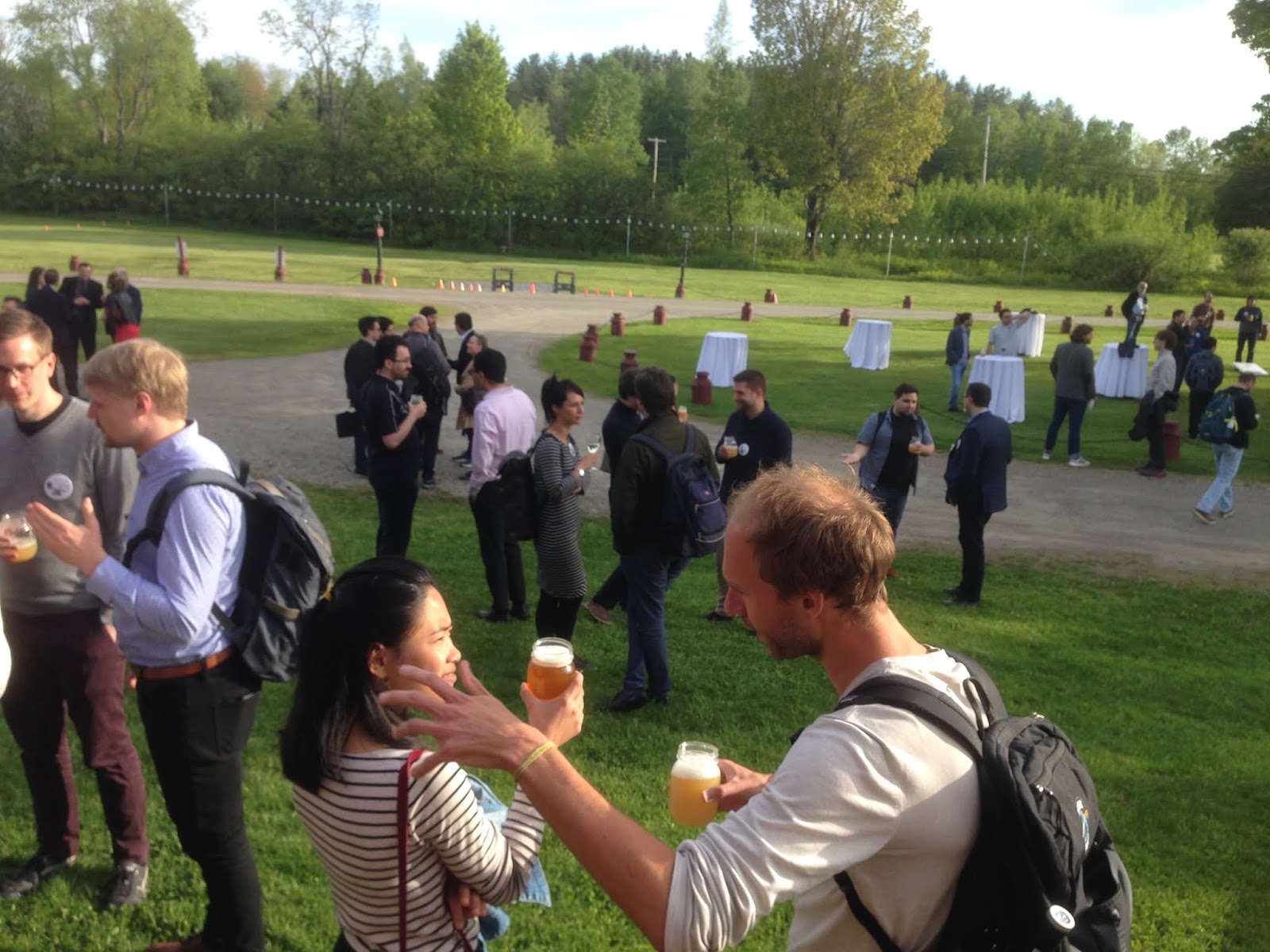
A clear highlight was the banquet last Wednesday night. We drove, but buses were arranged for those who needed a ride to the banquet location, which was the Mansfield Barn in Jericho, Vermont. Many conferees enjoyed being on a school bus, some for the very first time!
 
 Our conference was marked with a milk jug, a nice rustic touch.

At the banquet, Professor Claudia Wagner sat next to me. She had just been to UMass Amherst for a conference organized by my Computer Science colleague, Professor Andrew McCallum, having traveled from Cologne, Germany.  What a wonderful, small academic world it is. We had a lovely conversation since she is originally from Austria, and I had lived in Innsbruck with my family while on a Distinguished Fulbright.


The banquet food was delicious (impossible to get a bad meal in Burlington) and I was so honored and thrilled to be recognized with the Fellows Award.
More background on the Fellows Award, including the list of the inaugural Fellows, many of whom I am sure you will recognize, can be found here.

It was extra special receive the Fellow plaque from Professors Motter and Moreno.
The citation above reads: "For sustained contributions to network science, including the formulation, analysis, and computation of solutions to engineered network systems, from congested urban transportation to supply chains, under varied decision-making behaviors."

Also, so deservedly recognized at the banquet was Professor Albert-Laszlo Barabasi, the Founder of the Network Science Society.
The wonderful scientific talks, discussions, and the beauty of the location as well as the hospitality will stay with me. It's also terrific to have some NetSci2019 souvenirs!

Congratulations to the NetSci2019 conference organizers, the speakers, and to all the award recipients. NetSci2019 was truly special and I am very grateful. The love of networks is bringing many scientific disciplines and its researchers closer together for even more impactful contributions!

Friday, March 31, 2017

Fabulous Talk by Professor Ozlem Ergun on Restoration of Network Connectivity In Large-Scale Disaster Response Problems

The weather forecast for today was dire (and it is March 31) with many area schools in Massachusetts even closing early.

Luckily, the day was just gray with some cold drizzle, and our speaker, Dr. Ozlem Ergun from Northeastern University, made it from Boston to Amherst. We had invited her to speak as part of our great UMass Amherst INFORMS Speaker Series, which the Student Chapter helps me to organize. The chapter does a terrific job advertising the talks, handling much of the logistics, including a reception prior to the talk, and providing information on its website as well as a newsletter through an e-list. Special thanks to officers: Pritha Dutta, Deniz Besik, Ekin Koker, Destenie Nock, and Amro El-Adle, for their hard work before and after the event today!

Dr. Ergun's presentation was on a topic of great interest to me - Restoration of Network Connectivity in Large-Scale Disaster Response Problems. The Chapter President, Pritha Dutta, had prepared the nice poster below announcing the talk, which also made the UMass Amherst homepage under events and was advertised at the Isenberg School on our fancy electronic displays.
Professor Ergun has been involved in humanitarian logistics and disaster relief research for a long time and joined the faculty at Northeastern University after being on the faculty of Georgia Tech. She is especially known for her work on debris removal post disasters. Her talk today focused on the restoration of network connectivity, specifically, critical infrastructure, such as transportation networks, in order to enable service networks to become, again, operational. For example, think of the destruction of roads and bridges post a disaster such as an earthquake and one wishes to deliver relief supplies and personnel from points of supply to points of demand under such conditions. Which roads should be repaired in the sense of removing debris so that they become passable and network connectivity in order to accomplish desired emergency response tasks is restored? She noted that multiperiod models are needed since in a given time period one may have only a certain amount of resources available.  She emphasized that if you can't get rid of debris you can't recover (just think of Haiti post the earthquake). Emergency agencies provide guidelines but not how to do it!

She emphasized the importance of integrating operations research and network science, which I fully concur with. Her talk especially resonated since I teach and do research on humanitarian operations and disaster relief and have also co-authored the Fragile Networks book with my former Isenberg School doctoral student and now tenured Associate Professor, Dr. Patrick Qiang.

And, coincidentally, I was just teaching the Nagurney-Qiang network performance measure and importance indicator for both nodes and links in my Humanitarian Logistics and Healthcare class last week!

I very much like how Professor Ergun emphasized that it is not just the topology of a network (or graph) that matters, before and after destruction/deterioration, but also what services are provided on the network! Since operations researchers care about  a variety of activities on networks from transportation and logistical flows to even financial and informational flows, this is quite "natural" for us. I also would put this in the area of "supernetworks."

She shared with us a network betweenness measure which she had extended with her doctoral students and then took us on a fascinating journey of a case study of resiliency of Boston versus Manhattan (two of my favorite locations on the planet)! She also presented an optimization problem, which one would need to solve in seconds consisting of the maximization of the benefit of making the connections over the time periods, given supply and demand points, and a variety of constraints.


Professor Ergun brought several of her PhD students and members of Northeastern's INFORMS Student Chapter to UMass Amherst, which made her visit extra special since our UMass Amherst INFORMS Student Chapter members could interact with their "sister" chapter in (eastern) Massachusetts.

I hosted the lunch at the University Club and the service and food were fantastic. Although it is a Friday, I suspect that many others had cancelled because of the weather forecast, which did not come to fruition! We enjoyed the clam chowder and the salad with crab cakes and we shared the chocolate torte, lemon mascarpone cake, and the cheesecake, which we had with tea and coffee.

Professor Ergun made it back safely with her students to Boston.

Tomorrow is April Fool's Day and there is snow, again, in the forecast! Operations researchers are resilient and we are so grateful to Professor Ergun for coming to UMass Amherst to speak and for also bringing some of her students and chapter officers of the INFORMS Student Chapter at Northeastern University!

Thursday, February 18, 2016

Great Visit to the Yale Institute for Network Science

Yesterday I had the great pleasure and honor of delivering a Distinguished Lecture at the Yale Institute for Network Science (YINS). The title of my presentation was: Supply Chain Networks Against Time: From Food to Pharma.


My full presentation can be downloaded here.

I had been invited to speak at Yale by the Co-Directors of  YINS, Professors Nicholas Christakis and Daniel Spielman, and was delighted to be introduced by the INFORMS President, the one and only Professor Ed Kaplan, whose latest column is a must read. YINS is thriving under the visionary leadership of Christakis and Spielman.

The wonderful attention to detail surrounding my visit I am most grateful for and extend special thanks to Ms. Emily Hau. Not only did I have an office, but there was even a welcome sign and even gifts. Plus, there was a luncheon spread that the audience could indulge in before and during my talk, which was videotaped.

The lecture took place on the third floor of  17 Hillhouse Avenue on the Yale University campus. Professor Ed Kaplan introduced me.
Given the composition of the affiliated faculty, postdocs, and students of YINS, which include not only MDs but also PhDs from disciplines such as computer science, sociology, operations research, electrical and computer engineering, biology, public health, as well as other (all lovers of networks),  I wanted to make sure that the topics I covered would appeal to such a broad audience.

A delightful surprise during my presentation was having Cyrus, the YINS mascot, a highly intelligent German Shepherd who loves chasing after laser beams of remote pointers, show up o make a command appearance right next to me! I had to have a photo taken with him.
After my presentation I enjoyed speaking to faculty and students and had additional appointments even with MD/PhDs, a sociology professor, and a postdoc in Electrical and Computer Engineering.

The day was filled with intellectual delights - from discussions on network models of the shared economy and new currencies to supply chains of pharmaceuticals in Africa - I wish that the day would not end.

And then to make a perfect ending to a fabulous day, we had dinner at the Union League Cafe. Walking through the Yale University campus was also a highlight of the day.

The ambience at the restaurant was perfect - with marble columns and Tiffany glass windows and the company magnificent - Professors Daniel Spielman, Ed Kaplan, and Leandros Tassiulas.

I marvel at what YINS has accomplished and look forward to its continuing growth and the breaking down of barriers between disciplines through Network Science and the building of new communities. Congratulations and thanks to its outstanding Directors: Professors Christakis and Spielman.

And I was even given souvenirs!

Friday, January 15, 2016

Looking Forward to Speaking at Yale at its Network Science Institute

The new semester begins at UMass Amherst on Tuesday. It will be a very busy semester but a thrilling one. Besides teaching two courses at the Isenberg School, I will also be hosting speakers not only in my classes but also through the UMass Amherst INFORMS Student Chapter as its Faculty Advisor. Plus, I will be traveling to give invited lectures at various universities and companies.

I very much enjoy traveling to different locations and giving talks and always come back with new ideas, an expanded professional network,  wonderful memories, and, sometimes, even adventures. Plus, what could be better than interacting with faculty, students, and practitioners that come to your presentations?

The first invited seminar that I am giving in 2016 will be at Yale University. Although I have given talks at such Ivy League schools (at some of these multiple times) as: Harvard, Brown, Cornell, and UPenn, I have never before spoken at Yale. For this reason, and quite a few others, I am quite excited about speaking there on February 17, 2016.

Since my host at Yale will be the Network Science Institute, it will be extra special to be surrounded by those who share my passion for networks!

I am speaking in the Yale Institute for Network Science (YINS) Distinguished Lecture Series and the title of my presentation is: "Supply Chain Networks Against Time: From Food to Pharma." The abstract and announcement YINS has already graciously posted.  My presentation will be videotaped. The lecture and Q&A will take place from noon until 1:30PM.

I have started working on my presentation, which I will be polishing over the next couple of weeks.
The Directors of the Institute for Network Science are Professor Nicholas A. Christakis and Professor Daniel Speilman. The Executive Director is Dr. Tom Keegan. The Faculty in Residence at the Institute represent many different disciplines from Engineering and Computer Science to Sociology, so I will do my best to have something fascinating for each of them. The Directors have done extraordinary research that has also been widely covered by the media. The YINS Distinguished Lecture Series has hosted such network science colleagues as Albert-László Barabási (whom I had dinner with on October 30,2015), Matthew O. Jackson of Stanford, and Jennifer Chayes of Microsoft Research, among others.

Also, I expect to see the INFORMS President, Professor Ed Kaplan, there, which will be an additional highlight of my visit to Yale.

Sunday, November 29, 2015

The Fun of Public Speaking and Giving Invited Seminars

When faculty (or students) complete research, it is important to disseminate it.  Of course, one should always disseminate research results through publications such as journal articles, OpEds, and, if you have a substantive amount around a central theme, even through books. Speaking at conferences is another wonderful way in which to share one's research and also to get feedback on it.

Another great venue at which to share your research and to educate is through forums such as invited seminars that many departments within colleges and universities organize and hold at regular intervals.

If you have a great talk (or, better yet, since sometimes it is more fun not to be repeating oneself even if the faces in the audience are different, several talks) and are willing to travel, then, when the right invitations come, giving an invited seminar can be great fun.

You may get to go to places that you might not otherwise have gone to and meet new colleagues and students during your travels and also learn about other schools and their challenges.  I recall giving the Kleber-Gery lecture at St. Olaf College in Northfield, Minnesota, where the faculty have survival gear, including snowshoes, in their car trunks. I was put up in a hotel where Jesse James stayed and I got the bridal suite, complete with a canopy bed!  I spoke at the University of Oklahoma as part of their Dream Course series, instituted by President Boren and was put up in my own villa with multiple rooms decorated with U. of Oklahoma paraphernalia.

I have also given quite a few invited seminars abroad in other beautiful locations such as Stockholm and Gothenburg, Sweden, Vienna, Austria,  and in Catania, Italy. Some of the questions I received from the audiences have turned into research problems that we are now pursuing. The food was also amazing in all those locations and the hospitality!

Other very enjoyable experiences I have had, in terms of speaking engagements, were through the INFORMS Speakers Program. I have traveled to Dallas to speak at SMU through this program, where the audience consisted of academics, students, and practitioners, many from the airline industry, and also to Boston to speak at the Boston INFORMS Chapter with my wonderful host, Dr. Les Servi of MITRE.  For the former presentation, I made it with just minutes to spare - the taxi driver was asking me for directions to SMU  and I had never been there, plus it was after 7PM and pitch dark!

Every audience that you speak to generates new ideas for you and that has something to do with the give and talk of a lively seminar.

Sometimes the invitation to speak may come from an organization or venue, which is unique and also very rewarding. Examples of the latter that I have had have included being a panelist at the World Science Festival on Traffic in NYC and also a panelist on Transport and Traffic at the New York  Times Energy for Tomorrow Conference, also in NYC, with a theme of Building Sustainable Cities. One member of the audience, from Toronto, at the former venue still communicates with me and told me that my panel and presentation changed his life! This year's Energy for Tomorrow conference is taking place in Paris next week under heightened security.

At times the audience may even be a bit "frightened" of your talk. When I organized a team residency at Rockefeller Foundation's Bellagio Center on Lake Como in Italy back in 2004 and was there for 2 weeks, my group, which consisted of three females - we were the first Operations Research group invited for a residency in the center's 50+ year history, gave a talk to other Center Fellows, who included civil rights activists, poets, and even a Lincoln historian. Some were a bit scared that we would be showing some math. I think that we made our talk quite enjoyable but then, to me, networks can be a global language. A similar experience I had while speaking on Dynamic Networks at Radcliffe Institute at Harvard University, while I was a Science Fellow there in 2005-2006.

In my previous blogpost, I wrote about how thrilled I was that so many students showed up to my game theory and cybercrime seminar late in the day just  two days before Thanksgiving, when the talk was not even required and no faculty member was taking attendance!  Now, that was an energizing experience and so rewarding.

I will be busy on the lecture circuit over the next few months.

This coming Wednesday, I will be speaking in a Cyber Security Faculty Seminar Series at UMass Amherst (no travel reuiqred). The week after, on December 9, 2015, I will be speaking at MIT in the Department of Civil and Environmental Engineering Seminar Series. I was invited to speak there last year but I was booked with travel and other professional commitments so am very glad that I can do it this academic semester.

On February 17, 2015 (I picked the date), I will be giving a Distinguished Lecture at Yale University in its YINS  (Yale Institute  for Network Science) seminar series, which I am very much looking forward to!

Then the day that our spring break begins, March 11, 2015, I will be speaking at the University of Buffalo (the invitation came before UMass Amherst's football team beat Buffalo's and knocked them out of a bowl game). The seminar series is the Praxis Seminar Series and it was very neat to see Michael Trick, a fellow blogger and INFORMS Fellow,  will be speaking there later this week and my colleague, Sundar Krishnamurthy, who is the chair of the Department of Mechanical and Industrial Engineering at UMass Amherst will follow me in this seminar series (Maybe it is because the U. of Buffalo is located in Amherst (NY)).

I have also agreed to speak at Carnegie Mellon University of April 4, 2016.

Many thanks to all those who extended such wonderful invitations!

Monday, November 9, 2015

What is Your Erdos Number and Network Science

On Friday, October 30, UMass Amherst had the pleasure of hearing Professor Albert-László Barabasi of Northeastern University speak on Network Science: From Structure to Control

This was a talk not to be missed. The talk was co-hosted by several entities at UMass including the Computational Social Science Institute (CSSI) ( a great group of colleagues with whom I enjoy being affiliated with). Room 150 in the Computer Science building was packed for his talk with an audience from many schools and colleges on our beautiful campus. My doctoral student, Shivani Shukla, and I represented the Isenberg School. Professor David Jensen of Computer Science introduced our distinguished speaker.


We had hosted Barabasi at the Isenberg School back in 2006 when I was on sabbatical at the Radcliffe Institute at Harvard in our great UMass Amherst INFORMS Speaker Series (and what an amazing list of speakers we had that Spring 2006, which even included Braess of Braess paradox fame).

I had last seen  Albert-László at a Network Science conference at the Media Lab at MIT, a few years ago,  to which I brought my doctoral student (now a Professor), Min Yu.

Barabasi began his lecture (I would have blogged it sooner but last week I was blogging from the INFORMS conference in Philadelphia and I was swamped) by bringing up Paul Erdos, a fellow Hungarian. Erdos,  the renowned mathematician,  had over 500 collaborators (some say 509 and others 511 - I have not counted them).  Erdos traveled the world from collaborator to collaborator with a suitcase typically staying for about 5 days.

Identifying one's Erdos number has become quite the hobby among STEM (and some other) folks. One has an Erdos number of 1 if one was a direct collaborator of Erdos', a number of 2, if one co-authored with a co-author of Erdos', and so on. My Erdos number is 4, by way of Paul Dupuis, Ofer Zeitouni, and Persi Diaconis.

You may be more familiar with the  Bacon number (named after the actor Kevin Bacon who starred in the move, "Footloose." 

And, of course, some actually know their Erdos + Bacon number.  Barabasi mentioned that his Bacon number was actually lower than his Erdos number, since he had been in a movie with someone who was in a movie with so and so and so on who starred with Kevin Bacon.

Now, what does this all have to do with Network Science?

Erdos is known for the Erdos-Renyi model in graph theory, which describes random graphs or networks. The degree distribution of the World Wide Web is not Poisson but follows the power law. Essentially, there are a very large number of small connected nodes in such a network and a few that are very highly connected. The World Wide Web is like an airline network with hubs. The Internet is a scale-free network according to the famous paper by yes, Faloutsos, Faloutsos and Faloutsos, but there has been some discussion about this claim.

Barabasi emphasized in his talk that a few actors are "hubs" and metabolic and protein interaction networks, which have evolved over 4 billions of years, also have hubs.

He noted that in network science (his books are definitely worth reading and he is highly cited), it is not just a matter of connecting nodes but that nodes are also evolving dynamically. He spoke of the preferential attachment model and then asked the question of where robustness comes from. He spoke about the Internet being robust to random failures and also noted that hubs are important both in the spread of ideas and diseases, as well. He referred to Vespignani, whom I have had the pleasure of meeting through the I3P association, which is a consortium based at Dartmouth.

His recent research, has, among many fascinating topics, been focusing on control. Just think of a car with 6,000 components but essentially only 4 are needed to control it. He also mentioned Kalman of Kalman filtering fame.

He described an interesting study that he conducted in Hungary in an organization to identify who were the hubs and found the 2 or 3 most influential people, one being the custodian, who was like "gossip central."

His talk was delivered with his fantastic energy, dynamism, and sense of humor. He included videos in addition to many vivid photographs. If you did not love networks before his talk, you would have fallen in love with them during it.

I was also very lucky to be invited to join Barabasi and a few colleagues from economics, computer science, and sociology (Professor James Kitts, who is the Co-Director of CSSI with Professor David Jensen). I also brought my husband along since he, like Barabasi, has a PhD in physics.


The discussions at dinner were fabulous. I wish that the evening would not end. We talked about topics as wide ranging as identifying Nobel prize winners from co-authorship of papers; determining through the language in an abstract whether a scientific paper was written by a female or a male, and we even discussed the Braess paradox.  I keep on emphasizing the importance of including flows and economic behavior of decision-makers in network science. We also discussed the success of the first PhD program in Network Science, which he helped to establish at Northeastern University and a similar PhD at a university in Hungary that he is affiliated with and that the billionaire Soros is helping to fund. Yes, Soros is also Hungarian.

below are photos taken at the dinner that great Friday evening.
Thanks to Professor Barabasi for coming out to Amherst from Boston and for your brilliant lecture on Network Science!