Thursday, November 22, 2012

Happy Thanksgiving and Thanks to My Great Students and Collaborators!

Many have traveled by planes, trains, busses, and/or cars or perhaps walked to get to their destinations today to celebrate Thanksgiving. Some will be the hosts and the delicious aromas of the turkey baking, along with all the fixings, are permeating homes. Others who have lost homes and are struggling, hopefully, will  be welcomed by their communities where there are volunteers to make sure that all those in need feel welcome.

As I communicated with my doctoral students at the Isenberg School of Management and several close collaborators yesterday, it has certainly been a very eventful year. Some responded by saying that they remember celebrating Thanksgiving dinner over our home and were introduced to such traditions by my family.

I'd like to take this opportunity to give thanks to all those who have offered me advice and support this year, especially colleagues at INFORMS, at WORMS (Women in Operations Research and the Management Sciences),  RSAI (Regional Science Association International), the AMS (American Mathematical Society), and my wonderful new colleagues at the School of Business, Economics and Law at the University of Gothenburg, where I have been spending part of my sabbatical this year. Special thanks to my great students and collaborators.

Alone we can only do so much but together we can accomplish tremendous things and also have an enjoyable time working together!

With best wishes to everyone for a safe, warm, and inviting Thanksgiving Day!

The photos below were taken at a Thanksgiving dinner that we hosted a few years back to which I invited my doctoral students at that time. They all successfully graduated and several have achieved tenure (even in record time). These memories we will always treasure.


Monday, November 19, 2012

The Magic of Holiday Windows in NYC

I spent 3 days in NYC recently. Usually, when I travel it is to give a talk or to attend a conference but this time I was playing the role of a "spouse" and was in NYC to support my husband who was being honored by the Radio Club of America.

The weather at this time of year could not have been better so we walked for miles.

The Christmas tree was up in Rockefeller Center but had not yet been decorated and the shades were still drawn at the Saks windows.

Several major stores (lucky for us) had already decorated their holiday windows and the below photos were taken at Macy's (which will be the destination of the Thanksgiving parade this Thursday as it has been for many years), at Lord & Taylor's, and at Tiffany's.

I thought that these displays captured so well the magic of this season and,  given all the major weather events of the past year including, Superstorm Sandy, it was relaxing to just view some beautiful window displays.

Happy Thanksgiving to all those who celebrate this special holiday!
Holiday Windows at Macy's
Holiday Windows at Lord & Taylor
     Holiday Windows at Tiffany's
When I was an Assistant Professor at UMass Amherst, after receiving my PhD from Brown University, two colleagues from Marketing, who have since left, and have had prominent careers, Professor Tom Madden and Professor Bill Dillon, used to tease me that "they don't do windows."

The beauty and artistry in the above (and the Tiffany window displays are miniatures), can't help but inspire.


Sunday, November 18, 2012

Congrats to the New Fellows of the Radio Club of America and Other Awardees and a Thank You

We recently returned from NYC where, this past Friday, my husband and I attended the 103rd Anniversary Awards Banquet of the Radio Club of America at the New York Athletic Club on Central Park South.
 

The evening was truly special, with the recognition of individuals who have contributed in a multiplicity of ways to radio communications and broadcasting, education, and even to engineering and the manufacturing of radio communications equipment.

Among the honorees was Ms. Carole J. Perry, who received The President's Award for her outstanding development and advancement of the Amateur Radio Youth Program. Ms. Perry is from Staten Island, and in her acceptance speech, she, as did several others, spoke of the devastation wrought by Superstorm Sandy. She noted that even though some still do not have power they still have strength! Ms. Erin King, who is a freshman at MIT, received the Young Achiever Award. David Buchanan received an award for his contributions to public safety.

I was at the banquet since my husband, Lad Nagurney (the other Professor Nagurney), was one of the five recipients of the Fellow Award.  Glenn Bischoff, the Publisher of Urgent Communications, was one of the other Fellow awardees, and I very much enjoyed talking with him about disaster communications and humanitarian logistics.
                                    
The keynote speaker was David Sumner, the Chief Executive Officer and Secretary of the American Radio Relay League (ARRL). He had recently returned from Vietnam. He was the contact person who had suggested, when I was organizing, under the auspices of the Rockefeller Foundation's Bellagio Center Programs,  the conference on Humanitarian Logistics: Networks for Africa, that I have Dr. Cosmas Zavazava of the International Telecommunications Union of the United Nations, speak.

David Sumner spoke brilliantly on the importance of communications, especially robust radio communications, in saving people's lives. Brian Williams had been the keynote speaker at last year's banquet, and Walter Cronkite, the year before he passed away..

We had a wonderful group of fascinating people at our banquet table, including Andrew Conte, and his wife, who had spent a year at UMass Amherst on an exchange program from Rutgers. Mr. Conte received the Jack Poppele Award, named after the founder of the radio station WOR and Director of the Voice of America under President Eisenhower.
                                        
Below, I have posted some additional photos taken at the New York Athletic Club and of those who attended

Congratulations to all the award recipients and thanks for all that the members have done over one century in communications and in education!


Friday, November 16, 2012

Interesting Upcoming Conferences on Networks, Computational Management Science, and Logistics in Great Locations

I recently returned from the 59th Annual North American Meetings of the Regional Science Association International in Ottawa, Ontario, Canada, November 7-10, 2012, which was wonderful not only scientifically but also socially. At the conference the Japan section of the RSAI also honored Professor David E. Boyce for his research with a wonderful dinner, medal, and certificate.

Last Saturday, at the conference, I also was completely surprised and so deeply honored when NARSC (North American Regional Science Association Council) presented me with the Walter Isard Award for my scholarly contributions. Walter Isard was the Founder of Regional Science and someone whose legacy because of his writings, mentorship, leadership, and wide impact globally will continue to inspire new generations.

Conferences are special -- we get together to present our latest research, to reconnect with colleagues and friends, to learn from one another, and to celebrate achievements and recognitions. Conferences also may take place in  interesting locations/destinations so, in going, one learns also from travel experiences.

There are several upcoming conferences that may be of interest to some of my readers. These are smaller, focused conferences in locations that I have been to and have very much enjoyed. I admit, I am involved in these conferences in various capacities (on the program committee, for example, or as an invited speaker), so I do care about their success.

The conferences are:

4th Workshop on Complex Networks: CompleNet 2013
Berlin, Germany, March 13-15, 2013

The flier below is for the above logistics conference in Gothenburg.
And, just to further pique your interest,  below I have posted several photos of Gothenburg taken this year since I am a Visiting Professor at the School of Business, Economics and Law at the University of Gothenburg and have fallen in love with the city and its people plus all that the city has to offer!


Wednesday, November 14, 2012

Congratulations to the Inaugural Group of Fellows of the American Mathematical Society (AMS)

The American Mathematical Society (AMS) recently announced its inaugural list of Fellows.

Other societies, that I am a member of, have had the "Fellows" distinction (much)  longer from INFORMS  to The Econometric Society to SIAM to RSAI. I am a Fellow of the RSAI.

Needless to say, since AMS just introduced the Fellows recognition in 2012 the list is quite long with the goals of the Fellows Program being, according to the AMS website;
  • To create an enlarged class of mathematicians recognized by their peers as distinguished for their contributions to the profession.
  • To honor not only the extraordinary but also the excellent.
  • To lift the morale of the profession by providing an honor more accessible than those currently available.
  • To make mathematicians more competitive for awards, promotion, and honors when they are being compared with colleagues from other disciplines.
  • To support the advancement of more mathematicians in leadership positions in their own institutions and in the broader society.
Looking at the list of AMS Fellows took me down memory lane since not only were there names of mathematicians that I had cited in my papers and books and that I serve on editorial boards with and have also interacted with in various professional settings over the years, but there were 15 AMS Fellows from Brown University, my alma mater. From the Division of Applied Mathematics the AMS Fellows are: Constantine Dafermos, Wendell Fleming, Stuart Geman, John Mallet-Paret, Donald McClure, David Mumford, Chi-Wang Shu, and Walter Strauss and the honorees from the Department of Mathematics are: Thomas Goodwillie, Thomas Banchoff, Stephen Lichtenbaum, Hee Oh, Jill Pipher, Joseph Silverman, and John Wermer.

Since I have 3 degrees in Applied Math from Brown and also a degree in Russian Language and Literature (yes, I love languages of all sorts, including computer programming languages)  I know and even had as instructors many of the faculty on the above list in Applied Math. Plus, Constantine Dafermos was Stella Dafermos' husband and she was my doctoral dissertation advisor at Brown. 

Of course, on the list are individuals who already are Fellows of other societies that I mentioned above.

Congratulations to all the AMS Fellows!

Tuesday, November 13, 2012

Supply Chain Networks with Global Outsourcing and Quick-Response Production -- Operations Research and Fast Fashion

Last Sunday's New York Times magazine had a terrific article by Suzy Hansen, "How Zara Grew Into the World's Largest Fashion Retailer,"  which I very much enjoyed reading. I do admit that,  when I live in Gothenburg, Sweden, I enjoy visiting the Zara, H&M, and TopShop stores there since I conduct research on a variety of network systems, including supply chain networks.  Along with my former doctoral student, who is now an Assistant Professor, Min Yu,  we have published two papers on what is known as fast fashion.


The first paper on the topic that we wrote is: Fashion Supply Chain Management Through Cost and Time Minimization from a Network Perspective, Anna Nagurney and Min Yu, in Fashion Supply Chain Management: Industry and Business Analysis (2011), T.M. Choi, Editor, IGI Global, Hershey, PA, pp 1-20.

The second is: Sustainable Fashion Supply Chain Management Under Oligopolistic Competition and Brand Differentiation, Anna Nagurney and Min Yu, International Journal of Production Economics, Special Section on Green Manufacturing and Distribution in the Fashion and Apparel Industries 135: (2012) pp 532-540.

In The New York Times article,  Hansen writes about the company Inditex, which owns the Zara brand and series of stores. She writes:  More than half of Inditex’s manufacturing takes place either in the factories it owns or within proximity to company headquarters, which is to say in Europe or Northern Africa. Inditex owns factories in Spain and outsources production to factories in Portugal, Morocco and Turkey — considered costly labor markets, typically. The rest of its clothes are produced in China, Bangladesh, Vietnam and Brazil, among other countries. The trendiest items are made closest to home, however, so that the production process, from start to finish, takes only two to three weeks. Inditex’s higher labor costs are offset by greater flexibility — no extra inventory lying around — and on faster turnaround speed. 

The article also has some very nice quotes from Professor Fraiman of Columbia University that got me excited because of the language and terminology. Fraiman, in commenting on Inditex's  ideas on expanding in China stated that: “Their factories in La Coruña have a finite capacity to respond quickly. You open more and more stores, and you don’t have flexibility of the last-minute response. Once they have a big thrust in China, then what happens is that they will have to take the whole model” — the processing of customer reactions, the quick-turnaround design teams, the logistics platform — “and replicate it in China.” But the bigger Inditex gets, he says, the more it will lose control over quality and efficiency. 

In a recent paper of ours, Supply Chain Networks with Global Outsourcing and Quick-Response Production Under Demand and Cost Uncertainty, Zugang Liu and Anna Nagurney, which is in press in a special issue of the Annals of Operations Research, we use Zara, as well as toy production, as some of the motivating examples. The paper is also interesting from a methodological perspective since we integrate stochastic programming, game theory, and variational inequality theory, as well as real options from finance.

Specifically, in our paper, which my co-author presented at the INFORMS conference in Phoenix and will also be presenting at the DSI conference in San Francisco next week, we developed a modeling and computational framework for supply chain networks with global outsourcing and quick-response production under demand and cost uncertainty. The  model considers multiple off-shore suppliers, multiple manufacturers, and multiple demand markets. Using variational inequality theory, we were able to formulate the governing equilibrium conditions of the competing decision-makers (the manufacturers) who are faced with two-stage stochastic programming problems but who also have to cooperate with the other decision makers (the off-shore suppliers). Our theoretical and analytical results shed light on the value of outsourcing from novel real option perspectives. In addition, our simulation studies reveal important managerial insights regarding how demand and cost uncertainty affects the profits, the risks, as well as the global outsourcing and quick-production decisions of supply chain firms under competition.

 The paper will appear in a special issue dedicated to the memory of Professor Cyrus Derman, who passed away last April at age 85. According to Columbia University, Professor Emeritus Cyrus Derman, was considered the driving force behind the success of Columbia Engineering's Department of Industrial Engineering and Operations Research (IEOR). He had also served as the doctoral dissertation advisor of well-known colleagues in Operations Research, including Professor Michael Katehakis, one of the co-editors of the special memorial volume, Peter Kolesar, and Art Veinott, Jr.

The theme of the special issue is
Optimization under Uncertainty Costs, Risks and Revenues.

Monday, November 12, 2012

More Photos from the Great Regional Science Conference in Ottawa, Canada

I do find it rather amazing that, although I was born in Canada, until the 59th Annual North American Meetings of the Regional Science Association International, which recently took place in Ottawa, Ontario, Canada, I had never been to Ottawa, Canada's capital!

In my previous blogpost, I wrote about the wonderful dinner in honor of  Professor David E. Boyce, that was hosted by Professor Yoshiro Higano of Japan and the accompanying ceremony and also included several photos taken at the very memorable evening.

I often include photos in my blogposts because then one gets a sense of different locations, the atmosphere there, and, of course, the people and sights.

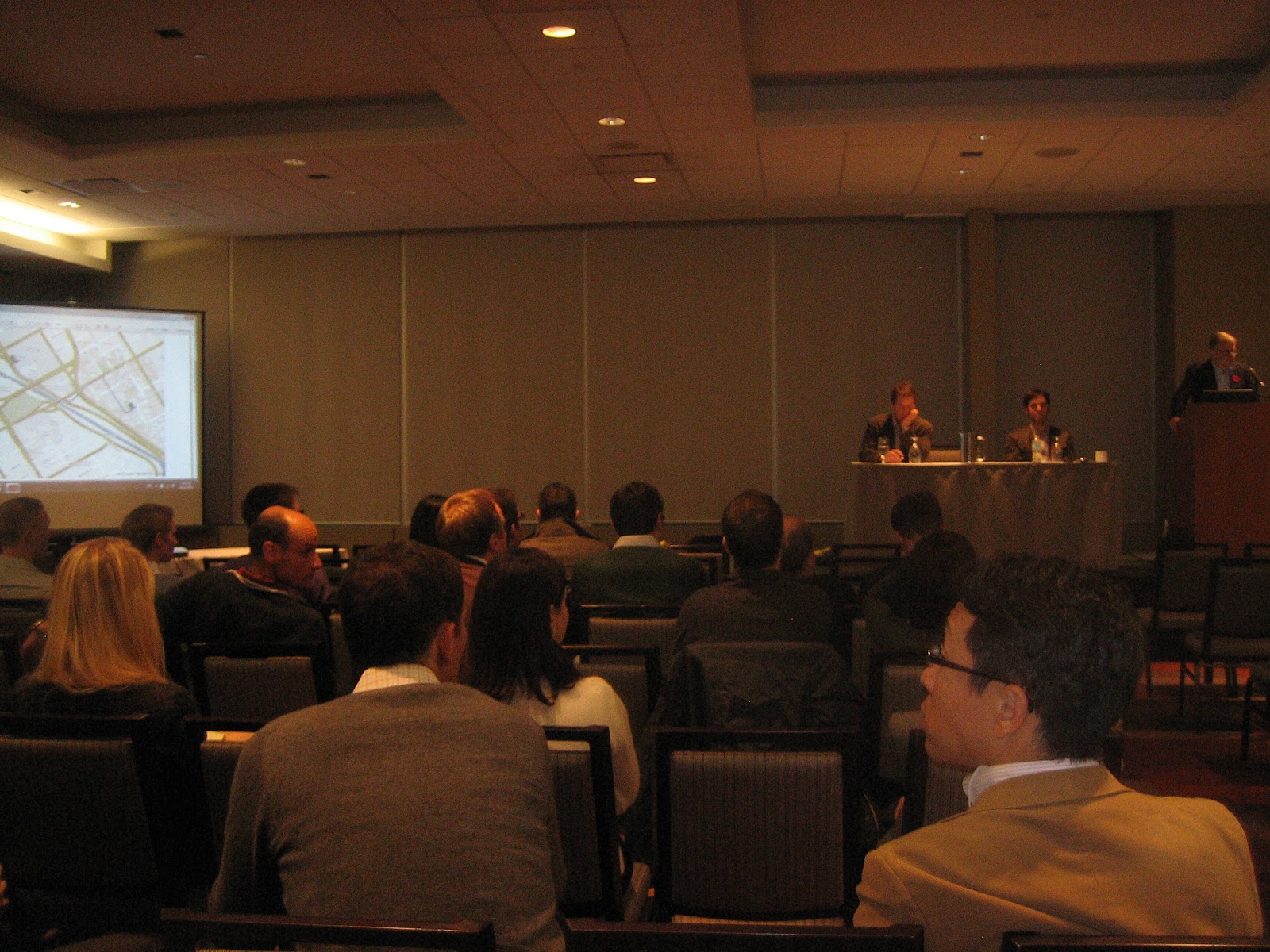
Below I have posted several photos taken at the conference. The first photo below is a snapshot of the view from my window at the Westin hotel that was the conference venue. The other photos were taken at the RSAI Fellows luncheon,  at the coffee breaks,  of my very own session speakers, and at a special session to honor the great contributions of Professor John Quigley, who passed away this year.
 In a separate blogpost I will be writing and including photos of the awards luncheon that took place at the conference this past Saturday.