Showing posts with label COVID-19. Show all posts

Monday, March 28, 2022

Congratulations to Mojtaba Salarpour on His Successful PhD Dissertation Defense!

In an academic's life, one of the many joys is seeing one's students achieve milestones.

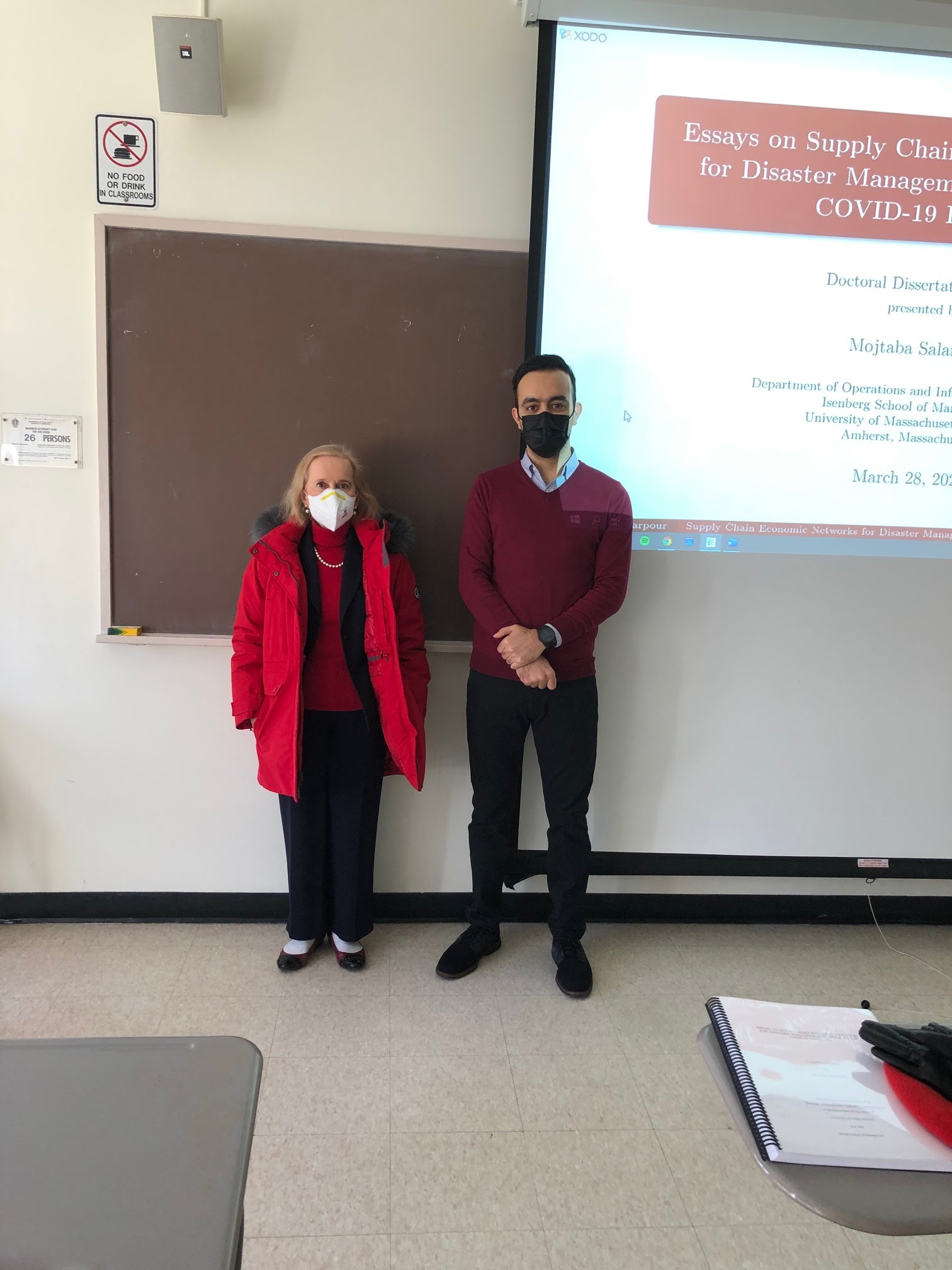
Today was a very special day, since Mojtaba Salarpour,  my PhD student in Management Science at the Isenberg School of Management at UMass Amherst, successfully defended his doctoral dissertation, with the title: "Essays on Supply Chain Economic Networks for Disaster Management Inspired by the Covid-19 Pandemic." The abstract of his dissertation can be viewed here. Mojtaba is my 23rd PhD student. I am grateful to the committee members: Professor Priyak Arora of the Isenberg School and Professors Hari Balasubramanian and Chaitra Gopalappa of the College of Engineering at UMass Amherst. 

When I arrived for the defense today, Mojtaba had assembled all sorts of treats and refreshments and we managed a quick photo before the committee members and others arrived.

Mojtaba's PhD dissertation research has already yielded several journal articles and a book chapter.


Mojtaba served for two years as the President of the UMass Amherst INFORMS Student Chapter (1 1/2 of those in the pandemic). Under his leadership, the chapter received two national awards from INFORMS because of its activities. Below is a photo taken at the Phoenix National INFORMS Meeting in 2021, at which the Chapter was honored with its latest award.

Mojtaba also taught required two different courses at the Isenberg School and has experience teaching in both face to face and in online formats. He clearly, is the "full academic package" with talents in research and scholarship, teaching, as well as service.

I am delighted that he will be joining the faculty of Texas A&M Commerce as an Assistant Professor, in the tenure track, in the Fall.

It is wonderful to see the academic family tree growing with the list of my PhD students, whose dissertation committees I chaired listed here.

And, my academic genealogy, in terms of those "who came before me" is featured below with incredible scientists such as Maxwell, Newton, and Galileo!


My students and I are clearly "standing on the shoulders of giants." 

Sunday, January 16, 2022

Congratulations to the Supernetwork Team at the Isenberg School of Management for a Great Year!

As we begin the New 2022 Year, it is time to take stock and to reflect on the year that has passed.

2021 was a remarkable year in many respects, not the least of which was that it marked the second year of the COVID-19 pandemic.  As the Center Director, I feel it to be important to share with you reflections on this extraordinary year, and to highlight some of the accomplishments of ours at the Virtual Center for Supernetworks.

In 2021, the book, "Dynamics of Disasters - Impact, Risk, Resilience, and Solutions," that I co-edited with Professors  Ilias S. Kotsireas and  Panos M. Pardalos, and Dr.  Arsenios Tsokas was published by Springer. In it, you will find many fascinating contributions, all peer-reviewed, including co-authored work by Center Associates Professor Patrizia Daniele of the University of Catania in Italy and Professor Tina Wakolbinger on the Vienna University of Economics and Business in Austria. My paper - the very first on incorporating labor into supply chain networks, which was done in the context of perishable food supply chains, also appears therein. And, in July 2021, we, again, co-organized another Dynamics of Disasters conference, which this year, because of the pandemic, although based in Athens, Greece,  nevertheless, virtual. The conference included four plenary speakers and we were delighted to hear from all of them, including Center Associate Dr. Stavros Siokos of Astarte Capital, which he co-founded in London. Center Associates were very active at this conference and included presentations of work by Center Associates Professor Patrizia Daniele,  Professor Tina Wakolbinger, Professor Deniz Besik of the University of Richmond, Professor Pritha Dutta of Pace University, Professor Ladimer S. Nagurney of the University of Hartford,  and Isenberg Doctoral Student Center Associate Mojtaba Salarpour. Mojtaba successfully defended his doctoral dissertation in March 2021.
On June 7, 2021, I was deeply honored with the receipt of the 2020 Harold Larnder Prize from the Canadian Operational Research Society.  I delivered my talk, "Novel Supply Chain Network Models Inspired by the COVID-19 Pandemic: From Optimization to Game Theory," virtually and, remarkably, the prize certificate was delivered through express courier services around the same time!  The video of my prize lecture can be viewed here. I am only the second female in its 35 year history to receive this prize - the first one was Dr. Ailsa Land, who, sadly, died in 2021. I was honored to be a panelist to recognize her receipt of the Beale Medal, which I blogged about.
In the pandemic, our expertise on supply chains and various network systems continued to be sought after. Since part of the Center's focus is public outreach, in addition to our mission of research and education, we responded to numerous media interview requests from the print media, radio shows, as well as TV news programs, and podcasts.  Print media coverage can be viewed here. For various TV and radio interviews plus podcasts, see here,
Center Associates presented at the EURO Conference as well as the INFORMS Conference, which was in hybrid format, with Professor Deniz Besik presenting at this Anaheim conference in person as well as Center Associate Professor Sara Saberi of WPI and Mojtaba Salarpour. I had the honor and pleasure of giving a tutorial at the INFORMS conference, which was recorded - "Game Theory and the COVID-19 Pandemic," which is also an INFORMS publication in its tutorial series. I thank Professors John Carlsson and Doug Shier for their great assistance and support.
In addition, to other conference presentations, we took part in an interesting conclave in India and a workshop in  Nepal, demonstrating the reach of the research that we do.  Of particular focus this year, was researching various supply chain disruptions in the pandemic, continuing work on food supply chains, modeling various trade measures in the pandemic, expanding on disasters and game theory, and  including labor into various supply chain networks in a series of papers,  as well as constructing models of human migration and associated policies, and even building a model of convalescent plasma donations! I was deeply honored that my paper, "Supply Chain Game Theory Network Modeling Under Labor Constraints: Applications to the Covid-19 Pandemic," that was published in the European Journal of Operational Research, receive a 2021 Editor's Choice Award.

I am also very grateful to Isenberg Dean Anne P. Massey and to the UMass President Marty Meehan for appointing me  the Eugene M. Isenberg Chair in Integrative Studies in April 2021.  I am very appreciative of having held the John F. Smith Memorial Professorship of Operations Management from 1998 until that point and especially thank my wonderful benefactor - Jack Smith, the former CEO and Chairman of the Board of General Motors and a UMass Amherst alumnus. 

Center Associates achieved additional accolades. Professor Deniz Besik submitted a letter with testimony to Congress on food insecurity in the pandemic. Professor Pritha Dutta was interviewed by FOX on supply chain disruptions in the pandemic, and Professor Sara Saberi received a major NSF grant to help Massachusetts manufacturing prepare for future crises.

In addition, it was a great year - despite the pandemic - for the UMass Amherst INFORMS Student Chapter, which I have served as the Faulty Advisor of since 2004. We hosted several panels as well as Dr. Mauricio Resende of Amazon and Dr. Robin Lougee, formerly of IBM in our Speaker Series! The chapter was recognized by INFORMS with the Cum Laude Award at the Annual Meeting in Anaheim. Mojtaba Salarpour, continued to serve as the Chapter President until September 2021, completing two years of exceptional service.

Plus, it was uplifting to be the invited Faculty Speaker at the UMass Amherst Chancellor's Donor Breakfast in November. The title of my presentation was: "From Supernetworks to Supply Chain in the Pandemic."

We continued to write OpEds, several of which were published in The Conversation, including my article on the shipping container, that appeared on September 21, 2021, and, to-date, has over 315,000 reads!

And, to show the research that we are engaged in, below I highlight some of our recent publications:

Supply Chain Networks, Wages, and Labor Productivity: Insights from Lagrange Analysis and Computations
Anna Nagurney, to appear in Journal of Global Optimization.

A Multiperiod Supply Chain Network Optimization Model with Investments in Labor Productivity Enhancements in an Era of COVID-19 and Climate Change
Anna Nagurney, accepted for publication in Operations Research Forum.

Optimization of Investments in Labor Productivity in Supply Chain Networks
Anna Nagurney, accepted for publication in International Transactions in Operational Research.

Wage-Dependent Labor and Supply Chain Networks in the COVID-19 Pandemic and Beyond
Anna Nagurney, in press in Analysis, Geometry, Nonlinear Optimization and Applications, P.M. Pardalos and T. M. Rassias, Editors World Scientific Publishing, Singapore, October 2021.

Game Theory and the COVID-19 Pandemic
Anna Nagurney, in INFORMS TutORials in Operations Research, October 2021. Also presented at the INFORMS 2021 Annual Meeting.

Modeling of Covid-19 Trade Measures on Essential Products: A Multiproduct, Multicountry Spatial Price Equilibrium Framework
Anna Nagurney, Mojtaba Salarpour, and June Dong, International Transactions in Operational Research 29(1), 2022, pp 226-258.

A Multiclass, Multiproduct Covid-19 Convalescent Plasma Donor Equilibrium Model
Anna Nagurney and Pritha Dutta, Operations Research Forum 2, 31 (2021) Open Access on SpringerLink

Spatial Price Equilibrium, Perishable Products, and Trade Policies in the Covid-19 Pandemic
Anna Nagurney, Montes Taurus Journal of Pure and Applied Mathematics 4(3), 2022, 9-24.

A Multicountry, Multicommodity Stochastic Game Theory Network Model of Competition for Medical Supplies Inspired by the Covid-19 Pandemic
Mojtaba Salarpour and Anna Nagurney, International Journal of Production Economics 235: (2021), 108074.

Optimization of Supply Chain Networks with Inclusion of Labor: Applications to COVID-19 Pandemic Disruptions
Anna Nagurney, International Journal of Production Economics 235: (2021) 108080.

Perishable Food Supply Chain Networks with Labor in the Covid-19 Pandemic
Anna Nagurney, Dynamics of Disasters - Impact, Risk, Resilience, and Solutions, I.S. Kotsireas, A. Nagurney, P.M. Pardalos, and A. Tsokas, Editors, Springer Nature Switzerland AG, 2021, pp 173-193.

Capacitated Human Migration Networks and Subsidization
Anna Nagurney, Patrizia Daniele, and Giorgia Cappello, Dynamics of Disasters - Impact, Risk, Resilience, and Solutions, I.S. Kotsireas, A. Nagurney, P.M. Pardalos, and A. Tsokas, Editors, Springer Nature Switzerland AG, 2021, pp 195-217.

Preface to Dynamics of Disasters Impact, Risk, Resilience, and Solutions, Ilias S. Kotsireas, Anna Nagurney, Panos M. Pardalos and Arsenios Tsokas, Editors, Springer Nature Switzerland AG, 2021, pp v-xii.

International Human Migration Networks Under Regulations
Anna Nagurney and Patrizia Daniele, European Journal of Operational Research 291(3): (2021), pp 894-905.

Networks in Economics and Finance in Networks and Beyond: A Half Century Retrospective
Anna Nagurney, written for the Special 50th Anniversary Issue of Networks, Networks 77(1): (2021), pp 50-65.

Tuesday, September 21, 2021

Teaching Face to Face in the Pandemic - The First 3 Weeks

It has been exciting, and quite interesting, to be back to teaching face to face at UMass Amherst in the pandemic.

When the COVID-19 pandemic was officially declared by the World Health Organization on March 11, 2020, I was on sabbatical for that spring term, and, hence, was not teaching.

Last academic year the instruction was done remotely, except for a few classes at the Isenberg School of Management. Hence, I taught all my courses in the Fall 2020 and Spring 2021 remotely via Zoom. It was a novel experience, especially since I had never taught online before. With the right technology, coupled with a lot of energy and creativity, the courses actually worked out quite well. A big plus was being able to host remarkable guest speakers, who are top professionals, in classes (and the speakers did not have to travel but could Zoom in even from Europe). 

The students regularly showed up to my Zoom office hours and I got to know many of them as individuals. Quite a few continue to stay in touch, even though they have now graduated!

UMass Amherst has a vaccination mandate (with exceptions for medical and religious reasons) for students, faculty, and staff, so that has provided some reassurance even with the Delta variant. Of course, there are still hundreds who are not vaccinated.

Also, UMass Amherst has a mask mandate inside buildings and students have to be masked in classes (although, strangely, faculty do not, and this has been bothering me a lot but this policy, to date, has not been changed). I am teaching with an N95 mask my Transportation and Logistics course.

It is very clear to me that students are glad that the instruction is now face to face. The first two lectures (I have now taught for three weeks) I reminded the students that the masks must be worn so that they cover their noses and mouths. If a student needs to drink, then the student should leave the classroom, and do so outside the room. The students have been truly wonderful at complying. They care about the health and safety of all and doing their best so that we can continue to have the university open and classes conducted in person.

Some features of  "remote" learning remain, which are actually positives. Assignments, lecture notes, and homeworks are all posted on Blackboard. This saves paper and the environment and the grades are easy to calculate but the "marking" of the homeworks can be challenging since it is much easier to write on paper. The students have gotten used to submitting homeworks online and this positive feature remains.

Also, and this is also advantageous pedagogically, when we were teaching (and learning) via Zoom, the classes were recorded and I would post the videos on Blackboard. Students, could then go back to review the material. This feature was very convenient and helpful.

Now, each of my classes (I had to have a classroom switch, due to several issues, including broken windows and technology that did not work) is recorded via Echo 360. I post the videos of the classes on Blackboard. Last year, I taught synchronously on Zoom and I liked the fact that we had a set schedule, which provided a nice rhythm to the week with the class meetings and also office hours. The students very much appreciated that the classes were "live" and not prerecorded (asynchronous teaching and learning).

I emphasize to the students that they must let me know if they will be missing a class and that is certainly happening in the pandemic. Having recordings of class meetings helps, but being healthy and in class is the best. The courses I teach are quite technical and having students ask questions while the class is in session can save a lot of time and enhances learning. 

I make sure that a window is open and the door to the classroom as well for ventilation since a layered approach to minimizing risk and contagion is important. Even the vaccinated can transmit the Delta variant so one has to be very careful.

So far, the teaching in person experience (once I got a new classroom) has been enjoyable and rewarding, despite it being the pandemic. 

I receive many "Thank you!s" after each class, which makes my day. I hope to instill the passion that I have for the subject in my students.

I am sure that this semester will bring new challenges, but, so far, I am feeling, more or less, "safe" and I love teaching my Transportation and Logistics class and interacting with the students in person.

Now, if only my PhD student had gotten his visa in time, so that he could be my TA. He is scheduled to arrive now in Spring 2020.

Monday, September 6, 2021

Our Research on the Inclusion of Labor into Supply Chain Networks

On this Labor Day, September 6, 2021, I thought it appropriate to write this blogpost in celebration of labor in the pandemic. Indeed, the COVID-19 pandemic has vividly and dramatically shown the importance of keeping our workers healthy and safe in all sectors of the economy from agriculture to healthcare. Many worked tirelessly and some suffered tremendously to ensure that products were produced, transported, and then consumed. Essential workers have become our heroes from farmers and food processors to freight service providers, including truckers, to healthcare workers, educators, and many others. 

During the pandemic, I have been researching how to include labor into supply chain networks so that disruptions could be better quantified, appropriate wages identified, and, even more recently, how firms should invest in enhancing the productivity of their workers through enhanced health and safety measures. This research continues and has become a great passion of mine.

I am pleased that three papers of mine on the inclusion of labor have now been published. The first paper, "Perishable Food Supply Chain Networks with Labor in the Covid-19 Pandemic," was published in the edited volume: Dynamics of Disasters - Impact, Risk, Resilience, and Solutions, I.S. Kotsireas, A. Nagurney, P.M. Pardalos, and A. Tsokas, Editors, Springer Nature Switzerland AG, 2021,  pp. 173-193. A prepint of it can be downloaded here.

The second paper, "Optimization of Supply Chain Networks with Inclusion of Labor: Applications to Covid-19 Pandemic Disruptions (2021),  was published in the International Journal of Production Economics, 235, 108080.

This IJPE paper continues to be among the most downloaded from the journal website over the past couple of months, which demonstrates the interest in this topic. This paper focused on the healthcare product supply chains, including PPEs.

The above two papers are optimization models and capture different types of constraints on labor availability. 

My paper, "Supply Chain Game Theory Network Modeling Under Labor Constraints: Applications to the Covid- 19 Pandemic (2021), was published in the European Journal of Operational Research, 293(3), 880-891. It proposes a series of game theory models in which competition for labor by firms is also considered. This is something that we are seeing in the COVID-19 pandemic, which has different sectors suffering from labor shortages. 

I was greatly honored that the Editors of this journal selected this paper of mine for an Editors' Choice Award and the publisher has made the paper available for free from the journal website.

I have also spoken at multiple conferences about this research; most recently, at the MOPTA Conference organized by Lehigh University, which I enjoyed very much. The title of my plenary talk at MOPTA was: "Labor and Supply Chain Networks: Insights from Models Inspired by the COVID-19 Pandemic."


The above papers all acknowledge and thank essential workers. And, today, I extend my gratitude to laborers world-wide. 

Thursday, July 22, 2021

Thanks to All Who Made Our 2021 Dynamics of Disasters Conference a Success!

The 5th International Conference on Dynamics of Disasters has now come to a close. It was Professor Panos M. Pardalos who had the vision to start this conference series. I have had the honor of co-organizing the last four of them. This year the conference was virtual due to the COVID-19 pandemic and was co-organized by Professors Pardalos, Ilias S. Kotsireas, Chrys Vogiatzis, and me, with support provided by Professor Fuad Aleskerov and Sofia Papadaki. The conference website has a link to the full program and information on the outstanding plenary speakers: Professor Maria Besiou and Professor Oleg Prokopyev, and Dr. Stavros Siokos and Dr. George Karagiannis. It was very appropriate and illuminating to have plenary speakers from academia, industry, and government, who shed light on the latest research as well as best practices. 

The plenary talks were truly inspirational!


This was a single stream conference, which worked very well. There were excellent questions and a lot of discussions. Speakers and participants came from many countries, including: Austria, Germany, Italy, India, Nepal, Russia, the UK and the United States! It was very special to have four of my former PhD students present: Dr. Deniz Besik of the University of Richmond, Dr. Pritha Dutta of Pace University, Dr. Tina Wakolbinger of the Vienna University of Economics and Business, and the plenary speaker, Dr. Stavros Siokos! Dr. Besik presented on our latest food supply chain research with disruptions due to the COVID-19 pandemic, which is joint work with Dr. Dutta. Dr. Dutta, in turn, presented on our convalescent plasma research, a paper that was very recently published in Operations Research Forum. Also, my PhD student, Mojtaba Salarpour, presented  our paper published in the International Journal of Production Economics. In addition, I presented a paper on refugee migration networks that was co-authored with Professor Patrizia Daniele of the University of Catania and Professor Ladimer S. Nagurney of the University of Hartford. Our paper had been recently published in the Journal of Global Optimization. Professor Daniele also presented a paper on UAVs and 5G for disaster relief, work with Daniele Sciacca and Gabriella Colajanni.

As Professor Stephan Onggo of the UK (he is originally from Indonesia and is heading the Ops-Relief project) said: Disaster Management is complex and requires many different tools. And, indeed, the conference talks demonstrated the utility and applicability of optimization and simulation tools, AI and Machine Learning, game theory, network science, Data Envelope Analysis, and even the analysis of Twitter. There was definitely a "network" theme in many of the presentations!

Special thanks to colleagues in Nepal, India, and Russia, who joined us despite the challenges with their time zones and the conference talk scheduling. I am so grateful to each and every speaker and participant for the knowledge that was exchanges and also for the very supportive community that we have been building across the miles.

I am very pleased that many new research ideas were generated and new connections made virtually across the miles. It was wonderful to have 3 INFORMS Fellows take part in the conference, Professors Pardalos and Vicki Bier and me!

Below is a virtual group picture of the conferees.


Professor Panos M. Pardalos closed out the conference with the following quote, which I leave you with, "Keep positive but test negative!"

Professor Pardalos, inspired by Dr. Siokos, who emphasized that trees are the only "technology" that removes carbon from the air, then showed us the book in the photo below. Dr. Siokos is the co-founder of Astarte Capital Partners, based in London, England, which invests heavily in forests around the globe.

And we will be co-editing a special issue of the journal Operations Research Forum on our conference theme. The call for papers can be downloaded here.

Friday, July 9, 2021

Busy Week with the EURO 2021 and the Dynamics of Disasters Conferences

My Supernetworks group has been hard at work preparing for conferences that we will be speaking at. This Sunday the EURO 2021 Conference begins. It is a hybrid conference, based in Athens, and goes from July 11-July 14. On July 16, the 5th International Conference on Dynamics of Disasters begins and will last through July 18. It was originally scheduled to be in person and also in Athens, but has turned virtual. I am co-organizing the latter conference with Professors Kotsireas and Pardalos and Vogiatzis with great support from Sophia Paradaki.

Interestingly, back in the summer of 2019, I spoke at EURO Dublin and we organized also a Dynamics of Disasters (DOD) Conference, which took place in Kalamata, Greece! I blogged about the great Dublin conference, where many photos can also be found.  Please also check out my post on the DOD conference in Kalamata, which was a big success and we even edited a refereed volume, which was published by Springer.

The 2021 EURO Conference has a very busy and interesting program. I was delighted to be invited by Ruth Kaufman to give a lightning talk in the OR and COVID session in the Making an Impact Stream. The Making an Impact Stream I spoke at (on a panel) in Dublin and enjoyed the experience and discussions immensely. My lightning talk is entitled, "OR and COVID-19: From Research to Policy." Also, our latest work on game theory and disasters will be presented (the talk has been recorded by my PhD student, Mojtaba Salarpour, since it was placed in an invited session but at 5:30AM EDT). The presentation is based on a paper of ours published in the International Journal of Production Economics (IJPE) in 2021. We thank Professor Tina Wakolbinger of the Vienna University of Economics and Business for inviting us to speak in this Humanitarian Operations session that she organized for EURO 2021.


One can definitely see that we have been heavily engaged in research on various supply chain network themes in the COVID-19 pandemic.

The Dynamics of Disasters Conference has an excellent line-up of plenary speakers: Professor Maria Besiou and Professor Oleg Prokopyev plus Dr. Stavros Siokos and Dr. George Karagiannis.

Our presentations at the DOD conference will include research done with Professors Deniz Besik and Pritha Dutta on food supply chains and disruptions in the pandemic; on convalescent plasma, based on a paper with Professor Pritha Dutta, recently published in Operations Research Forum, and on refugee migration networks - work done with Professors Patrizia Daniele and Ladimer S. Nagurney and based on a paper published in the Journal of Global Optimization. Mojtaba will also present our paper in IJPE presented at EURO 2021. I am looking forward to many interesting discussions and idea generation!


Looking forward to "seeing" many wonderful colleagues at these exciting conferences!

Monday, June 21, 2021

So Honored to Receive the Harold Larnder Prize from CORS (Canadian Operational Research Society)

It has been a whirlwind past two weeks, beginning with the CORS 2021 Conference, which was virtual because of the pandemic, and at which I was honored with the official receipt of the Harold Larnder Prize in a lovely award ceremony. Many thanks to the co-organizers of the conference, Professors Fatma Gzara and Timothy Chan, for the very special introduction and also thanks to the CORS President, Professor Michael Pavlin!


And, the Prize certificate arrived, just in time from Canada, so that I could share it virtually with those at the ceremony. 

The first time that the award was given was back in 1986. The full list of recipients is here and we created a collage of previous recipients, posted below.

I am only the second female recipient of this prize and now the only living one, since, sadly, Ailsa Land passed away on May 16, 2021, at the age of 93.  Quite remarkably, we honored her receipt of the Beale Medal (first female recipient of that award) with a panel on February 25, 2021, and both she and her husband were able to be virtually present. I provide a link to the video of the panel at which I had the honor of speaking and some additional information in a previous blogpost.

As part of the Harold Larnder Prize, I delivered the opening keynote talk, "Novel Supply Chain Network Models Inspired by the COVID-19 Pandemic: From Optimization to Game Theory," at the conference. I have made my slide deck available for viewing and downloading. 


A recording of my Harold Larnder Prize keynote  can be viewed here.

Some background on Harold Larnder, which I highlighted in my keynote:


The framed prize certificate now hands in my office for inspiration. Many thanks to the Canadian Operational Research Society for this great honor! Our great discipline of Operations Research was instrumental in WWII, and its rigorous methodologies and scope of applications have benefited businesses, governments, numerous organizations, including nonprofits, and societies. And, now, its creative minds and powerful tools are helping in the battles in the pandemic.


Saturday, May 1, 2021

In Appreciation of the Wonderful Guest Speakers in My Humanitarian Logistics and Healthcare Class

As the semester draws to a close, as well as the academic year, I would like to take this opportunity to publicly thank the wonderful guest speakers in my Humanitarian Logistics and Healthcare class this semester. In a class such as this, the students learn a tremendous amount from practitioners and, even more so, given their immense challenges because of the COVID-19 pandemic.

On February 18, 2021, we had the honor of hearing from Mr. Tim Pitoniak, who is a Regional Disaster Program Officer for the American Red Cross (ARC) in Massachusetts. Mr. Pitoniak spent the first 10 years of his Red Cross career in Greater New York where his focus was staffing, training, and partnerships. He assumed his position in Massachusetts in 2015 and has been the job director for multiple large operations, including the 2018 Lawrence gas explosion. He has regularly been deployed to national jobs, working in leadership roles for disasters all over the continental U.S.  and Puerto Rico. Mr. Pitoniak shared with us the challenges the Red Cross has faced in the pandemic and how it has been able to provide certain support services virtually, because of the need for social distancing. The students were amazed by the number of volunteers associated with the ARC and also how they are constantly adapting to provide a wide range of services, and not only to disaster victims.


On March 2, 2021, we were honored to have Dr. George Karagiannis Zoom in all the way from Athens, Greece for his guest lecture. Dr. Karagiannis is Greece's Deputy Secretary-General for Civil Protection, the US equivalent of Deputy FEMA Administrator. From 2016 to 2019, he was a Technical Officer at the European Commission Joint Research Center, where his area of expertise revolved around emergency management, critical infrastructure protection, and hybrid threats. Prior to joining the Joint Research Center, he was a Disaster Management Consultant. The title of his guest lecture was, "Humanitarian Needs Assessment & Information Management."  So many of the insights provided by Dr. Karagiannis resonated with the students, including his emphasis on the use of technology and even AI for needs assessment. And he also told the class that, despite what you see on TV and in the movies, one rarely gains much information from helicopter rides over disaster areas. Additional information and discussion during his great talk can be found on my blogpost here.

I am delighted that Dr. Karagiannis has accepted our invitation to be a plenary speaker at the next Dynamics of Disasters conference that I am, again, co-organizing with Professors Kotsireas and Pardalos, but this time it will be virtual. More information can be accessed here with additional information being posted in the coming weeks.

On March 11, 2021, the students and I were thrilled to have Ms, Dawn Brantley present to the class. She is the Assistant Director for Planning and Preparedness for MEMA (Massachusetts Emergency Management Agency) and was responsible for establishing  a program of COVID Isolation Hotels, which was also the topic of her presentation. The subtitle of it (and this spoke volumes) was: "building a plane while you fly it." Her presentation was absolutely mesmerizing. The initiative was made operational in 7 days and the logistics behind it were incredible, with so many issues such as food provision, laundry services, nursing care, and so much more needed. And to accomplish so much with attention having to be paid to COVID protocols. It was not easy getting certain hotels "on board," especially with some local communities not being supportive.


The dedication of Ms. Brantley to this important enterprise and that of her team were truly inspiring! The ARC had also been assisting in this endeavor so there was some nice synergy with Mr. Pitoniak's guest lecture. March 11, 2021, the day of Ms. Brantley's presentation,  was  the one year anniversary of the World Health Organization declaring the COVID-19 pandemic!

I cannot thank all the speakers sufficiently - they were fighting the pandemic on the front lines and still made time to help in the education of students.  They left a lasting impact and were part of a transformative educational experience. Each was presented with a special letter that I wrote as well as a certificate signed by our great Dean Anne P. Massey in appreciation.

On March 23, 2021, we had the Nursing Director Team from Cooley Dickinson Hospital present to my class. The title of the panel presentation was,  "Cooley Dickinson Hospital: A Year of COVID: Readiness, Response and Resilience." There were 8 speakers who shared with us their incredible work in transforming parts of the hospital to be able to handle more COVID patients and how personnel were retrained and needed PPEs acquired. 

No healthcare worker contracted COVID, which is, frankly, remarkable and such a relief. I wrote an earlier blogpost on the nursing team and sent my thank you letter to the Interim Director of Cooley Dickinson Hospital, Dr. Brown, who responded so quickly. Some of the lessons learned included the importance of communications and appreciating the workers' fatigue and challenges.


The team also shared a video with us and there was not a dry eye in the audience. I would like to, again, thank the incredible panelists: Angela Belmont, VP, Patient Care Services & Chief Nursing Officer, Lynn M. Grondin, Director of Nursing for Perioperative and CVIR Services, Mike Netta, Director of Operations for Perioperative and CVIR Services, Alexandra Penzias, Director of Nursing and Professional Practice Education, Sara C. McKeown, Nurse Director, Emergency Department, Ann LeBrun, Nursing Director, Critical Care Services, Margaret-Ann Azzaro, Director, Medical Surgical & Childbirth Services, Jacquelyn Ouellette, Director, Behavioral Unit.

On March 30, we had our very "own" Mr. Jeff Hescock join us. Mr. Hescock is the Executive Director of EH&S and Emergency Management at UMass Amherst. The students have been receiving many messages from Mr. Hescock since the pandemic was declared and he, along with his staff and Ms. Ann Becker, have been behind our outstanding COVID-19 testing and now vaccinations! On the day that he spoke, Mr. Hescock told us that UMass Amherst had by then done 400,000 COVID tests and 16,000 vaccinations! He emphasized the important role of testing, contact tracing, and also isolation quarters at UMass Amherst as well as the role of our nursing students in testing and vaccinations. It has been an extraordinary team effort and the students, the community at large, the faculty, and staff are so grateful for the outstanding work of Mr. Hescock and his team in keeping us safe.

The students, as well as I, learned so much from our guest speakers and each left an indelible impression on us.