Showing posts with label American Red Cross. Show all posts

Friday, March 20, 2026

Thanks to the Outstanding Guest Lecturers in My Humanitarian Logistics Class at the Isenberg School of Management

This spring, I am, again, teaching my Humanitarian Logistics and Healthcare class at the Isenberg School of Management. The class meets, bright and early, on Tuesday and Thursday mornings at 8:30AM.

I have amazing students this term - one of whom commutes by bus from Boston and many times he beats me to the classroom before 8AM. He is completing two Master's degrees this spring from UMass Amherst, as is another student in the class. The enrolled students come from the Isenberg School of Management, the Riccio College of Engineering, and the School of Public Health. The course is interdisciplinary since it requires a team approach to handle challenges associated with all phases of disaster management.

I work hard on making the course material very current and relevant. An aspect of the course that the students and I enjoy very much is the presentations by invited guest speakers.

So far this semester, we have had the great honor of having Mr. Jeff Hescock, Assistant Vice Chancellor, Environmental Health & Safety and Emergency Management at UMass Amherst, and Ms. Nicole Barbosa,  American Red Cross Community Disaster Program Manager - Western Massachusetts, speak in the class.

Mr. Hescock and his team have done outstanding work in support of the health and safety of all of us at UMass Amherst and even the neighboring community. Students very much relate to him and he shared with us his career trajectory, his focus on relationships and community building, and the numerous disasters that his team has responded to from the meningitis outbreak at UMass Amherst and the COVID-19 pandemic to the recent Olympia Drive fires in Amherst, MA. The latter fires burnt down a private apartment complex off-campus and one under construction, where the fire started. Over 200 students resided in the complex. Luckily, there were no injuries but housing had to be quickly found for those affected as well as the replacement of many essentials, destroyed in the fire.

Mr. Hescock spoke on February 12, 2026 this semester and,  since the date was close to Valentine's Day, I surprised everyone with these special cupcakes, which were enjoyed. 

I am a big proponent of writing Thank You letters to our guest speakers and in copying the letters to their supervisors and also share photos. 


Ms. Nicole Barbosa spoke to the class on March 5, 2026 and her passion in working for the American Red Cross (ARC) resonated with all of us. She has worked with Mr. Hescock, most recently, in the response to the Olympia Drive fires.  

The ARC has been very innovative and focuses much more now on recovery and reconstruction and also in providing victims of disasters financial support. The ARC has 7 levels of disasters. Ms. Barbosa told of one of their volunteers, who has been with the ARC for 44 years. The ARC relies heavily on volunteers for disaster response. Ms. Barbosa was such an inspiring guest speaker and an outstanding Professor for a Day. Our great Isenberg Dean Ann P. Massey signed the framed certificate that I presented her with.


I was touched by the beautiful letter I received from Mr. Ryan Avery, Mr. Barbosa's supervisor at the ARC, in response to my letter of appreciation for her guest lecture. Mr. Ryan Avery is a Regional Disaster Officer for the ARC.

We are very lucky to have in our community such incredible experts in disaster management.

Thank you for your service and for sharing some of your very valuable lessons learned with my students.

Monday, March 17, 2025

Thanks to Mr. Ryan Avery, Regional Disaster Officer of the American Red Cross

As an educator, I hope to inspire my students in all the classes that I teach and also to impart knowledge gained from years of doing research and teaching a plethora of courses at both undergraduate and graduate levels.

This spring semester, I am, again, teaching my Humanitarian Logistics and Healthcare class at the Isenberg School of Management. The class attracts students not only from our business school, but also from Public Health and from Engineering at UMass Amherst. The class meets, bright and early, on Tuesdays and Thursdays at 8:30AM. The scheduling of this course so early makes sense since a very important part of the course is hearing from expert practitioners, some of whom  travel close to 2 hours to give a guest lecture. 

This past Thursday,  we had the great honor and pleasure of having Mr. Ryan Avery, a Regional Disaster Officer (RDO) for the American Red Cross (ARC), speak in my Humanitarian Logistics & Healthcare class

Ryan's presentation was so informative and engaging that we all left energized, inspired, filled with hope, and grateful for the work that the ARC does in alleviating suffering. Ryan manages an ARC team of 12 employees and 750 volunteers and serves as a member of the Northeast Division Response Management Team as an Assistant Director of Workforce.  

He began his Red Cross journey in 2010 as a Disaster Cycle Services Volunteer in Connecticut, serving in this capacity for 6 years. In 2016, Ryan transitioned to becoming an employee with the ARC, working in different roles with the Wisconsin and Massachusetts teams, and as an RDO since 2023. His wealth of experience in responding to numerous national disaster relief operations including Hurricanes Matthew, Irma, Maria, Laura, Ian, and even to the 2021 Afghan Repatriation, Hurricane Helene, and the recent DCA plane crash left us awe-struck. It was very impressive to hear how the ARC continues to innovate; to be as efficient as possible; to focus on preparedness as well as on response, and to even work on long-term recovery programs. There are true heroes among us - many thanks to Mr. Ryan Avery and to the American Red Cross!

I presented Ryan with a framed Professor for a Day certificate signed by our Isenberg School Dean Anne P. Massey. I also followed up with a formal Thank You letter for his outstanding presentation and copied it to several ARC officials. I continue to get emails from students who were incredibly moved by his presentation and by his willingness to answer so many questions. During these very challenging times, goodness and kindness and professionalism of our disaster relief workers give me hope as does the appreciation of my students for the workers' courage and selflessness. 

Tuesday, April 18, 2023

Thanking Mr. David Gutierrez of the American Red Cross for His Brilliant Guest Lecture in My Humanitarian Logistics & Healthcare Class

Having expert practitioners speak to students and share their experiences and lessons from the field supports transformative education.

Last week, we had the honor and pleasure of hosting Mr. David Gutierrez of the American Red Cross (ARC) as a guest lecturer in my Humanitarian Logistics and Healthcare class at the Isenberg School of Management. Mr. Gutierrez was an outstanding Professor for a Day! The certificate was kindly signed by the Isenberg School Dean - Dr. Anne P. Massey.

The original date of his lecture was rescheduled because he had been intensively responding to the aftermath of the tornado in Rolling Fork, Mississippi.

Mr. David Gutierrez in the Senior Director of the National Incident Command Team of the American Red Cross. The National Incident Command Team was established about 1 year ago due to the unprecedented number of disasters. According to Mr. Gutierrez: "disasters have been nonstop." The ARC has been dealing with many challenges including climate displacement.

Mr. Gutierrez shared his "story" with us and his incredible career with the ARC, which continues. Professionally, he started out as a High School teacher and began volunteering with the ARC in 1992. Over more than three decades, he has served in various roles including: Health & Safety Director, AFES Station Manager, Chapter Executive, Chapter Operations Manager, State Relations Disaster Liaison, State Resource Office Coordinator, Emergency Services Director, State Disaster Officer, Division Disaster Director and Division Disaster Executive. In his current role as the Senior Director for the National Incident Command Team, he is responsible for initiating a Red Cross disaster response for level 5 disasters and higher. This includes oversight and direction of all activities related to disaster leadership development, disaster response training, partnerships with government and non-government agencies, and capacity building for the organization. An example of a  level 1 disaster is a house fire, that the ARC would also respond to.

He spoke about the 3Hs - Health, Hunger, and Housing, and how the ARC provides security to victims of disasters for up to 1 year. Many of those impacted by disasters are experiencing poverty and disasters create further stressors on the most vulnerable. The #1 priority of the National Incident Command Team is to respond. The other priority is to build capacity and to make sure that the workforce is trained. The students were very inspired and also amazed that 98% of the ARC workforce consists of volunteers! I very much appreciated that Mr. David Gutierrez noted the relevance of the logistics behind the workforce and in getting the workers to impacted areas in a timely manner. Sometimes there can be as many as 2,000 volunteers. The ARC pays for the travel expenses as well as the room and board. He discussed the specific case of Hurricane Ian and the impact on Tampa Bay, along with the response of the ARC.

Mr. Gutierrez has deployed to over 50 relief operations throughout his tenure with the Red Cross. He also serves as a National Disaster Relief Operation Job Director for the ARC. He served as the job director for Hurricane Ian, Hurricane Laura, Hurricane Ida, and Hurricane Harvey. In the role of job director, Mr. Gutierrez is responsible for leading a team of individuals who provide a range of clients with a comfortable, safe, welcoming environment by delivering mass care services, which include shelter, feeding, distribution of relief supplies, reunification, Disaster Health Services, Disaster Mental Health Services, Disaster Spiritual Care, Casework and Recovery Planning, and access to a host of services provided by partners in the community.

He emphasized the importance of needs assessment and in learning from previous disaster experiences. This reinforced what the students have learned from other guest speakers this semester, including Dr. George Karagiannis of Resilience First and Mr. Jeff Hescock of UMass Amherst! Lessons learned must be captured and shared. He also noted the necessity behind collaboration with partners; coordination with response partners, and also effective communication.

Mr. Gutierrez's dedication to the American Red Cross shone through his presentation  Along with his team,  he works to ensure timely, efficient disaster response efforts, ensuring that local community organizations and the Red Cross are coordinating and collaborating in order to efficiently and effectively meet community needs.

Mr. Gutierrez is a role model. His dedication, work ethic, kindness, and effectiveness are awe-inspiring. On behalf of my students, and all those that he and his team have helped, I send my deepest gratitude.

Thursday, May 5, 2022

Thanking the Fabulous Guest Speakers in my Humanitarian Logistics and Healthcare Class

Now that the Spring 2022 semester has come to a close (except for some grading), I thought it important to publicly thank and recognize the outstanding guest speakers in my Humanitarian Logistics and Healthcare class this term.  In this class, we cover many relevant topics in disaster management, as well as applications to current events, and having experts, who are very knowledgeable in terms of practice, speak to my students, provides for a transformative educational experience.

The class met Tuesdays and Thursdays at the Isenberg School of Management at 8:30AM. Amazingly, and this speaks to the interest of the students in the class, there were several students who would arrive before me, shortly after 8:00AM, which I found very inspiring.

On February 17, 2022, we had the honor of having Mr. Vince Mullen, who is a Major in the Massachusetts National Guard, and who is also the VP of Operations at JP Morgan in Boston, as our first guest speaker. He traveled about 2 hours from eastern MA, and appeared in military dress to speak to my students. The topic of his presentation was: "The Military and Humanitarian Logistics and Healthcare." He spoke about his experiences responding to the earthquake that hit Haiti in 2010 and the logistical and other challenges encountered in the relief efforts. He also discussed how his experiences in the army and the National Guard have helped him as an Executive in a financial services firm, including having very logical thinking skills and being able to adapt to dynamic, evolving situations. Major Mullen also shared with us information about his participation in Phases I and III of the National Guard's COVID response operations. Soldiers’ mission included handling medical supplies, swabbing, transportation, and driving school buses. The constraints included: a lack of vaccines at the time, a lack of organization, non-medical training background of soldiers, and addressing the fundamental question: Where is the need? In Massachusetts alone, the Guard's COVID response has included the logistical issues of handling 1000 soldiers, 69 hospitals, 40 nursing homes, 12 ambulances, 13 dialysis centers, 95000 shift hours, 64000 observed patients, 4500 transported EMS, and 74000 delivered meals.

I found it profoundly moving, as did the students, how much Major Mullen cared about helping disaster victims. I am so grateful for his exceptional service for many years!


The second guest speaker was Dr. Denise Sumpf, who is the highest ranking UN official in Armenia. Her guest lecture took place on February 24, 2022, which, you may recall, is the date of the latest invasion of Ukraine, a sovereign country, by Russia. Dr. Sumpf had taken part in a UN Security Council meeting just hours before her guest presentation, in which she spoke virtually to my class from Yerevan, Armenia. She spoke about the situation between Armenia and Azerbaijan and the many challenges associated with Nagorno-Karabakh. She also discussed the UN cluster approach, which was great, since this reinforced some of the material I had covered in my lectures. Dr. Sumpf also continued to bring up the invasion of Ukraine by Russia. And, clearly, our world has, sadly, dramatically changes since February 24, 2022.

I had hosted Dr. Sumpf a while back in our UMass Amherst INFORMS Speaker Series, when she was based in NYC with the United Nations. She contributed a very interesting co-authored chapter, "The Impact of the Syria Crisis on Lebanon," to the first Dynamics of Disasters volume that I co-edited with Professors Ilias S. Kotsireas and Panos M. Pardalos. It was very special to have her speak to my class.

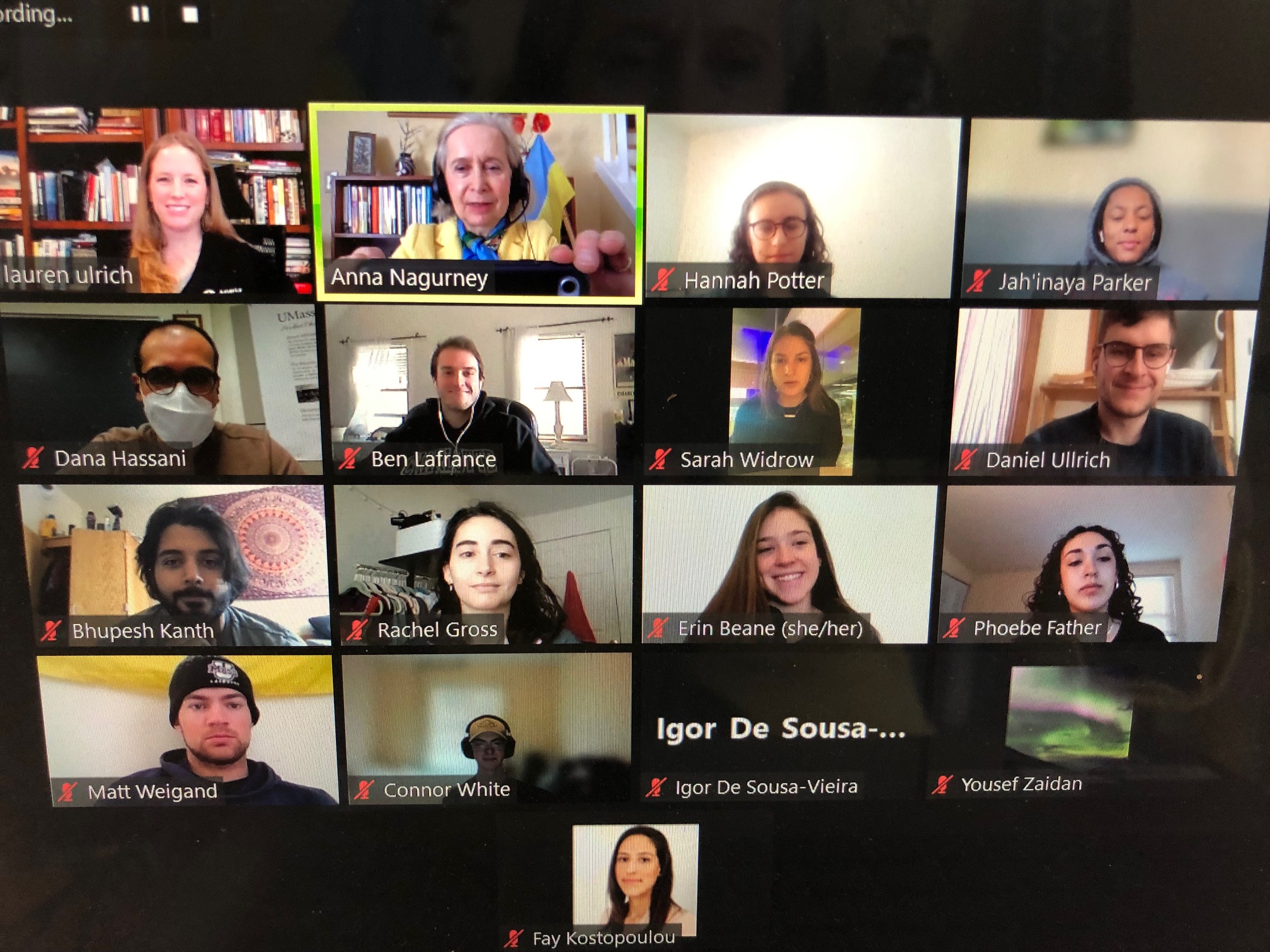
On March 10, 2022, Ms. Lauren Ulrich, the Executive Director, Operations Management & Logistics, American Red Cross, spoke to my class virtually.  She leads the teams necessary to carry out the key functions for major Red Cross relief operations including incident command, operations management, planning, logistics, finance, and external relations. They have the responsibility for the readiness, planning, resourcing, and implementation of scalable response operations to meet the needs of disaster clients for large-scale Red Cross domestic disaster operations, including across all U.S. States, Territories, and Commonwealths. In her amazing career (she had also been a Marine), Ms. Ulrich has taken part in  multitude operations ranging from Operations Enduring and Iraqi Freedom; to international disaster response operations, including the Haiti Earthquake, Typhoon Haiyan, and Alberta Floods; to domestic disaster response operations, including Hurricane Sandy, Michigan Water Crisis, Hurricane Harvey, and the California Wildfires! Support, according to Ms. Ulrich, must be repeatable and scalable with the disaster response necessitating speed to market and speed to scale. Speed to market means having access to the required assets for help and shelter, and speed to scale means scaling from  a single home to tens of thousands of homes in 72 hours. Holistically, the logistics team’s mission is to have the required assets to get the volunteers on the ground in 2 hours and to hold the ground for 72 hours while quickly scaling up. She also shared with us the challenges associated with disaster response in the COVID pandemic and how she and her boss were very well-prepared in terms of PPEs, since the Red Cross was closely following the spread of the coronavirus globally, already in January 2020. Her lecture was incredibly engaging and informative.

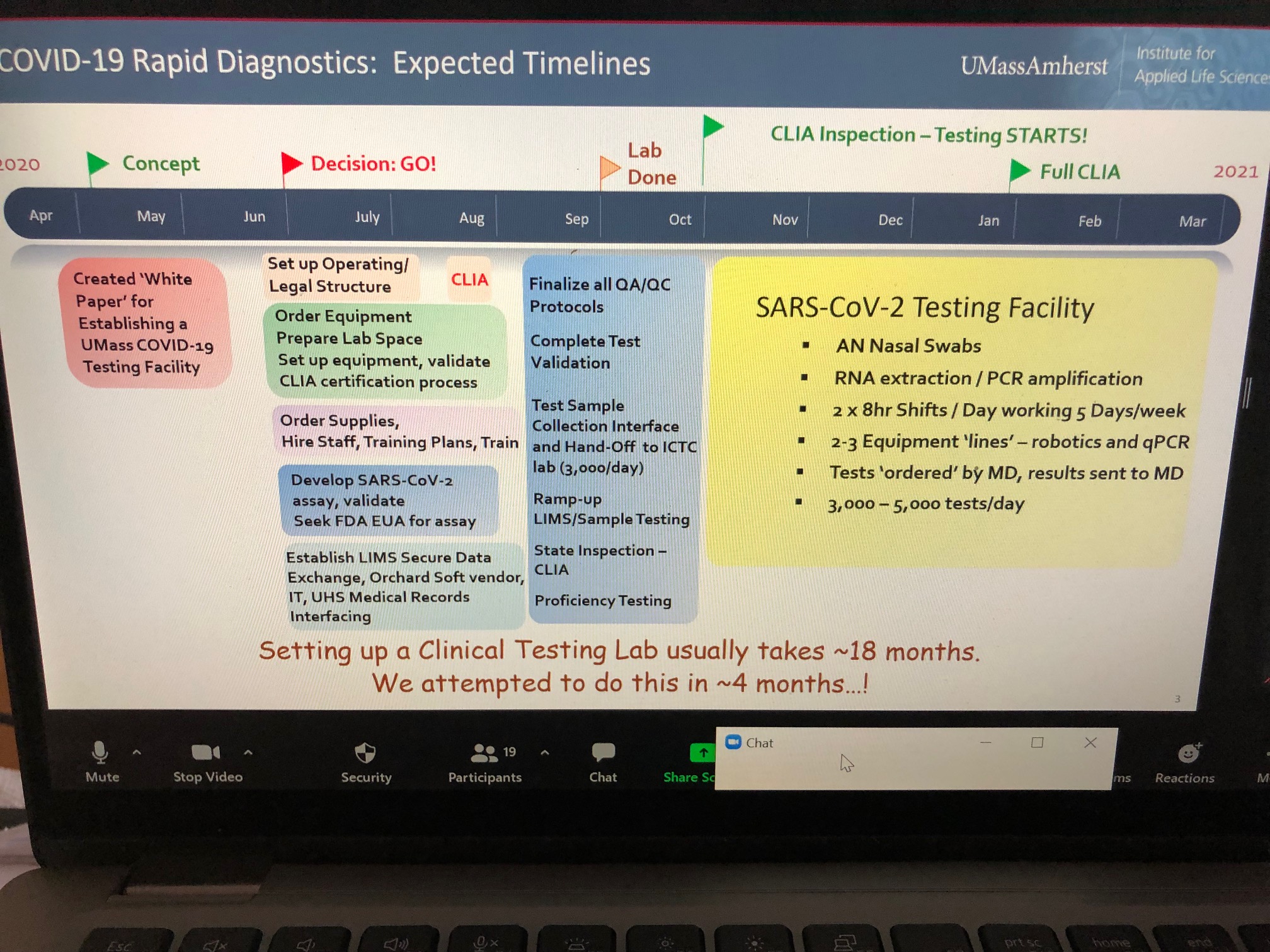
The fourth guest speaker was UMass Amherst's very own Dr. Peter Reinhart! Dr. Reinhart is the founding Director of the Institute for Applied Life Science (IALS) at UMass Amherst and has more than 25 years of R&D management experience in academia (Duke University), biotechnology (Cogent Neuroscience, Proteostasis Therapeutics), and large pharma (Wyeth, Pfizer). He  came to the University of Massachusetts Amherst from the Cambridge MA biotechnology company, Proteostasis Therapeutics (PTI), where he was President and Chief Scientific Officer. Dr. Reinhart shared with us how the incredibly effective and, frankly, life-saving, in my opinion, COVID-19 Testing Center at UMass was founded from scratch. As of April 2020, when UMass shut down and reverted to online teaching, 750 scientists in the Applied Life Sciences building had to stay at home. That was when he thought that they could use these human resources and talent to form the Testing Center. He made the idea into a “white paper” and handed it to be reviewed by Chancellor Subbaswamy.  After a month, Chancellor permitted Dr. Reinhart to start the project, who came up with a timeline to make it functional in 100 days, from the preliminary processes and operational foundations to the beginning of the testing. This required exceptional logistics, team work, planning, scientific expertise, legal interventions, and even the assistance of Massachusetts Governor Charlie Baker. Thousands of students, faculty, and staff and members of our community have benefited from the exceptional convenience and turn around time and accuracy of the UMass Amherst COVID Testing Center. We are all so proud of this truly exceptional achievement in the service of our community during the pandemic and so grateful!


The fifth and final guest speaker was Professor Ladimer S. Nagurney of the University of Hartford, who spoke in person on April 26, 2022. The topic of his guest lecture was: "Disaster Communications." He even brought hardware to demonstrate to the students. The slide deck of his lecture can be downloaded here.

He discussed many interesting topics with some of the highlights being the disruptions to communications after the volcanic eruption in Tonga (and the restoration efforts) and the importance of communications to the war efforts of  Ukraine against the Russian aggressors.


Many thanks to these outstanding guest speakers, who took the time from their very busy schedules to share their important insights and experiences with my Humanitarian Logistics and Healthcare class!

Saturday, May 1, 2021

In Appreciation of the Wonderful Guest Speakers in My Humanitarian Logistics and Healthcare Class

As the semester draws to a close, as well as the academic year, I would like to take this opportunity to publicly thank the wonderful guest speakers in my Humanitarian Logistics and Healthcare class this semester. In a class such as this, the students learn a tremendous amount from practitioners and, even more so, given their immense challenges because of the COVID-19 pandemic.

On February 18, 2021, we had the honor of hearing from Mr. Tim Pitoniak, who is a Regional Disaster Program Officer for the American Red Cross (ARC) in Massachusetts. Mr. Pitoniak spent the first 10 years of his Red Cross career in Greater New York where his focus was staffing, training, and partnerships. He assumed his position in Massachusetts in 2015 and has been the job director for multiple large operations, including the 2018 Lawrence gas explosion. He has regularly been deployed to national jobs, working in leadership roles for disasters all over the continental U.S.  and Puerto Rico. Mr. Pitoniak shared with us the challenges the Red Cross has faced in the pandemic and how it has been able to provide certain support services virtually, because of the need for social distancing. The students were amazed by the number of volunteers associated with the ARC and also how they are constantly adapting to provide a wide range of services, and not only to disaster victims.


On March 2, 2021, we were honored to have Dr. George Karagiannis Zoom in all the way from Athens, Greece for his guest lecture. Dr. Karagiannis is Greece's Deputy Secretary-General for Civil Protection, the US equivalent of Deputy FEMA Administrator. From 2016 to 2019, he was a Technical Officer at the European Commission Joint Research Center, where his area of expertise revolved around emergency management, critical infrastructure protection, and hybrid threats. Prior to joining the Joint Research Center, he was a Disaster Management Consultant. The title of his guest lecture was, "Humanitarian Needs Assessment & Information Management."  So many of the insights provided by Dr. Karagiannis resonated with the students, including his emphasis on the use of technology and even AI for needs assessment. And he also told the class that, despite what you see on TV and in the movies, one rarely gains much information from helicopter rides over disaster areas. Additional information and discussion during his great talk can be found on my blogpost here.

I am delighted that Dr. Karagiannis has accepted our invitation to be a plenary speaker at the next Dynamics of Disasters conference that I am, again, co-organizing with Professors Kotsireas and Pardalos, but this time it will be virtual. More information can be accessed here with additional information being posted in the coming weeks.

On March 11, 2021, the students and I were thrilled to have Ms, Dawn Brantley present to the class. She is the Assistant Director for Planning and Preparedness for MEMA (Massachusetts Emergency Management Agency) and was responsible for establishing  a program of COVID Isolation Hotels, which was also the topic of her presentation. The subtitle of it (and this spoke volumes) was: "building a plane while you fly it." Her presentation was absolutely mesmerizing. The initiative was made operational in 7 days and the logistics behind it were incredible, with so many issues such as food provision, laundry services, nursing care, and so much more needed. And to accomplish so much with attention having to be paid to COVID protocols. It was not easy getting certain hotels "on board," especially with some local communities not being supportive.


The dedication of Ms. Brantley to this important enterprise and that of her team were truly inspiring! The ARC had also been assisting in this endeavor so there was some nice synergy with Mr. Pitoniak's guest lecture. March 11, 2021, the day of Ms. Brantley's presentation,  was  the one year anniversary of the World Health Organization declaring the COVID-19 pandemic!

I cannot thank all the speakers sufficiently - they were fighting the pandemic on the front lines and still made time to help in the education of students.  They left a lasting impact and were part of a transformative educational experience. Each was presented with a special letter that I wrote as well as a certificate signed by our great Dean Anne P. Massey in appreciation.

On March 23, 2021, we had the Nursing Director Team from Cooley Dickinson Hospital present to my class. The title of the panel presentation was,  "Cooley Dickinson Hospital: A Year of COVID: Readiness, Response and Resilience." There were 8 speakers who shared with us their incredible work in transforming parts of the hospital to be able to handle more COVID patients and how personnel were retrained and needed PPEs acquired. 

No healthcare worker contracted COVID, which is, frankly, remarkable and such a relief. I wrote an earlier blogpost on the nursing team and sent my thank you letter to the Interim Director of Cooley Dickinson Hospital, Dr. Brown, who responded so quickly. Some of the lessons learned included the importance of communications and appreciating the workers' fatigue and challenges.


The team also shared a video with us and there was not a dry eye in the audience. I would like to, again, thank the incredible panelists: Angela Belmont, VP, Patient Care Services & Chief Nursing Officer, Lynn M. Grondin, Director of Nursing for Perioperative and CVIR Services, Mike Netta, Director of Operations for Perioperative and CVIR Services, Alexandra Penzias, Director of Nursing and Professional Practice Education, Sara C. McKeown, Nurse Director, Emergency Department, Ann LeBrun, Nursing Director, Critical Care Services, Margaret-Ann Azzaro, Director, Medical Surgical & Childbirth Services, Jacquelyn Ouellette, Director, Behavioral Unit.

On March 30, we had our very "own" Mr. Jeff Hescock join us. Mr. Hescock is the Executive Director of EH&S and Emergency Management at UMass Amherst. The students have been receiving many messages from Mr. Hescock since the pandemic was declared and he, along with his staff and Ms. Ann Becker, have been behind our outstanding COVID-19 testing and now vaccinations! On the day that he spoke, Mr. Hescock told us that UMass Amherst had by then done 400,000 COVID tests and 16,000 vaccinations! He emphasized the important role of testing, contact tracing, and also isolation quarters at UMass Amherst as well as the role of our nursing students in testing and vaccinations. It has been an extraordinary team effort and the students, the community at large, the faculty, and staff are so grateful for the outstanding work of Mr. Hescock and his team in keeping us safe.

The students, as well as I, learned so much from our guest speakers and each left an indelible impression on us. 

Wednesday, March 18, 2020

The Blood Supply Chain in the Coronavirus Pandemic

Much has happened since my most recent blogpost on March 7, which celebrated the successful PhD defense of my student, Deniz Besik.

On March 11, 2020, WHO declared a pandemic due to the coronavirus, which causes the respiratory illness now known as COVID-19.

As an operations researcher, who does research on various network systems, including perishable product supply chains, with applications in healthcare - blood supply chains and pharma supply chains, I had already been following a multiplicity of disruptions as the coronavirus was spreading globally.

In addition to the supply chain disruptions, I have also experienced professional ones as have virtually all academics worldwide as well as students.

I am on sabbatical now and was honored and delighted to have been invited to give seminars and plenary talks in multiple countries (Canada, France, Italy, and the USA, with others still on the horizon). These have all been postponed/cancelled causing not only disappointment but many foregone experiences, networking opportunities, and adventures.

But safety and health first, and we must do anything and everything in our power to mitigate the pandemic, and to flatten the curve.

I strongly believe that researchers, if at all possible, and if they have an inclination to do so, should write articles for the popular press. I saw the looming crisis in blood supply chains, having been following events in China and Iran, as closely as possible, because of COVID-19. I collected our relevant articles on blood supply chains (a topic we have been researching for the last decade), and impacts of disruptions, and wrote an Op Ed for The Conversation: How coronavirus is upsetting the blood supply chain https://theconversation.com/how-coronavirus-is-upsetting-the-blood-supply-chain-133424

The article has now been reprinted in numerous publications including: SALON, MarketWatch, NavyTimes, EconTimes, and many others. I have been contacted by individuals who wish to help out. I have reached out to medical professionals that I know at top medical facilities to see if plasma of those who have recovered from COVID-19 may be used as treatment, as has been tried in China, supposedly with some success, and is now being investigated at Johns Hopkins.

The research that we have done on the blood supply chain includes the modeling of the perishability of red blood cells; the investigation of a disruption due to a major disease outbreak, which would result in a decrease in eligible donors, as well as disruptions to capacities of testing and processing, that clearly can happen with personnel being quarantined and/or struck by the coronavirus now. Our papers have also explored competition for blood donors using game theory as well as the design of blood supply chains plus the modeling of multiple tiers and even the competition among blood service organizations. We have also worked on quantifying the potential synergy associated with the merging or teaming of blood service organizations as in the case of a disaster.

Also,  we wrote a book to unify some of the knowledge on perishable product supply chains.
It is important to note that respiratory viruses are not transmitted via blood and all those who have the facility and the capability should donate. Since my article in The Conversation was published, the situation has become even more dire with severe blood shortages being reported by the American Red Cross. Blood, unlike many other products, cannot be manufactured, but must be donated by willing donors. Blood service organizations need to make this process now as comfortable and as easy for donors, as possible, by expanding mobile unit coverage, for example.

*********************************************************************************
An update since the above post was published. Thanks to INFORMS Analytics for publishing my updated article to The Conversation piece in the Coronavirus Chronicles.

And now, as we move further into the pandemic, the possibility of utilizing convalescent plasma in different ways in providing potential therapies, is generating optimism, while, at the same time, there is growing competition among different organizations, and even profit-making ones, for Covid-19 survivors' blood plasma.