Showing posts with label Competing on Supply Chain Quality. Show all posts

Tuesday, January 5, 2016

On Writing and Editing Books

This is my first blogpost of the New 2016 Year.

I thought it fitting to write about an activity that I have been engaged in both last year and this year and that has also obsessed me ever since I wrote my first book - Network Economics: A Variational Inequality Approach, which was published by Kluwer (now Springer) in 1993, and the second edition of which appeared in 1999.

This blogspot is about writing and editing books.

I was also inspired by an article in The New York Times, "Bill Gates: Billionaire Book Critic," which highlighted what a voracious reader Bill Gates is, who reads books on quite technical and scientific topics, and then comments on them (he only blogs about books that he enjoys) on his blog: Gates Notes. Of course, books mentioned on his blog experience what is known as  "Gate's Bump" in terms of sales - reminiscences of Oprah Winfrey's effects on book sales of a while back.

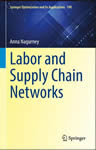
This past year, I was very busy writing the book, Competing on Supply Chain Quality: A Network Economics Perspective, with Dong Li, which will be out within the next month. The book is being published by Springer International Publishing Switzerland. The book is the second volume in the new Springer Series on Supply Chain Management.  The editor of this book series is Distinguished University  Professor Christopher S. Tang of UCLA's Anderson School of Management. My co-author, who is an Isenberg 2015 PhD alumna, and is now an Assistant Professor of Supply Chain / Operations Management at Arkansas State University, and I are very excited about the book's upcoming publication. It is 400 pages in length and represents a half decade of our collaborative research. There will also be an ebook version available.

Writing books (all of my books, thus far, have been nonfiction, since they are scientific monographs) is challenging but as Professor Dimitri Bertsekas of MIT told me years ago, and whose eminent advice I follow: "Anna, when you have 5 to 10 papers on a topic, you write a book." On December 9, 2015, I had the pleasure of giving an invited seminar at MIT, and Professor Joe Sussman of the Transportation and Logistics Center there and I had a wonderful conversation, which included the writing of our books. He noted that if you think that you are 95% finished you still have a ways to go and that is so true -- that last leg of writing a book, which involves so much checking and paying extensive attention to details, can sometimes seem the most onerous.

The Competing on Supply Chain Quality book is my twelfth book.
In the meantime, 2016 promises to be extra exciting because I am also involved in co-editing a book on Dynamics of Disasters, with Springer also as the publisher. Although I have edited books alone, in particular the Innovations in Financial and Networks, published in 2003, and the Annals of Operations Research (hardbound) volume on Advances in Equilibrium Modeling, Analysis, and Computations, published in 1993, the Dynamics of Disasters  book I am co-editing with Distinguished University Professor Panos M. Pardalos of the University of Florida and Professor Ilias Kotsireas of Wilfrid Laurier University. The volume is based on refereed papers submitted and presented at the conference on the same theme that we organized and which took place last summer in Kalamata, Greece with additional invited papers from experts in the field.

In editing a book, selecting good referees is important and the reports need to be done in a timely manner. At the same time, one wants to make sure that there is both breadth and depth in the contributions. Authors also, hopefully, revise their papers without delay. An edited volume can bring different perspectives to a topic and I enjoy having contributors from many different countries as well as contributions, in this case, from practitioners, because of the theme of the book. Having such responsive and wonderful co-editors also makes for a very enjoyable book editing project!

When it comes to editing a book, sometimes a publisher will help out in making sure the stylefiles are consistent and, at other times, the onus is on the editor to even put the references in a consistent manner.  Some publishers help with the stylistic editing whereas others do not. Editing a book can take longer than writing one, since in writing a book, the authors have more control and the work and output only depends on them.

Three of my books were single-authored, five of my books (including the Competing on Supply Chain Quality book) had one co-author, one book had two co-authors (both females), and one book (my shortest one) had three co-authors!  And, as I mentioned before, two books I edited myself, and the forthcoming Dynamics of Disasters book, I am co-editing with two colleagues.

I hope that part of my legacy will be the books that I have written. At the very least, some of them are my most highly cited publications, so I know that there is value to them and the hard work is worth it. I especially appreciate when students from around the world thank me for writing books.

Happy New Year to my readers! Best of luck with your writing projects.

Thursday, August 27, 2015

The Joy of Sending Your Book to the Publisher

Last week, I uploaded the finished manuscript of  my latest book, "Competing on Supply Chain Quality: A Network Economics Perspective,"  to my publisher's (Springer's) website. The book is co-authored with Dong "Michelle" Li, my former doctoral student, who is now an Assistant Professor at the College of Business at Arkansas State University.

The book will appear in the Springer Series in Supply Chain Management, whose Founding Editor is Professor Chris Tang of the UCLA Anderson School of Management. He has been very supportive throughout this project and we acknowledge him warmly in the book.

The book is 400 pages and represents about half a decade of our work on developing supply chain network models with quality, as well as prices or quantities,  as strategic variables, of manufacturers, suppliers, or firms that are outsourced to, as well as freight service providers. The book deals with critical issues such as information asymmetry, make or buy decisions, and supplier selection, and also demonstrates how to identify and rank the most important suppliers to a firm's supply chain and to the supply chain network economy. 

Completing the book was a big task since some of the final writing was done while I was in Gothenburg, Sweden as a Visiting Professor this summer and also speaking at many conferences and Michelle was in Amherst,  getting ready for her move to assume her Assistant Professorship position.

The feeling of accomplishment (and relief) in getting the book finished and even ahead of schedule is very rewarding.

I enjoy writing technical books since one can put a stamp on a topic that one is very passionate about and integrate the existing research and literature in a fresh way. Sometimes I am asked what my legacy will be and I hope that it does include my books. Colleagues from different parts of the world have told me that when a new book of mine arrives in their offices, students often disappear with it, which I find to be a great compliment.

Submitting the manuscript and all the chapter files and jpgs to a Springer website was easy and smooth and I was reminded of  how several of my other books in earlier days were shipped off to the publisher. For example, several of my early books, including my first, published in 1993: "Network Economics: A Variational Inequality Approach," which is my most highly cited publication according to Google Scholar,  and which also had a second edition in 1999, were submitted on special paper in camera-ready form and obviously mailed. Kluwer was my first publisher and then the company was bought by Springer.

Several of my books have had disasters associated with the shipment and, so far, luckily, the latest one has had a peaceful arrival and acknowledgment and is now in production, which is thrilling.
My book, "Supernetworks: Decision-Making for the Information Age," published in 2002, which I wrote with June Dong of SUNY Oswego, who was my first female PhD student, was mailed to the publisher, Edward Elgar Publishing in Cheltenham, England, just before 9/11. It ended up during the terror attacks and aftermath at JFK airport before the airspace opened up again.

And, my book, "Networks Against Time: Supply Chain Analytics for Perishable Products," which was published by Springer in 2013, was emailed just before Superstorm Sandy struck on October 29, 2012 to the Springer offices in NYC, which were flooded (they are located on Spring Street). I could not reach my Springer editor for days. This book was written with Min Yu of the University of Portland and Amir H. Masoumi of Manhattan College (both of whom were my former doctoral students), and the other Professor Nagurney, my husband, Ladimer S. Nagurney of the University of Hartford.

There is something special about seeing a book that you have written, hot off the press, holding it in your hands and looking through it (and hoping all the pages are there and nothing is missing).

So, whatever your legacy will be, I do hope that mine, in part, will be the books that I have written and still hope to write.  Even in this era of so many distractions and shortened attention spans, books, I believe, can make a contribution and a difference.