Showing posts with label MIT. Show all posts

Friday, March 29, 2024

It Was Great to Be Back at MIT to Speak on Agricultural Supply Chain Networks and Trade Policies

This past Tuesday I had the pleasure of speaking at MIT at the Center for Transportation and Logistics in its seminar series. I'd like to thank Austin Iglesias Saragih for the invitation to speak. The title of my presentation was: Agricultural Supply Chain Networks: Trade, Policies, and Resilience.


In my seminar, I first highlighted research that we had done on food supply chains over the past decade with collaborators: Min Yu, Deniz Besik, and Pritha Dutta (all of whom were my former PhD students, and now are thriving as Professors), and, more recently, with my present PhD student Dana Hassani and collaborators at the Kyiv School of Economics (KSE) Professor Oleg Nivievskyi and Dr. Pavlo Martyshev. 

In my presentation, I did a deep dive into the paper, "Exchange Rates and Multicommodity International Trade: Insights from Spatial Price Equilibrium Modeling with Policy Instruments via Variational Inequalities," Anna Nagurney, Dana Hassani, Oleg Nivievskyi, and Pavlo Martyshev, Journal of Global Optimization 87: (2023), pp 1-30.

The paper was the lead article in the volume and was also displayed at the INFORMS Phoenix conference. In the below photo I am standing next to the journal Editor, Professor Sergiy Butenko, and my PhD student Dana Hassani. The Springer editors Razia Amzad and Christian Rauscher are next to Dana.


I also discussed some results from my Labor and Supply Chain Networks book.


I am very grateful to the audience for the excellent questions and discussions and to Austin for handling the logistics of my visit. 

It was also extra special to have one of my former students, Emilio Alvarez Flores, who is now pursuing an MBA at Sloan at MIT, come to my presentation. In addition, I thoroughly enjoyed meeting Dr. Elenna Dugundji, who is a Research Scientist at the Center for Transportation ad Logistics at MIT.


My talk was also streamed on Zoom (which I had not been informed of). It was great to see MIT faculty Zooming in and others from different locations, including Georgia Tech.

It was terrific to be back at MIT. Coincidentally, the Center for Transportation and Logistics (CTL) is located at 1 Amherst Street in Cambridge so I felt right at home. I had spent 2 years at MIT and recall when the OR Center was also located there.

In my presentation, I discussed the importance of alternative routes and appropriate policies for agricultural trade with a focus on the impacts of Russia's war on Ukraine and, that night, as we all know, the Francis Scott Key Bridge in Baltimore collapsed after being hit by the cargo ship Dali. I had multiple requests for media interviews but had to decline because of my presentation and meetings at MIT. Lo and behold, whom did I see on the TV news, a few hours afterwards - none other than the Director of CTL, Professor Yossi Sheffi! He had hugged me when he saw me at MIT, something his PhD students told me they have never seen him do before. Professor Sheffi was also my host when I had an NSF Visiting Professorship for Women at MIT and I spent my first year at CTL, which was then located in Building 1.


The slide deck of my seminar presentation is posted on the Supernetwork Center website.

I had previously given a seminar at MIT in December 2015 and was hosted by Professor Carolina Osorio, who is no longer at MIT. She and Professor Jim Orlin joined us for dinner after my talk and Professor Orlin even Zoomed into my presentation this past Tuesday. My blogpost with photos from that visit can be accessed here.

That evening, I stopped by the Radcliffe Institute for Advanced Study (RIAS) at Harvard University, where I has been a Science Fellow in 2005-2006. The Fellows that year included Professor Claudia Goldin, who in 2023 received the Nobel Prize in Economics. I had been back to RIAS as a Summer Fellow twice since then.

And to celebrate being back in Cambridge, we enjoyed a delicious Amareno gelato topped by a chocolate macaron.


Sunday, January 15, 2017

Your First Conference Presentation and Amazing Coincidences

Do you remember the first professional conference presentation that you ever gave on your research?

I suspect that no matter how many years ago or how recent it was that you remember it very well.

In fact, I even recall the outfit that I wore but, then again, I was the only female presenter at the conference and, not surprisingly, the only one wearing a skirt suit, which was bright blue. There were numerous MIT professors in the audience and several admirals as well.

I decided to write on "your first conference presentation" not only because one of my doctoral students is giving hers this week at the INFORMS Computing Society (ICS) Conference, which is taking place, January 15-17, 2017 in Austin, Texas, but also because of an amazing coincidence between her first talk and my first talk. It is coincidences such as these or may I say, "serendipity," that makes being an operations researcher so much fun, interesting, and filled with surprises. And some of the surprises and special delights involve the great people in our profession.

This morning, my doctoral student, Deniz Besik, who last week endured a 12 hour wait at the Istanbul airport for her flight back to Boston because of snow there, and finally made it back from a winter break, emailed me the photo below of herself with a "celebrity" that she met at the ICS Conference.
The operations research superstar, and member of the National Academy of Engineering, is Professor Dimitri Bertsekas of MIT, who is one of my favorite professors on the planet! He is one of two plenary speakers at the conference.

I smile every time I look at this photo because guess who was on the program of the first conference that I ever spoke at - indeed, Professor Bertsekas!

That conference was the second MIT/ONR Workshop on Distributed Communication and Decision Problems Motivated by Naval C^3 Systems. It took place at the Naval Postgraduate School in beautiful Monterey, California. I was working at Systems Consultants then in Newport, Rhode Island,  and had not even completed my Master's degree from Brown University.  In fact, this was also my first publication since the conference resulted in a 4 volume refereed proceedings.
You can see my name and paper title below on the same page as Bertsekas'! My talk was on: "The Role of Optimal Routing in Multiplatform Naval Task Force Operations." Networks were always a favorite research theme of mine! Only volume 2 is online and there you can see the list of all presenters, many quite renowned.

What is also quite amazing is that I ended up continuing at Brown University for my PhD in Applied Mathematics, with a specialty in Operations Research, and my advisor was Professor Stella Dafermos, who was a good friend of Bertsekas'. Yes, they are both Greek. She passed away at age 49 but left a tremendous intellectual legacy.

Deniz' talk at ICS is on: "Quality in Competitive Fresh Produce Supply Chains with Applications to Farmers' Markets" and her full presentation can be downloaded here.

I even blogged about some great advice that Professor Bertsekas gave me a while back, which I still follow. Hope that everyone has an amazing time in Austin, Texas!

Tuesday, October 25, 2016

Broadening Your Horizons - How a Female Operations Researcher Did It

After receiving my PhD in Applied Mathematics, with a specialty in Operations Research, from Brown University, and evaluating offers from both academia and industry, I accepted the offer of  a tenure track faculty position in Management Science, a STEM field, at the business school at the University of Massachusetts Amherst, now the Isenberg School of Management. Since arriving on campus in 1983, I have managed to make “herstory” by becoming the first female Full Professor at the Isenberg School and the first female named chair professor in the UMass system.

Although UMass Amherst is my home and has provided me with the right environment in which I could pursue my research and teach courses on subjects on a variety of network themes including humanitarian logistics and healthcare, I have always felt that to thrive one needs new academic experiences and to challenge oneself by broadening one's horizons.  Such experiences enrich your scholarship as well as teaching.

In 1988, shortly after receiving promotion and tenure, I received a National Science Foundation Visiting Professorship for Women (NSF-VPW) award. I was off to MIT's Civil and Environmental  Engineering Department for a year as a Visiting Professor in the Center for Transportation. At that time,I was the only female faculty member in the department. While there, I taught a transportation network course  and also organized a speaker series focusing on Females in Operations Research at the Operations Research Center. It was a time when MIT Management Professor Lotte Bailyn organized get-togethers for female faculty. I remember them fondly and was able to meet and be inspired by such renowned female scientists as Mildred Dresselhaus. While at MIT I received a UMass Faculty Fellowship, which allowed me to spend another year at MIT, this time at the Sloan School.

In 1996, I was invited to be a Distinguished University Visiting Professor at the Royal Institute of Technology (KTH) in Stockholm, Sweden. The goal of this professorship was to broaden the visibility of female Full Professors at the KTH since, at the time, there were only two.  With my husband, who also managed to get a Visiting Professorship there as well, and our 2 year old daughter, we embarked on a 7 month adventure during which I taught a class on optimization, met with many colleagues there and students, and managed to co-author the book, Financial Networks. Picking up my daughter, who was enrolled in daycare in Stockholm, then known as daghis, was always interesting because sometimes I would have to find her in a local park with her group where she was learning to climb trees and rocks. She was well-nourished there with a team of cooks preparing lunches consisting of salmon, potatoes, and carrots, with crunchy bread and fish egg spreads for snacks for the children between ages 2 and 7. We lived in the Wenner Gren Center with 150 other visiting academic families. It was a joy to see groups of children with no common language playing together. We ended up returning to Stockholm for multiple months in 1998 and again in 2001, when I co-authored Supernetworks: Decision-Making for the Information Age.

In 2002, I received a Distinguished Fulbright Visiting Professorship at the SOWI School of Business at the University of Innsbruck in Austria, so with my now 8 year old daughter and husband we were off to live in a villa in the Alps while I taught a series of courses on networks, while our daughter attended school (2nd grade), which was only in the morning, and learned her multiplication tables in German. If the students did well on math questions they got to stand on their desks and be applauded. The teacher also taught the children to rollerblade. Culturally, it is expected that Oma and Opa (grandparents) will take care of children once school is over, which we did not have the advantage of, so there was always juggling. Again, the mountains inspired, and no wonder my daughter ended up majoring in geology and is soon off for her PhD in this field. We have returned to beautiful Innsbruck because of the friendships made and once when we did, a colleague was wearing the Isenberg School t-shirt I had given him. Even the waiters remembered our orders in our favorite restaurants there.

In 2005-2006, I had the terrific honor of being one of twelve Science Fellows in a group of about  fifty Fellows at the Radcliffe Institute for Advanced Study at Harvard University. This fellowship in a community of writers, scholars from different disciplines, who listened to one another's guest lectures, and enjoyed lunches and great esprit de corps, cemented my thrust to continue placing myself in new environments. While at Radcliffe, I collaborated with female colleagues that Radcliffe helped to support  and completed my book: Supply Chain Network Economics. It was the year that Larry Summers resigned and the Dean of Radcliffe, Drew Gilpin Faust, became the first female president of Harvard.

Over the years 2011-2015, I held a Visiting Professorship at the School of Business, Economics and Law at the University of Gothenburg in Sweden, with a commitment of 44 days a year, which was very manageable. Living again in that marvelous country I have come to appreciate my male colleagues serious about their parental leaves, the celebrations associated with having a paper or book published, complete with coffee and cakes, and a quality of life with great transportation systems  and a focus on the environment that I wish I could bring back to the US with me.  My family has continued to travel with me as their commitments allow.

Last July, I returned from being a Visiting Fellow at All Souls College at Oxford University, where I spent the Trinity Term,  and was provided with an office overlooking a garden and fountain, and an apartment, with delicious lunches and formal dinners, so that I could just think, reflect, and write. Although scientists are the minority among both Visiting Fellows and Fellows of All Souls College, the conversations with a naval historian, medieval historian, archeologist, classicist,  Sanskrit expert, along with the mathematicians, physicists, and, of course, economists, I will never forget.  And I managed to complete the co-editing of the Dynamics of Disasters book and my Competing on Supply Chain Quality book was published with acknowledgment of Oxford, which I presented to the Codrington library. On June 22, 2016, Encaenia took place at Oxford University, during which 9 were awarded honorary degrees, including Mildred Dresselhaus of MIT. I had the special privilege of speaking with her and reminiscing about MIT at a reception and luncheon at All Souls College following the ceremony. Serendipitously, Louise Richardson, who was the Executive Dean at the Radcliffe Institute. when I was a Science Fellow there, is now the first female Vice Chancellor at Oxford University. On June 23, Britain voted to leave the European Union, with major ramifications for the economy as well as for research funding, and with shock waves permeating globally. And on June 24, 2016, we celebrated at All Souls College the 50th anniversary of this magnificent program with a full day of events, despite Brexit.

While a visitor at different universities, I have attracted students to our graduate program at UMass. I have also used the knowledge of the various universities to help advise UMass students on their future. I believe that my research was only propelled by my time away and am looking forward to the next opportunity.

Thursday, June 23, 2016

Majestic Honorary Degree Celebrations Encaenia at Oxford University with Photos

It is an extraordinary experience to be a Visiting Fellow at All Souls College at Oxford University in England this Trinity term.

Yesterday, Fellows and many dignitaries were invited to take part and celebrate 9 honorary degree recipients. And what a tremendous list of awardees this is!

Below is a photo of the recipients, compliments of Oxford University.
I was absolutely thrilled to see the Nobel laureate in Economic Sciences Paul Krugman and also the National Medal of Science recipient Professor Mildred "Millie"  Dresselhaus of MIT plus the Spanish filmmaker Pedro Almodovar as well as Sir Jonathan Ive is Chief Design Officer of Apple Inc and designer of the iMac, PowerBook, iBook, iPod, iPhone, iPad, AppleWatch and MacBookat Oxford on the list! The opera singer Jessye Norman was not able to attend this year.

The day began with peaches, strawberries, and champagne, and a procession in Radcliffe Square to the Sheldonian where the ceremony took place.

After the Encaenia ceremony at the Sheldonian the Quad at All Souls College was the site for drinks before a lavish lunch that took place at the Codrington Library with tea and coffee out in the Quad afterwards. Magically, the skies cleared up so the outdoor events took place on the bright green lawn.

I was absolutely thrilled to be able to speak to Professor Millie Dresselhaus and to even meet one of her granddaughters. I had met Professor Millie when I was a Visiting Scholar and Associate Professor at MIT and we would take part in female get-togethers with Professor Lotte Bailyn of the Business School. She told me yesterday how important it is to have technical female professors at business schools and I agree. We also spoke about several of our well-known colleagues in Operations Research at MIT.

The lunch was fabulous and the seating arrangement very carefully thought out.
The dessert was also wonderful.
My husband was seated in front of the former principal of Hertford College at Oxford University, Dr. John Landers . Hertford used to have an exchange program with his university, the University of Hartford, so we took the following photo.
Seated across from me was the head of public affairs at Oxford University and next to me an amazing female entrepreneur. the conversations just flowed. I continue to be very impressed by Oxford's website and we talked about the importance of getting news on research out by faculty.

After lunch we chatted on the lawn. You can see Pedro Almodovar strolling on the lawn below in red.  I had to have a photo taken with Visiting Fellow Richard Vokes, an anthropologist from Australia. I also took the photo of him, my hsusband, and the brilliant nabal historian Nicholas Rodger.
And, if you take a look at the photo above, which I took because I very much like my Math Fellows Professors Francis Brown and Constantin Teleman, I also serendipitously snapped Pedro Almodovar on the right in the red gown!

Then it was time to walk to Merton College of Oxford University (the university  has 38 grand colleges) to attend the Vice Chancellor's garden party. The Vice Chancellor is Dr. Louise Richardson, who was the Executive Dean at the Radcliffe Institute for Advanced Study at Harvard University, when I was a Science Fellow there in 2005-2006. It was great to see her and to shake her hand and to congratulate her on becoming the first female VC in Oxford's 800 year history!
The lawns are beautiful at Merton and the spread of food plus orchestra were grand.
And, later that evening, the remaining Visiting Fellows got together at a pub for dinner and to finish off a truly special day! The full list of Visiting Fellows during this past year is here.
Thank you to All Souls College plus Oxford University for memories that I will always treasure and for friendships made across disciplines! My only disappointment was not being able to personally congratulate Paul Krugman despite trying to find him after the lunch!


Thursday, March 24, 2016

Professor Joe Sussman of MIT Speaks on High Speed Rail at UMass Amherst

Today, after hosting Lt Col James Bishop of the Westover Air Reserve base in my Humanitarian Logistics and Healthcare class, meeting with collaborators, and having such pleasant office hours that they ran over by an hour, I managed to head to the UMass Mullins Center where a special event was taking place.

The event was organized to celebrate Transportation Professor John Collura's illustrious career at UMass Amherst. The program, featured below, which continue tomorrow morning is wonderful.

And at 3PM today I had the pleasure of hearing Professor Joe Sussman of MIT give the plenary talk which was on High Speed Rail. Professor Sussman had met with me and came to my talk last December at MIT so, of course, I had to return the favor.
Professor Sussman began his presentation by  introducing CSTSs, complex socio technical systems. He noted both nested complexity as well as evaluative complexity, where different stakeholders may measure performance of a system differently. For example, some may care about environmental justice, whereas others may care about social justice. His presentation was very clear, interesting, and well-done.

He emphasized that high speed rail is a CSTS and economic, environmental, and equity criteria all come to bear in this. He noted, which I liked very much, that "sustainability should be the overall design principle" in complex systems. He spoke of the concept of sustainable mega regions supported by high speed rail and brought out that when he received his chaired professorship at MIT in 1991 it was funded by Japanese Railways. When a group from JR landed in JFK and then took the "high speed" Acela from NY to Boston, he knew that their experience was not quite like the Japanese truly high speed rail, the Shinkansen.

He emphasized the importance of high speed rail connecting urban centers and noted that the sweet spot was for distances between 200 and 600 miles. For distances greater than 600 miles it was preferable to fly and for distances less than 200 miles it would be better to use road transport.

He brought out high speed rail in France (I have had the pleasure of riding the TGV there) and  in Germany,   He noted that the Japanese built their first high speed rail in 1964! They needed the capacity and then innovated accordingly and continue to do so.

He mentioned the political gridlock in the US as well as the capital costs associated with high speed rail although projects are under discussion in Florida, Texas, and with Chinese involvement, a link between LA and Las Vegas.

The audience very much enjoyed his presentation.
I had the opportunity to have a photo taken with Professor Sussman and with Professor John Collura, which was a special highlight for me.

I plan on attending the session tomorrow morning with speakers from Virginia Tech and Purdue. The focus will be on critical infrastructure. Thanks to my colleagues in the Transportation program for a special tribute to Professor John Collura, who is now, unbelievably, a Professor Emeritus, but still very active and busy with exciting new professional endeavors, including a big project on aviation in Westover.

Thursday, December 10, 2015

Had a Great Time Speaking at MIT on Perishable Product Supply Chains from Food to Pharma

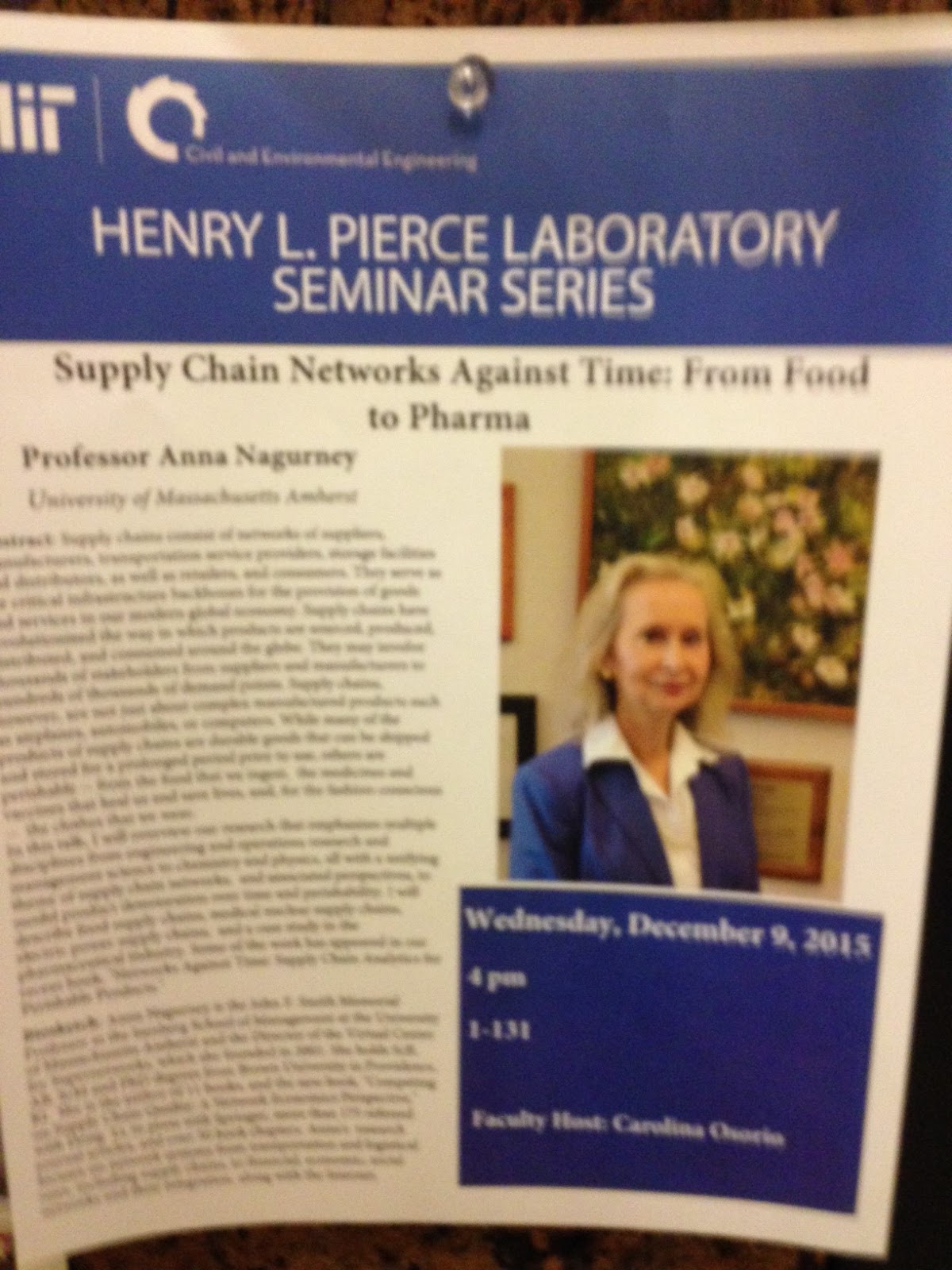
Yesterday I had the pleasure of delivering the Pierce Lab Seminar at MIT. My great host was Professor Carolina Osorio, who is doing fundamental research in transportation with wide impact in practice.

My seminar, Supply Chain Networks Against Time: From Food to Pharma, was given in Room 1-131 at 4PM and although it is the last week of the Fall semester both faculty and students came. MIT prepared the lovely poster announcing my talk. My presentation can be downloaded here.

Wandering the halls of MIT and the infinite corridor it was interesting to see how much had and had not changed since I had spent two years there. I had been back to give talks and also co-organized a workshop at the Sloan School in September 2014, as I have blogged about, but it was nostalgic to be back in Building 1! Many faculty still have the same offices and I got to see my former office in the Center for Transportation and Logistics.

The hospitality extended to me was wonderful and Professor Osorio's assistant, Rebecca Fowler, is a UMass Amherst grad, so that made my visit extra special..

After my seminar, which was preceded my meetings with faculty, I was treated to a delicious dinner at Kendall Square. Amazingly, 5 restaurants had to be called before a place was booked because so many high tech companies in Cambridge were renting entire restaurants for their holiday parties! We ate at the Commonwealth restaurant and my starter salad was exquisite!


The dinner conversation was also fabulous. We talked about business analytics, associated curricula at MIT in new degree programs that are being developed, the doctoral program at the Operations Research Center and a new one being established,  as well as strategies for promotion and tenure.

And the dessert to top off a perfect day included an apple and cranberry fruit cobbler (warm) with homemade vanilla ice cream on top!

The day and evening were so pleasant and so relaxing and I came back energized and very satisfied and happy.

Plus, I received some wonderful news upon my return to Amherst which I hope to share soon!

Sunday, November 29, 2015

The Fun of Public Speaking and Giving Invited Seminars

When faculty (or students) complete research, it is important to disseminate it.  Of course, one should always disseminate research results through publications such as journal articles, OpEds, and, if you have a substantive amount around a central theme, even through books. Speaking at conferences is another wonderful way in which to share one's research and also to get feedback on it.

Another great venue at which to share your research and to educate is through forums such as invited seminars that many departments within colleges and universities organize and hold at regular intervals.

If you have a great talk (or, better yet, since sometimes it is more fun not to be repeating oneself even if the faces in the audience are different, several talks) and are willing to travel, then, when the right invitations come, giving an invited seminar can be great fun.

You may get to go to places that you might not otherwise have gone to and meet new colleagues and students during your travels and also learn about other schools and their challenges.  I recall giving the Kleber-Gery lecture at St. Olaf College in Northfield, Minnesota, where the faculty have survival gear, including snowshoes, in their car trunks. I was put up in a hotel where Jesse James stayed and I got the bridal suite, complete with a canopy bed!  I spoke at the University of Oklahoma as part of their Dream Course series, instituted by President Boren and was put up in my own villa with multiple rooms decorated with U. of Oklahoma paraphernalia.

I have also given quite a few invited seminars abroad in other beautiful locations such as Stockholm and Gothenburg, Sweden, Vienna, Austria,  and in Catania, Italy. Some of the questions I received from the audiences have turned into research problems that we are now pursuing. The food was also amazing in all those locations and the hospitality!

Other very enjoyable experiences I have had, in terms of speaking engagements, were through the INFORMS Speakers Program. I have traveled to Dallas to speak at SMU through this program, where the audience consisted of academics, students, and practitioners, many from the airline industry, and also to Boston to speak at the Boston INFORMS Chapter with my wonderful host, Dr. Les Servi of MITRE.  For the former presentation, I made it with just minutes to spare - the taxi driver was asking me for directions to SMU  and I had never been there, plus it was after 7PM and pitch dark!

Every audience that you speak to generates new ideas for you and that has something to do with the give and talk of a lively seminar.

Sometimes the invitation to speak may come from an organization or venue, which is unique and also very rewarding. Examples of the latter that I have had have included being a panelist at the World Science Festival on Traffic in NYC and also a panelist on Transport and Traffic at the New York  Times Energy for Tomorrow Conference, also in NYC, with a theme of Building Sustainable Cities. One member of the audience, from Toronto, at the former venue still communicates with me and told me that my panel and presentation changed his life! This year's Energy for Tomorrow conference is taking place in Paris next week under heightened security.

At times the audience may even be a bit "frightened" of your talk. When I organized a team residency at Rockefeller Foundation's Bellagio Center on Lake Como in Italy back in 2004 and was there for 2 weeks, my group, which consisted of three females - we were the first Operations Research group invited for a residency in the center's 50+ year history, gave a talk to other Center Fellows, who included civil rights activists, poets, and even a Lincoln historian. Some were a bit scared that we would be showing some math. I think that we made our talk quite enjoyable but then, to me, networks can be a global language. A similar experience I had while speaking on Dynamic Networks at Radcliffe Institute at Harvard University, while I was a Science Fellow there in 2005-2006.

In my previous blogpost, I wrote about how thrilled I was that so many students showed up to my game theory and cybercrime seminar late in the day just  two days before Thanksgiving, when the talk was not even required and no faculty member was taking attendance!  Now, that was an energizing experience and so rewarding.

I will be busy on the lecture circuit over the next few months.

This coming Wednesday, I will be speaking in a Cyber Security Faculty Seminar Series at UMass Amherst (no travel reuiqred). The week after, on December 9, 2015, I will be speaking at MIT in the Department of Civil and Environmental Engineering Seminar Series. I was invited to speak there last year but I was booked with travel and other professional commitments so am very glad that I can do it this academic semester.

On February 17, 2015 (I picked the date), I will be giving a Distinguished Lecture at Yale University in its YINS  (Yale Institute  for Network Science) seminar series, which I am very much looking forward to!

Then the day that our spring break begins, March 11, 2015, I will be speaking at the University of Buffalo (the invitation came before UMass Amherst's football team beat Buffalo's and knocked them out of a bowl game). The seminar series is the Praxis Seminar Series and it was very neat to see Michael Trick, a fellow blogger and INFORMS Fellow,  will be speaking there later this week and my colleague, Sundar Krishnamurthy, who is the chair of the Department of Mechanical and Industrial Engineering at UMass Amherst will follow me in this seminar series (Maybe it is because the U. of Buffalo is located in Amherst (NY)).

I have also agreed to speak at Carnegie Mellon University of April 4, 2016.

Many thanks to all those who extended such wonderful invitations!

Monday, June 1, 2015

Bank Stability and Regulation Conference in Sweden and Small Academic World

Today and tomorrow I am taking part in a Finance conference here at the School of Business, Economics and Law at the University of Gothenburg in Sweden on Bank Stability and Regulation.


One of my finance colleagues here in Gothenburg, Professor Ted Lindblom, invited me and I have been enjoying the talks and meeting people very much. Below he is standing with another Finance colleague of mine here in Gothenburg, Professor Stefan Sjogren.

The academic world is so small - even though Finance is not my primary discipline (but I have co-authored the Financial Networks book and quite a few papers on multitiered financial networks and even the integration of financial and social networks),  I still find it very easy to talk to people and there is only "one ddegree of separation."

For example, Professor Deborah Lucas of MIT, with me below, knows my Isenberg School colleague, Professor Mila Sherman, very well, And Professor Manju Puri of Duke, who is also here, went to grad school at NYU with my colleague at Isenberg, Professor Nikunj Kapadia.


Plus, the first speaker today, Dr. Jiao Santos of the Federal Reserve Bank of New York, who gave a fabulous talk, has as his co-author on the paper, Matthew Plosser, whose father, Charles Plosser, is the President of the Federal Reserve Bank of Philadelphia. He is stepping down and Pat Harker, the President of the University of Delaware, an INFORMS Fellow, and former Editor of the journal, Operations Research, and whom I know, is becoming the next President and CEO of this institution.

Below I have posted some photos of the speakers and discussants and some of the papers have been made available and are accessible from the conference website:
 
Papers available:
Joao A.C. Santos, Federal Reserve Bank of New York and Nova School of Business and Economics; "Banks' Incentives and the Quality of Internal Risk Models"
Giorgia Piacentino, Washington University in St Louis; "Bank Capital, Bank Credit, and Unemployment"
Piero Gottardi, European University Institute and University of Venice; "Capital Structure, Investment, and Fire Sales"
Nittai K. Bergman, MIT; "Financial Accelerator at Work: Evidence from Corn Fields"
Paolo Fulghieri, University of North Carolina; "Uncertainty Aversion and Systemic Risk"

 I have enjoyed the diversity of topics and approaches, from empirical studies to theoretical general equilibrium models.  The presentations and discussions have been excellent and it would be interesting to apply such ideas as aggregate risk and aversion to uncertainty that I heard about today to supply chain networks.
The full program for the conference can be accessed here.

And, although I see many New York Yankees caps on  residents of Gothenburg, Professor Nittal Bergman of MIT brought his Red Sox cap, so I had to photograph it below. Nice to see folks from Massachusetts here in Sweden!
 Many thanks to the organizers of this great conference.