Showing posts with label transportation. Show all posts

Friday, May 22, 2026

Honored to Have Reached Over 25,000 Citations on Google Scholar

I was my PhD Dissertation Advisor's  (Stella Dafermos's) first PhD student at Brown University. She was a trailblazer and left an incredible scholarly legacy although she passed away at the age of 49.

Somehow, with effort, luck, passion, and serendipity, I have managed to build a wonderful collaboration network with students (past and present) as well as researchers around the globe. For all my collaborators, I am deeply grateful.

And, as a female scholar, I think it is meaningful to have reached the milestone of over 25,000 citations to my work on Google Scholar. The full list of my publications, as well as my collaborators over the years,  can be found on my Google Scholar page: 

https://scholar.google.com/citations?user=ecFsBp0AAAAJ&hl=e


It is interesting that my two most highly cited publications are the first two books that I wrote, one with a former PhD student of mine, now Professor at SUNY Oswego, Dr. Ding Zhang. And, my most highly cited journal paper, published in Transportation Science, is a translation from German to English of the famous Braess (1968) paradox paper. That paper was co-authored with Professor Dietrich Braess and my former PhD student, now Professor Tina Wakolbinger of the Vienna University of Economics and Business. And, in 2002,  along with Professor Ding Zhang, and his wife (also a former PhD student of mine),  SUNY Oswego Professor June Dong, we published the paper, "A supply chain network equilibrium model," in Transportation Research E, which is my 4th most highly cited work.

Many thanks to all the researchers and scholars who cite our work!

Doing research (and having it make some impact) is the greatest reward but it is nice also to have the work acknowledged, read, and cited.

Friday, May 16, 2025

Presentations of Our POMS Talks in Atlanta Have Been Posted: From Agricultural Trade to War Risk Insurance

Last week,  I was busy with events and the last week of the academic year, but my Isenberg School PhD students traveled to Atlanta to present our joint work at the POM (Production and Operations Management) Society 35th Conference. They had an outstanding time and also, thanks to Isenberg PhD alumna, Dr. Deniz Besik of the University of Richmond, enjoyed a delicious lunch at a Turkish restaurant. My former PhD student, now at the University of Portland, as a tenured Associate Professor, Dr. Min Yu, also joined them. Below is a collage of photos of my PhD students: Dana Hassani, Ismael Pour, and Samira Samadi, presenting plus a lunch photo.

Dr. Deniz Besik also presented on our work on food banks. Below is a graphic of the first slide of our four presentations.

The slide decks of the full presentations, which, in the case of my PhD students, were all based on recently published papers, can be found on the Supernetwork Center website:  https://supernet.isenberg.umass.edu/visuals.html Dana's presentation was based on a paper published in the INFORMS journal Transportation Science. Ismael's paper appeared recently in International Transactions in Operational Research, and both his and Dana's paper was co-authored with colleagues in Ukraine. Samira's paper, which was co-authored also with Ismael, appeared in the Journal of Nonlinear and Variational Analysis.

I am very lucky to have excellent PhD students (present and former).

Wednesday, May 7, 2025

My 3 PhD Students Will Present Our Recently Published Papers at the POMS Conference in Atlanta

I am a very lucky and proud Academic Mom. My 3 Isenberg School of Management, UMass Amherst PhD students will present our recently published papers at the POMS Conference in Atlanta, which overlaps with Mother's Day https://pomsmeetings.org/conf-2025/

Dana Hassani will present the paper, "A Multiperiod, Multicommodity, Capacitated International Agricultural Trade Network Equilibrium Model with Applications to Ukraine in Wartime," which was co-authored with colleagues at the Kyiv School of Economics: Oleg Nivievskyi and Pavel Martyshev, and published in the INFORMS journal Transportation Science: https://lnkd.in/eUC3PA3J.  Ismael will present the paper, "Integrated Crop and Cargo War Risk Insurance: Application to Ukraine," which was co-authored with Borys Kormych of the National University "Odessa Law Academy" and published just this morning in the IFORS journal International Transactions in Operational Research: https://lnkd.in/e-3MxaDY. Samira will present the paper, "A Variational Inequality Trade Network Model in Prices and Quantities Under Commodity Losses," that we co-authored with Ismael, and that was published open access in the Journal of Nonlinear and Variational Analysis: https://lnkd.in/eSuiqC_C. Support for co-authors in Ukraine was made possible through the outstanding partnership between the University of Massachusetts Amherst and the Kyiv School of Economics, thanks to the leadership of Vice Chancellor of Global Affairs Kalpen Trivedi and Isenberg School of Management, UMass Amherst Dean Anne P. Massey. 

Our presentations are ready!


Happy Mother's Day and Happy Conferencing! 

Saturday, October 7, 2023

Traffic Paradoxes Continue to Fascinate

I have been reading the paper, "Bibliometric analysis and systematic literature review of the traffic paradoxes (1968–2022),"  co-authored by Jia Yao, Ziyi Cheng, and Anthony Chen, published recently in the journal Transportation Research B, 177 (2023) 102832.  It contains a very thorough, exhaustive compendium and analysis of a plethora of traffic paradoxes, beginning with the classical Braess Paradox (1968) paper. I had the honor of translating the 1968 paper from German to English, along with Dietrich Braess and my then PhD student Tina Wakolbinger. The translation, "On a paradox of traffic planning was published in Transportation Science in 2005, along with a preface that I wrote with David Boyce.

Below is a photo taken with Professor Dietrich Braess and Tina Wakolbinger, when we hosted him at the Isenberg School of Management after our translation was published in 2006.


2005-2006 was a very busy year for me since I was then a Science Fellow at the Radcliffe Institute for Advanced Study at Harvard University.

The Braess Paradox has inspired many researchers from different disciplines and, over the years, I have written several papers on this paradox and others, which I have co-authored with both PhD students and other collaborators. 

In the study by Yao, Cheng, and Chen, I was thrilled and humbled to see that I am the "top leading author with a minimum of five publications" on traffic paradoxes and that I am in some amazing scholarly company.

I have had the pleasure of working on paradoxes and the authors of this Transportation Research B bibliometric study have listed the top 50 cited papers, which include not only the translation paper of ours but also my work with my PhD advisor (now deceased) Stella Dafermos, Ding Zhang, and Qiang "Patrick" Qiang.

Below is a list of the 50 most cited papers that the authors compiled.

I'd like to commend Yao, Cheng, and Chen on their paper, which is an incredibly valuable resource, which, I am sure, will generate much additional research.


Below is a list of some of the papers that I have referred to either explicitly or implicitly in this post.

References

Braess, D., 1968. Über ein paradoxon aus der verkehrsplanung. Unternehmensforschung 12 (1), 258–268.

Braess, D., Nagurney, A., Wakolbinger, T., 2005. On a paradox of traffic planning. Transportation Science 39 (4), 446–450.

Dafermos, S., Nagurney, A., 1984a. On some traffic equilibrium theory paradoxes. Transportation Research  B 18 (2), 101–110.

Dafermos, S., Nagurney, A., 1984b. Sensitivity analysis for the asymmetric network equilibrium problem. Mathematical Programming 28 (2), 174–184.

Nagurney, A., 2000. Congested urban transportation networks and emission paradoxes. Transportation Research D 5 (2), 145–151.

Nagurney, A., 2010. The negation of the Braess paradox as demand increases: the wisdom of crowds in transportation networks. EPL (Europhysics Letters) 91 (4), 48002.

Nagurney, A., Qiang, Q., 2007a. A network efficiency measure for congested networks. EPL 79 (3), 38005.

Nagurney, A., Qiang, Q., 2007b. Robustness of transportation networks subject to degradable links. EPL  (Europhysics Letters) 80 (6), 68001.

Nagurney, A., Qiang, Q., 2008a. An efficiency measure for dynamic networks modeled as evolutionary variational inequalities with application to the internet and vulnerability analysis. Netnomics 9 (1), 1–20.

Nagurney, A., Qiang, Q., 2008b. A network efficiency measure with application to critical infrastructure networks. Journal of  Global Optimization 40 (1–3), 261–275.

Nagurney, A., Zhang, D., 1997. Projected dynamical systems in the formulation, stability analysis, and computation of fixed-demand traffic network equilibria. Transportation Science 31, 147–158.

Nagurney, L.S., Nagurney, A., 2016. Physical proof of the occurrence of the Braess paradox in electrical circuits. EPL (Europhysics Letters) 115, 28004.

And, in 2007, a paper that I co-authored with Patrizia Daniele, who was supported by Radcliffe as my collaborator, and with David Parkes (now Dean of SEAS at Harvard) was published! Full citation:

Nagurney, A.,  Parkes, D.C.,  Daniele, P. 2007. The Internet, evolutionary variational inequalities, and the time-dependent Braess paradox. Computational Management Science 4(4): 355-375.


Sunday, July 10, 2022

Honored to Have Our Supply Chain Network Equilibrium Paper Recognized in the 25 Year Retrospective of the Journal Transportation Research E: Logistics and Transportation Review

 Academics work very hard on their research and enjoy seeing their work published. One also hopes that one's work is appreciated and recognized and, in academia, getting cited and also doing impactful research is deeply rewarding.

I'd like to first congratulate all the Editors of the journal Transportation Research E: Logistics and Transportation Review on the significant milestone - its 25th anniversary. I did serve on the Editorial Board of this journal for several years but am no longer doing so.

I was delighted to see a 25 year retrospective on the publications in this journal published recently by the two Co-Editors, T-M. Choi and Qiang Meng, with Shukai Chen. 

In the retrospective, the authors recognized the most highly cited articles on various themes that have dominated the journal over the past 25 years.

The paper, "A Supply Chain Network Equilibrium Model," which I co-authored with June Dong and Ding Zhang, was the top cited paper in "network modeling." Dong and Zhang are Professors at SUNY Oswego, and both were my PhD students at UMass Amherst.


In fact, this paper, is among my top cited works according also to Google Scholar:


I also very much appreciate what the authors of the retrospective wrote in the following: "Another noticeable feature is that, although the universities in the United States may not publish a very high number of papers, their research work can be very impactful and attract lots of citations, e.g., the University of Maryland and the University of Massachusetts Amherst."  Thanks for this. We work as a team at the Virtual Center for Supernetworks that I founded in 2001.


Plus, from the following tables, it is great to see the research that we have done at UMass Amherst on supply chains and on networks, two of the "hot topics" in the journal over the years, noted.


Congratulations are in order to all those whose research has been recognized in this 25 year retrospective! I'd also like to thank the authors of the retrospective for their thorough analysis and very interesting highlights of the contributions in the journal over the past quarter century. I look forward to many more interesting and important findings in the next 25 years in logistics and transportation, themes that have never been more important than they are now!

Of course, many thanks to all those who have cited our work!

Sunday, January 3, 2021

Beginning My 13th Year of Blogging

Hard to believe that not only is the horrific 2020 year behind us, but that this month marks the beginning of my 13th year of blogging! Interestingly, I went back to my very first blogpost, which was on the new US administration in 2009 and the election of President Barack Obama. In the post, I also noted a Letter to the Editor that I had had published in The New York Times, which spoke about how much I enjoyed teaching my Transportation and Logistics class. And I taught this class, albeit remotely, this past Fall because of the pandemic. Now, once again, we have a new incoming administration, to be led by President-elect Joe Biden, and Vice President-elect Kamala Harris, on the horizon!

2020 has been a remarkable year in human history and there is now hope because of the Covid-19 vaccines. It was a year in which so many in our profession pivoted to inform the public through their writings, virtual speaking engagements, and many interviews with the media. I learnt so much from speaking to many journalists from The New York Times, The Wall Street Journal, USA Today, The Chicago Tribune, and The Boston Globe, as well as numerous other publications, including industry-based ones. It was a pleasure to be on NBC News in Boston and in Dallas and to also be on many radio programs, including NPR and Marketplace (and, remarkably, quite a few of the holiday cards that we received noted that I had been heard by friends and relatives from near and far)! I so much enjoyed the intellectual exchanges with journalists that I wrote a tribute to them in a recent blogpost. One journalist thanked me for my blog and reached out to me because of my writings. In addition, during this pandemic I managed to write three articles in The Conversation on the impacts of the pandemic on blood supply chains; game theory and competition for medical supplies (and now relevant to vaccines), plus the vaccine cold chain. These articles generated a great deal of interest and I was honored to be written up by the Isenberg School of Management and the University of Massachusetts Amherst in its 2020 Report on Research with the photo below on the back cover of this report.

With all the disruptions and pain and suffering caused by the pandemic, I am thankful that we managed to continue our research at the Supernetwork Center, with several articles of relevance to supply chains in the pandemic written. Also, our newest Dynamics of Disasters volume, will be published soon by Springer.

I would like to take this opportunity to thank professional societies, including INFORMS, for the support during the pandemic and for nurturing professional exchanges and community. I look forward to the time; hopefully, before too long, when we can again meet face to face at conferences and other venues. In the meantime, best wishes for this New 2021 Year!

Tuesday, June 16, 2020

Postscript on My INFORMS Webinar: Blood, Sweat, and PPEs: Rescuing Perishable Product Supply Chains and Impacting Policy Through Analytics

First, I would like to thank the INFORMS Practice Section for the invitation to deliver the inaugural webinar in its Analytics Series, which took place last Friday. The title of my webinar was: "Blood, Sweat, and PPEs: Rescuing Perishable Product Supply Chains and Impacting Policy Through Analytics." 

As noted on the INFORMS Section's webpage: the goal of the webinar series is to bring awareness of the value of applying analytics to real-world problems. The series is organized by Dr. Patricia Neri of Bayer Crop Science and Dr. Carrie Beam of the University of Arkansas.


Also, special thanks to all those who were able to join in. I was thrilled to hear from colleagues in many different countries, who were able to Zoom in.

This blogpost is a postscript on the webinar with links to my presentation and to the full webinar, which is now on youtube, and answers to questions in the Q&A.

That morning began with getting ready for the virtual event.

The logistics of the webinar, which was carried out via Zoom, was handled by Beth West and Mary Leszczynski of INFORMS and it was exciting to have it be open to the public and to have the registration be free. 

We had had multiple practice sessions, since there were slides to be included prior to my presentation about the series as well as slides afterwards, providing a link to this blog and noting that the webinar would also be posted on youtube.

Dr. Neri gave a lovely introduction to my presentation.
In the webinar, I spoke about a variety of perishable product supply chains impacted by the Covid-19 pandemic, including: food, PPE, and blood supply chains, and also provided some hope based on convalescent plasma as a treatment, under the reality of competition.  I discussed both earlier relevant research as well as research that we have conducted on supply chain disruptions and resilience during the Covid-19 pandemic. And, I also spoke about the impact of analytics during the Covid-19 pandemic on policy, including our work on blood supply chains. I emphasized the importance of the work being done by our Operations Research and Analytics community and also highlighted inspiring younger generations.


The webinar is now also online, thanks to INFORMS. 


Dr. Carrie Beam expertly handled the Q&A.

And, as promised, since we did not get a chance to address all the questions, below I provide a list of questions, followed by my response. For completeness, I also include the questions that were "live."


Question from Don Mustard of Canada: Covid has exposed a global supply chain that was not prepared for a global pandemic. What is the role of government in reinforcing supply chains' structure against disaster, ensuring that disruption is minimized?

My answer: This is an excellent question. I believe that national governments must be involved in disaster mitigation and preparedness and clearly this pandemic is a healthcare disaster. First and foremost, the government must ensure that we are prepared for a worst case scenario, as we are are experiencing now. This is an extreme disaster given the impact and prevalence over space and time (unlike an earthquake, flood, tsunami, etc.).  Many of the supply chains that have been most severely disrupted now are being referred to as "critical infrastructure" and the associated workers are truly essential ones. The government should guarantee that we have adequate stockpiles of  PPEs and medical supplies as well as the capacity to produce them, including vaccines. Investing in food supply chains is also warranted. As I discussed in my presentation, labor in many industries, including food processing, has suffered in the pandemic, resulting in product shortages. Having healthcare for workers will keep everyone safer and make our supply chains more resilient.

Question from Dr. Angelika Leskovskaya of Southern Methodist University: Will it be possible to send slides and probably recording after the webinar?

My answer: The links to the slide and the recording of the webinar are given above. I will check with INFORMS about further broadcasting of the information. Thank you.

Question from Don Mustard of Canada: Perhaps could you discuss your thoughts on the concept that Covid didn't create problems in the supply chain, but rather, just exposed them... and what your confidence that we will learn from this (vs. revert to our historical patterns of behavior).

My answer: Clearly, the pandemic dramatically illustrated to everyone not only the importance of supply chains but also the need for flexibility, agility, and having multiple suppliers, among many other important characteristics. At the same time, the necessity of closing many businesses,  incorporating social distancing measures in production and processing facilities, dealing with employee illnesses and fears of contagion, modifying freight service provision, etc., put many additional stressors on the supply chains. I do believe that Operations Research and Analytics will be utilized and valued more by many organizations as a result of the pandemic because our tools are extremely useful and can identify vulnerabilities (as well as synergies) in supply chain networks. We (firms, organizations, governments) cannot turn our backs on the lessons learned.

Question from Dr. Duncan Klett, Cofounder of Kinaxis: It seems logical that national stockpiles should be filled to close to necessary levels, then supplies would flow through the stockpile so the oldest get sent out to hospitals for immediate use, keeping the stockpile "current."

My answer: Yes, one would think that that would be and should be the case. I believe that some were surprised that masks actually can, in effect, perish over time because their quality deteriorates. This should have been addressed and mitigated way before the pandemic hit us.  

Question from Dr. Amir Masoumi of Manhattan College: Once the volume of blood donations and transfusions across the US are back to "normal", in which direction do you see the blood banking industry moving with respect to balancing the supply and demand for blood products?

My answer: I believe that there will have to be more cooperation, rather than competition among blood service organizations. That was actually one of the themes in a paper co-authored with you and with Dr. Min Yu that I mentioned in my webinar presentation. Also, with the demand for convalescent plasma, obtained through apheresis of blood donations, as I had discussed in my presentation, which is emerging as a possible treatment for Covid-19, there is now some added hope for hospitalized patients battling this disease. There is competition now for the valuable convalescent plasma but, ultimately, there should be system optimization and allocation accordingly.


Question from Rishabh Bhandawat, PhD Candidate at the University of Buffalo: Would centralized inventory with some sort of sharing mechanism have helped with Covid? 

Answer: I think that definitely, yes, especially in the case of the National Stockpile of PPEs and medical supplies. However, as I had mentioned in the webinar, there were not sufficient amounts plus there was deterioration in the quality (hence, perishability) of many items, which exacerbated the shortages. We need a sufficient centralized inventory and management of the critical needs supplies along with a fair distribution to points of demand.

Question from Dr. Robin Lougee of IBM: Does Anna want to talk about the role of blockchain?

Answer: Time did not permit a discussion on blockchain.  However, how blockchain can influence supply chains in the pandemic would be an excellent topic for a future webinar. Thanks.

Question from Dr. Robin Lougee of IBM: What's the NEXT presentation in the series?

Answer: The next webinar will take place on July 10, 2020 and is entitled, "Inventory, Packages, Price Points and People: An Inside Look at leading Technical People." The webinar will consist of panelists who will address: "How do the best geeks in the industry motivate and manage their technical teams. The panelists will be: Dr. Pooja Dewan of Otis Elevator, Dr. Anne Robinson of Kinaxis, Dr. Mallory Freeman of UPS, and Dr. Pallav Chhaochhria of Citi.

Many thanks for all the great questions! During the Q&A there were also comments sent by Marino Biagini and by Teja Krasek (from Slovenia), which were very much appreciated.

There was a glitch at the beginning of the webinar, which was quickly corrected, by the projector unmuting the computer. The Chat facility was disabled by the INFORMS folks due to prior issues for security reasons. 

Being "first" in anything is always risky, but nothing ventured, nothing gained. And with technology and the Internet there is always the possibility of a disruption.

I like forward to further discussions and important contributions from our community during these challenging times and when the pandemic is past us.

Saturday, April 4, 2020

Marking the 30th Anniversary of the Passing of Dr. Stella Dafermos, the Second Female PhD in Operations Research in the World

During the COVID-19 pandemic, many of us are hearing from relatives and friends, from far and wide, offering support during these extremely challenging times.

Last week, I heard from my Brown University room-mate, with whom I shared a dorm room for 2 years. She was also a fellow Applied Math major, with a love of Operations Research, and an exceptional ballerina from South America, who then became a member of Brown's women's crew team. I co-founded the Brown Women's track team.

My room-mate wrote to me: "Stella Dafermos has appeared on my horizon these days. I can see Stella, wearing her grey knitted vest, writing on the blackboard, remember? It may well be that we’re living one of those math models she was trying to explain back then."

And then in a follow-up message last week, she continued: "I have a memory, crystal clear in my mind’s eye: we were sophomores, we were in our room (4th floor Diman), I am looking at my notes from her latest class, literally turning the notebook upside down and sideways to see if any of it would make any sense, thinking I really don’t think this is for me..  you were changing into your running clothes, munching on an apple, you come over, eye the notes and say.. oh, yeah, there it is, that’s good! You’ll get it!   And off you go running. I didn’t get it, but later, much, much later, from Vedic texts where they teach how our reality is actualized out of infinite probabilities, well, now the value of those lessons is evident."

Interestingly, unlike my room-mate, I never had Stella while I was an undergraduate student at Brown but I would hear about her from other female Applied Math majors. 

Dr. Stella Dafermos, the second female to receive a PhD in Operations Research (OR), passed away on April 5, 1990, so we now mark the 30th anniversary of her passing.  She was the only female Professor in the Divisions of Applied Math and Engineering at Brown at that time, and I became her first PhD student. Although she passed away at the age of 49, her incredible legacy on contributions to transportation and networks, notably, continues. Her contributions were recognized in an obituary that I wrote for the journal Operations Research, the only female thus honored. Her PhD was from Johns Hopkins University in 1968, and she was surrounded by luminaries in OR there.
Below is the academic genealogy tree, with academic ancestors including Maxwell, Newton, and Galileo. It, in an expanded form, with my PhD students, hangs in my office for inspiration. You can see the list of my PhD students, with the latest, Deniz Besik, to be added soon, here.


And, in a very interesting blogpost by the esteemed Dr. Mike Trick, who happens to be not only a fellow Canadian by birth, but also my academic cousin, you can read more.

Stella passed away on a Thursday. I was that year a Visiting Scholar at the Sloan School of MIT, and, shortly after I received the phone call about her death, I gave a talk at the OR Center. Such resilience is needed now, more than ever. I recall Professor Jim Orlin coming to my office to support me. Interestingly, Dr. Les Servi, now of MITRE (and with whom I also corresponded this week), was on sabbatical at the Sloan School then, and also offered much appreciated support. 

My husband drove us to the funeral, which was on the following Saturday. I remember the daffodils at the cemetery on beautiful Blackstone Boulevard and also some snow falling. I always consider daffodils to be Stella's flower because of her surname "Dafermos."  I wrote a tribute to my "Academic Mother" here.  I also wrote a bit on my personal journey in another post, in which I recognised the 20th anniversary of her passing.

One of Stella's paper (on variational inequalities, of course) is among the most impactful ones published in the INFORMS journal Transportation Science in 50 years!

Thursday, August 8, 2019

An Ode to My Chevy

Good-bye, Chevy, my car of almost 20 years! They (the local public radio station) are coming to pick you up tomorrow to take you away. The photos have been taken, you have been cleaned, and the mourning has begun.
Growing up in Yonkers, New York, I thought that I could always be like Barbara Walters or Robert Moses and get away without getting a driver's license. I loved the busses, the subways, walking everywhere of interest and, later, flying when I was invited to give talks as an academic. And, I almost succeeded without getting a driver's license but life interfered. Nevertheless, stubbornly, I did everything in reverse: first, becoming a Full Professor at the Isenberg School of Management in bucolic Amherst, Massachusetts. (Ironically, my expertise and specialty are transportation and logistics but I figured I could be more objective by not knowing how to drive.) Then, after having a child, and, after 3 drivers' road tests with the last one with a female state police officer straight out of the academy and in a uniform, to boot, success! This "talent" seems to run in my family - it took my father 13 attempts to get his license and my mother never learned how to drive. I survived unofficial driver's ed lessons on Sundays with my daughter napping and with one of my Finance colleagues giving me instructions, complete with a cushion for the car seat (I am short) in a mall parking lot, and he on the ready with his blue exam books to grade my driving in. The reward for him was breakfast at the local Burger King - my treat, of course.

I waited as long as I could to buy a car and when my daughter was about to embark to kindergarten I got my Chevy Venture. Why a Chevy, you may ask?! It had to be a General Motors car since I had recently been appointed the John F. Smith Memorial Professor, a chaired professorship endowed by the then CEO and Chairman of the Board of General Motors, and named after his father, also an alum of my university. The vehicle gave me "lift," a terrific view driving to and from my daughter's school and provided me with some respite, when I tried to catch up on The New York Times while waiting for her through elementary school, and, afterwards, most of her high school, until she got her license. My Chevy  served as a neighborhood fort for children, a place that kids, including my own, would chatter in the back, fortified with snacks that I provided. Through its windows we saw the seasons, listened to music, car pooled for sports and other activities, and even had a few vacation drives.

For the past few years, you aging grand dame, my Chevy, have had no heat or air conditioning - sometimes my wet hair would freeze even on the short commute to teach my 8:30AM classes in the winter. You rarely did not start, though, and when I received an award from UMass with the coveted UMass park "any time, anywhere" parking pass, I would leave you in my favorite parking lot for days and nights on end, when I commuted on a weekly basis by bus and then subway to Harvard (the Radcliffe Institute for Advanced Study) where I was on sabbatical as a Science Fellow. Even this past spring, when you, my dear Chevy, developed an oil leak, I, gently, nursed you along, with help from our neighborly mechanic.

Tomorrow, as you get towed away, Chevy, and a new vehicle takes your place in the garage, the glow from your headlights will linger; whatever parts you ultimately get disassembled into, remember, it was you that kept us company on the journey that is life. As you await disassembly and your final fate, remember the giggling girls that you ferried over time and space, who are now studying for their PhDs! It is the beginning of a new era - thank you for being you!

As much as I had hoped that my Chevy would have lasted 2 more years, it was not to be. But the memories will always be with us.

Monday, June 3, 2019

A Very Special Network Science Conference in Beautiful Burlington, Vermont

The wonderful message arrived on March 30, 2019. It was from Dr. Adilson E. Motter, the Morrison Professor of Physics and Astronomy at Northwestern University.

He was writing to inform me that I was elected a Fellow of the Network Science Society, Class of 2019, and that the award ceremony would be taking place at a banquet during the International Conference on Network Science, in Burlington, Vermont, May 29-31, 2019.  Would I be able to come?

I checked my schedule, and, luckily, I was available, and, given that Burlington is about a 4 hour drive from Amherst through beautiful landscapes, I accepted the invitation.

There was a news blackout on this good news until the award was officially announced on May 29.

Last week I had the wonderful experience of taking part in the conference, which attracted over 600 conferees from around the globe to the venue at the University of Vermont (UVM) in Burlington. The Conference Chairs were: Professors Laurent Hebert-Dufresne and Peter S. Dodds of UVM, with Juniper Lovato, of the UVM Complex Systems Center, serving as the superb lead conference organizer. 

The drive up took place last Tuesday, on a cold, rainy day, but once we arrived in Burlington, the weather soon improved and it was absolutely lovely. The view from the hotel room of Lake Champlain was magnificent.

The building for the conference presentations was stunning.
I thoroughly enjoyed keynote talks by Drs. Duncan Watts, Mark E. Newman, Tina Eliassi, Michelle Girvan, and several others, with even the banquet keynote given by Dr. Emily Bernard. 
It was also very special to meet, face to face, such incredible network scientists as Dr. Vittoria Colizza, Dr. Guido Caldarelli, Dr. Raissa D'Souza, as well as Dr. Yamir Moreno, the President of the Network Science Society. Below I am standing with Professor Moreno.
This conference was especially timely for me, since for many weeks I have been working on an invited article for a special issue of the journal Networks, marking the 50th anniversary of its inception, and in the article I had integrated research from many disciplines, focusing on economic and financial networks. This paper has grown to 45 pages.

A clear highlight was the banquet last Wednesday night. We drove, but buses were arranged for those who needed a ride to the banquet location, which was the Mansfield Barn in Jericho, Vermont. Many conferees enjoyed being on a school bus, some for the very first time!
 
 Our conference was marked with a milk jug, a nice rustic touch.

At the banquet, Professor Claudia Wagner sat next to me. She had just been to UMass Amherst for a conference organized by my Computer Science colleague, Professor Andrew McCallum, having traveled from Cologne, Germany.  What a wonderful, small academic world it is. We had a lovely conversation since she is originally from Austria, and I had lived in Innsbruck with my family while on a Distinguished Fulbright.


The banquet food was delicious (impossible to get a bad meal in Burlington) and I was so honored and thrilled to be recognized with the Fellows Award.
More background on the Fellows Award, including the list of the inaugural Fellows, many of whom I am sure you will recognize, can be found here.

It was extra special receive the Fellow plaque from Professors Motter and Moreno.
The citation above reads: "For sustained contributions to network science, including the formulation, analysis, and computation of solutions to engineered network systems, from congested urban transportation to supply chains, under varied decision-making behaviors."

Also, so deservedly recognized at the banquet was Professor Albert-Laszlo Barabasi, the Founder of the Network Science Society.
The wonderful scientific talks, discussions, and the beauty of the location as well as the hospitality will stay with me. It's also terrific to have some NetSci2019 souvenirs!

Congratulations to the NetSci2019 conference organizers, the speakers, and to all the award recipients. NetSci2019 was truly special and I am very grateful. The love of networks is bringing many scientific disciplines and its researchers closer together for even more impactful contributions!

Sunday, March 31, 2019

Delightful Surprises During My Visit to Speak at RPI on Disaster Relief


This past Friday, I had the pleasure of speaking at RPI (Rensselaer Polytechnic Institute) in Troy, New York, at 10AM, so the day began quite early with a two hour drive from Amherst, MA. I was hosted by two Engineering departments and had been invited to give a talk there a year ago but my schedule did not permit a visit until now.
                                                   RPI
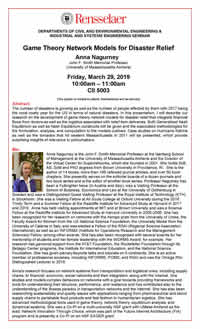
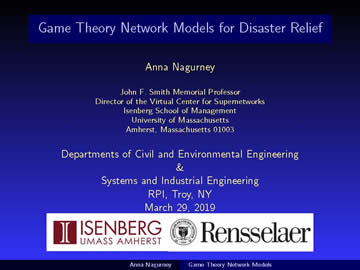
I had given my host, Professor David Mendonca, a list of topics that I could speak on and the one selected was: Game Theory Network Models for Disaster Relief.
 RPI
My talk is available for download and it was exciting to polish it since, in just the past three weeks, three of our papers on the topic have been published in journals, including: An Integrated Financial and Logistical Game Theory Model for Humanitarian Organizations with Purchasing Costs, Multiple Freight Service Providers, and Budget, Capacity, and Demand Constraints,  Anna Nagurney, Mojtaba Salarpour, and Patrizia Daniele, International Journal of Production Economics 212: (2019), pp 212-226.

The drive on the Mass Pike was smooth, despite the rain, and my husband was the designated driver. He had not been to RPI since he had been accepted there for Grad School, but ended up matriculating at Brown University, so he was eager to go back. I had to check my cv to see when was the last time I had spoken at RPI and found that I had given a seminar at RPI at the Electrical, Computer, and Systems Engineering Department,  December 5, 2001! I recall a lavish holiday party with white roses and shrimp that I viewed in passing.

Once the technology for my presentation was set up, I heard some footsteps behind me and was absolutely thrilled to see one of my Operations and Information Management students from the Isenberg School of Management - Emily Agoglia! She had been a student in my Humanitarian Logistics and Healthcare class at Isenberg, is from Philadelphia, and is a world traveler, having most recently taken part in an academic program in Cuba! And she presented me with the lovely memento from Cuba below.
She had been in Cuba, when I was speaking and taking part in the amazing Congreso Futuro in Chile, so when we get together, we cannot stop comparing experiences. Her father is Professor Chris Agoglia, a renowned Accounting faculty member at Isenberg.

And, there was another delightful surprise - Professor William "Al" Wallace, who is now the Chair of the Department of Industrial and Systems Engineering at RPI, came to my talk. He was the doctoral dissertation advisor of the incoming Isenberg School Dean - Dr. Anne P. Massey! Dr. Massey will be the first female Dean of the Isenberg School and it has an illustrious history of over 70 years. In fact, this coming Friday, we will be celebrating the 50th anniversary of our PhD program! I am very excited since many of my former PhD students will be coming back to campus. I am preparing a talk and have organized the Management Science PhD alumni panel for that day.

The photo below is of me with Professor Wallace and Emily.
After my talk, I had the pleasure of meeting with Professors Sergio Pequito, Thomas Sharkey, and Kristin Bennett. Sergio and I talked about our love of interdisciplinary work. With Thomas "Tom" we discussed his thrilling NSF project on the Arctic and he recently returned from Alaska, so I had to take the photo below. We also chatted about colleagues Dr. Renata Konrad of WPI (a fellow Ukrainian, whom we hosted in our UMass Amherst INFORMS Speaker Series) and Dr. Kayse Maas of Northeastern (and, of course, we then talked about the NSF workshop on human trafficking). Professor Bennett remembers me from way back when when she was in Amherst and from one of her first INFORMS conferences and thanked be for being an inspiration (that and many other surprises  made that rainy day a very bright one)! She received her PhD from University of Wisconsin Madison and Dr. Olvi Mangasarian was her PhD advisor.
The lunch was at the RPI Faculty Club where I enjoyed great conversations with Professors David Mendonca, Kristen Schell, and Cara Wang,  and ate a spicy lunch with purple rice!
Dr. Cara Wang is a Professor of transportation and her advisor was Professor Kara Kockelman of UT Austin. I know Kara from the regional science community. Interestingly, Cara had been at Bucknell University and then moved to RPI. Coincidentally, we recently hosted Dr. Thiago Serra in our UMass Amherst INFORMS Speaker Series and he is off to Bucknell University as an Assistant Professor in the Fall. Also, Dr. Kristen Schell is a relatively new faculty member of ISE at RPI and received her PhD from CMU in engineering policy. Our IE/OR doctoral student, Destenie Nock at UMass Amherst, defended her dissertation recently and will be joining that program as an Assistant Professor in the Fall.

And I would be remiss to forget to mention that Professor David Mendonca is an undergrad alumnus of UMass Amherst, and my Management colleague, Professor Emeritus Art Elkins, had convinced him to go to CMU since the Nobel laureate in Economic Sciences Herbert Simon was there (I had had dinner with Dr. Simon in Amherst at the Lord Jeffery Inn a while ago.) Dr. Mendonca collaborates with a cognitive psychologist, Dr. Wayne Gray at RPI, who is a Lafayette College alumnus, from the same class as my husband, so he kindly kept my husband busy and very entertained while I was speaking and meeting with colleagues!

On our journey back, we turned on the radio, only to hear UMass Amherst hockey score its first goal in its game against Harvard University and they won 4-0; they repeated their amazing performance yesterday evening against Notre Dame University, also with a score of 4-0, and are now off to the NCAA Frozen Four for the first time in the history of UMass Amherst hockey! The first game in the final will be on April 11, right when we are having a special banquet at the Isenberg School for the $62 million Business Innovation Hub celebration with the official unveiling (although we have been using it already a lot since late January) on April 12.