Showing posts with label Nobel laureates. Show all posts

Saturday, September 28, 2024

Congratulations to the Radcliffe Institute for Advanced Study at Harvard University on its 25th Anniversary!

The Radcliffe Institute for Advanced Study at Harvard is truly a very special place. I had the great honor of being a Science Fellow in 2005-2006, just a few years after its founding in 1999. It was an incredible year for me with wonderful new friendships made, the writing of my Supply Chain Network Economics book, and many experiences plus collaborations, including with the now Dean of SEAS, David Parkes. Radcliffe also supported my collaborator Patrizia Daniele of Catania, Italy, and she wrote her Dynamic Networks book while at Radcliffe. She also worked with me and Parkes. The Science Fellows were housed at Putnam House and there were engineers, physicists, mathematicians, and computational linguists with us. Radcliffe, at that time, had several buildings for the Fellows. We joined one another for delicious lunches and talks as well as receptions and special events. Since that fabulous year, I have been back to visit many times, and have been a Summer Fellow at Radcliffe twice. I also co-organized with David Parkes an Exploratory Radcliffe Seminar focusing on dynamic networks. Radcliffe now has its own quad and all Fellows are housed in the same building. I love the garden and fountain and there are also often art exhibits.

So, when I heard that Radcliffe would be celebrating its 25th anniversary on September 26 and 27, I had to join, despite a busy teaching schedule, office hours, hosting of  a speaker, and also an All School Meeting of the Isenberg School! To-date, there have been about 1,200 Radcliffe Fellows. 


On September 26, Radcliffe, to kick off its 25th anniversary, hosted an outstanding panel. The session began with introductory remarks by Radcliffe Institute Dean Tomiko Brown-Nagin, who shared some of the history of the Radcliffe Institute and also noted her predecessors as Dean. When I was at Radcliffe, Drew Gilpin Faust was the Radcliffe Dean, and I told her that she would become the next President of Harvard and she did the year after my Fellowship year! The Science Dean my year was the outstanding, very inspiring computer scientist Barbara Grosz.  Brown-Nagin also shared a terrific video of an astronomy discovery by Radcliffe Fellows, which included Alyssa Goodman, whom I have met.

The panel, consisting of two Nobel laureates in Economic Sciences, Claudia Goldin and Oliver Hart, both of whom had been Radcliffe Fellows,  was moderated by the present President of Harvard, Alan Garber. Claudia was a Radcliffe Fellow the same year that I was and here you can see the full 2005-2006 list: https://news.harvard.edu/gazette/story/2005/06/radcliffe-names-2005-06-fellows/

President Garber was an outstanding moderator and I was very impressed by his delightful sense of humor! He reminisced about carrying punch cards across campus, as a student, and always being worried about dropping them. When Claudia spoke, she brought back so many memories of that magical year. She mentioned Geraldine Brooks and her husband Tony Horwitz (who sadly passed away not that long ago) and said that Claudia Olivetti became her best friend. Coincidentally, Claudia is Italian as is my collaborator, Patrizia Daniele. I recall fondly many conversations over lunch together about Berlusconi. Claudia spoke beautifully about what economics is and noted that there are too few females majoring in economics. Male undergrads think econ is finance, so they major in it whereas females also think that econ is finance, so they shy away from it. She emphasized that economics is about people! That reminded me of the essay that I wrote for ORMS Today: In the End, It's All About People!   Oliver Hart, when asked about the influence of technology on his work, said that, as a theoretical economist, he just needs a yellow pad and pencil. He said that he does use technology to communicate with his collaborators but misses the trips that he would take to collaborate face to face. Claudia said that having access to AI would have saved her lots of drudgery type work.

Both Claudia and Oliver are so passionate about their research and that was incredibly energizing and inspiring to hear. 

Information on the Radcliffe Institute for Advanced Study and its Fellowship Program can be found here.

And here is a post on the 10th anniversary of Radcliffe in which I have several photos from our Fellowship year and in the photos are several individuals noted above.

Wednesday, September 28, 2016

INFORMS History and Traditions -- Why Operations Research Is Fascinating

I was honored to be appointed to the INFORMS (Institute for Operations Research and the Management Sciences) History and Traditions Committee and will be serving on this committee through 2018.

The committee is a wonderful group of Operations Research /Management Science scholars and includes also a historian of science, Dr. Will Thomas. We had hosted Will at the Isenberg School of Management back in 2005 in our UMass Amherst INFORMS Speaker Series, when he was a doctoral student at Harvard University. He is the author of a recent book,published by MIT Press. Also, on the committee is Dr. Irv Lustig, who was an undergraduate in Applied Math at Brown University when I was a PhD student there and I was his TA for a course taught by my dissertation advisor, Professor Stella Dafermos. Irv went on to get his PhD at Stanford University and his dissertation advisor was none other than a giant of Operations Research, Professor George Dantzig, whose research and mentorship and friendship helped to build the great community of INFORMS, as well as its predecessors, ORSA and TIMS.  Irv spoke in our Speaker Series in the Spring of 2006. That year I was a Fellow at the Radcliffe Institute for Advanced Study at Harvard and still managed to help the students organize the Speaker Series and to come back on Fridays to support them. Dantzig passed away in May 2005 at age 90. There is a memorial site in his honor.

Dr. Mark Eisner of Cornell University has chaired this committee for the past three years and his energy and ideas as well as leadership is making a log of exciting things happen in preserving our history and also providing exceptional resource and educational materials about our field. Also, and this I find to be something quite special, Mark knew Stella when she was a postdoc at Cornell University, after receiving her PhD from Johns Hopkins in Operations Research, and before coming to Brown University.

Also on the committee are luminaries of Operations Research who are household names: Dr. Arjang Assad, Dr. Art Geoffrion, Dr. John D.C. Little, and Dr. Shaler Stidham Jr.

When I teach my classes I always include stories of individuals who have been instrumental in the development of the various topics and even include photos of the personages in my lecture slides. I think that it is very important that students know and can visualize who made the scientific discoveries, whether in terms of a methodology, an algorithm, or a very cool application. I have been lucky that through our professional societies that I have been able to meet many of the shining stars, starting when I was a graduate student. I think that meeting people whose work inspires you brings a humanity to the research and also motivates you. Plus, you can learn so much from such people in terms of professional development, if you just ask.

A wonderful contribution to the INFORMS History and Tradition webpages are the compilations of the oral histories. I have been enjoying viewing and learning from them immensely. Listening to the words of wisdom is making history of our field come alive and it also helps to preserve it. Right now all the interviews are with males so I am doing my best to get more female operations researchers featured. I know that several additional interviews are planned even for the INFORMS Conference in Nashville this coming November.

And speaking of leadership in Operations Research, I urge you to visit the Miser-Harris Presidential Portrait Gallery, where the Presidents of ORSA, TIMS, and, INFORMS are featured a long with links to their biographies. The gallery is named after Professors Hugh Miser and Carl Harris and Hugh was a Professor at UMass Amherst for several years but before I joined the faculty. All the Presidents of TIMS were male. There was only one female President of ORSA and that was Dr. Judith Liebman, who was a contemporary doctoral student of Stella  Dafermos' at Johns Hopkins. Several of my doctoral students have received the Judith Liebman Award from INFORMS for their activities with our award-winning UMass Amherst INFORMS Student Chapter. I am delighted that there have been 7 female Presidents of INFORMS, which is fabulous. Dr. Robin Keller, the President before Dr. Ed Kaplan, has also been taking part in our committee teleconferences, as well as Melissa Moore, the Executive Director of  INFORMS and Mary Magrogan, INFORMS Director of Membership, Subdivisions & International Activities.

I urge you to visit the INFORMS History and Traditions pages. I find the personal memoirs also very informative and inspiring. More information on the committee and its activities can be found in the article written by Assad and Eisner. A guided tour of the website is provided in an article written by Mark that appeared in OR/MS Today.

The biographical profiles of those who have made significant contributions to our field and were born before the end of World War II are also very interesting to read. And, of course, the list of Nobel Laureates in Economic Sciences with OR affiliations and contributions is also very worthwhile to peruse and among those listed I note that dozens of my papers have cited the work of John Nash.

INFORMS will be redesigning its website and I hope that we can feature the information associated with the History and Traditions more directly and prominently. Also, INFORMS is looking for a part-time student website intern to assist in the enhancement of the web site devoted to the history of Operations Research. The intern would work from his or her home location via email at the direction of members of the History and Traditions Committee of INFORMS, the Institute for Operations Research and the Management Sciences. If you may be interested or know of someone who may be, please let me or any of the committee members know. Thanks!

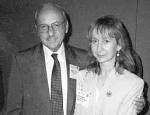
Actually, visiting the site and serving on this committee is sometimes like a walk down Memory Lane and I conclude this blogpost with a photo taken of me and Professor George Dantzig, way back when, at an ORSA conference in San Francisco.