Showing posts with label applied math. Show all posts

Saturday, April 4, 2020

Marking the 30th Anniversary of the Passing of Dr. Stella Dafermos, the Second Female PhD in Operations Research in the World

During the COVID-19 pandemic, many of us are hearing from relatives and friends, from far and wide, offering support during these extremely challenging times.

Last week, I heard from my Brown University room-mate, with whom I shared a dorm room for 2 years. She was also a fellow Applied Math major, with a love of Operations Research, and an exceptional ballerina from South America, who then became a member of Brown's women's crew team. I co-founded the Brown Women's track team.

My room-mate wrote to me: "Stella Dafermos has appeared on my horizon these days. I can see Stella, wearing her grey knitted vest, writing on the blackboard, remember? It may well be that we’re living one of those math models she was trying to explain back then."

And then in a follow-up message last week, she continued: "I have a memory, crystal clear in my mind’s eye: we were sophomores, we were in our room (4th floor Diman), I am looking at my notes from her latest class, literally turning the notebook upside down and sideways to see if any of it would make any sense, thinking I really don’t think this is for me..  you were changing into your running clothes, munching on an apple, you come over, eye the notes and say.. oh, yeah, there it is, that’s good! You’ll get it!   And off you go running. I didn’t get it, but later, much, much later, from Vedic texts where they teach how our reality is actualized out of infinite probabilities, well, now the value of those lessons is evident."

Interestingly, unlike my room-mate, I never had Stella while I was an undergraduate student at Brown but I would hear about her from other female Applied Math majors. 

Dr. Stella Dafermos, the second female to receive a PhD in Operations Research (OR), passed away on April 5, 1990, so we now mark the 30th anniversary of her passing.  She was the only female Professor in the Divisions of Applied Math and Engineering at Brown at that time, and I became her first PhD student. Although she passed away at the age of 49, her incredible legacy on contributions to transportation and networks, notably, continues. Her contributions were recognized in an obituary that I wrote for the journal Operations Research, the only female thus honored. Her PhD was from Johns Hopkins University in 1968, and she was surrounded by luminaries in OR there.
Below is the academic genealogy tree, with academic ancestors including Maxwell, Newton, and Galileo. It, in an expanded form, with my PhD students, hangs in my office for inspiration. You can see the list of my PhD students, with the latest, Deniz Besik, to be added soon, here.


And, in a very interesting blogpost by the esteemed Dr. Mike Trick, who happens to be not only a fellow Canadian by birth, but also my academic cousin, you can read more.

Stella passed away on a Thursday. I was that year a Visiting Scholar at the Sloan School of MIT, and, shortly after I received the phone call about her death, I gave a talk at the OR Center. Such resilience is needed now, more than ever. I recall Professor Jim Orlin coming to my office to support me. Interestingly, Dr. Les Servi, now of MITRE (and with whom I also corresponded this week), was on sabbatical at the Sloan School then, and also offered much appreciated support. 

My husband drove us to the funeral, which was on the following Saturday. I remember the daffodils at the cemetery on beautiful Blackstone Boulevard and also some snow falling. I always consider daffodils to be Stella's flower because of her surname "Dafermos."  I wrote a tribute to my "Academic Mother" here.  I also wrote a bit on my personal journey in another post, in which I recognised the 20th anniversary of her passing.

One of Stella's paper (on variational inequalities, of course) is among the most impactful ones published in the INFORMS journal Transportation Science in 50 years!

Tuesday, December 23, 2014

A Trip Back to Brown University, My Alma Mater

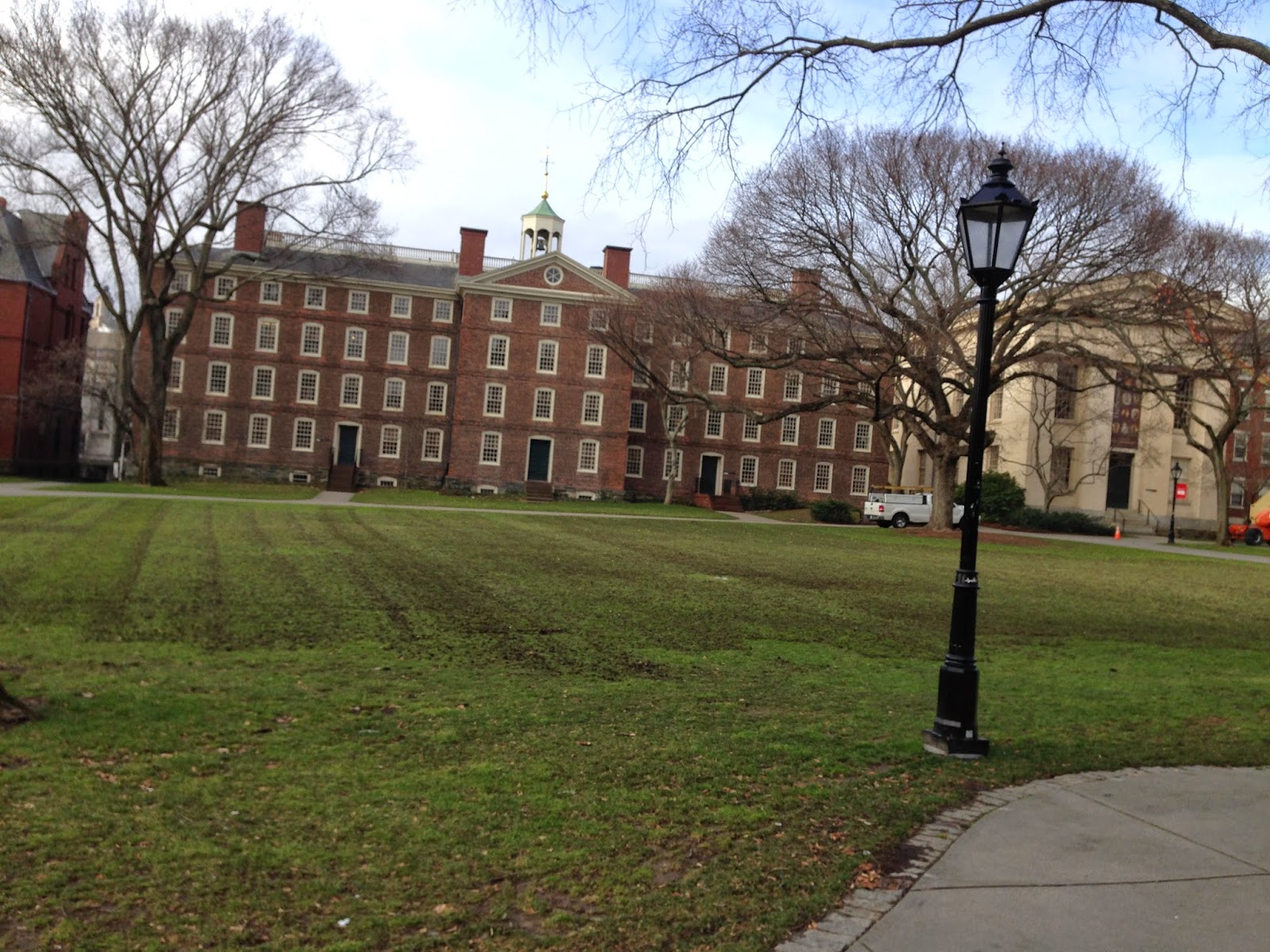
Yesterday, in traveling back from early holiday celebrations with relatives in Newport, Rhode Island, we stopped in Providence. I was curious to see how my alma mater, Brown University, was faring, given that I had heard that construction was in the plans.

There is something very special about going back to the place where you received a great education, made many friends, and have lifelong memories. OK, I admit, I also met my husband there freshman week - he was a graduate student in physics.

Thayer Street - the main commercial street that cuts through the campus is filled with even more restaurants than ever - quite a few with an international focus, which is great.

Pembroke, pictured below, where I lived as a freshman, still looks good.

As does Diman House, where I lived, and had the best room-mate, Teresa Davila, who was on the women's crew team - amazing for a former ballerina from Chile, and fellow Applied Math major.
I loved living at Diman, because it was close to the "Ratty," the main cafeteria, as well as to the frat quad, which made life always interesting. Yes, in those days, we even got to see "streakers," including members of the football team.

Also, I have incredibly fond memories of living in the Russian House and,  even last summer, while visiting my daughter, who was doing research at the University of Colorado, Boulder, we got to see Dr. Mark Kiken, who received his PhD from Brown. He was the dorm resident assistant of Russian House when I lived there for a year. My other major (I hold an AB and an ScB from Brown) was Russian Language & Literature.
I reconnected this past year with two other Russian majors, Janice Pilch, now at Rutgers, and Jill Rappaport, now teaching at Temple. We would spend a lot of time at Marston Hall where many of  the language faculty had offices. I could not resist having the photo taken below in front of Marston.
 
Then, just a few feet away, is the beautiful Applied Math building with stained glass windows, where I would visit faculty during office hours and we would pick up our exams and homeworks.
Less than a decade after getting my PhD from Brown in Applied Math, with a specialization in Operations Research, I was back in that building on my sabbatical and there I wrote my first book, Network Economics: A Variational Inequality Approach. I lived then in an apartment complex known as Wayland Manor, on Wayland Square,  which I visited yesterday.
My apartment was on the first floor behind the trees in the photo above.

Walking through the main campus was nostalgic.
Brown had invited me back (the Mathe Department) in 2007 to speak at the SUMS conference on Operations Research to undergraduates and a clip of my talk was posted on youtube. 

And, speaking of fellow Brown University Applied Math majors, I just heard that (I was his TA in OR courses), Dr. Irv Lustig has left IBM!  Dr. Les Servi of Mitre, another fellow Brown Applied Math major, is also rrenowned in our INFORMS professional community.  And, of course, I have to mention Dr. Georgia Perakis of the Sloan School at MIT. Georgia was my dissertation advisor's 4th PhD student and I was her first.

And, while on the main campus green, I had to take a photo of Wilson Hall, where I had my calculus classes from one of the founder's of dynamical systems, Professor Joe LaSalle.
The campus was very quiet since it is now the winter break period.

After exploring Brown, it was time to head to the Italian section of Providence, on Atwell's Avenue, to see what kind of holiday pastries were on display.

I couldn't resist taking the photo of the tree below - note that instead of a double yellow line on the street, there is a long Italian flag painted.

With best wishes for a joyous holiday season to my readers!


Saturday, April 7, 2012

Congratulations to the 2012 SIAM Fellows!

Having received a PhD in Applied Mathematics from Brown University, with a specialization in Operations Research, I have been a member of quite a few professional societies from INFORMS and POMS  to the Econometric Society, the Regional Science Association International, the Society for Computational Economics, and, of course, the American Mathematical Society (AMS), and SIAM (the Society for Industrial and Applied Mathematics).

I also belong to various special interest groups within certain societies in both INFORMS and POMS that focus on transportation and logistics, computing, and humanitarian operations.

Being a member of a professional society is very important since one gains a community of interest and expands one's disciplinary connections as well as personal ones.

I was delighted to see the new list of SIAM Fellows, which included several well-known operations researchers, including Don Goldfarb of Columbia and Bob Vanderbei of Princeton and, if I may say, a fellow PhD in Applied Math from Brown, Thaleia Zariphopoulou. Thaleia and I shared a room a while back at the INFORMS Conference in Orlando, and we had a fabulous time. She is now a chaired professor at Oxford University, having been previously at Wisconsin and Texas Austin. She has done outstanding work in financial mathematics.

I was also thrilled to see at the top of the list Tamer Basar from Illinois. I last saw Tamer at the NetGCoop Conference in Glorious Paris back in October, when I gave a keynote talk. He was the General Chair of this fabulous conference.

You may see the entire list here (and, last but not least, given her surname, you will find Thaleia).

Congrats to all the SIAM Fellows on an honor richly deserved. It is especially nice to see familiar faces!

Thursday, August 25, 2011

Revolutionizing Math Education Through Operations Research and Applications

What if Math was taught through Applications?

Sol Garfunkel, the executive director of the Consortium for Mathematics and its Applications, and David Mumford, a professor emeritus of Applied Mathematics at Brown University, argue in an OpEd piece in today's New York Times that math education in the US needs serious "fixing."

Dr. Mumford taught for years at my alma mater, Brown University, from which I happen to have 3 degrees in Applied Math, with my PhD specialty in Applied Math being Operations Research. (A sidebar -- I also have a degree from Brown in Russian Language and Literature).

In the OpEd, How to Fix Our Math Education, they note the wide-spread of alarm in the US about the state of math education, and argue that the sequence of math courses that students (obviously, not all) take in high school, i.e., algebra, geometry, and calculus should be replaced by a sequence of applied math courses, focusing on finance (I teach in a finance and operations management department at the Isenberg School of Management), data, and basic engineering. They argue that math and science should be taught and learned together and the data course would focus on data-gathering from sports to medicine.

Garfunkel and Mumford state:
In math, what we need is “quantitative literacy,” the ability to make quantitative connections whenever life requires (as when we are confronted with conflicting medical test results but need to decide whether to undergo a further procedure) and “mathematical modeling,” the ability to move practically between everyday problems and mathematical formulations (as when we decide whether it is better to buy or lease a new car).

This sounds like Operations Research to me.

I would argue that a course on modeling and optimization should be included (with an overview of computing) and then students could select among a spectrum of courses in applications of their interest -- whether sport (by the way, the Isenberg School of Management also houses the McCormack Department of Sports Management), transportation & logistics, the environment and sustainability, and even the modeling and analysis of social networks!

Nevertheless, Garfunkel and Mumford have begun the conversation on a most important topic -- how to entice and capture the interest of high schoolers in quantitative literacy and math modeling and to sustain it.

By the way, Dr. Mumford received the National Medal of Science from President Obama in 2010. One of my former colleagues at UMass Amherst, Dr. Val Haensel, did as well, and the dinner at the Chancellor's house that I was invited to for the celebration, I will always remember. Val became a special friend and when I received the Chancellor's Medal for my research, he and his wife came to the dinner that followed. The then Provost, Dr. Cora Marrett, now at NSF, also joined us, and a dear friend, Dr. Kei May Lau, who is now a Professor in Hong Kong.