Showing posts with label computers. Show all posts

Saturday, October 8, 2016

A Fabulous Conversation with Steve Wozniak - Co-Founder of Apple

Yesterday, after a three and a half hour journey (it was the Friday before the Columbus Day long weekend), from the Isenberg School of Management at UMass Amherst, via the Mass Turnpike (a journey that should take no more than 2 hours), we arrived at The UMass Club in downtown Boston.

We were driven by a UMass student, Jenna, on a courtesy van provided by the Isenberg School to attend an event with Steve Wozniak, the co-founder of Apple. The event was an inaugural lecture in a new series, part of the Isenberg School's #Driven campaign.

The van ride was long but what made it fun was being with colleagues such as my department chair, Iqbal Agha, the chair of the Finance department, Sanjay Nawalkha, and our new clinical professor, Charlie Johnson, who was hired for our entrepreneurship program, and has been a Boston lawyer for over 30 years. Also with us was our wonderful Isenberg School Communications Director, Lou Wigdor.

The faculty on the van had been invited to be table facilitators with the evening program consisting of a 60 minute conversation with Steve Wozniak, moderated by the fabulous Tom Ashbrook, the host of NPR's, On Point, followed by a dinner. Other faculty facilitators included the chair of the Marketing Department, the one and only Bruce Weinberg, and my colleague, Alan Robinson.

Attendance was great at this event, and several remarked to me that they heard of it on NPR a few days ago and decided to come. The view of Boston from The UMass Club, which is on the 32nd floor, was stunning. I saw several alums, including Vinnie Daboul!
Sitting with me at the table were several GE employees, an employee of Nuance Communications, of the Markley Group, and  Mendix, as well as an Operations and Information Management (OIM) undergraduate student who had volunteered to help out. We talked about our jobs, Wozniak, high tech, and had a great time.

It was fabulous to see the UMass President, Marty Meehan, there and I told him how one of my former students shared with me that, when he turned 21, and was then a student at UMass Lowell, President Meehan took him out to celebrate. The student will never forget this.

While nibbling on some canapes the conversation began and the energy of Wozniak was incredible. I had caught up with his travels by checking out his Twitter account and he had come in from London just the day before and the week before he had spoken in Canada. He lives in California.
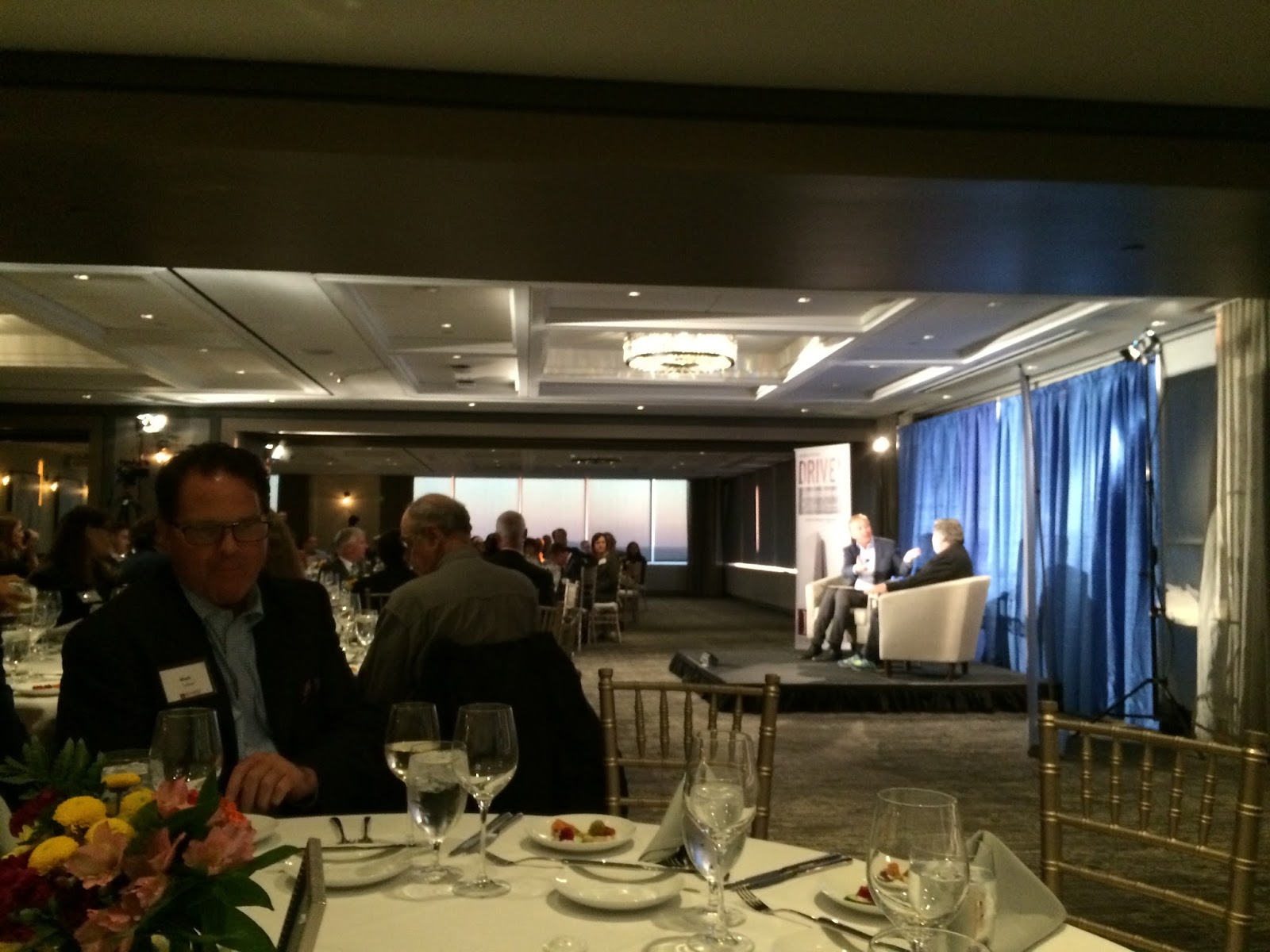

He spoke on the founding of Apple, his childhood, during which he loved ham radios (my husband is a ham radio operator so I very much appreciated this) and also electronics. I am sure that many of you have read both the book on Steve Jobs by Walter Isaacson and Wozniak's book iWoz. But it was extra special to see him in person and also to meet with him afterwards with a group asking for autographs. He, like Jobs, was a prankster, and usually got away with his pranks, since he did not advertise them.  He loved soldering and constructing computers so as to minimize resources, typically, computer chips. He clearly has a mindset of an Operations Researcher! He recalled fondly his time with the Homebrew Computer Club and thought that he would spend his entire life as an engineer at HP and could design computers in the off hours. His design of the Apple I and Apple II computers revolutionized personal computers and the computer industry.
He emphasized that happiness is important and his integrity was vivid throughout his presentation/conversation.  He said that he builds computers since he was inspired by social causes. Steve Jobs was the one with the business mind and, together, originally they had to hustle for the computer parts that they needed. He did mention that the Lisa and Apple III computers were not successful but he was not involved in their designs.

Interestingly, although the general public believes he is no longer with Apple, Wozniak actually still gets a paycheck from Apple. Apple II provided the company with revenues for 10 years. He also spoke about gaming and the importance of color and how the fact that Visicalc could run on an Apple computer very much helped in sales. People wanted computer solutions. Steve Jobs wanted computers to get easier and easier to use. He was not technical, according to Wozniak.

He said that in order to lead you have to be willing to take risks. Ashbrook asked him about the future of technology and Wozniak emphasized that we had earlier the advantage of Moore's Law. As for Artificial Intelligence, the question is how can it improve the world? 

He was proud that he eventually received his college degree from UC Berkeley but since he was already very well-known at that time, it is "Rocky" Raccoon Clark that appears ob his diploma.

He still has the first Apple I computer that he ever made.

Wozniak noted that we should be partners with computers.

He told us it is about "food, fun, and friends," and that his equation for happiness is: smiles minus frowns. He also mentioned that his wife is from Kansas.

We had time but only for a few questions and I enjoyed his insights on autonomous vehicles. 

It was a fantastic evening and we made it back to the Isenberg School in less than 2 hours. Joining us on the van back was Susan Boyer. The conversations were fabulous and the evening is one we will long remember.

Many thanks to Steve Wozniak  and to Tom Ashbrook as well as to the Isenberg Dean, Dr. Mark Fuller, and to Assistant Dean Chris Pilsner for organizing and making possible this great inaugural lecture! Also thanks to Associate Dean Tom Moliterno for inviting me to be a table facilitator at this great inaugural lecture.

Wednesday, January 1, 2014

Facebook Data to the Rescue of Metcalfe's Law

The December 2013 issue of IEEE"s Computer magazine has as its theme: Computing Laws Revisited. Our hardcopy issue (my husband is a subscriber) arrived yesterday, on New Year's Eve, and, today, New Year's Day, I sat down to read the article, "Metcalfe's Law after 40 Years of Ethernet," written by none other than Bob Metcalfe, Ethernet's inventor, himself. The Ethernet is the physical transport level of today's Internet. On May 22, 2013, Ethernet industry leaders gathered at the Computer History Museum in California to celebrate its 40th birthday and to catch up on what has become a $100 billion industry (do I now have your attention?).
I have been interested in Metcalfe's Law since, as an Associate Editor of over a dozen journals, and a frequent reviewer of journal articles, as well as a Co-PI on a Future Internet Architecture NSF grant: Network Innovation Through Choice (which I most recently spoke on at the Network Frontiers Workshop at Northwestern University), I not only encounter related controversies but also write and review papers that touch upon this law.

I guess that Metcalfe must have been reading over my shoulder!

Now, back to a controversy: In 2006, Briscoe, Odlyzko (I do like some of his math models a lot), and Tilly published an article, "Metcalfe's Law is Wrong" in the IEEE Spectrum, which you can read online without a subscription. These authors described Metcalfe's Law as both "wrong" and "dangerous."

So, what is Metcalfe's law, you may be asking (for those not so much into hardware). As explained by Metcalfe himself in his very clear and erudite December Computer magazine article: The "law" bearing his name states that the value of a network grows as the square number of users: V= NxN. The law started as a high-concept Ethernet sales tool in the early 1980s and entered into the public discourse in the new millennium when Gilder "championed" Metcalfe's law in his book, "Telecosm: The World After Bandwidth Abundance," published in 2000.

During  a presentation to the 3Com sales force (Metcalfe cofounded this company in 1979), Metcalfe showed the figure below (thanks to his article in Computer magazine) to argue that if  a network is too small its cost exceeds its value, but if a network gets large enough to reach a critical mass, then the sky is the limit.

Valuation of Internet-based companies such as Google, LinkedIn, Facebook, Twitter, Snapchat, and others is clearly important and detractors have said that Metcalfe's law may be overvaluing such firms.

The main critique of Metcalfe's law, noted by Metcalfe, himself, was that Briscoe, Odlyzko, and Tilly countered that not all network connections are of equal value and that the growth in the value of a network is approximately Nxln(N) and not NxN as Metcalfe had stated.

Moreover, neither "law" had been validated empirically until Metcalfe did recently and reported the results in his article in the December issue of the IEEE Computer magazine.

And he used 10 years of real data from Facebook and fitted the data looking at N as a function of time. To estimate the growth of users and individual groups of friends, he first applied a sigmoid function (S-shaped adoption function). He then generalized it to what he calls a "netoid" function using the Python programming language. (It looks as though Metcalfe also thinks in code, which is cool.) He plotted Facebook annual revenue (as the value V) for the last 10 years and used a Python slider to the Metcalfe's function to "get a pretty good visual fit to this data" as he displayed in the figure below reported in Computer magazine.

Metcalfe also notes that a more elaborate model of network growth and value would involve using "nesting netoids." Fascinatingly, he observed that Facebook groups seem to be netoiding (a new verb) towards Dunbar's number, which is due to the anthropologist Robin Dunbar who theorized that humans have a cognitive limit on the number of people with whom they can maintain stable social relationships with this figure being about 150. And, since Facebook has about 1.06 billion users and 150 billion friend connections this implies  an average of 141 friends per user.

So, as we begin to celebrate the New 2014 Year, it is quite interesting that we are also marking technological advances that challenge and intrigue us in both theory and practice and that are still very much with us such as the Ethernet, which is now 40 years old!

There is also a great interview with Bob Metcalfe, thanks to Charles Severance of Computer magazine, which can be viewed below.


Saturday, August 20, 2011

If the Stakes are So High, Why Do Math Errors Still Occur?

I have always been fascinated by numbers. I find them beautiful and incredibly useful, when used correctly. Numbers and math, together, are a language through which we can express ourselves and make sense of the world around us. Coupled with technology and computers, algorithms enable us to get information at our fingertips at the speed of electrons, and drive the scheduling and execution of complex processes in transportation and logistics, energy, healthcare, and finance.

As a student at Brown University, in the dual degree (ScB & AB) program with majors in Applied Math and Russian Language & Literature, respectively, I would spend hours in the Sciences Library working through math problems (when I wasn't devouring economics books in the Rockefeller Library). I always had a fascination with networks, optimization, and game theory and solving those tough word problems plus modeling systems and computing solutions to them. I figured that, if I could work through all the problems in the various texts, I would be prepared for those exams and I was -- perhaps scholarship students just know that they have to work harder.

Another aspect of math that I love is that many answers are either right or wrong and I appreciate that kind of clarity and objectivity in what may be a very nuanced world. Now my passion has become my career as a researcher and writer and educator.

The Numbers Guy also has a fascination with numbers and writes a blog and column for the Wall Street Journal. His focus is on a critical theme -- how numbers are used, and abused. He holds a degree from Yale in Math and Physics and his column is always thought-provoking and illuminating.

He got in touch with me this past week, since he was working on a column as to why math errors persist in high-stakes situations, even in the computer age. With the dramatic and costly errors both in the UK and the US lately regarding high-stakes economics data, analysis, and policy impacts, his latest blog posting and column are a must read and you can read my take on what has been happening.

Perhaps we need an organization such as the National Transportation Safety Board for Data and Analytics Quality and "Safety?!"