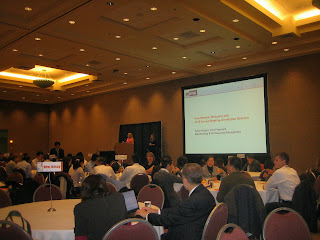
I arrived in San Francisco for the INFORMS conference late on Saturday and, since then, the conference has been a whirlwind of activity. I have enjoyed outstanding plenary talks, the session that I organized ( I am a bit biased), hearing many of our doctoral students in Management Science present, some for the first time at an INFORMS conferences, and attending numerous meetings - many with great food, and award events. It is wonderful to see friends from around the globe, even from New Zealand, Switzerland, and the UK!
While in San Fran, I have also been blogging on the conference blog, which you can access here. You can get a great sense of the dynamism here and the exciting events while reading various posts on the link above.
One of the best parts has been seeing many of my former PhD students and two of my present ones from the Isenberg School of Management here. We always find time to share a pleasant dinner and to reconnect and recharge!
INFORMS is such a special community and yesterday when the students of the UMass Amherst INFORMS Student Chapter (over a dozen of them here) were recognized with the cum laude award with a gorgeous plaque, I was so proud of their work ethic and collegiality.
I will be posting (many) photos after I return to Amherst.
Showing posts with label great conference. Show all posts
Showing posts with label great conference. Show all posts
Tuesday, November 11, 2014
Friday, October 11, 2013
Was This One the Best One Ever?! - Photos from the INFORMS Minneapolis Conference
Those of us who were at the INFORMS Annual Conference in Minneapolis, which took place October 6-9, 2013 will never forget it!
I have been going to INFORMS conferences since I graduated from Brown University but, last year, since I was on sabbatical in Sweden, missed the Phoenix one -- my collaborators and students were there, though, in full force.
Not only was the venue of this year's conference at the Minneapolis Convention Center great with 8 miles of Sky Walks (warm, dry, and carpeted) to navigate through downtown from location to location, and with the beautiful Loring Park close by, but the talks and events kept us engaged, entertained, and informed. I would say that time was too short but that means that the conference was very successful. I very much enjoyed such new initiatives as Coffee with a New Member and even the New Members Breakfast at which we could meet new INFORMS members.
Seeing friends and former students and colleagues from around the globe was the biggest plus and taking part in various awards ceremonies energizing and so pleasant.
The INFORMS staff and conference organizers did an outstanding job -- thank you, thank you, thank you!
Below I have posted some photos. I know that many of us arrived back home in the wee hours of the morning, but it was worth it!
The new members breakfast at which various fora (WORMS, JFIG) and societies networked
 We had meetings within the meeting in the form of various journal editorial board meetings -- a great lunch hosted by Wiley for the International Transactions in Operational Research board
 We interacted with the great INFORMS staff
 And when the sun came out on Monday enjoyed some of the sights outdoors

 We celebrated our students' achievements through various awards (student chapter, Judith Liebman, etc.)

 We celebrated the recipients of various awards including the WORMS Award given to Dr. Kathryn Stecke by the President of WORMS, Dr. Laura McLay of the University of Wisconsin Madison, and Dr. Susan Albin of Rutgers
 We did more networking and catching up
 We were very excited to see our latest book, Networks Against Time: Supply Chain Analytics for Perishable Products, on display at the Springer booth
 We learned from fabulous plenary talk presenters about the latest results in operations research and the management sciences and analytics
 And members of my supernetworks team gave many talks
 We dined together and had so much fun

 As the President of INFORMS, Dr. Anne Robinson, who is also the Director of Supply Chain Strategy and Analytics at Verizon, wrote me, after I thanked her, Dr. Olga Raskina, and various members of the INFORMS staff for such a great conference: The energy level and interest in our community these days is breath-taking and I completely agree.
Until we all meet again in person (face time really matters), keep up the great work!
And for those that could not join us or just want to further reminisce and hear about other perspectives, events, and impressions, do check out the various blogsposts and social media.
I have been going to INFORMS conferences since I graduated from Brown University but, last year, since I was on sabbatical in Sweden, missed the Phoenix one -- my collaborators and students were there, though, in full force.
Not only was the venue of this year's conference at the Minneapolis Convention Center great with 8 miles of Sky Walks (warm, dry, and carpeted) to navigate through downtown from location to location, and with the beautiful Loring Park close by, but the talks and events kept us engaged, entertained, and informed. I would say that time was too short but that means that the conference was very successful. I very much enjoyed such new initiatives as Coffee with a New Member and even the New Members Breakfast at which we could meet new INFORMS members.
Seeing friends and former students and colleagues from around the globe was the biggest plus and taking part in various awards ceremonies energizing and so pleasant.
The INFORMS staff and conference organizers did an outstanding job -- thank you, thank you, thank you!
Below I have posted some photos. I know that many of us arrived back home in the wee hours of the morning, but it was worth it!
The new members breakfast at which various fora (WORMS, JFIG) and societies networked


Until we all meet again in person (face time really matters), keep up the great work!
And for those that could not join us or just want to further reminisce and hear about other perspectives, events, and impressions, do check out the various blogsposts and social media.


Thursday, March 29, 2012
The 2012 Social Computing, Behavioral-Cultural Modeling, and Prediction Conference
I am flying to the 2012 International Conference on Social Computing, Behavioral-Cultural Modeling, and Prediction (SBP 2012) this Sunday.
The conference takes place at the University of Maryland, College Park.
The program is single-track and the papers are all refereed and published in a Springer volume.
I am the tutorial chair of this conference (and served in this capacity last year as well).
The tutorials take place on Monday, April 2.
The information on the tutorials is below.
Dynamic Network Analysis − Kathleen M. Carley
The conference takes place at the University of Maryland, College Park.
The program is single-track and the papers are all refereed and published in a Springer volume.
I am the tutorial chair of this conference (and served in this capacity last year as well).
The tutorials take place on Monday, April 2.
The information on the tutorials is below.
Dynamic Network Analysis − Kathleen M. Carley
Dynamic network analysis enables the analyst to assess change in groups and organizations as they move through time and space on multiple dimensions. By focusing on the network of relations that connect who, what, how, why, where and when we are better able to assess and predict change and identify emergent leaders. This tutorial provides an overview of dynamic network analysis, it's value for identifying emergent leaders, and the capabilities for spatio-temporal reasoning about groups and organizations.
Kathleen M. Carley, Harvard Ph.D., is a faculty member at Carnegie Mellon University, in the School of Computer Science, the department Institute for Software Research. She is also the founder and director of the center for Computational Analysis of Social and Organizational Systems (CASOS). Her research combines cognitive science, social networks and computer science to address complex social and organizational problems. Her specific research areas are dynamic network analysis, computational social and organization theory, adaptation and evolution, text mining and the impact of telecommunication technologies and policy on communication, information diffusion, disease contagion and response within and among groups particularly in disaster or crisis situations. She and members of her center have developed novel tools and technologies for analyzing largescale geo-centric dynamic-networks and various multi-agent simulation systems. These tools include: ORA, a statistical and graphical toolkit for analyzing and visualizing multi-dimensional networks; AutoMap, a text-mining system for extracting semantic networks from texts and then cross-classifying them using an organizational ontology into the underlying social, knowledge, resource and task networks; CEMAP, a system for extracting networks from email and blogs; and SORASCS, a service oriented plus architecture for designing and sharing workflows in the human socio-cultural space. Her simulation models meld multi-agent technology with network dynamics and empirical data. Three of the large-scale multi-agent network models she and the CASOS group have developed are: BioWar a city-scale dynamic-network agent-based model for understanding the spread of disease and illness due to natural epidemics, chemical spills and weaponized biological attacks; Construct an agent-based dynamic-network based nmodel for assessing network evolution and the diffusion of information and beliefs under diverse socio-demograohic and media environments; and RTE a model for examining state failure and the escalation of conflict at the city, state, nation and international as changes occur within and among red, blue and green forces.
Crowdsourcing, Human Computation, and Collective Intelligence − Haym Hirsh
"Crowdsourcing," "human computation," and "collective intelligence" refer to various ways that information and communications technologies are bringing people and computing together to achieve outcomes that were previously beyond our individual capabilities or expectations. Google's search algorithms, Wikipedia's millions of articles, Amazon's recommendations, and open source software's multiple successes are prominent examples of the many ways in which technology and people are being brought together to exhibit new behaviors and outcomes that exceed those previously possible by people or machines in isolation. This tutorial will survey the state of the art and emerging topics in this area. Attendees will acquire knowledge of a wide range of examples in this area, a conceptual framework for relating them to each other, and an appreciation of our growing experience with how such systems can be used in unintended and undesirable ways.
Haym Hirsh is Professor of Computer Science at Rutgers University. His research focuses on crowdsourcing, data mining, human computation, and machine learning, especially targeting question that integrally involve both people and computing. From 2006-2010 he served as Director of the Division of Information and Intelligent Systems at the Nation al Science Foundation, and most recently was a visiting scholar at MIT's Center for Collective Intelligence. Haym received his BS from the Mathematics and Computer Science Departments at UCLA and his MS and PhD from the Computer Science Department at Stanford University.
Public Health Concepts: An Introduction for Modelers − Nathaniel Osgood & Patricia L. Mabry
This tutorial is designed to introduce people with backgrounds in computer science, mathematics, engineering, physics, and related disciplines to fundamental concepts in health-related research, and provide resources and strategies for applying for National Institutes of Health (NIH) grant funding. The tutorial is aimed at health at the behavioral and social levels, rather than at biomedical and biological levels. The tutorial is aimed at systems scientists who have little or no formal background or training in the health-related disciplines, with the goal of helping prepare them to apply their methodological skills in the health domain. The tutorial will lay out the concepts necessary to facilitate the building of health related models, improve their quality, and help build cross-disciplinary relationships (i.e., bridge to health researchers). The tutorial will include: an explanation of the rationale for modeling in health; a description of classification of issues in the public health space (e.g., environmental health, communicable diseases); an appreciation for the diversity of disciplines within the health arena; and a brief discussion of specific topics of interest to the NIH. Also covered in this tutorial: important terminology issues to be aware of when working across domains; an exploration of the time dimension and its impact on health issues; a brief review of types of models and the health problems they are well suited to addressing; and major public health data types and sources that modelers should be familiar with. Presenters will also give an overview of funding agencies that support public health modeling with an emphasis on the component organizations within NIH along with specific funding opportunities at NIH and strategies for preparing grant applications. Some attention will also be paid to issues surrounding tenure and interdisciplinary work, training challenges and opportunities, and resources for learning more.
Learning Objectives:
- Understand why investigators in public health are motivated to use systems science methodologies
- Understand some basic terminology used in the public health field
- Appreciate the diversity of disciplines within health; be able to name the broad domains of health and understand their differences
- Be aware of the pitfalls of working across disciplines and how to address them proactively
- Be aware of the types of data and a few of the large data sets frequently used in health
- Name several major funders of health research and understand how their missions differ
- Be aware of a variety of journals and conferences that welcome systems science health projects
- Obtain some ideas for identifying collaborators in the health field and for developing partnerships
- Be exposed to some existing work featuring systems science methodologies applied to health problems
- Obtain resources and some explanation of the NIH grants process and specific funding opportunities
- Obtain resources on where to learn more about the above topics
Nathaniel Osgood is an Associate Professor in the Department of Computer Science and Associate Faculty in the Department of Community Health & Epidemiology and Division of Bioengineering at the University of Saskatchewan. His research is focused on providing tools to inform understanding of population health trends and health policy tradeoffs. This work includes both application and methodological components. On the application side, Dr. Osgood works closely with cross-disciplinary teams applying simulation modeling, smartphone-based epidemiological sensing platforms, Bayesian inference and mathematical analysis to address urgent public health challenges in both the chronic and infectious disease areas. Dr. Osgood's methodological work seek to advance the science and art of model building and epidemiological data collection for models through improved formalisms, algorithms, ubiquitous sensing frameworks, analysis techniques, and software tools. Dr. Osgood received his PhD in 1999 from MIT's Department of Electrical Engineering and Computer Science. Prior to joining the U of S faculty, he worked for many years in a number of academic and industry positions, including on industry & academic projects applying modeling to tobacco and environmental epidemiology, health informatics, and multi-framework modeling for natural resource policy-making.
Dr. Patricia L. Mabry, is a Senior Advisor in the Office of Behavioral and Social Sciences Research (OBSSR) at the National Institutes of Health (NIH) where she is facilitating the emergence of a new field that integrates systems science with health-related behavioral and social science research. Dr. Mabry’s specific achievements include issuing funding opportunity announcements in systems science (including PAR-11-314(R01) and PAR-11-315(R21) Systems Science and Health in the Behavioral and Social Sciences) and leading the development of an annual training course, the Institute on Systems Science and Health (ISSH). She co-leads (with the National Institute on Child Health and Human Development) Envision, a collaboration of modeling teams aiming to inform policy interventions to combat obesity. Envision is an activity of the National Collaborative on Childhood Obesity Research (NCCOR). Dr. Mabry was Conference Chair for the 2010 International Conference on Social Computing, Behavioral Modeling, and Prediction (SBP10) and the Organizing Chair for the 2011 Conference of the System Dynamics Society.
Dr. Mabry has authored a number of peer reviewed publications including articles in The Lancet, the American Journal of Public Health, and the American Journal of Preventive Medicine. She is Guest Editor of the upcoming special issue of Health Education and Behavior entitled, Systems Science Applications in Health Promotion and Public Health. She is a Guest Editor of the March 2010 supplement of the American Journal of Preventive Medicine entitled, Increasing Tobacco Cessation in America: A Consumer Demand Perspective and is also a Guest Editor for the 2011 Special Issue of Research in Human Development entitled, Embracing Systems Science: New Methodologies for Developmental Science.
Dr. Mabry has been recognized for her leadership in systems science and health; she was a member of the team that received the inaugural Applied Systems Thinking Prize from the Applied Systems Thinking Institute in 2008.
Dr. Mabry earned her Ph.D. in Clinical Psychology from the University of Virginia (1996) and since then has worked in small business, academia, and government.
This is the third SBP Conference that I have been involved in and I find them always very engaging professionally and intellectually and also socially.
Thanks to the wonderful sponsors who make this conference possible.
Subscribe to:
Posts (Atom)

 Posts
Posts