Showing posts with label information asymmetry. Show all posts

Saturday, September 26, 2015

Thanks to Dr. Janet Yellen, the Most Powerful Figure in World Finance, for Speaking at UMass Amherst

Those of us who are in academia get to meet and interact with leaders on the world stage.

This can happen through our work, through serendipity, because we tend to travel a lot, and also through various speaking venues.

This past Thursday, UMass Amherst was host to Dr. Janet Yellen, the Chair of the Board of Governors of the Federal Reserve system. She has been called the most powerful figure in world finance and she spoke to an audience of almost 2,000 in the UMass Fine Arts Center, beginning shortly after 5PM. She only gives a few public speeches a year, so this speech was eagerly anticipated,  and her lecture was the Philip Gamble Memorial lecture. 


The Gamble lecture series has brought renowned economists to UMass Amherst. Last year the speaker was Thomas Piketty, whom I blogged about, and, in 2011, it was the Nobel laureate, Elinor Ostrom, the first female Nobel laureate in Economic Sciences. She died of cancer in 2012. And, in 2012, Professor George Akerlof, also a Nobel laureate, who is  Yellen's husband, delivered the Gamble lecture.  His first paper on information asymmetry, which has inspired several of my papers on supply chains and information asymmetry, which I wrote with Dong "Michelle" Li, was rejected 3 times before it was finally accepted for publication in a journal and for this work he received the Nobel prize in Economic Sciences! Our first publication on the topic was: Equilibria and Dynamics of Supply Chain Network Competition with Information Asymmetry in Quality and Minimum Quality Standards, Anna Nagurney and Dong Li, Computational Management Science 11(3): (2014) pp 285-315.

Back in 2002, the Nobel laureate, John F. Nash, delivered the Gamble lecture. I have cited his work in probably close to 100 papers that I have written. He passed away last May in a car crash in which his wife also died, having just returned from Norway, where he was awarded the Abel prize from the king.

I had the pleasure of sitting during Yellen's lecture next to my great Finance colleague, Professor Ben Branch, and to my husband. Ben had heard Yellen speak a few years back at the Financial Management Association meeting so he gave me an excellent preview of what to expect. She would read from a script and there would be no questions. Professor Michael Ash, the chair of our Economics Department, introduced Yellen and emphasized that she was the first female head in the Federal Reserve system's history.

Since her words have so much clout and can literally move markets, her speeches have to be very precise and carefully constructed. Her speech was on Inflation Dynamics and Monetary Policy.. In her speech she emphasized the dual goals of full employment and keeping the inflation rate at 2%. She presented numerous graphs and discussed inflation also from a historical perspective dating to the 1960s. She noted highlights from the Federal Open Market Committee (FOMC). About 50 minutes into her speech, she made what Professor Ben Branch said to me was the newsworthy announcement and that many were awaiting - that the interest rate will be gradually increased. This statement made national and  international news including The New York Times and The Wall Street Journal.

Shortly, thereafter, she went silent and the audience was completely still, in suspense. She coughed a bit, found her place again, went silent again, and stated that she would end now.  Needless to say, we were all very anxious and concerned and as we exited with several students and faculty form the Isenberg School I wondered whether she had been thirsty. I did not see her take a break to drink some water or to catch her breath during about 50 minutes of continuous speaking.

We also saw an ambulance stop at the Fine Arts Center. She had been dehydrated and once EMTs treated her,  given her impact, this also made news. She recovered and then enjoyed dinner with our Chancellor, Dr. Kumble Subbaswamy, and special guests.

Dr. Yellen received her undergraduate degree at my alma mater, Brown University.  It is pretty cool that we are both on the same Wikipedia page as notable Brown University alumni.  I am under "Academia" and she is under "Advisors."

I hope that all is well with her and that the Federal Research system, the US, and the world, can still count on her leadership and monetary policy wisdom.

Tuesday, May 5, 2015

My 18th PhD Student - Another Successful Dissertation Defense

Yesterday, was a very happy day since my 18th PhD student, Dong "Michelle" Li successfully defended her doctoral dissertation in Management Science at the Isenberg School of Management.

The title of her dissertation, which was nearly 250 pages long, was: Quality Competition in Supply Chain Networks with Applications to Information Asymmetry, Product Differentiation, Outsourcing, and Supplier Selection.

Michelle did a great job presenting, although we had to do some disruption management since in her scheduled room there was a final exam taking place and then an hour into her presentation in another room, another group of students entered for their final exams.

Michelle's full presentation can be downloaded here and it is stunning and her delivery was great, too.


Special thanks to the great committee members: Professor Adam Steven of my very own Operations and Information Management Department, Professor Hari Balasubramaian of the Department of Mechanical and Industrial Engineering, and Professor Christian Rojas of the Resource Economics Department for all their valuable inputs and also for helping Michelle in her academic job search process. She has had more on-campus interview invitations and visits than any of my former students but I expect, given her offers, that she will soon reach closure.

Michelle has an outstanding record of publications in such journals as the Annals of Operations Research, the International Transactions in Operational Research, Computational Economics, Computational Management Science, Netnomics, and the International Journal of Sustainable Transportation, with a series of other articles in review in other journals.

She has worked very hard as an Officer of the award-winning UMass Amherst INFORMS Student Chapter and even taught 3 sections of our required Operations Management undergraduate course at the Isenberg School. Both of her parents are academics in China and she told me that 18 is a lucky number in China.

Great to see my academic offspring genealogy tree growing.

Interestingly, my 17th PhD student, Dr. Amir H. Masoumi, told me that 17 was always his favorite number.

Wednesday, November 19, 2014

Net Neutrality and Opening Up the Black Box

I very much care about fairness, equity, and making sure that there is no discrimination and that also is the case for the Internet.

Net neutrality is a topic that is now being fiercely debated on the news and talk shows and has many taking political sides.


To many consumers, and even businesses, the Internet is a “black box,” which has revolutionized the way in which economic and social transactions and interactions are conducted, entertainment is obtained and experienced, communications are done, and numerous educational activities participated in. If one were to ask Internet users to identify the mechanisms by which the videos that they view, the news that they read online, and the messages that they disseminate, one may very well find that a consumer would be able to identify the content provider and, perhaps, the network provider. The user/consumer will not know where the content is being delivered from, the routes that have been taken to transmit the data, and the service providers that might have been transacted with en route. Moreover, they will not be aware of the encumbered costs and, very likely, the profit garnered.

Hence, we are dealing with information asymmetry in today’s Internet, a subject that, in terms of quality, dates to the Nobel laureate’s George Akerlof’s classic 1970 paper. Consumers, as well as businesses, are unaware of the intermediaries involved in network provision, the costs and profits of service providers, and are locked into contracts of durations that are inflexible and, possibly, not optimal from their utility perspectives. Such an economic landscape creates an inertia for innovation as well as consumer satisfaction and limits competitive behavior. Furthermore, it is not clear, due to the lack of transparency and information asymmetry, whether scarce resources are being utilized in an optimal manner, with the understanding that different stakeholders and decision-makers may be faced with distinct objective functions, which may, include, for example, aspects of environmental sustainability as well as cybersecurity and even enhanced quality for network transport provision.

Furthermore, the constraints that stakeholders and decision-makers are faced with are not transparent, which may result of an inefficient use of resources. The information asymmetry results in a lack of trust, and, even to a certain extent, paranoia on the consumers’ part since vital economic and engineering information is not shared in a transparent and clear manner.


The topic inspired us to write a Guest Commentary entitled, "Net Neutrality, the Past, Present, Future and What It Means to Us"  for masslive.com


My colleagues and I have been working since 2011 on a project funded by the National Science Foundation (NSF), Network Innovation Through Choice. As part of the project, we are envisioning the components of an economy plane for Future Internet Architectures and, in particular, one which we are developing and which we are calling ChoiceNet. 

Specifically, we wish to offer consumers more choices and in a transparent way. Why should we be locked into long-term contracts, for example, when it comes to Internet services?!

Towards that end, we have proposed duration-based contracts for a service-oriented Internet. In the paper, A Game Theory Model for a Differentiated Service-Oriented Internet with Duration-Based Contracts, co-authored with my doctoral student, Sara Saberi, Professor Tilman Wolf, the PI on our NSF project, and Professor Ladimer S. Nagurney, we introduced a game theory model of a service-oriented Internet in which the network providers compete in usage service rates, quality levels, and duration-based contracts. We formulate the network-based Nash equilibrium conditions as a variational inequality problem, provide qualitative properties of existence and uniqueness, and describe an algorithm, which yields closed-form expressions at each iteration. The numerical examples include sensitivity analysis for price functions at the demand markets as well as variations in the upper bounds on the quality levels for the services.

The paper will be presented at the INFORMS Computing Society Conference in January 2015 in Richmond, VA and will be published in its Proceedings.

And speaking of quality, our paper,  A Network Economic Game Theory Model of a Service-Oriented Internet with Price and Quality Competition in Both Content and Network Provision, appears in the December 2014 issue of the INFORMS journal Service Science.

In the meantime, I am sure that the lively discussions on net neutrality and regulations will continue!

Transparency is key!


Friday, July 25, 2014

Competing on Quality and Supply Chain Networks

Quality was recognized already by Feigenbaum in 1982 as the single most important force leading to the economic growth of companies in international markets. Also, Buzzell and Gale in 1987 in their book, The PIMS Principles: Linking Strategy to Performance, recognized that, in the long run, quality is the most important factor affecting  business unit's performance and competitiveness relative to the quality levels of its competitors.

So, why are we seeing so many examples of quality failures?

Recent shocking examples have included  revelations, as reported by Bloomberg News, that consumers in both China and Japan of hamburgers, chicken nuggets and other products that they bought from some of the world’s best-known food chains -- including McDonald’s Corp. (MCD) and Yum! Brands Inc. (YUM)’s KFC and Pizza Hut -- were made with spoiled meat.The meat came from a Chinese unit of OSI Group Inc., which is based in Illinois and is a global food processor. Allegations have included also that meat that was dropped on the ground was then scooped up and processed further. 

Or what about the case of Takata Corp., which is the world's second largest supplier of airbags for automobiles. There are ongoing recalls called for by four Japanese car manufacturers and even BMW since the airbag inflator may rupture and injure passengers and may also catch on fire.

And as K.R. Karu eruditely wrote on the Sparta Systems blog on the topic of supplier quality management (and lack thereof): A few years ago, a single supplier of a peanut based ingredient single handedly impacted the entire peanut based food industry.  This company supplied a contaminated ingredient that was used by over 390 separate companies in nearly 4,000 different peanut products, including peanut butter, candies, oils and more.  The results were over a billion dollars in losses to the industry, with peanut butter sales dropping by more than 25%, regardless if the ingredient was used in the product or not.  More important than these financial losses was the danger to the consuming public.  Over 700 people were made ill by this contamination, and there were 9 confirmed related deaths.  The supplier was forced to close their doors, and criminal charges were brought against the executives of this company.

The biggest asset of any company is its reputation and quality failures, as we are seeing now even with General Motors, and the faulty ignition switch, can have lasting impacts and affect the bottom line because of costly recalls.

Quality management and how to compete on quality in a supply chain context are topics that we have been deeply researching over the past several years. Whether it is food or pharmaceuticals or consumer goods such as cars or high tech products, we all want and deserve for our hard-earned cash to have the quality in our products that we expect and have paid for.

Our first paper on product quality, in which we considered a single firm, with a focus on pharmaceuticals, with multiple manufacturing plants and multiple possible outsourcers, was: Pharmaceutical Supply Chain Networks with Outsourcing Under Price and Quality Competition, Anna Nagurney, Dong Li, and Ladimer S. Nagurney, International Transactions in Operational Research 20(6): (2013) pp 859-888. In this paper we captured the cost of disrepute, or the cost associated with a firm's reputational loss due to inferior quality. In this paper the demand for the product was fixed at the various demand markets.

In the next paper, which we have just revised, and expect to hear good news on soon, A Supply Chain Network Game Theory Model with Product Differentiation, Outsourcing of Production and Distribution, and Quality and Price Competition, Anna Nagurney and Dong Li, we captured competition among multiple firms who compete in quantities and quality and also have the options of outsourcing the production and delivery of their products, which are differentiated by brands. Here, again, we assumed fixed demands and also included the cost of disrepute.

In the paper, A Dynamic Network Oligopoly Model with Transportation Costs, Product Differentiation, and Quality Competition, Anna Nagurney and Dong Li, Computational Economics 44(2): (2014) pp 201-229, which was just recently published, we demonstrated how firms adjust their quality levels and quantities over time through a dynamic adjustment process until an equilibrium is achieved. The consumers now respond to the quality levels and quantities of the products through the prices that they are willing to pay for the differentiated products.

And, in a paper, just published last week, Equilibria and Dynamics of Supply Chain Network Competition with Information Asymmetry in Quality and Minimum Quality Standards, Anna Nagurney and Dong Li, Computational Management Science 11(3): (2014) pp 285-315, we investigated, in a supply chain network context, the impacts of information asymmetry. If producers know the quality of their products, but consumers only know the average quality, what can happen? This kind of quality information asymmetry was introduced (but not in a supply chain context) by George Akerlof in his famous lemons paper in 1970 (which was rejected 3 times by journals and finally published and he was awarded the Nobel Prize in Economic Sciences in 2001 for this work). Akerlof's paper is: "The market for `lemons': Quality uncertainty and the market mechanism," Quarterly Journal of Economics, 84(3), 488-500. Akerlof shared the Nobel with Professor Joseph Stiglitz and Michael Spence. In our paper, we show how critical it is for policy-makers to work together on the imposition of minimum quality standards so that the do-gooders don't get cheated in terms of profits and so that consumers also don't lose out.

Tuesday, May 27, 2014

Information Asymmetry vs. Transparency and Why It Matters to Consumers and Investors

Recently, we have been devoting a lot of time to investigating information asymmetry, whether from a quality perspective, a time perspective, or a sustainability one.

Information matters and is crucial to good decision-making and, even in a world dominated by the Internet, with many experiencing information overload,  obtaining the right information at the right time may not be attainable.

Having incomplete information can also lead to bad decisions and losses in investments.

Coincidentally, in a recent Financial Times OpEd, dated May 20, 2014, the former mayor of NYC, who needs no introduction whatsoever, Michael Bloomberg, and Mary Schapiro, the former chair of the US Securities and Exchange Commission, write on precisely this issue. Their OpEd,  "Give investors access to all the information they need," is a MUST read! They begin their eloquent and extremely timely OpEd with the statement: The most valuable currency in financial markets is reliable information. They note that in a 2014 study it was found that 2/3 of global investors evaluate non-financial disclosures. However, only half of this group uses a structured process to make their assessments. They emphasize the importance of climate risk, quality issues, as in adulterated pharmaceutical products, and even data security issues and financial fraud. They note the organization established in 2011 that they serve as chair and co-chair of, respectively, the Sustainability Accounting Standards Board, that is working with US-listed companies and investors to establish industry-specific measurement and reporting standards on non-financial data.

Transparency  matters and can assist in both competitiveness and resiliency. And, clearly, Bloomberg speaks from a wealth of know-how and practical experience - just remember the impact of SuperStorm Sandy on NYC and surrounding areas!

As for our research in this domain, I am very pleased to note that our paper, Equilibria and Dynamics of Supply Chain Network Competition with Information Asymmetry in Quality and Minimum Quality Standards, Anna Nagurney and Dong Li, has now been accepted for publication in Computational Management. Science. The paper emphasizes the importance of uniform quality standards and is inspired, in part, by failures in the pharma industry, as well as other products, too long of a list to note all of them. I am obsessed by quality - from the air that we breathe, to the food that we eat, the water that we drink, and the products that our families use. If only producers know the quality of their goods and not consumers, we all lose!

In addition, we have co-authored a paper that focuses on information asymmetry in time and utilizes gane theory to evaluate supply chain network competition in both product flows and the average time of product deliveries.  The paper is Supply Chain Network Competition in Time-Sensitive Markets, Anna Nagurney, Min Yu, Jonas Floden, and Ladimer S. Nagurney. We will be presenting this paper at two different conferences in Europe in June.

Finally, environmental sustainability is a theme that we have long been very passionate about and have written alot on (including books on sustainable transportation and environmental networks). Making environmental impact information available to consumers can greatly influence their purchasing decisions and the environment.  Given that I spend a lot of time in Sweden where environmental sustainability is almost a "given," our paper, Fashion Supply Chain Network Competition with Ecolabelling,  Anna Nagurney, Min Yu, and Jonas Floden, quantifies the gains from ecolabelling. In our model, consumers are provided with the information associated the GHG emissions or the equivalent in the supply chain of the products.

Thanks to Bloomberg and Schapiro for their terrific OpEd and, remember, it was the Nobel laureate Robert Akerlof, whose inspiring paper on quality information asymmetry and 'lemons,' which was rejected by different journals 3 times, helped to enlighten us as to the value of information as well as quality!

Wednesday, February 19, 2014

Fabulous Optimization Conference in Florida Plus a Too Exciting Plane Landing

I returned from Gainesville,  Florida this morning about 1:30AM on a two-legged flight through Charlotte to Bradley airport in Hartford/Springfield and was greeted with more snow.  The flight from Gainesville to Charlotte on a puddle jumper plane was rather exciting since the pilot announced that our wingflaps would not go down (this was a first for me and I have written about various flying adventures on this blog). We were to land going very fast, he announced, and, as we were landing, I could see the pageant of firetrucks that were there to welcome us. As we taxied I was amazed at the number of fire trucks that were on both sides of us with flashing lights. I was waiting to smell smoke but that did not happen. We were asked whether we needed "Customer Service" after the experience and when the pilot exited the cockpit I thought that he could be one of my undergraduates at the Isenberg School.  Great job - we made it safely and that is what counts. My flight from Charlotte to Bradley was uneventful and I enjoyed speaking with a UConn student who was returning from a med school interview.

I had been in Florida for two days to attend and speak at the Learning and Intelligent Optimization (LION 8) Conference that was organized by Professor Panos M. Pardalos of the University of Florida and Dr. Mauricio Resende of AT&T Labs Research with great support provided by Dr. Pardalos' doctoral students.

Panos, as some of you may have heard, was recently appointed a Preeminent Chair at the University of Florida for his work in Big Data. Bravo, bravo, bravissimo. Coincidentally, just one year ago, I was with Panos and other luminaries at the AAAS Symposium Dynamics of Disasters in very cold Boston.

Speakers and participants came to the optimization conference in Gainesville from Japan, Russia, Singapore, China, Sweden, Italy, Germany, Franc, Ireland, Australia, Greece, Colombia, Canada, Spain, and the U.S.

The venue was lovely and warm and it was great to get away from the white stuff (snow), albeit for only two days. The audience consisted primarily of operations researchers, computer scientists, and engineers,  with papers ranging from models  to algorithms with interesting directions such as portfolios of algorithms and configuration optimization for solvers. 

On Monday I enjoyed the first (invited) talk given by Dr. Vijay Vazirani of Georgia Tech who spoke on Linear Complementarity Problems and Walrasian equilibria. I do find the continuing interplay among economics, operations research, and computer science exciting and intriguing. I brought to his attention the work of Dafermos and others in variational inequalities and the computation of equilibria, which has been a very active field over the past 20 years. Conferences such as this are so important for communication!

Many of the presentation slides are being made available by the authors and are being posted on the conference website, which is great.

I enjoyed giving my presentation on joint work with one of my doctoral students, Dong "Michelle" Li, entitled: "Equilibria and Dynamics of Supply Chain Network Competition with Information Asymmetry in Quality and Minimum Quality Standards."  Given last Friday's article in The New York Times on the global manufacturing of medicines and quality issues, the talk, I thought,  was quite timely.

The photos below were taken at the conference. It was great to engage the mind and also the soul with the warmth and beauty of the surroundings. We had lunches and the conference dinner outside. I see why people move to Florida, given this winter in the Northeast.

The food was fabulous, too.
As was the ambience both inside and outside.
Some had to sleep in the Atlanta airport, given the 10,000 flight cancellations last week in the U.S., because of the snow and ice, but everyone made it to the conference. One of our Russian colleagues, did laps in the pool above at 7AM.

Although the Springer books and journals arrived yesterday, it was so nice to see our book, Networks Against Time: Supply Chain Analytics for Perishable Products, that I co-authored with Dr. Min Yu, Dr. Amir H. Masoumi (both my former doctoral students), and the other "Professor Nagurney," Dr. Ladimer S. Nagurney, on display. It was also wonderful to meet Ramzia Amad from Springer, who was a Math major in college and was also attending the conference. Our book survived Superstorm Sandy last year and was emailed and then the Springer offices closed. But we are resilient!

Thanks to the organizers for bringing researchers from around the globe with a passion for models, algorithms, and computations together!


Thursday, October 17, 2013

Information Asymmetry, Nobel Prize in Economics, and Favorite Chidlren's Books

In a recent post I wrote about the 2013 Nobel laureates in Economic Sciences and connections to and  reflections on Operations Research.

In parallel, I have been doing research, when not conferencing and teaching, on supply chains and information asymmetry.

Of course, George A. Akerlof's paper, "The Market for "lemons": Quality Uncertainty with the Market Mechanism," published in The Quarterly Journal of Economics in 1970 is the classic in information asymmetry. And, you may recall that I wrote about believing in your work, since this paper was rejected by journals 3 times, and then was published and earned Akerlof the Nobel Prize in Economic Sciences in 2001.

Akerlof is married to Janet Yellen, who has been in the news a lot lately since  President Obama has selected her to be the next chair of the Federal Reserve Bank, succeeding Ben Bernanke. She and I share the same undergraduate alma mater, Brown University, although we did not overlap in our studies. She then went on to receive her PhD at Yale in economics.

Also, the most recent paper that my team at the Supernetworks Center wrote was inspired by Akerlof's lemon paper. The paper is Spatial Price Equilibrium with Information Asymmetry in Quality, Anna Nagurney, Dong Li, and Ladimer S. Nagurney. We are completing another paper on this general theme and have authored several papers on quality and supply chains as well as quality and the future Internet.

Coincidentally, in preparing my blogpost on the 2013 Nobel laureates, I came across George Akerlof's Nobel Prize acceptance speech and I have been smiling ever since.

He begins his Nobel speech Behavioral Macroeconomics and Macroeconomic Behavior (the text is here) with: Think about Richard Scarry’s Cars and Trucks and Things That Go. Think about what that book would have looked like in sequential decades of the last century had Richard Scarry been alive in each of them to delight and amuse children and parents. Each subsequent decade has seen the development of ever more specialized vehicles. We started with the model-T Ford. We now have more models of backhoe loaders than even the most precocious four- year old can identify.

Can you believe it -- starting a Nobel prize speech by acknowledging a children's book and in a series which was one of my daughter's favorites as a child. When we traveled and lived n Europe we would see Richard Scarry's books in bookstores and libraries with such favorite characters as Huckle Cat and Lowly Worm in different languages. The humor, lessons, and imagination in these books we treasured and we have kept many in our collection.

Below, I feature a photo taken yesterday of some of our favorite Richard Scarry books in honor of Akerlof and his work and his wife, whom he acknowledged in his speech.

Never lose your sense of wonder and never give up! And when life gives you lemons, make lemonade!

Akerlof mentioned Robert Shiller's work in his Nobel speech and Shiller is sharing the 2013 Prize with Fama and Hansen -- small world!

Since Akerlof and Yellen have a son, who has a PhD in economics, and is also a professor,  I suspect that they read Richard Scarry books to him when he was a child.

Friday, April 30, 2010

The Last Spring 2010 Lecture in Operations Research / Management Sciences


Today we were treated to a wonderful lecture by Professor Mehmet Gumus of the Desautels Faculty of Management at McGill University in Montreal, Canada. Professor Gumus concluded our Spring 2010 Speaker Series in Operations Research / Management Sciences
with a lecture on supply chains, information asymmetry, and agreements between a buyer and a reliable and a not reliable suppliers. He brought in such issues as visibility and insurance and considered uncertainty associated with the capacities of the suppliers. His results were very interesting and well-presented.

The lecture was a fitting conclusion to a wonderful Spring Speaker Series and to a wonderful set of talks that we hosted all year.

As the Faculty Advisor to the award-winning UMass Amherst INFORMS Student Chapter, I thank all of our terrific guest speakers, and commend the chapter officers and members.

Next Tuesday, we will be recognizing our chapter officers as well as staff members who have been so helpful to our chapter's activities all year at a party at the Isenberg School at UMass Amherst.

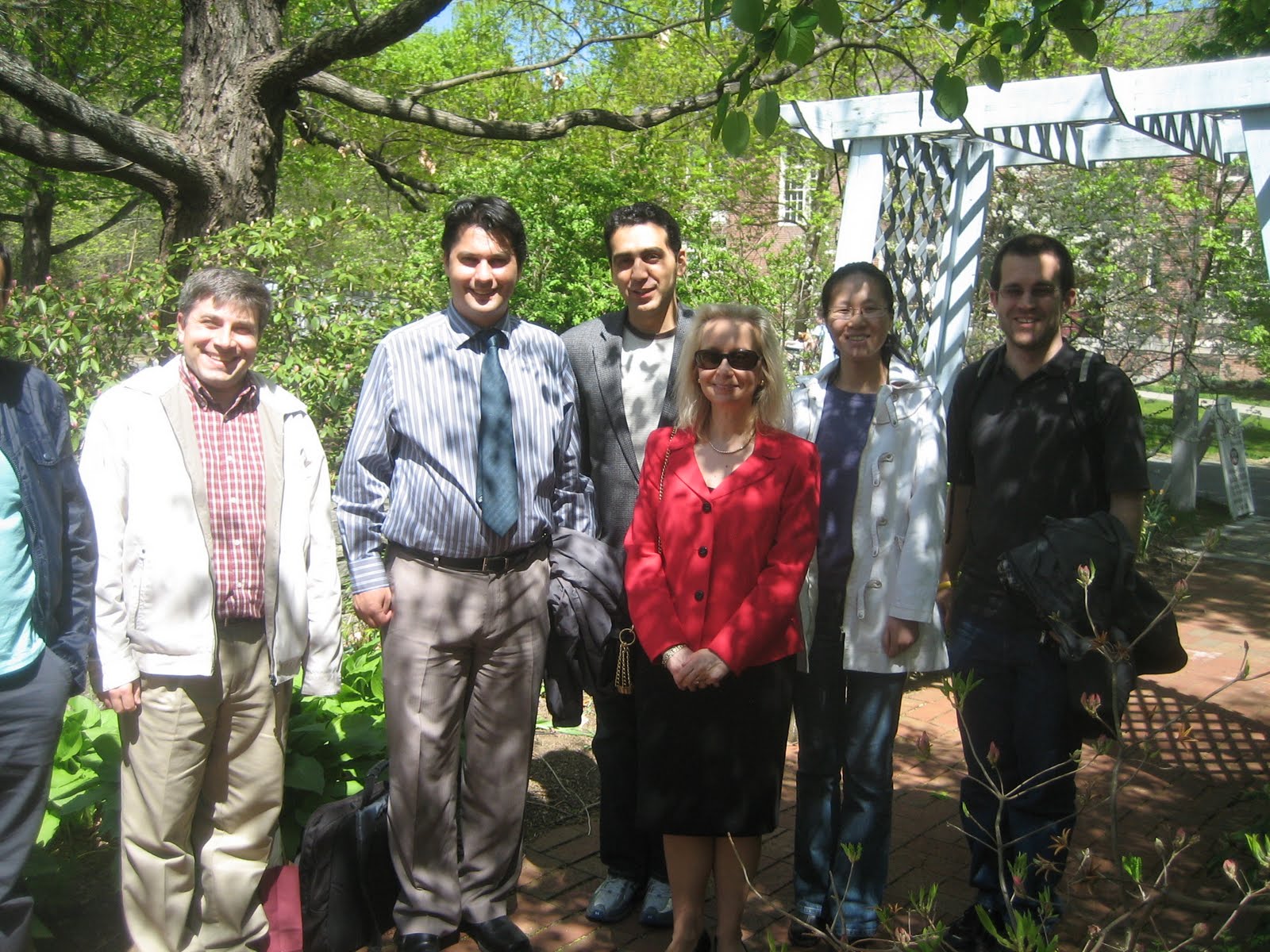
Above are some photos taken during Professor Gumus' visit on a simply spectacular April day.