Showing posts with label innovations. Show all posts

Tuesday, June 20, 2023

A Conference that Ended in a Standing Ovation, Thanks to WPI!

How often have you experienced a standing ovation at the end of a conference?

I must admit that I had, for the first time, such an experience on June 2, 2023, at the outstanding Innovations in Immigration Analytics Conference at the Worcester Polytechnic Institute (WPI) in Worcester, Massachusetts. Kudos to the conference organizers: Dr. Geri Dimas (who will be an Assistant Professor at Bryant University, starting this Fall), and WPI Professors Andrew Trapp and Daniel Reichman.

The program, which can be viewed here, brought together faculty, practitioners, as well as students, who are very much engaged in issues of migration and immigration.

The format, consisting of individual presentations, lightning talks, as well as a panel, was excellent, and with coffee breaks and a delicious buffet lunch provided. And there were no registration fees!

The conference opened up with remarks by the WPI Provost Winston "Wole" Soboyejo, who set the stage for the importance of the issues and challenges that we discussed at the conference including: refugee resettlement, dynamic migrant flows and operational responses, matching refugees to employment opportunities, strategic border resource deployment challenges, and even the modeling of US immigration courts using discrete-event simulation.

My presentation was entitled, "Refugee Migration Networks with Regulations," and it has been posted on the Supernetwork Center site at the Isenberg School of Management, UMass Amherst

The presentation was based on a paper published in the Springer Nature Journal of Global Optimization and was co-authored by Professor Patrizia Daniele of the University of Catania and Professor Ladimer S. Nagurney of the University of Hartford. 

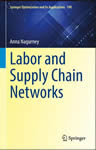
I also spoke in my presentation on recent work on investing in immigration to alleviate labor shortages in supply chains and coalition formation among countries to address migrant issues. The former topic is a chapter in my latest book, "Labor and Supply Chain Networks," with info on the book here.

The latter topic was explored in a recently published paper that I co-authored with Professors Passacantando and Raciti and is available open access!

It was terrific to meet conferees with the passion and focus to address one of the greatest challenges of our time with 103 million people around the world having been forced to leave their homes. I was deeply touched to hear, time and time again, Ukraine mentioned at this conference and the impacts of Russia's war on it, including by Dean Debora Jackson of the WPI Business School in her brilliant closing remarks. Research matters and making it accessible to organizations, nonprofits, and governments can create positive change and truly benefit humanity. 

Below, I have posted a collage of photos from the conference. 


Many thanks to the organizers: Dr. Geri Dimas and Professors Andrew Trapp and Daniel Reichman for bringing us together in such a warm and engaging event. Much work remains to be done but, together, we can accomplish much good and we will.

And for those who are interested in additional work of ours on human migration networks, a topic that we have been researching for several decades, have a look at my post.


Tuesday, July 16, 2013

Business Professors as the Ultimate Entrepreneurs

From investors to educators and the media there is a storm of attention being paid to entrepreneurship  with initiatives ranging from the much-publicized Venture for America, founded by a fellow Brown University alum, Andrew Yang,  to newly formed centers, even here at the Isenberg School of Management, which is headed by my colleague, Professor James Theroux (he is the brother of the award-winning travel writer, Paul Theroux). There are also well-established entrepreneurship programs, typically, at business schools.

The Center for Entrepreneurship is only of several centers at the Isenberg School. 

For example, back in 2001, I founded and continue to direct  the Virtual Center for Supernetworks.
 
So what is entrepreneurship?

Consider, as pointed out by Brett Nelson in Forbes, the following two definitions of “entrepreneur”: the first one from in Merriam-Webster’s dictionary, and the other from Dictionary.com:
  • Merriam-Webster: “one who organizes, manages and assumes the risks of a business or enterprise.”
  • Dictionary.com: “a person who organizes and manages any enterprise, especially a business, usually with considerable initiative and risk.”

We both agree that the latter definition, which considers any enterprise ... as being the relevant one today.

To survive and thrive in academia, including business schools, one must be entrepreneurial. One can't just sit back and leave the status quo, since the environment in both business and academia is much too dynamic, evolving, and changing. Entrepreneurship goes hand in hand with innovation.

Without entrepreneurship and innovation on the part of faculty:

  • No new courses will be offered.
  • No new programs and majors started.
  • No new partnerships, including global ones, initiated.
  • No frontier research conducted.
  • No centers established nor grants obtained.
  • An academic institution will fail to evolve and thrive.

Business professors, in particular, are great at seeking out new opportunities -- it is Darwinian -- if you don't take risks and initiate, you rot -- and the students and institutions suffer.

We are also quite good (thanks to the professors that we have had and, for some of us, actual industrial experience) in allocating our scarce resources in as optimal of a fashion as possible in order to get the highest return with some risk involved, of course. I think that this is part of our DNA.

If you don't have courage and take risks, nothing valuable or interesting happens -- Nothing ventured -- nothing gained.

Of course, companies have also been formed by business school profs and we in operations research and the manageement sciences can name a few easily off the tops of our heads.

As importantly, the students that we have educated and inspired go on to organize and manage their enterprises through their initiatives!  What is more entrepreneurial than an excellent doctoral dissertation?!