Showing posts with label network vulnerability. Show all posts

Friday, March 4, 2016

Looking Forward to Speaking at MITRE on Cybersecurity

On March 14, 2016, a day that is known as "Pi Day," I will be speaking at the MITRE Corporation in Bedford, Massachusetts.  The invitation came from Dr. Les Servi, who not only is an INFORMS Fellow, but he and I both received undergrad and graduate degrees in Applied Math at Brown University. I stayed on for my PhD there and Les went to Harvard for his.

The title of my talk, which I have been hard at work on, and enjoying preparing very much, is: "From Cybercrime in Financial Services to Cybersecurity Investments and Network Vulnerability."

I now have a stream of papers in cybersecurity, beginning with the paper: A Multiproduct Network Economic Model of Cybercrime in Financial Services, Anna Nagurney, Service Science 7(1): (2015) pp 70-81.  The paper: A Supply Chain Game Theory Framework for Cybersecurity Investments Under Network Vulnerability, Anna Nagurney, Ladimer S. Nagurney, and Shivani Shukla, in Computation, Cryptography, and Network Security, N.J. Daras and M.T. Rassias, Editors, Springer International Publishing Switzerland (2015) pp 381-398 is our first paper examining cyber network vulnerability in a supply chain context and extends our paper, A Game Theory Model of Cybersecurity Investments with Information Asymmetry, Anna Nagurney and Ladimer S. Nagurney, Netnomics 16(1-2): (2015) pp 127-148.
 
Since then, we have introduced nonlinear budget constraints on cyber security investments in the paper: A Supply Chain Network Game Theory Model of Cybersecurity Investments with Nonlinear Budget Constraints, Anna Nagurney, Patrizia Daniele, and Shivani Shukla, and,  with my collaborators in Italy, Professors Patrizia Daniele and Antonino Maugeri, we have co-authored the paper, Cybersecurity Investments with Nonlinear Budget Constraints: Analysis of the Marginal Expected Utilities, which is an invited paper for the volume: Operations Research, Engineering and Cyber Security: Trends in Applied Mathematics and Technology, T.M. Rassias and N.J. Daras, Editors, Springer International Publishing Switzerland.

Along with one of my doctoral students, Shivani Shukla, we have also recently revised and resubmitted a rather expansive paper: Multifirm Models of Cybersecurity Investment Competition vs. Cooperation and Network Vulnerability, in which we explore distinct concepts of Nash Equilibrium, Nash Bargaining, and System-Optimization for cybersecurity investments, and describe three case studies to the retail, financial services, and energy sectors, respectively.

In my MITRE presentation, I will focus on both the Service Science paper, and our most recent work, but will also highlight results for our supply chain game theory and cybersecurity investments models.

And, speaking of reciprocity, I am delighted that Dr. Les Servi will be speaking at the Isenberg School of Management on March 25 and the topic will also be cuybersecurity. The wonderful UMass Amherst INFORMS Student Chapter President and students prepared the nice poster announcement for his talk below.
This month will certainly be an exciting one!


Thursday, September 17, 2015

Photos + Some Highlights of New England Security Day @UMassAmherst

This week is only the second week of the new academic year at UMass Amherst and has it been a busy start!

Today, after teaching my Transportation and Logistics class at the Isenberg School,  I was off to the College of Information and Computer Sciences (newly named) to take part in the New England Security Day (NESD 2015).  The program was fantastic with individual talks, a keynote by Jeremy Epstein of the National Science Foundation, and several panels. Plus, in the afternoon, there was a poster session.

The day began with welcoming remarks by Dr. Brian Levine of Computer Science, who has been spearheading cybersecurity initiatives at UMass, and by our Povost, Dr. Katherine Newman.
The keynote by Jeremy Epstein was simply fabulous.  It was not only very informative but also delivered with a great sense of humor. The importance of cybersecurity research as well as the challenges associated with multidisciplinary research were highlighted.

He also noted the importance of the NSF EAGER program, which I was delighted to hear about since my colleague, Professor Tilman Wolf, and I, with collaborators from the University of Kentucky recently received an EAGER grant. Epstein is a rotator at NSF, has had the position for 4 years, and is stepping down in January. His will be big shoes to fill.

There were 115 registrants for NESD and faculty and students came not only from many New England academic institutions (including Harvard, Dartmouth, WPI, Brown University, UConn, UMass Lowell, Northeastern) but also from New York (SUNY Stony Brook) and New Jersey  (Rutgers and Stevens Institute of Technology). This speaks to the timeliness and importance of cybersecurity research.

Below are photos of the speakers this morning and of the audience.
Lunch was provided and was delicious.

Dr. Susan Landau of WPI was the first speaker in the afternoon.
All the talks were great and it was nice to see female speakers as well as many female students. Several told me that they were so impressed by the number of females in attendance.

The refreshments were also perfect - Atkins cider donuts, fresh fruit, veggies, and cheese and crackers.
The poster session was also very interesting and a great opportunity for networking. I was very happy that my doctoral students, Shivani Shukla and Sara Saberi, presented posters and, speaking of serendipity, the poster that Shivani presented was based in part on a paper of ours just published today in the new book, Computation, Cryptography, and Network Security, edited by N.J. Daras and M.T. Rassias.  Dr. Rassias co-edited another book with John Nash, which will be John Nash's last book.

I enjoyed talking with 2 PhD students in Computer Science from Brown University, my alma mater.
One of the best aspects of today's event was not only the exchange of ideas but the conversations and the meeting of new colleagues. I can foresee new collaborations because of this event. It was also terrific to work over the summer with colleagues from Computer Science, the Isenberg School, the Department of Electrical and Computer Engineering, and Math/Stats to make this event happen.
Kudos also to those in the last session, which still had a big audience because the topics were so interesting.
A huge thank you to Professor Brian Levine for bringing us all together for the terrific New England Security Day. Based on the response and interest, I suspect that such an event will be held not once but, possibly, twice a year.
Thanks to everyone for a very stimulating and energizing day! Special thanks to Michelle Roberts for the flawless logistics and smooth operation.

Wednesday, December 19, 2012

A Lot of Great News from the Supernetworks Center

It has been a real privilege serving as the Director of the Virtual Center for Supernetworks at the Isenberg School of Management at UMass Amherst.

I founded the Center back in 2001 and,  in 2003, the Supernetworks Laboratory for Computation and Visualization was established. The Center and Lab have hosted many luminaries from the research and corporate worlds and even from the non-profit sector.

We have always emphasized scholarship and education and our website is regularly updated. It also provides a terrific timeline of visitors, research, talks given, and many other activities that the Center and Center Associates have been involved in.

I always say that, by working together,  we can accomplish so much more and I take great pride in the research that we have done on network systems addressing such important issues as: transportation and  network vulnerability, humanitarian and healthcare supply chains, financial networks and risk management, sustainable transportation, decision-making on complex networks, including e-commerce, and, more recently, even the redesign of the Internet to offer more Choices. We have tried to advance both applications as well as methodologies.

Our research and associated activities have garnered support from many different foundations, from the National Science Foundation to AT&T, the Rockefeller Foundation, the Institute for International Education, among others. I have also used funds from the John F. Smith Memorial Fund to support the Center's activities and its various missions.

As the 2012 year draws to a close, I am pleased to share with you the 2013 Winter edition of The Supernetwork Sentinel, which is the Center's newsletter.

All editions of our newsletter can be found and downloaded here.

Wishing everyone a safe, healthy, and prosperous New 2013 Year!

Thank you for your support!

Monday, November 5, 2012

Sustaining Supply Chains in Disasters and Post Hurricane Sandy

One week after Hurricane Sandy made landfall in the mid-Atlantic states of the United States there are still over a million electric power outages.

With cold temperatures, shortages of fuel for both vehicles and generators, and now a shelter crisis, due to so many homes being destroyed in parts of  New York and New Jersey, and major impacts on transportation infrastructure from bridges to subways, plus a nor'easter storm forecast for mid-week, I am wondering why more was not done and is not being done to help those in the recovery process.

Our relatives in New Jersey are still without power one week after losing it and friends have had to seek shelter since they are now homeless.

Clearly,  there are issues of serious resource misallocations as well as information shortages, among other shortages. Trained personnel are needed to restore power where it is needed and fuel needs to be transported and people informed as to where they can obtain it. Information needs to be provided to those who have lost their abilities to receive news and to receive communications electronically.

There are also questions, in certain communities,  surrounding how, if any, prioritization was done, in terms of restoring electric power, delivering fuel and other resources.

Commercial supply chains are different from humanitarian ones  and  we need to learn from previous disasters.

Different organizations can accomplish much more through synergistic teaming.  and it is good to see the military, including the National Guard, making extraordinary efforts to assist after this extraordinary disaster.

I was interviewed by Mr. Michael Breen for an AMS podcast on Sustaining the Supply Chain and the podcast can be accessed here.

There was also a recent special issue of the journal Transportation Research A on Network Vulnerability of Large-Scale Transport Networks in which Patrick Qiang and I published the paper, A bi-criteria indicator to assess supply chain network performance for critical needs under capacity and demand disruptions.

In this paper,  we constructed  a performance indicator in the case that demands for critical needs products (water, food, medicines, etc.) can be satis fied. We then considered the case when not all the demands can be satis fied and de fined another performance indicator. In order to assist cognizant organizations, such as governments, relevant corporations, and NGOs, to better manage critical needs supply chains, a bi-criteria performance indicator was, subsequently, proposed in this paper. This indicator synthesizes the preceding two in that it considers the following factors:

  • Supply chain capacities may be a ffected by disruptions;
  • Demands may be a ffected by disruptions; and
  • Disruption scenarios are categorized into two types.
We also showed how our supply chain performance indicators could be applied in practice and now we are seeing yet another disaster. More severe scenarios can be expected, given climate change, which is upon us and our communities. 

Time to harness all of our energies and expertise to minimize the damages, the pain, and the suffering.


Wednesday, October 31, 2012

When the Critical Infrastructure Collapses -- Rebuilding for Resiliency

Many of us have seen the news and photos and have also personally experienced tremendous losses because of Hurricane Sandy, which continue.

There are still, days after Hurricane Sandy made landfall in the Northeast,  extensive power outages and, in many parts of the mid-Atlantic states of the US, still uncertainty as to when electricity will be restored, and as to when the transportation networks (both nodes and links) will be fully operational and buildings that were once homes, businesses, and medical facilities, habitable. Dozens have lost their lives.

What I also find absolutely stunning is the number of colleges and universities in the mid-Atlantic states that are still without power and have cancelled classes for this full week!

And, it is next to impossible, to identify a mode or series of modes of transportation, given the disruptions to air travel, bus travel, trains, and subways  in major and smaller metropolitan areas, that would get (m)any of the students safely back home, assuming that their homes even exist.

Mind you, it is October and Fall here.

I have received messages  not only from operations research colleagues who lived through Hurricane Katrina but even from Italy, expressing concern for the devastation and the suffering. Thank you for asking and for caring about others. I have heard from relatives in several mid-Atlantic states, who are without power.

Who would have thought that a natural disaster could impact tens of millions of people in the US over such a short, intense period of time, and disrupt their routines, livelihoods, and even educations and affect an area of 900 miles!

At a Transportation Research Board meeting in Washington DC, in 2011,  I had the honor of speaking on a panel, with the title, Disaster Recovery and Mitigation Planning and Resilience, which does seem uncannily prescient, with the program below:


Event Description:Transportation systems throughout the world are greatly affected by natural disasters and human-created events. These systems are critical for daily activities and the economy. The magnitude of the U.S. transportation infrastructure makes protecting it extremely challenging and costly. This special session highlights innovative approaches to disaster recovery planning and assesses improving transportation infrastructure resilience to extreme events.


Presentations:
  Update on TRB Activities (P11-1419)
     Jeffrey L. Western - Western Management and Consulting, LLC
  Building Resilience into Fragile Transportation Networks in an Era of Increasing Disasters (P11-1394)
     Anna Nagurney - University of Massachusetts
  Infrastructure: Critical Link and Cutting Edge for Disaster Recovery and Mitigation (P11-1397)
     Rae Zimmerman - New York University
  Learning from the Haiti Reconstruction Efforts (P11-1399)
     Herby Lissade - California Department of Transportation
  U.K. Perspective (P11-1464)
     Sujith Kollamthodi - AEA Group, United Kingdom

TRB

My presentation, Building Resilience into Fragile Networks in an Era of Increasing Disasters, I have posted since, in it, I also emphasized the impact of climate change on critical infrastructure, especially that of transportation networks. This is a topic that we have done a lot of research on and even Governor Andrew Cuomo of New York realizes that we need to design our infrastructure for resiliency as we adapt and cope with climate change. 


We are now seeing that, as I have written many times, we are in an Era of Supernetworks, in which our critical infrastructure networks from electric power to transportation and logistics to communications and financial networks are so intertwined and interdependent that a failure in one can have cascading failures and long-term disruptions that propagate. And when a disaster strikes, in the form of Hurricane Sandy, we are painfully reminded that we need to design for resiliency.

Dr. June Dong and I wrote our Supernetworks book back in 2001 and it was published in 2002. When 9/11 struck, the camera-ready copy was stuck at the JFK airport but eventually made it to the publisher in England.

Now, my latest book, which  was just sent off to the publisher last week, is probably floating in electronic form somewhere in lower Manhattan since my publisher's office is shut down due to the flooding and lack of electric power.

Plus, I cannot even figure out a way of getting my daughter home from her college, besides driving 5 hours on roads and over bridges, in conditions that I cannot fathom and  that, just this past Sunday, were fine.

So many of our critical nodes and links have been affected, changing economic and human activities in ways we did not foresee.


Monday, May 7, 2012

Critical Needs Supply Chains Under Capacity and Demand Disruptions

The special issue of Transportation Research A on the theme of Network Vulnerability in Large Scale Transport Networks, edited by Michael A.P. Taylor, is now published.

Our paper, "A bi-criteria indicator to assess supply chain network performance for critical needs under capacity and demand disruptions," Patrick Qiang and Anna Nagurney, appears in this issue, which is volume 46 (5), June 2012.

This paper was also highlighted in a newsletter of  the OR Society (thanks). Patrick is a faculty member at the Graduate School of Professional Studies at Penn State University Malvern and I am at the Isenberg School at UMass Amherst.

In this paper, we developed a supply chain network model for critical needs products, which captures disruptions in capacities associated with the various supply chain activities of production, transportation, and storage, as well as those associated with the demands for the product at the various demand points. Critical needs products may be defined as those products and supplies that are essential to human health and life. Examples include food, water, medicines, and vaccines. The demand for critical needs is always present and, hence, the disruption to the production, storage, transportation/distribution, and ultimate delivery of such products can result not only in discomfort and human suffering but also in loss of life. Such supplies are essential in times of disasters and emergencies.

The objective is to minimize the total network costs, which are  generalized costs that may include the monetary, risk, time, and social costs. Two different cases of disruption scenarios are considered. In the first case, we assume that the impacts of the disruptions are mild and that the demands can be met.  In the second case, the demands cannot all be satisfied. For these two cases, we propose two individual performance indicators.
 
We showed that the governing optimality conditions can be formulated as a variational inequality problem with nice features for numerical solution.

In addition, we proposed two distinct supply chain network performance indicators for critical needs products. The first indicator considers disruptions in the link capacities but assumes that the demands for the product can be met. The second indicator captures the unsatisfied demand. We then constructed a bi-criteria supply chain network performance indicator and used it for the evaluation of distinct supply chain networks. The bi-criteria indicator allows for the comparison of the robustness of different supply chain networks under a spectrum of real-world scenarios. We illustrated the new concepts in the paper with numerical supply chain network examples in which the supply chains were subject to a spectrum of disruptions involving capacity reductions as well as demand changes.

Given that the number of disasters has been growing globally, we expect that the methodological tools introduced in this paper will be applicable in practice in disaster planning and emergency preparedness.


Thanks also to Wiley for publicizing our first critical needs supply chain network paper, which focused on design, in its Asia blog on What's New in Operations Research.

Friday, February 10, 2012

Network Vulnerability in Large-Scale Transportation Networks

Transportation networks are the lifelines in times of peace and prosperity as well as during and post disasters.

From roads to bridges, and whether by land, air, or sea, and via different modes of transportation, such networks provide the connectivity for the movement of people, goods, and services.

When Professor Michael Taylor of the University of South Australia in Adelaide issued a call for papers for a special issue of the journal Transportation Research A on Network Vulnerability in Large-Scale Transport Networks, my co-author of the Fragile Networks book, Dr. Patrick Qiang, and I knew that, given the timeliness of this special issue, we hoped to make a contribution.

We are delighted that we have heard from Professor Taylor who has let us know that the special issue is now in production with the publisher of the journal, Elsevier.

The papers in the special issue are:

Jenelius, E and Matsson, L-G, Road network vulnerability analysis of area-covering disruptions: a grid-based approach with case study

Taylor, M A P and Susilawati, S, Remoteness and accessibility in the vulnerability analysis of regional road networks

Watling, D and Balijepalli, N, A method to assess demand growth vulnerability of travel times on road network links

Bell, M G H, Trozzi, V, Hosseinloo, S-H, Gentile, G and Fonzone, A, Time-dependent Hyperstar algorithm for robust vehicle navigation in time-dependent stochastic road networks

Qiang, Q and Nagurney, A, A bi-criteria indicator to assess supply chain network performance for critical needs under capacity and demand disruptions

Nagae, T, Fujihara, T and Asakura, Y, Anti-seismic reinforcement strategy for urban road networks

Snelder, M, Van Zuylen, H and Immers, B, A framework for robustness analysis of road networks for short term variations in supply

Knoop, V, Snelder, M, Van Zuylen, H J, and Hoogendoorn, S P, Link-level vulnerability indicators for real-world networks

According to Professor Taylor: These are all excellent papers and define the global interest in vulnerability analysis. The special issue should be of wide interest.

Our paper in this special issue focuses on critical needs product supply chains. Critical needs products are those products and supplies that are essential to human health and life. Examples include food, water, medicines, and vaccines. The demand for critical needs is always present and, hence, the disruption to the production, storage, transportation/distribution, and ultimate delivery of such products can result not only in discomfort and human suff ering but also in loss of life.

Critical needs supply chains also play a pivotal role during and post disasters during which severe disruptions can be expected to have occurred. Indeed, the past few decades have visibly demonstrated that disasters, whether natural or man-made, may severely damage infrastructure networks, such as transportation and logistical networks, may cause great loss to human life, and also may result in tremendous damage to a nation's economy.

In our paper, we develop a supply chain/logistics network model for critical needs in the case of disruptions. The objective is to minimize the total network costs, which are generalized costs that may include the monetary, risk, time, and social costs. The model assumes that disruptions may have an impact on both the network link capacities as well as on the product demands. Two diff erent cases of disruption scenarios are considered. In the first case, we assume that the impacts of the disruptions are mild and that the demands can
be met. In the second case, the demands cannot all be satis fied. For these two cases, we propose two individual performance indicators. We then construct a bi-criteria indicator to assess the supply chain network performance for critical needs. An algorithm is described which is applied to solve a spectrum of numerical examples in order to illustrate the new concepts.

Friday, July 23, 2010

Supernetworks in China


Supernetworks are big in China and two of my collaborators, Professor June Dong and Professor Patrick Qiang, are now in Shanghai discussing the formation of a sister Supernetworks Center to the Virtual Center for Supernetworks that I direct.

With June Dong I wrote the 2002 book, "Supernetworks: Decision-Making for the Informatiom Age," and last year Patrick Qiang and I co-authored the "Fragile Networks" book.

My last trip to China was back in 2006 when I spoke at the Fudan Management Science Forum in Shanghai on Supernetworks: Management Science for the 21st Century. I also served on the Fudan Management Science Prize committee.

It was a terrific conference and trip, especially since June Dong was also there and she is a former native of Shanghai, China. Such well-known researchers as Mike Pinedo, Charles Corbett, and Eitan Zemel were also there. I took tons of photos.

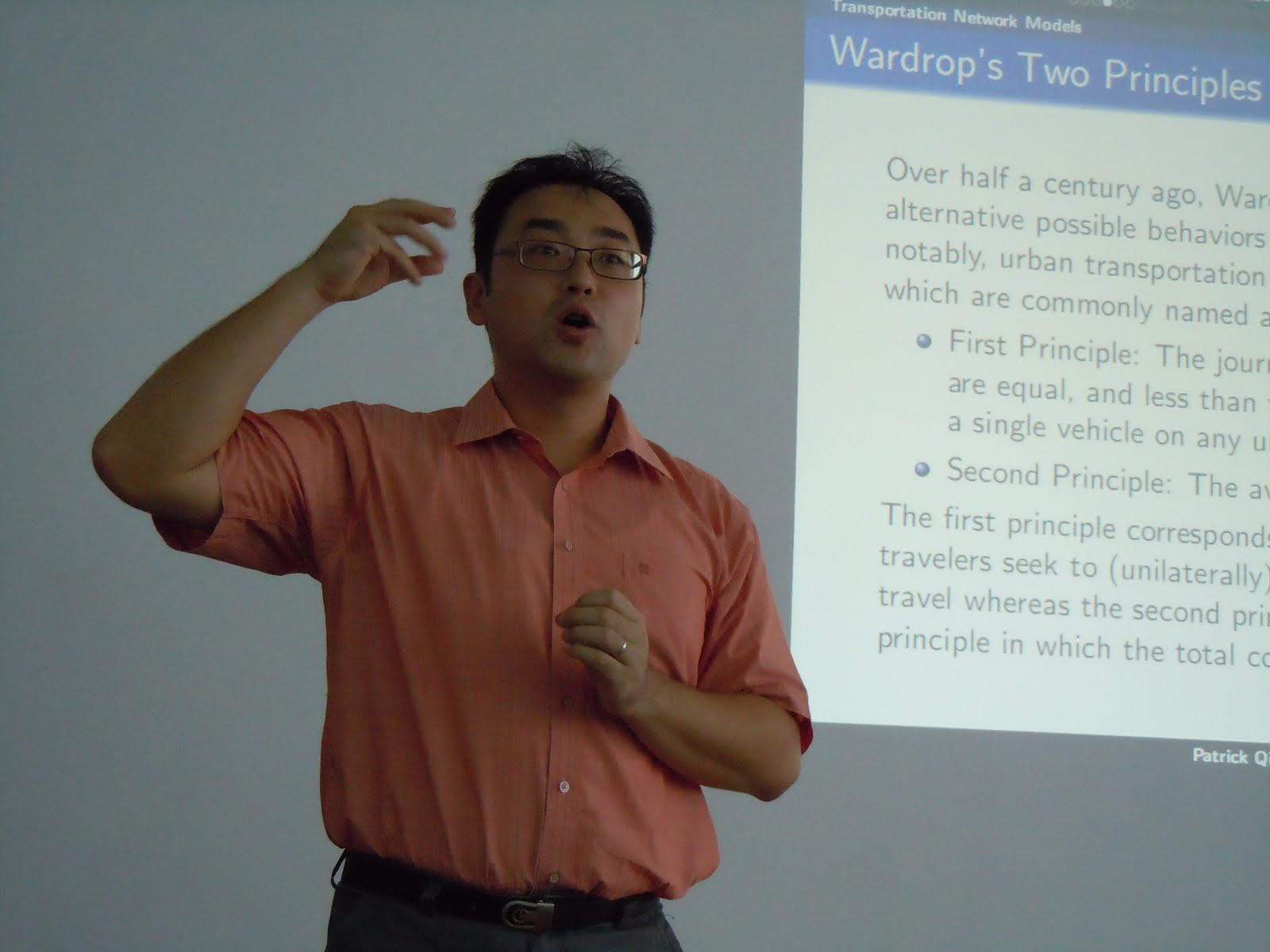
Patrick Qiang recently gave a presentation, "Vulnerability of Fragile Networks," at the School of Management at the Shanghai University for Science and Technology and was hosted by June. Above are photos taken at his presentation, with his host, a group photo with the audience, and an announcement on the university home page, which a student of mine, helped to translate. The audience for Patrick's talk even included students of Professor Daoli Zhu, who received the Fudan Management Science prize in 2006.