Showing posts with label critical infrastructure. Show all posts

Sunday, April 19, 2026

Thanks to Dr. Les Servi for Speaking in Our UMass Amherst INFORMS Speaker Series

On April 10, 2026, we had the honor and pleasure of having Dr. Les Servi speak in our UMass Amherst INFORMS Speaker Series. We were very excited to have Dr. Servi back at UMass Amherst. 

The title of his presentation was: “Identifying Critical Nodes in Mission Systems: An Operations Research Framework.” 

Dr. Les Servi is an Operations Research Scientist and former Chief Scientist for Cyber Operations Research at The MITRE Corporation. Earlier, he conducted research at MIT Lincoln Laboratory, Bell Laboratories, and GTE Laboratories (now Verizon), and spent a sabbatical year as a visiting scientist at Harvard University and MIT.  He has served as an Associate Editor for the journals: Operations Research, Management Science, and the INFORMS Journal on Computing. He is also  a MORS Fellow, an INFORMS Fellow, and served six years on the INFORMS Board of Directors. Dr. Servi is an INFORMS VP Chapters and Forums Board member.

Dr. Servi's book, "Mission Dependency Network Analysis," was published by Springer in 2026 and he kindly presented me with a copy. It was nice to see one of my papers with Patrick Qiang cited therein.

We had a great discussion after his presentation and at lunch. Many thanks to the INFORMS Student Chapter for doing such a nice job in publicizing his presentation - the announcement even made the UMass Amherst homepage with special thanks to the Chapter President Samira Samadi.

And, after the delicious lunch at the UMass Commonwealth Restaurant, Dr. Servi was off to Logan Airport to catch a flight to DC for the INFORMS Analytics Conference, where I joined him on Sunday!

Sunday, July 16, 2023

Thanks to ALL Who Took Part in Our International Conference on Dynamics of Disasters in Greece

It has been an incredibly busy, yet energizing, several few weeks with two international conferences on different continents and different seasons (summer and winter).

I'd like to take the opportunity to thank all those who took part in the 6th International Conference on Dynamics of Disasters, which took place in Piraeus, Greece, July 3-6, 2023.

The below collage was constructed to capture a few of the highlights.

The venue of the conference was the Historical Library of the Aikaterini Laskaridis Foundation in Piraeus.

We had the pleasure of hearing from outstanding plenary speakers, both practitioners and academics.

It was inspiring to see conferees representing many different countries including: Austria, Germany, Nepal, Japan, Canada, Greece,  Italy, Turkey, the UK, and the US.

In a period in history with compounding disasters, the exchange of knowledge and best practices and working together to address the great challenges that we are faced with are needed more than ever.

Information about the conference, including the presenters and their talk titles can be found on the conference website.

I had the pleasure of presenting work done with my PhD student at the Isenberg School of Management Dana Hassani and colleagues at the Kyiv School of Economics: Professor Oleg Nivievskyi and Dr. Pavlo Martyshev. The link to the slidedeck of the presentation can be accessed here.

Not everyone could join us because of visa and other extenuating circumstances. Sadly, in April, Professor Urmila Pyakurel of Nepal passed away. She was an avid participant in our previous Dynamics of Disasters conference. We paid a tribute to her in Piraeus. A PhD student of hers presented on their joint work. Urmila lost her life to cancer, which she had battled for many years. She was also a Humboldtian. You can read about some aspects of her amazing life here.

And, while I was at the IFORS conference in Santiago, Chile, July 10-14, 2023, at which I gave a keynote, we heard from Springer Nature that we are getting a contract to edit the volume: "Dynamics of Disasters: From Natural Phenomena to Human Activity." My fellow Co-Editors on this project are: Professors Ilias S. Kotsireas, Panos M. Pardalos, Stefan Pickl, and Chrys Vogiatzis. It was a pleasure to work with them on the organization of this very timely conference.

Tuesday, October 1, 2019

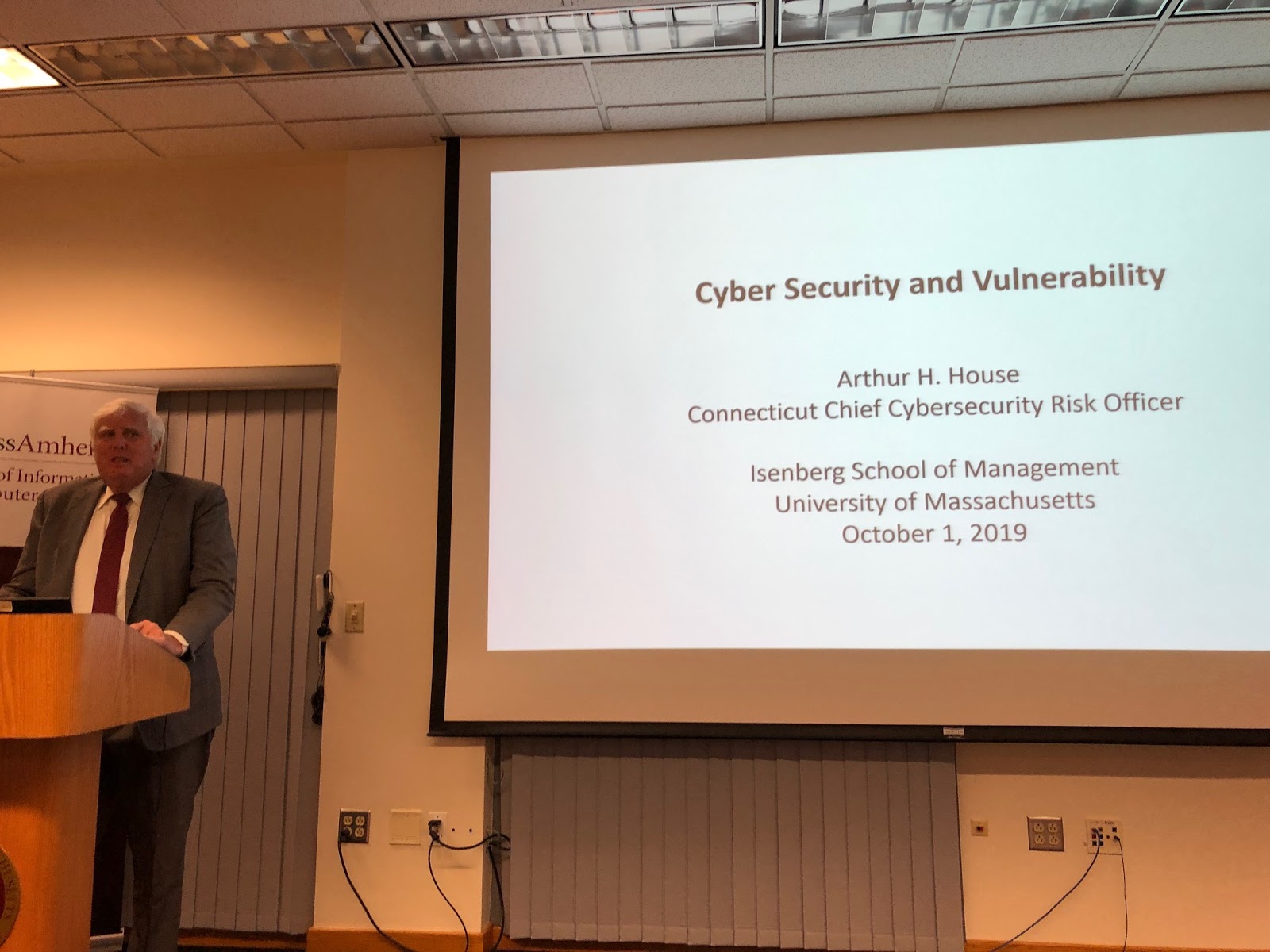
Cybersecurity and Vulnerability - Brilliant Lecture by Dr. Art House, Chief Cybersecurity Risk Officer of Connecticut

After teaching my Transportation and Logistics class this morning, it was time to help host the guest lecture of Dr. Arthur H. House, who is the Chief Cybersecurity Risk Officer of Connecticut. Former Isenberg School Dean, Dr. Thomas O'Brien, had made the introductions to Dr. House, for me and my great Finance colleague, Professor Mila Sherman. His lecture was part of the UMass Amherst Security Series.  The topic of his talk was: Cybersecurity and Vulnerability. Mila and I had had several grants on cybersecurity with colleagues from the Isenberg School and the College of Engineering and both of us continue to do research and to publish in this area. The UMass Amherst INFORMS Student Chapter also helped to publicize his talk and the turnout was fabulous, with students and faculty from multiple schools and colleges at UMass Amherst!

We began his visit with a nice lunch at the University Club and we talked for 2 hours!
Joining Dr. House and me at lunch were: former Dean Tom O'Brien, a friend of House's for 6 decades, Chris Misra, who is the CIO at UMass Amherst, and Professor Mila Sherman.

Dr. House has had an incredible career, having earned his PhD at the Fletcher School of Diplomacy at Tufts University.  He became the Chief Cybersecurity Risk Officer for the State of Connecticut in October 2016, after four years as Chairman of Connecticut's Public Utilities Regulatory Authority (PURA). He recently returned from speaking in Latvia (and we compared notes, given my recent visit to Kyiv, Ukraine). His work includes cybersecurity strategy and action plans in the Black Sea and Balkan regions.  
He has worked in national security, and served as Director of Communications in the Office of the Director of National Intelligence and the National Geospatial-Intelligence Agency.  As a White House Fellow, he was Special Projects Officer at the National Security Council. Tom O'Brien was also a White House Fellow. House spent 10 years in the Congo, and shared some of those fascinating experiences with us at lunch. He also worked for the World Bank and  was a Congressional Adviser to the United States Mission to the United Nations.
In the United States Senate, Dr. House was Chief of Staff to Senate Majority Leader Robert Byrd and Senator Abraham Ribicoff and Legislative Assistant to Senator Chris Dodd.  Amazingly, as can be seen from various writeups on his career, specific assignments included the Camp David Peace Agreement, the Strategic Arms Limitation Treaty and the Tokyo Round Trade Negotiations. The stories he shared with us at lunch even included the SALT negotiations at which he was present in Russia, with Brezhnev in attendance. It is not every day that you get to have lunch with someone who has taken part in major historical events in the US!  And can he do imitations of famous people; honestly, SNL should just hire him. His ability to reproduce accents is simply incredible and hilarious.
Since there were no classrooms available for this guest lecture at Isenberg, since it was prime class time, his talk took place at the Computer Science building. It was good to walk after the leisurely lunch (and we did share desserts).
Dr. Mila Sherman  introduced our speaker and then he began his mesmerizing lecture, which had the audience at the edge of their seats throughout.

He began his lecture by sharing some personal details and then asked the question: "Are we safe" and answered: "Of course, not!" We can't assume that a business or organization is safe from cyberattacks since even the Pentagon has been compromised.
He made the following points, which he then elaborated upon:
1. We are dependent on the digital world (computers and Internet) and, hence, vulnerable;
2. We need to protect ourselves;
3. We need to anticipate strategic surprises, and
4. States must play a critical role in cyber defense.
He emphasized that the advantages of cyber are immense from air traffic control to critical infrastructure but so are the vulnerabilities. The Internet was not designed with security in mind since it was supported by DARPA and was initially for academics who trusted one another. He envisions 3 Internets eventually, with Bakanization, and you can probably guess who would be behind the other two.
He spoke about who is behind the threats and the monetary aspects of selling the hacked products (which I have actually published a paper on in the INFORMS journal Service Science). Even health records are commodities that can be sold. He talked about phishing attacks as well as ransomware with the latter sometimes targeting smaller enterprises from hospitals to municipalities, etc. for payments in bitcoins.
Sadly, he stated that the "US is losing its edge" in cyber defense and also spoke about cyberwar and asymmetries.
He spoke about certain nation states targeting our elections and critical infrastructure and the details that he had were quite frightening. And, he even showed a slide of Kyiv at night after the cyberattack in 2015 on its power grid.
He emphasized that we need norms and rules and he suggested a great idea - for businesses and organizations to have a cyber rating similar to a credit score, and this would be audited regularly, since one's brand reputation as well as stock value can be seriously negatively affected after a cyberattack.
"Cyber is the perfect weapon" he said and "We need to defend ourselves." We can't get the feds to do this, so states must, and Connecticut is leading the way! 
He also noted the need to create a positive cybersecurity culture; to plan, and to be ready for the unexpected. Sad to say, he also sees "massive complacency." 

After his talk, Art House stayed to meet and continue the discussions with the audience. I was so delighted that even some of my undergrads, in addition to my PhD students, came. This was an incredible talk and educational experience!
Many thanks to Dr. Tom O'Brien for giving us this incredible opportunity with special thanks also to Professor Brian Levine, the Director of the Cybersecurity Institute at UMass Amherst! The brilliant lecture by Dr. Arthur H. House we will never forget!

Wednesday, July 26, 2017

Great Time Speaking on Investing in Infrastructure on the Dr. Matt Townsend Show

Last April, I published an article in The Conversation, "Calculating where America should invest in its transportation and communication networks." 

The article was republished in multiple publications and in May I received an email from a very friendly segment producer of the Matt Townsend Show. The message stated that Dr. Townsend had read my article, liked it a lot, and would like to have me as a guest on his radio show. Multiple dates as options were provided, but, given my very busy conference schedule this summer, plus the fact that I am a Summer Fellow at the Radcliffe Institute for Advanced Study (RIAS) at Harvard, we settled on today as the date!

Trying to find a landline was not easy but, thanks to RIAS, a nice quiet and comfortable office was found and I also had a cell phone as a backup. I had listened to several segments of the show and very much enjoyed the facility with which Dr. Townsend asked questions and kept the conversation going on numerous timely topics being addressed by those that he was interviewing.

I came prepared with a bottle of water and my latte from Peet's to keep myself hydrated and pumped, which was easy.
 
Critical infrastructure networks is a topic I am extremely passionate about and have done research on with wonderful doctoral students from the Isenberg School as well as collaborators from Harvard to many other universities; some of these are Supernetwork Center Associates. Most notably, I mention Dr. Patrick Qiang, with whom I wrote the Fragile Networks book, and which was featured in the interview.


The interview can be accessed online.

Many thanks to Dr. Matt Townsend for the invitation to be on his show and for his terrific questions as an interviewer! I enjoyed the experience a lot.

And, coincidentally, afterwards, I had lunch with Professor David Parkes, a chaired professor of computer science at Harvard. When I was a Science Fellow at RIAS in 2005-2006, he, Professor Patrizia Daniele of the University of Catania, and I co-authored a paper on the Internet and the Braess paradox, which was published. 
Of course, in my interview with Dr. Matt Townsend I had to speak on the Braess paradox!

Sunday, November 6, 2016

Game Theory for Security Conference in NYC Attracts Speakers from Around the Globe

We returned yesterday evening from NYC from the fabulous Decision and Game Theory for Security Conference, GameSec2016, which took place November 2-4 at the New York University (NYU) Tandon School of Engineering,  located in Brooklyn. The view below is from our hotel room on the 18th floor of the Marriott. Since the venue was close to one of my absolutely favorite structures, the Brooklyn Bridge, I had to walk it.

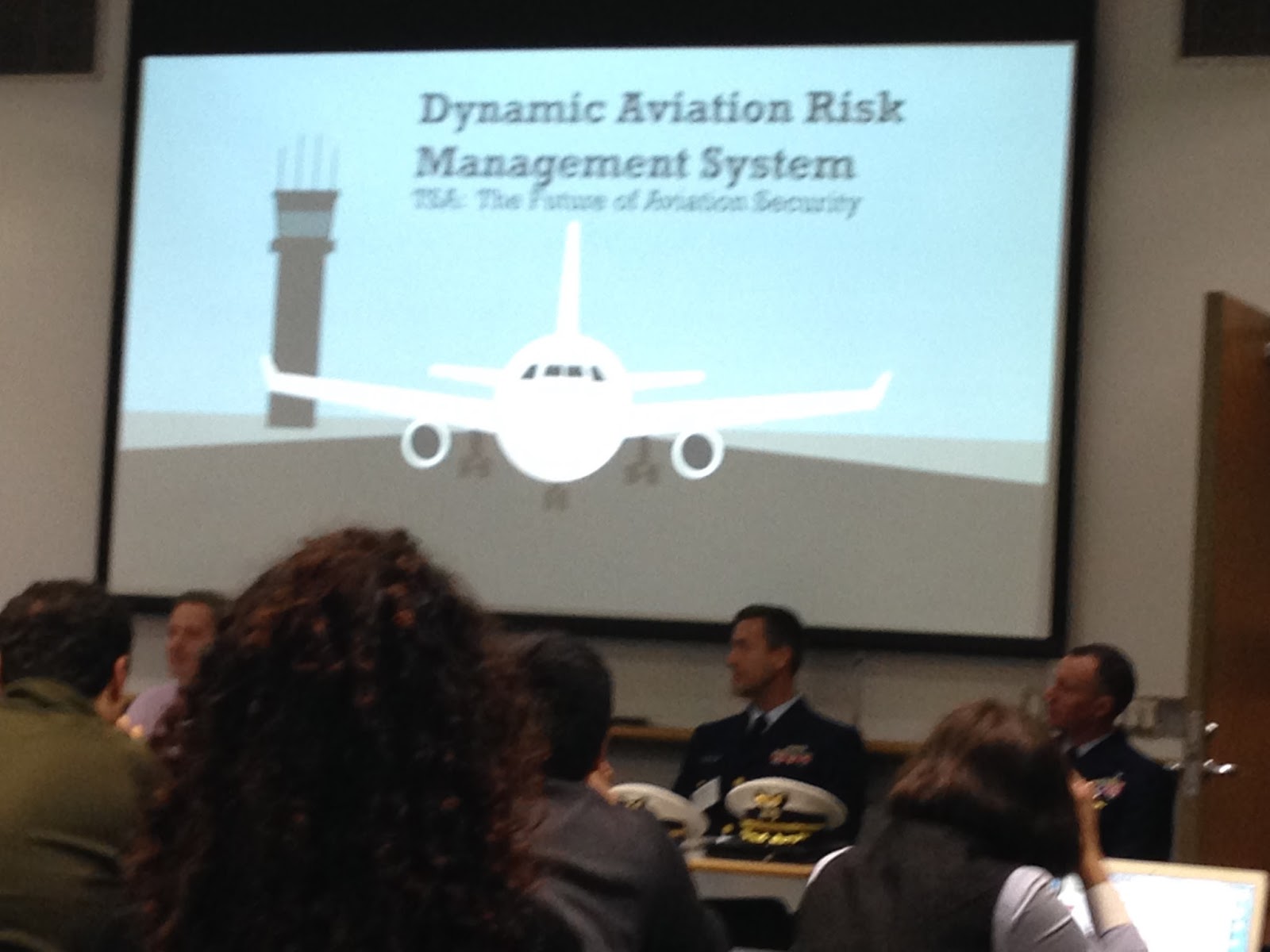
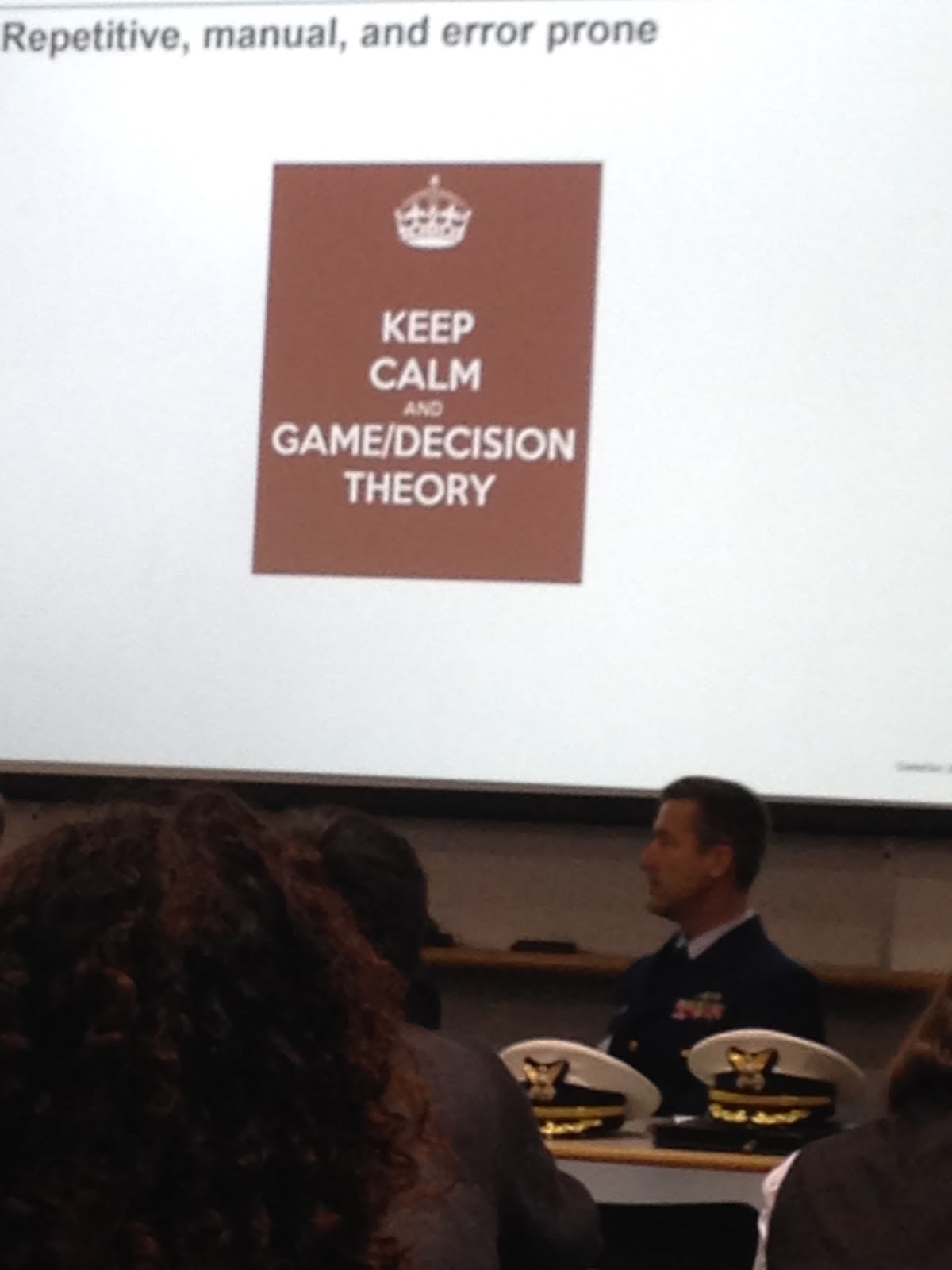
The General Chair of the conference was Quanyan Zhu of NYU and he deserves a big congratulations on the success of the conference as do the steering board and all the organizers. This focused conference, with the elegantly produced conference proceedings, had a single stream of presentations,  a panel with experts from the Coast Guard, the Transportation Security Agency, industry and academic reps, and two plenary talks given by George Cybenko of Dartmouth and me.

The special session on validating models and the panel were alone worth coming to the conference!
 Panel Discussion - Panelists Include:

  • Capt. Tom Morkan (US Coast Guard)
  • CDR Brian Murphy (US Coast Guard)
  • Nathaniel Gleicer (Illumio; Former Director for Cybersecurity Policy for the National Security Council)
  • Dr. Pratyusa Manhadatta (HP Labs)
  • Ron Sartini (Transportation Security Administration) 


It was outstanding to hear from the expert panelists how game theory is essential to their decision-making in practice and that includes such major tasks as protecting the Port Authority of New York & New Jersey and the port of Boston. Hearing how research that one engages in can make a difference is very inspiring, motivating, and energizing, and I will be sharing some of the insights when I teach my class on Tuesday at the Isenberg School of Management! 

Below are additional photos taken at the conference.


Lunches were provided, as well as snacks during the conference breaks.
On Thursday evening we were treated to a sumptious banquet at NYU's Torch Club in Manhattan.  It was great fun to travel together on the NY subway.

 
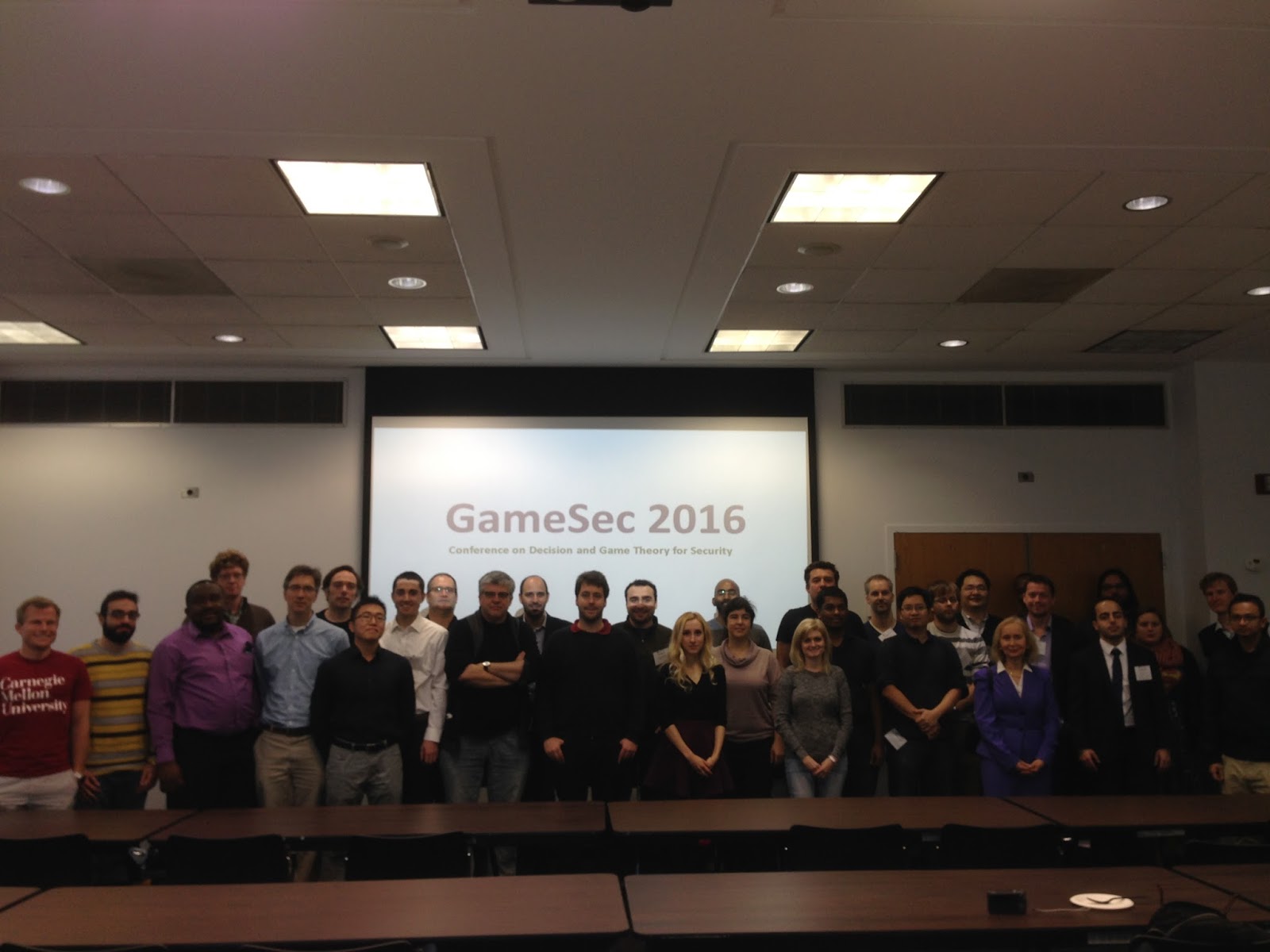
Below is a group photo of many of the participants, which was taken on Friday.
As can be seen from the conference program, the talks described many creative theoretical frameworks that add to our understanding of the strengths of game theory in a wide range of security settings, including: cybercrime and cybersecurity, cyber-physical systems, auditing elections, Internet of Things (IoT), denial of service attacks, strategic cybersecurity investments, voting systems, compliance, denial of service attacks (DOS), and more! I know that I will be reading the proceedings edited by Quanyan Zhu, Tansu Alpcan, Emmanouil Panaousis, Milind Tambe, and William Casey, from cover to cover, and will be citing the papers in this very valuable volume.
What very much impressed me about the participants and their talks and this speaks to the caliber of this conference, which was started in 2010, was the global participation, with speakers from, besides the US (including California), France, Austria, England, Australia,  Greece, Poland, Czechoslovakia, Switzerland, and other countries. The quality of the research and science was inspiring and the conversations and discussions throughout the conference made for very enjoyable networking as well  as scientific exchanges.

I was so honored to be introduced by Tamer Basar of the University of Illinois, whom I last saw at the great NETGCOOP conference in Paris, France. Professor Basar is a member of the National Academy of Engineering and his work on game theory and security is truly innovative and, if I may say, beautiful.

My friend, Rae Zimmerman of NYU also stopped by to say hello before flying out to speak at a conference in Portland. Below is a photo of Quanyan Zhu with Rae and me after my plenary talk. My plenary talk slides can be downloaded here.

Another highlight was to see the Springer booth with books on security, including a book in which my husband, my doctoral student, Shivani Shukla, and I have a book chapter: A Supply Chain Game Theory Framework for Cybersecurity Investments Under Network Vulnerability, Anna Nagurney, Ladimer S. Nagurney, and Shivani Shukla, in Computation, Cryptography, and Network Security, N.J. Daras and M.T. Rassias, Editors, Springer International Publishing Switzerland (2015) pp 381-398.

 And, on Friday, several of us, coincidentally, just happened to be wearing the NYU school color of purple, so I had to have the photos below taken as mementos.
To add to the excitement of the conference was that the NYC marathon is taking place today, November 6, 2016, so we also saw the planning for this mega race with about 50,000 participants taking part and with the finish line in Central Park and with a mini international race taking place in NYC in Manhattan yesterday morning. Since my fist language is Ukrainian I was delighted to see the Ukrainian flag in Central Park.

Thanks to Quanyan Zhu and the conference organizers for such a memorable, exciting, and very informative conference!