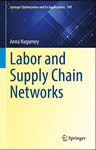
In 1993, my first book, Network Economics: A Variational Inequality Approach, was published as the first volume of the ACE series: Advances in Computational Economics. The second and revised edition of this book came out in 1999. My 10th book, Networks Against Time, was just published by Springer.
Since the publication of my Network Economics book, there have been many synergies associated with the modeling of the Internet and other network systems, including decentralized transportation networks, with even the Braess paradox, which was identified in 1968, being relevant also to the Internet.
What I find amazing, and actually quite exciting, is that some of the language associated with the Internet is similar to that which we are encountering and using in supply chain networks -- from service providers to transport network providers, to start.
I have been involved, since last year, in a truly innovative and challenging project: funded by the National Science Foundation (NSF) entitled Collaborative Research: Network Innovation Through Choice. The investigators on this project are: Dr. Tilman Wolf (lead PI) and Dr. Anna Nagurney (Co-PI) - UMass Amherst; Dr. Jim Griffioen and Dr. Ken
Calvert - University of Kentucky; Dr. Ilia Baldine - RENCI at UNC, and Dr. Rudra Dutta and
Dr. George Rouskas - NCSU.
We have regular teleconferences during which we discuss our research and brainstorm and it is fascinating to be working with such top electrical and computer engineers and computer scientists. Together, we generate many good ideas and the discussions are always very stimulating. There are several doctoral students also involved in this multiyear project. I am supporting, through this grant, one doctoral student in Management Science at the Isenberg School of Management at UMass.
The project that we are working on we are calling ChoiceNet and we have two papers with all 7 of us as co-authors: our SIGCOMM paper, "Choice as a Principle in Network Architecture," and an invited paper, "ChoiceNet: Network Innovation Through Choice," that Dr. George Rouskas will be presenting in France next month at the Optical Network Design & Modeling Conference.
As we note in the latter paper, The Internet has been amazingly robust to changes in both technology and usage over the past three decades. A large reason for this success has been the fact that users are able to create and deploy a wide range of applications, devices, and services on end-systems around the edge of the network. In addition to enabling the Internet to support new uses that were not envisioned by its creators, this has also led to a vibrant economic environment for innovation at the application layer.
The many successful Internet companies that have arisen in the last two decades testify to the ability of a platform on which novel ideas can be developed, tested, and adopted to lead to value creation. Ironically, the same paradigm (i.e., the ability to create new functionality and let users choose winners and losers) is not presently supported inside the network. It is widely agreed that the current Internet architecture inadequately supports adaptation in the data and control planes.
In the early days of the Internet, innovations were deployed in the core by consensus among a small community of researchers and operators. With today’s dramatically larger community, consensus is more difficult to achieve and innovation is for the most part limited to the edge. This limitation inhibits the development and deployment of new networking services, protocols, security designs, management frameworks, and other components that are essential to support the increasingly diverse systems, applications, and communication paradigms of the next-generation Internet.
We are hoping through a vision for the Internet to offer more choices and this entails the crucial economy plane. Users should not be stuck with contracts over extended time horizons and should be able to dynamically select service and transport network providers.
The underlying network economics issues from contracts to game theory models of competition from Cournot and Nash to Bertrand are very intriguing and we have been developing computable game theory models using variational inequality theory and projected dynamical systems theory. Drawing on some results in my first book we are also designing and constructing extensions and pushing the methodological foundations forward.
For more information on the NSF Future Internet Architecture (FIA) projects click here.
Showing posts with label projected dynamical systems. Show all posts
Showing posts with label projected dynamical systems. Show all posts
Wednesday, March 6, 2013
Tuesday, October 9, 2012
The Coolness of Dynamical Systems and Equilibrium Analysis -- from Economics to Ecological Systems to Even Sleep!
I work on systems and have beem fascinated by systems, especially network systems, since I was a child.
Who does not love transportation, for example -- from riding busses and trains, to flying, to trying out a motorcycle or a convertible?
I am especially intrigued by how actions of many individuals affect the outcomes in systems and have worked on large-scale transportation network models, food supply chains, and even ecological predator-prey networks.
I use such methodologies as network theory, optimization theory, multicriteria decision-making, game theory, as well as variational inequality theory and projected dynamical systems theory (which I helped to develop). in my research. The applications that I focus on are often of interest to many disciplines from operations research and management science to economics and engineering.
In studying complex systems, equilibrium analysis may be interpreted as a generalization of optimization theory. Essential to such analysis is also capturing and understanding the underlying dynamics since deicison-makers interact over space and time.
Steven Strogatz's piece in The New York Times is so beautifully written that it deserves mention and I will digress from finishing up a paper, for this reason.
I am seated in my lovely office at the School of Business, Economics and Law at the University of Gothenburg, in Sweden, where I am spending part of my sabbatical and I have been writing about my wonderful experiences here.
Strogatz, in his essay, not only points out the importance of equilibrium analysis in many different systems from the ones that are more apparent, such as those in economics, and in ecology, but also regarding sleep.
In his beautifully written piece, he captures the elegance of mathematics and how it can explain important phenomena and focuses on catastrophe theory!
When mathematics combines with fascinating applications and great writing we can say that man has evolved to a level that we should be celebrating!
Do the math or, at least, appreciate it and its powers, and continue to see the wonders in our world!


Sunday, February 5, 2012
Predator-Prey Networks as Nature's Food Supply Chains -- Where Economics, Operations Research, and Ecology All Meet

I have always loved economics and operations research but as an undergrad at Brown University almost majored in Applied Mathematics -- Biology. Hence, I have also taken a lot of science courses, including courses in ecology and botany, but until recently had never done research in ecological modeling.
I became interested in this area of research due to a truly original paper, entitled "NEATS: A Network Economics Approach to Trophic Systems," published in the journal Ecological Modelling, co-authored by a group of researchers based in France: Mullon, Shin, and Cury. The paper applies some of the results in my Network Economics: A Variational Inequality Approach book to formulate and determine equilibria in predator-prey complex webs. One reads regularly about the impact of science on economics but this paper demonstrates how economics and, especially, network economics, can be used to combine both biological constraints that couple biomass balance equations with complementarity principles using Walras' law. The authors investigate the solutions to simple food chains, bilayer networks, complex food webs, and even to cannibalism (the links loop back to the specific nodes in such networks)!
I read the paper and I was hooked. I also began a correspondence with Christian Mullon, the first author of the above paper.
I was intrigued by the possible relationships between ecological predator-prey networks in nature and supply chains. If we can rigorously establish the connections, we should be able to learn how to design more resilient and robust supply chain networks.
In a recent paper, Dynamics and Equilibria of Ecological Predator-Prey Networks as Nature’s Supply Chains, that I co-authored with the "other" Professor Nagurney, we were able to establish the equivalence between predator-prey ecological networks (think of food chains, for example, as in fisheries, to start) and multitiered supply chains consisting of "agents" who are manufacturers, retailers, or consumers, respectively. What I found fascinating is that in "product" or, shall I say, "corporate" supply chains, one explicitly considers various decision-makers' objective functions, which tend to include the maximization of profits, at least for the manufacturers and the retailers. Moreover, the various decision-makers "compete." In predator-prey ecological networks, on the other hand, the competition (for food and survival) is clear, but, until now, no-one really quantified prices or value in that context.
In our paper, we showed, using a dynamic model of predator prey interactions, that the stationary points or equilibria coincide precisely with those of the equilibria in supply chain networks! The general supply chain model that we used to show this equivalence was the supply chain network equilibrium model that I developed with Professors June Dong and Ding Zhang and which was published in Transportation Research E in 2002. That model has served as the foundation for numerous extensions; for just a few, click here.
The dynamics that we utilized was that of projected dynamical systems, since in operations research, as well as in economics, we need to be able to deal with constraints.
Hence, amazingly, predator-prey interactions have an underlying economics, whereas supply chain networks, in a sense, are ecological predator-prey systems.
Through operations research and network economics, we have built bridges to ecology.
Our paper, Dynamics and Equilibria of Ecological Predator-Prey Networks as Nature’s Supply Chains, was recently published in Transportation Research E. It expanded on our earlier work that showed the equivalence between bipartite predator-prey networks and classical spatial price equilibrium problems going back to the work of the Nobel Laureate, Paul Samuelson. That paper, "Spatial Price Equilibrium and Food Webs: The Economics of Predator-Prey Networks," was published in the Proceedings of the 2011 IEEE International Conference on Supernetworks and System Management, F. Y. Xu and J. Dong, Editors, IEEE Press, Beijing, China, pp 1-6.
I had the chance to meet Dr. Mullon when I was in Paris last October to give a plenary talk on supply chains at the NetGCoop conference. He and his wife treated me to a delicious lunch and we walked for miles.
I am delighted that Mullon and I have now collaborated and the result is a paper on game theory and big fish versus small fish, which combines some of my work in variational inequalities and human migration with punctuated equilibria and fish behavior and ecology. Appropriately, it has been submitted to an ecology journal.
For those of you who enjoy economics and operations research as much as I do, do read Professor Fred Murphy's wonderful essay. It first appeared in 1995 and has been updated (he graciously provided me with the latest version this past week) and published in the centennial edition of the Encyclopedia of Operations Research and Management Science, edited by Saul Gass and Michael Fu. And Fred cited my Network Economics book (thanks!) as well as the spatial price equilibrium paper of Samuelson noted above and quite a few of my other favorite citations.
Monday, January 2, 2012
New Year -- Teaching New Courses at the Isenberg School
I have enjoyed this break not only because it is such a special time of the year but because I have had time to prepare two new courses that I will be teaching this 2012 term at the Isenberg School of Management.
Getting a syllabus together (as well as the course materials and lectures) requires a lot of planning and work and with this task accomplished for both my "Humanitarian Logistics and Healthcare" course and my "Advanced Mathematical Programming: Dynamic Network Systems" course, I have even managed to get several lectures together that I am very excited about.
I wrote an earlier post on the Humanitarian Logistics and Healthcare course and the syllabus for this course is now available online.
The Dynamic Network Systems course will be covering projected dynamical systems, some evolutionary variational inequalities, and applications ranging from dynamic transportation networks to complex supply chains and models of the Internet. We will be reading and discussing many journal articles and it will be an exciting and challenging course. What I find truly fascinating is how the methodology that we developed (along with Dupuis, Zhang, and others) has now broken through other disciplines and has generated additional interesting results and applications to population games in economics, predator-prey networks in ecology, and even neural networks and neuroscience, to start. I love it when applications drive innovations in methodologies and vice versa.
I will make available to the students in this course two of my books: Network Economics: A Variational Inequality Approach, the second and revised edition, published in 1999, and Projected Dynamical Systems and Variational Inequalities with Applications, written with Ding Zhang, and published in 1996. The latter book is the second book in the International Series in Operations Research and Management Science, edited by Fred S. Hillier. In addition, I will be making use of Patrizia Daniele's book, Dynamic Networks and Evolutionary Variational Inequalities, published by Edward Elgar Publishing in 2006. Patrizia wrote this book while she was a Visiting Scholar at the Radcliffe Institute for Advanced Study at Harvard University while I was a Science Fellow there in 2005-2006 and we collaborated. I wrote my Supply Chain Network Economics book that year that was published by Edward Elgar Publishing in the New Dimension in Networks series.
The syllabus for the Dynamic Network Systems course is now available online.
Sunday, April 10, 2011
Supernetworks -- The Science of Complexity
I've been thinking a lot about complexity lately and recently completed an invited paper, "Supernetworks: The Science of Complexity."
In doing the research for this paper, which presents some of the highlights of methodological advances and applications over the past decade, what amazed me was how research conducted in one discipline can have major impacts in others.
Specifically, I was interested in overviewing the breadth and depth of applications of supernetworks, and associated methodologies, since I wrote the Supernetworks: Decision-Making for the Information Age book with Dr. June Dong back in 2002.
What I pleasantly discovered was that the methodology of projected dynamical systems, which I wrote a book on with Dr. Ding Zhang in 1996, results of which were also included in the second edition of my Network Economics book, is now being utilized and applied in evolutionary game theory, in neuroscience and robotics, and in ecological predator-prey networks! Projected dynamical systems (unlike classical dynamical systems) can handle constraints underlying dynamical systems and the theory allows for the investigation of qualitative properties, including stability of systems, and has associated with it appropriate algorithmic schemes.
Our book, Projected Dynamical Systems and Variational Inequalities with Applications, was the second volume in the International Series in Operations Research & Management Science. As reported in the book (and since), my collaborators and I have used projected dynamical systems to model dynamic traffic problems, dynamic supply chain networks and financial networks, electric power generation and distribution systems, and a variety of spatial and aspatial economic problems.
Sometimes it may take awhile for a methodology developed in one discipline to be discovered by other disciplines but when it allows for breakthroughs, it is very gratifying, I must say!
Subscribe to:
Posts (Atom)

 Posts