Showing posts with label Mathematics. Show all posts

Monday, August 31, 2026

The Mathematics for the Real World Conference in Odense - Kyiv was Outstanding and Inspiring

I am back from a whirlwind trip. Last week, I took part in my 4th conference of this summer and it was extra special - the Mathematics for the Real World Conference in Odense and Kyiv organized by the International Centre for Mathematics (ICMU) in Ukraine (the host in Kyiv) and the Center for Quantum Mathematics at the University of Southern Denmark (the host in Odense). I flew from Boston Logan to Copenhagen and then took a shuttle to Odense (and also back).

The event had outstanding speakers and even students from Ukraine as participants, now studying at universities in other countries. 

Last Wednesday was what I call a "perfect day" at the conference. It began with the Fields Medalist Maryna Viazovska delivering the plenary talk on "Formal and Informal Mathematics of Sphere Packing," followed by my plenary on "Networks, Supply Chains, and Variational Inequalities," with terrific Q&A. Additional great talks were by Mykola Maksymenko on "Quantum Computations in Practice" and Oleksii Kuchaiev on "Artifical Intelligence in Practice." The panel discussion on Maths-Driven Innovations with Anna Lysyanskaya, Maryna Viazovska, Jørgen Ellegaard Andersen, and me in Odense, and Jean-Pierre Bourguignon, streaming in, plus colleagues in Kyiv taking part, with Khrystyna Gnatenko moderating and with an introduction by Maria Vlasenko was so exciting that it lasted past 6PM.

I am grateful to the organizers: Khrystyna Gnatenko, Alexander Marynych, Volodymyr Minin, and Anna Lysyanskaya, and to Jørgen Ellegaard Andersen, and to Oleksandra Golovkova plus Maria Vlasenko and Maryna Viazovska for their hard work on making this unique conference a big success. Congratulations also to the International Centre for Mathematics in Ukraine - ICMU, which was founded only in 2022, a very tough year for Ukraine and the world, and to the Centre for Quantum Mathematics (QM) on their accomplishments.

And a big shoutout to all the wonderful students from Ukraine who joined us  plus an appreciation to Li Quan, who, at the lunch on Wednesday, when I mentioned chocolate, produced some that he had recently bought in Munich and shared it with all of us at our table. I am sure that new collaborations will come out of this great event.

Information on the conference can be found on the ICMU website: https://icmu.ua/en/events/applied-maths-2026

Those of you who have been following the news, would know about the multiday continuing bombing of Kyiv by Russia. The last two days of the conference our colleagues in Kyiv spent in a bomb shelter but they insisted that the conference continue. Their fortitude, dedication, and courage inspire me.

Thank you, also, to UMass Amherst for this news release: https://www.umass.edu/news/article/anna-nagurney-delivers-keynote-joint-odense-kyiv-conference-mathematics-real-world

I have posted my presentation on the Supernetwork Center website: https://supernet.isenberg.umass.edu/visuals/ICMULecture-Nagurney-2026%201.pdf

Thanks to all my students (present and past) and to all of my co-authors!

Friday, July 24, 2026

Looking Forward to Giving a Plenary Talk at the Mathematics for the Real World Conference Taking Place in Odense/Denmark and Kyiv, Ukraine

I received the invitation last December and quickly accepted it.

I am thrilled and honored to have been selected to deliver a plenary talk at the "Mathematics for the Real World" conference happening next month simultaneously in Odense, Denmark and Kyiv, Ukraine. 


Many thanks to the organizers: Khrystyna Gnatenko, Alexander Marynych, Volodymyr Minin, and Anna Lysyanskaya, and to the International Centre for Mathematics in Ukraine - ICMU, its Executive Director Masha Vlasenko and the ICMU Scientific Director Maryna Viazovska, and the Centre for Quantum Mathematics (QM) at Syddansk Universitet - University of Southern Denmark for spearheading this exciting conference. 

I'm enjoying preparing my plenary presentation: "Networks, Supply Chains, and Variational Inequalities." 


Maryna Viazovska, the 2nd female Fields Medalist (and it is great that the 3rd female recipient of this prestigious math award, Hong Wang, was announced yesterday), will deliver the plenary talk: "Formal and Informal Mathematics of Sphere Packing." 

I'm also looking forward to being a panelist on the panel: Maths-Driven Innovations, along with Jean-Pierre Bourguignon, Maryna Viazovska, Oleksii Kuchaiev, Mykola Maksymenko, and Tymofiy Mylovanov. 


Additional information about this 5-day conference, including the invited speakers, and full program, can be found here: https://icmu.ua/en/events/applied-maths-2026

Thursday, January 23, 2025

Our In Memoriam for Dr. Marguerite Frank Is Now Published and Open Access!

The daughters of Dr. Marguerite Straus Frank informed me over the recent holiday season that she had passed away at the age of 97 on December 11, 2024 in Palo Alto.

I quickly notified Professor Immanuel M. Bomze, the Editor in Chief of the EURO Journal on Computational Optimization (EJCO), of this sad news and he then asked me to partner with him in composing an In Memoriam for Marguerite for EJCO.

Marguerite had been a friend and I even had a photo of her in my presentation on the panel, "What Our Past Can Tell Us About Our Future," that took place at the INFORMS Seattle meeting in October, and that I had written about; see https://annanagurney.blogspot.com/2024/11/many-thanks-to-informs-history.html

Despite it being the holiday period, Immanuel and I managed to write the In Memoriam and it did take a lot of research to ensure accuracy. We were in communications with her daughters: Dr. Claudine Frank and Dr. Isabelle Frank. Since Marguerite and I shared some common research interests, writing the In Memoriam brought back many memories, including when she visited me at the Isenberg School and when I hosted her talk at MIT, when I held an NSF Visiting Professorship for Women there. 

We completed the In Memoriam, but the publisher had "technical difficulty," and it took almost 3 weeks to receive the galleys.  Luckily, it was quickly published online. Plus, the In Memoriam is open access.

You may read and download it here: https://www.sciencedirect.com/science/article/pii/S2192440625000012?via%3Dihub

We shared the In Memoriam with the daughters and they were very appreciative.

Marguerite is best known for being the co-developer of the Frank-Wolfe (1956) algorithm. She faced challenges as a female in STEM but left a lasting legacy. I enjoyed our discussions on the Braess Paradox, which was even a theme in my doctoral dissertation at Brown University.

I am also very grateful to Immanuel Bomze for spearheading an annual paper prize in his journal named after Marguerite. As he wrote to her daughters: "We will keep the memory alive, also with the help of the annual EJCO Award."  More info can be found in the In Memoriam.

Saturday, April 4, 2020

Marking the 30th Anniversary of the Passing of Dr. Stella Dafermos, the Second Female PhD in Operations Research in the World

During the COVID-19 pandemic, many of us are hearing from relatives and friends, from far and wide, offering support during these extremely challenging times.

Last week, I heard from my Brown University room-mate, with whom I shared a dorm room for 2 years. She was also a fellow Applied Math major, with a love of Operations Research, and an exceptional ballerina from South America, who then became a member of Brown's women's crew team. I co-founded the Brown Women's track team.

My room-mate wrote to me: "Stella Dafermos has appeared on my horizon these days. I can see Stella, wearing her grey knitted vest, writing on the blackboard, remember? It may well be that we’re living one of those math models she was trying to explain back then."

And then in a follow-up message last week, she continued: "I have a memory, crystal clear in my mind’s eye: we were sophomores, we were in our room (4th floor Diman), I am looking at my notes from her latest class, literally turning the notebook upside down and sideways to see if any of it would make any sense, thinking I really don’t think this is for me..  you were changing into your running clothes, munching on an apple, you come over, eye the notes and say.. oh, yeah, there it is, that’s good! You’ll get it!   And off you go running. I didn’t get it, but later, much, much later, from Vedic texts where they teach how our reality is actualized out of infinite probabilities, well, now the value of those lessons is evident."

Interestingly, unlike my room-mate, I never had Stella while I was an undergraduate student at Brown but I would hear about her from other female Applied Math majors. 

Dr. Stella Dafermos, the second female to receive a PhD in Operations Research (OR), passed away on April 5, 1990, so we now mark the 30th anniversary of her passing.  She was the only female Professor in the Divisions of Applied Math and Engineering at Brown at that time, and I became her first PhD student. Although she passed away at the age of 49, her incredible legacy on contributions to transportation and networks, notably, continues. Her contributions were recognized in an obituary that I wrote for the journal Operations Research, the only female thus honored. Her PhD was from Johns Hopkins University in 1968, and she was surrounded by luminaries in OR there.
Below is the academic genealogy tree, with academic ancestors including Maxwell, Newton, and Galileo. It, in an expanded form, with my PhD students, hangs in my office for inspiration. You can see the list of my PhD students, with the latest, Deniz Besik, to be added soon, here.


And, in a very interesting blogpost by the esteemed Dr. Mike Trick, who happens to be not only a fellow Canadian by birth, but also my academic cousin, you can read more.

Stella passed away on a Thursday. I was that year a Visiting Scholar at the Sloan School of MIT, and, shortly after I received the phone call about her death, I gave a talk at the OR Center. Such resilience is needed now, more than ever. I recall Professor Jim Orlin coming to my office to support me. Interestingly, Dr. Les Servi, now of MITRE (and with whom I also corresponded this week), was on sabbatical at the Sloan School then, and also offered much appreciated support. 

My husband drove us to the funeral, which was on the following Saturday. I remember the daffodils at the cemetery on beautiful Blackstone Boulevard and also some snow falling. I always consider daffodils to be Stella's flower because of her surname "Dafermos."  I wrote a tribute to my "Academic Mother" here.  I also wrote a bit on my personal journey in another post, in which I recognised the 20th anniversary of her passing.

One of Stella's paper (on variational inequalities, of course) is among the most impactful ones published in the INFORMS journal Transportation Science in 50 years!

Thursday, April 20, 2017

STEMing the Tide: Brilliant Lecture On How Female Experts and Peers Act as "Social Vaccines" to Protect Young Women's Self-Concept in STEM

Yesterday, I had the distinct pleasure of attending a Distinguished Faculty Lecture at UMass Amherst given by the experimental social psychologist Dr.Nilanjana "Buju" Dasgupta. Dr. Dasgupta is renowned for her research on implicit prejudice and her work has been recognized with numerous awards.She is a faculty member in the Department of Psychological and Brain Sciences at UMass.

The title of her lecture yesterday: STEMing the tide: How female experts and peers act as "social vaccines" to protect young women's self-concept in STEM (Science, Technology, Engineering, and Mathematics." With such a title, I had to go to the talk plus Dr. Dasgupta is committed to making a difference in the world and her research is fascinating.

Professor Dasgupta was introduced by our Provost, Dr. Katherine E. Newman.
Her lecture was brilliant. She noted that females, by not majoring in STEM fields, which tend to be some of the most highly paying ones, end up with income inequality. Although females have the freedom to say no to STEM, are their choices really free?
She began her lecture by thanking her husband, her sister, numerous colleagues, as well as students, including undergraduates.

Her lecture was true to the press release (but that did not capture her eloquence, energy, and passion).  She discussed how constraints can be lifted to allow students real freedom to pursue any academic and professional path, especially ones where their group is underrepresented. She highlighted results  from a decade of research identifying people and environments in high-achieving academic settings that act as “social vaccines” to inoculate young women’s self-confidence, motivation and persistence, protecting them against negative stereotypes.

Her prescriptions from data to policy are all based on rigorous scientific research and, if there is a will from institutions, eminently doable. For example, she made the following recommendations:

1. There is a need to increase students' contact with female faculty (we are speaking here of female students in STEM, in particular).

2. Colleges need to hire more female faculty in STEM.

3. Colleges must fund peer mentoring in STEM, beginning with students in their first year of college, since the benefits last over their college careers. Evidence for this was obtained from a study of engineering students at UMass Amherst and the results were clear and definitive.

4. Showcase successes of technical women in classes. This can be done through guest speakers and even having photos of successful females in your lecture slides!  Here I was reminded of the STEMGems book, by Stephanie Espy, which features 44 females in STEM, to inspire young females. I was honored to be one of the 44 selected for this book, which I have given out to some of my PhD students, my daughter (she is a STEMGem), and nieces.
5. For classes involving teamwork (a big part of business education as well as engineering) pay attention to the gender composition. It is especially important to have females motivated in STEM and having confidence.

6.  Timing matters - juncture points are especially critical - as when one matriculates in college or then decides on graduate programs.


After her lecture she was awarded the Chancellor's Medal from the UMass Amherst Chancellor, Dr. Kumble Subbaswamy.
Multiple times Dr. Dasgupta was recognized with voluminous applause from the audience. It was also interesting to hear her say that STEM majors are more likely to have a parent or sibling in STEM.

The Q&A that followed was also excellent and demonstrated the interest from the audience in the topic. And, yes, there were quite a few males present, which was great.

I never had a single female professor in STEM during my Brown University undergraduate days. When pursuing my PhD there in Applied Mathematics, with a specialty in Operations Research, I was drawn to Stella Dafermos, the only female professor in either the School of Engineering or the Division of Applied Math, in which she held joint appointments. She became my doctoral dissertation advisor and I her first PhD student. STEM was highly valued in my family and I always loved Math and saw it as the absolute truth. I will be graduating soon my 20th PhD student, and 10th female.

Friday, April 14, 2017

Fabulous STEM Slam Organized by the UMass Amherst INFORMS Student Chapter

I just returned from a very exciting event organized by the award-winning UMass Amherst INFORMS Student Chapter.

The event was a STEM (Science, Technology, Engineering, Mathematics) Slam in which undergraduate and graduate students could present their research in a 3 minute talk with only props that they could carry on to the stage. There were 3 judges, two student ones, and my OR/MS colleague, Professor Hari Balasubramanian.
The student chapter officers did a spectacular job organizing this event which attracted speakers from numerous science and engineering departments at UMass Amherst. A big shoutout to Pritha Dutta, Ekin Koker, Deniz Besik, Amro El-Adle, Rodrigo Mercado, and Swaminathan Kandaswamy, with Destenie Nock, as the fabulous emcee, and Amirhossein Alamdar Yazdi assisting the officers!

The attention to detail made for a very successful, memorable, and exciting scientific and social event. There was also great attendance (and this is the Friday of a long weekend in Massachusetts plus a holiday weekend.)

Below are a few photos of the speakers who spoke on fascinating and wide-ranging scientific topics such as AI and consciousness, the preservation of food nutrients in outer space, reducing traffic congestion through cooperation, antibiotics and resistance to them, what causes butterflies in your stomache, RNA, rocket science, and even math modeling. All thirteen speakers were recognized with a nice slide. Props included an orange, a balloon, emulsions, and some bottles.

Pizza and donuts were provided  to fuel the speakers and the audience, which also voted for their audience choice award recipient.
While the votes were being tabulated, which were done with a nice Excel spreadsheet, there was a very entertaining trivia segment in which audience members who answered the questions posed by Destenie Nock correctly earned prizes.  In addition to the audience award winner, there was a first place and a second place winner.

All presenters were given certificates and we took the nice group photo of the speakers, judges, officers, and friends, below.


Congratulations to all involved on a wonderfully organized scientific event that showcased the importance (and fun) of public speaking on your scientific research! Thanks to the hard-working, creative, spirited, and super enthusiastic UMass Amherst Student Chapter Officers on the success of this event that will be hard to top and that was intellectually rewarding and great fun!
Bravo to the terrific UMass Amherst Student Chapter Officers for the magnificent team-work and attention to detail! You are all operations research stars!

Friday, July 22, 2016

The STEM Gems Book - Inspiring Female Role Models in Science, Technology, Engineering and Mathematics

This has been a terrific summer. Not only did I have the extraordinary experience of being a Visiting Fellow at All Souls College at Oxford University, which I blogged a lot about, but also two books were published this June: my Competing on Supply Chain Quality book, which I wrote with Dong "Michelle" Li, and  STEM Gems: How 44 Women Shine in Science, Technology, Engineering and Mathematics, and How You Can Too!

In my most recent blogpost, I blogged about why we wrote the Competing on Supply Chain Quality book.

This blogpost is about STEM Gems, which was authored by Stephanie Espy, who has degrees from MIT and UC Berkeley in chemical engineering and also an MBA from Emory University and is the founder of MathSP. 
I was delighted that when I returned from Oxford the book had arrived in Amherst and my daughter had already dived into it. I have now had a chance to read it and could not put it down. The book, which Espy dedicated to her daughter, Zoe, is aimed at middle school and high school girls but, frankly, I enjoyed it tremendously. Espy wishes that she had had such a book when she was growing up and I am sure that it will be a "go to" book for many educators, parents, relatives, and friends to share with girls and young women.

I was honored to be one of the 12 females in Mathematics featured in the book, and enjoyed very much the interview process and even the photoshoot at the Isenberg School of Management 2 years ago.  My area of expertise and passion is networks and operations research.
The book is very elegant and beautifully written and edited. It was great to see several females that I have corresponded with and even heard speak at different conferences! There are females in industry, government, and academia featured, and also in the health sciences. The entrepreneurial spirit shines through!

I always find it fascinating to hear stories from successful women as to why they chose a particular career path and what kind of activities they engaged in as children and who may have mentored and inspired them on their journeys. There are clearly themes that emerge from this book, and I know that I will return to it time and time again, because Stephanie Espy has put together a stunning volume. Many of the 44 females in the book speak of curiosity as a child about the world, about playing outside, about enjoying working on puzzles and noting patterns, and also having a stubbornness when it comes to solving problems and not giving up! 

I bought a copy for my niece and will be purchasing more to share with administrators, my female doctoral students, and also benefactors.

Below is a photo of my daughter, a summa cum laude Geology graduate, and my niece, an ocean engineering graduate, both STEM Gems, with the book. And the day after this photo was taken, they ran a half marathon, which speaks to their stamina and dedication.


They look great after covering 13 miles in rather warm weather at the Twin Reservoirs Half Marathon in Holyoke, Massachusetts.

Yesterday, I brought over a copy of my new supply chain book and the STEM Gems book for our Isenberg School of Management Dean Mark Fuller for some enjoyable summer reading.
And last week, I celebrated with the co-author of the supply chain book, Dong "Michelle" Li,  and my doctoral student, Deniz Besik, both books.

To all girls and young women out there, believe in yourselves! Thanks to Stephanie Espy for her hard work in producing this very valuable book and congratulations!

Sunday, August 2, 2015

The Academic Family Tree Going Back to Maxwell, Newton, and Galileo

I always felt like I was standing on shoulders of giants in terms of outstanding researchers and scientists and, yesterday, my most recent Isenberg doctoral student to receive the PhD, Dong "Michelle" Li, surprised me with a truly special gift. Michelle is my 18th PhD student to receive the PhD.

She had my academic math genealogy tree printed through the Mathematics Genealogy project.

Typically, one is aware (obviously) of one's own PhD students and, of course, of one's dissertation advisor and probably knows of her or his advisor but how far back can you go? Below, I am with Michelle and her parents, both of whom are academics, and who traveled to Amherst for their first visit to the US to help Michelle in her move to assume an Assistant Professorship. Michelle and I are holding a poster of my academic family tree (ancestors and progeny).

Below is a photo of my academic family tree, which includes some renowned scientists such as James Maxwell, Isaac Newton, and Galileo, going back years, and operations researchers, more recently - Stella Dafermos and her advisor, Frederick (Tom) Sparrow.

Speaking of Maxwell, my academic great-great...-grandfather was looking over us when we were recently in Scotland to attend the EUROPT and EURO2015 conferences.


And, since the above photo of the academic family tree is hard to read, below I have included snapshots of the huge poster that Michelle presented to me. What surprises me is the list of academic ancestors that I have who received their PhDs from the University of Edinburgh or the University of Cambridge! Next spring I will be a Visiting Fellow at Oxford University so will have to stop by Cambridge to pay my respects.


It is quite amazing that operations researchers can trace their lineage to physicists but, then again, the father of operations research, Philip Morse, was a physicist!

And since I could not fit all of my PhD students into a readable photo the full list is here.

Just over 4 years ago, OR superstar and fellow blogger, Mike Trick, had a great post: Hello cousin!  In it he noted that we were actually cousins, academically related through Frederick (Tom) Sparrow, who was my advisor's (Stella Dafermos') advisor at The John Hopkins University. His post inspired my blogpost at that time.

Monday, December 29, 2014

Scenes from Radcliffe Institute for Advanced Study at Harvard and Cambridge

Yesterday I had the pleasure of being back in Cambridge, MA so I had to visit Brattle Street, Radcliffe,  and Harvard Square.

I spent the 2005-2006 year as a Science Fellow at the Radcliffe Institute for Advanced Study at Harvard University and that year I wrote my Supply Chain Network Economics book

I have wonderful memories of that year --  of the people that I met, the friends that I made, and of the research  and writing that I did.

I lived on 83 Brattle Street in the building below on the 6th floor.

My office was in Putnam House a few buildings down from my apartment, where, in the Fall that year, one of my neighbors was the French mathematician, Pierrette.Cassou-Nogues from Bourdeaux. 
In the Spring, my collaborator Professor Patrizia Daniele, who is an operations researcher, joined me for several months and Radcliffe provided her with an office in Putnam House, which was terrific! Patrizia is from the University of Catania in Italy and she is also a Supernetwork Center Associate.

Below is a photo taken in front of Putnam House.
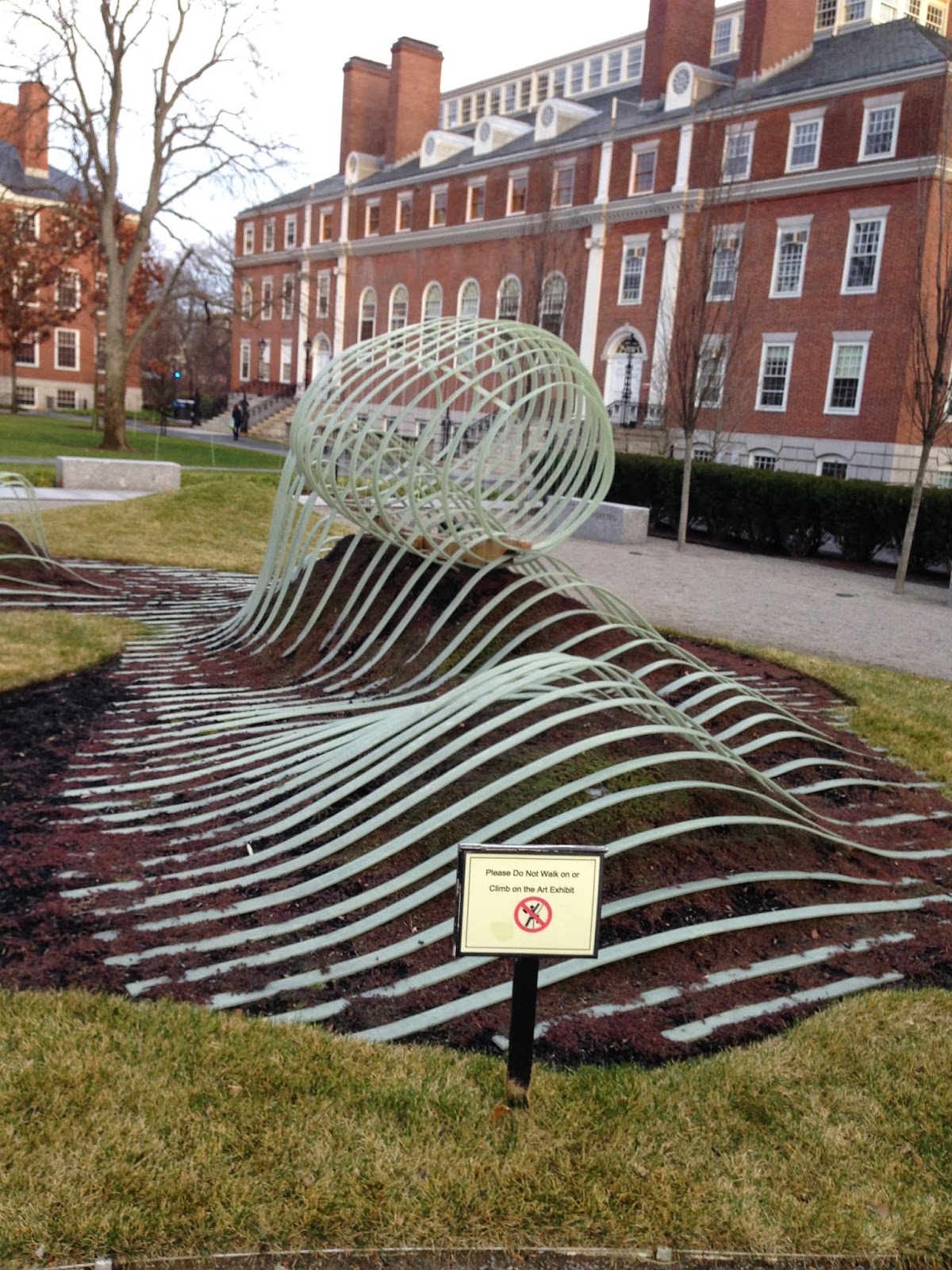
Radcliffe Yard looked beautiful and I enjoyed checking out the award-winning sculpture.

The sculpture is an installation called Saturate the Moment.

We wandered over to Bartley's, a Cambridge institution but it was closed.
 
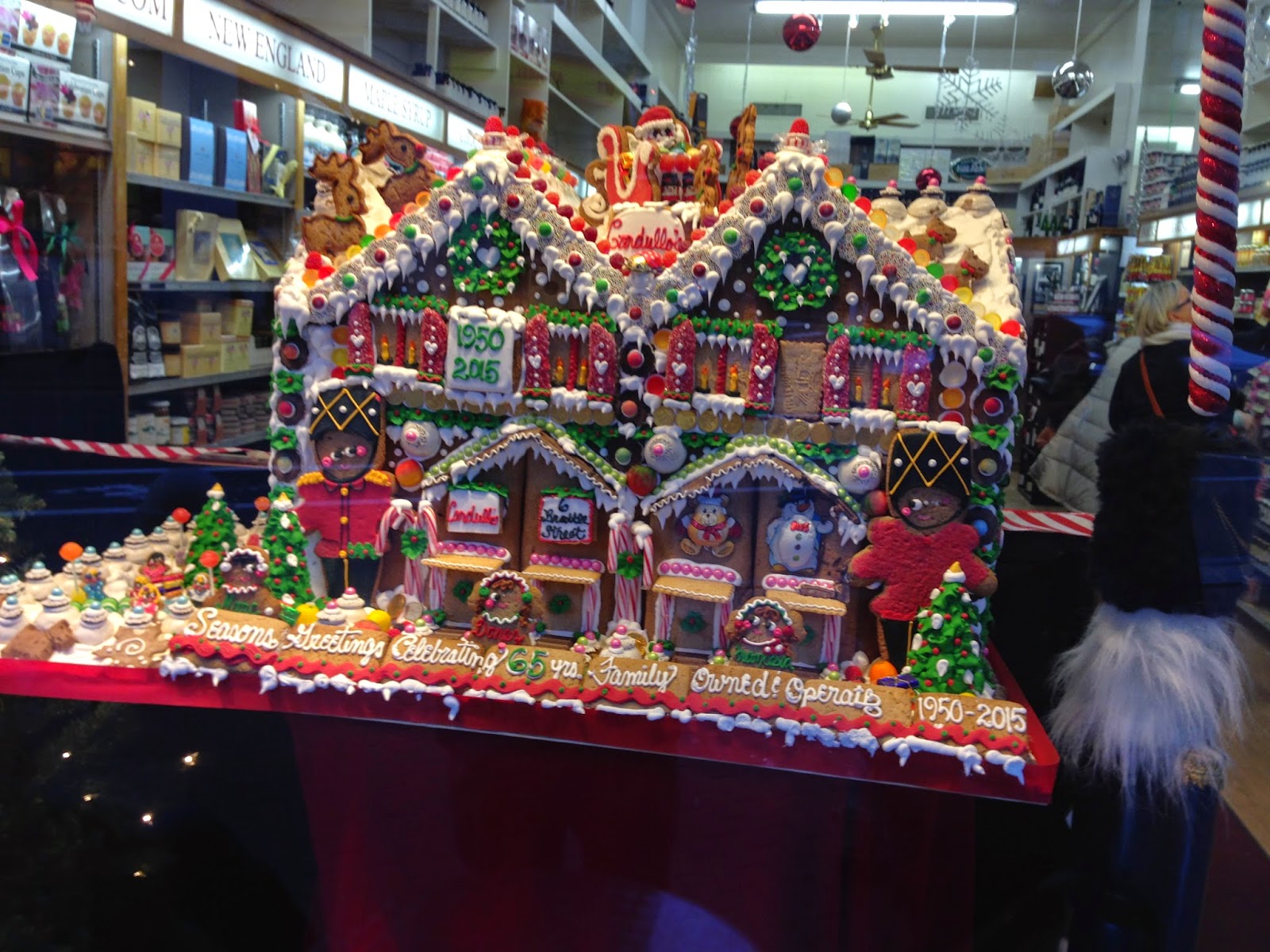
 Cardullo's in Harvard Square had the beautiful gingerbread house in its window below.

Burdick's was open so we enjoyed some delicious hot chocolate! 
We had traveled to eastern MA, since my daughter wanted to meet a friend who had returned from a semester abroad at the University of St Andews in Scotland.  The head (known as the Principal and Vice-Chancellor) of St Andrews is Dr. Louise Richardson, who was the Executive Dean of Radcliffe when I was there. You can see her at our Radcliffe Fellows "graduation" ceremony  in the top photo in my blogpost here.

You may recall that Prince William and his wife, Kate Middleton, the Duke and Dutchess of Cambridge (in England), were recently in NYC for a fundraiser for St Andrews, since they met at this university, and Dr. Richardson can be seen with them here. The 600th anniversary gala for the University of St Andrews took place at the Metropolitan Museum of Art.

And, when I returned back to Amherst last night, I had a message from none other than Dr. Pierrette Cassou-Nogues, wishing me a Happy New Year!