Showing posts with label workshop. Show all posts

Tuesday, October 8, 2024

The Supply Chain Resilience (SCRIPS) Workshop in DC and More!

Last week I had the great pleasure of attending the SCRIPS (Supply Chain Resilience Issues, Problems and Solutions for the Homeland Security Enterprise) Workshop in Washington DC. The workshop was extraordinary, bringing together experts from government, academia and industry. The venue was excellent - the Texas A&M Bush Center, very close to The White House. 

It was an honor to be invited to deliver the keynote: Supply Chain Resilience Research: Insights from Agricultural & Food Supply Chains.

There were 3 themes to this workshop: the agricultural and food industry, the semiconductor industry, and ports. The organizers were incredibly prescient with the workshop taking place October 1 and 2, 2024, and the  East Coast and Gulf Coast dock workers set to go on strike at midnight on October 1!

I had anticipated a possible dock workers strike and wrote this article for  The Conversation: "Brown bananas, crowded ports, empty shelves: What to expect with the US dockworkers strike." The article was updated, once the strike was announced, before my keynote on October 1. I was busy going back and forth with my Editor.  The strike ended, preventing an economic disaster, within 3 days, and I had this article published in The Conversation: "Dockworkers pause strike after Biden administration’s appeal to patriotism hits the mark." 

I'd like to take the opportunity to thank the Department of Homeland Security (DHS) Supply Chain Resilience Center, the Center for Accelerating Operational Efficiency (CAOE) at Arizona State University and the Cross-Border Threat Screening and Supply Chain Defense Center (CBTS) at Texas A&M University, both DHS Centers of Excellence, for hosting this workshop. Special thanks to Ronald Askin for inviting me to speak with gratitude also to: Ross Maciejewski, Hilary Shackelford, and Pompelli Greg, who did an amazing job leading our food/ag industry break sessions. Appreciation is extended to: Cynthia Gerber, Manish Bansal and Sara Saberi for taking and sharing some of the nice photos in the collage below. Thanks to ALL for their participation and the incredibly inspiring insights and discussions.


It was terrific to see colleagues that I know from Operations Research from multiple universities at the workshop as well as to have CDC, FEMA, and, of course, DHS representatives taking part in the workshop.

It rained periodically during the workshop but, propitiously, the rain would stop when Robert, who is responsible for the amazing Ukraine Rally DC, would be out. I had brought my Ukrainian flag and, both last Monday and Tuesday, I joined him and others.

It was very special to meet refugees from Ukraine and even Kiran and Alan, who had worked in the Peace Corps in Ukraine, and I spoke Ukrainian with them!


My time in DC was incredibly rewarding and very special! And, while walking on the street back to my hotel one evening, a gentleman cried out my name and starting hugging me. He had just arrived from Mexico, was very familiar with my research, and was starting his new job at The World Bank the next day. He also knows our UMass Amherst Chancellor Javier Reyes, who is from Mexico. What a small world it is!

Saturday, August 24, 2024

Outstanding Future BA (Business Analytics) Prof Workshop at the University of Iowa

I recently returned from the Tippie College of Business at the University of Iowa. I was there to give an invited talk on research at the 3rd Future BA (Business Analytics) Workshop. Many thanks to Professor Ann Melissa Campbell for inviting me and congratulations to her and to her workshop co-organizers Professors Kang Zhao and Beste Basciftci on the success of the workshop!

There had been 80 applicants with 28 selected and participating with advanced PhD students and postdocs from many universities taking part including: UC Berkeley, Virginia Tech, Purdue, Clemson, University of Oklahoma, University of Buffalo, Harvard, MIT, and UMass Amherst.  It was my first time in Iowa and it was great to see the faculty and to also hear from the other invited speakers: Professor Tallys Yunes, who spoke on teaching, and Professor Bin Gu, who also spoke on research. 

Below is a photo that was taken of the group. It was quite remarkable that I had met several of the PhD students previously. 


I was also thrilled that my PhD student, Dana Hassani, took part. It was great to hear him give the elevator speech on his research and to hear from the others.


What impressed me was the enthusiasm and passion of the participants for their research, which I found uplifting and inspiring. 

The workshop kept us all very busy with the presentations, nice lunches and coffee breaks, networking sessions, and a dinner at a winery.

We could not resist taking a few more photos and the smiles on everyone's faces show how rewarding this workshop was.


I wish all those who took part best of luck on their research and completing their dissertations, if they have not done so, plus successful academic job interviews!

I was very touched by the number of nice email messages I received from the PhD students and participants - they were very heartwarming and I appreciate the politeness and the reaching out.

This group has established a very nice and supportive network and I warmly thank Professors Campbell, Zhao, and Basciftci. It was also terrific to hear from Professor Barrett Thomas and to see Professor Thiago Serra, who has just joined the Tippie Business Analytics faculty after spending 5 years at Bucknell University.


Friday, November 26, 2021

My Talk at the Managing Disaster Risk: A Way to Sustainability Workshop in Nepal

This past week I had the pleasure of speaking at the Managing Disaster Risk: A Way to Sustainability Workshop organized by NEGAAS (Nepal Germany Academic Association). Speakers and participants joined virtually from multiple continents. 

My presentation was entitled, “Labor and Supply Chain Networks: Insights from Models Inspired by the COVID-19 Pandemic.” 


After a very warm introduction and welcome by Professor Tanka Nath Dhamala, I thanked him and co-organizer Professor Urmila Pyakurel, as well as Er. Ravi Khanal and the Nepal German Academic Association (NEGAAS) and its Program on Migration and Diaspora for the invitation to speak.

In my presentation,  I first emphasized that the COVID-19 pandemic is a healthcare disaster that unlike, natural disasters, even those exacerbated by climate change, is not limited to time and space and has affected virtually the entire globe. I spoke about research on perishable and time-sensitive supply chain networks that I had done with collaborators even before the pandemic that enabled us to pivot to produce relevant research in the pandemic. Among the applications of such supply chains are: food supply chains as well as pharmaceutical and vaccine ones. Such supply chains were especially impacted in the pandemic. 

I discussed a stream of publications that I had published in the pandemic on mathematical models, both optimization and game theory ones, that include labor as a critical resource in supply chains, along with labor availability and productivity. I first discussed, at a high level, the food supply chain network model introduced in Nagurney (2021a), in which there are bounds on labor associated with supply chain network economic links of production, transportation, storage, and distribution using a generalized network optimization framework to capture food product perishability. 

I then (cf. Nagurney (2021b) highlighted another optimization model in which there are distinct sets of bounds on labor - on links, or on a tier of supply chain activity, or on the entire supply chain network. Finally, I discussed a model and results in Nagurney (2021c), where a game theory model with multiple competing firms under various labor constraints are engaged in competition under profit-maximizing behavior. The governing concept in the case of bounds on labor on links is that of Nash Equilibrium, whereas in the case of the two other sets of constraints, in which the firms compete for labor (a reality in the pandemic), the concept is that of a Generalized Nash Equilibrium. Highlights of a case study on blueberries and migrant labor, which has suffered in the pandemic, was also presented.  This paper, published in the European Journal of Operational Research was recognized by a 2021 Editor's Choice Award.

In my talk, I also noted that it is important that firms pay laborers the wages that they deserve and this can actually give them a competitive advantage (cf. Nagurney (2021d)). I  further noted the benefits of cooperation, from a study (see Nagurney and Qiang (2020)), in which synergies associated with the teaming of humanitarian organizations in disaster response can be quantified. 

In my presentation, I emphasized the importance of research and publishing on disaster management but also the need to get the research out to the public. I noted the benefits of writing OpEds and speaking with the media as well as in working with legislators to effect positive change. Below are just some of the media that I have been interviewed for in the pandemic.


I concluded my presentation by describing how work on blood supply chains that I had written about in The Conversation has impacted  national policy in the US in the pandemic.


I very much appreciated the thoughtful comments and questions after my presentation.

The full slide deck of my presentation can be downloaded here.

References

Nagurney, A., 2021a. Perishable food supply chain networks with labor in the Covid-19 pandemic. In: Dynamics of Disasters - Impact, Risk, Resilience, and Solutions. I.S. Kotsireas, A. Nagurney, P.M. Pardalos, and A. Tsokas, Editors, Springer Nature Switzerland AG, pp 173-193. 

Nagurney, A., 2021b. Optimization of supply chain networks with the inclusion of labor: Applications to Covid-19 pandemic disruptions. International Journal of Production Economics, 235, 108080.

Nagurney, A., 2021c. Supply chain game theory network modeling under labor constraints: Applications to the Covid-19 pandemic. European Journal of Operational Research, 293(3), 880-891.

Nagurney, A., 2021d. Wage-dependent labor and supply chain networks in the COVID-19 pandemic and beyond. In press in: Analysis, Geometry, Nonlinear Optimization and Applications, P.M. Pardalos and T.M. Rassias, Editors, World Scientific Publishing, Singapore. 

Nagurney, A., Qiang, Q., 2020. Quantifying supply chain network synergy for humanitarian organizations. IBM Journal of Research and Development, 64(1/2), pp 12:1-12:16.

The program of the workshop can be viewed below.


The ideas generated at this workshop were fabulous and. A big plus was the mix of academics, practitioners, and representatives from government, which made for meaningful conversations.

Tuesday, April 22, 2014

Sustainable Supply Chains for Sustainable Cities, Earth Day, and Erice

Today is Earth Day on which we celebrate planet earth and the environment.

I have been hard at work on a presentation, Sustainable Supply Chains for Sustainable Cities, which I will be presenting at a fascinating workshop, which will take place in early May, at the Ettore Majorana Scientific Center in Erice, Sicily. I had been then before, back in 2006, and it was a fitting ending to not only my year as a Science Fellow at the Radcliffe Institute at Harvard but also to the World Cup (Italy beat France and we were in Italy).

The title of the Workshop that I will be speaking at is given below.

      ERICE INTERNATIONAL SEMINARS ON PLANETARY EMERGENCIES
47th Session
Erice, 11 –15 May 2014
THE ENERGY PLANETARY EMERGENCY
Workshop on Energy, Cities, and the Control of Complex Systems.

I received the formal invitation from the Director and Chairman of the Ettore Majorana Scientific Center, Professor Antonino Zichichi. The workshop is organized by Professor Adlison Motter of the Department of Physics and Astronomy, Northwestern University,
http://dyn.phys.northwestern.edu/  and by Dr. Robert Schock, Center for Global Security Research, Energy Permanent Monitoring Panel, World Federation of Scientists:

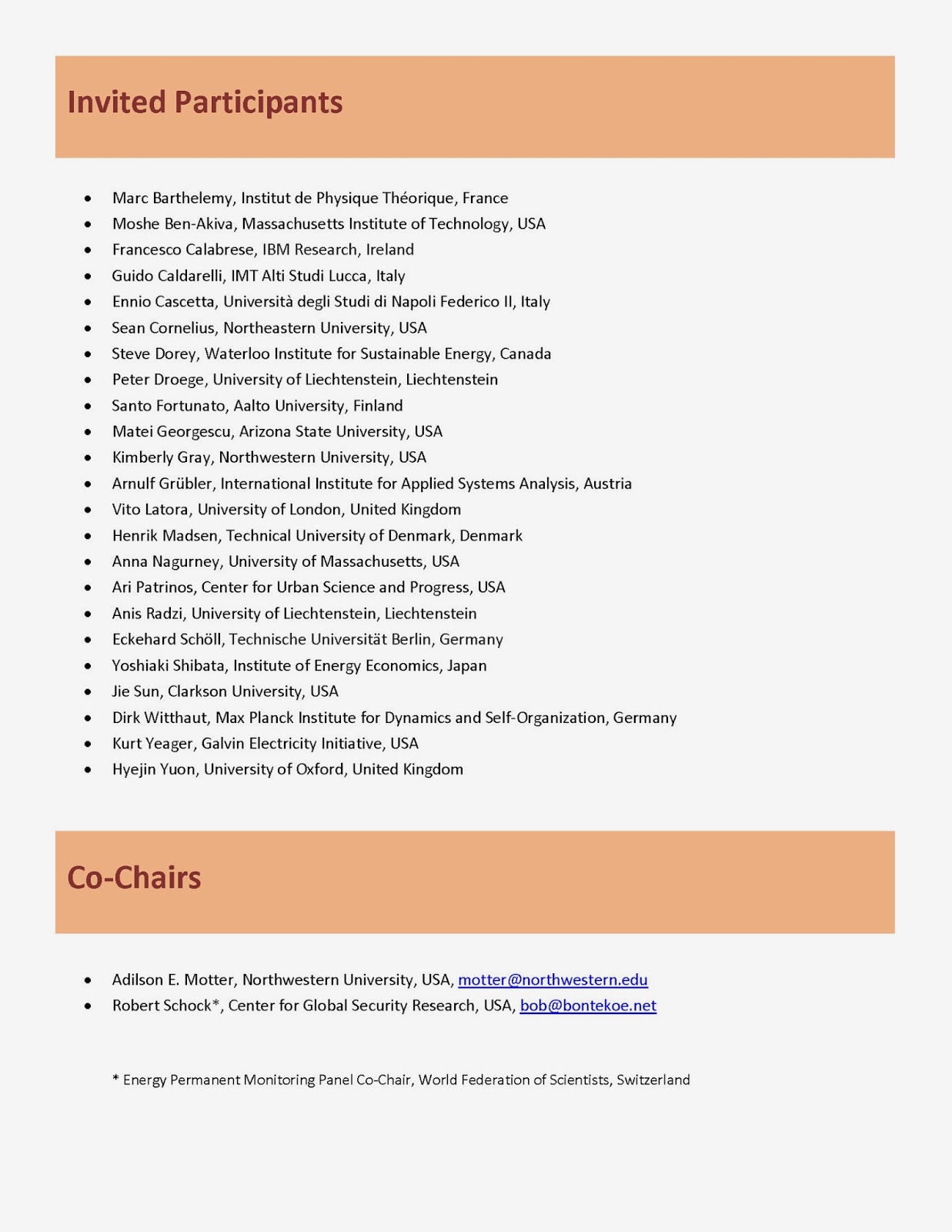
The list of invited participants is below.
 

In my presentation I will present both a supply chain network design model with a focus on frequencies, which is in press in the journal Environment & Planning B and will discuss highlights of a model developed with Drs. Min Yu and Jonas Floden on sustainable supply chain network competition and game theory with frequencies of supply chain activities as strategic variables and product path flows. This paper was recently published in the journal Computational Management Science in a special issue devoted to Planet Earth.


Monday, September 16, 2013

Photos from the Fabulous Supply Chain Workshop in Switzerland

Yes, it was a whirlwind trip -- I flew from Boston to Zurich on September 10 and returned yesterday, September 15, with new research ideas, great new contacts, and visual scenes and experiences that were simply fabulous.

Below, I present, in photos, some of the highlights. The purpose of my trip was to deliver the talk Networks Against Time: From Food to Pharma at the Workshop on Supply Chain Vulnerability and Resilience. The Workshop was organized by the ETH Risk Center and the Zurich Insurance Group.

The view from my room at the Zurich Development Center (ZDC) (Lake Zurich and the Alps with the green landscape in the foreground):
Some of the art displayed at the ZDC, which was a former sanitarium and where Bircher invented bircher muesli -- delicious -- soccer fans will appreciate the photos, I am sure:


 Some photos from the conference:


 Scenes outside the workshop venue:
Thanks to the organizers of this Supply Chain Workshop for such an extraordinary workshop in a perfect venue!


Wednesday, August 28, 2013

Looking forward to the Vulnerability and Resilience of Supply Chains Workshop in Zurich

The other day I saw a colleague of mine and asked him what was he looking forward to, given that the new academic year was about to begin. 

The response surprised me -- he said "January."  He was serious and was not joking.

I know that, sometimes, perhaps, one may not feel valued by one's immediate organization and that can include one's school or university but one has to look at the bright side of things and make the most of any situation.

As an operations researcher and management scientist, I try to optimize the resources that I am given and to take advantage of any opportunities and, of course, make opportunities for students and colleagues (as much as is feasible).  One needs to be resilient!

I have written a lot on network vulnerability and robustness from supply chains to transportation networks and the Internet with fabulous former students, who are now great colleagues at other universities from Dr. Patrick Qiang to Dr. June Dong, as well as with my collaborators from Dr. Patrizia Daniele of the University of Catania in Italy and Dr. David Parkes of Harvard University, among many others.

Besides getting ready for the new academic year, which begins at UMass Amherst next week, I am also working on a presentation for a workshop that I am very excited about. The workshop is on Vulnerability and Resilience of Supply Chains and it will take place at the ETH Risk Center in Zurich, Switzerland, September 12-13, 2013. Below, I have posted the agenda, which looks fabulous, and should be an outstanding workshop in terms of presentations and discussion -- so looking forward to it!


 More information on the workshop is available from the workshop website.

Many thanks to all those who have put the agenda and associated activities together!
 

Organizing Committee

Organizing Team

Friday, August 2, 2013

Vulnerability and Resilience of Supply Chains

Resilience is a theme that resonates among researchers, practitioners, and policy-makers. Michael Batty, in his editorial,  Resilient cities, networks, and disruption,  in the latest issue of Environmental & Planning B, argues that: Resilience is a more precise term than sustainability and, although it has some rather ill-defined properties, resilience can be defined relatively unambiguously, making it somewhateasier to apply to complex systems like cities.

I would argue that sustainability is a key building block of resiliency whether it comes to cities or supply chains, which span our globe and, interestingly, my paper, "Design of sustainable supply chains for sustainable cities," is now in press in Environment & Planning B.

I have written a lot on network vulnerability, including that of supply chains, as well as robustness and synergies associated with partnerships and teaming and even mergers and acquisitions. So, when the invitation to attend the ETH Risk Center Workshop on Vulnerability and Resilience of Supply Chains -- see information below came -- I was very intrigued and accepted to speak.

I am honored to be in such a great lineup and I am sure that there will be many stimulating presentations and discussion!

The talk that I am preparing for this workshop is: Networks Against Time: From Food to Pharma. I will discuss some o fthe major methodologies, models, and applications in our latest book Networks Against Time: Supply Chain Analytics for Perishable Products.

Hope that some of you can join us in Zurich, Switzerland for the workshop next month! 

Risk Center: Vulnerability and resilience of supply chains

Workshop 2013 - ETH Risk Center: Vulnerability and resilience of supply chains

ETH Zurich (Switzerland), September 12-13, 2013

Topics

  • Supply chains as economic networks and “critical infrastructures”
  • Response to external shocks and inherent instabilities
  • Risk reduction, disaster response management, and insurance issues
The following questions will be addressed:
  • What kinds of hazards are there? What are the challenges?
  • What does the interaction of regulators and the industry look like during a critical event?
  • What are the critical parts in supply chains seen from the different perspectives? How can one identify them, what could be improved?

Speakers

Program

The workshop will run for two days, with an evening dinner cruise on Lake Zurich after the first day. Two sessions each day will consist of talks by invited speakers and there will be a panel discussion at the end of each day.

Poster session

The poster session offers an opportunity for an interactive presentation of your work.
If you want to present a poster, please submit a pdf file of it (max. 5 megabytes) to info-riskcenter@ethz.ch. The best posters will be selected for the poster exhibition by the program committee. The submission deadline is July 31.

Registration

Please click here for your registration to the workshop. There is a participation fee of 200 CHF. Note: The number of participants is limited.

Organizing Committee

Organizing Team

The workshop is sponsored by the ETH Risk Center and the Zurich Insurance Group.
ETH_Risk_Center
ZurichInsLogo
 

Monday, October 15, 2012

Complex Network Workshop in Berlin -- Deadline for Submissions Approaching

The 4th International Workshop on Complex Networks  (CompleNet 2013) will take place March 13-15, 2013 in Berlin, Germany.

According to the nice flier on this workshop, CompleNet 2013 aims at bringing together researchers and practitioners working on areas related to complex networks. In the past two decades we have been witnessing an exponential increase on the number of publications in this field. From biological systems to computer science, from economic to social systems, complex networks are becoming pervasive in many fields of science. It is this interdisciplinary nature of complex networks that this workshop aims at addressing.

I am on the Program Committee for this conference, and it promises to be very intellectually stimulating and provocative and it will take place at a great venue!

The deadline for paper submissions is coming up and it is November 2, 2012.  Information on paper submissions and stylefiles can be found here.

Hope to see many of you at CompleNet 2013!


Monday, May 24, 2010

Social Computing Workshop in Hawaii a Great Success

The Workshop on Social Computing, which took place May 22-23, 2010 in Honolulu, Hawaii is now over and it was a great success. It takes a lot of intellectual confidence, creativity, and, may I say, guts, to organize a truly interdisciplinary workshop which brings scholars and researchers from disparate fields. Dr. Sun-ki Chai, of the University of Hawaii, deserves congratulations and thanks for his extraordinary efforts in pulling off such an exciting workshop in such an extraordinarily beautiful location!

This workshop brought together social scientists (sociologists, political scientists, economists, communications experts) with computer scientists, engineers, and an applied mathematician/operations researcher/computational economist/network scientist (me). I had an outstanding time intellectually as well as socially. It was a privilege to listen to some of the pioneers in the area of social computing who are breaking boundaries of different disciplines.

My presentation was on: Network Design: From the Physical World to Virtual Worlds and it can be found here. I enjoyed the presentations as well as the discussions immensely.

Saturday, May 22, 2010

I Was on Flight 1 to Hawaii

Yesterday, I was on flight 1 from Chicago to Honolulu and this United flight was wonderful. It was very cool to be on Flight 1 and I could not have asked for a nicer seatmate -- an army reservist, named DJ, who, after training, was being deployed to Honolulu. We talked for a long time about military training, operations, and logistics. He will hear in a month whether he goes to Afghanistan or stays in Honolulu for two years.

This young man, age 20, had such entertaining stories to share about his basic and specialized training that the flight of over 8 hours passed by quickly. The United staff was fantastic and allowed us to stand for quite a while. They were courteous and friendly and even told me of sights in Honolulu that I should see. Although with the workshop I do not have spare time for sightseeing. There were quite a few military members on our flight since Hawaii's main industries are now tourism and the military base. As we were landing we clapped for the military present as well as for the veterans.

As for Honolulu, the workshop is at a hotel on Waikiki beach and the views and shops are simply magnificent. I have been taking long walks early in the morning and my hotel room has a balcony with a view of the Pacific Ocean. It is a location filled with beauty.

I am very much enjoying the workshop, which is funded by the Air Force and it is multidisciplinary with fascinating perspectives. I like to be in such an intellectually challenging environment.

I gave my presentation today and very much enjoyed the experience. An earlier blogpost has information about my talk and the workshop program.

Tuesday, May 18, 2010

Speaking in Hawaii on Network Design

I am getting ready for the Workshop on Social Theory and Social Computing: Steps to Integration, which takes place next weekend in Honolulu, Hawaii. This workshop is sponsored by the Air Force Office of Scientific Research (AFOSR) and is the brainchild of Dr. Sun-Ki Chai of the University of Hawaii.

According to the workshop website:

The rise of the internet, both as a platform for social action and a rich source of social data, has turned computer science's focus increasingly to measuring, analyzing, and predicting social phenomena. However, the level of engagement between this work and the body of existing social science work leaves much to desired. While certain social science methodologies and formalisms have been adopted widely, social networks being by far the most notable, more disconnect is more generally noticeable than dialog and integration. By bringing together a group of prominent social scientists (themselves from different disciplines), computer scientists, and engineers who are studying similar kinds of social phenomena but generally do not move in the same academic circles, we hope to kick-start this interchange of ideas and to promote further interdisciplinary collaboration.

I am so honored to be an invited speaker at this workshop and am so looking forward to the presentations and intellectual exchanges.

My presentation is on: "Network Design -- From the Physical World to Virtual Worlds."

Abstract: In this talk, I will present recent research on the design of networks from different perspectives (centralized/cooperative vs. decentralized/competitive). The approach is sufficiently general to capture the network designer's multicriteria-decision-making behavior. I will illustrate how this theoretical and computational framework can be applied to physical networks, ranging from transportation to telecommunication ones, as well as to logistical ones (including supply chains). I will also discuss issues of redesign, as well as network integration, with applications as varied as corporate mergers and acquisitions and humanitarian logistics operations.

I will then overview how networks such as social and knowledge ones can also be subject to network design (and even be integrated with physical networks) and discuss the unique challenges of network design in virtual worlds.

More information about the workshop can be found here
.

I have only been in Hawaii while being processed at the airport en route to/from Australia. Although I will be spending most of the time indoors at the workshop I hope to somehow absorb this state's beauty.