Showing posts with label operations. Show all posts

Saturday, March 3, 2018

An Amazing Lecture: “A Day in the Life of an Ebola Treatment Center,” by a Medical Professional Extraordinaire

Ten days ago, we had the true honor of having a consummate medical professional, Ms. Deborah "Debbie" Wilson, speak to my Humanitarian Logistics and Healthcare class at the Isenberg School of Management. On February 22, 2018, we were educated and deeply inspired when she delivered the outstanding lecture: “A Day in the Life of an Ebola Treatment Center.” Ms. Wilson is a nurse and recently received additional MSN/MPH degrees from Johns Hopkins University.

I had the pleasure of meeting Ms. Wilson a few years ago, and reached out to her after I read her very honest and provocative Letter to the Editor in The New York Times.

She also contributed a refereed chapter published in our Springer 2016 Dynamics of Disasters book, entitled: "Ode to the Humanitarian Logistician: Humanistic Logistics Through a Nurse’s Eye," which the students had read, as part of the course, and they were very excited to meet her in person! Ms. Wilson spent 6 weeks battling Ebola in Liberia in the Fall of 2014 and has also returned to the country to meet with nurses. You can read another writeup on her experiences here.
Her incredible work with Médecins Sans Frontières (MSF), also known as Doctors Without Borders,  in extremely challenging healthcare environments brought out the critical importance of nursing as well as logistical support in patients' treatment and recovery from Ebola, along with the importance of understanding and being sensitive to the culture that one is working in.


She worked 12 hours a day, sweating profusely, while wearing PPE (personal protective equipment), to tend to her patients, one hour at a time. In fact, she inspired some of my recent research in game theory, freight service provision, and disaster relief with a case study on PPEs and Ebola.
During her time there, she subsisted primarily on white bread and french fries, and was involved in expanding the ETU (Ebola Treatment Unit) from 30 to 120 beds. The extremely challenging logistical issues included transport of needed supplies by air and boat, and over decrepit roads; the setting up of a water treatment facility and waste burning mechanisms, obtaining clean clothing for those who had recovered; the testing of the blood samples (initially it took 5 days); the preparation of body bags for burial (cremation is against the culture), to highlight just a few.

The impact that she made and her dedication to medical service around the world are extraordinary and she shared with us the photo of the smiling child below with a certificate of being cured of Ebola.
Interestingly, just three days before Ms. Wilson spoke in my class, BBC ran an article: "Life After Ebola,"which included many photos. We got to hear from someone who not only was there, but who saved lives, and has been back to focus on lessons learned.

Ms. Wilson answered numerous questions from the students.

Her courage, dedication, professionalism, and integrity are awe-inspiring and we are so grateful that she was able to give a lecture that we will never forget.

And a special thank you to my doctoral student, Mojtaba Salarpour, for taking the above photos since I had left my cellphone charging at home that day.

Monday, February 13, 2017

Keeping Our Universities Safe - Lessons in Emergency Management and Business Continuity

We have had 2 major snowstorms in the past 5 days in Massachusetts and UMass Amherst, along with most schools and colleges, was closed last Thursday. This morning, the commute was a bit dicey but there was not even a scheduled delay on our campus.

Below is a photo of the accumulation of the snow from the two storms, so you have an idea.

This spring I am again teaching my course on Humanitarian Logistics and Healthcare and I regularly blog about the guest speakers in the course. This term there has been some disruption management necessary since not only have two of my classes been cancelled, due to snow, but also, because of the Presidential Executive Order on immigration, my first guest speaker, Mr. Jeff Hescock, had to reschedule, but, speak he did, last Tuesday. Luckily, all went smoothly after the Patriots superbowl win so he did not have to postpone again. Never a dull moment at a university, I must say.

Mr. Hescock is the Director of Emergency Management and Business Continuity at UMass Amherst, and, coincidentally, he is part of the team that makes the decision of whether to close UMass Amherst due to weather. This, of course, was very interesting to the students and, also, rather timely.

Mr. Hescock shared with the class how the campus responds to emergencies and emphasized the importance of coordination with police and fire departments and the necessity of being more efficient.  He noted that the tragedy at Virginia Tech in 2007 was the game changer for emergency management at universities, signalling that an institution, such as a university, cannot have big delays  and "sign-offs" from multiple stakeholders before notification and action are taken.

Prior to Mr. Hescock's appointment at UMass Amherst in 2013, he had worked in the UMass President's office and also assisted in the evacuation of UMass Dartmouth post the Boston Marathon bombing on April 15, 2013, another date that is permanently cemented in my memory.

Mr. Hescock emphasized the importance of training and educating alternate persons who can take over in the event of a university emergency as happened last spring at UMass Amherst with an incident taking place during the public school vacation break, during which some of the emergency staff were away.

Hescock is a leader in securing grants for a variety of emergency preparedness initiatives and I have personally taken part in a big exercise for sheltering at the UMass Mullins Center. You can read my blogspot on this exercise, which also has a lot of photos, here.

The campus has a hazard mitigation plan and this past year the drought was a big issue. Luckily, UMass can notify students and staff to decrease their water usage and emphasize the importance of doing so.

I appreciated that he also brought up "enterprise risk management," since my research team does a lot of work on supply chains and viewing them holistically as systems and we also work on vulnerability analysis of networks.

In addition, the necessity of meeting with many different stakeholders in order to be prepared for emergencies is essential, and, in the case of a university, that would include the facilities group, the compliance group, among others, in order to assess risk. He also stated that the most dangerous spot on campus is a cross walk.

There exist templates already in the computer system to get a message out as soon as possible, which is reassuring, and I can speak to the fact that, with the incident last year, the notification system, in the form of loudspeakers, email, and text alerts was very effective. Now we can sign up for practice exercises in the case of a similar incident.

UMass Amherst has 13,000 students living on campus and has about the same number living off campus. It has one of the highest on campus number of student residents in the US. When need be, given the importance of communications, crisis communication experts are kept on a retainer.

UMass Amherst also has MOUs with the Five Colleges in our area, with the state police, Amherst police, and also MEMA (Massachusetts Emergency Management Association). I will be hosting a speaker from MEMA in the class next week.
Mr. Hescock has also worked for MEMA and has worked in the private sector, where he appreciated the funds. He brings a wealth of experience and practical know-how. He, for example, made sure that there were backup generators for the cold storage units for food at UMass Amherst. And told us that UMass generates 60% of its electric power. It was an oasis that my family and I benefited from when we had the freaky Halloween snowstown in October 2011 and lost power for about 5 days in our home in Amherst. Getting a hot cup of coffee was a challenge, not to mention a hot shower. We ate many delicious meals at the UMass dining halls (I felt guilty having lobster during the power outages but enjoyed it immensely).

It is a wonderful educational experience for students to hear from expert practitioners such as Mr. Jeff Hescock. He was a terrific Professor for a Day and we thank him!

Sunday, April 12, 2015

Great Hackathon @UMassAmherst

This morning I visited the Hackathon at UMass Amherst, which is taking place April 11-12, 2015 at the stunning Integrated Learning Center.

The Hackathon is called HackUMass and is the largest hackathoon in the Pioneer Valley.

My husband and I were invited by Tom Kopec, who is an entrepreneur and a mentor to the hackers this year.

The host of this year's hackathon is the Berthiaume Center for Entrepreneurship at the Isenberg School of Management, which is under the managing directorship of my colleague in the Department of Management, Professor Bill Wooldridge.

We enjoyed seeing the students. some of whom were bright-eyed whereas others were fast asleep (on the floor, on couches, or on their keyboards).

We enjoyed talking to some of the teams, including a team of students from multiple universities (I had to take a photo since I am a Brown U. grad), who have known each other since they were students at Wayland High School.
I loved the drone with parts built by a 3-D printer, which also was used to construct the statue of my colleague, who is serving as a judge later today, Professor David McLaughlin of the College of Engineering.

It was great to talk to Professor Wooldridge, who told me that he had slept in his office on an air mattress since he had to be available if there was an issue overnight.  That's the dedication of Isenberg faculty!

I look forward to hearing the results of the judging later today and the awarding of prizes. Given that 300 hackers showed up, according to Wooldridge,  and that there was even an entrant from USC, this was clearly a very successful event.

I was thrilled also to get t-shirst  from Professor Wooldridge!
I heard from Tom Kopec (in the above photo with me and Wooldridge) that last year's hackathon, which was hosted by the Department of Electrical and Computer Engineering, had mostly hardware entries - this year,  about 75% of the projects are are software projects. I was also delighted to see female students om the mix.

Thanks to the sponsors - some of my favorite companies, where I have both former students and great colleagues from INFORMS working.

Saturday, February 21, 2015

Resilience in a Winter of Disruptions

At the Isenberg School of Management, we pride ourselves on our students being resilient and "gritty" even.

This winter has certainly put the faculty, students, and staff to the test.

For example, WWLP.com is reporting that: Temperatures dropped to -19º at the Westover Air Reserve Base in Chicopee Saturday morning. This broke the previous record low of -6º set back in 1950. To put this cold in perspective, -19º is the coldest low we’ve ever had in the lower Pioneer Valley in February.

This February,  we have had 2 cancellations of classes at UMass Amherst on a Monday (I teach Mondays) due to big snowfalls, and  a burst pipe that flooded our Isenberg School atrium and a computer lab below. I am not even acknowledging the later start times because the parking lots and roads and walkways needed clearing.

Because of the frigid weather and snowstorms, I have also had to reschedule 2 guest speakers in my Humanitarian Logistics class and I so much appreciate the speakers' flexibility! The most recent speaker had to deal not only with a loss of communications (computer and phone) in his healthcare organization but also with a flood in one of the principal rooms because of a burst sprinkler pipe! He told me that he will have many stories to share with my students later this week.

And, yesterday, I heard from one of my former doctoral students, who is now an Assistant Professor and lives in eastern MA. In the middle of the night last weekend (after Valentine's Day) his living room and basement were flooded when the sprinkler went off. He and his wife and young child now have to relocate to a hotel for a month so that the walls in the flooded rooms can be torn down and replaced because of all the water damage.

Somehow in western MA, our mobility, despite the horrid February, has not been drastically affected. (I will not share with you the multiple schedules that had to be updated for prospective faculty interview candidates because of flight cancellations. The search is now over and our offer has been accepted so we will have a great new colleague in the Fall).

The situation is even worse in Boston and Cambridge in eastern MA!  The winter of 2015 with 7 feet of snow already having fallen in eastern MA (and topping records in Buffalo)  has had a tremendous negative effect on public transportation with suffering commuters having to contend with complete shutdowns of the MBTA for days on end, major delays, and with serious disruptions to businesses and individuals. Police even had to transport certain healthcare professionals to work!

I was contacted by a journalist last week to offer suggestions on how to remove the snow so offered ideas on the use of freight trains to transport the snow out to warmer climes and, posisbly, drier ones, as well.

Last week,  I was telling my students (we were discussing risk management and emergency preparedness) about  Jane Garvey, who used to live in Amherst and was head of the FAA during 9/11 and responsible for managing air traffic control that horrific day.  I had the great honor of receiving an award named after her, the Jane Garvey Transportation Leadership Award,  which I treasure. Last night, on the evening news, because of the MBTA issues this winter, Governor Charlie Baker (who has been contending with water leaks in his home as well), appointed a panel to review the MBTA and Jane Garvey is one of the seven members of the panel with the charge to find long-term solutions for the MBTA's financial and operational woes.

In today's Daily Hampshire Gazette, Jane Garvey is quoted as saying about the MBTA transit sytem:
" It's a system that is so critical to the economy and so critical to the state and the region. We all have I think an interest in seeing it run well." I completely agree with Garvey. (I wrote a post on her a while back.) I had the pleasure of meeting her at a dinner party hosted by a senior colleague of mine, Professor Joe Balintfy, who has since passed away. He was a neighbor of hers on Blue Hills Road in Amherst.

I have spent 3 years living in Cambridge - the first two when I was a Visiting Scholar at the Center for Transportation & Logistics at MIT (under a wonderful NSF Visiting Professorship for Women grant that I had received) and then a Visiting Scholar at the Sloan School at MIT. In 2005-2006, I was at the other institution in Cambridge, on my sabbatical, as a Science Fellow at the Radcliffe Institute for Advanced Studies at Harvard University. The MBTA Red Line was how I got around when I was not walking from place to place or taking a Peter Pan bus back to Amherst on some weekends and holidays. And now the Peter Pan busses, based in Springfield, are being used to shuttle commuters in eastern MA because of the MBTA transit fiasco!

And just to end on a positive note, yesterday, one of my colleagues and collaborators at the University of Gothenburg in Sweden, Professor Jonas Floden, emailed me the photos below which he took close to his home on the island of Donso. Yes, there are spring flowers now in Sweden!

So, just hang in there - we will make it through this winter in Massachusetts!

Tuesday, April 22, 2014

Sustainable Supply Chains for Sustainable Cities, Earth Day, and Erice

Today is Earth Day on which we celebrate planet earth and the environment.

I have been hard at work on a presentation, Sustainable Supply Chains for Sustainable Cities, which I will be presenting at a fascinating workshop, which will take place in early May, at the Ettore Majorana Scientific Center in Erice, Sicily. I had been then before, back in 2006, and it was a fitting ending to not only my year as a Science Fellow at the Radcliffe Institute at Harvard but also to the World Cup (Italy beat France and we were in Italy).

The title of the Workshop that I will be speaking at is given below.

      ERICE INTERNATIONAL SEMINARS ON PLANETARY EMERGENCIES
47th Session
Erice, 11 –15 May 2014
THE ENERGY PLANETARY EMERGENCY
Workshop on Energy, Cities, and the Control of Complex Systems.

I received the formal invitation from the Director and Chairman of the Ettore Majorana Scientific Center, Professor Antonino Zichichi. The workshop is organized by Professor Adlison Motter of the Department of Physics and Astronomy, Northwestern University,
http://dyn.phys.northwestern.edu/  and by Dr. Robert Schock, Center for Global Security Research, Energy Permanent Monitoring Panel, World Federation of Scientists:

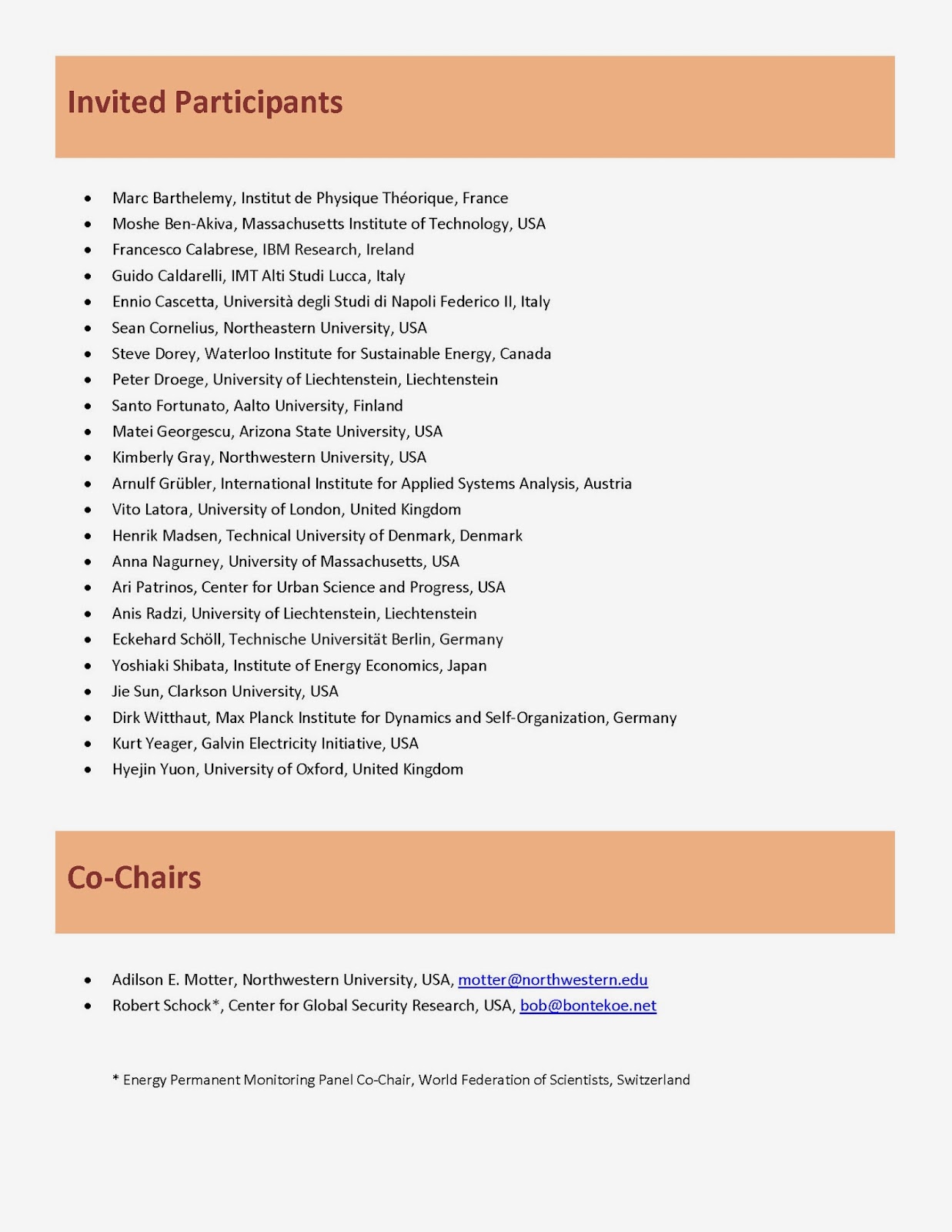
The list of invited participants is below.
 

In my presentation I will present both a supply chain network design model with a focus on frequencies, which is in press in the journal Environment & Planning B and will discuss highlights of a model developed with Drs. Min Yu and Jonas Floden on sustainable supply chain network competition and game theory with frequencies of supply chain activities as strategic variables and product path flows. This paper was recently published in the journal Computational Management Science in a special issue devoted to Planet Earth.


Saturday, August 25, 2012

A Great College Move-In Day Experience

I have just come back from a long walk with many neighbors asking "How was your daughter's move-in to college?"

Wearing a "parent" hat, rather than an "academic" hat, and reflecting on my own move-in experience freshman year, I was very impressed as to how well-organized, painless, and, actually, very pleasant the whole experience was.

Some colleges have figured out systems to make what could be a very tiring, onerous process flow well and efficiently, and as someone who teaches operations, I care about having processes work and flow well.

We had driven our overloaded Volvo with a carrier on top, and, after overnighting in a local hotel, proceeded to her college. We  followed the directions that we were given, parked our car a few feet from my daughter's dorm, and there was a group of upper classmen in nice college t-shirts just waiting to carry all the labeled boxes to her dorm room.


We even had members of the college football team (Division 1 for those who care about such things) complete the job. It took no more than 15 minutes! Her room is on the second floor but I counted 3 short flights of stairs to get there. Coaches were driving around providing water and energy drinks.

My daughter managed to unpack and organize many of her belongings and then her room-mate came. It was wonderful how they had communicated beforehand to determine who would bring what that they could share.

While the room-mates were getting to know one another and organizing their room, I had  time to meet many of her dorm-mates, their parents, and relatives. It is a very good sign when the conversations with so many of the parents are so enjoyable that you wish that you can continue talking for hours (this also brings a sense of relief).

Afterwards -- certain colleges certainly do move-in days nicely -- during the convocation and even reception with the College President and his wife,  we met a family from the Philippines, a girl from Madagascar, and several new freshmen from China, plus families that had come from California, Idaho, Montana, and Nebraska to situate their college  freshmen.

When I was dropped off as a freshman at Brown University I had a minimal amount of  clothes (but I did take some of my paintings that I had done) and my freshman room-mate, who was from Kansas, and one of only two engineering majors that year, had already picked her side of the room.

We had a room at the end of the corridor and now so does my daughter.

Now for those who have dorm rooms in high rises (some of my daughter's friends will be living in rooms above the 20th floor at their universities), the scheduling of arrivals has been done with great finesse. Let's hope that the elevators work throughout the process.

The New York Times has an article on college move-in day but I especially enjoyed Professor Boylan's essay on "A Freshman All Over Again," in which she wrote about her son's move-in day into Vassar and reflected on her freshman transition at Wesleyan University. The comments from readers on the latter piece are very engaging and here we go again with the deja vu.


Thursday, July 28, 2011

Looking Forward to the Integrated Risk Management Conference in Operations and Global Supply Chains

I am very much looking forward to the Integrated Risk Management Conference in Operations and Global Supply Chains that begins this weekend at McGill University in Montreal, Canada.

This conference is being organized by Professors Mehmet Gumus and Saibal Ray and is co-hosted by the Desautels Faculty of Management, McGill University, and the Olin School of Business, Washington University in St. Louis.

According to the conference announcement, this two-day conference features a single track of fourteen talks and six poster presentations that combines technical presentations, industry practices, and discussions on relevant challenges and approaches in the topic area. Detailed information about the conference can be found here with the conference program located here. Those who would like to attend the conference can register before July 30, 2011 (at no registration fee since it is covered by the conference sponsors).


I will be speaking on Medical Nuclear Supply Chain Design: A Tractable Network Model and Computational Approach, co-authored with Professor Ladimer S. Nagurney (my husband, who has a PhD in physics). Our presentation is based on the paper that we recently wrote. This health care topic was also the subject of our published Op-Ed piece.


Thursday, July 8, 2010

Haiti 6 Months After -- Unblock the Roads and Fragile Networks

One year ago, our book, Fragile Networks: Identifying Vulnerabilities and Synergies in an Uncertain World, was published and was recently noted by the Library Journal to be a top selling book in technology and engineering.

6 months ago, on January 12, 2010, a huge earthquake hit Haiti and awakened the world to the wrought devastation.

I wrote regularly in this blog about the earthquake, the resulting human suffering and loss of lives, and the loss of critical infrastructure from the roads to telecommunications, plus hospitals and even schools, which only added to the suffering of the survivors. I also called for better coordination among the stakeholders and especially the humanitarian organizations for the provision of necessary supplies and decent logistics.

Today, The New York Times has an OpEd piece written by my colleagues at Georgia Tech, which is right on target, and which speaks to one of the major themes of our Fragile Networks book: that the identification of the critical network links before (and after) their degradation and even ultimate devastation is essential.

According to the OpEd piece, Haiti's External Weight, by Professors Desroches, Ergun, and Swann, 6 months after the earthquake: twenty million to 25 million cubic yards of debris fill the streets, yards, sidewalks and canals of Port-au-Prince — enough to fill five Louisiana Superdomes.

Debris is one of the most significant issues keeping Haitians from rebuilding Port-au-Prince and resuming normal lives. Much of the stuff has been left in place or simply moved to the center or the sides of roads. Some streets with especially large piles of refuse are impassable. As a result, it can take hours to travel just a few miles. Meanwhile, schools, hospitals, businesses and homes remain blocked.

Amazingly, only about 5% of the original debris has been properly disposed of and there are serious concerns about the ultimate impact of the debris on the environment, as well.

Clearly, the efficiency and performance of the transportation and logistical networks in Haiti have been severely affected and degraded without a timely debris removal. Since such networks provide the infrastructure for the movement of people and goods, how can Haiti's economy and its citizens move forward?!

In May, 2008, I had the privilege of convening a workshop: Humanitarian Logistics: Networks for Africa at the Rockefeller Foundation's Bellagio Center on Lake Como. It was apparent to us then, as it is now, that with the increasing number of disasters documented globally more attention to education, to research, and to policy analysis regarding humanitarian logistics and sustainable operations is sorely needed.

Crises don't end once the media attention dissipates.

Friday, June 25, 2010

Portfolio optimization, risk management, and operations

As we see every day -- whether in business or in our personal and professional lives -- decision-making and its consequences, are fraught with risk. The risks may take on many forms from political risk to exchange rate risk and price volatility risk to environmental risk and disruption-based risk, as in disasters due to natural causes, accidents, or planned attacks, to name just a few. The world now is reeling from the BP Deep Horizon oil rig blowout, the most graphic, high impact recent environmental and economic disaster.

Risk management, hence, has evolved as a topic in its own right and is necessarily interdisciplinary because of its vital components, be they social, engineering-based, financial, natural, operational, etc.

In terms of business operations, firms may need to decide whether to outsource various economic activities associated with their supply chains or to continue business as usual. They may need to assess whether to merge or to acquire another firm, which may lie thousands of miles away. They may have to identify new partnerships or to shed older ones; to promote and hire new executives, or let others go. Should one build a new manufacturing plant and where? Should one bring to production a new product? Should one expand into new global markets? All such decisions must have embedded within them some measure of risk since we live in uncertain and very dynamic times.

The areas of finance and operations management (propitiously also the name of my department at the Isenberg School of Management at UMass Amherst) can bring much to both research in and the practice of risk management.

Last year I had the honor and pleasure of instructing a course on portfolio optimization in the Executive Education program at Harvard University's Graduate School of Design. The course covered the fundamentals of portfolio optimization and risk management and also discussed the importance of a network and systems perspective to financial management.

My course lecture notes can be accessed here
.

Today we are conducting research on global outsourcing and risk management as well as on supply chain network design and risk. Our recent studies on various supply chain network as well as financial network topics can be accessed here.

Without appropriate risk management and risk mitigation strategies our already fragile and vulnerable networks may not be sustainable.

Sunday, June 13, 2010

The Greening of the Metropolis


On my flights back from the ALIO-INFORMS in Buenos Aires, Argentina I had the distinct pleasure of reading the latest issue of Bloomberg Businessweek. There was a special segment in it on Clean Energy and an excellent article, "The Greening of the Metropolis." With cities being home to more than half of the world's population and generating more than two thirds of the world's carbon dioxide, greening of our megacities can make a significant difference in improving the environment.

I am hopeful. With the leadership of some of the biggest cities in the world taking proactive, creative steps to reduce emissions, much can be accomplished especially since regions and nations are failing to act.

Kudos to Los Angeles and its mayor, Antonio Villaraigosa, for 1,700 miles of bike paths that are to be completed by 2015, complete with showers and bicycle storage areas.

Bravo to the mayor of Toronto, David Miller, who plans on investing over $1 billion in public transport and environmentally-friendly air-conditioning systems for buildings.

In Tokyo, where, amazingly, 68 percent of the trips are by bike, subway, or on foot, in April a cap and trade system was instituted for carbon dioxide that is city-wide. As for Houston, Texas, where an astonishing 95% of the trips are made by car, at least officials are getting electric cars to reduce emissions.

Robert Doyle, the Lord Mayor of one of my favorite cities, Melbourne, in Australia, plans to bar cars from downtown and to offer incentives for green investments.

Copenhagen, in Denmark, is spending over a billion and a half dollars on bike paths, green energy projects, and retrofitting city buildings.

Amsterdam's infrastructure is being improved to the tune of 1 billion dollars, with its 2,400 houseboats being retrofitted to use electricity instead of diesel.

New York City, one of my absolutely favorite cities, since I grew up in Yonkers, is moving forward with its PlaNYC, to make buildings more energy efficient, power plants more environmentally-friendly, and with tax breaks for the use of solar panels.

Having spent over a week recently in another megacity -- Buenos Aires, Argentina, with about 11 million people in the central and surrounding areas, I know that much needs to be done.

The architecture of this city is stunning as are the neighborhoods with unique identities, and the lively, warm people and culture.

However, the traffic is horrendous with the busses running frequently but on diesel and their evident fumes spewing and belching out. Not only do they emit toxic pollutants but the noise that they generate is substantial. As one former Argentine physics colleague of my husband's, dating back to our Brown University days, told us during a lovely 3 hour dinner in Buenos Aires: when the busses go on strike, the people notice how much cleaner the air gets and how much more peaceful the city is even with more cars! Ironically, in parts of the developing world, getting rid of public transit with aging engines may actually improve air quality.

A better approach (and our colleague told us that he expects that this may happen but it will take about 10 years), is for the city of Buenos Aires (where 1/3 of Argentina's population lives) to purchase busses with the latest green technologies and with quieter designs.

Above are photos taken from the 14th floor of the Etoile Hotel in Buenos Aires where we spent last week. In the photos one can see the famous La Recoleta Cemetery where Eva Peron is buried and the Law School with the big columns, where the operations research conference that I attended and spoke at took place.

My talk at the ALIO-INFORMS conference was on "Sustainable Supply Chain Network Design: A Multicriteria Perspective" and it certainly hit "close to home." The paper is available here and the pdf of the presentation is here.