Thursday, April 9, 2015

Great Data Science Center Launch at UMass Amherst Today with Photos

Today was a jampacked, fabulous day (although we did wake up to a blanket of snow and ice and it is April 9)!

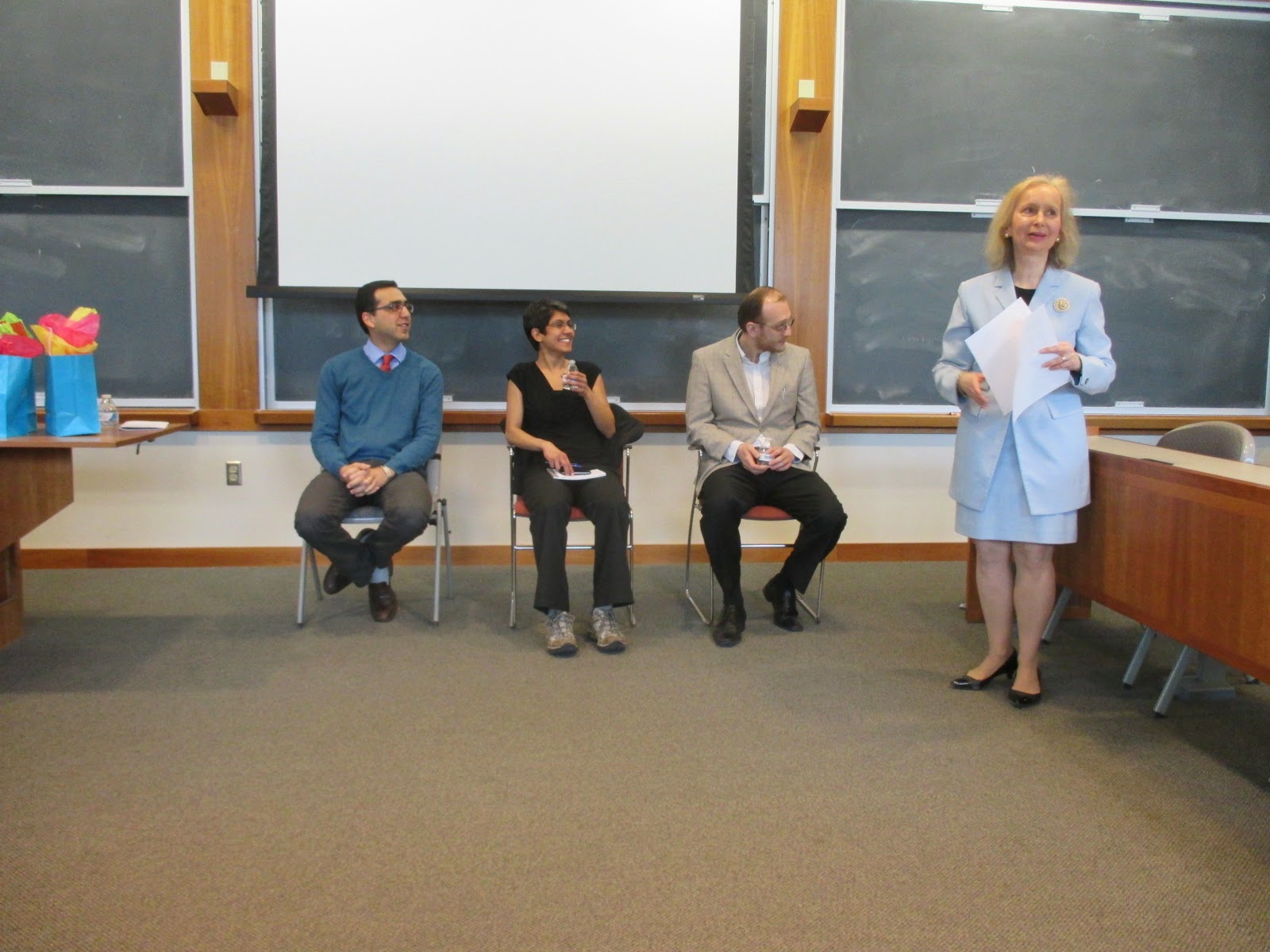
Today was the Data Science Center launch at UMass Amherst with a terrific program, many friends in attendance, and great talks and panelists.

The venue was the 6th floor of the new Life Sciences Lab building at UMasss Amherst and there were refreshments upon our arrival.

The first one I saw was Professor Andrew McCallum of the Computer Science Department, who is the Director of the new Data Science Center (and we hosted Andre in our UMass Amherst INFORMS Speaker Series a while back).
He was a terrific master of ceremonies and the visionary and leader behind this endeavor as our Provost, Dr. Katherine Newman emphasized in her remarks. I snapped the photo of them hugging below.
I got to chat with our Vice Chancellor for Research and Engagement Dr. Mike Malone and Professor David Jensen of Computer Science, who also spoke in our series.

It was great to see my colleagues from Civil and Environmental Engineering, Professors Eleni Chritofa and Eric Gonzales, fellow transportation researchers.

Our Chancellor, Dr. Kumble Subbaswamy and Provost Dr. Katherine Newman had opening remarks as did Professor McCallum.
The keynote was given by Distinguished University Professor Jim Kurose, who is now serving in the CISE Directorate at NSF. He remarked how warm and lovely it was in DC with the cherry blossoms in bloom and then he landed in Bradley Airport and drove to Amherst through a hailstorm. He, as always, had some good jokes including his first presentation as an NSF program officer during which he did not thank the most important person (but thanked others).

I left the event for 2 hours since one of my doctoral students, Sara Saberi, was defending her doctoral dissertation proposal (she passed, so congratulations are in order) and the photo below is of her with the dissertation committee: Professor Adams Steven, Tilman Wolf, and Michael Zink.


 I then came back for the poster session with my doctoral student Shivani Shukla and got to see more colleagues from the College of Engineering and the Isenberg School as well as meeting a professor from Smith College and talking with more Comp Sci professors. Another highpoint was seeing Chris Hill of MIT who came up to me to reminisce about when we were at the U. of Illinois' Supercomputing Center one summer for several weeks - this was very special and I have fond memories of (massively) parallel computing, which I loved to do! Once a programmer, always a programmer!

As Professor Kurose said in his remarks, Congratulations to the Data Science Center,, and on a great launch event.

Military Logistics in Disaster Relief

Yesterday, we had the honor and pleasure of hosting SMSgt Thomas Orifice, who is with the 104h Fighter Wing of the Air National Guard, in my Humanitarian Logistics and Healthcare class.

At first there was some added excitement because his presentation was secure and would not load but we managed to get it working!

I had read an interview with Mr. Orifice , which I liked very much, including the wonderful quotes: I know that all of us would tell you that there is a shared sense of purpose and mission in the military that you don’t regularly see in civilian life. It is one of the major reasons I chose to make this my career. I work with people that are focused on getting the job done, and don’t let obstacles stop them. It’s amazing to see what the human collective can accomplish when they put their minds to it.

Mr. Orifice has had an over thirty year career with the National Guard and has served in France Italy, Germany, and Kyrgyztan, where he told us he saw "frozen fog," and he considers that assignment one of his most fulfilling ones.  He also took part in the liberation of Bosnia and Iraq Operation Freedom.

He kept us on the edge of our seats as yhe spoke about the capabilities of the military in disaster relief, the restrictions, the Stafford Act, and the fascinating case of Superstorm Sandy and his experiences in the response in NYC.

He eloquently emphasized emergency operations centers and showed informative photos and videos, including several on the emergency preparedness and response to Superstorm Sandy, the second costliest natural disaster in U.S. history. To be able to respond so quickly to Superstorm Sandy through effective military  command and control, successful coordination with NYC city planners and the assistance of Mayor Bloomberg, and such impressive military logistics, for the timely delivery of food, water, and fuel, and the provision of shelter for the responders was awe-inspiring!  NOAA had forecast the superstorm one week ahead of time which allowed for emergency declarations and meticulous preparation on the part of the National Guard. They were able to set up staging areas within 24 hours to deliver the necessary supplies and coordinated with NYC city planning authorities. They were not allowed to carry weapons and, hence, needed police assistance to assist in deliveries.

The vehicles that the National Guard has from planes to high water vehicles to forklifts were very helpful in this major disaster relief  mobilization. In addition, the National Guard brought their own shelters and set them up so as not to take up valuable hotel spaces in NYC. He emphasized specifically the devastation of the Rockaways.

Also, Mayor Bloomberg allowed for taxis to obtain fuel since NYC residents are so dependent on access to transportation and the public transit system was shut down for days because of the flooding and electric power outages as well as fuel shortages.

SMSgt Orifice  did a great job reinforcing what the students have learned so far in this course and educated us with new information and material. He clearly showed the importance of logistics in humanitarian operations!
 
And, he said that my students next academic year can get a tour of his National Guard facility - great to hear! A big thank you to SMSgt Thomas Orifice!

Wednesday, April 8, 2015

Blood Services and the Red Cross Lecture

I am so pleased to report that the lecture by Mr. Jeff Meyer, the CEO of  Red Cross Blood Services for Massachusetts and Connecticut, which he delivered on March 25, 2015 to my Humanitarian Logistics and Healthcare class is now available and posted so that everyone can learn and benefit.

Many thanks to Mr. Meyer for his graciousness in allowing us to do this! I wrote up a summary of the lecture on this blogpost and I have heard from several readers who very much appreciated it.

The Red Cross is now marking the second anniversary of the Boston marathon bombings with blood drives.  And to further emphasize the importance of blood donations, in that article you can read that:


Bombing survivor Heather Abbott, who lost a leg, says she wouldn't have survived without the several units of blood she received. Transit police officer Richard Donohue, who was critically wounded in the police standoff with the bombers and needed 46 units of blood, is also urging people to give blood. 

Mr. Lou Wigdor, who attended Jeff Meyer's guest lecture, wrote this illuminating piece on it for the Isenberg School of Management website, Business Students Embrace Blood Supply Economics.

Read more here: http://www.bellinghamherald.com/2015/04/05/4225245/red-cross-marking-marathon-bombings.html#storylink=cpy

Mr. Meyer's talk and visit continue to generate many discussions as well as research ideas. But, then again, a speaker (without any prompting) who notes "network optimization" several times in his lecture, is definitely a kindred spirit!

Tuesday, April 7, 2015

Launch of Data Science Center at UMass

This is quite the exciting week with not only one of my doctoral students (Sara Saberi) defending her dissertation proposal on Thursday but also the launch of the new Data Science Center at UMass Amherst. The program looks terrific and I will be there before the proposal defense and shortly thereafter for the poster session, where we will be presenting our latest research on cyber crime and cybersecurity, done with another doctoral student of mine, Shivani Shukla, who also prepared the poster below.


The program is as follows:


Center for Data Science Launch Symposium


Thursday, April 9th 2015

Life Sciences Laboratories, 6th floor
240 Thatcher Road Amherst, MA, 01003
The event will bring together leaders in academia, industry and government.

Expected Agenda


9:00am
Light breakfast and social networking
10:00am
Welcome by Chancellor, Provost and other dignitaries
10:10am
Andrew McCallum, Professor & Director of Center for Data Science, UMass
Overview of day's agenda and the Center for Data Science
10:20am
Pat Larkin, Director, Innovation Institute at Mass Tech Collaborative
Data Science and the Massachusetts economy
10:30am
Jim Kurose, head of Computer & Information Science and Engineering, NSF
Keynote presentation
11:00am
Examples of our Research and Interaction with Industry
Industry and Academic spotlights
Information Economy
  • Steve Vinter, Site Director & Engineering Director, Google Cambridge
  • Andrew McCallum, Professor, UMass CS (information integration)
  • Misha Davidson, Director of Engineering, HP Vertica
  • Yanlei Diao, Associate Professor, UMass CS (big and fast data analytics)
Energy and Sustainability
  • Brian Beauregard, Electric Division Head, Holyoke Gas & Electric
  • Prashant Shenoy, Professor, UMass CS (distributed systems)
  • Scott Schwenk, North Atlantic LCC Coordinator, U.S. Fish & Wildlife Service
  • Dan Sheldon, Assistant Professor, UMass CS (computational ecology)
Business and Analysis
  • Gareth Ross, SVP Data, MassMutual
  • David Jensen, Professor, UMass CS (causality)
  • Andrew Merlino, Founder & CEO, Pixel Forensics
  • Erik Learned-Miller, Associate Professor, UMass CS (computer vision)
Health and Medicine
  • Deb Bulger, Executive Director of Strategic Programs, McKesson
  • Benjamin Marlin, Assistant Professor, UMass CS (machine learning)
  • Joel Vengco, CIO, BayState Health
  • Deepak Ganesan, Associate Professor, UMass CS (wearable sensors)
12:00pm
Lunch
and TV, radio and print press interviews
1:30pm
Industry and Government panel
statements and discussion
  • Brian Ulicny, Director of Data Science, Thomson Reuters
  • Rohit Prasad, Director of Research, Echo & Speech, Amazon
  • Eric Brown, Director of Watson Technologies, IBM
  • Alex Cosmas, Chief Scientist, Booz Allen Hamilton
  • Raj Subbu, Analytics Leader, Pratt & Whitney
  • C.A. Webb, Executive Director, NE Venture Capital Association
  • Mark Corner, CTO, Fiksu
  • Jennifer Chayes, Distinguished Scientist and Managing Director, Microsoft Research New England and New York City
  • Steve Strassmann, CTO, Commonwealth of Massachusetts
2:30pm
Education panel
statements and discussion
Using Data Science to improve education & Data Science Education
  • Beverly Woolf, Professor and White House Presidential Innovation Fellow, UMass CS
  • Rick Adrion, Professor, Director or ECEP,  UMass CS
  • James Allan, Professor & future Chair, UMass CS 
  • Ben Marlin, Assistant Professor, UMass CS
  • Kathy McKeown, Director, Data Science Institute, Columbia Univ.
3:20pm
Provost Katherine Newman & Andrew McCallum.  Closing remarks
3:30pm
Poster session and open discussion
Browse posters describing Data Science research by faculty from across UMass, Mt. Holyoke, Smith, Amherst and Hampshire Colleges, as well as industry representatives.
4:30pm
End of formal event.  Open discussion continues.


Monday, April 6, 2015

Dynamics of Disasters Conference in Greece

I am co-organizing the 2015 Dynamics of Disasters conference with Professor Panos M. Pardalos of the University of Florida and Professor Ilias Kotsireas of Wilfrid Laurier University in Canada.

The conference website is here.

The deadline for submissions of abstracts is April 15 and additional information I have posted below.

Paper submission information  is available on this link.


For easy reference, here is the paper submission schedule:

1) April 15, 2015: abstract submission deadline

2) July 31, 2015: full paper submission deadline

3) December 15, 2015: acceptance notification

4) January 15, 2016: camera-ready paper due at Springer.

Registration is now open. The link to register here.

The conference days coincide with a very busy tourist season in Kalamata, so it is advisable to book your room at the conference hotel sooner rather than later. Please follow the link here.

Looking forward to seeing you in sunny Kalamata this summer!

Please do not hesitate to contact us for any further information that you might require.

Sincerely and with best wishes,

        Anna,  nagurney@isenberg.umass.edu
        Panos, pardalos@ufl.edu
        Ilias,  ikotsire@wlu.ca

Friday, April 3, 2015

Getting that Dream Academic Job - What We Learned from Isenberg School Panelists

Today was a jam-packed Friday with multiple strategic planning committee meetings plus a great event hosted by the UMass Amherst INFORMS Student Chapter -  An Academic Career Panel.

Coming back to the Isenberg School of Management were 2 of our PhD graduates in Management Science, Dr. Amir H. Masoumi, who received his PhD in 2013 and Dr. Davit Khachatryyan, who also received a PhD in Management Science from the Isenberg School in 2010.  Amir is now an Assistant Professor of Operations and Supply Chain Management at Manhattan College in NYC and Davit is an Assistant Professor at Babson College. Also, joining them on the panel was Dr. Chaitra Gopalappa, an Assistant Professor in the Department of Mechanical and Industrial Engineering at UMass Amherst who received her PhD from the University of South Florida, also in 2010.

The panelists were selected - many thanks to the Chapter President - Michael Prokle for all his efforts on this -  for their different trajectories in obtaining a tenure-track academic position.

Amir went directly into academia. Davit worked for PriceWarterhouseCoopers (PWC), the top consulting company, and was based in Virginia for 3 years, with projects in the healthcare, financial, and government sectors.  Chaitra had a postdoc at the Centers for Disease Control (CDC) for 3 years and then worked at the Futures Institute in Glastonbury, CT in healthcare modeling and policy.

I had the pleasure of introducing the panelists and Michael Prokle moderated the panel and the Q&A segment.
Some tips from the panelists on the academic job search:

From Amir: You need to be very organized and star the job search in latte summer. Amir, during his doctoral studies was not sure whether to pursue an academic or industrial position, but in teaching at the Isenberg School (we had a 2 course requirement at that time), he knew that he absolutely loved teaching and wanted academia.

He emphasized to be very prepared for interviews, both at conferences, and at the campus visits.  He advised the students to research the college/university webpages, that of the department that is interviewing you, and the faculty pages, as well. Also, study the institution's Wikipedia page, which will have what the place prides itself for. He would have campus sports topics, for example, that he could talk about during breaks in conversations at interviews. Amir (I am biased as to his great talents, poise, and personality, since I was his doctoral dissertation advisor) received his job offer from Manhattan College in December of that year, and couldn't be happier there. Amir's research is on perishable product supply chains with applications to blood supply chains and pharmaceuticals.

From Chaitra: Chaitra has taught at USF and really enjoyed it and while completing her doctoral studies looked at both academic and industrial positions. However, the prestigious CDC postdoc caught her eye and, although she was the only one hired on such a fellowship that year who had an engineering background, she very much enjoyed working across disciplines, and still does.  She emphasized the importance of having an "elevator" speech during your job interviews and the importance of doing your homework on the institution. She also said that one has to have a list of different questions to ask on the interview and these should be different for different audiences. You will be meeting with faculty, administrators, staff, and students and you need to be prepared.

From Davit: Davit during his doctoral studies had had an internship with GE. He is an applied statistician.and an expert on time series analysis. He wanted to experience practice and through his consulting work at PWC realized that much of the data was not well-organized and he had to spend a lot of time cleaning up data and also much more time computer programming than he had expected. He enjoyed working with clients and his expertise in analytics - probably one of the hottest areas now on the academic job market - enabled him to secure a faculty position at Babson, which was ideal for him, since he wanted a job in the eastern Massachusetts area. Davit admitted that Amir had helped him on the academic job market by offering him tips - although he did tell him that he had started the search "too late." Nevertheless, Davit got his dream job in an ideal location!

During the Q&A the importance of Resume (CV) building was emphasized from the first year of doctoral students, in terms not just with respect to classwork, but in terms of publications, conference presentations, and, also (I did not suggest this) taking part in UMass Amherst INFORMS Student Chapter activities. Students get to meet and interact with our speakers, hold officer positions, practice their communications skills (soft skills were further emphasized by Davit) , and build up their resumes. Also, this is a very supportive and collegial group.

The students had prepared a wonderful reception beforehand - thanks to Sara Saberi, our treasurer, and we enjoyed the discussions afterwards, as well.
And, to top off a terrific panel, I took 5 students plus Amir out to lunch at the Blue Wall in the UMass Campus Center. The other panelists had to head back for meetings.

We topped off a great lunch with gelato for dessert!
Thanks to our panelists and the students for their great teamwork with the chapter!


Tuesday, March 31, 2015

Great PhD Student Research in Supply Chains, Transportation and Logistics

This week has been off to a great start and the theme is clearly that of great doctoral student research!


Yesterday morning, we heard that our paper, Supply Chain Network Competition in Price and Quality with Multiple Manufacturers and Freight Service Providers, Anna Nagurney, Sara Saberi, Shivani Shukla, and Jonas Floden, was published in the journal,  Transportation Research E 77: (2015) pp 248-267. 

Both Sara Saberi and Shivani Shukla are two of my doctoral students in Management Science at the Isenberg School. And, coincidentally, or, propitiously, Sara was discussing this very same paper in our doctoral seminar that afternoon so the work was really hot off the press! The publication of this paper is quite exciting, since it is Shivani's first refereed journal article as a doctoral student, and our collaborator is Professor Jonas Floden of the School of Business, Economics and Law at the University of Gothenburg in beautiful Sweden. Professor Floden has become a wonderful collaborator of our supernetwork team since I am also a Visiting Professor there and the Swedes are excellent in transportation, including freight transportation, in both research and practice!

And, speaking of Gothenburg, today I heard from Dr. Niklas Arvidsson, who defended his PhD dissertation last year. I was a co-supervisor of his dissertation, with my colleague there, Professor Johan Woxenius, and enjoyed Skyping in for Niklas' dissertation defense.  Niklas did a wonderful dissertation, including a chapter on the milk run paradox, that I had even blogged about, and which was published in the journal Transportation Research A.  The great news that he shared with me today is the following: He received the message:   

I am very pleased to let you know that the committee decided that you are the winner of the first NECTAR PhD Award with your thesis “Essays on operational freight transport efficiency and sustainability”. You have written an excellent thesis, of an original nature and you have published various parts in high-quality journals. Congratulations!
 
Karst Geurs
Professor of Transport Planning
Chair of NECTAR - Network on European Communications and Transport Activities Research - www.nectar-eu.org


Plus, just recently, my doctoral student, Dong "Michelle" Li, had her co-authored paper, A Supply Chain Network Game Theory Model with Product Differentiation, Outsourcing of Production and Distribution, and Quality and Price Competition, Anna Nagurney and Dong Li, appear in the  Annals of Operations Research 228(1), (2015) pp 479-503.

Michelle will be defending her doctoral dissertation proposal in early May  and Sara Saberi will be defending her  dissertation proposal in April.

So, I am a very proud academic Mom. and to make this even a more perfect week, on Friday, the great UMass Amherst INFORMS Student Chapter and I are hosting an event on the Academic Job Process. Coming back to campus will be Dr. Amir H. Masoumi, who was my doctoral student and is now an Assistant Professor at Manhattan College in NYC, and Dr. Davit Khachatryan, who took several courses from me, and is now an Assistant Professor at Babson (after several years in consulting for PriceWaterhouseCoopers). Dr. Masoumi did an outstanding (alright, I am a bit biased) dissertation on perishable product supply chains in healthcare, and, together, with two other co-authors, including my great former doctoral student, Dr. Min Yu, now of the University of Portland, we wrote the book, "Networks Against Time: Supply Chain Analytics for Perishable Products."