This is my first blogpost of the New 2016 Year.
I thought it fitting to write about an activity that I have been engaged in both last year and this year and that has also obsessed me ever since I wrote my first book - Network Economics: A Variational Inequality Approach, which was published by Kluwer (now Springer) in 1993, and the second edition of which appeared in 1999.
This blogspot is about writing and editing books.
I was also inspired by an article in The New York Times, "Bill Gates: Billionaire Book Critic," which highlighted what a voracious reader Bill Gates is, who reads books on quite technical and scientific topics, and then comments on them (he only blogs about books that he enjoys) on his blog: Gates Notes. Of course, books mentioned on his blog experience what is known as "Gate's Bump" in terms of sales - reminiscences of Oprah Winfrey's effects on book sales of a while back.
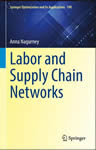
This past year, I was very busy writing the book, Competing on Supply Chain Quality: A Network Economics Perspective, with Dong Li, which will be out within the next month. The book is being published by Springer International Publishing Switzerland. The book is the second volume in the new Springer Series on Supply Chain Management. The editor of this book series is Distinguished University Professor Christopher S. Tang of UCLA's Anderson School of Management. My co-author, who is an Isenberg 2015 PhD alumna, and is now an Assistant Professor of Supply Chain / Operations Management at Arkansas State University, and I are very excited about the book's upcoming publication. It is 400 pages in length and represents a half decade of our collaborative research. There will also be an ebook version available.
Writing books (all of my books, thus far, have been nonfiction, since they are scientific monographs) is challenging but as Professor Dimitri Bertsekas of MIT told me years ago, and whose eminent advice I follow: "Anna, when you have 5 to 10 papers on a topic, you write a book." On December 9, 2015, I had the pleasure of giving an invited seminar at MIT, and Professor Joe Sussman of the Transportation and Logistics Center there and I had a wonderful conversation, which included the writing of our books. He noted that if you think that you are 95% finished you still have a ways to go and that is so true -- that last leg of writing a book, which involves so much checking and paying extensive attention to details, can sometimes seem the most onerous.
The Competing on Supply Chain Quality book is my twelfth book.
In the meantime, 2016 promises to be extra exciting because I am also involved in co-editing a book on Dynamics of Disasters, with Springer also as the publisher. Although I have edited books alone, in particular, the Innovations in Financial and Networks, published in 2003, and the Annals of Operations Research (hardbound) volume on Advances in Equilibrium Modeling, Analysis, and Computations, published in 1993, the Dynamics of Disasters book I am co-editing with Distinguished University Professor Panos M. Pardalos of the University of Florida and Professor Ilias Kotsireas of Wilfrid Laurier University. The volume is based on refereed papers submitted and presented at the conference on the same theme that we organized and which took place last summer in Kalamata, Greece with additional invited papers from experts in the field.
In editing a book, selecting good referees is important and the reports need to be done in a timely manner. At the same time, one wants to make sure that there is both breadth and depth in the contributions. Authors also, hopefully, revise their papers without delay. An edited volume can bring different perspectives to a topic and I enjoy having contributors from many different countries as well as contributions, in this case, from practitioners, because of the theme of the book. Having such responsive and wonderful co-editors also makes for a very enjoyable book editing project!
When it comes to editing a book, sometimes a publisher will help out in making sure the stylefiles are consistent and, at other times, the onus is on the editor to even put the references in a consistent manner. Some publishers help with the stylistic editing whereas others do not. Editing a book can take longer than writing one, since in writing a book, the authors have more control and the work and output only depends on them.
Three of my books were single-authored, five of my books (including the Competing on Supply Chain Quality book) had one co-author, one book had two co-authors (both females), and one book (my shortest one) had three co-authors! And, as I mentioned before, two books I edited myself, and the forthcoming Dynamics of Disasters book, I am co-editing with two colleagues.
I hope that part of my legacy will be the books that I have written. At the very least, some of them are my most highly cited publications, so I know that there is value to them and the hard work is worth it. I especially appreciate when students from around the world thank me for writing books.
Happy New Year to my readers! Best of luck with your writing projects.
Showing posts with label quality. Show all posts
Tuesday, January 5, 2016
Saturday, December 19, 2015
Congratulations and Kudos to the Supernetwork Team for a Great 2015!
Every year around this time I prepare a new page for the Supernetwork Center site noting some of the achievements of its Center Associates over the past 12 months.
As the Center's Director, reflecting on the Associates' accomplishments is always enjoyable and helps us to synergize our energies as a team and to take on new challenges in the coming year.
2015 was an exceptional year in terms of grants, research accomplishments from humanitarian logistics to cybersecurity, awards and recognitions received, as well as impact of our work. Below I provide a few of the highlights.
Center Associate Dong "Michelle" Li successfully defended her doctoral dissertation at the Isenberg School of Management on May 4, 2015 and the title of her thesis was "Quality Competition in Supply Chain Networks with Applications to Information Asymmetry, Product Differentiation, Outsourcing, and Supplier Selection." She is now an Assistant Professor of Supply Chains / Operations Management a the College of Business at Arkansas State University and was featured on her university's homepage. The 400 page book, Competing on Supply Chain Quality: A Network Economics Perspective, authored by Michelle and me will be published by Springer in February 2016. In addition, our recent research on supply chain competition in quality and supply chain performance assessment and importance indicators appears in the following publications:
Center Associate Professor Tina Wakolbinger of the Vienna University of Economics and Business in Austria serves as the Head of the Research Institute for Supply Chain Management there. Her research project funded by the Austrian Science Fund (FWF) is on: Optimal Pricing and Contract Design in Humanitarian Logistics and will continue until 2016. A writeup on her research on humanitarian logistics appeared in scilog, a publication of FWF. At the EURO conference in Glasgow, Scotland, July 11-14, 2015, she organized the invited session: Coordination and Cooperation in Humanitarian Supply Chains, at which Center Associates Professor Amir H. Masoumi of Manhattan College presented a paper with Center Associate Min Yu of the University of Portland, and me entitled: "An Integrated Disaster Relief Supply Chain Network Model with Time Targets and Demand Uncertainty." The paper appears in the edited volume: Regional Science Matters: Studies Dedicated to Walter Isard, P. Nijkamp, A. Rose, and K. Kourtit, Editors, Springer International Publishing Switzerland (2015), pp 287-318. The Nobel laureate and renowned economist Paul Krugman also has an invited chapter in this volume.
Center Associate Professor Patrizia Daniele of the University of Catania had a very eventful year scientifically. In addition to organizing the stream “Recent Advances in Dynamics of Variational Inequalities and Equilibrum Problems”, for EURO 2015, Glasgow, she was also a Member of the Program Committee of the 2nd International Conference on Dynamics of Disasters, Kalamata, Greece, June 29 – July 2, 2015 and a Co-director of the International Workshop “Variational Analysis and Applications", Erice, Italy, August 28 – September 5, 2015. I had the pleasure of co-organizing the Dynamics of Disasters conference, along with Professor Panos M. Pardalos of the University of Florida and Professor Ilias Kotsireas of Wilfrid Laurier University in Canada. Professor Wakolbinger was also on the Program Committee and presented a paper there. I presented the paper: A Mean-Variance Disaster Relief Supply Chain Network Model for Risk Reduction with Stochastic Link Costs, Time Targets, and Demand Uncertainty, co-authored with Center Associate Professor Ladimer S. Nagurney of the University of Hartford, which will appear in Dynamics of Disasters, I.S. Kotsireas, A. Nagurney, and P.M. Pardalos, Eds., Springer International Publishing Switzerland. Indeed, we are now in the process of editing a volume on the theme of the conference, under contract with Springer.
We completed our 4 year National Science Foundation (NSF) project on ChoiceNet: An Economy Plane for the Internet. This project was part of NSF's Future Internet Architecture (FIA) program with our grant titled: NETS Large: Collaborative Research: Network Innovation Through Choice.The University of Massachusetts Amherst was the lead and Professor Tilman Wolf, Associate Dean at the College of Engineering, and I collaborated with our colleagues at the University of Kentucky, NCState, and RENCI. Isenberg School Doctoral Student Canter Associate Sara Saberi was funded by this grant for two years. Sara last year was selected to take part in the doctoral colloquia at POMS, at INFORMS in Philadelphia, and at DSI in Seattle. She also received a WORMS (Women in Operations Research and the Management Sciences) Travel Award to attend the Philadelphia conference. She successfully defended her doctoral dissertation proposal in 2015.
In addition, we were very pleased to receive another grant from NSF, working again with Professor Tilman Wolf, at UMass Amherst. We continue to collaborate with our University of Kentucky colleagues. The new project, funded under the EAGER program, is: EAGER: Collaborative Research: Enabling Economic Policies in Software-Defined Internet Exchange Points.
Center Associate Professor Patrick Qiang received tenure and was promoted to Associate Professor at the Graduate School of Professional Studies at Penn State University so big congratulations are in order! He was the track chair in International Business at the NEDSI conference in Cambridge, MA in March 2015.
The INFORMS Conference in Philadelphia, November 1-4, 2015, served as a wonderful venue at which many of the Supernetwork Center Associates organized sessions and delivered papers, including: Professors Jose M Cruz of the University of Connecticut and Trisha Anderson of Texas Wesleyan University, who continue their great work on supply chains, sustainability, and corporate social responsibility, collaborating often with Center Associate Professor Zugang "Leo" Liu of Penn State University Hazleton. Professor Dmytro Matsypura of the University of Sydney Australia also presented at this conference as did Center Associates Professors Min Yu, Dong Li, and Amir H. Masoumi, and Doctoral Student Center Associates Shivani Shukla and Sara Saberi.
And, at the INFORMS Philadelphia conference, the UMass Amherst INFORMS Student Chapter, which I have served as the Faculty Advisor of going on 12 years now received the Summa Cum Laude Award from INFORMS at a special ceremony. Many Center Associates, who have been doctoral students at the Isenberg School of Management, have served as officers of this Student Chapter.
Professor Cruz has had another truly exceptional year and in 2015 received the following awards from the School of Business at the University of Connecticut:
· 2015 PMBA OPIM Teacher of Year
· 2015 Distinguished Service Award
· Ackerman Scholar, 2014-2016.
2015 was a very significant year for our work in cybersecurity. Doctoral Student Center Associate Shivani Shukla was very busy presenting our latest cybersecurity research at a variety of venues. She was awarded a first prize for her poster by the Air Force Association on September 22, 2015 at UMass Lowell. The title of her poster presentation, which was joint with Professors Daniele, Ladimer S. Nagurney, and me, was: "A Game Theoretic Model for Cyberecurity Investments with Nonlinear Budget Constraints."
We published several papers on cybersecurity in 2015:
Some additional highlights of our activities can be found on the Supernetwork Center's media page.
For our recent publications, click here.
As the Center's Director, reflecting on the Associates' accomplishments is always enjoyable and helps us to synergize our energies as a team and to take on new challenges in the coming year.
2015 was an exceptional year in terms of grants, research accomplishments from humanitarian logistics to cybersecurity, awards and recognitions received, as well as impact of our work. Below I provide a few of the highlights.
Center Associate Dong "Michelle" Li successfully defended her doctoral dissertation at the Isenberg School of Management on May 4, 2015 and the title of her thesis was "Quality Competition in Supply Chain Networks with Applications to Information Asymmetry, Product Differentiation, Outsourcing, and Supplier Selection." She is now an Assistant Professor of Supply Chains / Operations Management a the College of Business at Arkansas State University and was featured on her university's homepage. The 400 page book, Competing on Supply Chain Quality: A Network Economics Perspective, authored by Michelle and me will be published by Springer in February 2016. In addition, our recent research on supply chain competition in quality and supply chain performance assessment and importance indicators appears in the following publications:
A General Multitiered Supply Chain Network Model of Quality Competition with Suppliers, Dong Li and Anna Nagurney, International Journal of Production Economics 170: (2015) pp 336-356, and
Supply
Chain Performance Assessment and Supplier and Component Importance
Identification in a General Competitive Multitiered Supply Chain Network
Model, Dong Li and Anna Nagurney, in press in the Journal of Global Optimization.
Center Associate Professor Tina Wakolbinger of the Vienna University of Economics and Business in Austria serves as the Head of the Research Institute for Supply Chain Management there. Her research project funded by the Austrian Science Fund (FWF) is on: Optimal Pricing and Contract Design in Humanitarian Logistics and will continue until 2016. A writeup on her research on humanitarian logistics appeared in scilog, a publication of FWF. At the EURO conference in Glasgow, Scotland, July 11-14, 2015, she organized the invited session: Coordination and Cooperation in Humanitarian Supply Chains, at which Center Associates Professor Amir H. Masoumi of Manhattan College presented a paper with Center Associate Min Yu of the University of Portland, and me entitled: "An Integrated Disaster Relief Supply Chain Network Model with Time Targets and Demand Uncertainty." The paper appears in the edited volume: Regional Science Matters: Studies Dedicated to Walter Isard, P. Nijkamp, A. Rose, and K. Kourtit, Editors, Springer International Publishing Switzerland (2015), pp 287-318. The Nobel laureate and renowned economist Paul Krugman also has an invited chapter in this volume.
Center Associate Professor Patrizia Daniele of the University of Catania had a very eventful year scientifically. In addition to organizing the stream “Recent Advances in Dynamics of Variational Inequalities and Equilibrum Problems”, for EURO 2015, Glasgow, she was also a Member of the Program Committee of the 2nd International Conference on Dynamics of Disasters, Kalamata, Greece, June 29 – July 2, 2015 and a Co-director of the International Workshop “Variational Analysis and Applications", Erice, Italy, August 28 – September 5, 2015. I had the pleasure of co-organizing the Dynamics of Disasters conference, along with Professor Panos M. Pardalos of the University of Florida and Professor Ilias Kotsireas of Wilfrid Laurier University in Canada. Professor Wakolbinger was also on the Program Committee and presented a paper there. I presented the paper: A Mean-Variance Disaster Relief Supply Chain Network Model for Risk Reduction with Stochastic Link Costs, Time Targets, and Demand Uncertainty, co-authored with Center Associate Professor Ladimer S. Nagurney of the University of Hartford, which will appear in Dynamics of Disasters, I.S. Kotsireas, A. Nagurney, and P.M. Pardalos, Eds., Springer International Publishing Switzerland. Indeed, we are now in the process of editing a volume on the theme of the conference, under contract with Springer.
We completed our 4 year National Science Foundation (NSF) project on ChoiceNet: An Economy Plane for the Internet. This project was part of NSF's Future Internet Architecture (FIA) program with our grant titled: NETS Large: Collaborative Research: Network Innovation Through Choice.The University of Massachusetts Amherst was the lead and Professor Tilman Wolf, Associate Dean at the College of Engineering, and I collaborated with our colleagues at the University of Kentucky, NCState, and RENCI. Isenberg School Doctoral Student Canter Associate Sara Saberi was funded by this grant for two years. Sara last year was selected to take part in the doctoral colloquia at POMS, at INFORMS in Philadelphia, and at DSI in Seattle. She also received a WORMS (Women in Operations Research and the Management Sciences) Travel Award to attend the Philadelphia conference. She successfully defended her doctoral dissertation proposal in 2015.
In addition, we were very pleased to receive another grant from NSF, working again with Professor Tilman Wolf, at UMass Amherst. We continue to collaborate with our University of Kentucky colleagues. The new project, funded under the EAGER program, is: EAGER: Collaborative Research: Enabling Economic Policies in Software-Defined Internet Exchange Points.
Center Associate Professor Patrick Qiang received tenure and was promoted to Associate Professor at the Graduate School of Professional Studies at Penn State University so big congratulations are in order! He was the track chair in International Business at the NEDSI conference in Cambridge, MA in March 2015.
The INFORMS Conference in Philadelphia, November 1-4, 2015, served as a wonderful venue at which many of the Supernetwork Center Associates organized sessions and delivered papers, including: Professors Jose M Cruz of the University of Connecticut and Trisha Anderson of Texas Wesleyan University, who continue their great work on supply chains, sustainability, and corporate social responsibility, collaborating often with Center Associate Professor Zugang "Leo" Liu of Penn State University Hazleton. Professor Dmytro Matsypura of the University of Sydney Australia also presented at this conference as did Center Associates Professors Min Yu, Dong Li, and Amir H. Masoumi, and Doctoral Student Center Associates Shivani Shukla and Sara Saberi.
And, at the INFORMS Philadelphia conference, the UMass Amherst INFORMS Student Chapter, which I have served as the Faculty Advisor of going on 12 years now received the Summa Cum Laude Award from INFORMS at a special ceremony. Many Center Associates, who have been doctoral students at the Isenberg School of Management, have served as officers of this Student Chapter.
Professor Cruz has had another truly exceptional year and in 2015 received the following awards from the School of Business at the University of Connecticut:
· 2015 PMBA OPIM Teacher of Year
· 2015 Distinguished Service Award
· Ackerman Scholar, 2014-2016.
2015 was a very significant year for our work in cybersecurity. Doctoral Student Center Associate Shivani Shukla was very busy presenting our latest cybersecurity research at a variety of venues. She was awarded a first prize for her poster by the Air Force Association on September 22, 2015 at UMass Lowell. The title of her poster presentation, which was joint with Professors Daniele, Ladimer S. Nagurney, and me, was: "A Game Theoretic Model for Cyberecurity Investments with Nonlinear Budget Constraints."
We published several papers on cybersecurity in 2015:
A Supply Chain Game Theory Framework for Cybersecurity Investments Under Network Vulnerability, Anna Nagurney, Ladimer S. Nagurney, and Shivani Shukla, in Computation, Cryptography, and Network Security, N.J. Daras and M.T. Rassias, Editors, Springer International Publishing Switzerland (2015) pp 381-398;
A Game Theory Model of Cybersecurity Investments with Information Asymmetry, Anna Nagurney and Ladimer S. Nagurney, Netnomics 16(1-2): (2015) pp 127-148;
A Multiproduct Network Economic Model of Cybercrime in Financial Services, Anna Nagurney, Service Science 7(1): (2015) pp 70-81.
Many thanks to the Supernetwork Team for another tremendous year!
Some additional highlights of our activities can be found on the Supernetwork Center's media page.
For our recent publications, click here.
Sunday, December 14, 2014
Getting Great News While on the Train - You are a Fellow!
When one gets some very good news (or bad), one remembers that very moment - from what you were doing when you heard the news to where you were when you received it.
Nowadays, much good news comes via email and, with smartphones, the messages can be received almost anywhere.
While on a recent trip to NYC, via the MetroNorth train from New Haven, I was engrossed in my New York Times and enjoying the journey. I love riding trains. My husband reached for my smartphone and decided to check my email and said, "You have a message from Oxford University."
I suspected that this was a decision on my application to be a Visiting Fellow at Oxford, a dream I had harbored for a while.
And indeed, it was! The message said that a letter inviting me to take up a Visiting Fellowship had been posted and the sender stated that "I take great pleasure in attaching a pdf copy."
The letter, a hardcopy of which I also subsequently received via Royal Mail, stated that I had been offered the fellowship for the 2015-2016 year for the trinity term, which is the term that I had requested.
I will be a Fellow at All Souls College at Oxford and will be researching supply chains and quality, a topic that I a very passionate about since it impacts so many products that affect consumers from pharmaceuticals and food to high tech and durable products. Almost every day, one reads about quality failures of suppliers, some with devastating effects on human lives.
According to the letter, I will be provided with a workroom in the college, will have free accommodation at Oxford, and will have meals at Common Table (yes, capitalized). The atmosphere and support will be incredible.
One can become a Fellow of a professional society (for example, I was so honored to become a Fellow of INFORMS and also RSAI). One can also be a Visiting Fellow, as at Oxford, and other universities that have such programs, as well as at Institutes. For example, in 2005-2006 I was a Science Fellow at the Radcliffe Institute for Advanced Study at Harvard University, one of the best experiences that I have ever had, and where I wrote my Supply Chain Network Economics book.
I am so honored to have this great opportunity at one of the greatest universities in the world!
And, amazingly, On December 4, 2014, at our wonderful tribute to Gene Isenberg, after whom our School of Management at UMass Amherst is named, I had the pleasure of speaking with one of the grandsons, Stefan, who had recently graduated from Oxford! He told me about the unique place that All Souls College has at Oxford and its exceptional library. I know that I will be inspired tremendously and will do my utmost to contribute to research and the life of the college while I am there and afterwards. Also, Stefan told me that he has appeared in several recent episodes of the PBS Masterpiece Mystery Inspector Lewis series (a followup on the Inspector Morse series), which takes place in Oxford, with many of the characters affiliated (fictionally) with Oxford University, I became captivated by this program while being a Visiting Professor in Gothenburg (the Swedes show a lot of British TV programs).
A list of the Visiting Fellows this year is comprised of an economist, lawyers, literature scholars, and an astronomer, to start, with renowned universities such as Harvard and Stanford represented. I thrive in interdisciplinary settings such as Radcliffe, so am so looking forward to experiences that I know will be truly special.
Nowadays, much good news comes via email and, with smartphones, the messages can be received almost anywhere.
While on a recent trip to NYC, via the MetroNorth train from New Haven, I was engrossed in my New York Times and enjoying the journey. I love riding trains. My husband reached for my smartphone and decided to check my email and said, "You have a message from Oxford University."
I suspected that this was a decision on my application to be a Visiting Fellow at Oxford, a dream I had harbored for a while.
And indeed, it was! The message said that a letter inviting me to take up a Visiting Fellowship had been posted and the sender stated that "I take great pleasure in attaching a pdf copy."
The letter, a hardcopy of which I also subsequently received via Royal Mail, stated that I had been offered the fellowship for the 2015-2016 year for the trinity term, which is the term that I had requested.
I will be a Fellow at All Souls College at Oxford and will be researching supply chains and quality, a topic that I a very passionate about since it impacts so many products that affect consumers from pharmaceuticals and food to high tech and durable products. Almost every day, one reads about quality failures of suppliers, some with devastating effects on human lives.
According to the letter, I will be provided with a workroom in the college, will have free accommodation at Oxford, and will have meals at Common Table (yes, capitalized). The atmosphere and support will be incredible.
One can become a Fellow of a professional society (for example, I was so honored to become a Fellow of INFORMS and also RSAI). One can also be a Visiting Fellow, as at Oxford, and other universities that have such programs, as well as at Institutes. For example, in 2005-2006 I was a Science Fellow at the Radcliffe Institute for Advanced Study at Harvard University, one of the best experiences that I have ever had, and where I wrote my Supply Chain Network Economics book.
I am so honored to have this great opportunity at one of the greatest universities in the world!
And, amazingly, On December 4, 2014, at our wonderful tribute to Gene Isenberg, after whom our School of Management at UMass Amherst is named, I had the pleasure of speaking with one of the grandsons, Stefan, who had recently graduated from Oxford! He told me about the unique place that All Souls College has at Oxford and its exceptional library. I know that I will be inspired tremendously and will do my utmost to contribute to research and the life of the college while I am there and afterwards. Also, Stefan told me that he has appeared in several recent episodes of the PBS Masterpiece Mystery Inspector Lewis series (a followup on the Inspector Morse series), which takes place in Oxford, with many of the characters affiliated (fictionally) with Oxford University, I became captivated by this program while being a Visiting Professor in Gothenburg (the Swedes show a lot of British TV programs).
A list of the Visiting Fellows this year is comprised of an economist, lawyers, literature scholars, and an astronomer, to start, with renowned universities such as Harvard and Stanford represented. I thrive in interdisciplinary settings such as Radcliffe, so am so looking forward to experiences that I know will be truly special.
Wednesday, November 5, 2014
Supply Chain Network Quality, Sustainability, and Risk
The supernetwork team is very much looking forward to the 2014 INFORMS Annual Conference in San Francisco, which begins this coming Sunday!
I organized a session in the Network Optimization cluster: Supply Chain Network Competition: Advances in Models, Methods, and Applications, which will take place next Monday afternoon.
The session will feature talks on supply chain quality, sustainability, as well as risk associated with supplier selection (using supernetworks, of course)!
Three of the presentations have been completed and I include links to them below.
Link to presentation on quality.
Link to first presentation on sustainability.
Link to second presentation on sustainability.
The final presentation in my session will be given by Professor June Dong (who was my first female PhD student at the Isenberg School of Management) and her collaborator, June Ma, who was a visitor at SUNY Oswego, where Professor Dong is a Full Professor, and who is with the Shengyang University of Science and Technology in China. Their talk is titled: "Supply Chan Supernetwork Model with Suppliers Risk Diversification."
Additional publication information on the first and third presentations above can be found below.
Equilibria and Dynamics of Supply Chain Network Competition with Information Asymmetry in Quality and Minimum Quality Standards, Anna Nagurney and Dong Li, Computational Management Science 11(3): (2014) pp 285-315.
Supply Chain Network Sustainability Under Competition and Frequencies of Activities from Production to Distribution, Anna Nagurney, Min Yu, and Jonas Floden, Computational Management Science 10(4): (2013) pp 397-422.
Professor Patrick Qiang's presentation is based on his paper, which is in press in the Journal of Cleaner Production.
I organized a session in the Network Optimization cluster: Supply Chain Network Competition: Advances in Models, Methods, and Applications, which will take place next Monday afternoon.
The session will feature talks on supply chain quality, sustainability, as well as risk associated with supplier selection (using supernetworks, of course)!
Three of the presentations have been completed and I include links to them below.
Link to presentation on quality.
Link to first presentation on sustainability.
Link to second presentation on sustainability.
The final presentation in my session will be given by Professor June Dong (who was my first female PhD student at the Isenberg School of Management) and her collaborator, June Ma, who was a visitor at SUNY Oswego, where Professor Dong is a Full Professor, and who is with the Shengyang University of Science and Technology in China. Their talk is titled: "Supply Chan Supernetwork Model with Suppliers Risk Diversification."
Additional publication information on the first and third presentations above can be found below.
Equilibria and Dynamics of Supply Chain Network Competition with Information Asymmetry in Quality and Minimum Quality Standards, Anna Nagurney and Dong Li, Computational Management Science 11(3): (2014) pp 285-315.
Supply Chain Network Sustainability Under Competition and Frequencies of Activities from Production to Distribution, Anna Nagurney, Min Yu, and Jonas Floden, Computational Management Science 10(4): (2013) pp 397-422.
Professor Patrick Qiang's presentation is based on his paper, which is in press in the Journal of Cleaner Production.
Tuesday, May 27, 2014
Information Asymmetry vs. Transparency and Why It Matters to Consumers and Investors
Recently, we have been devoting a lot of time to investigating information asymmetry, whether from a quality perspective, a time perspective, or a sustainability one.
Information matters and is crucial to good decision-making and, even in a world dominated by the Internet, with many experiencing information overload, obtaining the right information at the right time may not be attainable.
Having incomplete information can also lead to bad decisions and losses in investments.
Coincidentally, in a recent Financial Times OpEd, dated May 20, 2014, the former mayor of NYC, who needs no introduction whatsoever, Michael Bloomberg, and Mary Schapiro, the former chair of the US Securities and Exchange Commission, write on precisely this issue. Their OpEd, "Give investors access to all the information they need," is a MUST read! They begin their eloquent and extremely timely OpEd with the statement: The most valuable currency in financial markets is reliable information. They note that in a 2014 study it was found that 2/3 of global investors evaluate non-financial disclosures. However, only half of this group uses a structured process to make their assessments. They emphasize the importance of climate risk, quality issues, as in adulterated pharmaceutical products, and even data security issues and financial fraud. They note the organization established in 2011 that they serve as chair and co-chair of, respectively, the Sustainability Accounting Standards Board, that is working with US-listed companies and investors to establish industry-specific measurement and reporting standards on non-financial data.
Transparency matters and can assist in both competitiveness and resiliency. And, clearly, Bloomberg speaks from a wealth of know-how and practical experience - just remember the impact of SuperStorm Sandy on NYC and surrounding areas!
As for our research in this domain, I am very pleased to note that our paper, Equilibria and Dynamics of Supply Chain Network Competition with Information Asymmetry in Quality and Minimum Quality Standards, Anna Nagurney and Dong Li, has now been accepted for publication in Computational Management. Science. The paper emphasizes the importance of uniform quality standards and is inspired, in part, by failures in the pharma industry, as well as other products, too long of a list to note all of them. I am obsessed by quality - from the air that we breathe, to the food that we eat, the water that we drink, and the products that our families use. If only producers know the quality of their goods and not consumers, we all lose!
In addition, we have co-authored a paper that focuses on information asymmetry in time and utilizes gane theory to evaluate supply chain network competition in both product flows and the average time of product deliveries. The paper is Supply Chain Network Competition in Time-Sensitive Markets, Anna Nagurney, Min Yu, Jonas Floden, and Ladimer S. Nagurney. We will be presenting this paper at two different conferences in Europe in June.
Finally, environmental sustainability is a theme that we have long been very passionate about and have written alot on (including books on sustainable transportation and environmental networks). Making environmental impact information available to consumers can greatly influence their purchasing decisions and the environment. Given that I spend a lot of time in Sweden where environmental sustainability is almost a "given," our paper, Fashion Supply Chain Network Competition with Ecolabelling, Anna Nagurney, Min Yu, and Jonas Floden, quantifies the gains from ecolabelling. In our model, consumers are provided with the information associated the GHG emissions or the equivalent in the supply chain of the products.
Thanks to Bloomberg and Schapiro for their terrific OpEd and, remember, it was the Nobel laureate Robert Akerlof, whose inspiring paper on quality information asymmetry and 'lemons,' which was rejected by different journals 3 times, helped to enlighten us as to the value of information as well as quality!
Information matters and is crucial to good decision-making and, even in a world dominated by the Internet, with many experiencing information overload, obtaining the right information at the right time may not be attainable.
Having incomplete information can also lead to bad decisions and losses in investments.
Coincidentally, in a recent Financial Times OpEd, dated May 20, 2014, the former mayor of NYC, who needs no introduction whatsoever, Michael Bloomberg, and Mary Schapiro, the former chair of the US Securities and Exchange Commission, write on precisely this issue. Their OpEd, "Give investors access to all the information they need," is a MUST read! They begin their eloquent and extremely timely OpEd with the statement: The most valuable currency in financial markets is reliable information. They note that in a 2014 study it was found that 2/3 of global investors evaluate non-financial disclosures. However, only half of this group uses a structured process to make their assessments. They emphasize the importance of climate risk, quality issues, as in adulterated pharmaceutical products, and even data security issues and financial fraud. They note the organization established in 2011 that they serve as chair and co-chair of, respectively, the Sustainability Accounting Standards Board, that is working with US-listed companies and investors to establish industry-specific measurement and reporting standards on non-financial data.
Transparency matters and can assist in both competitiveness and resiliency. And, clearly, Bloomberg speaks from a wealth of know-how and practical experience - just remember the impact of SuperStorm Sandy on NYC and surrounding areas!
As for our research in this domain, I am very pleased to note that our paper, Equilibria and Dynamics of Supply Chain Network Competition with Information Asymmetry in Quality and Minimum Quality Standards, Anna Nagurney and Dong Li, has now been accepted for publication in Computational Management. Science. The paper emphasizes the importance of uniform quality standards and is inspired, in part, by failures in the pharma industry, as well as other products, too long of a list to note all of them. I am obsessed by quality - from the air that we breathe, to the food that we eat, the water that we drink, and the products that our families use. If only producers know the quality of their goods and not consumers, we all lose!
In addition, we have co-authored a paper that focuses on information asymmetry in time and utilizes gane theory to evaluate supply chain network competition in both product flows and the average time of product deliveries. The paper is Supply Chain Network Competition in Time-Sensitive Markets, Anna Nagurney, Min Yu, Jonas Floden, and Ladimer S. Nagurney. We will be presenting this paper at two different conferences in Europe in June.
Finally, environmental sustainability is a theme that we have long been very passionate about and have written alot on (including books on sustainable transportation and environmental networks). Making environmental impact information available to consumers can greatly influence their purchasing decisions and the environment. Given that I spend a lot of time in Sweden where environmental sustainability is almost a "given," our paper, Fashion Supply Chain Network Competition with Ecolabelling, Anna Nagurney, Min Yu, and Jonas Floden, quantifies the gains from ecolabelling. In our model, consumers are provided with the information associated the GHG emissions or the equivalent in the supply chain of the products.
Thanks to Bloomberg and Schapiro for their terrific OpEd and, remember, it was the Nobel laureate Robert Akerlof, whose inspiring paper on quality information asymmetry and 'lemons,' which was rejected by different journals 3 times, helped to enlighten us as to the value of information as well as quality!
Thursday, May 1, 2014
Supernetwork Center Associates to Present Supply Chain + Future Internet Papers at POMS Atlanta
It is the first day of May and, although the academic semester is over in terms of teaching, faculty and doctoral students are, nevertheless, very busy getting ready for a new cycle of conferences.
This is exciting!
The Production and Operations Management Society (POMS) is holding its 25th Annual Conference in Atlanta, Georgia, May 9-12, 2014.
And, although I will then be speaking at a fascinating workshop in Erice, Sicily - Italy, the work conducted by Supernetwork Center Associates will be highly visible at POMS. .
One of my doctoral students, Dong "Michelle: Li, who recently received a 2014Outstanding Doctoral Student Researcher Award from the Isenberg School, will be presenting our joint paper, Equilibria and Dynamics of Supply Chain Network Competition with Information Asymmetry in Quality and Minimum Quality Standards, which has been accepted for publication in the journal Computational Management Science We have prepared this POMS presentation:
Two other supply chain papers that I co-authored with Supernetwork Center Associates, both of whom were my former doctoral students, and are now thriving as Professors, will also be presented: One is: An Integrated Disaster Relief Supply Chain Network Model with Time Targets and Demand Uncertainty, co-authored with Professors Amir H. Masoumi and Min Yu, and the other: Competitive Food Supply Chain Networks with Application to Fresh Produce, which was published in the European Journal of Operational Research 224(2): (2013) pp 273-282.
Center Associate Professor Patrick Qiang will be presenting his latest work on supply chains and sustainability: The Closed-loop Supply Chain Network with Competition and Design for Remanufacturability. Dr. Qiang was also my doctoral student in Management Science at the Isenberg School of Management. He has done pioneering work in network vulnerability and performance assessment.
Finally, Doctoral Student Center Associate Sara Saberi will present a paper co-authored with Professor Tilman Wolf and me on work funded by the Future Internet Architecture (FIA) program at the National Science Foundation (NSF). The title of that paper is: A Network Economic Game Theory Model of a Service -Oriented Internet with Price and Quality Competition in Both Content and Network Provision. Our POMS presentation can be downloaded from the supernetworks site.
Networks can really take you places!
This is exciting!
The Production and Operations Management Society (POMS) is holding its 25th Annual Conference in Atlanta, Georgia, May 9-12, 2014.
And, although I will then be speaking at a fascinating workshop in Erice, Sicily - Italy, the work conducted by Supernetwork Center Associates will be highly visible at POMS. .
One of my doctoral students, Dong "Michelle: Li, who recently received a 2014Outstanding Doctoral Student Researcher Award from the Isenberg School, will be presenting our joint paper, Equilibria and Dynamics of Supply Chain Network Competition with Information Asymmetry in Quality and Minimum Quality Standards, which has been accepted for publication in the journal Computational Management Science We have prepared this POMS presentation:
Two other supply chain papers that I co-authored with Supernetwork Center Associates, both of whom were my former doctoral students, and are now thriving as Professors, will also be presented: One is: An Integrated Disaster Relief Supply Chain Network Model with Time Targets and Demand Uncertainty, co-authored with Professors Amir H. Masoumi and Min Yu, and the other: Competitive Food Supply Chain Networks with Application to Fresh Produce, which was published in the European Journal of Operational Research 224(2): (2013) pp 273-282.
Center Associate Professor Patrick Qiang will be presenting his latest work on supply chains and sustainability: The Closed-loop Supply Chain Network with Competition and Design for Remanufacturability. Dr. Qiang was also my doctoral student in Management Science at the Isenberg School of Management. He has done pioneering work in network vulnerability and performance assessment.
Finally, Doctoral Student Center Associate Sara Saberi will present a paper co-authored with Professor Tilman Wolf and me on work funded by the Future Internet Architecture (FIA) program at the National Science Foundation (NSF). The title of that paper is: A Network Economic Game Theory Model of a Service -Oriented Internet with Price and Quality Competition in Both Content and Network Provision. Our POMS presentation can be downloaded from the supernetworks site.
Networks can really take you places!
Monday, February 3, 2014
Do You Know Where Your Meds and Other Products Came From - Information Asymmetry in Quality
I am excited about speaking at the upcoming Learning and Intelligent Optimization (LION 8) Conference in Gainesville, Florida later this month, especially since the snow is again falling in Massachusetts with more to come!
I am also excited because this will be the first time that I will be presenting the paper, "Equilibria and Dynamics of Supply Chain Network Competition with Information Asymmetry in Quality and Minimum Quality Standards," joint with one of my doctoral students, Dong "Michelle" Li.
Quality of products, especially those that one ingests, from pharmaceuticals to food and even, in a sense, human blood (and I am not talking about vampires here), is a topic of great concern and one that we have been researching for a while now.
Do you know where your medicines, for example, are coming from?
As we noted in our earlier paper, Pharmaceutical Supply Chain Networks with Outsourcing Under Price and Quality Competition, Anna Nagurney, Dong Li, and Ladimer S. Nagurney, International Transactions in Operational Research 20(6): (2013) pp 859-888, up to 40% of the drugs that Americans take are now imported, and more than 80% of the active ingredients for drugs sold in the United States are outsourced, often to countries such as India and China. The problem is that there may not be sufficient oversight and lack of quality standards.
Furthermore, the manufacturing of products, including pharmaceuticals, may take place in multiple manufacturing plants, so one may have no idea as to the place of production or the level of quaality!
In our new paper, which focuses on quality competition under information asymmetry, we were inspired by the work of the Nobel laureate George Akerlof and his classical paper 1970 paper (which got rejected 3 times by journals, before it finally got accepted and for which he earned the Nobel prize): "The market for `lemons': Quality uncertainty and the market mechanism," Quarterly Journal of Economics, 84(3), 488-500. Akerlof shared the Nobel with Professor Joseph Stiglitz and Michael Spence.
In our paper, we construct a supply chain network model with information asymmetry in product quality. The competing, profit-maximizing firms with, possibly, multiple manufacturing plants, which may be located on-shore or off-shore, are aware of the quality of the product that they produce but consumers, at the demand markets, only know the average quality. Such a framework is relevant to products ranging from certain foods to pharmaceuticals. We propose both an equilibrium model and its dynamic counterpart and demonstrate how minimum quality standards can be incorporated. Qualitative results as well as an algorithm are presented, along with convergence results. The numerical examples, accompanied by sensitivity analysis, reveal interesting results and insights for firms, consumers, as well as policy-makers, who impose the minimum quality standards.
Specifically, we find from the computations the following. Since consumers at the demand market do not differentiate between the products from different firms, and there is information asymmetry in quality between the firms (sellers) and the consumers (buyers) at the demand market, the average quality level at the demand market, as well as the price, which is determined by the quality levels of both firms, is for both firms' products. Firms prefer a higher average quality, since, at the same demand level, a higher average quality results in a higher price of the product.
However, once a firm increases its own quality level, of course, the average quality level and, hence, the price increases, but its total cost will also increase due to the higher quality. Furthermore, the price increase is not only for the firm's own product, but also for its competitor's product. If a firm increases its own quality, both the firm and its competitor would get the benefits of the price increase, but only the firm itself would pay for the quality improvement. Thus, a firm prefers a “free ride,” that is, it prefers that the other firm improve its product quality and, hence, the price, rather than have it increase its own quality.
Consequently, a firm may not be willing to increase its quality levels, while the other firm is, unless it is beneficial both cost-wise and profit-wise. This explains why, as the minimum quality standard of one firm increases, its competitor's quality level increases slightly or remains the same.
When there is an enforced higher minimum quality standard imposed on a firm's plant(s), the firm is forced to achieve a higher quality level, which may bring its own profit down but raise the competitor's profit, even though the latter firm may actually face a lower minimum quality standard. When the minimum quality standard of a firm increases to a very high value, but that of its competitor is low, the former firm will not be able to afford the high associated cost with decreasing profit, and, hence, it will produce no product for the demand market and will be forced to leave the market.
The above results and discussion indicate the same result, but in a much more general supply chain network context, as found in Ronnen (1991), who, in speaking about minimum quality standards, noted that: ``low-quality sellers can be better off ... and high-quality sellers are worse off." Also the computational results support the statement on page 490 in Akerlof (1970) that ``good cars may be driven out of the market by lemons." Moreover, our results also show that the lower the competitor's quality level, the more harmful the competitor is to the firm with the high minimum quality standard. The implications of the sensitivity analysis for policy-makers are clear -- the imposition of a one-sided quality standard can have a negative impact on the firm in one's region (or country). Moreover, policy-makers, who are concerned about the products at particular demand markets, should prevent firms located in regions with very low minimum quality standards from entering the market; otherwise, they may not only bring the average quality level at the demand market(s) down and hurt the consumers, but such products may also harm the profits of the other firms with much higher quality levels and even drive them out of the market.
Therefore, it would be beneficial and fair for both firms and consumers if the policy-makers at the same or different regions or even countries could impose the same or at least similar minimum quality standards on plants serving the same demand market(s). In addition, the minimum quality standards should be such that they will not negatively impact either the high quality firms' survival or the consumers at the demand market(s).
I am also excited because this will be the first time that I will be presenting the paper, "Equilibria and Dynamics of Supply Chain Network Competition with Information Asymmetry in Quality and Minimum Quality Standards," joint with one of my doctoral students, Dong "Michelle" Li.
Quality of products, especially those that one ingests, from pharmaceuticals to food and even, in a sense, human blood (and I am not talking about vampires here), is a topic of great concern and one that we have been researching for a while now.
Do you know where your medicines, for example, are coming from?
As we noted in our earlier paper, Pharmaceutical Supply Chain Networks with Outsourcing Under Price and Quality Competition, Anna Nagurney, Dong Li, and Ladimer S. Nagurney, International Transactions in Operational Research 20(6): (2013) pp 859-888, up to 40% of the drugs that Americans take are now imported, and more than 80% of the active ingredients for drugs sold in the United States are outsourced, often to countries such as India and China. The problem is that there may not be sufficient oversight and lack of quality standards.
Furthermore, the manufacturing of products, including pharmaceuticals, may take place in multiple manufacturing plants, so one may have no idea as to the place of production or the level of quaality!
In our new paper, which focuses on quality competition under information asymmetry, we were inspired by the work of the Nobel laureate George Akerlof and his classical paper 1970 paper (which got rejected 3 times by journals, before it finally got accepted and for which he earned the Nobel prize): "The market for `lemons': Quality uncertainty and the market mechanism," Quarterly Journal of Economics, 84(3), 488-500. Akerlof shared the Nobel with Professor Joseph Stiglitz and Michael Spence.
In our paper, we construct a supply chain network model with information asymmetry in product quality. The competing, profit-maximizing firms with, possibly, multiple manufacturing plants, which may be located on-shore or off-shore, are aware of the quality of the product that they produce but consumers, at the demand markets, only know the average quality. Such a framework is relevant to products ranging from certain foods to pharmaceuticals. We propose both an equilibrium model and its dynamic counterpart and demonstrate how minimum quality standards can be incorporated. Qualitative results as well as an algorithm are presented, along with convergence results. The numerical examples, accompanied by sensitivity analysis, reveal interesting results and insights for firms, consumers, as well as policy-makers, who impose the minimum quality standards.
Specifically, we find from the computations the following. Since consumers at the demand market do not differentiate between the products from different firms, and there is information asymmetry in quality between the firms (sellers) and the consumers (buyers) at the demand market, the average quality level at the demand market, as well as the price, which is determined by the quality levels of both firms, is for both firms' products. Firms prefer a higher average quality, since, at the same demand level, a higher average quality results in a higher price of the product.
However, once a firm increases its own quality level, of course, the average quality level and, hence, the price increases, but its total cost will also increase due to the higher quality. Furthermore, the price increase is not only for the firm's own product, but also for its competitor's product. If a firm increases its own quality, both the firm and its competitor would get the benefits of the price increase, but only the firm itself would pay for the quality improvement. Thus, a firm prefers a “free ride,” that is, it prefers that the other firm improve its product quality and, hence, the price, rather than have it increase its own quality.
Consequently, a firm may not be willing to increase its quality levels, while the other firm is, unless it is beneficial both cost-wise and profit-wise. This explains why, as the minimum quality standard of one firm increases, its competitor's quality level increases slightly or remains the same.
When there is an enforced higher minimum quality standard imposed on a firm's plant(s), the firm is forced to achieve a higher quality level, which may bring its own profit down but raise the competitor's profit, even though the latter firm may actually face a lower minimum quality standard. When the minimum quality standard of a firm increases to a very high value, but that of its competitor is low, the former firm will not be able to afford the high associated cost with decreasing profit, and, hence, it will produce no product for the demand market and will be forced to leave the market.
The above results and discussion indicate the same result, but in a much more general supply chain network context, as found in Ronnen (1991), who, in speaking about minimum quality standards, noted that: ``low-quality sellers can be better off ... and high-quality sellers are worse off." Also the computational results support the statement on page 490 in Akerlof (1970) that ``good cars may be driven out of the market by lemons." Moreover, our results also show that the lower the competitor's quality level, the more harmful the competitor is to the firm with the high minimum quality standard. The implications of the sensitivity analysis for policy-makers are clear -- the imposition of a one-sided quality standard can have a negative impact on the firm in one's region (or country). Moreover, policy-makers, who are concerned about the products at particular demand markets, should prevent firms located in regions with very low minimum quality standards from entering the market; otherwise, they may not only bring the average quality level at the demand market(s) down and hurt the consumers, but such products may also harm the profits of the other firms with much higher quality levels and even drive them out of the market.
Therefore, it would be beneficial and fair for both firms and consumers if the policy-makers at the same or different regions or even countries could impose the same or at least similar minimum quality standards on plants serving the same demand market(s). In addition, the minimum quality standards should be such that they will not negatively impact either the high quality firms' survival or the consumers at the demand market(s).
Thursday, October 17, 2013
Information Asymmetry, Nobel Prize in Economics, and Favorite Chidlren's Books
In a recent post I wrote about the 2013 Nobel laureates in Economic Sciences and connections to and reflections on Operations Research.
In parallel, I have been doing research, when not conferencing and teaching, on supply chains and information asymmetry.
Of course, George A. Akerlof's paper, "The Market for "lemons": Quality Uncertainty with the Market Mechanism," published in The Quarterly Journal of Economics in 1970 is the classic in information asymmetry. And, you may recall that I wrote about believing in your work, since this paper was rejected by journals 3 times, and then was published and earned Akerlof the Nobel Prize in Economic Sciences in 2001.
Akerlof is married to Janet Yellen, who has been in the news a lot lately since President Obama has selected her to be the next chair of the Federal Reserve Bank, succeeding Ben Bernanke. She and I share the same undergraduate alma mater, Brown University, although we did not overlap in our studies. She then went on to receive her PhD at Yale in economics.
Also, the most recent paper that my team at the Supernetworks Center wrote was inspired by Akerlof's lemon paper. The paper is Spatial Price Equilibrium with Information Asymmetry in Quality, Anna Nagurney, Dong Li, and Ladimer S. Nagurney. We are completing another paper on this general theme and have authored several papers on quality and supply chains as well as quality and the future Internet.
Coincidentally, in preparing my blogpost on the 2013 Nobel laureates, I came across George Akerlof's Nobel Prize acceptance speech and I have been smiling ever since.
He begins his Nobel speech Behavioral Macroeconomics and Macroeconomic Behavior (the text is here) with: Think about Richard Scarry’s Cars and Trucks and Things That Go. Think about what that book would have looked like in sequential decades of the last century had Richard Scarry been alive in each of them to delight and amuse children and parents. Each subsequent decade has seen the development of ever more specialized vehicles. We started with the model-T Ford. We now have more models of backhoe loaders than even the most precocious four- year old can identify.
Can you believe it -- starting a Nobel prize speech by acknowledging a children's book and in a series which was one of my daughter's favorites as a child. When we traveled and lived n Europe we would see Richard Scarry's books in bookstores and libraries with such favorite characters as Huckle Cat and Lowly Worm in different languages. The humor, lessons, and imagination in these books we treasured and we have kept many in our collection.
Below, I feature a photo taken yesterday of some of our favorite Richard Scarry books in honor of Akerlof and his work and his wife, whom he acknowledged in his speech.
Never lose your sense of wonder and never give up! And when life gives you lemons, make lemonade!
Akerlof mentioned Robert Shiller's work in his Nobel speech and Shiller is sharing the 2013 Prize with Fama and Hansen -- small world!
Since Akerlof and Yellen have a son, who has a PhD in economics, and is also a professor, I suspect that they read Richard Scarry books to him when he was a child.
In parallel, I have been doing research, when not conferencing and teaching, on supply chains and information asymmetry.
Of course, George A. Akerlof's paper, "The Market for "lemons": Quality Uncertainty with the Market Mechanism," published in The Quarterly Journal of Economics in 1970 is the classic in information asymmetry. And, you may recall that I wrote about believing in your work, since this paper was rejected by journals 3 times, and then was published and earned Akerlof the Nobel Prize in Economic Sciences in 2001.
Akerlof is married to Janet Yellen, who has been in the news a lot lately since President Obama has selected her to be the next chair of the Federal Reserve Bank, succeeding Ben Bernanke. She and I share the same undergraduate alma mater, Brown University, although we did not overlap in our studies. She then went on to receive her PhD at Yale in economics.
Also, the most recent paper that my team at the Supernetworks Center wrote was inspired by Akerlof's lemon paper. The paper is Spatial Price Equilibrium with Information Asymmetry in Quality, Anna Nagurney, Dong Li, and Ladimer S. Nagurney. We are completing another paper on this general theme and have authored several papers on quality and supply chains as well as quality and the future Internet.
Coincidentally, in preparing my blogpost on the 2013 Nobel laureates, I came across George Akerlof's Nobel Prize acceptance speech and I have been smiling ever since.
He begins his Nobel speech Behavioral Macroeconomics and Macroeconomic Behavior (the text is here) with: Think about Richard Scarry’s Cars and Trucks and Things That Go. Think about what that book would have looked like in sequential decades of the last century had Richard Scarry been alive in each of them to delight and amuse children and parents. Each subsequent decade has seen the development of ever more specialized vehicles. We started with the model-T Ford. We now have more models of backhoe loaders than even the most precocious four- year old can identify.
Can you believe it -- starting a Nobel prize speech by acknowledging a children's book and in a series which was one of my daughter's favorites as a child. When we traveled and lived n Europe we would see Richard Scarry's books in bookstores and libraries with such favorite characters as Huckle Cat and Lowly Worm in different languages. The humor, lessons, and imagination in these books we treasured and we have kept many in our collection.
Below, I feature a photo taken yesterday of some of our favorite Richard Scarry books in honor of Akerlof and his work and his wife, whom he acknowledged in his speech.
Never lose your sense of wonder and never give up! And when life gives you lemons, make lemonade!
Akerlof mentioned Robert Shiller's work in his Nobel speech and Shiller is sharing the 2013 Prize with Fama and Hansen -- small world!
Since Akerlof and Yellen have a son, who has a PhD in economics, and is also a professor, I suspect that they read Richard Scarry books to him when he was a child.
Subscribe to:
Posts (Atom)