Next week, while I will be speaking on cybersecurity at the Heinz College at Carnegie Mellon University, my collaborator on our NSF ChoiceNet project, and now NSF EAGER project, Associate Dean in the UMass Amherst College of Engineering Professor Tilman Wolf, will be flying to Berlin, Germany, to present our invited paper at the 1st IEEE International Conference on the Internet of Things Design and Implementation.
The title of our paper is below and it will be published in the Proceedings of the First IEEE International Conference on Internet-of-Things Design and Implementation (IoTDI), Berlin, Germany, April 2016.
The abstract is as follows: Many solutions to important societal problems relating to the environment, health care, transportation, etc. seek to utilize the promises of the Internet of Things (IoT), where sensing, computation, and actuation merge the physical world with the computational world. To date, many such solutions have focused on a single problem domain and require dedicated sensor and actuator infrastructure. This vertical integration makes the development of innovative, novel solutions costly and difficult to deploy. An architectural approach to addressing this challenge is to enable horizontal integration, where sensors and actuators from different applications can interconnect with any computational IoT application. In order to isolate complexities and to support heterogeneous systems and software, it is necessary to provide clear abstractions. We present such abstractions in the form of a layered protocol architecture that describes the necessary interfaces. Beyond technical challenges for horizontal integration, this paper also addresses network economic considerations since the various entities owning and operating sensors and actuators need suitable economic motivation to participate in such an approach. We believe that this work provides a conceptual foundation for future, scalable IoT solutions.
In quantifying the synergy associated with horizontal integration, we have assumed that system optimization, in the form of total cost minimization, is the desired criterion. This reflects centralized decision-making. Earlier applications of synergy measures that I have done research on were in the context of supply chain networks and included a means of evaluating mergers and acquisitions.
Since the costs on the links prior to horizontal integration in the Internet of Things (IoT) and post correspond to generalized costs, this gives us the flexibility to include risk measures, emission measures (if there are environmental concerns), and other relevant criteria, and, with appropriate extensions, even time.
Below are the networks corresponding to two applications prior to integration in our IoT framework that includes ideas from network economics and operations research.
Also, we may have different degrees of horizontal integration:
The synergy measure is calculated as follows:
Interestingly, in supply chain network applications, thus far, the network topologies (see the references in a prior blogpost) have been less expansive than in the IoT context revealed here. Also, the added links in the horizontal integration cases corresponded to transportation activities and not data transfer activities as in the above network figures.
Wishing everyone at the IEEE conference in Berlin, Germany a very rewarding time!
Showing posts with label network economics. Show all posts
Friday, April 1, 2016
Tuesday, January 5, 2016
On Writing and Editing Books
This is my first blogpost of the New 2016 Year.
I thought it fitting to write about an activity that I have been engaged in both last year and this year and that has also obsessed me ever since I wrote my first book - Network Economics: A Variational Inequality Approach, which was published by Kluwer (now Springer) in 1993, and the second edition of which appeared in 1999.
This blogspot is about writing and editing books.
I was also inspired by an article in The New York Times, "Bill Gates: Billionaire Book Critic," which highlighted what a voracious reader Bill Gates is, who reads books on quite technical and scientific topics, and then comments on them (he only blogs about books that he enjoys) on his blog: Gates Notes. Of course, books mentioned on his blog experience what is known as "Gate's Bump" in terms of sales - reminiscences of Oprah Winfrey's effects on book sales of a while back.
This past year, I was very busy writing the book, Competing on Supply Chain Quality: A Network Economics Perspective, with Dong Li, which will be out within the next month. The book is being published by Springer International Publishing Switzerland. The book is the second volume in the new Springer Series on Supply Chain Management. The editor of this book series is Distinguished University Professor Christopher S. Tang of UCLA's Anderson School of Management. My co-author, who is an Isenberg 2015 PhD alumna, and is now an Assistant Professor of Supply Chain / Operations Management at Arkansas State University, and I are very excited about the book's upcoming publication. It is 400 pages in length and represents a half decade of our collaborative research. There will also be an ebook version available.
Writing books (all of my books, thus far, have been nonfiction, since they are scientific monographs) is challenging but as Professor Dimitri Bertsekas of MIT told me years ago, and whose eminent advice I follow: "Anna, when you have 5 to 10 papers on a topic, you write a book." On December 9, 2015, I had the pleasure of giving an invited seminar at MIT, and Professor Joe Sussman of the Transportation and Logistics Center there and I had a wonderful conversation, which included the writing of our books. He noted that if you think that you are 95% finished you still have a ways to go and that is so true -- that last leg of writing a book, which involves so much checking and paying extensive attention to details, can sometimes seem the most onerous.
The Competing on Supply Chain Quality book is my twelfth book.
In the meantime, 2016 promises to be extra exciting because I am also involved in co-editing a book on Dynamics of Disasters, with Springer also as the publisher. Although I have edited books alone, in particular, the Innovations in Financial and Networks, published in 2003, and the Annals of Operations Research (hardbound) volume on Advances in Equilibrium Modeling, Analysis, and Computations, published in 1993, the Dynamics of Disasters book I am co-editing with Distinguished University Professor Panos M. Pardalos of the University of Florida and Professor Ilias Kotsireas of Wilfrid Laurier University. The volume is based on refereed papers submitted and presented at the conference on the same theme that we organized and which took place last summer in Kalamata, Greece with additional invited papers from experts in the field.
In editing a book, selecting good referees is important and the reports need to be done in a timely manner. At the same time, one wants to make sure that there is both breadth and depth in the contributions. Authors also, hopefully, revise their papers without delay. An edited volume can bring different perspectives to a topic and I enjoy having contributors from many different countries as well as contributions, in this case, from practitioners, because of the theme of the book. Having such responsive and wonderful co-editors also makes for a very enjoyable book editing project!
When it comes to editing a book, sometimes a publisher will help out in making sure the stylefiles are consistent and, at other times, the onus is on the editor to even put the references in a consistent manner. Some publishers help with the stylistic editing whereas others do not. Editing a book can take longer than writing one, since in writing a book, the authors have more control and the work and output only depends on them.
Three of my books were single-authored, five of my books (including the Competing on Supply Chain Quality book) had one co-author, one book had two co-authors (both females), and one book (my shortest one) had three co-authors! And, as I mentioned before, two books I edited myself, and the forthcoming Dynamics of Disasters book, I am co-editing with two colleagues.
I hope that part of my legacy will be the books that I have written. At the very least, some of them are my most highly cited publications, so I know that there is value to them and the hard work is worth it. I especially appreciate when students from around the world thank me for writing books.
Happy New Year to my readers! Best of luck with your writing projects.
I thought it fitting to write about an activity that I have been engaged in both last year and this year and that has also obsessed me ever since I wrote my first book - Network Economics: A Variational Inequality Approach, which was published by Kluwer (now Springer) in 1993, and the second edition of which appeared in 1999.
This blogspot is about writing and editing books.
I was also inspired by an article in The New York Times, "Bill Gates: Billionaire Book Critic," which highlighted what a voracious reader Bill Gates is, who reads books on quite technical and scientific topics, and then comments on them (he only blogs about books that he enjoys) on his blog: Gates Notes. Of course, books mentioned on his blog experience what is known as "Gate's Bump" in terms of sales - reminiscences of Oprah Winfrey's effects on book sales of a while back.
This past year, I was very busy writing the book, Competing on Supply Chain Quality: A Network Economics Perspective, with Dong Li, which will be out within the next month. The book is being published by Springer International Publishing Switzerland. The book is the second volume in the new Springer Series on Supply Chain Management. The editor of this book series is Distinguished University Professor Christopher S. Tang of UCLA's Anderson School of Management. My co-author, who is an Isenberg 2015 PhD alumna, and is now an Assistant Professor of Supply Chain / Operations Management at Arkansas State University, and I are very excited about the book's upcoming publication. It is 400 pages in length and represents a half decade of our collaborative research. There will also be an ebook version available.
Writing books (all of my books, thus far, have been nonfiction, since they are scientific monographs) is challenging but as Professor Dimitri Bertsekas of MIT told me years ago, and whose eminent advice I follow: "Anna, when you have 5 to 10 papers on a topic, you write a book." On December 9, 2015, I had the pleasure of giving an invited seminar at MIT, and Professor Joe Sussman of the Transportation and Logistics Center there and I had a wonderful conversation, which included the writing of our books. He noted that if you think that you are 95% finished you still have a ways to go and that is so true -- that last leg of writing a book, which involves so much checking and paying extensive attention to details, can sometimes seem the most onerous.
The Competing on Supply Chain Quality book is my twelfth book.
In the meantime, 2016 promises to be extra exciting because I am also involved in co-editing a book on Dynamics of Disasters, with Springer also as the publisher. Although I have edited books alone, in particular, the Innovations in Financial and Networks, published in 2003, and the Annals of Operations Research (hardbound) volume on Advances in Equilibrium Modeling, Analysis, and Computations, published in 1993, the Dynamics of Disasters book I am co-editing with Distinguished University Professor Panos M. Pardalos of the University of Florida and Professor Ilias Kotsireas of Wilfrid Laurier University. The volume is based on refereed papers submitted and presented at the conference on the same theme that we organized and which took place last summer in Kalamata, Greece with additional invited papers from experts in the field.
In editing a book, selecting good referees is important and the reports need to be done in a timely manner. At the same time, one wants to make sure that there is both breadth and depth in the contributions. Authors also, hopefully, revise their papers without delay. An edited volume can bring different perspectives to a topic and I enjoy having contributors from many different countries as well as contributions, in this case, from practitioners, because of the theme of the book. Having such responsive and wonderful co-editors also makes for a very enjoyable book editing project!
When it comes to editing a book, sometimes a publisher will help out in making sure the stylefiles are consistent and, at other times, the onus is on the editor to even put the references in a consistent manner. Some publishers help with the stylistic editing whereas others do not. Editing a book can take longer than writing one, since in writing a book, the authors have more control and the work and output only depends on them.
Three of my books were single-authored, five of my books (including the Competing on Supply Chain Quality book) had one co-author, one book had two co-authors (both females), and one book (my shortest one) had three co-authors! And, as I mentioned before, two books I edited myself, and the forthcoming Dynamics of Disasters book, I am co-editing with two colleagues.
I hope that part of my legacy will be the books that I have written. At the very least, some of them are my most highly cited publications, so I know that there is value to them and the hard work is worth it. I especially appreciate when students from around the world thank me for writing books.
Happy New Year to my readers! Best of luck with your writing projects.
Wednesday, October 7, 2015
Serving on Habilitation Dissertation (Higher than a PhD) Committee in France
Academics are always open to new experiences. New experiences are interesting and valuable and help you to grow.
Today, I had the pleasure of taking part in a dissertation defense since I am on a habilitation dissertation committee of Dr. Patrick Maille. Dr. Maille is an Associate Professor at Telecom Bretagne (part of Institut Mines-Telecom) in France and last year was a Visiting Scholar at the University of California Berkeley, working with Dr. Jean Walrand, whose work I am very much a fan of.
I agreed to be on Patrick's committee after I received an invitation from him last March since Patrick's work is very complementary to our NSF project research, both to our most recent ChoiceNet project and our new EAGER project.
Moreover, he is the co-author, with Dr. Bruno Tuffin, of the book: Telecommunication Network Economics, published by Cambridge University Press, which I have read and reread.
I like it that in the book he cites my Supply Chain Network Economics book since I consistently see (and he does, as well) many behavioral similarities associated with decision-makers in the Internet space and in supply chains.
A habilitation is even "higher" than a PhD. According to Wikipedia, a habilitation is "the highest academic qualification a scholar can achieve by his or her own pursuit in many countries in Europe, Central Asia, Egypt and the Caucasus." And it is usually earned after attaining a research doctorate.
This was a new experience for me since, although I have chaired 18 doctoral dissertations, and have served on committees as an external examiner for dissertations in Canada, Norway, and Sweden, this was my first habilitation experience.
In addition to reading the habilitation dissertation, I read quite a few papers of Dr. Maille's, and examined his professional dossier of accomplishments. I also had to complete a report on his publications provided to me one month before the defense date, which was today.
I was invited to the defense in Rennes, France, but, given all of my travel commitments this month, which I blogged about in a previous post, I asked whether I could teleconference in. Tough to turn down a trip to France during this beautiful time of year especially since another member of the committee, Dr. Eitan Altman, had been my host in Paris at the NetGCoop conference 4 years ago when I gave a keynote talk on supply chains. But, as I have written on this blog, this October is an extremely busy month for me.
Dr. Maille had received permission from his university to have me teleconference in for the defense. Yesterday, we checked out the technology, a new software I had never used before, and Skype. The new software worked yesterday but not this morning, so good old reliable Skype was used and it worked great! I had been sent the presentation slides this morning. Last year, I Skyped in for Niklas Arvidsson's doctoral dissertation defense at the University of Gothenburg in Sweden. Niklas received an international dissertation prize a few months ago for his thesis, which is terrific.
The habilitation this morning, for me, and the afternoon for my French colleagues, began with an introduction of the committee, followed by about a 45 minute presentation by the candidate. Then it was time for comments from the committee members, and questions from the committee, followed by more discussions. Overall, the defense took about 2 hours and then the committee members in France (with me, in the meantime, getting a virtual tour of the premises) ambled with the computer with Skype to another room where we together prepared a report in French. I am fluent in several languages but French is not one of them so this part was quite interesting. Luckily, some of my comments after Dr. Maille's presentation had been typed up so there was some translating and enhancing done and the report was completed. It was a very enjoyable part of a very pleasant habilitation experience!
The candidate successfully passed his habilitation so a BIG congratulations to Dr. Patrick Maille. He can now apply for a Full Professorship and can supervise doctoral students independently.
I toasted with a glass of champagne virtually!
Today, I had the pleasure of taking part in a dissertation defense since I am on a habilitation dissertation committee of Dr. Patrick Maille. Dr. Maille is an Associate Professor at Telecom Bretagne (part of Institut Mines-Telecom) in France and last year was a Visiting Scholar at the University of California Berkeley, working with Dr. Jean Walrand, whose work I am very much a fan of.
I agreed to be on Patrick's committee after I received an invitation from him last March since Patrick's work is very complementary to our NSF project research, both to our most recent ChoiceNet project and our new EAGER project.
Moreover, he is the co-author, with Dr. Bruno Tuffin, of the book: Telecommunication Network Economics, published by Cambridge University Press, which I have read and reread.
I like it that in the book he cites my Supply Chain Network Economics book since I consistently see (and he does, as well) many behavioral similarities associated with decision-makers in the Internet space and in supply chains.
A habilitation is even "higher" than a PhD. According to Wikipedia, a habilitation is "the highest academic qualification a scholar can achieve by his or her own pursuit in many countries in Europe, Central Asia, Egypt and the Caucasus." And it is usually earned after attaining a research doctorate.
This was a new experience for me since, although I have chaired 18 doctoral dissertations, and have served on committees as an external examiner for dissertations in Canada, Norway, and Sweden, this was my first habilitation experience.
In addition to reading the habilitation dissertation, I read quite a few papers of Dr. Maille's, and examined his professional dossier of accomplishments. I also had to complete a report on his publications provided to me one month before the defense date, which was today.
I was invited to the defense in Rennes, France, but, given all of my travel commitments this month, which I blogged about in a previous post, I asked whether I could teleconference in. Tough to turn down a trip to France during this beautiful time of year especially since another member of the committee, Dr. Eitan Altman, had been my host in Paris at the NetGCoop conference 4 years ago when I gave a keynote talk on supply chains. But, as I have written on this blog, this October is an extremely busy month for me.
Dr. Maille had received permission from his university to have me teleconference in for the defense. Yesterday, we checked out the technology, a new software I had never used before, and Skype. The new software worked yesterday but not this morning, so good old reliable Skype was used and it worked great! I had been sent the presentation slides this morning. Last year, I Skyped in for Niklas Arvidsson's doctoral dissertation defense at the University of Gothenburg in Sweden. Niklas received an international dissertation prize a few months ago for his thesis, which is terrific.
The habilitation this morning, for me, and the afternoon for my French colleagues, began with an introduction of the committee, followed by about a 45 minute presentation by the candidate. Then it was time for comments from the committee members, and questions from the committee, followed by more discussions. Overall, the defense took about 2 hours and then the committee members in France (with me, in the meantime, getting a virtual tour of the premises) ambled with the computer with Skype to another room where we together prepared a report in French. I am fluent in several languages but French is not one of them so this part was quite interesting. Luckily, some of my comments after Dr. Maille's presentation had been typed up so there was some translating and enhancing done and the report was completed. It was a very enjoyable part of a very pleasant habilitation experience!
The candidate successfully passed his habilitation so a BIG congratulations to Dr. Patrick Maille. He can now apply for a Full Professorship and can supervise doctoral students independently.
I toasted with a glass of champagne virtually!
Thursday, August 27, 2015
The Joy of Sending Your Book to the Publisher
Last week, I uploaded the finished manuscript of my latest book, "Competing on Supply Chain Quality: A Network Economics Perspective," to my publisher's (Springer's) website. The book is co-authored with Dong "Michelle" Li, my former doctoral student, who is now an Assistant Professor at the College of Business at Arkansas State University.
The book will appear in the Springer Series in Supply Chain Management, whose Founding Editor is Professor Chris Tang of the UCLA Anderson School of Management. He has been very supportive throughout this project and we acknowledge him warmly in the book.
The book is 400 pages and represents about half a decade of our work on developing supply chain network models with quality, as well as prices or quantities, as strategic variables, of manufacturers, suppliers, or firms that are outsourced to, as well as freight service providers. The book deals with critical issues such as information asymmetry, make or buy decisions, and supplier selection, and also demonstrates how to identify and rank the most important suppliers to a firm's supply chain and to the supply chain network economy.
Completing the book was a big task since some of the final writing was done while I was in Gothenburg, Sweden as a Visiting Professor this summer and also speaking at many conferences and Michelle was in Amherst, getting ready for her move to assume her Assistant Professorship position.
The feeling of accomplishment (and relief) in getting the book finished and even ahead of schedule is very rewarding.
I enjoy writing technical books since one can put a stamp on a topic that one is very passionate about and integrate the existing research and literature in a fresh way. Sometimes I am asked what my legacy will be and I hope that it does include my books. Colleagues from different parts of the world have told me that when a new book of mine arrives in their offices, students often disappear with it, which I find to be a great compliment.
Submitting the manuscript and all the chapter files and jpgs to a Springer website was easy and smooth and I was reminded of how several of my other books in earlier days were shipped off to the publisher. For example, several of my early books, including my first, published in 1993: "Network Economics: A Variational Inequality Approach," which is my most highly cited publication according to Google Scholar, and which also had a second edition in 1999, were submitted on special paper in camera-ready form and obviously mailed. Kluwer was my first publisher and then the company was bought by Springer.
Several of my books have had disasters associated with the shipment and, so far, luckily, the latest one has had a peaceful arrival and acknowledgment and is now in production, which is thrilling.
My book, "Supernetworks: Decision-Making for the Information Age," published in 2002, which I wrote with June Dong of SUNY Oswego, who was my first female PhD student, was mailed to the publisher, Edward Elgar Publishing in Cheltenham, England, just before 9/11. It ended up during the terror attacks and aftermath at JFK airport before the airspace opened up again.
And, my book, "Networks Against Time: Supply Chain Analytics for Perishable Products," which was published by Springer in 2013, was emailed just before Superstorm Sandy struck on October 29, 2012 to the Springer offices in NYC, which were flooded (they are located on Spring Street). I could not reach my Springer editor for days. This book was written with Min Yu of the University of Portland and Amir H. Masoumi of Manhattan College (both of whom were my former doctoral students), and the other Professor Nagurney, my husband, Ladimer S. Nagurney of the University of Hartford.
There is something special about seeing a book that you have written, hot off the press, holding it in your hands and looking through it (and hoping all the pages are there and nothing is missing).
So, whatever your legacy will be, I do hope that mine, in part, will be the books that I have written and still hope to write. Even in this era of so many distractions and shortened attention spans, books, I believe, can make a contribution and a difference.
The book will appear in the Springer Series in Supply Chain Management, whose Founding Editor is Professor Chris Tang of the UCLA Anderson School of Management. He has been very supportive throughout this project and we acknowledge him warmly in the book.
The book is 400 pages and represents about half a decade of our work on developing supply chain network models with quality, as well as prices or quantities, as strategic variables, of manufacturers, suppliers, or firms that are outsourced to, as well as freight service providers. The book deals with critical issues such as information asymmetry, make or buy decisions, and supplier selection, and also demonstrates how to identify and rank the most important suppliers to a firm's supply chain and to the supply chain network economy.
Completing the book was a big task since some of the final writing was done while I was in Gothenburg, Sweden as a Visiting Professor this summer and also speaking at many conferences and Michelle was in Amherst, getting ready for her move to assume her Assistant Professorship position.
The feeling of accomplishment (and relief) in getting the book finished and even ahead of schedule is very rewarding.
I enjoy writing technical books since one can put a stamp on a topic that one is very passionate about and integrate the existing research and literature in a fresh way. Sometimes I am asked what my legacy will be and I hope that it does include my books. Colleagues from different parts of the world have told me that when a new book of mine arrives in their offices, students often disappear with it, which I find to be a great compliment.
Submitting the manuscript and all the chapter files and jpgs to a Springer website was easy and smooth and I was reminded of how several of my other books in earlier days were shipped off to the publisher. For example, several of my early books, including my first, published in 1993: "Network Economics: A Variational Inequality Approach," which is my most highly cited publication according to Google Scholar, and which also had a second edition in 1999, were submitted on special paper in camera-ready form and obviously mailed. Kluwer was my first publisher and then the company was bought by Springer.
Several of my books have had disasters associated with the shipment and, so far, luckily, the latest one has had a peaceful arrival and acknowledgment and is now in production, which is thrilling.
My book, "Supernetworks: Decision-Making for the Information Age," published in 2002, which I wrote with June Dong of SUNY Oswego, who was my first female PhD student, was mailed to the publisher, Edward Elgar Publishing in Cheltenham, England, just before 9/11. It ended up during the terror attacks and aftermath at JFK airport before the airspace opened up again.
And, my book, "Networks Against Time: Supply Chain Analytics for Perishable Products," which was published by Springer in 2013, was emailed just before Superstorm Sandy struck on October 29, 2012 to the Springer offices in NYC, which were flooded (they are located on Spring Street). I could not reach my Springer editor for days. This book was written with Min Yu of the University of Portland and Amir H. Masoumi of Manhattan College (both of whom were my former doctoral students), and the other Professor Nagurney, my husband, Ladimer S. Nagurney of the University of Hartford.
There is something special about seeing a book that you have written, hot off the press, holding it in your hands and looking through it (and hoping all the pages are there and nothing is missing).
So, whatever your legacy will be, I do hope that mine, in part, will be the books that I have written and still hope to write. Even in this era of so many distractions and shortened attention spans, books, I believe, can make a contribution and a difference.
Wednesday, March 4, 2015
3 Papers Published in Less than 3 Weeks!
This has certainly been a winter of record-breaking cold as well as snowfalls in the Northeast of the US! In the case of Amherst, we had the coldest average temperatures in February since records were first taken back in 1835!
You may take some solace through the frigid temperatures and disruptions, the roof problems, ice dams, home water leaks, etc., from a recent study from Harvard University, "Rainmakers: Why bad weather means good productivity."
New Englanders tend to be very hardworking and, given the number of academic institutions in our area, we certainly contribute to the education and research missions.
I always say that "good news happens in 3s" and in less than 3 weeks I have had 3 papers published in journals, which I think is a record for me.
In academia, one may have a paper accepted for publication and then the journal will put it online but it may still take some time to have the paper actually appear in a journal volume. In academia we certainly learn patience and I try to instill that in my doctoral students, sometimes with mixed success.
On February 16, 2015, my paper, Design of Sustainable Supply Chains for Sustainable Cities, which was an invited paper for the Complex-City Workshop, December 5-6, 2011, Amsterdam, The Netherlands, was published in Environment & Planning B 42(1): (2015) pp 40-57. It had actually been posted online in January 2013, and then it took over 2 years to appear in a special edited volume of the journal.
The timing is, nevertheless, propitious, since, in mid-March, I will be delivering a big lecture at a plenary symposium in Berlin, Germany on the topic.
On February, 18, 2015, I had the pleasure of sharing the joy of a publication with one of my doctoral students, Dong "Michelle" Li. Our paper, A Supply Chain Network Game Theory Model with Product Differentiation, Outsourcing of Production and Distribution, and Quality and Price Competition, was published in the Annals of Operations Research 228(1), (2015) pp 479-503.
And today, March 4, 2015, the paper, A Multiproduct Network Economic Model of Cybercrime in Financial Services, was published in Service Science 7(1): (2015) pp 70-81.
Amazingly, even the temperature now is above freezing in Amherst and some of the snow is starting to melt.
You may take some solace through the frigid temperatures and disruptions, the roof problems, ice dams, home water leaks, etc., from a recent study from Harvard University, "Rainmakers: Why bad weather means good productivity."
New Englanders tend to be very hardworking and, given the number of academic institutions in our area, we certainly contribute to the education and research missions.
I always say that "good news happens in 3s" and in less than 3 weeks I have had 3 papers published in journals, which I think is a record for me.
In academia, one may have a paper accepted for publication and then the journal will put it online but it may still take some time to have the paper actually appear in a journal volume. In academia we certainly learn patience and I try to instill that in my doctoral students, sometimes with mixed success.
On February 16, 2015, my paper, Design of Sustainable Supply Chains for Sustainable Cities, which was an invited paper for the Complex-City Workshop, December 5-6, 2011, Amsterdam, The Netherlands, was published in Environment & Planning B 42(1): (2015) pp 40-57. It had actually been posted online in January 2013, and then it took over 2 years to appear in a special edited volume of the journal.
The timing is, nevertheless, propitious, since, in mid-March, I will be delivering a big lecture at a plenary symposium in Berlin, Germany on the topic.
On February, 18, 2015, I had the pleasure of sharing the joy of a publication with one of my doctoral students, Dong "Michelle" Li. Our paper, A Supply Chain Network Game Theory Model with Product Differentiation, Outsourcing of Production and Distribution, and Quality and Price Competition, was published in the Annals of Operations Research 228(1), (2015) pp 479-503.
And today, March 4, 2015, the paper, A Multiproduct Network Economic Model of Cybercrime in Financial Services, was published in Service Science 7(1): (2015) pp 70-81.
Amazingly, even the temperature now is above freezing in Amherst and some of the snow is starting to melt.
Tuesday, December 23, 2014
A Trip Back to Brown University, My Alma Mater
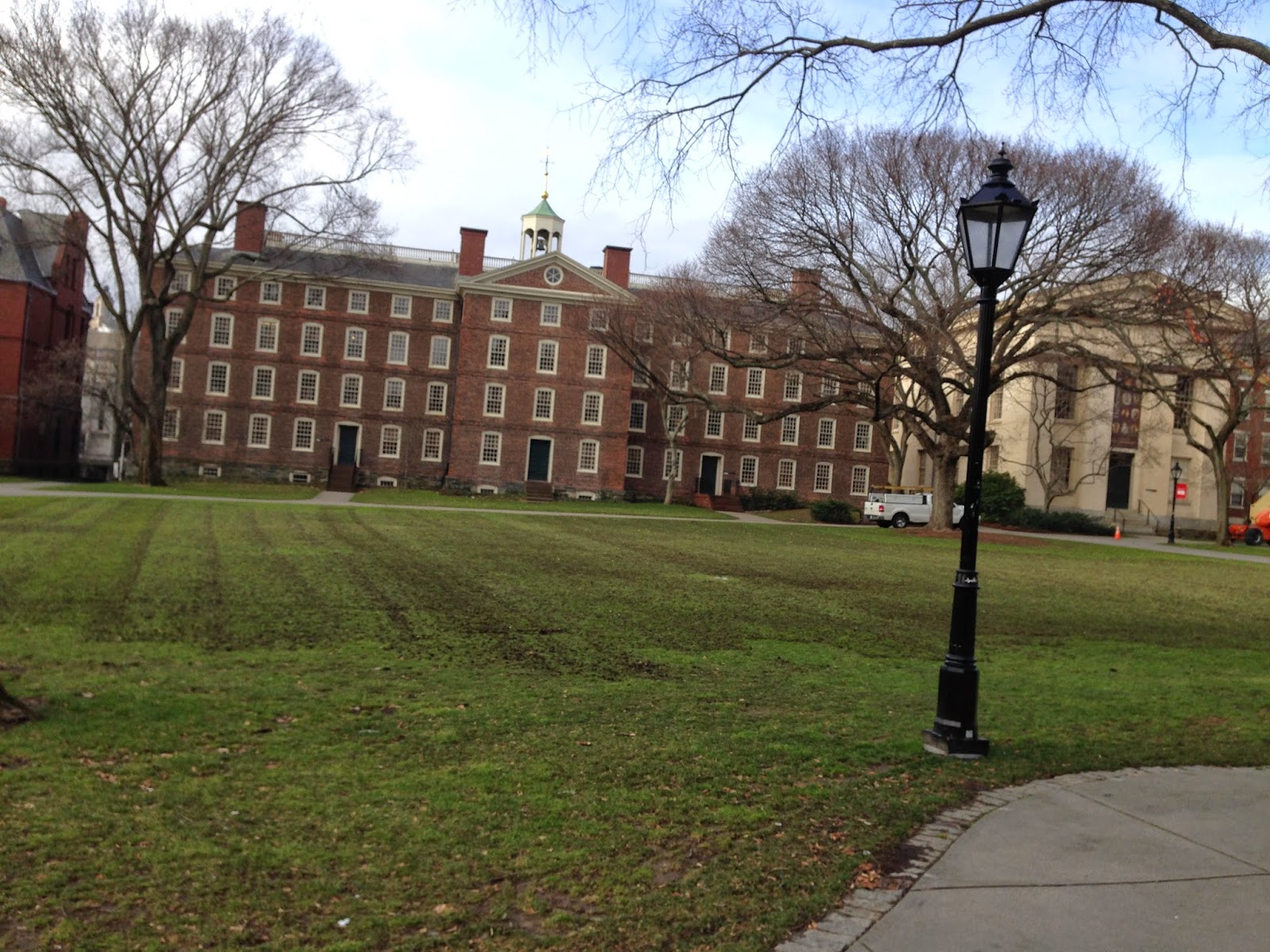
Yesterday, in traveling back from early holiday celebrations with relatives in Newport, Rhode Island, we stopped in Providence. I was curious to see how my alma mater, Brown University, was faring, given that I had heard that construction was in the plans.
There is something very special about going back to the place where you received a great education, made many friends, and have lifelong memories. OK, I admit, I also met my husband there freshman week - he was a graduate student in physics.
Thayer Street - the main commercial street that cuts through the campus is filled with even more restaurants than ever - quite a few with an international focus, which is great.
Pembroke, pictured below, where I lived as a freshman, still looks good.
As does Diman House, where I lived, and had the best room-mate, Teresa Davila, who was on the women's crew team - amazing for a former ballerina from Chile, and fellow Applied Math major.
I loved living at Diman, because it was close to the "Ratty," the main cafeteria, as well as to the frat quad, which made life always interesting. Yes, in those days, we even got to see "streakers," including members of the football team.
Also, I have incredibly fond memories of living in the Russian House and, even last summer, while visiting my daughter, who was doing research at the University of Colorado, Boulder, we got to see Dr. Mark Kiken, who received his PhD from Brown. He was the dorm resident assistant of Russian House when I lived there for a year. My other major (I hold an AB and an ScB from Brown) was Russian Language & Literature.
I reconnected this past year with two other Russian majors, Janice Pilch, now at Rutgers, and Jill Rappaport, now teaching at Temple. We would spend a lot of time at Marston Hall where many of the language faculty had offices. I could not resist having the photo taken below in front of Marston.
Then, just a few feet away, is the beautiful Applied Math building with stained glass windows, where I would visit faculty during office hours and we would pick up our exams and homeworks.
Less than a decade after getting my PhD from Brown in Applied Math, with a specialization in Operations Research, I was back in that building on my sabbatical and there I wrote my first book, Network Economics: A Variational Inequality Approach. I lived then in an apartment complex known as Wayland Manor, on Wayland Square, which I visited yesterday.
My apartment was on the first floor behind the trees in the photo above.
Walking through the main campus was nostalgic.
Brown had invited me back (the Mathe Department) in 2007 to speak at the SUMS conference on Operations Research to undergraduates and a clip of my talk was posted on youtube.
And, speaking of fellow Brown University Applied Math majors, I just heard that (I was his TA in OR courses), Dr. Irv Lustig has left IBM! Dr. Les Servi of Mitre, another fellow Brown Applied Math major, is also rrenowned in our INFORMS professional community. And, of course, I have to mention Dr. Georgia Perakis of the Sloan School at MIT. Georgia was my dissertation advisor's 4th PhD student and I was her first.
And, while on the main campus green, I had to take a photo of Wilson Hall, where I had my calculus classes from one of the founder's of dynamical systems, Professor Joe LaSalle.
The campus was very quiet since it is now the winter break period.
After exploring Brown, it was time to head to the Italian section of Providence, on Atwell's Avenue, to see what kind of holiday pastries were on display.
I couldn't resist taking the photo of the tree below - note that instead of a double yellow line on the street, there is a long Italian flag painted.
With best wishes for a joyous holiday season to my readers!
There is something very special about going back to the place where you received a great education, made many friends, and have lifelong memories. OK, I admit, I also met my husband there freshman week - he was a graduate student in physics.
Thayer Street - the main commercial street that cuts through the campus is filled with even more restaurants than ever - quite a few with an international focus, which is great.
Pembroke, pictured below, where I lived as a freshman, still looks good.
As does Diman House, where I lived, and had the best room-mate, Teresa Davila, who was on the women's crew team - amazing for a former ballerina from Chile, and fellow Applied Math major.
I loved living at Diman, because it was close to the "Ratty," the main cafeteria, as well as to the frat quad, which made life always interesting. Yes, in those days, we even got to see "streakers," including members of the football team.
Also, I have incredibly fond memories of living in the Russian House and, even last summer, while visiting my daughter, who was doing research at the University of Colorado, Boulder, we got to see Dr. Mark Kiken, who received his PhD from Brown. He was the dorm resident assistant of Russian House when I lived there for a year. My other major (I hold an AB and an ScB from Brown) was Russian Language & Literature.
I reconnected this past year with two other Russian majors, Janice Pilch, now at Rutgers, and Jill Rappaport, now teaching at Temple. We would spend a lot of time at Marston Hall where many of the language faculty had offices. I could not resist having the photo taken below in front of Marston.
Then, just a few feet away, is the beautiful Applied Math building with stained glass windows, where I would visit faculty during office hours and we would pick up our exams and homeworks.
Less than a decade after getting my PhD from Brown in Applied Math, with a specialization in Operations Research, I was back in that building on my sabbatical and there I wrote my first book, Network Economics: A Variational Inequality Approach. I lived then in an apartment complex known as Wayland Manor, on Wayland Square, which I visited yesterday.
My apartment was on the first floor behind the trees in the photo above.
Walking through the main campus was nostalgic.
Brown had invited me back (the Mathe Department) in 2007 to speak at the SUMS conference on Operations Research to undergraduates and a clip of my talk was posted on youtube.
And, speaking of fellow Brown University Applied Math majors, I just heard that (I was his TA in OR courses), Dr. Irv Lustig has left IBM! Dr. Les Servi of Mitre, another fellow Brown Applied Math major, is also rrenowned in our INFORMS professional community. And, of course, I have to mention Dr. Georgia Perakis of the Sloan School at MIT. Georgia was my dissertation advisor's 4th PhD student and I was her first.
And, while on the main campus green, I had to take a photo of Wilson Hall, where I had my calculus classes from one of the founder's of dynamical systems, Professor Joe LaSalle.
The campus was very quiet since it is now the winter break period.
After exploring Brown, it was time to head to the Italian section of Providence, on Atwell's Avenue, to see what kind of holiday pastries were on display.
I couldn't resist taking the photo of the tree below - note that instead of a double yellow line on the street, there is a long Italian flag painted.
With best wishes for a joyous holiday season to my readers!
Monday, November 24, 2014
Cybersecurity Research and the Isenberg School of Management
There is tremendous interest in cybersecurity issues at UMass as well as at the Isenberg School of Management.
For example, on December 2, 2014, there will be a Cybersecurity Network Workforce Summit taking place at UMass Boston with participation from the UMass system President Dr. Robert Caret and the UMass Amherst Chancellor Dr. Kumble Subbaswamy.
And, just this past September, along with my Isenberg School of Management colleagues, Professor Mila Sherman of Finance and Professor Senay Solak of my Operations and Information Management Department, we, together with Professor Wayne Burleson of ECE, organized, with help from Professor Andrew Lo of the Sloan School, a very successful cybersecurity workshop at MIT. This workshop was supported by the second grant that we had received from the Advanced Cuber Security Center (ACSC).
I have posted all the presentations from our Workshop here.
Since our workshop at MIT, my OIM colleague, Professor Ryan Wright, received an NSF grant, joint with his University of Oklahoma colleagues, entitled, Building the Human Firewall. Plus, we heard that one of our Management Science doctoral students, Yueran Zhuo, who is being supervised by Solak, had her poster, titled "Optimizing Cybersecurity Investments with Risk: Insights for Resource Allocation" tie for second place as voted by ACSC Annual Conference attendees as a Best Cyber Security Solution for 2014. The $1,000 prize will be shared with the other second place winner "Authentication Using Embedded Logical Queries."
There is a lot of excitement on the UMass Amherst campus surrounding the possibility of a Cybersecurity Institute that would be across colleges and schools, which is terrific.
My interests and research in cybersecurity center around the network economics of cyber crime and cybersecurity with additional foci on risk management, information asymmetry, information sharing and security investments, Internet vulnerability and resilience, as well as supply chain aspects of security and vulnerability due, for example, to outsourcing. My latest paper on the theme is A Multiproduct Network Economic Model of Cybercrime in Financial Services.
A video of my presentation on cybercrime and financial service organizations filmed at the INNFORMS Minnepolis conference can be viewed here.
For example, on December 2, 2014, there will be a Cybersecurity Network Workforce Summit taking place at UMass Boston with participation from the UMass system President Dr. Robert Caret and the UMass Amherst Chancellor Dr. Kumble Subbaswamy.
And, just this past September, along with my Isenberg School of Management colleagues, Professor Mila Sherman of Finance and Professor Senay Solak of my Operations and Information Management Department, we, together with Professor Wayne Burleson of ECE, organized, with help from Professor Andrew Lo of the Sloan School, a very successful cybersecurity workshop at MIT. This workshop was supported by the second grant that we had received from the Advanced Cuber Security Center (ACSC).
I have posted all the presentations from our Workshop here.
Since our workshop at MIT, my OIM colleague, Professor Ryan Wright, received an NSF grant, joint with his University of Oklahoma colleagues, entitled, Building the Human Firewall. Plus, we heard that one of our Management Science doctoral students, Yueran Zhuo, who is being supervised by Solak, had her poster, titled "Optimizing Cybersecurity Investments with Risk: Insights for Resource Allocation" tie for second place as voted by ACSC Annual Conference attendees as a Best Cyber Security Solution for 2014. The $1,000 prize will be shared with the other second place winner "Authentication Using Embedded Logical Queries."
There is a lot of excitement on the UMass Amherst campus surrounding the possibility of a Cybersecurity Institute that would be across colleges and schools, which is terrific.
My interests and research in cybersecurity center around the network economics of cyber crime and cybersecurity with additional foci on risk management, information asymmetry, information sharing and security investments, Internet vulnerability and resilience, as well as supply chain aspects of security and vulnerability due, for example, to outsourcing. My latest paper on the theme is A Multiproduct Network Economic Model of Cybercrime in Financial Services.
A video of my presentation on cybercrime and financial service organizations filmed at the INNFORMS Minnepolis conference can be viewed here.
Tuesday, October 21, 2014
Congrats to the ChoiceNet Future Internet Architecture Team on the Success of their Tutorial at GEC 21!
Today, I held a review for the midterm exam for students in my Logistics & Transportation class plus I had office hours, so I could not take part in the GEC21 Conference at the University of Indiana.at which, as I wrote in my blogpost yesterday, our ChoiceNet project team was presenting a two part tutorial.
ChoiceNet is our NSF Future Internet Architecture (FIA) project, which we have been working on for several years now. Our goal in ChoiceNet is to introduce an economy plane for the Internet.
The tutorial is now over with and Professor Tilman Wolf of UMass Amherst, with whom I and our colleagues at the University of Kentucky, NCState, and UNC, along with our doctoral students, have been working with, emailed the photos below from the tutorial. There were 53 in attendance.
The two-part tutorial, including the slides can be accessed here and here.
Those on our team who were present at the tutorial are featured below.
Below is the Acknowledgments page from the tutorial:
And for those of you who may be wondering where are the female faces, two of my doctoral students, who are working with me on the project, Sara Saberi and Dong "Michelle" Li are female, but they were busy at UMass Amherst so could not attend the tutorial sessions. We provided feedback on the second part over the summer since the focus there was on the network economics and payments. We have several models of competition in quality and in prices for the FIA, which have been pubslished in a series of our papers.
ChoiceNet is our NSF Future Internet Architecture (FIA) project, which we have been working on for several years now. Our goal in ChoiceNet is to introduce an economy plane for the Internet.
The tutorial is now over with and Professor Tilman Wolf of UMass Amherst, with whom I and our colleagues at the University of Kentucky, NCState, and UNC, along with our doctoral students, have been working with, emailed the photos below from the tutorial. There were 53 in attendance.
The two-part tutorial, including the slides can be accessed here and here.
Those on our team who were present at the tutorial are featured below.
Below is the Acknowledgments page from the tutorial:
And for those of you who may be wondering where are the female faces, two of my doctoral students, who are working with me on the project, Sara Saberi and Dong "Michelle" Li are female, but they were busy at UMass Amherst so could not attend the tutorial sessions. We provided feedback on the second part over the summer since the focus there was on the network economics and payments. We have several models of competition in quality and in prices for the FIA, which have been pubslished in a series of our papers. Monday, October 20, 2014
ChoiceNet at Global Environment for Network Innovations (GENI) Engineering Conference (GEC21)
Today, the GENI Engineering Conference 21 (GEC21) begins at Indiana University and, tomorrow afternoon, there will be a two part tutorial on our National Science Foundation (NSF) project ChoiceNet.
More details on the tutorial can be found here and here. My UMass ciolleague, Professor Tilman Wolf, and University of Kentucky colleague, Professor Jim Griffioen, will be conducting the tutorial along with two doctoral students.
The full schedule can be accessed here.
GENI, also known as the Global Environment for Network Innovations, provides a virtual laboratory for networking and distributed systems research and education. It is well suited for exploring networks at scale, thereby promoting innovations in network science, security, services and applications.
ChoiceNet is our project, funded by NSF under the grant: Network Innovation Through Choice. UMass Amherst is the lead on this multiunveisrity project with Professor Tilman Wolf of the Department of Computer and Electrical Engineering as the PI and me as the Co-PI, along with colleagues from the University of Kentucky, North Carolina State University, and the University of North Carolina. ChoiceNet is one of five NSF Future Internet Architecture projects.
Professor Wolf prepared this page on our ChoiceNet project, which will continue to be updated.
Specifically, we seek to introduce an Economy plane into the Internet.
providers.
Thus, in today’s Internet (i) no single provider controls all end-to-end paths; (ii) money flow between providers is outside the architecture and by necessity changes slowly; and (iii) traffic flow is constrained at the granularity of providers to follow the money flow. The result is that transit providers have neither means nor incentive to compete via new service offerings, and consumers have essentially no control over the service they receive or its quality. A central thesis of ChoiceNet is that enabling money flow to follow traffic flow (instead of vice versa), coupled with greater support for choice among end-users, should lead to increased provider competition and more innovation.
ChoiceNet’s economy plane aims to give assurances to providers that they can compete for customers and be compensated for the services they render. At the same time, ChoiceNet provides users with the ability to select from a set of offerings and combine them to form complex services, thereby separating services that are currently entangled in the current Internet. Key to such an architecture is the ability to market services and then form or dissolve business relationships on (potentially small) time scales. Moreover, ChoiceNet must enable providers (and consumers) to prove (or verify) that the contracted service was rendered as promised.
I have two doctoral students at the Isenberg School of Management conducting research on ChoiceNet: Sara Saberi and Dong "Michelle" Li. We are specifically working on the game theory and network economics aspects and have already published a series of papers, including:
More details on the tutorial can be found here and here. My UMass ciolleague, Professor Tilman Wolf, and University of Kentucky colleague, Professor Jim Griffioen, will be conducting the tutorial along with two doctoral students.
The full schedule can be accessed here.
GENI, also known as the Global Environment for Network Innovations, provides a virtual laboratory for networking and distributed systems research and education. It is well suited for exploring networks at scale, thereby promoting innovations in network science, security, services and applications.
ChoiceNet is our project, funded by NSF under the grant: Network Innovation Through Choice. UMass Amherst is the lead on this multiunveisrity project with Professor Tilman Wolf of the Department of Computer and Electrical Engineering as the PI and me as the Co-PI, along with colleagues from the University of Kentucky, North Carolina State University, and the University of North Carolina. ChoiceNet is one of five NSF Future Internet Architecture projects.
Professor Wolf prepared this page on our ChoiceNet project, which will continue to be updated.
Specifically, we seek to introduce an Economy plane into the Internet.
Vision
The goal of ChoiceNet is to enable choices and the associated economic relationships between entities in the network. ChoiceNet makes it possible for network service providers to compete for customers and be rewarded for quality and innovation. In today’s network, money enters the network ecosystem only around the edges: consumers (individuals or enterprises) pay access providers for Internet service. Most access providers, in turn, pay other ISPs to carry their traffic to/from the rest of the Internet. Indeed, most end-to-end traffic in the Internet traverses at least three distinct serviceproviders.
Thus, in today’s Internet (i) no single provider controls all end-to-end paths; (ii) money flow between providers is outside the architecture and by necessity changes slowly; and (iii) traffic flow is constrained at the granularity of providers to follow the money flow. The result is that transit providers have neither means nor incentive to compete via new service offerings, and consumers have essentially no control over the service they receive or its quality. A central thesis of ChoiceNet is that enabling money flow to follow traffic flow (instead of vice versa), coupled with greater support for choice among end-users, should lead to increased provider competition and more innovation.
ChoiceNet’s economy plane aims to give assurances to providers that they can compete for customers and be compensated for the services they render. At the same time, ChoiceNet provides users with the ability to select from a set of offerings and combine them to form complex services, thereby separating services that are currently entangled in the current Internet. Key to such an architecture is the ability to market services and then form or dissolve business relationships on (potentially small) time scales. Moreover, ChoiceNet must enable providers (and consumers) to prove (or verify) that the contracted service was rendered as promised.
I have two doctoral students at the Isenberg School of Management conducting research on ChoiceNet: Sara Saberi and Dong "Michelle" Li. We are specifically working on the game theory and network economics aspects and have already published a series of papers, including:
- Anna Nagurney, Dong Li, Tilman Wolf, and Sara Saberi. A network economic game theory model of a service-oriented internet with choices and quality competition. NETNOMICS: Economic Research and Electronic Networking, 14(1–2):1–25, November 2013. (Notable Article in Computing in 2013 by ACM Computing Reviews) DOI
- Anna Nagurney and Tilman Wolf. A Cournot-Nash-Bertrand game theory model of a service-oriented internet with price and quality competition among network transport providers. Computational Management Science, 11(4), pages 475-502. DOI
- Sara Saberi, Anna Nagurney, Tilman Wolf, A network economic game theory model of s service-oriented Internet with price and quality competition in both content and network provision. Service Science, 6(4), December 2014, pages 1-24.
Tuesday, October 14, 2014
Which Suppliers Really Matter to Your Supply Chain Performance?
We have certainly experienced a long list of supplier failures, whether from natural disasters, quality shortcomings (with the automotive industry being a notable example, as well as compounding pharmacies), or even due to the Ebola healthcare and humanitarian logistics crisis, with great demand for the timely delivery of critical needs supplies for both healthcare providers and patients being unmet, not to mention the healthcare providers themselves in the form of human supply chains.
With numerous supply chains, from high tech products, to pharmaceuticals, to even food, being increasingly complex in terms of both the network topology, the number of decision-makers, as well as the distances involved, it is high time for performance metrics and ranking tools to enable the identification of which suppliers as well as the components that they provide matter not only to the full supply chain but also to your individual firm.
First, one has to realize that this is the Era of the Supply Chain Network Economy and tools that just handle one supplier - one manufacturer are completely out-of-date. One has to be able to capture the interrelationships among suppliers, who are profit-maximizing, as well as the firms that they supply, who in turn, compete with other firms.
In our most recent paper: Supply Chain Performance Assessment and Supplier and Component Importance Identification in a General Competitive Multitiered Supply Chain Network Model, Dong Li and Anna Nagurney, that I co-authored with one of my doctoral students, who has done great work on supply chain network competition and quality, we provide a performance assessment metric for the full supply chain, and for that of an individual firm. The metric quantifies the efficiency of the supply chain or firm, respectively, and also allows for the identification and ranking of the importance of suppliers as well as the components of suppliers with respect to the full supply chain or individual firm. The firms are differentiated by brands and our general multitiered competitive supply chain network equilibrium model with suppliers and firms includes capacities and constraints to capture the production activities. Firms may have a certain amount of capability to produce components in-house, depending on their capacities.
The supply chain network performance measure is inspired by our work on network performance assessment in a variety of network systems ranging from transportation to the Internet (see Nagurney and Qiang (2009) and the references therein) as well as in supply chains (cf. Qiang, Nagurney, and Dong (2009), and Qiang and Nagurney (2012)) but with the addition of the supplier tier, which is the focus in our paper.
Suppliers in supply chains are even vital to cybersecurity and the above graphic taken from our paper was part of the presentation that I gave last month at the Sloan School at MIT as part of the Advanced Cyber Security Workshop that I co-organized with several Isenberg School colleagues and a College of Engineering one.
With numerous supply chains, from high tech products, to pharmaceuticals, to even food, being increasingly complex in terms of both the network topology, the number of decision-makers, as well as the distances involved, it is high time for performance metrics and ranking tools to enable the identification of which suppliers as well as the components that they provide matter not only to the full supply chain but also to your individual firm.
First, one has to realize that this is the Era of the Supply Chain Network Economy and tools that just handle one supplier - one manufacturer are completely out-of-date. One has to be able to capture the interrelationships among suppliers, who are profit-maximizing, as well as the firms that they supply, who in turn, compete with other firms.
In our most recent paper: Supply Chain Performance Assessment and Supplier and Component Importance Identification in a General Competitive Multitiered Supply Chain Network Model, Dong Li and Anna Nagurney, that I co-authored with one of my doctoral students, who has done great work on supply chain network competition and quality, we provide a performance assessment metric for the full supply chain, and for that of an individual firm. The metric quantifies the efficiency of the supply chain or firm, respectively, and also allows for the identification and ranking of the importance of suppliers as well as the components of suppliers with respect to the full supply chain or individual firm. The firms are differentiated by brands and our general multitiered competitive supply chain network equilibrium model with suppliers and firms includes capacities and constraints to capture the production activities. Firms may have a certain amount of capability to produce components in-house, depending on their capacities.
The supply chain network performance measure is inspired by our work on network performance assessment in a variety of network systems ranging from transportation to the Internet (see Nagurney and Qiang (2009) and the references therein) as well as in supply chains (cf. Qiang, Nagurney, and Dong (2009), and Qiang and Nagurney (2012)) but with the addition of the supplier tier, which is the focus in our paper.
Suppliers in supply chains are even vital to cybersecurity and the above graphic taken from our paper was part of the presentation that I gave last month at the Sloan School at MIT as part of the Advanced Cyber Security Workshop that I co-organized with several Isenberg School colleagues and a College of Engineering one.
Monday, September 29, 2014
Modeling the Network Economics of Cybercrime in Financial Services
For as long as I can remember, I have been fascinated by networks - their graphical structure and as a means of representing economic activity in terms of product flows, costs, and profits, along with the associated decision-making.
Typically, I work on network systems as varied as global supply chains, complex financial networks, electric power generation and distribution networks, as even the Internet, for which we have a large-scale National Science Foundation grant: Network Innovation Through Choice, which is part of the Future Internet Architecture program. In fact, soon I will be getting ready for our almost weekly teleconference among our partners on this project, which we are calling ChoiceNet.
Over two years ago, we started working, through a Prime the Pump project, funded by the Advanced Cyber Security Center (ACSC), on cybersecurity and risk assessment. As my readers know, this project was followed by another project, the culmination of which took place only 10 days ago, with a workshop that several Isenberg School colleagues and a College of Engineering colleague at UMass Amherst co-organized with me. On Friday, September 19, 2014, we hosted a workshop at the Sloan School at MIT, entitled: Cybersecurity Risk Analysis for Enterprise Security, which I blogged about, and which has received some nice press. I very much enjoyed the keynotes at the conference as well as the panels with terrific industry panelists.
In my presentation at the workshop on Network Science on Economics, I motivated the major issues through the following graphics which illustrate very dramatically the impacts of cybercrime and, also, if I may say, fascinating research questions.
Source: The Economic Impact of Cybercrime and Cyber Espionage, Center for Strategic and International Studies, July 2013, sponsored by McAfee.
According to a recent survey cyber crime is placing heavy strains on the global financial sector, with cyber crime now the second most commonly reported economic crime affecting financial services firms. Cyber crime accounted for 38% of all economic crimes in the financial sector, as compared to an average of 16% across all other industries. Every minute, of every hour, of ever day, a major financial institution is under attack (Wilson writing in The Telegraph, October 6, 2013).
Cyber attacks are intrusive and economically costly. In addition, they may adversely affect a company’s most valuable asset – its reputation.
There is both vertical and horizontal information asymmetry - as noted above, organizations may not even be aware that sensitive data has been stolen from them (and for many months, no less). Moreover, other firms in the same industry may not be aware of attacks of their competitors or even partners. Finally, and, again and again, I am seeing real commonalities between supply chains, behavior, and cyber crime activities: how confident are you that the software that is to battle computer viruses, malware, denial of service attacks, etc., delivers what is being promised? Here we get into the quality of outsourced production!
As noted by Ablon, Libicki, and Golay in their 2014 Rand Report, the black market for cybercrime products can be more profitable than the illegal drug trade. They also argued in their study that an economic approach to tackling cybercrime in warranted, which I completely agree with.
I had been researching the network economics of cybercrime for two years and had spoken both at the INFORMS Minneapolis conference last year and at the Boston Analytics Conference on the topic and, after our workshop, completed a paper: "A Multiproduct Network Economic Model of Cybercrime in Financial Services." In this paper, we propose a network economic model of cybercrime with a focus on financial services, since such organizations are one of the principal targets of such illicit activity. The model is a multiproduct one and constructed as a layered bipartite network with supply price, transaction cost, and demand price functions linking the networks. A novelty of the new model is the incorporation of average time associated with illicit product delivery at the demand markets with the demand price functions being decreasing functions of such times, as noted in reality. For example, it is recognized that there is a short time window during which the value of a financial product acquired through cybercrime is positive but it decreases during the time window. Following the major Target breach, credit cards obtained thus initially sold for $120 each on the black market, but, within weeks, as banks started to cancel the cards, the price dropped to $8 and, seven months after Target learned about the breach, the cards had essentially no value. In addition, different “brands” of credit cards can be viewed as different products since they command different prices on the black market. For example, credit cards with the highest credit limits, such as an American Express Platinum card, command the highest prices. A card number with a low limit might sell for $1 or $2, while a high limit can sell for $15 or considerably more, as noted above.
In the paper, the governing equilibrium conditions are formulated as a variational inequality problem with qualitative properties of the solution presented. An algorithm, with nice features for computations, is then applied to two sets of numerical examples in order to illustrate the model and computational procedure as well as the types of interventions that can be investigated from a policy perspective to make it more difficult for cybercriminals to obtain sensitive data.
Typically, I work on network systems as varied as global supply chains, complex financial networks, electric power generation and distribution networks, as even the Internet, for which we have a large-scale National Science Foundation grant: Network Innovation Through Choice, which is part of the Future Internet Architecture program. In fact, soon I will be getting ready for our almost weekly teleconference among our partners on this project, which we are calling ChoiceNet.
Over two years ago, we started working, through a Prime the Pump project, funded by the Advanced Cyber Security Center (ACSC), on cybersecurity and risk assessment. As my readers know, this project was followed by another project, the culmination of which took place only 10 days ago, with a workshop that several Isenberg School colleagues and a College of Engineering colleague at UMass Amherst co-organized with me. On Friday, September 19, 2014, we hosted a workshop at the Sloan School at MIT, entitled: Cybersecurity Risk Analysis for Enterprise Security, which I blogged about, and which has received some nice press. I very much enjoyed the keynotes at the conference as well as the panels with terrific industry panelists.
In my presentation at the workshop on Network Science on Economics, I motivated the major issues through the following graphics which illustrate very dramatically the impacts of cybercrime and, also, if I may say, fascinating research questions.
Source: The Economic Impact of Cybercrime and Cyber Espionage, Center for Strategic and International Studies, July 2013, sponsored by McAfee.
According to a recent survey cyber crime is placing heavy strains on the global financial sector, with cyber crime now the second most commonly reported economic crime affecting financial services firms. Cyber crime accounted for 38% of all economic crimes in the financial sector, as compared to an average of 16% across all other industries. Every minute, of every hour, of ever day, a major financial institution is under attack (Wilson writing in The Telegraph, October 6, 2013).
Cyber attacks are intrusive and economically costly. In addition, they may adversely affect a company’s most valuable asset – its reputation.
There is both vertical and horizontal information asymmetry - as noted above, organizations may not even be aware that sensitive data has been stolen from them (and for many months, no less). Moreover, other firms in the same industry may not be aware of attacks of their competitors or even partners. Finally, and, again and again, I am seeing real commonalities between supply chains, behavior, and cyber crime activities: how confident are you that the software that is to battle computer viruses, malware, denial of service attacks, etc., delivers what is being promised? Here we get into the quality of outsourced production!
As noted by Ablon, Libicki, and Golay in their 2014 Rand Report, the black market for cybercrime products can be more profitable than the illegal drug trade. They also argued in their study that an economic approach to tackling cybercrime in warranted, which I completely agree with.
I had been researching the network economics of cybercrime for two years and had spoken both at the INFORMS Minneapolis conference last year and at the Boston Analytics Conference on the topic and, after our workshop, completed a paper: "A Multiproduct Network Economic Model of Cybercrime in Financial Services." In this paper, we propose a network economic model of cybercrime with a focus on financial services, since such organizations are one of the principal targets of such illicit activity. The model is a multiproduct one and constructed as a layered bipartite network with supply price, transaction cost, and demand price functions linking the networks. A novelty of the new model is the incorporation of average time associated with illicit product delivery at the demand markets with the demand price functions being decreasing functions of such times, as noted in reality. For example, it is recognized that there is a short time window during which the value of a financial product acquired through cybercrime is positive but it decreases during the time window. Following the major Target breach, credit cards obtained thus initially sold for $120 each on the black market, but, within weeks, as banks started to cancel the cards, the price dropped to $8 and, seven months after Target learned about the breach, the cards had essentially no value. In addition, different “brands” of credit cards can be viewed as different products since they command different prices on the black market. For example, credit cards with the highest credit limits, such as an American Express Platinum card, command the highest prices. A card number with a low limit might sell for $1 or $2, while a high limit can sell for $15 or considerably more, as noted above.
In the paper, the governing equilibrium conditions are formulated as a variational inequality problem with qualitative properties of the solution presented. An algorithm, with nice features for computations, is then applied to two sets of numerical examples in order to illustrate the model and computational procedure as well as the types of interventions that can be investigated from a policy perspective to make it more difficult for cybercriminals to obtain sensitive data.
Tuesday, May 6, 2014
Toward An Economy Plane for the Internet - A Paradigm Shift Through Our NSF Research
Yesterday we heard the good news that our paper:
had been accepted by the Editor of Computer Communication Review (CCR) for publication. We expect it to appear in the July 2014 issue.
CCR, according to its website, is the magazine of ACM SIGCOMM. ACM, as some of you may know, is the acronym for the Association for Computing Machiner, the world's largest educational and scientific computing society. SIGCOMM is the special interest group on Data Communication.
The scope of CCR is that: Technical papers accepted to CCR typically report on practical advances or the practical applications of theoretical advances. CCR serves as a forum for interesting and novel ideas at an early stage in their development. The focus is on timely dissemination of new ideas that may help trigger additional investigations. While the innovation and timeliness are the major criteria for its acceptance, technical robustness and readability will also be considered in the review process. We particularly encourage papers with early evaluation or feasibility studies.
Our paper reports on our vision for our National Science Foundation (NSF) project: Network Innovation Through Choice, which, as you can see from the names on our paper, is multiuniversity and multidisciplinary (and also multiyear). I truly enjoy working with this great team of computer scientists and electrical and computer engineers and provide the network economics and operations research and management science perspective.
In particular, we are envisioning and working on a Future Internet Architecture (FIA) and are, in fact, one of five such teams in the U.S. selected by NSF. Our FIA is called ChoiceNet.
In this paper, in the Abstract, we state that: "The Internet has been a key enabling technology for many new distributed applications and services. However, the deployment of new protocols and services in the Internet infrastructure itself has been sluggish, especially where economic incentives for network providers are unclear. In our work, we seek to develop an “economy plane” for the Internet that enables network providers to offer new network- based services (QoS, storage, etc.) for sale to customers. The explicit connection between economic relationships and network services across various time scales enables users to select among service alternatives. The resulting competition among network service providers will lead to overall better technological solutions and more competitive prices. In this paper, we present the architectural aspects of our ChoiceNet economy plane as well as some of the technological problems that need to be addressed in a practical deployment."
Also, we are delighted that our earlier paper,A Network Economic Game Theory Model of a Service-Oriented Internet with Choices and Quality Competition, Anna Nagurney, Dong Li, Tilman Wolf, and Sara Saberi, Netnomics 14(1-2): (2013) pp 1-25, which is also based on this NSF funded project was selected by ACM Computing Reviews in its list of Best of 2013. The list recognizes notable items published in computing.
Our paper was selected in the Computer Applications category and the full list can be downloaded here. Both Sara Saberi and Dong Li are my doctoral students in Management Science at the Isenberg School at UMass Amherst.
It is terrific to see interdisciplinary research making advances in what may actually be a paradigm shift!
had been accepted by the Editor of Computer Communication Review (CCR) for publication. We expect it to appear in the July 2014 issue.
CCR, according to its website, is the magazine of ACM SIGCOMM. ACM, as some of you may know, is the acronym for the Association for Computing Machiner, the world's largest educational and scientific computing society. SIGCOMM is the special interest group on Data Communication.
The scope of CCR is that: Technical papers accepted to CCR typically report on practical advances or the practical applications of theoretical advances. CCR serves as a forum for interesting and novel ideas at an early stage in their development. The focus is on timely dissemination of new ideas that may help trigger additional investigations. While the innovation and timeliness are the major criteria for its acceptance, technical robustness and readability will also be considered in the review process. We particularly encourage papers with early evaluation or feasibility studies.
Our paper reports on our vision for our National Science Foundation (NSF) project: Network Innovation Through Choice, which, as you can see from the names on our paper, is multiuniversity and multidisciplinary (and also multiyear). I truly enjoy working with this great team of computer scientists and electrical and computer engineers and provide the network economics and operations research and management science perspective.
In particular, we are envisioning and working on a Future Internet Architecture (FIA) and are, in fact, one of five such teams in the U.S. selected by NSF. Our FIA is called ChoiceNet.
In this paper, in the Abstract, we state that: "The Internet has been a key enabling technology for many new distributed applications and services. However, the deployment of new protocols and services in the Internet infrastructure itself has been sluggish, especially where economic incentives for network providers are unclear. In our work, we seek to develop an “economy plane” for the Internet that enables network providers to offer new network- based services (QoS, storage, etc.) for sale to customers. The explicit connection between economic relationships and network services across various time scales enables users to select among service alternatives. The resulting competition among network service providers will lead to overall better technological solutions and more competitive prices. In this paper, we present the architectural aspects of our ChoiceNet economy plane as well as some of the technological problems that need to be addressed in a practical deployment."
Also, we are delighted that our earlier paper,A Network Economic Game Theory Model of a Service-Oriented Internet with Choices and Quality Competition, Anna Nagurney, Dong Li, Tilman Wolf, and Sara Saberi, Netnomics 14(1-2): (2013) pp 1-25, which is also based on this NSF funded project was selected by ACM Computing Reviews in its list of Best of 2013. The list recognizes notable items published in computing.
Our paper was selected in the Computer Applications category and the full list can be downloaded here. Both Sara Saberi and Dong Li are my doctoral students in Management Science at the Isenberg School at UMass Amherst.
It is terrific to see interdisciplinary research making advances in what may actually be a paradigm shift!
Labels:
ACM,
architecture,
best paper,
CCR,
computing reviews,
future internet,
game theory,
Isenberg School,
management science,
network economics,
NSF,
operations research,
SIGCOMM,
UMass Amherst
Wednesday, April 2, 2014
Cybersecurity and Financial Services and Prescriptive Analytics
Yesterday, I had the honor of speaking on Cybersecurity and Financial Services at the INFORMS Analytics Conference in Boston. The conference was very well-organized, the venue at the Westin Waterfront hotel was marvelous, and the speakers came from both industry (many of the top analytics firms as developers and/or users were there) and academia. Also, there were many students and even a good-sized cohot from our UMass Amherst INFORMS Student Chapter, which I highlighted in one of my posts.
I had multiple roles at this conference, which made the experience extra rewarding, and INFORMS staff presented me with the nice streamers below.
My talk was in the Prescriptive Analytics track, which was appropriate, and Dr. Marius Solomon of Northeastern University introduced me. I have known Marius for many years through the Transportation & Logistics Society of INFORMS. He shared with me that there were 104 submissions for presentations and out of these 30 were selected. I had carefully thought about the topics that I would like to speak on and chose Cybersecurity and Financial Services since I believe that cybersecurity is a topic that could greatly benefit from analytics and operations research methodologies and the wonderful geeks and brainiacs in our professional community for whom tough problems are both challenging and enticing!
It was great to have Dr. Irv Lustig of IBM in the audience and some of you may know that Irv was also an Applied Math major at Brown University and I was his TA for an operations research course taught there by my dissertation advisor Professor Stella Dafermos. Irv is well-known at INFORMS and very active in its Certified Analytics Professional program. I posted a photo of Irv and me in my previous blogpost.
Irv asked good questions, but, then again, he has had an outstanding education (his doctoral dissertation advisor at Stanford was Professor George Dantzig, one of the founders of Operations Research). And we continued the discussion after my presentation. Great to hear that IBM is also interested in Financial Networks!
In my presentation I spoke about a project that was funded by the Advanced Cyber Security Center (ACSC) and then segued into our NSF project.
My full presentation, in pdf format, can be downloaded from the Supernetworks Center website.
In the presentation I highlighted a network model that we developed to assess financial network vulnerability and importance of different financial network components, described a network economic model of cyber crime, and also discussed our latest NSF project on envisioning a Future Internet Architecture that we are calling ChoiceNet. Imagine if we could enhance the resilience of the network through redesign.
Thanks to INFORMS for organizing such a fabulous analytics conference!
I had multiple roles at this conference, which made the experience extra rewarding, and INFORMS staff presented me with the nice streamers below.
My talk was in the Prescriptive Analytics track, which was appropriate, and Dr. Marius Solomon of Northeastern University introduced me. I have known Marius for many years through the Transportation & Logistics Society of INFORMS. He shared with me that there were 104 submissions for presentations and out of these 30 were selected. I had carefully thought about the topics that I would like to speak on and chose Cybersecurity and Financial Services since I believe that cybersecurity is a topic that could greatly benefit from analytics and operations research methodologies and the wonderful geeks and brainiacs in our professional community for whom tough problems are both challenging and enticing!
It was great to have Dr. Irv Lustig of IBM in the audience and some of you may know that Irv was also an Applied Math major at Brown University and I was his TA for an operations research course taught there by my dissertation advisor Professor Stella Dafermos. Irv is well-known at INFORMS and very active in its Certified Analytics Professional program. I posted a photo of Irv and me in my previous blogpost.
Irv asked good questions, but, then again, he has had an outstanding education (his doctoral dissertation advisor at Stanford was Professor George Dantzig, one of the founders of Operations Research). And we continued the discussion after my presentation. Great to hear that IBM is also interested in Financial Networks!
In my presentation I spoke about a project that was funded by the Advanced Cyber Security Center (ACSC) and then segued into our NSF project.
My full presentation, in pdf format, can be downloaded from the Supernetworks Center website.
In the presentation I highlighted a network model that we developed to assess financial network vulnerability and importance of different financial network components, described a network economic model of cyber crime, and also discussed our latest NSF project on envisioning a Future Internet Architecture that we are calling ChoiceNet. Imagine if we could enhance the resilience of the network through redesign.
Thanks to INFORMS for organizing such a fabulous analytics conference!
Sunday, January 5, 2014
FireEye Acquires Mandiant and Why Cybersecurity Matters
My most recent post on this blog was on networks in mergers and acquisitions and shortly thereafter there was a very interesting acquisition announcement in the cybersecurity space: FireEye acquired Mandiant Corp. This is considered one of the biggest recent security deals as reported by The New York Times, which noted that The combination of the two companies — one that detects attacks in a
novel way (FireEye), another that responds to attacks (Mandiant) — comes as corporate America
has become wary of relying on the federal government to monitor the
Internet and warn of incoming attacks. And according to The Wall Street Journal: Mandiant and FireEye market themselves to
businesses, not consumers, and focus on blocking highly skilled hackers
who can evade traditional antivirus software. But
they have unique specialties. Mandiant has become famous for its
investigators that act like a cyber-SWAT team for companies that have
been hacked. They focus on figuring out how hackers got in and removing
them from corporate systems.
Mandiant is named after its founder, Kevin Mandia, who also served as the company's CEO prior to its acquisition. According to the company's website: Mandia was profiled on the cover of Fortune magazine and recognized by Foreign Policy magazine as one of the 100 leading global thinkers of 2013. The New York Times a few months ago had major coverage of the expertise of Mandiant which was fascinating.
Mr. Mandia went to Lafayette College, in Easton, PA, which is also my husband's undergraduate alma mater. From an article on Lafayette College's website, I learned that Kevin Mandia was a computer science graduate, and also holds a Master’s in forensic science from George Washington University. He is co-author of Incident Response: Investigating Computer Crime and articles for The International Journal of Cyber Crime.
I became interested in cybersecurity and cyber crime in my research on modeling the Internet and was involved in an Advanced Cyber Security Center (ACSC) project, Prime the Pump, entitled: Cybersecurity Risk Analysis and Investment Optimization with colleagues in Operations & Information Management and in Finance at the Isenberg School of Management, and in Electrical and Computer Engineering, at UMass Amherst, along with one of the university's chief information officers.
I presented some of our funded research at the INFORMS Annual Meeting in Minneapolis last October and posted some information prior to the conference. Our session, organized by Professor Alla Kammerdiner, was entitled: Big Data Analytics for Cybersecurity, and it was videotaped. INFORMS recently posted the video of my presentation: Network Economics of Cyber Crime with Applications to Financial Service Organizations on INFORMS' great youtube channel and it can be accessed directly below.
We hope to extend this and related work through the auspices of ACSC.
Also, Alla's presentation was on Network Inference for Monitoring Cyber-physical Systems (CPS) and it can be viewed below.
Alla ran the Boston Marathon last April 15 and is an elite runner. She heard about the bombings after she completed the marathon route and while on the Green line traveling back to her hotel.
Also, Alla's presentation was on Network Inference for Monitoring Cyber-physical Systems (CPS) and it can be viewed below.
Labels:
ACSC,
Advanced Cyber Security Center,
big data,
cyber crime,
cybersecurity,
finance,
FireEye,
INFORMS,
Mandiant,
mergers and acquisitions,
network economics,
operations research,
security,
video,
youtube
Wednesday, December 4, 2013
Being Thanked in a Book - A Great Compliment
I love writing books and also reading books.
Every once in a while these two are connected as in the book recently written by Dr. Christian Mullon, "Network Economics of Marine Ecosystems and their Exploitation," and published by CRC Press.
Dr. Mullon in the book's Preface writes: The origin of the idea of applying network economics to ecological problems has been the reading of Anna Nagurney's book: Network Economics, A Variational Inequality Approach. I have found there the level of abstraction, the level of complexity, the mathemtical tools I was seeking for several years to model real marine systems. I acknowledge this influence and I thank her for the collaboration we have initiated since.
Network Economics: A Variational Inequality Approach, was the first book that I ever wrote and it also appeared in a second edition.
I have read Dr. Mullon's book and will continue to go back to it many times as one always does with great books. It demonstrates, as the first paragraph of the first chapter states, and I fully agree: This book shows how to apply the principles and tools of network economics, such as variational inequalities and complementarity problems, to study large exploited natural systems, especially the marine systems, at a global, continental or regional level. These systems are exposed to both climate change and economic globalization, a phenomenon referred to as "double exposure."
I met Dr. Mullon and his lovely wife in Paris after I spoke at the NetGCoop conference there in October 2011. We had already started our collaboration but had never before then met face to face.
The elegance of his research, which combines theoretical and computational tools with important ecological applications and data, continues to inspire me and I have written about our related work on predator prey networks, which blends economics, operations research, and ecology, as nature's supply chains.
I would like to return the thanks and compliment to Dr. Christian Mullon on his fabulous new book and congratulate him!
Every once in a while these two are connected as in the book recently written by Dr. Christian Mullon, "Network Economics of Marine Ecosystems and their Exploitation," and published by CRC Press.
Dr. Mullon in the book's Preface writes: The origin of the idea of applying network economics to ecological problems has been the reading of Anna Nagurney's book: Network Economics, A Variational Inequality Approach. I have found there the level of abstraction, the level of complexity, the mathemtical tools I was seeking for several years to model real marine systems. I acknowledge this influence and I thank her for the collaboration we have initiated since.
Network Economics: A Variational Inequality Approach, was the first book that I ever wrote and it also appeared in a second edition.
I have read Dr. Mullon's book and will continue to go back to it many times as one always does with great books. It demonstrates, as the first paragraph of the first chapter states, and I fully agree: This book shows how to apply the principles and tools of network economics, such as variational inequalities and complementarity problems, to study large exploited natural systems, especially the marine systems, at a global, continental or regional level. These systems are exposed to both climate change and economic globalization, a phenomenon referred to as "double exposure."
I met Dr. Mullon and his lovely wife in Paris after I spoke at the NetGCoop conference there in October 2011. We had already started our collaboration but had never before then met face to face.
The elegance of his research, which combines theoretical and computational tools with important ecological applications and data, continues to inspire me and I have written about our related work on predator prey networks, which blends economics, operations research, and ecology, as nature's supply chains.
I would like to return the thanks and compliment to Dr. Christian Mullon on his fabulous new book and congratulate him!
Friday, November 29, 2013
Speaking on Future Internet Architecture at Network Frontier Workshop at Northwestern
First, I hope that all those celebrating had a very pleasant Thanksgiving and for all those who still have journeys ahead of you, I wish you safe and comfortable travels!
Next week, I will be speaking at the Network Frontier Workshop at Northwestern University. This should be a fascinating event and has been organized by Dr. Adilson E. Motter.
The workshop will bring scientists from different disciplines together who are passionate about networks and are contributing to their study and understanding in numerous ways.
The full list of invited speakers can be seen here.
The full program with all speakers' talk titles is available in pdf format here.
After the great TEDx UMass Amherst Professor Speaker Showcase event last Monday at which I spoke on The Traffic Circle of Life I started to prepare my presentation for Northwestern.
I will be speaking next Thursday on "Envisioning a Future Internet Architecture: The Network Economics of ChoiceNet." My presentation is based on our NSF multi-university project: Network Innovation Through Choice. Our great team already has several papers published or in press -- some of which are highlighted below:
A Network Economic Game Theory Model of a Service-Oriented Internet with Choices and Quality Competition, Anna Nagurney, Dong Li, Tilman Wolf, and Sara Saberi, Netnomics 14(1-2): (2013) pp 1-25.
ChoiceNet: Network Innovation Through Choice, George N. Rouskas, Ilia Baldine, Ken Calvert, Rudra Dutta, James Griffioen, Anna Nagurney, and Tilman Wolf, invited paper for the 17th Conference on Optical Network Design and Modeling (ONDM 2013).
Choice as a Principle in Network Architecture, Tilman Wolf, Jim Griffioen, Ken Calvert, Rudra Dutta, George Rouskas, Ilia Baldine, and Anna Nagurney, in the Proceedings of ACM SIGCOMM 2012, Helsinki, Finland, August 13-17, 2012.
I will be focusing my presentation on one of our most recent papers: A Cournot-Nash–Bertrand Game Theory Model of a Service-Oriented Internet with Price and Quality Competition Among Network Transport Providers, Anna Nagurney and Tilman Wolf, in press in Computational Management Science.
I am very much looking forward to being back at Northwestern!
Next week, I will be speaking at the Network Frontier Workshop at Northwestern University. This should be a fascinating event and has been organized by Dr. Adilson E. Motter.
The workshop will bring scientists from different disciplines together who are passionate about networks and are contributing to their study and understanding in numerous ways.
The full list of invited speakers can be seen here.
The full program with all speakers' talk titles is available in pdf format here.
After the great TEDx UMass Amherst Professor Speaker Showcase event last Monday at which I spoke on The Traffic Circle of Life I started to prepare my presentation for Northwestern.
I will be speaking next Thursday on "Envisioning a Future Internet Architecture: The Network Economics of ChoiceNet." My presentation is based on our NSF multi-university project: Network Innovation Through Choice. Our great team already has several papers published or in press -- some of which are highlighted below:
A Network Economic Game Theory Model of a Service-Oriented Internet with Choices and Quality Competition, Anna Nagurney, Dong Li, Tilman Wolf, and Sara Saberi, Netnomics 14(1-2): (2013) pp 1-25.
ChoiceNet: Network Innovation Through Choice, George N. Rouskas, Ilia Baldine, Ken Calvert, Rudra Dutta, James Griffioen, Anna Nagurney, and Tilman Wolf, invited paper for the 17th Conference on Optical Network Design and Modeling (ONDM 2013).
Choice as a Principle in Network Architecture, Tilman Wolf, Jim Griffioen, Ken Calvert, Rudra Dutta, George Rouskas, Ilia Baldine, and Anna Nagurney, in the Proceedings of ACM SIGCOMM 2012, Helsinki, Finland, August 13-17, 2012.
I will be focusing my presentation on one of our most recent papers: A Cournot-Nash–Bertrand Game Theory Model of a Service-Oriented Internet with Price and Quality Competition Among Network Transport Providers, Anna Nagurney and Tilman Wolf, in press in Computational Management Science.
I am very much looking forward to being back at Northwestern!
Monday, October 14, 2013
2013 Nobel Laureates in Economic Sciences -- Reflections and Connections
This time of the year is when the Nobel Prizes get announced (and it is also the time of the year when several of our major conferences take place including the INFORMS one) so there is a lot of anticipation, drama, and excitement.
The 2013 recipients of the Nobel Prize in Economic Sciences are: Professors Eugene Fama and Lars Peter Hansen of the University of Chicago and Professor Robert Shiller of Yale. They are receiving the Nobel prize "for their empirical analysis of asset prices."
Photo courtesy of TT/Claudio Bresciani/AP Bloomberg.com
What continues to amaze me is the connections between economic sciences, including computational economics, and operations research and the management sciences, over the span of Nobel Prize recipients in Economic Sciences. The first Nobel Prize in Economic Sciences was given back in 1969 and the full list of recipients (one female to-date, Elinor Ostrom) can be found here on the official Nobel site.
For example, Eugene Fama has published in Management Science: "Three Asset Cash Balance and Dynamic Portfolio Problems." Gary D. Eppen and Eugene F. Fama; Management Science, 1971, 17(5, Theory Series), pp. 311-19.http://links.jstor.org/sici?sici=0025-1909%28197101%2917%3A5%3C311%3ATACBAD%3E2.0.CO%3B2-Y
Also I cited Fama's work in my Financial Networks book, co-authored with a former doctoral student of mine, Stavros Siokos, who actually received his PhD from UMass Amherst in Industrial Engineering and Operations Research and is an extremely successful financier, based in London. We cite Fama's work in the ninth chapter.
As for Lars Peter Hansen, I crossed paths with him back in 2010, when he, Professor Andrew Lo of MIT, and David Marshall organized the Measuring Systemic Risk Conference, which took place in December in Chicago. I spoke on Financial Networks and I acknowledged Hansen on the second page of my talk. Joining me was my wonderful colleague in Finance, who was Professor Lo's doctoral student at MIT, Mila Getmansky Sherman.
Professor Shiller I have never met but I have met his colleague, Karl Case, and have written about their joint work and about NSF and entrepreneurship on this blog.
As for the only female Nobel laureate in Economic Sciences, I will never forget meeting Dr. Elinor Ostrom, when she spoke at UMass Amherst and I brought one of my PhD students with me, who is now Dr. Min Yu. Elinor would visit and work closely with my colleagues at the School of Business, Economics and Law at the University of Gothenburg in Sweden where I have held a Visiting Professorship.
Along with Professor Hans Amman, I have coedited the Advances in Computational Economics book series (started with Kluwer and now with Springer) and the Nobel laureate, Daniel McFadden, was on our editorial board even before he received the Nobel Prize and I have dined with him at one of our Computational Economics conferences. Chris Sims and Tom Sargent I also met at a Computational Economics conference. My first book, Network Economics: A Variational Inequality Approach, was the first book in the Advances in Computational Economics book series and it continues to be my most highly-cited work. Its second edition came out in 1999.
And, of course, who can ever forget meeting Paul Samuelson, whose work I have cited since I was a doctoral student at Brown University. As for the Nobel laureate Harry Markowitz, whose work in portfolio optimization I have cited numerous times, I met him at an INFORMS conference in an elevator -- he is over a foot taller than I am!
My INFORMS colleague and fellow blogger. Professor Mike Trick of CMU, wrote last year on Shapley and Roth receiving the Nobel in Economic Sciences and connections to operations research and the management sciences.
The 2013 recipients of the Nobel Prize in Economic Sciences are: Professors Eugene Fama and Lars Peter Hansen of the University of Chicago and Professor Robert Shiller of Yale. They are receiving the Nobel prize "for their empirical analysis of asset prices."
Photo courtesy of TT/Claudio Bresciani/AP Bloomberg.com
What continues to amaze me is the connections between economic sciences, including computational economics, and operations research and the management sciences, over the span of Nobel Prize recipients in Economic Sciences. The first Nobel Prize in Economic Sciences was given back in 1969 and the full list of recipients (one female to-date, Elinor Ostrom) can be found here on the official Nobel site.
For example, Eugene Fama has published in Management Science: "Three Asset Cash Balance and Dynamic Portfolio Problems." Gary D. Eppen and Eugene F. Fama; Management Science, 1971, 17(5, Theory Series), pp. 311-19.http://links.jstor.org/sici?sici=0025-1909%28197101%2917%3A5%3C311%3ATACBAD%3E2.0.CO%3B2-Y
Also I cited Fama's work in my Financial Networks book, co-authored with a former doctoral student of mine, Stavros Siokos, who actually received his PhD from UMass Amherst in Industrial Engineering and Operations Research and is an extremely successful financier, based in London. We cite Fama's work in the ninth chapter.
As for Lars Peter Hansen, I crossed paths with him back in 2010, when he, Professor Andrew Lo of MIT, and David Marshall organized the Measuring Systemic Risk Conference, which took place in December in Chicago. I spoke on Financial Networks and I acknowledged Hansen on the second page of my talk. Joining me was my wonderful colleague in Finance, who was Professor Lo's doctoral student at MIT, Mila Getmansky Sherman.
Professor Shiller I have never met but I have met his colleague, Karl Case, and have written about their joint work and about NSF and entrepreneurship on this blog.
As for the only female Nobel laureate in Economic Sciences, I will never forget meeting Dr. Elinor Ostrom, when she spoke at UMass Amherst and I brought one of my PhD students with me, who is now Dr. Min Yu. Elinor would visit and work closely with my colleagues at the School of Business, Economics and Law at the University of Gothenburg in Sweden where I have held a Visiting Professorship.
Along with Professor Hans Amman, I have coedited the Advances in Computational Economics book series (started with Kluwer and now with Springer) and the Nobel laureate, Daniel McFadden, was on our editorial board even before he received the Nobel Prize and I have dined with him at one of our Computational Economics conferences. Chris Sims and Tom Sargent I also met at a Computational Economics conference. My first book, Network Economics: A Variational Inequality Approach, was the first book in the Advances in Computational Economics book series and it continues to be my most highly-cited work. Its second edition came out in 1999.
And, of course, who can ever forget meeting Paul Samuelson, whose work I have cited since I was a doctoral student at Brown University. As for the Nobel laureate Harry Markowitz, whose work in portfolio optimization I have cited numerous times, I met him at an INFORMS conference in an elevator -- he is over a foot taller than I am!
My INFORMS colleague and fellow blogger. Professor Mike Trick of CMU, wrote last year on Shapley and Roth receiving the Nobel in Economic Sciences and connections to operations research and the management sciences.
Friday, September 27, 2013
Network Economics of Cyber Crime
I have been working on network economics with interfaces to various applications for quite a while, with the first edition of my book on the topic being published twenty years ago!
About two years ago, we were approached to submit a proposal to the Advanced Cyber Security Center, which was soliciting proposals for its Prime the Pump Initiative and our project, Cybersecurity Risk Analysis and Investment Optimization, was funded.
Our project team is interdisciplinary, and consists of Professors Wayne Burleson of Electrical and Computer Engineering, Mila Getmansky Sherman of Finance, Senay Solak, and yours truly of the Operations & Information Management Department, of the Isenberg School of Management, and Chris Misra, of the OIT Department -- all of us at UMass Amherst.
The Project Synopsis:
The vision of this project was to develop:
The presentation can be downloaded here.
The invitation to submit a paper to the invited session came from Dr. Alla Kammerdiner, whom I met at a marvelous conference in Yalta, Ukraine.
The session information is here.
Dr. Kammerdiner I wrote about earlier in this blog -- she had run the Boston Marathon that was the site for the terrorist attack last April 15.
Another presentation on our project, from a broader perspective, can be accessed here.
About two years ago, we were approached to submit a proposal to the Advanced Cyber Security Center, which was soliciting proposals for its Prime the Pump Initiative and our project, Cybersecurity Risk Analysis and Investment Optimization, was funded.
Our project team is interdisciplinary, and consists of Professors Wayne Burleson of Electrical and Computer Engineering, Mila Getmansky Sherman of Finance, Senay Solak, and yours truly of the Operations & Information Management Department, of the Isenberg School of Management, and Chris Misra, of the OIT Department -- all of us at UMass Amherst.
The Project Synopsis:
The vision of this project was to develop:
- rigorous models for cybersecurity risk,
- models for costs and benefits of various cybersecurity technologies,
- techniques for integrating these models into higher level models that account for other risks and risk management expenditures.
The presentation can be downloaded here.
The invitation to submit a paper to the invited session came from Dr. Alla Kammerdiner, whom I met at a marvelous conference in Yalta, Ukraine.
The session information is here.
Dr. Kammerdiner I wrote about earlier in this blog -- she had run the Boston Marathon that was the site for the terrorist attack last April 15.
Another presentation on our project, from a broader perspective, can be accessed here.
Subscribe to:
Posts (Atom)