Showing posts with label NSF. Show all posts

Sunday, November 24, 2019

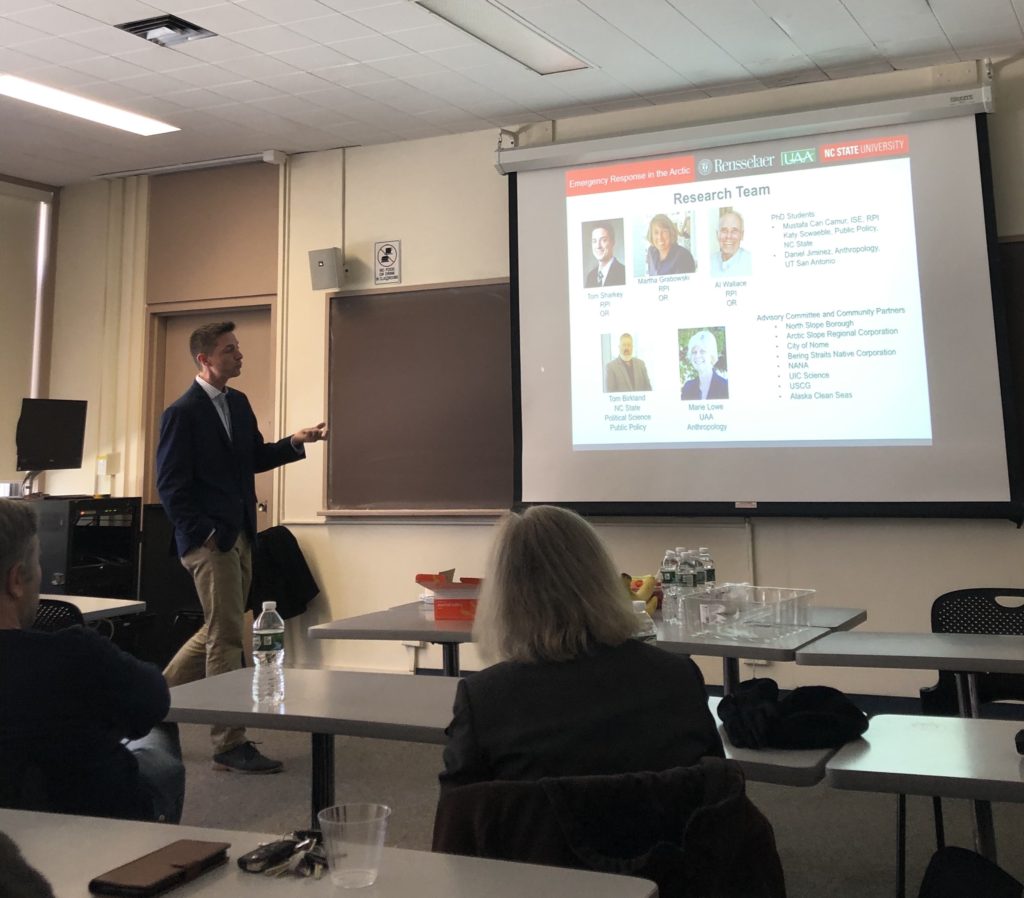
Great Talk on Emergency Response in the Arctic by Professor Tom Sharkey of RPI

Recently, we had the great pleasure of hosting RPI Professor Tom Sharkey in our UMass Amherst INFORMS Speaker Series.  His talk, based on an NSF-funded research project, was extremely timely and fascinating.
In fact, an article on this project, co-authored by Professor Sharkey with his project collaborators, including Professor Al Wallace of RPI,  was the cover story in the November issue of ISE Magazine and is definitely worthwhile to read.

His talk attracted an audience of faculty and students from multiple departments and schools at UMass Amherst, including the Isenberg School, the College of Engineering, and also the College of Natural Sciences and Mathematics.

It was a pleasure to introduce Professor Sharkey - I had last seen him this past March when I gave a talk at RPI. Since then, a PhD alumna of RPI's ISE program, whose PhD advisor was Professor Wallace, Dr. Anne P. Massey, has become the first female Dean of the Isenberg School - very exciting!


Professor Sharkey emphasized the interdisciplinary nature of the project in his presentation and noted that the team is working on constructing Operations Research (OR) models to help in emergency response (ER), while also helping communities. Collaborators, outside of RPI faculty, include a professor at NCState and one at the University of Alaska.

He noted the changes that are happening in the Arctic, including tourism and increasing commercial activity, as well as the possibility of broadened maritime shipping,  and the various associated challenges from uncertainty in sea conditions to shortcomings in infrastructure, including broadband. He stated that, even without oil exploration, there is still the possibility of spills. The shipping time from China to Rotterdam has now been decreased by 10-14 days. And, when it comes to ER, mobilization may be bottlenecked by the limited capacity of a community. Infrastructure investments take a while to build out. He discussed the need to determine the minimum budget required in order to achieve a certain response time in an emergency.

Also, he emphasized that there may be unintended consequences and it is important to identify who actually benefits from infrastructure investments.

Professor Sharkey described a mass rescue event, with accompanying network figure, in the case of the need to rescue cruise ship evacuees. His talk clearly resonated with me since we have done a lot of work on disaster relief and, to-date, I have co-edited two volumes on Dynamics of Disasters, with Professors Ilias S. Kotsireas and Panos M. Pardalos.

In 2016, I hosted the visit of Rasmus Dahlberg, who is a disaster researcher, based in Denmark (and also a novelist and TV and radio personality).  After Sharkey's visit to UMass Amherst, I connected the two of them, due to their very similar interests in Arctic emergency response research. Dahlberg is also a practitioner in this important domain. He also has a contributed chapter in the first Dynamics of Disasters (DOD) volume that I co-edited and spoke at the first DOD conference that I co-organized in Kalamata, Greece.

Professor Sharkey spoke abut identifying "dual-use" infrastructure planning, a concept I like very much. For example, improved "connectivity" for Arctic regions is an important goal, in transport (in terms of roads and ports) as well as in communications.  Fast and reliable Internet could then allow for telemedicine, as well as teleeducation in the Arctic. Of course, he also brought up the important question: "Who is going to pay?"

There were many questions during and after his very information talk. We took a group photo and then enjoyed a lunch at the University Club. We thank Professor Sharkey for his excellent, very inspiring  lecture in our Speaker Series!
Also, we celebrated, with cake, 15 years of the UMass Amherst INFORMS Student Chapter (30 semesters of great speakers in its Speaker Series)!

Professor Sharkey was interviewed after the lunch for the chapter's youtube channel, and, when the approved video is posted, we will let everyone know via social media.

In the meantime, many thanks to the outstanding UMass Amherst INFORMS Student Chapter, and to its Officers, for their amazing work, that brings all those interested in Operations Research/Management Science throughout UMass Amherst (and beyond) closer together as a community, both professionally and socially.

Friday, April 1, 2016

Internet of Things, Network Economics, and Operations Research

Next week, while I will be speaking on cybersecurity at the Heinz College at Carnegie Mellon University, my collaborator on our NSF ChoiceNet project, and now NSF EAGER project, Associate Dean in the UMass Amherst College of Engineering Professor Tilman Wolf, will be flying to Berlin, Germany, to present our invited paper at the 1st IEEE International Conference on the Internet of Things Design and Implementation.

The title of our paper is below and it will be published in the Proceedings of the First IEEE International Conference on Internet-of-Things Design and Implementation (IoTDI), Berlin, Germany, April 2016.

The abstract is as follows: Many solutions to important societal problems relating to the environment, health care, transportation, etc. seek to utilize the promises of the Internet of Things (IoT), where sensing, computation, and actuation merge the physical world with the computational world. To date, many such solutions have focused on a single problem domain and require dedicated sensor and actuator infrastructure. This vertical integration makes the development of innovative, novel solutions costly and difficult to deploy. An architectural approach to addressing this challenge is to enable horizontal integration, where sensors and actuators from different applications can interconnect with any computational IoT application. In order to isolate complexities and to support heterogeneous systems and software, it is necessary to provide clear abstractions. We present such abstractions in the form of a layered protocol architecture that describes the necessary interfaces. Beyond technical challenges for horizontal integration, this paper also addresses network economic considerations since the various entities owning and operating sensors and actuators need suitable economic motivation to participate in such an approach. We believe that this work provides a conceptual foundation for future, scalable IoT solutions.

In quantifying the synergy associated with horizontal integration, we have assumed that system optimization, in the form of total cost minimization, is the desired criterion. This reflects centralized decision-making. Earlier applications of synergy measures that I have done research on were in the context  of supply chain networks and included a means of evaluating mergers and acquisitions.

Since the costs on the links prior to horizontal integration in the Internet of Things (IoT) and post correspond to generalized costs, this gives us the flexibility to include risk measures, emission measures (if there are environmental concerns), and other relevant criteria, and, with appropriate extensions, even time.

Below are the networks corresponding to two applications prior to integration in our IoT framework that includes ideas from network economics and operations research.


 Also, we may have different degrees of horizontal integration:
The synergy measure is calculated as follows:

Interestingly, in supply chain network applications, thus far, the network topologies (see the references in a prior blogpost) have been less expansive than in the IoT context revealed here. Also, the added links in the horizontal integration cases corresponded to transportation activities and not data transfer activities as in the above network figures.

Wishing everyone at the IEEE conference in Berlin, Germany a very rewarding time!

Saturday, December 19, 2015

Congratulations and Kudos to the Supernetwork Team for a Great 2015!

Every year around this time I prepare a new page for the Supernetwork Center site noting some of the achievements of its Center Associates over the past 12 months.

As the Center's Director, reflecting on the Associates' accomplishments is always enjoyable and helps us to synergize our energies as a team and to take on new challenges in the coming year.

2015 was an exceptional year in terms of grants, research accomplishments from humanitarian logistics to cybersecurity, awards and recognitions received, as well as impact of our work.  Below I provide a few of the highlights.
 
Center Associate Dong "Michelle" Li successfully defended her doctoral dissertation at the Isenberg School of Management on May 4, 2015 and the title of her thesis was  "Quality Competition in Supply Chain Networks with Applications to Information Asymmetry, Product Differentiation, Outsourcing, and Supplier Selection."  She is now an Assistant Professor of Supply Chains / Operations Management a the College of Business at Arkansas State University and was featured on her university's homepage.  The 400 page book, Competing on Supply Chain Quality: A Network Economics Perspective, authored by Michelle and me will be published by Springer in February 2016. In addition, our recent research on supply chain competition in quality and supply chain performance assessment and importance indicators appears in the following publications:
A General Multitiered Supply Chain Network Model of Quality Competition with Suppliers, Dong Li and Anna Nagurney, International Journal of Production Economics 170: (2015) pp 336-356, and

Center Associate Professor Tina Wakolbinger of the Vienna University of Economics and Business in Austria serves as  the Head of the Research Institute for Supply Chain Management there. Her research project funded by the Austrian Science Fund (FWF) is on: Optimal Pricing and Contract Design in Humanitarian Logistics and will continue until 2016. A writeup on her research on humanitarian logistics appeared in scilog, a publication of FWF.  At the EURO conference in Glasgow, Scotland, July 11-14, 2015, she organized the invited session: Coordination and Cooperation in Humanitarian Supply Chains, at which Center Associates Professor Amir H. Masoumi of Manhattan College  presented a paper with Center Associate Min Yu of the University of Portland, and me entitled: "An Integrated Disaster Relief Supply Chain Network Model with Time Targets and Demand Uncertainty." The paper appears in the edited volume: Regional Science Matters: Studies Dedicated to Walter Isard, P. Nijkamp, A. Rose, and K. Kourtit, Editors, Springer International Publishing Switzerland (2015), pp 287-318. The Nobel laureate and renowned economist Paul Krugman also has an invited chapter in this volume.

Center Associate Professor Patrizia Daniele of the University of Catania had a very eventful year scientifically.  In addition to organizing the stream “Recent Advances in Dynamics of Variational Inequalities and Equilibrum Problems”, for EURO 2015, Glasgow, she was also a  Member of the Program Committee of the 2nd International Conference on Dynamics of Disasters, Kalamata, Greece, June 29 – July 2, 2015 and a Co-director of the International Workshop “Variational Analysis and Applications", Erice, Italy, August 28 – September 5, 2015.  I had the pleasure of co-organizing the Dynamics of Disasters conference, along with Professor Panos M. Pardalos of the University of Florida and Professor Ilias Kotsireas of Wilfrid Laurier University in Canada. Professor Wakolbinger was also on the Program Committee and presented a paper there.  I presented the paper: A Mean-Variance Disaster Relief Supply Chain Network Model for Risk Reduction with Stochastic Link Costs, Time Targets, and Demand Uncertainty, co-authored with Center Associate Professor  Ladimer S. Nagurney of the University of Hartford, which will appear in Dynamics of Disasters, I.S. Kotsireas, A. Nagurney, and P.M. Pardalos, Eds., Springer International Publishing Switzerland. Indeed, we are now in the process of editing a volume on the theme of the conference, under contract with Springer.

We completed our 4 year National Science Foundation (NSF) project on ChoiceNet: An Economy Plane for the Internet. This project was part of NSF's Future Internet Architecture (FIA) program with our grant titled: NETS Large: Collaborative Research: Network Innovation Through Choice.The University of Massachusetts Amherst was the lead and Professor Tilman Wolf, Associate Dean at the College of Engineering, and I collaborated with our colleagues at the University of Kentucky, NCState, and RENCI. Isenberg School Doctoral Student Canter Associate Sara Saberi was funded by this grant for two years. Sara last year was selected to take part in the doctoral colloquia at POMS, at INFORMS in Philadelphia, and at DSI in Seattle. She also received a WORMS (Women in Operations Research and the Management Sciences) Travel Award to attend the Philadelphia conference. She successfully defended her doctoral dissertation proposal in 2015.

In addition, we were very pleased to receive another grant from NSF, working again with Professor Tilman Wolf, at UMass Amherst. We continue to collaborate with our University of Kentucky colleagues. The new project, funded under the EAGER program,  is: EAGER: Collaborative Research: Enabling Economic Policies in Software-Defined Internet Exchange Points.

Center Associate Professor Patrick Qiang received tenure and was promoted to Associate Professor at the Graduate School of Professional Studies at Penn State University so big congratulations are in order!  He was the track chair in International Business at the NEDSI conference in Cambridge, MA in March 2015.

The INFORMS Conference in Philadelphia, November 1-4, 2015, served as a wonderful venue at which many of the Supernetwork Center Associates organized sessions and delivered papers, including: Professors Jose M Cruz of the University of Connecticut and Trisha Anderson of Texas Wesleyan University, who continue their great work on supply chains, sustainability, and corporate social responsibility, collaborating often with Center Associate Professor Zugang "Leo" Liu of Penn State University Hazleton. Professor Dmytro Matsypura of the University of Sydney Australia also presented at this conference as did Center Associates Professors Min Yu, Dong Li, and Amir H. Masoumi, and Doctoral Student Center Associates Shivani Shukla and Sara Saberi. 

And, at the INFORMS Philadelphia conference, the UMass Amherst INFORMS Student Chapter, which I have served as the Faculty Advisor of going on 12 years now received the Summa Cum Laude Award from INFORMS at a special ceremony. Many Center Associates, who have been doctoral students at the Isenberg School of Management, have served as officers of this Student Chapter.

Professor Cruz has had another truly exceptional year and in 2015 received the following awards from the School of Business at the University of Connecticut:
· 2015 PMBA OPIM Teacher of Year
· 2015 Distinguished Service Award
· Ackerman Scholar, 2014-2016.


2015 was a very significant year for our work in cybersecurity. Doctoral Student Center Associate Shivani Shukla was very busy presenting our latest cybersecurity research at a variety of venues. She was awarded a first prize for her poster by the Air Force Association on September 22, 2015 at UMass Lowell. The title of her poster presentation, which was joint with Professors Daniele, Ladimer S. Nagurney, and me, was: "A Game Theoretic Model for Cyberecurity Investments with Nonlinear Budget Constraints."

We published several papers on cybersecurity in 2015:

A Supply Chain Game Theory Framework for Cybersecurity Investments Under Network Vulnerability, Anna Nagurney, Ladimer S. Nagurney, and Shivani Shukla, in Computation, Cryptography, and Network Security, N.J. Daras and M.T. Rassias, Editors, Springer International Publishing Switzerland (2015) pp 381-398;

A Game Theory Model of Cybersecurity Investments with Information Asymmetry, Anna Nagurney and Ladimer S. Nagurney, Netnomics 16(1-2): (2015) pp 127-148;

A Multiproduct Network Economic Model of Cybercrime in Financial Services, Anna Nagurney, Service Science 7(1): (2015) pp 70-81.

Many thanks to the Supernetwork Team for another tremendous year!


Some additional highlights of our activities can be found on the Supernetwork Center's media page.

For our recent publications, click here.

Sunday, September 6, 2015

Eager to Start Work on our NSF EAGER Collaborative Research Project

The good news came just as our 4 year National Science Foundation (NSF) project was coming to a close last month. That project: NeTS: Large: Collaborative Research: Network Innovation through Choice, was a great collaboration with the PI, my colleague, Professor Tilman Wolf of the College of Engineering, who is also an Associate Dean, and fellow Co-PIs: Professors Ken Calvert and Jim Griffioen of the Department of Computer Science of the University of Kentucky, and Professors Rudra Dutta and George Rouskas of the Department of Computer Science at North Carolina State University, and Dr. Ilya Baldine of the Renaissance Computing Institute (RENCI) in Chapel Hill, NC.

This project involved the development of ChoiceNet: An Economy Plane for the Internet and, together and individually as well as with our students, we wrote a series of papers, many of which are on the ChoiceNet site. 

The ChoiceNet project was one of five Future Internet Architecture (FIA) projects selected by NSF.

This project helped to support, in part, 3 of my female doctoral students: Sara Saberi, Shivani Shukla, and Dong "Michelle" Li, who I am very happy received her PhD from UMass Amherst with a concentration in Management Science from the Isenberg School in 2015  and is now an Assistant Professor. She's already completed 2 weeks of teaching and is very happy to be an academic.

Our new NSF grant:  EAGER: Collaborative Research: Enabling Economic Policies in Software-Defined Internet Exchange Points has as the PI (Principal Investigator) Professor Tilman Wolf of our ChoiceNet project, and we will continue to work with our University of Kentucky colleagues, Professors Calvert and Griffioen. 


We have completed all of the followup internal processing paperwork on this grant (thanks to all the administrators for signing off so quickly) and the official start date of our project is October 1, 2015. The EAGER program at NSF is for Early Concepts Grants for Exploratory Research  According to the NSF website: the EAGER program  provides a funding mechanism that can be used to support exploratory work in its early stages on untested, but potentially transformative, research ideas or approaches. This work could be considered especially "high risk-high payoff" in the sense that it, involves radically different approaches, applies new expertise, or engages novel disciplinary or interdisciplinary perspectives.

As we did for our NSF FIA ChoiceNet project, we will be having regular (typically, weekly) teleconferences in which we brainstorm and discuss our ideas with focused, intense period of work for research, computing, and writing.

I very much appreciate the confidence that NSF and our program officer have in us and we will do our best to aim for transformative research results. Specifically, we expect that in terms of the broader impacts that the results from this research have the potential for a transformative impact on how inter-domain routing---which is at the core of economic interactions between network providers in the Internet---is implemented and used to provide novel services in networks. The interdisciplinary nature of this work---crossing the boundaries of engineering and economics---presents particular challenges in developing solutions that are technically sound and can be adopted in practice. The work involves an education component. Results from our work will be disseminated in the form of open-source toolsets and publications.

Nice way in which to begin the new academic year!

Sunday, May 31, 2015

Net Insecurity, Cybersecurity, and New Future Internet Architectures

I was mesmerized by the terrific article in The Washington Post written by Craig Timberg entitled: Net Insecurity: A Flaw in the Design.

Not only did it feature David Clark of MIT, who spoke at the Cybersecurity Rosk Analysis for Enterprise Risk Security Workshop that my Isenberg School of Management and College of Engineering colleagues and I organized, with funding provided by the Advanced Cyber Security Center (ACSC)  and which took place at the Sloan School of MIT last September, but also Richard Stallman, who was a keynote speaker at the INFORMS Computing Society Conference this past January (and I had the pleasure of not only speaking with him but also sharing a taxi with him to the airport).

Below are photos of Clark and Stallman (with my great INFORMS colleagues Bob Fourer and Matt Saltzman)  that I took at these respective events.
In Timberg's Post article, Clark is quoted as saying in regards to the development of the Internet that: "It’s not that we didn’t think about security,” Clark recalled. “We knew that there were untrustworthy people out there, and we thought we could exclude them.”

The Post article ends with the following prescient sentences: In 2008, Clark crafted a new list of priorities for a National Science Foundation project on building a better Internet. The first item was, simply, “Security.” I  could not agree more.

Coincidentally, on June 1 and 2,  the Future Internet Architecture (FIA) Spring 2015 meeting is taking place at MIT at the Stata building. Although I am in Sweden and will be taking part in a Finance conference in Gothenburg, two of my doctoral students will be presenting there on our NSF ChoiceNet project work, since we are one of five teams selected (and sponsored) by the NSF as part of its very ambitious and visionary Future Internet Architecture program.  Our ChoiceNet project aims to construct an economy plane for the Internet, which will allow more choices and cybersecurity is, of course, a possible primary feature.

Specifically, on June 2, my doctoral student, Shivani Shukla, will be presenting the poster below, which is based on a paper of ours: "Game Theoretic Model for Cybersecurity with Nonlinear Budget Constraints."


My doctoral student, Sara Saberi, will be presenting a poster on our paper, "A Network Economic Game Theory Model of a Service-Oriented Internet with Price and Quality Competition in Both Content and Network Provision," that was published in the INFORMS journal Service Science. The paper was co-authored with the lead PI on our NSF project, Tilman Wolf of UMass Amherst.

My first paper on cybercrime, "A Multiproduct Network Economic Model of Cybercrime in Financial Services,"  was also published in Service Science.

Our paper, "A Game Theory Model of Cybersecurity Investments with Information Asymmetry," Anna Nagurney and Ladimer S. Nagurney,  is now in press in Netnomics.

Also, our paper,  "A Supply Chain Game Theory Framework for Cybersecurity Investments Under Network Vulnerability,"  Anna Nagurney, Ladimer S. Nagurney, and Shivani Shukla, is in press in the book: Computation, Cryptography, and Network Security (2015), N.J. Daras and M.T. Rassias, Editors, Springer, New York. Since The Washington Post article expands on the challenges faced by encryption, especially in the early years of the Internet, this book should be very timely!

Given the importance of cybersecurity, I am delighted that the UMass Amherst  Provost Katherine S. Newman is helping to spearhead a new Cybersecurity Institute at UMass Amherst and, with the interest in the topic at the Isenberg School of Management, the School of Computer Science, the College of Engineering, and also other schools at UMass Amherst, this is a very exciting initiative!

Friday, January 30, 2015

Isenberg School of Management Prominent in UMass Amherst Annual Report on Research

Today, I received the hardcopy of the UMass Amherst Annual Report on Research, which is an elegantly produced and very informative report, thanks to the Editor, Karen J. Hayes.

The report begins with a message from our Vice Chancellor for Research & Engagement (VCRE), Dr. Mike Malone, who also is the Ronnie & Eugene Isenberg Distinguished Professor of Engineering. Research awards topped $165.5 million this year, which is quite impressive.

In the report is a segment called Faculty Bookshelf, which I always enjoy browsing through, and this year, 5 out of the 20 books featured are by Isenberg School of Management faculty! We have certainly been busy. It was great to see our book, "Networks Against Time: Supply Chain Analytics for Perishable Products," written with two of my former doctoral students, Professor Min Yu of the University of Portland and Professor Amir H. Masoumi of Manhattan College, and with Professor Ladimer S, Nagurney (the other Professor Nagurney).

And, just below our book, is the new book by our great new Provost, Dr. Katherine S. Newman!


Somehow the report made it to my Isenberg School mailbox although it was addressed to my husband who seems to be in the UMass database as a faculty member in my department (not true)!
Also, in the Annual Report is a feature on Incubating Innovation, in which the Isenberg Scholar Award recipients for 2014 are noted with an interview with my doctoral student, Sara Saberi and photo included. The online version appeared earlier on the ResearchNext website - thanks!

Congrats to all thirteen 2014 Isenberg Scholar Award recipients, an award which comes with a $10,000 fellowship! In addition to Sara, two other recipients are from my department and are doctoral students in Management Science - quite exceptional - David Agogo and Yueran Zhuo. I also mention Michael Prokle, from Mechanical and Industrial Engineering, since although he is not one of our grad students, he is the President of our UMass Amherst INFORMS Student Chapter, so he is definitely part of the Isenberg School "family."

Last, but not least, there is a stunning article (I am a bit biased), Internext, which highlights two of the five NSF Future Internet Architecture (FIA) projects that are based at UMass Amherst. The article discusses MobilityFirst and our ChoiceNet project (which Sara has been working on and also my doctoral student Dong "Michelle" Li). The article can be read online here. I love the quote from our VCRE in it:

“The fact that our campus was selected to take a leadership role on two of the five FIA projects speaks volumes about our faculty expertise,” says Mike Malone, Vice Chancellor for Research and Engagement. “We take an interdisciplinary approach to science, which is critical to an initiative of this size.”

Wednesday, December 10, 2014

The Physical Internet and Supernetworks

Now is that special  time of the year when surprise packages arrive at your door!

Recently, I received such a package with a letter inside from Dr. Russ Meller, well-known in logistics and transportation circles. The letter started with:

Dear Supporter, (crossed out with "Anna" handwritten over it) 

Along with this note you'll find a copy of the first book published on the Physical Internet (The Physical Internet: The Network of Logistics Networks). There were only 100 published - so, hang onto this collector's item!

The image of the book is above and it  is co-authored by Eric Ballot, Benoit Montreuil, and Russel D. Meller.

I felt very special getting a copy and expressed by appreciation in a Thank You message to Russ!

I have almost finished reading the book, which I am enjoying very much. It is a glossy production, not surprising, since it was published in beautiful Paris. There are numerous figures, networks images, bar charts, and tables.

The basic premise is that "Like the Digital Internet that conveys data, the concept is to connect and synchronize all logistics networks to create a collaborative and robust physical network of networks, capable of continually optimizing the shipment of "encapsulated" goods of many times and sizes."

Performance indicators are provided, including the impact on environmental emissions and the optimization of both the operator's and customer's economic models. There are also mini case studies throughout.

When I read "network of networks" I immediately thought of Supernetworks!


And, coincidentally, our supernetwork research group has been, for over a decade, contributing to the vast literature on supply chains with a focus on the network aspects.  Also, for the past 3 years we have been working on ChoiceNet, an NSF-funded multiuniversity project to develop an economy plane for the Internet. In fact, my collaborator, Professor Tilman Wolf, spoke on our project just this past Friday in our INFORMS Speaker Series.

Interestingly, in contrast to what the authors of the new book emphasize, we are doing the converse. We are bringing ideas from supply chain networks to the Future Internet Architecture(s) using network theory, game theory, variational inequality theory as well as projected dynamical systems theory. The work is multidisciplinary, as it should be, since knowledge about engineering, computer science, economics and operations research/management science are needed to explore all the relevant issues.

It is very exciting to see the commonalities being bridged from a supernetwork perspective! 

For some background on the foundation of the Physical Internet, see the paper by the book's co-authors.


Saturday, December 6, 2014

Thanks to Professor Tilman Wolf for a Great Talk on An Economy Plane for the Internet

This week was the last week of the Fall 2014 Fall semester and yesterday we hosted two great events: a seminar by Professor Tilman Wolf, who flew back from a conference in Paris (he had left on Monday afternoon) to speak in our UMass Amherst INFORMS Speaker Series followed by, shortly thereafter, our end of the semester party!

Professor Wolf is an Associate Dean at the College of Engineering at UMass Amherst and is a Professor in its Department of Computer and Electrical Engineering. He has received many awards for his research on networking.

I first treated Professor Wolf, along with a group of doctoral students,  to lunch at the University Club, and we had such a great time talking and laughing that we were late for the reception prior to his talk, which began at 2PM.

Tilman is the PI on our big NSF Future Internet Architecture project: Network Innovation Through Choice,  that I am a Co-PI on and that two of my doctoral students, Sara Saberi and Dong "Michelle" Li, have received support from.

We were all very much looking forward to his talk, "An Economy Plane for the Internet." Frankly, since I have hosted probably about 100 speakers in the series that the students of the UMass Amherst INFORMS Student Chapter help me to organize,  I was a bit worried that he might not make it back in time from Europe so it was a big relief when I reached him yesterday morning.

His presentation attracted faculty, staff, as well as students from both the Isenberg School of Management and the College of Engineering as well as from the Office of Information Technologies at UMass. We had advertised the talk widely through our e-lists, the Isenberg School website as well as the UMass Amherst events webpage.
Michael Prokle, the President of the UMass Amherst INFORMS Student Chapter, assisting me with the Introduction

His talk  provided an outstanding motivation and overview of why ChoiceNet, which is the architecture that we are developing, will lead to greater innovation of the Internet in terms of network services. He presented multicasting and why multicasting has not been as successful as had been originally theorized that it would be. He described the principles of ChoiceNet, which I have blogged about. It was thrilling for the doctoral students who have worked with us to see their papers and names in his presentation!  He emphasized how ChoiceNet would offer more choices in terms of duration-based contracts and even, if desired by consumers, enhanced cybersecurity, which I am also very interested in.

His presentation generated many excellent questions, always the signature of a great talk!

 He has kindly provided us with his presentation, which has been posted here.

We thank Professor Wolf for taking time out of his exceptionally busy schedule for giving us such an outstanding seminar presentation!
Some of the audience members with Professor Wolf after his presentation

Friday, November 28, 2014

Offering More Choices on the Internet Through Duration-Based Contracts

We, as consumers, are locked into contracts with Internet Service Providers (ISPs)  over time durations that are too rigid,  over periods of yesrs, typically.

Wouldn't it be wonderful if consumers could be offered more choices, with choices including having contracts for Internet services for the time period that you actually want and need? Perhaps you just want to catch up on the news or view a video or movie.

This is one of the characteristics of a Future Internet Architecture (FIA) that we have been working on as part of our multiuniversity National Science Foundation (FIA) project: Network Innovation Through Choice. Specifically, we have been researching both theoretically and in terms of implementation an architecture which we are calling ChoiceNet with the goal being of introducing an Economy Plane for the Internet. The three principles of ChoiceNet are depicted graphically below.

In one of our fundamental conceptual papers, written by all the investigators on this project, we note that: These three principles interact in a cyclic process that results in increased competition, a faster pace of innovation, and better information for consumers, making it possible for users to make more informed decisions. We expect this “virtuous cycle” to be repeated over and over, on much smaller time scales than is possible in today’s Internet, where customers are locked into their local provider and rely on the latter for everything. Furthermore, we note that omitting any element of the cycle destroys the effectiveness of the others.

In order to investigate duration-based contracts for the Internet, we developed a game theory model for a differentiated service-oriented Internet with duration-based contracts. The model uses variational inequality theory for the formulation of the equilibrium in service usage rates, quality, and contract durations and projected dynamical systems theory for the underlying competitive dynamics. This paper we will be presenting at the 2015  INFORMS Computing Society Conference in Richmond,, VA in mid-January.   The paper will also be published in the conference proceedings. My co-authors on this paper are: Professor Tilman Wolf, who is the Lead PI on our NSF project, Sara Saberi, one of my doctoral students in Management Science at the Isenberg School, who this year received the prestigious 2014 Isenberg Scholar Award, and also Professor Ladimer S. Nagurney, whose university posted a writeup on our paper.

And for those of you who can make it, next Friday, Professor Tilman Wolf will be delivering a talk on ChoiceNet at the Isenberg School of Management in our great UMass Amherst INFORMS Speaker Series. I hope that you can join us!


Tuesday, November 4, 2014

An Economy Plane for the Internet - Upcoming Talk

We are delighted that Professor Tilman Wolf of the College of Engineering at UMass Amherst will be speaking at the Isenberg School as part of our UMass Amherst INFORMS Speaker Series, which I help the UMass Amherst INFORMS Student Chapter to organize.

His talk is one month away and it should be quite a provocative one!

Professor Wolf and I started working on our joint National Science Foundation project: Network Innovation Through Choice in September 2011, and, together with our Co-PIs and collaborators at the University of Kentucky, the University of North Carolina, and NCState, we have spearheaded a new Future Internet Architecture that we are calling ChoiceNet.

More background on this project, along with a list of our publications can be found here.

Tuesday, July 22, 2014

Thanks to the National Science Foundation for Great Research Experiences for Undergraduates (REU) Program

I returned around 1AM from Colorado where I had spent a few days visiting my daughter who is taking part in a 10 week National Science Foundation (NSF) Research Experiences for Undergraduates (REU) program at the University of Colorado Boulder.

This was my first time in Boulder and I loved the vibe there, the natural beauty, the friendliness of the people, and, of course, the University of Colorado. I had been to Colorado multiple times for both conferences and visiting relatives but this was my first time in Boulder.
 

The specific project that my daughter, Alexandra, is working on is: Emissions Consequences of Shale Gas Production in the Rocky Mountain Region.  She is being hosted by Professor Jana Milford, who has both a a PhD and a law degree - impressive! In essence, she is quantifying the emissions associated with fracking but not only in terms of production but also in terms of delivery, which I think is very cool. One of my passions is sustainable supply chains and energy systems but more from the math modeling, game theory and optimization perspectives.

The National Science Foundation funds a number of REU sites around the US.  One has to apply for these and they are wonderful opportunities for undergraduates to become deeply engaged in research. Typically, about 10 or so students are part of an REU program. Now at Boulder there is both an environmental REU taking place as well as a physics one, and my daughter, who loves science - the hard kind - geological science - is involved in the environmental sustainability REU.

The students also get to visit other research sites, go to local conferences, do a lot of on-site field work and data analysis, meet students from around the country, and enjoy living and growing in a new environment.

Needless to say, she loves Boulder and is very grateful for the scientific experiences that she has had because of this great National Science Foundation program.

Boulder reminds us a bit of the Pioneer Valley, with Amherst, Northampton, and Deerfield at the core,  but on a much more majestic scale with the Rockies as a backdrop and with many high tech firms having research outlets there. I love just listening to the conversations as you walk on Pearl Street or sit in the numerous cafes. I heard "analytics" multiple times.

And another aspect of an REU is exploring a new location so, along with some new friends, my daughter climbed Grays Peak, a 14,000 foot mountain, quite the achievement.

I have sponsored about a dozen of undergraduates at the Isenberg School of Management under an REU supplementary grant that I had as part of a previous National Science Foundation grant.  Students worked in my Supernetwork Lab for Computational and Visualization, which is part of the Virtual Center for Supernetworks that I founded in 2001 and direct. And one of those students, Christina Calvaneso, who graduated back in 2003, was recently recognized by the Isenberg School of Management, with a Young Alumna Business Leadership Award.

Sunday, June 22, 2014

Delay Tolerant Networks - When Transportation Trumps the Internet

It has been fabulous to be back in Sweden where I am continuing my third year appointment as a Visiting Professor at the School of Business, Economics and Law at the University of Gothenburg. I arrived in Europe on May 11. 

Being based in Europe for a couple of glorious weeks allows for some great conference chaining which I have been doing and have also been highlighting on this blog in several previous posts.

There has also been a North South theme to this visit since I have given talks at workshops and conferences, since my arrival, in Erice, Sicily (south), came back to Sweden (north), then ventured to Taormina, Sicily and  Catania, also in Sicily (south) and onwards to Chalkidiki,  Greece (south). Back in the north now in Gothenburg.

As a researcher and a very frequent flier, who also works on networks and their numerous and fascinating applications, including transportation and communications, practical, real-world  experiences reinforce my research and vice versa! Plus, you acquire great stories to share with your students in classes.

Before flying to Europe, we were finishing up a paper on Delay Tolerant Networks, and, in the meantime, we have also completed another one. This is a collaboration initiated by a doctoral student in engineering, who is from Colombia, and who is visiting my Co-PI on our National Science Foundation project, Network Innovation Through Choice, Professor Tilman Wolf of the College of Engineering at UMass Amherst. The doctoral student is Luis Marentes and he sat in on my SOM 825 course this past semester on Variational Inequalities, Networks, and Game Theory.

In the beautiful parts of southern Europe - I can't resist sharing some photos of Sicily and Greece where I spoke at below, there, nevertheless, were major issues with the Internet!  Even when it was up it might take as long as an hour to access an email message and, as for tweeting 140 characters, sometimes we waited for 24 hours, and the tweet was still not transferred.  But we were patient and the beauty and the caliber of the  conferences and people made up for the technology shortcomings. I will share a story at the end of this post.


Our work on Delay Tolerant Networks, is inspired, in part, by that of Dr. Alex "Sandy" Pentland of MIT, whom we have hosted at the Isenberg School of Management at UMass in our INFORMS Speaker Series, and whom I have interacted with on other occasions. I am a huge fan of Sandy's and was thrilled when he was ecleted to the National Academy of Engineering this year.

Pentland's paper, DakNet: Rethinking Connectivity in Developing Nations, published in Computer in 2004, speaks of connecting remote villages in India and Cambodia through a combination of wireless and asynchronous means.  

When I tell people that there are parts of the globe in which residents desperately need information that we take for granted and that which we access through the Internet but they lack digital connectivity because of market and pricing forces (including poverty) and can benefit from using transportation modes (from busses to mules - I am not kidding) to secure the information, I receive expressions of shock!

In our first paper, "Overcoming Economic Challenges of Internet Operators in Low Income Regions Through a Delay Tolerant Architecture with Mechanic Backhauls," Luis Marentes, Tilman Wolf, Anna Nagurney, Yezid Donosoa, and Harold Castro,  we study the following. Regions with low population densities and low income, which may be rural, are far behind in Internet access as compared to their urban counterparts. Economic unsustainable deployments have been suggested as one of the factors with high negative impact. Researchers using the Delay Tolerant Network Architecture (DTN) have established a less expensive alternative, but they do not provide guidelines on how to price the new possible services nor any indication as to operators’ profitability. These two points are the contributions of this paper. Based on a continuous pricing model, we show that projects using the DTN architecture have a positive net present value using real demand data.

In this paper, we also explore how far the use of this technology is going to help in attaining profitable deployments with real and delay tolerant services. Our findings indicate that although it is not possible to support the investment reported in a previous actual deployment, a great portion of the investment is actually covered by the predicted gross profit of our model. We hypothesize that the remaining value is affordable if service differentiation is enabled by means of a new architecture. Three components to test the hypothesis are introduced: (1) the pricing elements to form service level agreements, (2) a general overview of the architecture requirements, and (3) a novel pricing model. In this regard, our results show a positive effect of service differentiation which improves profits by 10% without any customer additional payment.

In our second paper, "Towards Pricing Mechanisms for Delay Tolerant Services," Luis Marentes, Tilman Wolf, Anna Nagurney, and Yezid Donoso, we again note that one of the applications of the Delay Tolerant Architecture (DTN) is rural networks. For this application researchers have argued benefits on lowering costs and overcoming challenging conditions under which, for instance, protocols such as TCP/IP cannot work because their underlying requisites are not satisfied. New responses are required in order to understand the true adoption opportunities of this technology. Constraints in service level agreements and viable alternative pricing schemes are some of the new issues that arise as a consequence of the particular operation mode. 

In this paper, we propose a novel model for pricing delay tolerant services, which adjusts prices to demand variability subject to constraints imposed by the DTN operation. With this model we also show how important parameters such as channel rental costs, cycle times of providers, and market sensitivities affect business opportunities of operators.

In both of these papers, the consumers respond to the average time of the delivery of the services, which could consist of a combination of communication and transport modes!

As for our journeys in southern Europe, we ended up, in Chalkidiki, Greece taking the ferry to the neighboring town of Marmara (transport) and back to seek a decent WiFi connection.

And we were successful. Decent WiFi was found at a restaurant at which we also had a fabulous meal - it was so good that I blew kisses to the cooks and then they surprised us with a tray of fresh cherries and exotic, delicious Greek desserts!

We then, the next day, explored another mode of transport to access the Internet - we walked rather than taking the ferry to Marmara and it took us about the same amount of time - plus the beach views were glorious. And for those news junkies there, we even found a small shop where we purchased the same day edition of The International New York Times, which was printed in Greece. The owner is British.


Tuesday, May 6, 2014

Toward An Economy Plane for the Internet - A Paradigm Shift Through Our NSF Research

Yesterday we heard the good news that our paper:
had been accepted by the Editor of Computer Communication Review (CCR) for publication. We expect it to appear in the July 2014 issue.

CCR, according to its website, is the magazine of ACM SIGCOMM. ACM, as some of you may know, is the acronym for the Association for Computing Machiner, the world's largest educational and scientific computing society. SIGCOMM is the special interest group on Data Communication.

The scope of CCR is that:  Technical papers accepted to CCR typically report on practical advances or the practical applications of theoretical advances. CCR serves as a forum for interesting and novel ideas at an early stage in their development. The focus is on timely dissemination of new ideas that may help trigger additional investigations. While the innovation and timeliness are the major criteria for its acceptance, technical robustness and readability will also be considered in the review process. We particularly encourage papers with early evaluation or feasibility studies. 

Our paper reports on our vision for our National Science Foundation (NSF)  project: Network Innovation Through Choice, which, as you can see from the names on our paper, is multiuniversity and multidisciplinary (and also multiyear). I truly enjoy working with this great team of computer scientists and electrical and computer engineers and provide the network economics and operations research and management science perspective. 

In particular, we are envisioning and working on a Future Internet Architecture (FIA) and are, in fact, one of five such teams in the U.S. selected by NSF.   Our FIA is called ChoiceNet.

In this paper, in the Abstract, we state that: "The Internet has been a key enabling technology for many new distributed applications and services. However, the deployment of new protocols and services in the Internet infrastructure itself has been sluggish, especially where economic incentives for network providers are unclear.  In our work, we seek to develop an “economy plane” for the Internet that enables network providers to offer new network- based services (QoS, storage, etc.) for sale to customers. The explicit connection between economic relationships and network services across various time scales enables users to select among service alternatives. The resulting competition among network service providers will lead to overall better technological solutions and more competitive prices. In this paper, we present the architectural aspects of our ChoiceNet economy plane as well as some of the technological problems that need to be addressed in a practical deployment."

Also, we are delighted that our earlier paper,A Network Economic Game Theory Model of a Service-Oriented Internet with Choices and Quality Competition, Anna Nagurney, Dong Li, Tilman Wolf, and Sara Saberi, Netnomics 14(1-2): (2013) pp 1-25, which is also based on this NSF funded project was selected by ACM Computing Reviews in its list of Best of 2013.   The list recognizes notable items published in computing.

Our paper was selected in the Computer Applications category and the full list can be downloaded here.   Both Sara Saberi and Dong Li are my doctoral students in Management Science at the Isenberg School at UMass Amherst.

It is terrific to see interdisciplinary research making advances in what may actually be a paradigm shift!


Thursday, April 10, 2014

Design and Analysis of a Content-oriented Internet

Yesterday,  I marched down the hill from the Isenberg School of Management with my three doctoral students to attend the Distinguished Faculty Lecture given by Professor James Kurose of the Computer Science Department at UMass Amherst.

The title of his lecture, which was given in the Massachusetts Room of the Mullins Center to a standing room audience, was "Design and Analysis of a Content-oriented Internet."

Professor Kurose was introduced by Provost James Staros and Dean Steven Goodwin and our Chancellor, Dr. Subbaswamy,  was in attendance as well as our VCRE Mike Malone.

Professor Kurose began his lecture by saying that he is "A Teacher" and provided us with an overview of the major developments in communications from the telephone to packet switching to the Internet. He emphasized that the Internet is a Network of Networks and, since I founded and direct the Supernetwork Center at UMass,  I liked hearing this very much. Supernetworks are networks of networks and our research at the center has advanced both methodologies and the modeling and solution of applications ranging from multimodal transportation networks to complex supply chains and to now envisioning a Future Internet Architecture (FIA), which is funded by the National Science Foundation (NSF), and which we are working on with Co-PIs at multiple universities.  Our FIA is known as ChoiceNet.

Professor Kurose emphasized that "Content is King" and stated that Cisco is predicting that, by 2017, 80-90% of the Internet traffic will be for videos, TV streaming, peer to peer, etc. He noted that consumers don't care where the content comes from as long as we get it.

Everything used to be wired but now there are more wireless devices than wired ones connected to the Internet. There are also millions of access networks - for example, at UMass we would first be connected to that network.

He also spoke about the challenges that Netflix faces and that researchers in the Computer Science Department are working on. Some of my students and I had had a preview of this topic just the day before in my Management Science doctoral seminar on Variational Inequalities, Networks, and Game Theory, since a Computer Science professor and one of his doctoral students have been sitting in this course of mine and it has been terrific to have them. We had heard the day before about how Netflix is unsure of where to position movies (store them) and makes multiple copies in multiple locations - this may reduce the speed of delivery and also add to network congestion plus storage costs - topics I have spoken about.

Afterwards there were great questions, even from our Chancellor - not surprising since he is a physicist!

I commented that the Netflix problem reminded me of a problem in humanitarian logistics (another course that I am teaching this semester) in terms of the positioninng of supplies and also mentioned our FIA project ChoiceNet, which will allow consumers to select not only content but the mode of delivery which could include less congested paths with consumers willing to pay for such enhanced services as we say  "pay with their wallets."

Indeed, in our ChoiceNet project, which we already have multiple papers on, we draw comparisons with supply chain networks and freight delivery systems and recognize the importance of network economics, game theory, and operations research. Professor Kurose, after my comments, did note that I was in OR and mentioned  "facility location." I have a good idea as to how to model the Netflix problem and solve it. He also mentioned that 2 out of the 5 NSF FIA [projects had UMass Amherst contributors, which is wonderful!

After his fabulous talk - clear why he has received multiple teaching awards research recognitions, I took the photo below of him with my doctoral students.

We essentially closed up the reception since there were so many interesting faculty and graduate students to talk to from Computer Science, Electrical and Computer Engineering, and even Political Science!

Professor Kurose  has been at UMass Amherst for 30 years and over the next 30 we can continue to ask him many questions that his talk inspired.

I remember, back in 2005, sharing the stage with him at the Bowker Auditorium, when both of us were amongst the 12 faculty being recognized with a new award, which is now given annually - the Award for Outstanding Accomplishments in Research and Creative Activity.

Great to have the opportunity for my doctoral students in Management Science to meet him yesterday!


Thursday, December 19, 2013

A Thank You to a Great Philanthropist After Whom Our Isenberg School of Management is Named

Now is the time of the year when many are solicited to give what they can to various good causes. I am sure that you have your favorite organizations that you regularly donate to and truly believe in. It may be charity organizations, your alma mater, the place where you work, among others.

This post is to thank one of our greatest benefactors and by "our" I mean the Isenberg School of Management and the benefactor -- Mr. Eugene "Gene" Isenberg, after whom our business school is named.

Gene Isenberg is a great philanthropist and I especially enjoyed the definition of philanthropy in Wikipedia: Philanthropy etymologically means "love of humanity" in the sense of caring for, nourishing, developing, and enhancing "what it is to be human" on both the benefactors' (by identifying and exercising their values in giving and volunteering) and beneficiaries' (by benefiting) parts.  As for the more modern or conventional definition:  philanthrophy is private initiatives, for public good, focusing on quality of life. 

Mr. Gene Isenberg was recognized as a philanthropist, with many other household name executives, back in 1998 in The New York Times in a feature Business Day article, which noted that:  Mr. Isenberg's prime cause is education, and the major beneficiary has been his alma mater, the University of Massachusetts. Last year, he pledged $6 million over five years, giving $2 million of that sum in 1997. Separately, he gives $90,000 annually for scholarships at the university in mathematics, engineering, computer science and business.

''It was time to give something back to education,'' Mr. Isenberg said. ''I could afford to do it, and I did it.''

And because of Mr. Isenberg, we have our beautiful atrium, high technology classrooms, and much, much  more. 

Today, we received more good news because of the benevolence of Mr. Isenberg.

One of my PhD students, Sara Saberi, who is also a Doctoral Student Center Associate at the Virtual Center of Supernetworks that I founded in 2001,  was selected to be an Isenberg Scholar Award recipient for 2014 which comes with a wonderful stipend. Sara's PhD concentration is in Management Science. She is also working with me and several collaborators on our NSF project: Network Innovation Through Choice.

In the letter to Sara from the Director of the Isenberg Program for the Integration of Management, Engineering and Science,  it was stated that: This prestigious award is a tremendous honor and its recipients reflect the highest academic standards of the university. As you may recall, this fund was created in 1994 by Mr. and Mrs. Eugene M. Isenberg to encourage students whose study and plans demonstrate a commitment to the integration of science and/or engineering with management.

I have met the Isenbergs on many occasions and we thank them for their support of education of our students! This is philanthropy at its best.