Wednesday, April 12, 2017

Supernetwork Center Associates as Outstanding Teachers

Yesterday, I received some wonderful news from Dr. Dong "Michelle" Li, who was my 18th doctoral student at the Isenberg School, and who received her PhD in Management Science in 2015.  The night before, Michelle received the Arkansas State University College of Business Faculty Award for Excellence in Undergraduate Teaching at the Honors Banquet. There is only one recipient for this award every year.
 

She was not even  planning on attending the banquet since she was working on a paper but her department chair told her that she had to go. Michelle is an Assistant Professor there and this is only her second year of teaching there. However, all of the PhD students in our doctoral program at the Isenberg School of Management at UMass Amherst are required to teach for a few semesters. This helps them a lot in their future positions as academics and even assists the few who opt to go to industry since public speaking is so important in any profession today. Michelle had been earlier recognized by the Isenberg School with the Outstanding Doctoral Student Researcher Award and together we wrote the Competing on Supply Chain Quality book, which was published by Springer in 2016.

 Below is a photo of Dr. Li with her award next to her colleague, Dr. Mello.


To achieve a teaching award so early in one's academic career is quite the accomplishment and to have the award be a surprise makes it extra special and sweet. Plus, Michelle is not a native speaker of English. It was thrilling to share in Michelle's happiness and much-deserved recognition. She attributes some of her success, even in teaching, to the support that she has received from the Supernetwork Center at the Isenberg School, which I founded in 2001 and continue to direct. She has been with the center since she matriculated at UMass Amherst and continues to collaborate with us as an Assistant Professor.

Last year, also in the spring, my doctoral student Shivani Shukla, who will be defending her dissertation soon, and will be my 20th PhD student (Dr. Sara Saberi, who is now an Assistant Professor at WPI, was my 19th),  received the 2016 Outstanding Doctoral Student Teaching Award from the Isenberg School. Given that the Isenberg School has 7 different departments and even more tracks in its PhD program, this is quite an accomplishment. 

And the good news about my former doctoral students, many of who are now professors, some even Full Professors, continues to arrive.

As for recognition for outstanding teaching, Dr. Trisha Anderson was recognized in 2014 by her university, Texas Wesleyan University,  with the Exemplary Teaching Award.

Dr. Jose M. Cruz, who was also my PhD student and is a Supernetwork Center Associate, has been sweeping teaching awards at the University of Connecticut since 2010. He holds 5 degrees from UMass Amherst!  He has received not only awards for his undergraduate teaching but also for his graduate teaching and has been recognized by the School of Business, where he is a tenured Associate Professor, as well as by the Provost of his university.

Also, Dr. Dmytro Matsypura, who is a tenured Senior Lecturer (like an Associate Professor) at the School of Business at the University of Sydney, Australia, has also been recognized for his outstanding teaching.
In 2010 he received the Wayne Lonergan Outstanding Teaching Award (Early Career) from the Business School and in 2008 and 2013, he received the Discipline of Business Analytics Teaching Excellence Award.

The below photo was taken at the INFORMS conference in Nashville, where I treated all the Supernetwork Center Associates who could make it that evening, to a dinner. On my left are: Dr. Matsypura, Dr. Cruz, and Shivani Shukla, and Dr. Li is the second one on my right.

Now, as some of you may know, teaching Operations Management and Management Science requires the exchange and explanation of material that can be quite technical. Hence, to be recognized for teaching in this area is doubly impressive!  Then again, if you love what you research and your subject, the passion in sharing information and knowledge with your students shines through!

Sunday, April 9, 2017

Terrific Talk on Location Equilibria and Networks by Basilio Gentile of ETH in Switzerland

This past Friday, we were delighted to be able to host Mr. Basilio Gentile of ETH in Zurich, Switzerland in our INFORMS Speaker Series.

His talk was on: Distributed Dynamics to Achieve Location Equilibrium.

He had come to Massachusetts for about one month and had spoken at Harvard and will be speaking at MIT at LIDS tomorrow. He had reached out to me in mid March asking whether he could visit my research group. I was delighted that we could arrange for him to give a talk. His doctoral dissertation supervisor at ETH is Professor John Lygeros, who was educated at Imperial College in London and also UC Berkeley.

His presentation was on recent work that he has done with with Dario Paccagnan, Bolutife Ogunsola, and Professor John Lygeros.  That work was inspired by my work on migration equilibrium and variational inequalities, which is gratifying. I had blogged about migration equilibrium because of the refugee crises. 

Basilio described an elegant framework for what he is calling location equilibrium, consisting of a model and a novel algorithm, supported by theory. The framework has potentially a wide range of exciting potential applications. Location equilibrium can be viewed as a type of migration equilibrium in which the costs of migration between locations are not flow-dependent, as in my work with collaborators, but are fixed. One is interested in determining, given a fixed population in the economy or network, the equilibrium population distributions at the nodes. He mentioned some very nonobvious interesting applications from taxi distributions in Hong Kong to computer server allocations.
The audience benefited greatly from the clarity of his presentation on a fascinating subject, with an excellent overview also of variational inequalities, and nice network visuals. We were especially grateful that he was able to inform the audience, consisting of researchers from the College of Engineering and the Isenberg School of Management, also on the relationships of some of the most
important equilibrium concepts from Wardrop to Nash and their linkages to location and migration equilibrium! It was terrific that some of the graduate students who had taken my variational inequalities, game theory, and networks seminar got to hear more on the subject and from a speaker from Switzerland.  Basilio is originally from Italy and has met my wonderful collaborator and Supernetwork Center Associate, Professor Patrizia Daniele.

After the talk, joining us for lunch at the University Club were: Professor Eric Gonzales, one of my colleagues in Transportation at UMass Amherst, who is a UC Berkeley PhD, and two UMass Amherst INFORMS Student Chapter Officers: Pritha Dutta, who is the President, and Ekin Koker, who is the Vice President and Webmaster.
Then I had a chance to speak more with Basilio in my office and to show him my Supernetworks Lab.
Time flew by very quickly and he caught the bus back to Boston from UMass Amherst.

We thank Basilio Gentile for coming to speak at the University of Massachusetts Amherst!

Thursday, April 6, 2017

Dr. Pierre Rouzier on What Shapes Your Life? Lessons from a Truly Inspiring Physician

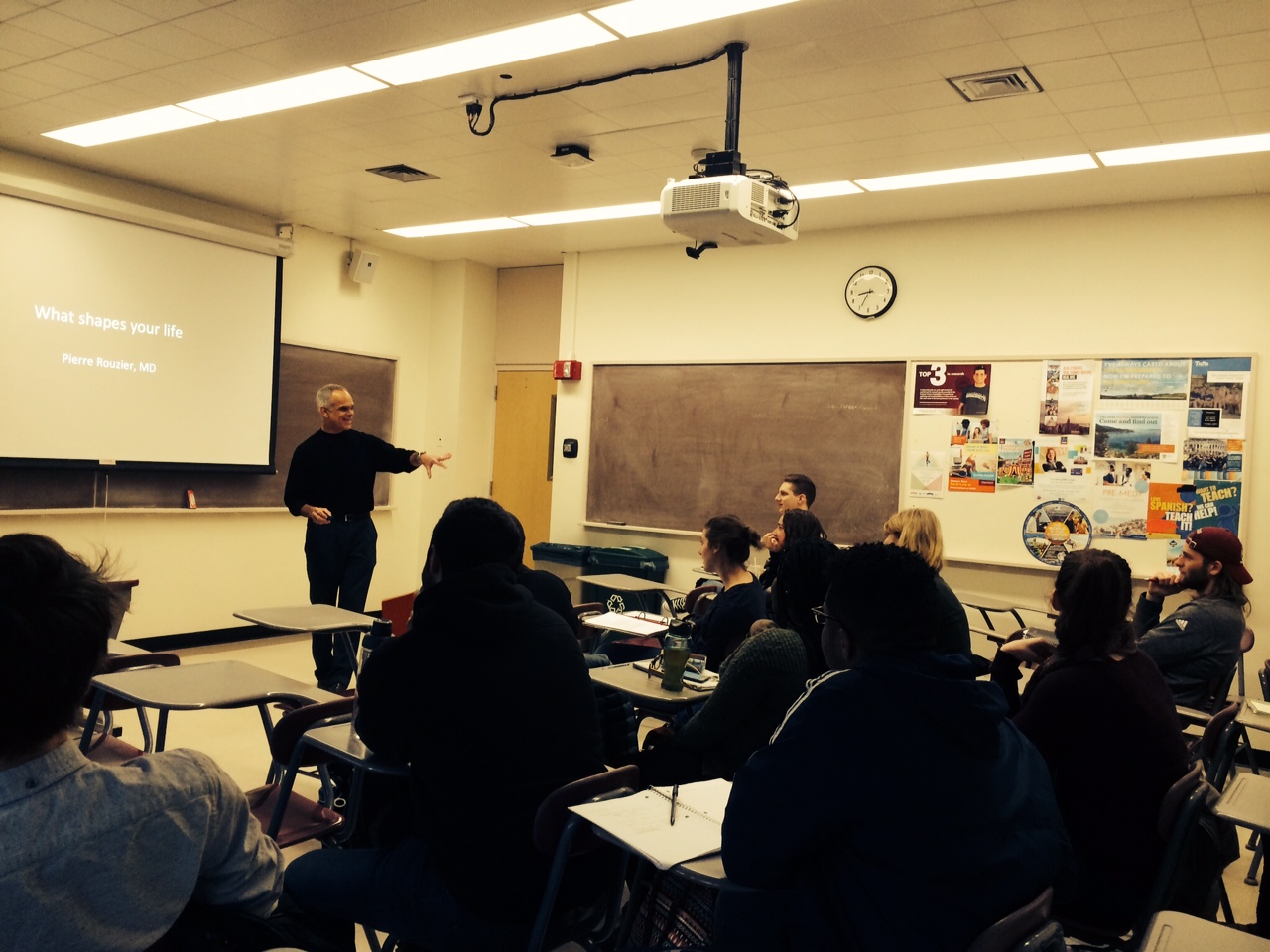
This morning, my students and I were mesmerized by the brilliant lecture of Dr. Pierre Rouzier, who spoke in my Humanitarian Logistics and Healthcare class at the Isenberg School.

Dr. Rouzier is the team physician at UMass Amherst and a doctor at our University Health Services. He is also a published author and a great humanitarian.

For many years he has also assisted in triage at the Boston Marathon, and was there at the bombing in 2013.

Dr. Rouzier's lecture was on "What Shapes Your Life?"  and he spoke on life shaping events, inspiring people to move (more on this), and also finding greatness in every day.

Last summer, he with a friend, Roger Grette, bicycled across the US, while disseminating the news on his children's book, Henry Gets Moving. It was published in 2012.

He covered 4,100 miles from Oregon through Massachusetts.  It took them 10 weeks to accomplish this feat and he said to us that "he had a life-changing summer and doesn't know if he even needed his life to change." Along the way he spoke to children and to adults publicizing his book, which focuses, in a warm-hearted way, on why children need to move more and to eat right. He showed us wonderful video clips of children, farmers, cowboys, and others along the way that were swept by his energy, openness, and passion for helping people and would chant: Ride, Henry, Ride!   He noted that, in 1980, 7% of children ages 6 to 11 were obese and in 2008, 20% were. Clearly, children eat what is provided. He stated that the obesification of America is a big problem.

Dr. Rouzier said that he is now in the last quarter of his life and wanted to take on the challenge of biking across the US and had done a lot of reading of experiences of others who had succeeded at this challenge. During his journey, he had many instances of the sense of wonder of meeting new people, serendipitous encounters with UMass connections, praying that the sun would shine and it did and then it snowed, and finding new friends along the journey.  The motto "Endure or Enjoy" from the book, "From the Atlantic to the Pacific on Two Wheels," by Alex Alvarez, served him well and continues to.

Dr. Rouzier also spoke about getting accepted at Stanford U. for his undergraduate studies but decided to go to UC Davis, due to the cost, and then went on to med school at USC because they had 13 weeks of vacation (rather than 6 as at UC Irvine) and he had fallen in love with travel (and also had a scholarship to med school). He had been a kinesiology major and had spent his junior year abroad in Edinburgh and loved it. He shared with us some of his hitchhiking stories in Europe, which were hysterical. He likes to travel OPM using "other people's money," which makes a lot of sense. While in med school he traveled to Australia, New Zealand, and Papua New Guinea, where he spent some time helping out at a healthcare facility. There he met 2 UMass Medical School Worcester graduates and ended up having his residency there. He has been at UMass Amherst since 1997 and are we lucky!

He has worked at Native American healthcare facilities, and spent 5 years in Colorado where he wrote a book, "The Sports Medicine Patient Advisor," which was inspired by a farmer who had hurt himself lifting bales of hay and could not take the time to drive a distance for physical therapy and asked him to just write the instructions down and he would follow them. Indeed, as his friend Bruce Bynum says: "The right book will set you free!"

Two of the life-changing events that he spoke about were the Haiti earthquake, which struck on January 12,  2010, and the Boston Marathon bombing, which took place April 15, 2013. We have talked about these two disasters in the Humanitarian Logistics and Healthcare class. Dr. Rouzier's father is from Haiti and he was in Haiti 9 weeks after the earthquake and was engaged in "despair medicine." At that point, many were suffering from illnesses brought about by the shock and ensuing stress. He even met a relative who lived on a hill and was one of the lucky ones.

Since Dr. Rouzier is not only an athlete, and former teacher and coach, but also a sports medicine expert, he also, for many years, has assisted in triage at the Boston Marathon. He was there during the bombing and shared with us that there was blood everywhere, the smell of burning flesh, and a surreal scene. He had been accompanied by a friend, Chad, who had recently had a child. He used a belt as a tourniquet and a fence post for a splint for a broken leg. He treated a female who said: I am going to die here and noone will know where I am." He said that he did not get her name and that it bothered him and it was very hard to get closure. The marathon bicycle journey across the US last summer, I believe, helped him tremendously, and he said that while en route he received a text from one of the victims thanking him.

The healing process was assisted also by people reaching out to him, even on Facebook, and especially UMass students doing so. He said: "people like you saved me."  His heroism and selflessness were so apparent throughout his brilliant lecture and we are so indebted to Dr. Pierre Rouzier for showing us what constitutes a life well lived. His nonprofit Team Henry is even helping out an orphanage in Tanzania. And, next week, Dr. Rouzier will again be assisting at the Boston Marathon.

Towards the end of his lecture today, Dr. Rouzier emphasized the power of positive thinking. He said that: "when you change the way you look at things, the things you look at change."

He told us that we need to look in the eyes of others and be nice - this is a choice that you can make. He said that "a stranger is a friend you have not yet met" and that "in every day there is something great about it."

We did not have much time for questions and answers but I wish that we had.

I presented Dr. Rouzier with a gift from the Isenberg School and also a certificate thanking him for being a terrific Professor for a Day! I then snapped a group photo of students with him as a memento of a truly inspirational and very wise lecture, with numerous life lessons.


Friday, March 31, 2017

Fabulous Talk by Professor Ozlem Ergun on Restoration of Network Connectivity In Large-Scale Disaster Response Problems

The weather forecast for today was dire (and it is March 31) with many area schools in Massachusetts even closing early.

Luckily, the day was just gray with some cold drizzle, and our speaker, Dr. Ozlem Ergun from Northeastern University, made it from Boston to Amherst. We had invited her to speak as part of our great UMass Amherst INFORMS Speaker Series, which the Student Chapter helps me to organize. The chapter does a terrific job advertising the talks, handling much of the logistics, including a reception prior to the talk, and providing information on its website as well as a newsletter through an e-list. Special thanks to officers: Pritha Dutta, Deniz Besik, Ekin Koker, Destenie Nock, and Amro El-Adle, for their hard work before and after the event today!

Dr. Ergun's presentation was on a topic of great interest to me - Restoration of Network Connectivity in Large-Scale Disaster Response Problems. The Chapter President, Pritha Dutta, had prepared the nice poster below announcing the talk, which also made the UMass Amherst homepage under events and was advertised at the Isenberg School on our fancy electronic displays.
Professor Ergun has been involved in humanitarian logistics and disaster relief research for a long time and joined the faculty at Northeastern University after being on the faculty of Georgia Tech. She is especially known for her work on debris removal post disasters. Her talk today focused on the restoration of network connectivity, specifically, critical infrastructure, such as transportation networks, in order to enable service networks to become, again, operational. For example, think of the destruction of roads and bridges post a disaster such as an earthquake and one wishes to deliver relief supplies and personnel from points of supply to points of demand under such conditions. Which roads should be repaired in the sense of removing debris so that they become passable and network connectivity in order to accomplish desired emergency response tasks is restored? She noted that multiperiod models are needed since in a given time period one may have only a certain amount of resources available.  She emphasized that if you can't get rid of debris you can't recover (just think of Haiti post the earthquake). Emergency agencies provide guidelines but not how to do it!

She emphasized the importance of integrating operations research and network science, which I fully concur with. Her talk especially resonated since I teach and do research on humanitarian operations and disaster relief and have also co-authored the Fragile Networks book with my former Isenberg School doctoral student and now tenured Associate Professor, Dr. Patrick Qiang.

And, coincidentally, I was just teaching the Nagurney-Qiang network performance measure and importance indicator for both nodes and links in my Humanitarian Logistics and Healthcare class last week!

I very much like how Professor Ergun emphasized that it is not just the topology of a network (or graph) that matters, before and after destruction/deterioration, but also what services are provided on the network! Since operations researchers care about  a variety of activities on networks from transportation and logistical flows to even financial and informational flows, this is quite "natural" for us. I also would put this in the area of "supernetworks."

She shared with us a network betweenness measure which she had extended with her doctoral students and then took us on a fascinating journey of a case study of resiliency of Boston versus Manhattan (two of my favorite locations on the planet)! She also presented an optimization problem, which one would need to solve in seconds consisting of the maximization of the benefit of making the connections over the time periods, given supply and demand points, and a variety of constraints.


Professor Ergun brought several of her PhD students and members of Northeastern's INFORMS Student Chapter to UMass Amherst, which made her visit extra special since our UMass Amherst INFORMS Student Chapter members could interact with their "sister" chapter in (eastern) Massachusetts.

I hosted the lunch at the University Club and the service and food were fantastic. Although it is a Friday, I suspect that many others had cancelled because of the weather forecast, which did not come to fruition! We enjoyed the clam chowder and the salad with crab cakes and we shared the chocolate torte, lemon mascarpone cake, and the cheesecake, which we had with tea and coffee.

Professor Ergun made it back safely with her students to Boston.

Tomorrow is April Fool's Day and there is snow, again, in the forecast! Operations researchers are resilient and we are so grateful to Professor Ergun for coming to UMass Amherst to speak and for also bringing some of her students and chapter officers of the INFORMS Student Chapter at Northeastern University!

Sunday, March 26, 2017

Isenberg School of Management PhD Students and Faculty Shine at NEDSI Conference

Yesterday was a glorious day and the last day of the Northeast Decision Sciences Institute conference, which took place March 22-25, 2017, in Springfield, Massachusetts. The full conference program can be downloaded here.

Given the proximity of Springfield to Amherst, Massachusetts and also the opportunity to network and to present papers, this was a conference that my doctoral students in Management Science and I were very much looking forward to.  The conference was wonderful and below I share just a few of the highlights and also some pleasant surprises.

My doctoral student in Management Science, Shivani Shukla, presented our paper on freight service provision security investments for high value cargo on Thursday.


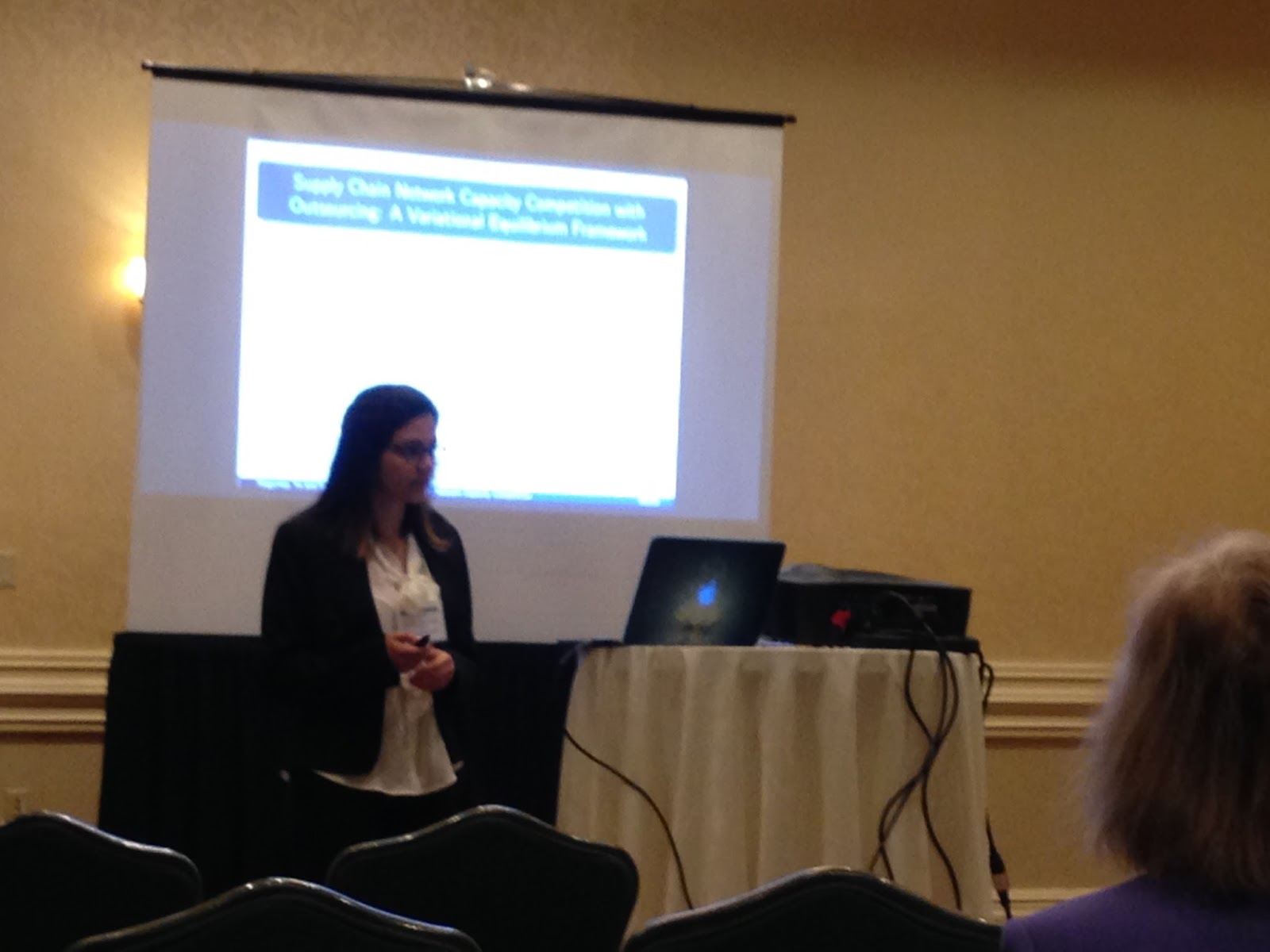
Yesterday, Deniz Besik, presented, for the first time at a conference, our paper, which was recently accepted for publication in the Journal of Global Optimization.

Then it was time for Pritha Dutta to present on our work on game theory and blood donations.

Our PhD students were terrific at answering questions from the audience and also enjoyed seeing other colleagues from the College of Engineering at UMass Amherst and even UMass Boston! Their full presentations can be downloaded here.
Also, the other Professor Nagurney - Dr. Ladimer S. Nagurney, enjoyed seeing his colleague from the Barney School at the University of Hartford.

Everyone appreciated very much the attention to detail with numerous delicious receptions throughout the day.

Last evening, before the sumptious gala banquet, we had the pleasure of hearing my colleague, Nirenberg Chaired Professor Charles "Chuck" Manz, deliver a keynote talk on Twisted Leadership. His presentation was fascinating as he took us on a journey discussing self-leadership, super leadership, shared leadership, and socially responsible leadership and how all of these should be intertwined like a rope. We had front row seats for his talk.
He was introduced by the conference organizer, Dr. Minoo Tehrani.

His talk was interspersed with many interesting cases from practice as well as words of wisdom from leaders over the centuries and also jokes.

Then it was time for the banquet!
The food was delicious and we thank the organizer and the venue - the Marriott in Springfield - for the soup, salad, roasted veggies, potatoes, beef, chicken, and salmon and incredible desserts!

Towards the end of the banquet, the awards were announced and what a truly special surprise awaited us.

The PhD presentation awards were swept by Isenberg School of Management PhD students in Management Science! A big congratulations to Pritha Dutta, who received the first place award for presenting on our work on blood donations, and to Yueran Zhuo, whose advisor is my colleague, Professor Senay Solak, and who spoke on management of cybersecurity investments, and received the second place award.

Pritha was presented with the first place award by Dr. Joy Field of Boston College and Dr. Minoo Tehrani.
Many thanks to all those involved for such special memories and congratulations to our wonderful Isenberg School PhD students in Management Science! Being able to present in an engaging and informative way on challenging, technical problems with enthusiasm and clarity is quite an accomplishment!

Tuesday, March 21, 2017

The Syrian Crisis and a Humanitarian Hero - Dr. Mahmoud Hariri

Today we had the great honor of hosting Dr. Mahmoud Hariri, who is a Scholars at Risk Fellow at Harvard University, as a guest speaker in my Humanitarian Logistics and Healthcare class.
 
 His guest lecture on the Syrian Crisis had been scheduled for March 7, but, since he had gotten into a course at the Macy Institute at Harvard, he asked for a postponement, and I graciously agreed. It was worth waiting for him!

There were logistics involved even in terms of getting him to speak to my class, which meets on Tuesdays and Thursdays at 8:30AM at the Isenberg School of Management. Since he is now at Harvard University for a few months, before returning to his home country of Syria, I arranged for a 6:15AM pickup in eastern Massachusetts and he arrived at the Isenberg School at 8:15AM!  Last night he had been busy speaking on a panel at Harvard and meeting with Syrian doctors until midnight.

Dr. Hariri has to be one of the bravest people I have ever met and, in teaching this course and working on disaster relief and operations research, I have communicated and interacted with many courageous and outstanding scholars and practitioners in this field.
He began his presentation by providing us with an overview of the Syrian Crisis and illustrated his presentation with numerous personal experiences. As a trauma surgeon, he has had to work in (and is now even helping to construct) makeshift hospitals, has driven an ambulance (these are usually covered in mud to camouflage), and has seen healthcare facilities targeted with bombs, especially using a double bomb attack tactic.

He shared with us conditions in prison that are so horrific I will spare you the details, but even children are imprisoned for "crimes" allegedly committed by a parent, which could even involve giving medical care to a patient.


Elderly parents are not spared.

He stated that high school students have three options, once they graduate:
1. become a refugee
2. carry arms and become a militant
3. continue one's education, if feasible.


Through incredible creativity and the novel use of technology he is working on educating medical students in Syria, most of whom will not be trained doing dissections, but will work directly on patients, many suffering from war wounds due to bombs and other weapons.


One hospital that he has worked at was targeted 25 times. The health system in Syria has almost collapsed with more than 50% of those working in hospitals now volunteers.


For security, they have moved hospitals underground and emergency rooms are sometimes located separately from hospitals to reduce the chance of detection and strikes. Dr. Hariri, has, at times, had to operate on patients, who are blindfolded, so that they don't recognize him in the community as a doctor, since medical professionals are targeted.

His creativity, drive to do good and help, have resulted in such innovations as having 5 ICUs being monitored from the US, medical education via smart phone, and with students studying on smart phones. He emphasized the importance of learning English among students in Syria and that even a warehouse of books was destroyed by the regime. Many of the books had been provided by the Dutch.  2 and a half million children in Syria are not in formal schools and mothers are trying to home school children.

Some of the bombs that are being dropped are in the form of toys.


There are now 5,000 Syrian doctors in the US but fewer than 2,000 in Syria.

To show you how dire the situation is, when speaking to militants, he was told that they did not want a hospital located in their area, since it was too dangerous!  What a challenge for operations research and applications of location theory!

Dr. Hariri believes that education is essential and will be pivotal in changing the crisis in Syria, a country in which dozens of weapons have been used in experiments.


His presentation, on Prezi, can be viewed here.


The love for his country, his brilliance, ingenuity, dedication, energy, and passion for doing what is right shone throughout his presentation today.

Below is a photo taken after his lecture. I presented him with a plaque for being a Professor for a Day and also a gift from the Isenberg School.

Afterwards, several students lingered to ask him more questions.
Many thanks to a humanitarian hero - Dr. Mahmoud Hariri, for a lecture that noone in the audience will ever forget.

For a nice article on Dr. Hariri in the Harvard Gazette, click here.

Thursday, March 9, 2017

Game Theory and Fresh Produce Supply Chains - It's About the Fruits and Veggies

Is there anything more delicious than a ripe peach or mango? Or, perhaps, you love biting into a sweet, crisp apple? I love my fresh fruit and veggies and, frankly, we are spoiled, in a sense, in the US, where we can savor berries and cherries even in the winter. You probably also enjoy a variety of vegetables and I am not speaking of just French fries.

At the same time, when the "fresh" produce is not so fresh, one gets quite disappointed and the wastage associated with this industry is vast. Quality of fruits and vegetables is a topic, hence, of great research and practical interest and not only for food scientists and economists,  but operations researchers as well.

The first paper that my group published on fresh produce supply chains was: Competitive Food Supply Chain Networks with Application to Fresh Produce, Min Yu and Anna Nagurney, European Journal of Operational Research 224(2): (2013) pp 273-282, a paper that is highly cited and was even recognized by the Editors of the journal in a special session last July at the fabulous EURO conference in Poznan, Poland. You can read my blogpost, which even has photos of delicious pierogies here.

In this paper, we utilized game theory to capture competition among food firms, who differentiate their products, which are perishable, and we applied the model to a case study of cantaloupes, subject also to a disruption. Indeed, there have been some major quality issues resulting in food-borne illnesses in this sector. Quality in this paper was modeled using a generalized network framework with link multipliers and it was assumed that as the fresh produce "moved" over links in the supply chain that a certain percentage would "perish" and would, hence, be discarded.

More recently, we turned to short fresh produce supply chains in the form of farmers' markets.  In the paper, Quality in Competitive Fresh Produce Supply Chains with Application to Farmers’ Markets,
Deniz Besik and Anna Nagurney, which is now in press in Socio-Economic Planning Sciences, we used kinetic formulae to model quality deterioration over time and under temperature conditions. I think that this is super cool and very much enjoy bringing scientific disciplines from chemistry to physics to operations research supply chain modeling.  We then applied the model to apple farms in western Massachusetts, and, since one of the farms was Apex Orchards (one of my favorites), below I have photos of their relatively new store in Shelburne Falls.
And I can't resist sharing the photo below of the bridge of flowers in neighboring Shelburne.
In Amherst, we have a farmers' market from May through October in downtown, which is very enjoyable and also highly social. The Farmers' Market then moves indoors for the winter and whenever we are in town we always visit and purchase produce. You know where it is coming from and when it was picked. Our paper we dedicated to Robert Colnes, who owned an orchard in New Salem and who was a fellow Brown University alumnus. Deniz had interviewed him multiple times. He passed away a few months ago at age 96 and before we could share with him the good news that our paper had been accepted for publication. He was so generous in answering questions.

Last spring/summer I spent several months as a Visiting Fellow at All Souls College at Oxford University (a simply heavenly intellectual and aesthetic experience that will be very hard to top). While at Oxford I would regularly go to the Farmers' Market in the center of Oxford and the photos below capture some of the spirit of it.
The food stalls at the Oxford Farmers' Market are fabulous and there is a wide variety of ethnic cuisines for purchase.


In the paper, Supply Chain Network Capacity Competition with Outsourcing: A Variational Equilibrium Framework, Anna Nagurney, Min Yu, and Deniz Besik, in press in the Journal of Global Optimization, we used game theory, but the governing equilibrium concept was a Generalized Nash Equilibrium (rather than a Nash Equilibrium as in the above papers), since the producers' constraints, and not just their utility functions, depended on the strategies of the other producers.  The case study was to apples in western Massachusetts. We used variational equilibrium to formulate the problem.

What I find so special about the discipline of Operations Research is that you can work on what you love and that includes food supply chains!