Showing posts sorted by relevance for query rick lee. Sort by date Show all posts

Friday, March 28, 2014

The Power of One

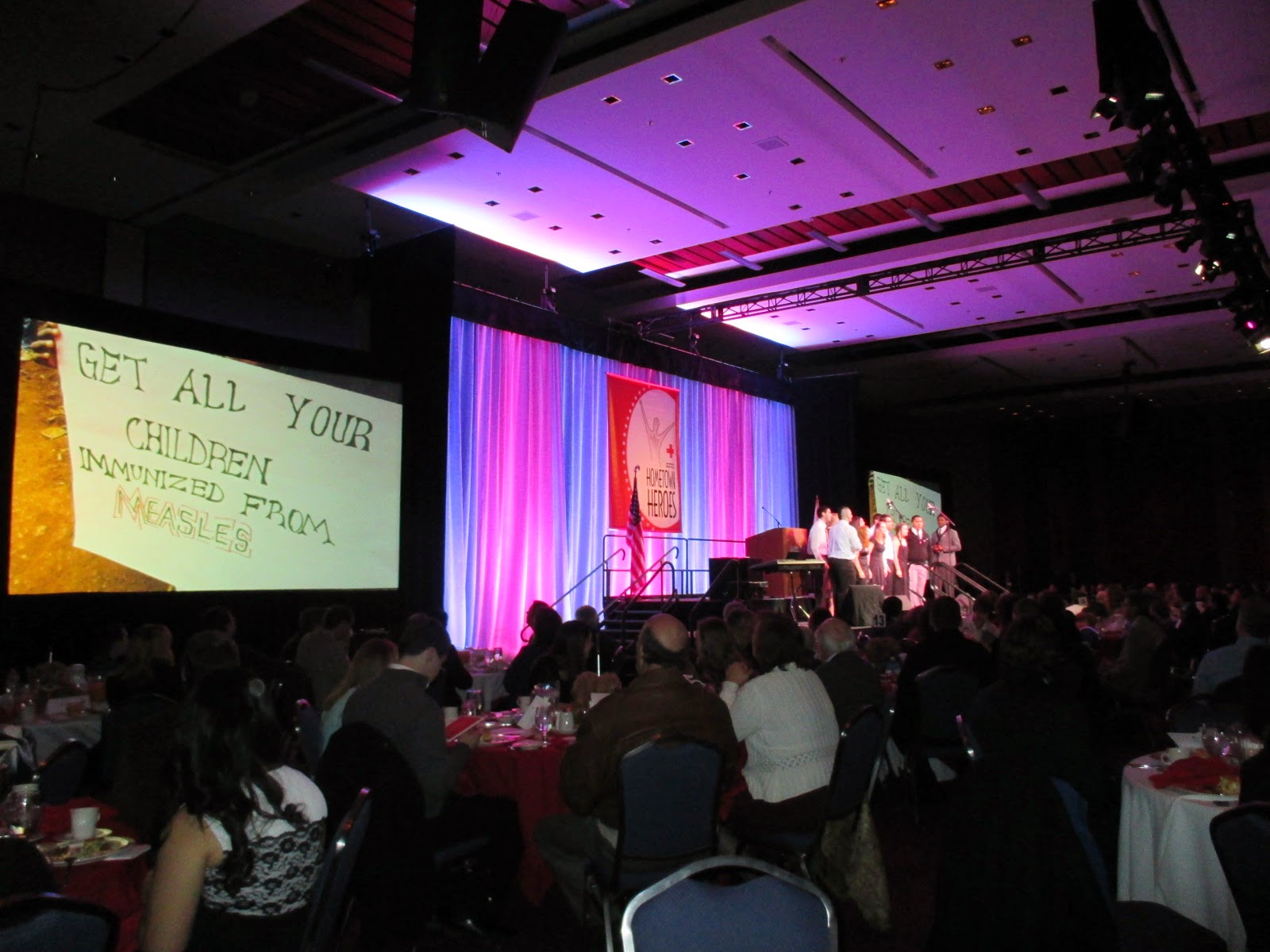
Yesterday, Nate Lare and I had the pleasure of attending the Hometown Heroes event at the Mass Mutual Center in Springfield, as guests of the Executive Director of the Pioneer Valley Chapter of the American Red Cross, Mr. Rick Lee.

Mr. Lee, along with several other community leaders and experts in emergency and disaster preparedness,  have spoken this semester in my Humanitarian Logistics and Healthcare class at the Isenberg School. I recognized them in a Guest Editorial that I wrote and that was recently published on masslive.com.

The Hometown Heroes event was truly inspiring with about 600 in attendance!

Eleven area residents were recognized by the Red Cross for "selfless acts of courage." A nice photo of these extraordinary individuals, including teenagers appears on masslive.com. Their acts, whether by giving blood hundreds of times, starting a sports program for disabled children, or, in the case of several individuals,  saving lives after accidents, fires, or health incidents, are exceptional!

I took the photos below at the event yesterday and commend the Red Cross for all that it does! Mr. Rick Lee announced at this event, at which he also received a Lifetime Achievement Award from the Red Cross for his 30 years of extraordinary service, that he will retire as of this August. Who will replace him?

The ending video to the theme and music of The Power of One was especially moving with many in the audience tearing up. It featured such extraordinary women as Clara Barton, Rosa Parks, and Anne Frank, with a segment on Mr. Rick Lee (which was a complete surprise to him). What a difference he has made through his work ethic, integrity, energy, and the building of powerful friendships and relationships. Who can say no to this amazing man!

So if, at times, you feel that you are all alone, know that you can, as the above individuals have, and the Hometown Heroes, as well, through The Power of One,  make a big difference. You can provide your students, colleagues, neighbors, and even strangers with a helping hand, a kind word, spiritual and physical sustenance, a smile, a token of appreciation, a congratulatory note, a conversation. Perhaps, through additional actions, research, writings, and a book you might even change the world! Never lose the courage to do what is right.

And, since, regrettably, the photo of  Mr. Rick Lee, Nate and me together at the event did not come out, I repost the photo taken of Mr. Rick Lee when he spoke to the students in my class this past February.
Nate is on the far left. And, to emphasize the amazing students in our Operations & Information Management program at the Isenberg School of Management at UMass Amherst that I am privileged to teach, Nate was a Hometown Hero in 2011 -- simply awesome! Nate alerted residents when a fire gutted their apartment complex.

Although this year's closing video is not online yet, I urge you to view last year's, which includes images of Clara Barton, Rosa Parks, and Anne Frank:


Wednesday, March 26, 2014

Hometown Heroes and Why I Wrote a Guest Editorial

Tomorrow morning, one of my Operations & Information Management students, who is in my Humanitarian Logistics and Healthcare class that I am teaching this semester, will be attending with me the Hometown Heroes event at the Mass Mutual Center in Springfield, MA.

We will be the guests of Mr. Rick Lee, the Executive Director of the Pioneer Valley Chapter of the American Red Cross, who spoke in my class in February.

The Pioneer Valley Chapter of the American Red Cross provides emergency response in Hampden, Hampshire and Franklin counties in western Massachusetts and is also behind a model call center for servicemen.

According to a lovely article in The Springfield Republican: The chapter created the Hometown Heroes program in the wake of the terrorist attacks of Sept. 11, 2001, Lee said. The idea was partially to help bridge gaps in funding left when so much charitable giving went to causes related to those attacks.
But the larger reason was, and remains, giving the community a way to honor people who go above and beyond to help others.

And in the beautiful words of Mr. Rick Lee:
"We are celebrating one of the most beautiful aspects of the human heart, which is kindness," Lee said.

This year 9 Hometown Heroes will be honored.

In addition to Mr. Rick Lee, this semester, we have hosted Mr. Jeff Hescock of UMass Amherst, Dr. Pierre Rouzier of UHS at UMass Amherst, Mr. Dave Madsen of WGGB, and even the other Dr. Nagurney, my husband, who gave a guest lecture on Disaster Communications.  The students and I were so inspired by these remarkable individuals that I wrote a Guest Editorial, Community Experts Enhance Disaster Management Education as Guest Speakers at the Isenberg School of Management at UMass,  about their talks (with the exception of my husband's since he was guest lecturing when I was out of town), which was published the other day on masslive.com.

I had to thank these very special people in a public way and that is why I wrote the Guest Editorial, which also features a photo of Mr. Rick Lee with the students in my class.

In addition, the Isenberg School of Management posted a two-part series on this course focusing on the presentation of Dr. Rouzier and also that of Mr. Madsen. Many thanks to the Communications Department and especially to Mr. Lou Wigdor who attended these lectures and wrote them up so eloquently.

We have amazing people in our midst, which deserve special honors and recognition and among those I include the above individuals.

We look forward to seeing Mr. Lee of the Red Cross again tomorrow and honoring this year's Hometown Heroes for their exceptional courage!  Even two UPS drivers will be honored (perfect humanitarian logistics example!)

Friday, February 21, 2014

A Truly Inspiring Lecture by Mr. Rick Lee of the Red Cross at the Isenberg School

Yesterday, we had the distinct honor and privilege of hearing from Mr. Rick Lee, the Executive Director of the American Red Cross, Pioneer Valley Chapter.  He was a guest lecturer in the Humanitarian Logistics and Healthcare course that I am teaching this semester at the Isenberg School of Management.
Mr. Lee oversees 38 employees and 1,000 volunteers and was instrumental in the development of the Service to the Armed Forces (SAF) program with a focus on communications.

We heard about Henri Dunant, the Swiss businessman,  who led what became the international Red Cross movement in the mid 1800s, received a Nobel Peace Prize, but then lost his business and died as a penniless hermit in Switzerland. Mr. Lee spoke about the Geneva Convention and how it is imperative to inject humanity in the inhumane act of war. He also spoke about the amazing Clara Barton, all 5 feet and 90 pounds of her, who, after a trip to Switzerland, realized what needed to be done and, through her incredible leadership abilities, founded the American Red Cross. She did so in 1881 at age 60 and continued to lead it for 23 years!

The foundation of the Red Cross is trust and ethics and contact with donors and volunteers. The provisioning of food, shelter, evaluation of how bad it is, and communications to the public, are all aspects of Red Cross activities in disaster relief. Mr. Lee also emphasized that disaster relief is "a team sport." Interestingly, he also said that there is emphasis now on mitigation, as well.

We heard of the lessons learned from Hurricane Katrina and the need to understand different community groups and their roles as well as the great importance of communications with stakeholders.

We were very surprised to learn that since the Red Cross depends on financial donations, that if these were to stop, the Red Cross would shut down in only 180 days! My former doctoral students, who are now very successful international professors, Dr. Tina Wakolbinger and Dr. Fuminori Toyasaki, have done research on the modeling of financial flow of funds for disaster relief and the earmarking of donations.

We also heard about the tremendous role that the Red Cross played in sheltering and feeding hundreds of people for a month after the tornado hit Springfield, MA on June 1, 2011. He also emphasized how helpful private organizations are and can be in disaster relief by providing discounts for much-needed supplies, warehousing between disasters, and helping with deliveries. He singled out Walmart and Big-Y supermarkets and even noted hotels and motels who provide discounts for sheltering purposes.

He also emphasized the importance of buying locally and the importance of building relationships over time so that,  when disasters strike, one is ready. He even told us of free mobile apps for first aid and emergency preparedness offered by the Red Cross, including earthquake and tornado warning apps.

What is the power of one person? Clara Barton changed the world and over a century before the Internet. her impact continues to this day.

Mr. Lee, your presentation changed all of us. Thank you for being the heart and soul of our American Red Cross and our Hometown Hero!


Wednesday, February 22, 2012

Humanitarian Relief and the Red Cross -- What We Learned

Yesterday, we had the privilege and honor of hosting a guest speaker in the Humanitarian Logistics and Healthcare course that I am teaching at the Isenberg School of Management.

Our speaker was Mr. Rick Lee, who has worked for the Red Cross for close to three decades and is the Executive Director of the Red Cross Pioneer Valley Chapter. He is in the photo above with some of the students. He is a regular guest on radio and TV programs and it was very special that he took the time out of his busy schedule to educate us.

In his presentation, he overviewed not only the history of the Red Cross, even going back to Clara Barton, but also described its various symbols from the Red Cross (see photo below) to the Red Crescent and the Red Crystal, which was introduced in 2006.

The founder of the Red Cross, Henry Dunant, was the first recipient of the Nobel Peace Prize in 1901 and the Red Cross has received 3 Nobel Peace Prizes. The Red Cross has to be politically neutral and relies entirely on the donations of others from time to money to blood.

Keeping the trust of people is job #1 and its principal role is in disaster and emergency response; hence, it has to guarantee the safety of the products that it provides (including food) as well as the integrity of its volunteers and paid staff (not many).

When the tornadoes hit our area on June 1, 2011
, and affected an area 1/4 of a mile wide but 39 miles long, the coordination and teamwork that took effect and the role of the Red Cross in it was amazing. The devastation was mapped by individuals walking the areas.

The Mass Mutual Center in Springfield was the major area shelter and the Red Cross served thousands of meals and thousands of snacks through June 30, providing personal care packages, as well as securing healthcare and even support for finding housing. Mr. Lee showed us photos of the devastation and the assistance that followed, with many major corporations, in addition to Mass Mutual, donating thousands of dollars and some bringing water and energy drinks in truckloads.

The Red Cross relies on trust and, hence, financial donations are what is sorely needed during and post disasters as well as trained volunteers (who have undergone background checks). After the tornado disaster, all 100 volunteers showed up (of different religions, races, and professional status, but all joined by the desire to help) without even being called. He told us how he then called 100 individuals representing various corporations to get financial assistance and of the many who responded. A gentleman from Colorado, with ties to Springfield, who had heard abut the unexpected devastation sent in a $100,000 check to help in relief operations.

As for who lifted the spirits of the amazing Red Cross volunteers at the Mass Mutual Center -- none other than Bill Cosby. He showed up and, I might add, he has a doctorate in education from UMass Amherst. He also entertained those who had been displaced to the shelter and lifted their spirits (but he did it outside on Manor Square).

Mr. Rick Lee emphasized many of the aspects of emergency response and disaster relief that we have been covering in the course that I am teaching (without even being prompted) and he brought his depth of humanity and years of experience with humanitarian relief work to the students. One can prepare for high probability, low impact events but the low probability, high impact events are the truly challenging ones (and Massachusetts and New England have certainly had their share of such events this past year alone).

He told us about how someone he knows, after hearing on the news that day that a tornado was to strike, called his wife because the meteorologist was projecting a certain path for the tornado in Springfield and it was to hit their house. He told his wife to put the car in the garage and to go into the basement bathroom and to get in the tub -- the tornado struck 4 minutes afterwards-- the house was leveled, but his wife survived and crawled out from under the rubble. This meteorologist, according to Mr. Lee, saved numerous lives, and will be honored as a Hometown Hero later this season.

He told us about how a preschool in Springfield with 24 children was also leveled but that everyone survived because they had also made it to the basement. When the caretakers and children stumbled out of their destroyed preschool, they saw in front of them a schoolbus (Mr. Lee invoked God here) with child seats and a driver who ferried them all away to safety.

One must understand that trees were downed, houses and buildings were destroyed, certain roads impassable, and electric power lines were down. That month of June, Mr. Lee and the Red Cross volunteers worked 16 hour days.

He also told us that what is needed in those who work in humanitarian organizations and operations is kindness and integrity (but he also said that he wishes that there were courses such as the one I am teaching when he went to college). He emphasized the importance of relationships and communications with the former taking time to develop.

He told us to "Do the Right Thing," although it may not be politically popular and it may be very difficult.

As for the personal rewards of such hard work -- clearly the rewards are not monetary, but as Mr. Lee told us yesterday, when you help someone during his/her darkest hours, there is no greater reward.

The class was too short and some of us continued the conversation with him as he left the Isenberg School of Management.

Tuesday, February 24, 2015

Thanks to Kim Goulette, Executive Director of the Pioneer Valley Chapter of the American Red Cross

Yesterday, the new Executive Director of the Pioneer Valley Chapter of the American Red Cross in western Massachusetts, Ms. Kim Goulette, spoke to the students in my Humanitarian Logistics and Healthcare class.

Ms. Goulette assumed this position after the retirement of Mr. Rick Lee, who had served with the Red Cross for over 3 decades and who spoke to my students in previous years on 2 separate occasions. As Kim said to the students: "She has big shoes to fill!"

She provided the class with a brief history of the Red Cross and Clara Barton, of course, and emphasized what is unique about the Red Cross as a nonprofit organization, which was very interesting. The Red Cross provides immediate response to people in need because of disasters  and, in a sense, consists of  "first responders," about 97% of whom are volunteers.  Whether it is food, blankets, drinks, or even teddy bears for children in the nearterm, or shelter, food, and resources during the recovery phase, Red Cross volunteers are there to help. I saw such teddy bears last spring when I had the honor of attending the Hometown Heroes breakfast in Springfield as a guest of Mr. Rick Lee's.

Ms. Goulette spoke about the big fire in Amherst last summer in an apartment complex at which she assisted after only about 1 week on the job.She also spoke about the role of the Red Cross in feeding the National Guardsmen who were deployed to eastern MA because of the multiple immense snowfalls this winter that disrupted lives, transportation, and other infrastructure because frozen and burst pipes and collapsed roofs.

She mentioned the gains for the community through the new Red Cross Springfield headquarters with its activities, including blood donations, under one roof. This consolidation has resulted in increased efficiencies in disaster responses.

Ms. Goulette highlighted the various activities of the Red Cross in communities that some may not be as aware of, such as the call centers for military families (Rick Lee's brilliant idea), CPR training and certification, youth programs, international programs, and volunteer training.

She shared many fascinating facts with us such as that every 9 minutes the Red Cross is responding to a disaster and it spends $360 million preparing for disasters. It is entirely dependent on donors for funding and she mentioned the challenges associated with financial donations that are earmarked for a particular disaster. In the US, there are 61,000 shelter sites, which include schools, and with the mobile kitchens, the RC is able to serve up to 1 million meals a day.  I was curious so I asked what meals the National Guardsmen were provided in the Boston area recently and she mentioned chicken soup, peanut butter and jelly sandwiches, hot chocolate, and coffee. The volunteers get woken up at 2AM and then retrieved the supplies for delivery in eastern MA.

I found the challenging new landscape of blood donations and collections very interesting since, along with two of my doctoral students, who are now professors, Amir H. Masoumi, and Min Yu, I wrote several articles on blood supply chains.  She mentioned "competition" in the blood supply chain industry, which one would not normally think of, different surgical procedures, which are resulting in less blood loss and, hence, need for transfusions, and also the emphasis on decreasing wastage. The Red Cross now supplies only about 40% of the blood in the US. We in Operations Management always care about supply meeting demand and, in this sector, there is the perishability aspect of blood, and uncertainty as to demand (for unscheduled procedures due to accidents, for example) as well as to supply (will the donors show up and, if so, how many).

There were many questions from the students and I am sure many thoughtful reflections that continue.

Thanks to Ms. Kim Goulette for the great lecture and to the American Red Cross and other Red Cross societies for great work in disaster relief and reducing human suffering!


Wednesday, March 5, 2014

UMass Amherst INFORMS Student Chapter Presents Panel on Teaching

This semester I have been very busy teaching my course on Humanitarian Logistics and Healthcare and a Management Science seminar on Variational Inequalities, Networks, and Game Theory. Both of these courses are interdisciplinary with students from the Isenberg School of Management, the College of Engineering, the School of Public Health, and the Computer Science Department.

In a recent exchange with the President and CEO of the America Red Cross, Ms. Gail McGovern (we were communicating about the great guest lecture of Mr. Rick Lee in my course), she said many things that resonated with me but the below was especially beautiful:

Having come straight from teaching MBAs to the Red Cross, I know firsthand that yours is such a noble profession.  I still keep in touch with many of my students, and I'm proud of  every one of their accomplishments.  It's truly the gift that keeps on giving.

How very  true!

And, this Friday, our great UMass Amherst INFORMS Student Chapter will be hosting a special panel on teaching in which our very own PhD students in Management Science will be sharing their experiences with a lot of exciting Q&A and discussions I am sure.

Refreshments are at 11:00AM with the panel and discussion from 11:30-12:30 in Isenberg Room 128.

Please join us if you can.

The students  prepared the poster below. In this day and age, we need to all also be graphic artists.
 Some very valuable teaching also takes place outside of the classroom!

Sunday, March 18, 2012

Disaster Communications and Humanitarian Logistics


Last week, the students in my Humanitarian Logistics and Healthcare course at the Isenberg School of Management at UMass Amherst had a guest lecture on Disaster Communications.

I had told the students, before I left for Gothenburg, Sweden, that there would be a surprise guest lecturer on March 13, who would be speaking to them on Disaster Communications.

The surprise guest speaker was my husband, Professor Lad Nagurney, who is an expert on computer engineering and communications, among other topics related to hardware. He has also been a ham radio operator for many years.

Throughout the semester, the theme of communications, and the importance of communications in emergency preparedness and response has been resonating.

To-date, the class has heard from such experts as: Mr. Tom O'Regan, emergency preparedness and business continuity manager at UMass Amherst, Mr. Rick Lee of the Red Cross, and Lt. Col. James Sahady of the National Guard.

The presentation on Disaster Communications has now been posted. It discusses trade-offs among different modes of communications and their resilience (or lack thereof) in disasters, along with the Tampere Convention, which the US as well as Russia have yet to ratify.

During the Bellagio Center workshop, Humanitarian Logistics: Networks for Africa, that I organized, under the auspices of the Rockefeller Foundation, the participants had the privilege of hearing Dr. Cosmas Zavazava of the International Telecommunications Union speak on Bridging the Last mile gap through Telecommunications/ICT in Disaster Management. My husband had actually suggested Dr. Zavazava, since he was well-aware of his leadership in this area, and his presentation was outstanding. This workshop, which took place in May 2008 at Lake Como, Italy, was sandwiched between the cyclone that hit Myanmar/Burma and the Sichuan earthquake in China (obviously I had not planned the workshop this way).

Resilient communications assist in a more timely response and enable the flow of critical needs supplies to the victims at points of demand. They are also extremely important in recovery operations and in reestablishing connections among family members and in getting the news out.

Without communications, disaster relief operates in a complete vacuum.

Thursday, January 8, 2015

Looking Forward to Teaching My Humanitarian Logistics and Healthcare Course at Isenberg

I have been enjoying working on my lectures for my SCH-MGMT 597LG - Humanitarian Logistics and Healthcare course during this winter break. I will be offering this course for the third time at the Isenberg School of Management (and have even taught a very condensed version of it at the Vienna University of Economics and Business while I was on sabbatical).

Some of the topics that I will be covering are:
  • Commercial vs. Humanitarian Supply Chains
  • Disaster Management Phases from Preparedness to Recovery
  • Supply Chain Risk Management
  • Fundamental Issues in Humanitarian Logistics
  • Network Performance, Robustness, and Resiliency
  • Learning from Disasters – Business and Humanitarian Ones
  • An Integrated Disaster Relief Model
  • Perishable Product Supply Chains in Healthcare
  • Earmarking and Financial Funds
  • Critical Needs Supply Chains Under Disruptions. 
The course attracts students from the Isenberg School of Management, the School of Public Health, and the College of Engineering.  Experts who are practitioners in the subject domain provide the students (and me) with deep insights and personal experiences. Last year, we benefited from lectures by Mr. Rick Lee of the Red Cross, who has since retired, and who made a lasting impact on this organization and numerous people through his 30 years with this organization, and from Dr. Pierre Rouzier, our UMass sports team physician, who spoke on his efforts during the Boston Marathon bombing to save lives and post the Haitian earthquake. We also had the pleasure of hearing from Mr. Jeff Hescock, the Director of  University Emergency Management and Business Continuity, We heard from Mr. Dave Madsen, a renowned news broadcaster in western MA with over 40 years of experience. In addition, my husband, Professor Ladimer S. Nagurney, spoke on disaster communications.

I have done a lot of research in this area with several members of my supernetworks team so the lectures are always being updated and are very current. And, hot off the press, is our paper, 
An Integrated Disaster Relief Supply Chain Network Model with Time Targets and Demand Uncertainty, Anna Nagurney, Amir H. Masoumi, and Min Yu, in Regional Science Matters: Studies Dedicated to Walter Isard, P. Nijkamp, A. Rose, and K. Kourtit, Editors, Springer International Publishing Switzerland (2015), pp 287-318. This book volume also contains a paper by the Nobel laureate in Economics, Professor Paul Krugman.

We were so inspired by the speakers and the value that they added to the course and the students' knowledge that I wrote a Guest Editorial about these "Hometown Heroes." 

This year, we will also be covering the Ebola crisis in western Africa, and the lessons learned. 

I'll be periodically blogging about this course and the speakers this year, so do stay tuned and stay warm!