On April 24, 2018, the students in my Humanitarian Logistics and Healthcare class at the Isenberg School and I had the special experience of taking a field trip to the North Amherst fire station, which is located at the corner of East Pleasant Street and Eastman Lane in the tow n of Amherst, Massachusetts. I was delighted to see that several students bicycled (one even used a UMass shared bicycle); some took the bus, and a few drove. The class would meet from 8:30-9:45AM so this was also the time for this very special field trip.
I would like to publicly thank the great Amherst Town Fire Department Chief Tim Nelson, and his outstanding team of firefighters, for this very special educational experience. In fact, it was hard to pull the students (and me) away at 10AM, even though several students had classes meeting down the hill at the UMass Amherst campus, afterwards!
The field trip began with an overview by Chief Tim Nelson as to the operations of the fire department and that it serves a community of 125 square miles with, typically, about 6,000 service calls a year. One aspect of the firefighters that is quite exceptional is that they are all cross-trained as EMTs, which many of the students marveled at. That very morning, there had already been 3 service calls before 7AM. The crew works quite an interesting schedule: 24 hours on, one day off; 24 hours on, and then 5 days off. Given that the population that they serve includes 25,000 students in just the UMass Amherst campus alone plus a wide range of ages of the neighboring population, the challenges are immense. The Amherst Fire Department provides extraordinary services with limited resources. For example, the neighboring city of Northampton has twice the firefighting staff as does Amherst.
It was a wonderful overview presentation with the Fire Chief and the firefighters chiming in and answering many questions that we had. Given the community that we live in, the Fire Chief told us that, if something goes wrong, it is, typically, the fire department that gets called, whether it is electric or plumbing problems or cats stuck in trees and, of course, a variety of medical emergencies as well as fires. He spoke of the importance of emergency preparedness and shared with us that the department had already prepared for the Cardi B concert that was to take place the next day at the Mullins Center (yes, I had one student go) since UMass Amherst had beat out over 5 dozen universities to earn this free concert with 7,500 tickets given out.
Highlights of the field trip included exploring the stunning fire trucks and the ambulances! I was told that, because of the height of firetruck ladders, I should never stay in a hotel room above 7 stories - advice, which I think many of us will heed.
The students and I truly appreciated this field trip and one student told me that although she has relatives who are firefighters and EMTs, this was the first time she got to experience the work environment and equipment firsthand!
And, only a few days after our field trip, early Sunday morning, the Amherst Fire Department made heroic rescues of students (including several Isenberg School ones) from an apartment building that was on fire. Fire Chief Nelson called the fire: "One of those nightmare situations." One of the Isenberg School students in my class, who works in housing, that Monday morning helped to relocate students and even to provide pillows, etc. many of the students are seniors who are graduating next week and lost mostly everything.
Our community is truly blessed to have such hometown heroes as Fire Chief Tim Nelson and his firefighting crew! I purchased a Thank You card, which the students and I signed, and we sent it to the Chief. I also wrote a formal thank you letter and forwarded it to the Amherst Town Manager, Paul Bockelman, and to the Isenberg School Dean, Dr. Mark A. Fuller, since we all so much appreciated the experience and the incredible work that these brave firefighters/EMTs do! And, yes, we even got to meet one of the female firefighters, who returned from a service run.
Showing posts with label Amherst. Show all posts
Thursday, May 3, 2018
Saturday, April 22, 2017
March for Science on Earth Day in Amherst, Massachusetts
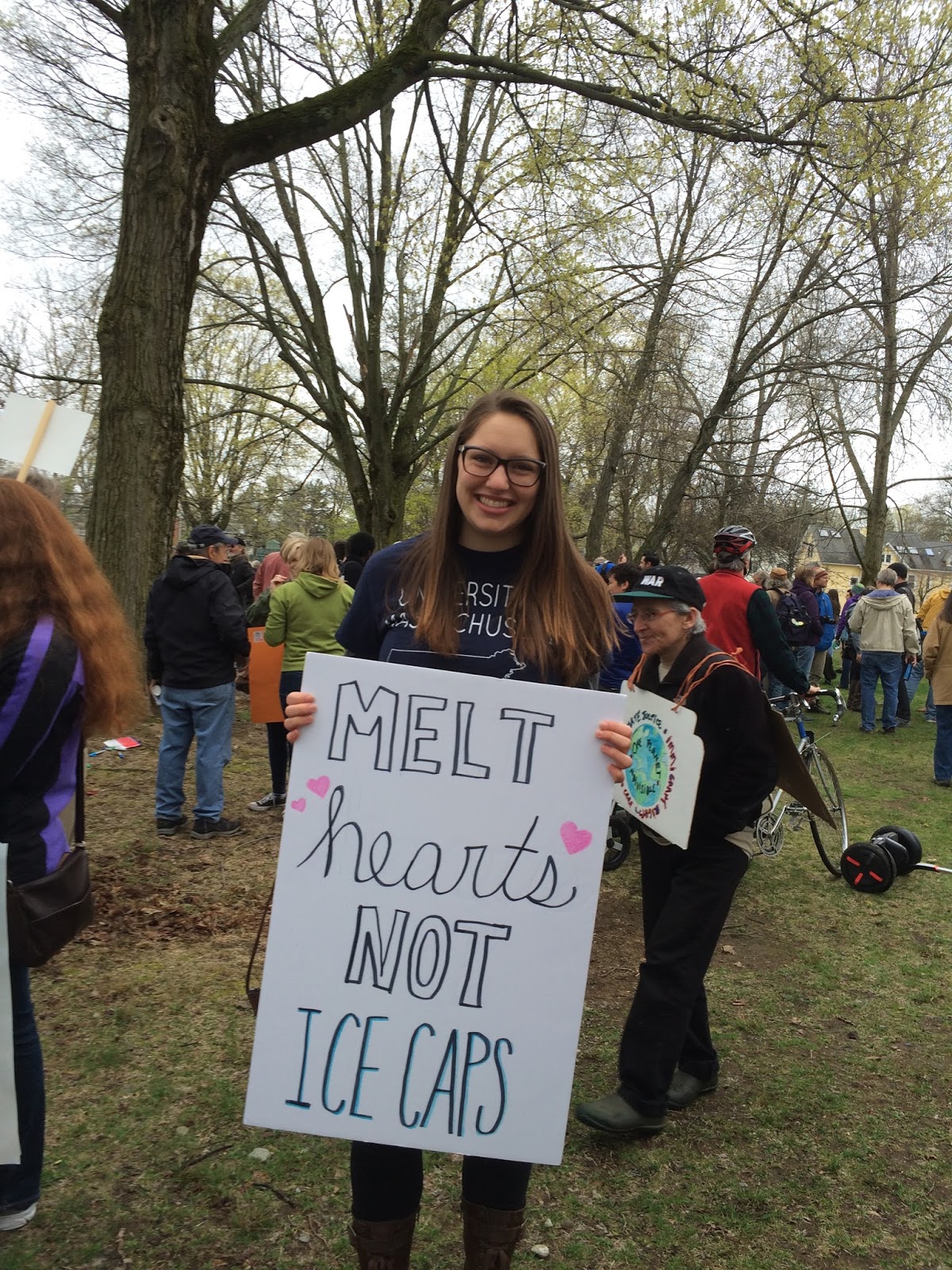
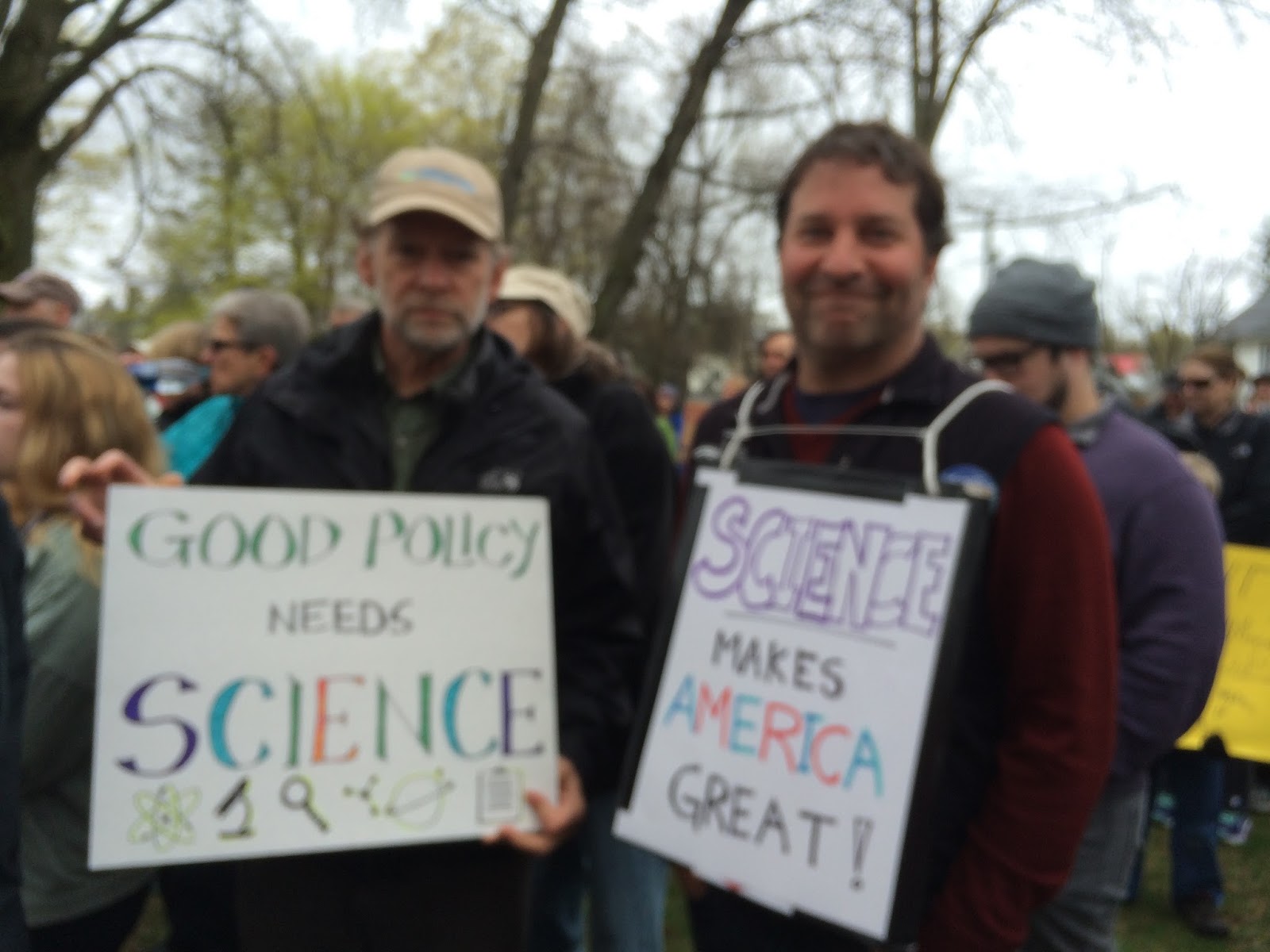
We just returned from the March for Science in Amherst, Massachusetts, which many said was the biggest march they ever recalled in our great town. Marches for Science were planned in over 600 cities on 6 continents today.
My husband made our signs - he is a Professor of Engineering and had the posts neatly nailed.
We had received the notice about the march from a colleague at UMass Amherst, Dr. Barbara Pearson, and had also read about it in our local paper. If I had not been marching I would have been revising another paper and refereeing one for a journal; these activities could wait - the march could not.
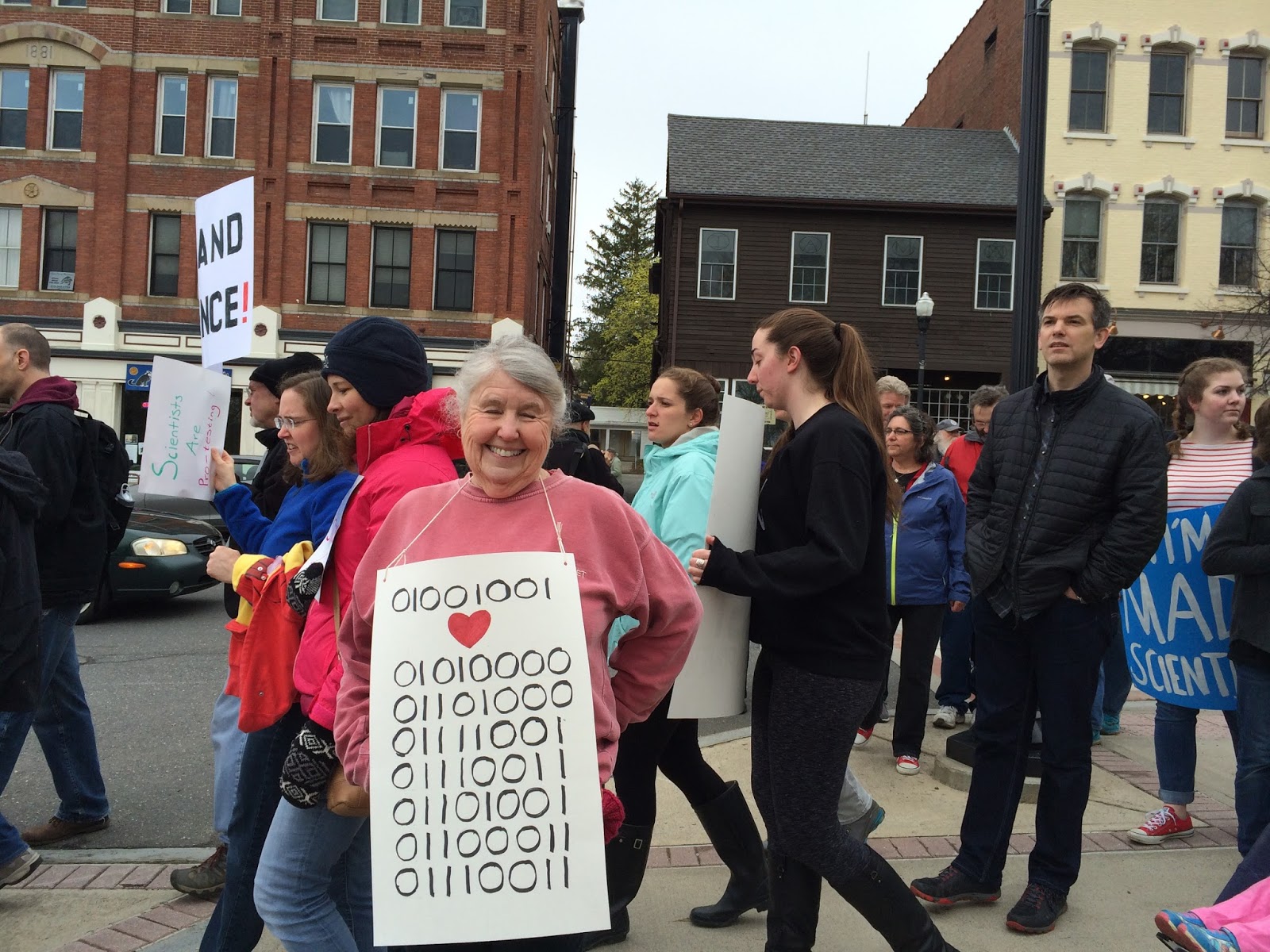
Below are some photos taken from the march which took almost 30 minutes for us to process from Kendrick Park in Amherst to our Town Common where a sustainability fair was taking place since it is Earth Day!
What I found so impressive was the sense of community today and a true sense of purpose. Below are some photos taken of the March for Science in Amherst. Seeing colleagues from UMass Amherst and other colleges and universities, friends, and neighbors, along with many children and dogs, demonstrates how universal the importance of science is to us and our world.
It was terrific to see Dr. Linda Slakey, former Dean of NSF at UMass Amherst, and NSF program officer, who gave a marvelous speech before we marched!
It was also great to see my Operations Research colleague, Professor Erin Baker, and her husband, as well as to chat with Dr. Connie Daniel, a management professor and Isenberg School of Management PhD alumna! We also saw Professor Sigfird Yngvesson of UMass Engineering and my colleague, and fellow Ukrainian and lover of anything Swedish, Dr. Bogdan Propovych.
Now it's back to research (and proofing two students' dissertations, whose committees I am chairing) with renewed energy and support and also fortified with the best cappuccino anywhere on the planet, from Amherst Coffee!
Thursday, March 9, 2017
Game Theory and Fresh Produce Supply Chains - It's About the Fruits and Veggies
Is there anything more delicious than a ripe peach or mango? Or, perhaps, you love biting into a sweet, crisp apple? I love my fresh fruit and veggies and, frankly, we are spoiled, in a sense, in the US, where we can savor berries and cherries even in the winter. You probably also enjoy a variety of vegetables and I am not speaking of just French fries.
At the same time, when the "fresh" produce is not so fresh, one gets quite disappointed and the wastage associated with this industry is vast. Quality of fruits and vegetables is a topic, hence, of great research and practical interest and not only for food scientists and economists, but operations researchers as well.
The first paper that my group published on fresh produce supply chains was: Competitive Food Supply Chain Networks with Application to Fresh Produce, Min Yu and Anna Nagurney, European Journal of Operational Research 224(2): (2013) pp 273-282, a paper that is highly cited and was even recognized by the Editors of the journal in a special session last July at the fabulous EURO conference in Poznan, Poland. You can read my blogpost, which even has photos of delicious pierogies here.
In this paper, we utilized game theory to capture competition among food firms, who differentiate their products, which are perishable, and we applied the model to a case study of cantaloupes, subject also to a disruption. Indeed, there have been some major quality issues resulting in food-borne illnesses in this sector. Quality in this paper was modeled using a generalized network framework with link multipliers and it was assumed that as the fresh produce "moved" over links in the supply chain that a certain percentage would "perish" and would, hence, be discarded.
More recently, we turned to short fresh produce supply chains in the form of farmers' markets. In the paper, Quality in Competitive Fresh Produce Supply Chains with Application to Farmers’ Markets,
Deniz Besik and Anna Nagurney, which is now in press in Socio-Economic Planning Sciences, we used kinetic formulae to model quality deterioration over time and under temperature conditions. I think that this is super cool and very much enjoy bringing scientific disciplines from chemistry to physics to operations research supply chain modeling. We then applied the model to apple farms in western Massachusetts, and, since one of the farms was Apex Orchards (one of my favorites), below I have photos of their relatively new store in Shelburne Falls.
And I can't resist sharing the photo below of the bridge of flowers in neighboring Shelburne.
In Amherst, we have a farmers' market from May through October in downtown, which is very enjoyable and also highly social. The Farmers' Market then moves indoors for the winter and whenever we are in town we always visit and purchase produce. You know where it is coming from and when it was picked. Our paper we dedicated to Robert Colnes, who owned an orchard in New Salem and who was a fellow Brown University alumnus. Deniz had interviewed him multiple times. He passed away a few months ago at age 96 and before we could share with him the good news that our paper had been accepted for publication. He was so generous in answering questions.
Last spring/summer I spent several months as a Visiting Fellow at All Souls College at Oxford University (a simply heavenly intellectual and aesthetic experience that will be very hard to top). While at Oxford I would regularly go to the Farmers' Market in the center of Oxford and the photos below capture some of the spirit of it.
The food stalls at the Oxford Farmers' Market are fabulous and there is a wide variety of ethnic cuisines for purchase.
In the paper, Supply Chain Network Capacity Competition with Outsourcing: A Variational Equilibrium Framework, Anna Nagurney, Min Yu, and Deniz Besik, in press in the Journal of Global Optimization, we used game theory, but the governing equilibrium concept was a Generalized Nash Equilibrium (rather than a Nash Equilibrium as in the above papers), since the producers' constraints, and not just their utility functions, depended on the strategies of the other producers. The case study was to apples in western Massachusetts. We used variational equilibrium to formulate the problem.
What I find so special about the discipline of Operations Research is that you can work on what you love and that includes food supply chains!
Saturday, October 15, 2016
The Awe of A Beautiful Fall Day in Amherst
Last Sunday, you may have seen the cover article in Parade magazine, along with the Sunday newspaper, on Awe. I thought that it was a very pleasant read and agree that having feelings of awe and wonder certainly add to happiness.
As an academic I experience feelings of awe especially while traveling and exploring new places but also sometimes, as the article emphasizes, you can get the sense of wonder even from your own neighborhood. Of course, as an academic, I also experience awe when I figure out a tough research problem, get a paper accepted, have a book published, receive a special recognition, and see my students succeed.
I had returned last night around 11PM from Washington DC where I had served on a panel. I had the serendipity the day before of seeing Professor Larry Samuelson and his wife at Bradley airport in Hartford while waiting for my flight to Reagan National. Samuelson is an economist at Yale University and he and I were Visiting Fellows at All Souls College at Oxford University this past spring and part of the summer and we lived at Beechwood Circle and had offices in the same beautiful building. We had always said that we would probably meet at that airport. On my return last night I was seated next to a colleague from the Computer Science department at UMass, which was also quite cool. You can see a photo of Larry and me and other Visiting Fellows at All Souls College on my blogpost here.
Having spent a lot of time in DC yesterday indoors on business and with today, being such a beautiful Fall day, a nice hike was in order and it did not disappoint.
One of the best aspects of living in Amherst is the beauty of the natural environment and I hike throughout the year in every season when I am here.
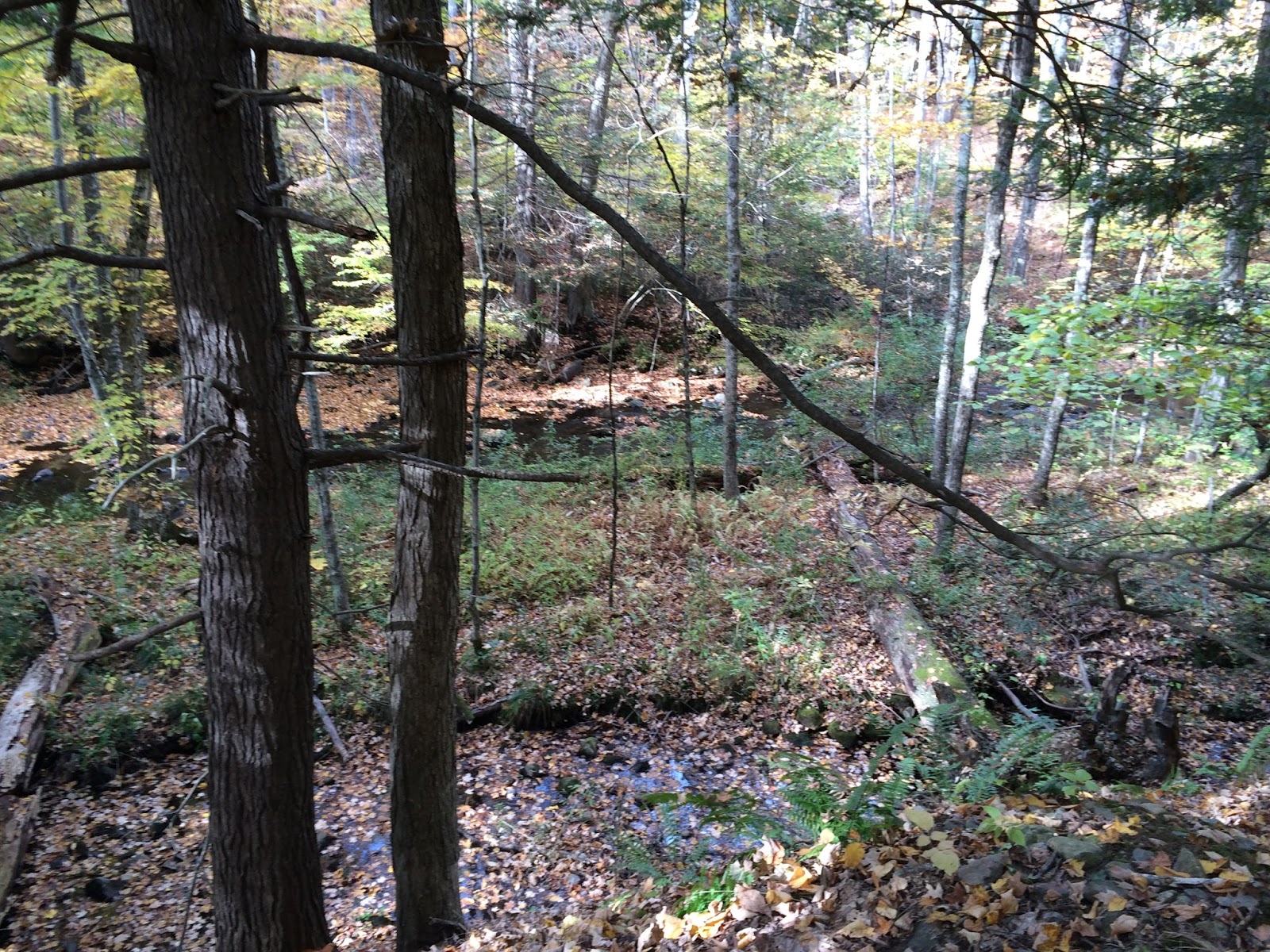
The photos below were taken today during a hike around Puffer's Pond, which is an Amherst natural wonder. Not only is the beauty of the season revealed through the landscape and colors of the foliage but I must also say that the smells were also delightful from the pine trees to some fall flowers.
Reinvigorated and refreshed it's now time to go back to working on a paper with collaborators on supply chain networks with freight transportation and sustainability.
Thursday, February 25, 2016
A Big Thank You to the Amherst Fire Department for Great Tour for My Humanitarian Logistics Class
This blogpost is being written to publicly thank the Amherst Fire Department and especially Chief Tim Nelson and Captain Jeff Olmstead and the EMTs for the wonderful tour of the North Amherst Fire Station this past Tuesday for my Humanitarian Logistics and Healthcare class. Our beautiful town of Amherst has two fire stations, one aging one downtown, and a newer one, but still decades old that is located on the corner of East Pleasant Street and Eastman Lane, a short trip down a hill to UMass Amherst, which is the one that we toured.
In teaching this class I host guest speakers since students need to hear from top practitioners. Having a field trip was extra special and kudos to the students who showed up bright and early at 8:30AM for the tour. Amazingly, during the 75 minute session there were no fire or ambulance calls!
Citizens turn to them in the case of flooded basements, burst pipes, power outages, illnesses, and even having cats rescued from trees (which our neighbors did and that was a day to remember), not to mention ambulance calls and, of course, fires, which happen in our community and at UMass. I remember fires caused by lit candles in a dormitory just a few years ago, for example. Our neighborhood has seen its share of ambulance runs as well.
The Amherst Fire Department also assists in calls and emergencies in several neighboring towns and is responsible for an area of about 125 square miles, if you include ambulance service. They work in 24 hour shifts with one day off, one day on, and then five days off.
The esprit de corps and camaraderie that they have for one another was evident. One of the EMTs was saying how they make dinner in a crockpot so the team members can eat when they can. They work closely with the UMass Amherst and town police and were busy even last Monday when Bernie Sanders had a rally at the Mullins Center. We even got to hear about disaster communications and that if you call 911 on a cell phone, you will reach a dispatcher in Northampton. If you call via a landline phone and use Verizon you will get the Amherst dispatcher who is, of course, better informed about locations in the community, terms, etc. When one says "campus pond" in Amherst it is the UMass pond and when one hears of the Notch, which they have to rescue hikers from who get lost or enjoyed regularly, then the local dispatcher knows this location south of downtown Amherst.
We were told that the fire department plans "for the unplanned" and are engaging more in analytics. We got to meet the "Numbers Guy," who provided us with multiple tables and facts. UMass Amherst relies on them for preparing for a spectrum of special events, which can include anything from rock concerts to major student spring parties.
The fire department team members truly care about the citizens of our town and students and are responsible for saving lives every single day.
I thank them for the tremendous work that they do and for their selflessness. Many have to work an additional 33% to cover the needs because of staff shortages.Their emphasis on having multiple skills and being efficient and responding to events and calls quickly resonated with the students and me since this is an Operations Management course. The Fire Chief has sometimes taken the fire truck for safety checks, just in case the fire truck would be needed for a call. It would be quicker to have the firetruck available than to have to drive back to the station and get it.
The Amherst Fire Department members are true Hometown Heroes and deserve more resources and support.
I am so grateful to Fire Chief Tim Nelson and to Captain Jeff Olmstead for taking the time out of their incredibly busy schedules to provide such valuable educational lessons for my students.
Plus, we even got to see the firetrucks - ladders only go up to about 7 stories and we do have some very tall buildings, especially our Tower Library at UMass. Sprinklers are essential and lifesavers we were told in such and many other buildings.
In teaching this class I host guest speakers since students need to hear from top practitioners. Having a field trip was extra special and kudos to the students who showed up bright and early at 8:30AM for the tour. Amazingly, during the 75 minute session there were no fire or ambulance calls!
We had an overview from the Chief and Captain with inputs from the EMTs.
The nearest hospital is in Northampton which is a good 20 minute drive from UMass over a bridge. Technology has expedited the ambulance driving time since the EMTs can change the traffic lights but sometimes the sensors do not work correctly because of wind or snow. The amazing work that our fire department does should be lauded. They have had only one new hire since 1976, but with a threefold increase in terms of annual calls, they clearly should be provided with more staff/support!

Citizens turn to them in the case of flooded basements, burst pipes, power outages, illnesses, and even having cats rescued from trees (which our neighbors did and that was a day to remember), not to mention ambulance calls and, of course, fires, which happen in our community and at UMass. I remember fires caused by lit candles in a dormitory just a few years ago, for example. Our neighborhood has seen its share of ambulance runs as well.
The Amherst Fire Department also assists in calls and emergencies in several neighboring towns and is responsible for an area of about 125 square miles, if you include ambulance service. They work in 24 hour shifts with one day off, one day on, and then five days off.
The esprit de corps and camaraderie that they have for one another was evident. One of the EMTs was saying how they make dinner in a crockpot so the team members can eat when they can. They work closely with the UMass Amherst and town police and were busy even last Monday when Bernie Sanders had a rally at the Mullins Center. We even got to hear about disaster communications and that if you call 911 on a cell phone, you will reach a dispatcher in Northampton. If you call via a landline phone and use Verizon you will get the Amherst dispatcher who is, of course, better informed about locations in the community, terms, etc. When one says "campus pond" in Amherst it is the UMass pond and when one hears of the Notch, which they have to rescue hikers from who get lost or enjoyed regularly, then the local dispatcher knows this location south of downtown Amherst.
We were told that the fire department plans "for the unplanned" and are engaging more in analytics. We got to meet the "Numbers Guy," who provided us with multiple tables and facts. UMass Amherst relies on them for preparing for a spectrum of special events, which can include anything from rock concerts to major student spring parties.
The fire department team members truly care about the citizens of our town and students and are responsible for saving lives every single day.
I thank them for the tremendous work that they do and for their selflessness. Many have to work an additional 33% to cover the needs because of staff shortages.Their emphasis on having multiple skills and being efficient and responding to events and calls quickly resonated with the students and me since this is an Operations Management course. The Fire Chief has sometimes taken the fire truck for safety checks, just in case the fire truck would be needed for a call. It would be quicker to have the firetruck available than to have to drive back to the station and get it.
The Amherst Fire Department members are true Hometown Heroes and deserve more resources and support.
I am so grateful to Fire Chief Tim Nelson and to Captain Jeff Olmstead for taking the time out of their incredibly busy schedules to provide such valuable educational lessons for my students.
Plus, we even got to see the firetrucks - ladders only go up to about 7 stories and we do have some very tall buildings, especially our Tower Library at UMass. Sprinklers are essential and lifesavers we were told in such and many other buildings.
Tuesday, September 22, 2015
Remembering John Musante - Amherst's Town Manager and Our Neighbor
Sometimes you feel as though it is a very bad dream and soon you will wake up and the sun will be shining again.
Two days ago, on September 20, my husband and I returned from visiting our daughter at her college for Family Weekend. The weather was simply perfect - a gorgeous late summer day in New England.
I had an uneasy feeling, for some reason, and checked masslive.com only to find headlines about our Town Manager, John Musante, who is also our neighbor in Amherst. I called out to my husband since I did not want to read the article alone. On Sunday morning, John Musante, loving husband, devoted father, and dedicated public servant of the highest integrity had passed away suddenly.
The neighborhood and the town of Amherst will never be the same.
Yesterday, we saw several of the family members and we all hugged, trying to understand from our shock this heartbreaking event. Neighbors are visiting one another, stopping to talk at length, in what was always a very caring and wonderful neighborhood.
John Musant was only 53 years of age. He left a tremendous legacy in our town and, just last Thursday evening, after a full day of teaching and also taking part in the New England Security Day, which I bloggesd about, we headed to the Amherst block party where we saw John talking to some colleagues of ours. The downtown was closed to traffic and people of all ages were there to enjoy entertainment, food, and companionship.
I will always remember seeing John walking his dog "Griffy" past our house, seeing him mowing his lawn, and taking time to chat. We would enjoy talking about our children and the unique town of Amherst, with its type of government, beauty, history, and many wonderful characters. John was the consummate professional, always cool, always pleasant, and extremely hard-working.
The photo below (apologies for it being a bit grainy). I took at a big emergency sheltering exercise at UMass Amherst at the Mullins Center back in 2014 in which several of the students in my Humanitarian Logistics and Healthcare class participated. There he is with our fire chief. My students were very excited to see them. John was a UMass Amherst alum and the tributes to him continue to flow, including those from college presidents as well as from the UMass Amherst Chancellor, Dr. Subbaswamy.
Our community lost a great person, and our hearts go out to his grieving family members.
Rest in Peace, Mr. John Musante - you will always be part of Amherst!
Saturday, February 21, 2015
Resilience in a Winter of Disruptions
At the Isenberg School of Management, we pride ourselves on our students being resilient and "gritty" even.
This winter has certainly put the faculty, students, and staff to the test.
For example, WWLP.com is reporting that: Temperatures dropped to -19º at the Westover Air Reserve Base in Chicopee Saturday morning. This broke the previous record low of -6º set back in 1950. To put this cold in perspective, -19º is the coldest low we’ve ever had in the lower Pioneer Valley in February.
This February, we have had 2 cancellations of classes at UMass Amherst on a Monday (I teach Mondays) due to big snowfalls, and a burst pipe that flooded our Isenberg School atrium and a computer lab below. I am not even acknowledging the later start times because the parking lots and roads and walkways needed clearing.
Because of the frigid weather and snowstorms, I have also had to reschedule 2 guest speakers in my Humanitarian Logistics class and I so much appreciate the speakers' flexibility! The most recent speaker had to deal not only with a loss of communications (computer and phone) in his healthcare organization but also with a flood in one of the principal rooms because of a burst sprinkler pipe! He told me that he will have many stories to share with my students later this week.
And, yesterday, I heard from one of my former doctoral students, who is now an Assistant Professor and lives in eastern MA. In the middle of the night last weekend (after Valentine's Day) his living room and basement were flooded when the sprinkler went off. He and his wife and young child now have to relocate to a hotel for a month so that the walls in the flooded rooms can be torn down and replaced because of all the water damage.
Somehow in western MA, our mobility, despite the horrid February, has not been drastically affected. (I will not share with you the multiple schedules that had to be updated for prospective faculty interview candidates because of flight cancellations. The search is now over and our offer has been accepted so we will have a great new colleague in the Fall).
The situation is even worse in Boston and Cambridge in eastern MA! The winter of 2015 with 7 feet of snow already having fallen in eastern MA (and topping records in Buffalo) has had a tremendous negative effect on public transportation with suffering commuters having to contend with complete shutdowns of the MBTA for days on end, major delays, and with serious disruptions to businesses and individuals. Police even had to transport certain healthcare professionals to work!
I was contacted by a journalist last week to offer suggestions on how to remove the snow so offered ideas on the use of freight trains to transport the snow out to warmer climes and, posisbly, drier ones, as well.
Last week, I was telling my students (we were discussing risk management and emergency preparedness) about Jane Garvey, who used to live in Amherst and was head of the FAA during 9/11 and responsible for managing air traffic control that horrific day. I had the great honor of receiving an award named after her, the Jane Garvey Transportation Leadership Award, which I treasure. Last night, on the evening news, because of the MBTA issues this winter, Governor Charlie Baker (who has been contending with water leaks in his home as well), appointed a panel to review the MBTA and Jane Garvey is one of the seven members of the panel with the charge to find long-term solutions for the MBTA's financial and operational woes.
In today's Daily Hampshire Gazette, Jane Garvey is quoted as saying about the MBTA transit sytem:
" It's a system that is so critical to the economy and so critical to the state and the region. We all have I think an interest in seeing it run well." I completely agree with Garvey. (I wrote a post on her a while back.) I had the pleasure of meeting her at a dinner party hosted by a senior colleague of mine, Professor Joe Balintfy, who has since passed away. He was a neighbor of hers on Blue Hills Road in Amherst.
I have spent 3 years living in Cambridge - the first two when I was a Visiting Scholar at the Center for Transportation & Logistics at MIT (under a wonderful NSF Visiting Professorship for Women grant that I had received) and then a Visiting Scholar at the Sloan School at MIT. In 2005-2006, I was at the other institution in Cambridge, on my sabbatical, as a Science Fellow at the Radcliffe Institute for Advanced Studies at Harvard University. The MBTA Red Line was how I got around when I was not walking from place to place or taking a Peter Pan bus back to Amherst on some weekends and holidays. And now the Peter Pan busses, based in Springfield, are being used to shuttle commuters in eastern MA because of the MBTA transit fiasco!
And just to end on a positive note, yesterday, one of my colleagues and collaborators at the University of Gothenburg in Sweden, Professor Jonas Floden, emailed me the photos below which he took close to his home on the island of Donso. Yes, there are spring flowers now in Sweden!
So, just hang in there - we will make it through this winter in Massachusetts!
Sunday, July 6, 2014
Summer Scenes of Nature's Beauty
I have been back in US now for a couple of days and although I miss Sweden and Europe a lot, it is truly a beautiful time now in Amherst and western Massachusetts.
In between episodes of revising a paper this weekend, and waiting for a collaborator to respond, I took some hikes in nature in both Amherst and Deerfield and below I share photos of nature's beauty. Some locals may recognize Puffer's Pond and Old Deerfield.
Nothing like nature to inspire.
In between episodes of revising a paper this weekend, and waiting for a collaborator to respond, I took some hikes in nature in both Amherst and Deerfield and below I share photos of nature's beauty. Some locals may recognize Puffer's Pond and Old Deerfield.
Nothing like nature to inspire.
Subscribe to:
Posts (Atom)