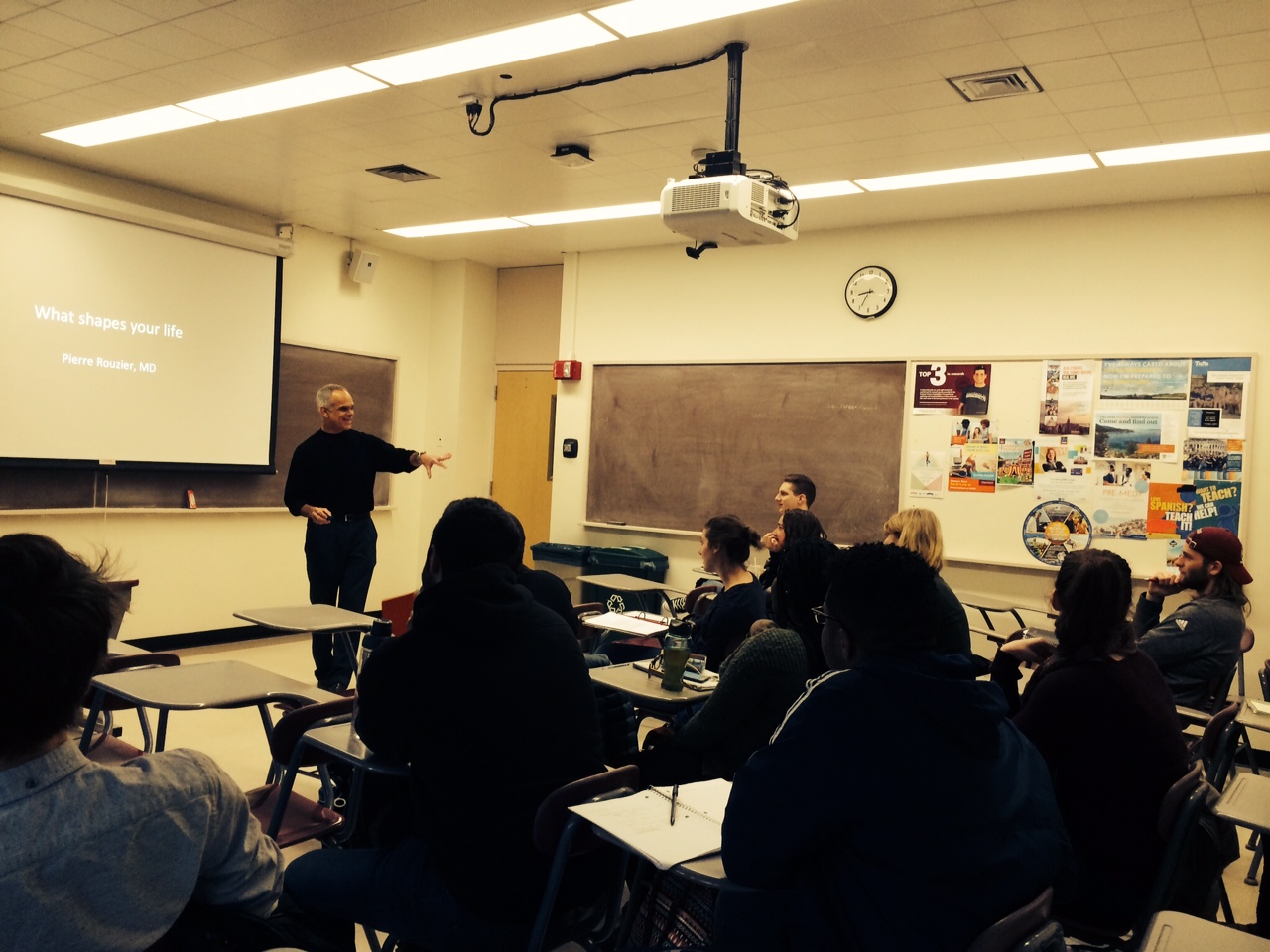
This morning, my students and I were mesmerized by the brilliant lecture of Dr. Pierre Rouzier, who spoke in my Humanitarian Logistics and Healthcare class at the Isenberg School.
Dr. Rouzier is the team physician at UMass Amherst and a doctor at our University Health Services. He is also a published author and a great humanitarian.
For many years he has also assisted in triage at the Boston Marathon, and was there at the bombing in 2013.
Dr. Rouzier's lecture was on "What Shapes Your Life?" and he spoke on life shaping events, inspiring people to move (more on this), and also finding greatness in every day.
Last summer, he with a friend, Roger Grette, bicycled across the US, while disseminating the news on his children's book, Henry Gets Moving. It was published in 2012.
He covered 4,100 miles from Oregon through Massachusetts. It took them 10 weeks to accomplish this feat and he said to us that "he had a life-changing summer and doesn't know if he even needed his life to change." Along the way he spoke to children and to adults publicizing his book, which focuses, in a warm-hearted way, on why children need to move more and to eat right. He showed us wonderful video clips of children, farmers, cowboys, and others along the way that were swept by his energy, openness, and passion for helping people and would chant: Ride, Henry, Ride! He noted that, in 1980, 7% of children ages 6 to 11 were obese and in 2008, 20% were. Clearly, children eat what is provided. He stated that the obesification of America is a big problem.
Dr. Rouzier said that he is now in the last quarter of his life and wanted to take on the challenge of biking across the US and had done a lot of reading of experiences of others who had succeeded at this challenge. During his journey, he had many instances of the sense of wonder of meeting new people, serendipitous encounters with UMass connections, praying that the sun would shine and it did and then it snowed, and finding new friends along the journey. The motto "Endure or Enjoy" from the book, "From the Atlantic to the Pacific on Two Wheels," by Alex Alvarez, served him well and continues to.
Dr. Rouzier also spoke about getting accepted at Stanford U. for his undergraduate studies but decided to go to UC Davis, due to the cost, and then went on to med school at USC because they had 13 weeks of vacation (rather than 6 as at UC Irvine) and he had fallen in love with travel (and also had a scholarship to med school). He had been a kinesiology major and had spent his junior year abroad in Edinburgh and loved it. He shared with us some of his hitchhiking stories in Europe, which were hysterical. He likes to travel OPM using "other people's money," which makes a lot of sense. While in med school he traveled to Australia, New Zealand, and Papua New Guinea, where he spent some time helping out at a healthcare facility. There he met 2 UMass Medical School Worcester graduates and ended up having his residency there. He has been at UMass Amherst since 1997 and are we lucky!
He has worked at Native American healthcare facilities, and spent 5 years in Colorado where he wrote a book, "The Sports Medicine Patient Advisor," which was inspired by a farmer who had hurt himself lifting bales of hay and could not take the time to drive a distance for physical therapy and asked him to just write the instructions down and he would follow them. Indeed, as his friend Bruce Bynum says: "The right book will set you free!"
Two of the life-changing events that he spoke about were the Haiti earthquake, which struck on January 12, 2010, and the Boston Marathon bombing, which took place April 15, 2013. We have talked about these two disasters in the Humanitarian Logistics and Healthcare class. Dr. Rouzier's father is from Haiti and he was in Haiti 9 weeks after the earthquake and was engaged in "despair medicine." At that point, many were suffering from illnesses brought about by the shock and ensuing stress. He even met a relative who lived on a hill and was one of the lucky ones.
Since Dr. Rouzier is not only an athlete, and former teacher and coach, but also a sports medicine expert, he also, for many years, has assisted in triage at the Boston Marathon. He was there during the bombing and shared with us that there was blood everywhere, the smell of burning flesh, and a surreal scene. He had been accompanied by a friend, Chad, who had recently had a child. He used a belt as a tourniquet and a fence post for a splint for a broken leg. He treated a female who said: I am going to die here and noone will know where I am." He said that he did not get her name and that it bothered him and it was very hard to get closure. The marathon bicycle journey across the US last summer, I believe, helped him tremendously, and he said that while en route he received a text from one of the victims thanking him.
The healing process was assisted also by people reaching out to him, even on Facebook, and especially UMass students doing so. He said: "people like you saved me." His heroism and selflessness were so apparent throughout his brilliant lecture and we are so indebted to Dr. Pierre Rouzier for showing us what constitutes a life well lived. His nonprofit Team Henry is even helping out an orphanage in Tanzania. And, next week, Dr. Rouzier will again be assisting at the Boston Marathon.
Towards the end of his lecture today, Dr. Rouzier emphasized the power of positive thinking. He said that: "when you change the way you look at things, the things you look at change."
He told us that we need to look in the eyes of others and be nice - this is a choice that you can make. He said that "a stranger is a friend you have not yet met" and that "in every day there is something great about it."
We did not have much time for questions and answers but I wish that we had.
I presented Dr. Rouzier with a gift from the Isenberg School and also a certificate thanking him for being a terrific Professor for a Day! I then snapped a group photo of students with him as a memento of a truly inspirational and very wise lecture, with numerous life lessons.
Showing posts with label Boston marathon bombing. Show all posts
Thursday, April 6, 2017
Thursday, January 28, 2016
Emergency Management at a University
A university is an ecosystem with many interacting parts.
The resiliency of a university depends on the procedures and practices in place for emergency management.
Today, we had the pleasure of hearing Mr. Jeff Hescock, the Director of Emergency Management and Business Continuity at UMass Amherst, in my Humanitarian Logistics and Healthcare class at the Isenberg School. He was a terrific Professor for a Day!
Mr. Hescock's described how his group, with many partners at UMass, prepares for a variety of emergencies, both man-made and natural ones, and assesses a page of risks that can affect students, research, energy, and infrastructure, to start. He also spoke of the emergency alert system, which includes text and email alerts, as well as sirens, and postings on the UMass homepage. The importance of relaying timely information was emphasized as well as post incident discussions and evaluations.
The National Weather Service recently awarded UMass Amherst a Storm Ready designation, the first public university in Massachusetts to receive this designation.
I also very much enjoyed his discussion of mitigation in terms of identifying flood plain regions and potential power outages. Luckily, we have our own power plant on campus but it can only generate about 60% of the university's needs. hence, there are generators in place at crucial locations.
UMass Amherst also works closely with the ton of Amherst in emergencies especially in terms of planned events (the Super Bowl, concerts at the Mullins Center, for example). Also, there are strong relationships with the other colleges in our 5 college system.
A major part of his presentation covered the response to the Boston Marathon bombing that took place at UMass Dartmouth, when he worked at the UMass President's office, because one of the perpetrators was a student there. This event emphasized vividly the importance of having best practices in place, including evacuation and sheltering. Many of the students, who could not go home, once UMass Dartmouth was evacuated, were sheltered at a local high school.
How a university responds to an emergency and deals with the news media can also have far-reaching impacts on its reputation.
UMass Amherst regularly runs different emergency exercises, including a sheltering exercise a few years ago that several of my students and I observed. This year, in April, it will be building a healthcare crisis exercise, inspired by outbreaks of meningitis at various campuses last year (at Princeton and the University of Oregon, for example).
Mr. Hescock's presentation can be downloaded here.
Clearly, the importance of information sharing, collaboration, and great teamwork were highlighted. And, of course, when it comes to business continuity, one can't underestimate the importance of information technology as well as shelter and food for students!
Many thanks to Mr. Hescock for such an illuminating and educational guest lecture today.
Students benefit greatly from ghearing from practitioners.
The resiliency of a university depends on the procedures and practices in place for emergency management.
Today, we had the pleasure of hearing Mr. Jeff Hescock, the Director of Emergency Management and Business Continuity at UMass Amherst, in my Humanitarian Logistics and Healthcare class at the Isenberg School. He was a terrific Professor for a Day!
Mr. Hescock's described how his group, with many partners at UMass, prepares for a variety of emergencies, both man-made and natural ones, and assesses a page of risks that can affect students, research, energy, and infrastructure, to start. He also spoke of the emergency alert system, which includes text and email alerts, as well as sirens, and postings on the UMass homepage. The importance of relaying timely information was emphasized as well as post incident discussions and evaluations.
The National Weather Service recently awarded UMass Amherst a Storm Ready designation, the first public university in Massachusetts to receive this designation.
I also very much enjoyed his discussion of mitigation in terms of identifying flood plain regions and potential power outages. Luckily, we have our own power plant on campus but it can only generate about 60% of the university's needs. hence, there are generators in place at crucial locations.
UMass Amherst also works closely with the ton of Amherst in emergencies especially in terms of planned events (the Super Bowl, concerts at the Mullins Center, for example). Also, there are strong relationships with the other colleges in our 5 college system.
A major part of his presentation covered the response to the Boston Marathon bombing that took place at UMass Dartmouth, when he worked at the UMass President's office, because one of the perpetrators was a student there. This event emphasized vividly the importance of having best practices in place, including evacuation and sheltering. Many of the students, who could not go home, once UMass Dartmouth was evacuated, were sheltered at a local high school.
How a university responds to an emergency and deals with the news media can also have far-reaching impacts on its reputation.
UMass Amherst regularly runs different emergency exercises, including a sheltering exercise a few years ago that several of my students and I observed. This year, in April, it will be building a healthcare crisis exercise, inspired by outbreaks of meningitis at various campuses last year (at Princeton and the University of Oregon, for example).
Mr. Hescock's presentation can be downloaded here.
Clearly, the importance of information sharing, collaboration, and great teamwork were highlighted. And, of course, when it comes to business continuity, one can't underestimate the importance of information technology as well as shelter and food for students!
Many thanks to Mr. Hescock for such an illuminating and educational guest lecture today.
Students benefit greatly from ghearing from practitioners.
Tuesday, February 25, 2014
Thanks to Dr. Pierre Rouzier for Sharing with Us Experiences from Haiti to the Boston Marathon Bombings
Today, we were mesmerized by the lecture given by Dr. Pierre Rouzier of the UMass University Health Services, who is also a team doctor. Dr. Rouzier shared with us, in the Humanitarian Logistics and Healthcare class that I teach at the Isenberg School of Management, his work post the January 12, 2010 Haiti earthquake and his life-saving efforts during last year's Boston Marathon bombings on April 15, 2013, where he was serving as a sports medicine expert volunteer.
His lecture was very dynamic and his presentation was filled with photographs of the people that he worked with both in Haiti and in Boston and of those that he met that have made these two events forever ingrained in his memory and in the way we look at the world today, which is riddled with disasters, both man-made and natural. He told us how he stayed with a woman post the bombing who told him that she did not want to die alone.
His love of people, selflessness, intellect and courage during triage and times of great stress and uncertainty, captivated us.
He is the author not only of a sports medicine book but even of a recent children's book, Henry Gets Moving, to help children stay in shape. He spoke of poverty, of inequality, and of the PTSD that he has experienced serving in these extremely difficult disasters. He also spoke of his efforts to raise funds for the recovery in Haiti and how he bicycled last summer hundreds of miles in Iowa to raise funds for the Boston Marathon bombing victims wearing his Boston Strong t-shirt.
He also spoke about how he discovered his love of teaching and will return to Haiti to teach sports medicine this summer. His father was Haitian but immigrated to the U.S. Dr. Rouzier's dream is to build a facility in Haiti that will inspire children through sports, especially, soccer, with a sports medicine clinic, and employment opportunities for families of the young athletes.
Dr. Rouzier's humanity and humanitarianism is an inspiration for all of us. How lucky are we at UMass Amherst to have such a hero and role model in our midst.
His lecture was very dynamic and his presentation was filled with photographs of the people that he worked with both in Haiti and in Boston and of those that he met that have made these two events forever ingrained in his memory and in the way we look at the world today, which is riddled with disasters, both man-made and natural. He told us how he stayed with a woman post the bombing who told him that she did not want to die alone.
His love of people, selflessness, intellect and courage during triage and times of great stress and uncertainty, captivated us.
He is the author not only of a sports medicine book but even of a recent children's book, Henry Gets Moving, to help children stay in shape. He spoke of poverty, of inequality, and of the PTSD that he has experienced serving in these extremely difficult disasters. He also spoke of his efforts to raise funds for the recovery in Haiti and how he bicycled last summer hundreds of miles in Iowa to raise funds for the Boston Marathon bombing victims wearing his Boston Strong t-shirt.
He also spoke about how he discovered his love of teaching and will return to Haiti to teach sports medicine this summer. His father was Haitian but immigrated to the U.S. Dr. Rouzier's dream is to build a facility in Haiti that will inspire children through sports, especially, soccer, with a sports medicine clinic, and employment opportunities for families of the young athletes.
Dr. Rouzier's humanity and humanitarianism is an inspiration for all of us. How lucky are we at UMass Amherst to have such a hero and role model in our midst.
Subscribe to:
Posts (Atom)