Showing posts with label disaster management. Show all posts

Friday, March 20, 2026

Thanks to the Outstanding Guest Lecturers in My Humanitarian Logistics Class at the Isenberg School of Management

This spring, I am, again, teaching my Humanitarian Logistics and Healthcare class at the Isenberg School of Management. The class meets, bright and early, on Tuesday and Thursday mornings at 8:30AM.

I have amazing students this term - one of whom commutes by bus from Boston and many times he beats me to the classroom before 8AM. He is completing two Master's degrees this spring from UMass Amherst, as is another student in the class. The enrolled students come from the Isenberg School of Management, the Riccio College of Engineering, and the School of Public Health. The course is interdisciplinary since it requires a team approach to handle challenges associated with all phases of disaster management.

I work hard on making the course material very current and relevant. An aspect of the course that the students and I enjoy very much is the presentations by invited guest speakers.

So far this semester, we have had the great honor of having Mr. Jeff Hescock, Assistant Vice Chancellor, Environmental Health & Safety and Emergency Management at UMass Amherst, and Ms. Nicole Barbosa,  American Red Cross Community Disaster Program Manager - Western Massachusetts, speak in the class.

Mr. Hescock and his team have done outstanding work in support of the health and safety of all of us at UMass Amherst and even the neighboring community. Students very much relate to him and he shared with us his career trajectory, his focus on relationships and community building, and the numerous disasters that his team has responded to from the meningitis outbreak at UMass Amherst and the COVID-19 pandemic to the recent Olympia Drive fires in Amherst, MA. The latter fires burnt down a private apartment complex off-campus and one under construction, where the fire started. Over 200 students resided in the complex. Luckily, there were no injuries but housing had to be quickly found for those affected as well as the replacement of many essentials, destroyed in the fire.

Mr. Hescock spoke on February 12, 2026 this semester and,  since the date was close to Valentine's Day, I surprised everyone with these special cupcakes, which were enjoyed. 

I am a big proponent of writing Thank You letters to our guest speakers and in copying the letters to their supervisors and also share photos. 


Ms. Nicole Barbosa spoke to the class on March 5, 2026 and her passion in working for the American Red Cross (ARC) resonated with all of us. She has worked with Mr. Hescock, most recently, in the response to the Olympia Drive fires.  

The ARC has been very innovative and focuses much more now on recovery and reconstruction and also in providing victims of disasters financial support. The ARC has 7 levels of disasters. Ms. Barbosa told of one of their volunteers, who has been with the ARC for 44 years. The ARC relies heavily on volunteers for disaster response. Ms. Barbosa was such an inspiring guest speaker and an outstanding Professor for a Day. Our great Isenberg Dean Ann P. Massey signed the framed certificate that I presented her with.


I was touched by the beautiful letter I received from Mr. Ryan Avery, Mr. Barbosa's supervisor at the ARC, in response to my letter of appreciation for her guest lecture. Mr. Ryan Avery is a Regional Disaster Officer for the ARC.

We are very lucky to have in our community such incredible experts in disaster management.

Thank you for your service and for sharing some of your very valuable lessons learned with my students.

Saturday, November 1, 2025

Slide Decks of Our Talks at INFORMS in Atlanta Are Now Posted on Topics from War Risk Insurance to Tariffs and Rerouting to Remembering the Great Hani Mahmassani

My immediate research group had five presentations at the recent INFORMS Conference, which took place in Atlanta, October 26-29, 2025.

I am delighted that the slide decks of all the above presentations have now been posted on the Virtual Center for Supernetworks website: https://supernet.isenberg.umass.edu/visuals.html.

Below is a photo of the speakers and the organizers (thanks to Himadri Sen Gupta and Andrés González for the invitation) of the Resilient Networks session in which Ismael Pour, my PhD student, presented our paper on integrated crop and cargo war risk insurance with applications to Ukraine. This paper we co-authored with Borys Kormych of the Odesa Law Academy and it was published in the International Transactions in Operational Research and is available free access: https://onlinelibrary.wiley.com/doi/10.1111/itor.70038?af=R

My PhD student, Samira Samadi, presented two papers (since I had to speak on a panel memorializing Hani Mahmassani, who passed away on July 15, 2025).


Samira's first paper presentation, which was on fresh produce quality deterioration under transportation congestion and disruptions, was on work we did with Deniz Besik of the University of Richmond. Her second paper, which we co-authored, was on tariffs and rerouting, and is in press in a volume in honor of Terry Rockafellar's 90th birthday: https://link.springer.com/book/9783032078599.

Dana Hassani delivered a paper of ours in the 8AM session on the last day of the conference. The paper, with Oleg Nivievskyi and Pavlo Martyshev of the Kyiv School of Economics (KSE), was published in an edited Dynamics of Disasters volume by Springer last December: https://www.springerprofessional.de/en/quantification-of-international-trade-network-performance-under-/50390576

I will blog about the panel in honor of Hani Mahmassani in a separate post but below I share a photo of the entire group that took part. Thanks to Karen Smilowitz and to the Transportation Science and Logistics (TSL) Society of INFORMS for allowing us to memorialize Hani in a session originally scheduled for the Robert Herman Lifetime Achievement Award recipient, who could not make it (Cynthia Barnhart of MIT was recognized this year). Hani was an earlier recipient of this award.


Monday, March 17, 2025

Thanks to Mr. Ryan Avery, Regional Disaster Officer of the American Red Cross

As an educator, I hope to inspire my students in all the classes that I teach and also to impart knowledge gained from years of doing research and teaching a plethora of courses at both undergraduate and graduate levels.

This spring semester, I am, again, teaching my Humanitarian Logistics and Healthcare class at the Isenberg School of Management. The class attracts students not only from our business school, but also from Public Health and from Engineering at UMass Amherst. The class meets, bright and early, on Tuesdays and Thursdays at 8:30AM. The scheduling of this course so early makes sense since a very important part of the course is hearing from expert practitioners, some of whom  travel close to 2 hours to give a guest lecture. 

This past Thursday,  we had the great honor and pleasure of having Mr. Ryan Avery, a Regional Disaster Officer (RDO) for the American Red Cross (ARC), speak in my Humanitarian Logistics & Healthcare class. 

Ryan's presentation was so informative and engaging that we all left energized, inspired, filled with hope, and grateful for the work that the ARC does in alleviating suffering. Ryan manages an ARC team of 12 employees and 750 volunteers and serves as a member of the Northeast Division Response Management Team as an Assistant Director of Workforce.  

He began his Red Cross journey in 2010 as a Disaster Cycle Services Volunteer in Connecticut, serving in this capacity for 6 years. In 2016, Ryan transitioned to becoming an employee with the ARC, working in different roles with the Wisconsin and Massachusetts teams, and as an RDO since 2023. His wealth of experience in responding to numerous national disaster relief operations including Hurricanes Matthew, Irma, Maria, Laura, Ian, and even to the 2021 Afghan Repatriation, Hurricane Helene, and the recent DCA plane crash left us awe-struck. It was very impressive to hear how the ARC continues to innovate; to be as efficient as possible; to focus on preparedness as well as on response, and to even work on long-term recovery programs. There are true heroes among us - many thanks to Mr. Ryan Avery and to the American Red Cross!

I presented Ryan with a framed Professor for a Day certificate signed by our Isenberg School Dean Anne P. Massey. I also followed up with a formal Thank You letter for his outstanding presentation and copied it to several ARC officials. I continue to get emails from students who were incredibly moved by his presentation and by his willingness to answer so many questions. During these very challenging times, goodness and kindness and professionalism of our disaster relief workers give me hope as does the appreciation of my students for the workers' courage and selflessness. 

Saturday, September 9, 2023

A Great Start to the New Academic Year and Our Research on UAVs!

 It was an exciting first week at UMass Amherst of the new 2022-2023 academic year.

I am delighted to again be teaching my Transportation & Logistics class this Fall. The students with their enthusiasm for a subject that I love keep me energized. And, this week, we discussed innovations in transportation technologies, including UAVs (sometimes referred to as drones).

Coincidentally, although last year, I had the great honor of giving a keynote at the outstanding Optimization and Decision Sciences conference (ODS 2022), which took place in Firenze (Florence), Italy, just before classes began, this year, I could not squeeze in this conference since it overlapped with the first week of classes. Nevertheless, I was delighted that my collaborators, Dr. Gabriella Colajanni and Professor Patrizia Daniele, both of the University of Catania, were able to attend and to present our latest work on UAVs. This year's ODS conference took place in another stunning location - Ischia! And, amazingly, we did the galleys for the paper on which our presentation was based this past Tuesday; the presentation took place on Wednesday, and our paper, "Centralized supply chain network optimization with UAV-based last mile deliveries," was published in the journal Transportation Research C this Thursday. It is open access and can be viewed here. The results therein demonstrate how a hybrid fleet can enhance profits and also reduce air pollution.


Professor Patrizia Daniele kindly sent me the photos below of Dr. Colajanni presenting our paper, a nice lunch get-together, and additional photos.


In the photos above are from l-r: Dr. Daniele Sciacca, Dr. Georgia Fargetta, Dr. Gabriella Colajanni, Professor Patrizia Daniele, and Professor Laura Scrimali. 


And just a few weeks ago, our paper on UAVs and 5G with a focus on three phases of disaster management, "A three-stage stochastic optimization model integrating 5G technology and UAVs for disaster management," was published in the Journal of Global Optimization. This paper is also open access and was co-authored with Dr. Gabriella Calajanni, Professor Patrizia Daniele,  Dr. Daniele Sciacca, and Professor Ladimer S. Nagurney. In the Spring semester, I teach a course on Humanitarian Logistics and Healthcare, and we discuss the four phases of disaster management. Great to have such excellent collaborators to engage on such topic research with.

Tuesday, April 18, 2023

Thanking Mr. David Gutierrez of the American Red Cross for His Brilliant Guest Lecture in My Humanitarian Logistics & Healthcare Class

Having expert practitioners speak to students and share their experiences and lessons from the field supports transformative education.

Last week, we had the honor and pleasure of hosting Mr. David Gutierrez of the American Red Cross (ARC) as a guest lecturer in my Humanitarian Logistics and Healthcare class at the Isenberg School of Management. Mr. Gutierrez was an outstanding Professor for a Day! The certificate was kindly signed by the Isenberg School Dean - Dr. Anne P. Massey.

The original date of his lecture was rescheduled because he had been intensively responding to the aftermath of the tornado in Rolling Fork, Mississippi.

Mr. David Gutierrez in the Senior Director of the National Incident Command Team of the American Red Cross. The National Incident Command Team was established about 1 year ago due to the unprecedented number of disasters. According to Mr. Gutierrez: "disasters have been nonstop." The ARC has been dealing with many challenges including climate displacement.

Mr. Gutierrez shared his "story" with us and his incredible career with the ARC, which continues. Professionally, he started out as a High School teacher and began volunteering with the ARC in 1992. Over more than three decades, he has served in various roles including: Health & Safety Director, AFES Station Manager, Chapter Executive, Chapter Operations Manager, State Relations Disaster Liaison, State Resource Office Coordinator, Emergency Services Director, State Disaster Officer, Division Disaster Director and Division Disaster Executive. In his current role as the Senior Director for the National Incident Command Team, he is responsible for initiating a Red Cross disaster response for level 5 disasters and higher. This includes oversight and direction of all activities related to disaster leadership development, disaster response training, partnerships with government and non-government agencies, and capacity building for the organization. An example of a  level 1 disaster is a house fire, that the ARC would also respond to.

He spoke about the 3Hs - Health, Hunger, and Housing, and how the ARC provides security to victims of disasters for up to 1 year. Many of those impacted by disasters are experiencing poverty and disasters create further stressors on the most vulnerable. The #1 priority of the National Incident Command Team is to respond. The other priority is to build capacity and to make sure that the workforce is trained. The students were very inspired and also amazed that 98% of the ARC workforce consists of volunteers! I very much appreciated that Mr. David Gutierrez noted the relevance of the logistics behind the workforce and in getting the workers to impacted areas in a timely manner. Sometimes there can be as many as 2,000 volunteers. The ARC pays for the travel expenses as well as the room and board. He discussed the specific case of Hurricane Ian and the impact on Tampa Bay, along with the response of the ARC.

Mr. Gutierrez has deployed to over 50 relief operations throughout his tenure with the Red Cross. He also serves as a National Disaster Relief Operation Job Director for the ARC. He served as the job director for Hurricane Ian, Hurricane Laura, Hurricane Ida, and Hurricane Harvey. In the role of job director, Mr. Gutierrez is responsible for leading a team of individuals who provide a range of clients with a comfortable, safe, welcoming environment by delivering mass care services, which include shelter, feeding, distribution of relief supplies, reunification, Disaster Health Services, Disaster Mental Health Services, Disaster Spiritual Care, Casework and Recovery Planning, and access to a host of services provided by partners in the community.

He emphasized the importance of needs assessment and in learning from previous disaster experiences. This reinforced what the students have learned from other guest speakers this semester, including Dr. George Karagiannis of Resilience First and Mr. Jeff Hescock of UMass Amherst! Lessons learned must be captured and shared. He also noted the necessity behind collaboration with partners; coordination with response partners, and also effective communication.

Mr. Gutierrez's dedication to the American Red Cross shone through his presentation  Along with his team,  he works to ensure timely, efficient disaster response efforts, ensuring that local community organizations and the Red Cross are coordinating and collaborating in order to efficiently and effectively meet community needs.

Mr. Gutierrez is a role model. His dedication, work ethic, kindness, and effectiveness are awe-inspiring. On behalf of my students, and all those that he and his team have helped, I send my deepest gratitude.

Thursday, January 12, 2023

My "Labor and Supply Chain Networks" Book is Published!

I was delighted to receive a shipment of my new book, "Labor and Supply Chain Networks," yesterday. The book was published by Springer Nature and contains 12 chapters, with Acknowledgments, Preface, and an Appendix.

Writing this book was a true labor of love. The book is dedicated to: essential workers and to those fighting for freedom in Ukraine, with gratitude for your heroism. It is the result of many years of  research and writing, accompanied by adrenaline during the COVID-19 pandemic and now the war on Ukraine. 

Springer has produced both hardcopy and online versions, with more information available on the Springer website for the book. I am indebted to Elizabeth Loew of Springer for her outstanding shepherding of this book project with publication even ahead of schedule!

The front matter for the book, with the Preface and the Acknowledgments, is available for free download. In the Acknowledgments, I thank the great Isenberg School Dean Anne P. Massey, the two Operations and Information Management Department Chairs: Professors Bob Nakosteen and Senay Solak, over the period that this book was written, as well as the Vice Provost for Global Affairs at UMass Amherst Kalpen Trivedi, for his leadership of international programs. With the war in Ukraine still raging, and with my service for the Kyiv School of Economics (KSE) in Ukraine a very important part of my life, both professionally and personally, I also thank the President of KSE Tymofiy Mylovanov and Rector Tymofii Brik plus KSE colleagues Oleg Nivievskyi and Nataliia Shapoval, who have done extraordinary work on documenting the impacts of the war. 

Collaborators throughout this challenging time have made work fascinating and enjoyable. I am indebted to Professor Ladimer S. Nagurney of the University of Hartford, Professor Patrizia Daniele of the University of Catania in Italy, Professor Tina Wakolbinger of the Vienna University of Economics and Business, Professor Deniz Besik of the University of Richmond, Professor Sara Saberi of WPI, Professor Pritha Dutta of Pace University, and Professor Mojtaba Salarpour of Texas A&M Commerce. All are Center Associates of the Virtual Center for Supernetworks that I founded in 2001 and continue to direct. Acknowledgments are also extended to my long-time collaborators on Dynamics of Disasters conferences and co-edited volumes: Professor Panos M. Pardalos of the University of Florida and Professor Ilias S. Kotsireas of Wilfrid Laurier University in Canada. I also thank my PhD student Dana Hassani.

Of course, writing a book requires a great deal of focus and time and dedication, and I am so thankful to my family for their support. And, in the pandemic, having a professional society such as INFORMS that helped us to stay connected and informed and also advocated our work to the media and government, was incredible supportive and sustaining.

Workers need to be valued, supported, recognized, and paid for their contributions. Supply chains would collapse without them, as we have seen. I hope that my book, which contains chapters on both profit-maximizing firms and non-profits, including blood service organizations and those in emergency response and disaster management, helps in decision-making as well as policy-making. I believe that students will also appreciate and gain value from the material therein.

I hope that this book will inspire further research as well as implementation in practice of results therein from wages that should be paid to laborers to the productivity investments that should be made for the benefit of workers, consumers, firms, and organizations.

After all, as I wrote in my ORMS Today invited essay (thank you, INFORMS): In the End,  It's All About People!


Thursday, May 5, 2022

Thanking the Fabulous Guest Speakers in my Humanitarian Logistics and Healthcare Class

Now that the Spring 2022 semester has come to a close (except for some grading), I thought it important to publicly thank and recognize the outstanding guest speakers in my Humanitarian Logistics and Healthcare class this term.  In this class, we cover many relevant topics in disaster management, as well as applications to current events, and having experts, who are very knowledgeable in terms of practice, speak to my students, provides for a transformative educational experience.

The class met Tuesdays and Thursdays at the Isenberg School of Management at 8:30AM. Amazingly, and this speaks to the interest of the students in the class, there were several students who would arrive before me, shortly after 8:00AM, which I found very inspiring.

On February 17, 2022, we had the honor of having Mr. Vince Mullen, who is a Major in the Massachusetts National Guard, and who is also the VP of Operations at JP Morgan in Boston, as our first guest speaker. He traveled about 2 hours from eastern MA, and appeared in military dress to speak to my students. The topic of his presentation was: "The Military and Humanitarian Logistics and Healthcare." He spoke about his experiences responding to the earthquake that hit Haiti in 2010 and the logistical and other challenges encountered in the relief efforts. He also discussed how his experiences in the army and the National Guard have helped him as an Executive in a financial services firm, including having very logical thinking skills and being able to adapt to dynamic, evolving situations. Major Mullen also shared with us information about his participation in Phases I and III of the National Guard's COVID response operations. Soldiers’ mission included handling medical supplies, swabbing, transportation, and driving school buses. The constraints included: a lack of vaccines at the time, a lack of organization, non-medical training background of soldiers, and addressing the fundamental question: Where is the need? In Massachusetts alone, the Guard's COVID response has included the logistical issues of handling 1000 soldiers, 69 hospitals, 40 nursing homes, 12 ambulances, 13 dialysis centers, 95000 shift hours, 64000 observed patients, 4500 transported EMS, and 74000 delivered meals.

I found it profoundly moving, as did the students, how much Major Mullen cared about helping disaster victims. I am so grateful for his exceptional service for many years!


The second guest speaker was Dr. Denise Sumpf, who is the highest ranking UN official in Armenia. Her guest lecture took place on February 24, 2022, which, you may recall, is the date of the latest invasion of Ukraine, a sovereign country, by Russia. Dr. Sumpf had taken part in a UN Security Council meeting just hours before her guest presentation, in which she spoke virtually to my class from Yerevan, Armenia. She spoke about the situation between Armenia and Azerbaijan and the many challenges associated with Nagorno-Karabakh. She also discussed the UN cluster approach, which was great, since this reinforced some of the material I had covered in my lectures. Dr. Sumpf also continued to bring up the invasion of Ukraine by Russia. And, clearly, our world has, sadly, dramatically changes since February 24, 2022.

I had hosted Dr. Sumpf a while back in our UMass Amherst INFORMS Speaker Series, when she was based in NYC with the United Nations. She contributed a very interesting co-authored chapter, "The Impact of the Syria Crisis on Lebanon," to the first Dynamics of Disasters volume that I co-edited with Professors Ilias S. Kotsireas and Panos M. Pardalos. It was very special to have her speak to my class.

On March 10, 2022, Ms. Lauren Ulrich, the Executive Director, Operations Management & Logistics, American Red Cross, spoke to my class virtually.  She leads the teams necessary to carry out the key functions for major Red Cross relief operations including incident command, operations management, planning, logistics, finance, and external relations. They have the responsibility for the readiness, planning, resourcing, and implementation of scalable response operations to meet the needs of disaster clients for large-scale Red Cross domestic disaster operations, including across all U.S. States, Territories, and Commonwealths. In her amazing career (she had also been a Marine), Ms. Ulrich has taken part in  multitude operations ranging from Operations Enduring and Iraqi Freedom; to international disaster response operations, including the Haiti Earthquake, Typhoon Haiyan, and Alberta Floods; to domestic disaster response operations, including Hurricane Sandy, Michigan Water Crisis, Hurricane Harvey, and the California Wildfires! Support, according to Ms. Ulrich, must be repeatable and scalable with the disaster response necessitating speed to market and speed to scale. Speed to market means having access to the required assets for help and shelter, and speed to scale means scaling from  a single home to tens of thousands of homes in 72 hours. Holistically, the logistics team’s mission is to have the required assets to get the volunteers on the ground in 2 hours and to hold the ground for 72 hours while quickly scaling up. She also shared with us the challenges associated with disaster response in the COVID pandemic and how she and her boss were very well-prepared in terms of PPEs, since the Red Cross was closely following the spread of the coronavirus globally, already in January 2020. Her lecture was incredibly engaging and informative.

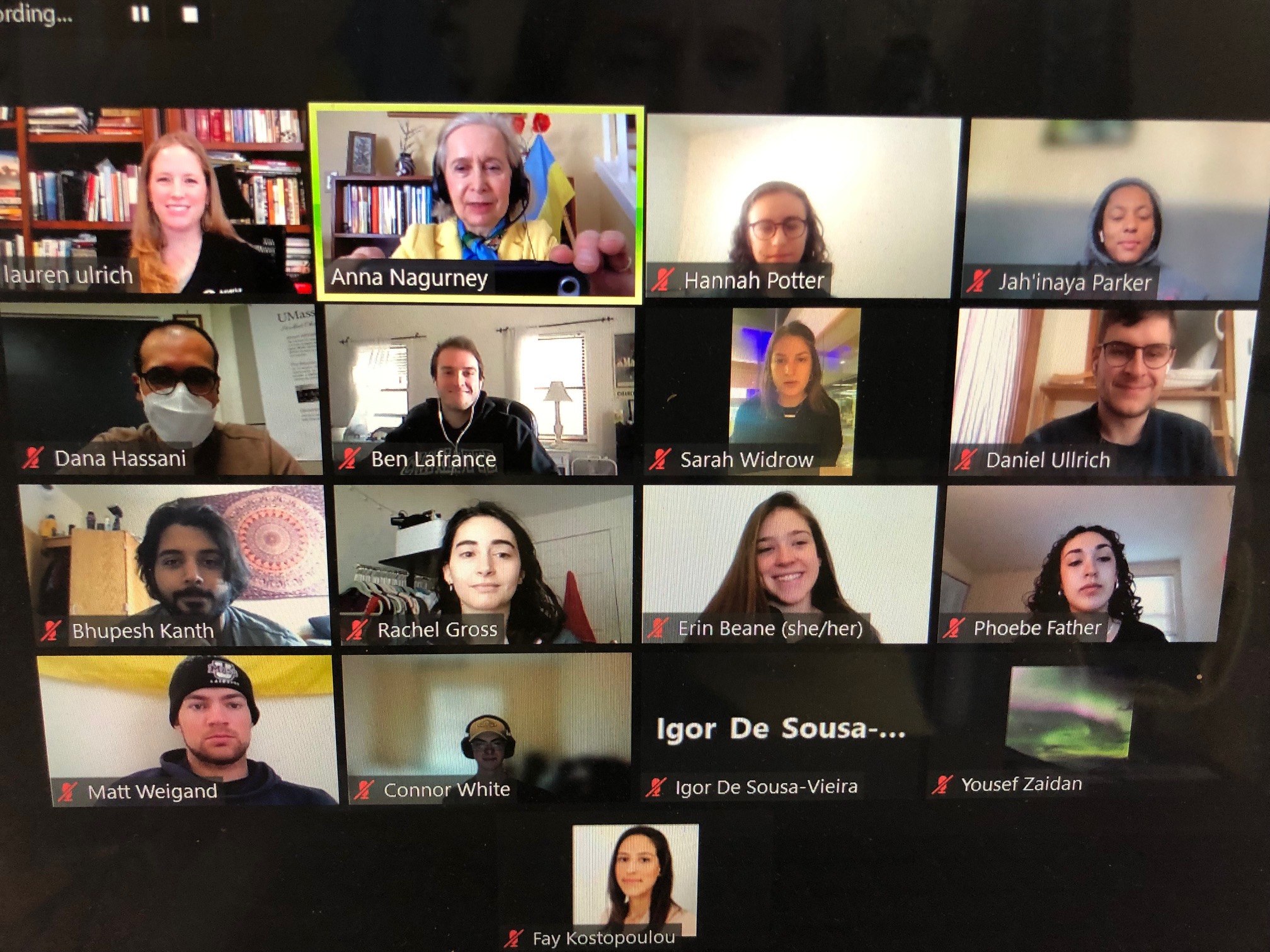
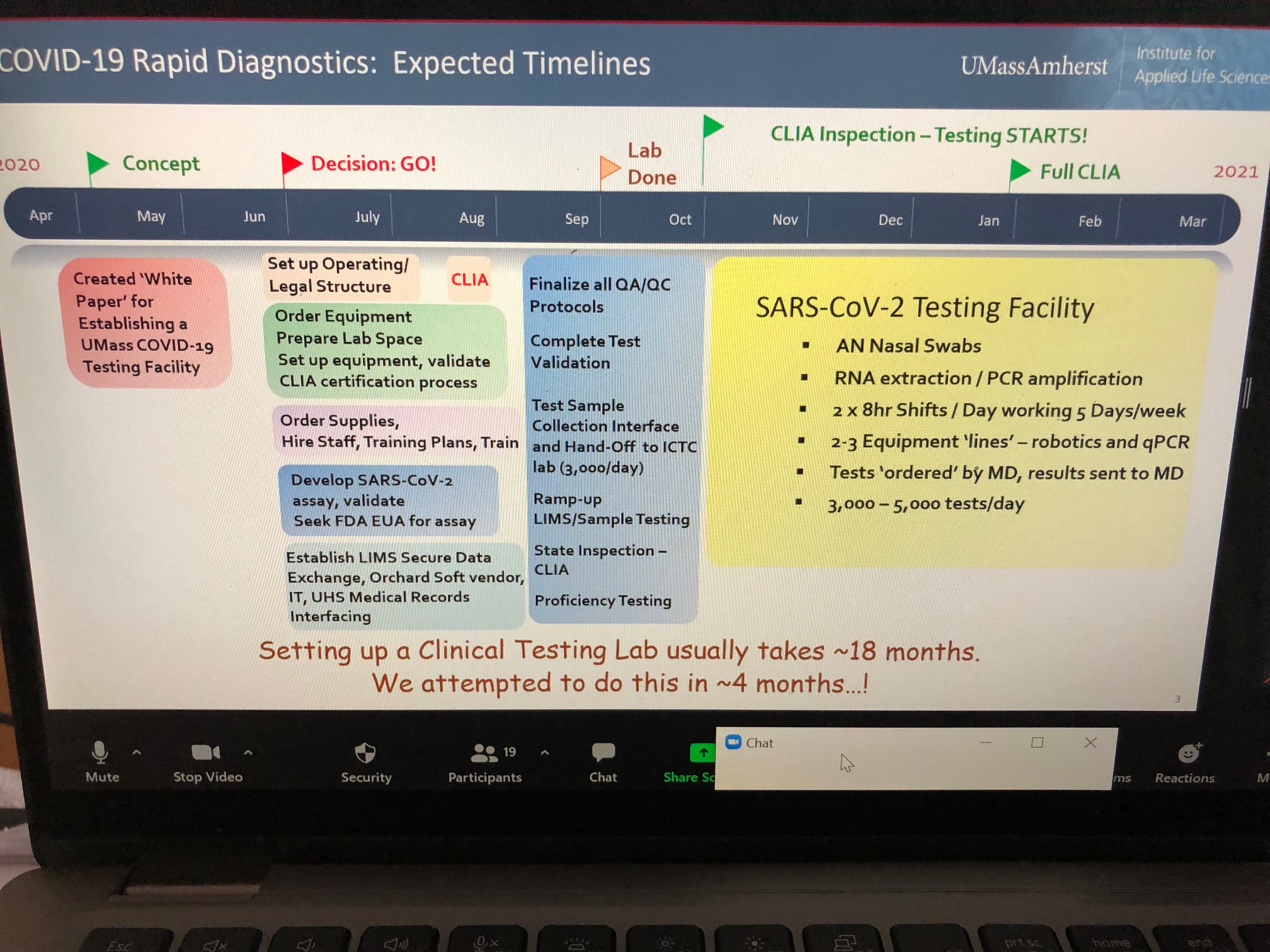
The fourth guest speaker was UMass Amherst's very own Dr. Peter Reinhart! Dr. Reinhart is the founding Director of the Institute for Applied Life Science (IALS) at UMass Amherst and has more than 25 years of R&D management experience in academia (Duke University), biotechnology (Cogent Neuroscience, Proteostasis Therapeutics), and large pharma (Wyeth, Pfizer). He  came to the University of Massachusetts Amherst from the Cambridge MA biotechnology company, Proteostasis Therapeutics (PTI), where he was President and Chief Scientific Officer. Dr. Reinhart shared with us how the incredibly effective and, frankly, life-saving, in my opinion, COVID-19 Testing Center at UMass was founded from scratch. As of April 2020, when UMass shut down and reverted to online teaching, 750 scientists in the Applied Life Sciences building had to stay at home. That was when he thought that they could use these human resources and talent to form the Testing Center. He made the idea into a “white paper” and handed it to be reviewed by Chancellor Subbaswamy.  After a month, Chancellor permitted Dr. Reinhart to start the project, who came up with a timeline to make it functional in 100 days, from the preliminary processes and operational foundations to the beginning of the testing. This required exceptional logistics, team work, planning, scientific expertise, legal interventions, and even the assistance of Massachusetts Governor Charlie Baker. Thousands of students, faculty, and staff and members of our community have benefited from the exceptional convenience and turn around time and accuracy of the UMass Amherst COVID Testing Center. We are all so proud of this truly exceptional achievement in the service of our community during the pandemic and so grateful!


The fifth and final guest speaker was Professor Ladimer S. Nagurney of the University of Hartford, who spoke in person on April 26, 2022. The topic of his guest lecture was: "Disaster Communications." He even brought hardware to demonstrate to the students. The slide deck of his lecture can be downloaded here.

He discussed many interesting topics with some of the highlights being the disruptions to communications after the volcanic eruption in Tonga (and the restoration efforts) and the importance of communications to the war efforts of  Ukraine against the Russian aggressors.


Many thanks to these outstanding guest speakers, who took the time from their very busy schedules to share their important insights and experiences with my Humanitarian Logistics and Healthcare class!

Monday, March 28, 2022

Congratulations to Mojtaba Salarpour on His Successful PhD Dissertation Defense!

In an academic's life, one of the many joys is seeing one's students achieve milestones.

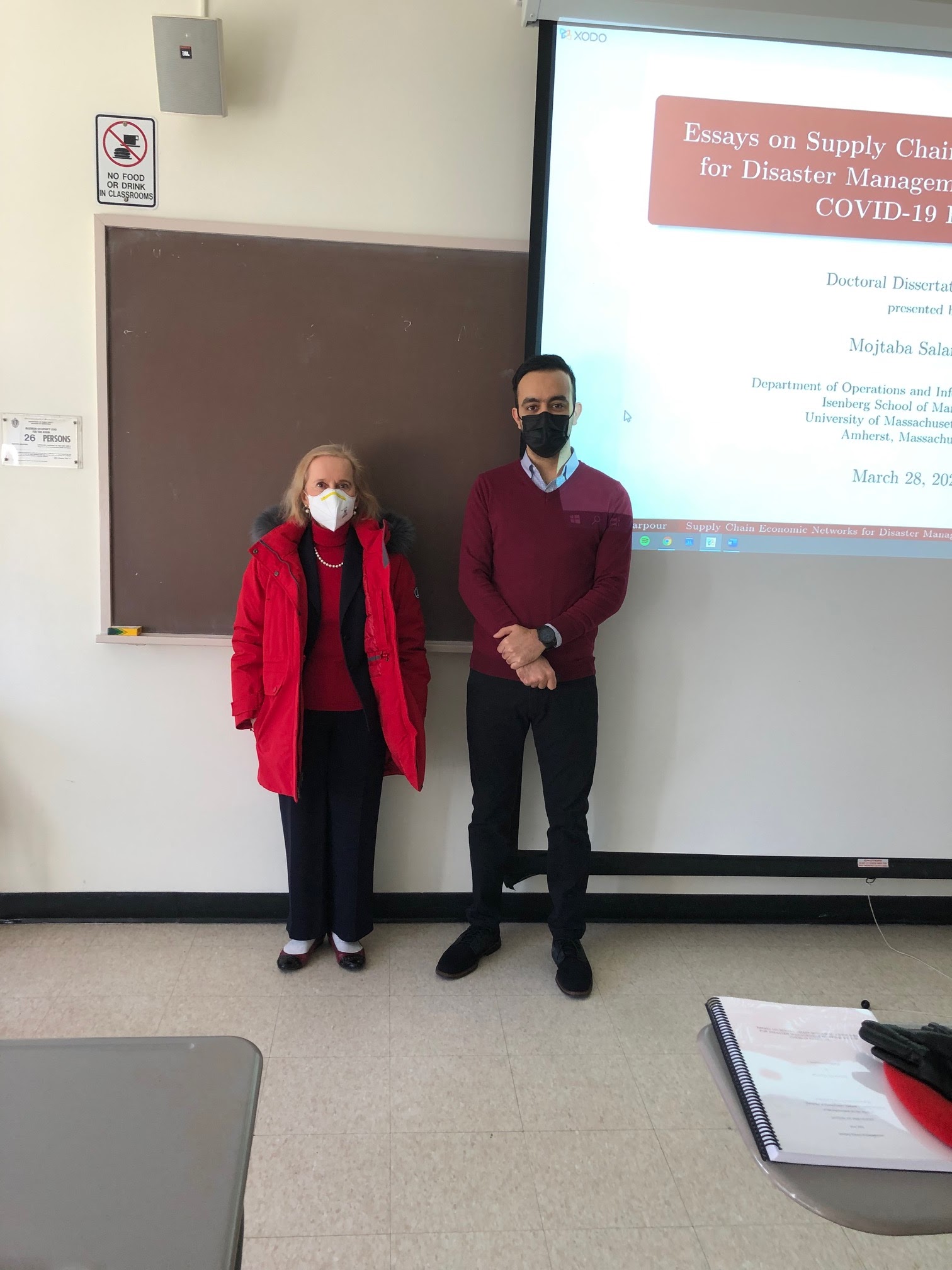
Today was a very special day, since Mojtaba Salarpour,  my PhD student in Management Science at the Isenberg School of Management at UMass Amherst, successfully defended his doctoral dissertation, with the title: "Essays on Supply Chain Economic Networks for Disaster Management Inspired by the Covid-19 Pandemic." The abstract of his dissertation can be viewed here. Mojtaba is my 23rd PhD student. I am grateful to the committee members: Professor Priyak Arora of the Isenberg School and Professors Hari Balasubramanian and Chaitra Gopalappa of the College of Engineering at UMass Amherst. 

When I arrived for the defense today, Mojtaba had assembled all sorts of treats and refreshments and we managed a quick photo before the committee members and others arrived.

Mojtaba's PhD dissertation research has already yielded several journal articles and a book chapter.


Mojtaba served for two years as the President of the UMass Amherst INFORMS Student Chapter (1 1/2 of those in the pandemic). Under his leadership, the chapter received two national awards from INFORMS because of its activities. Below is a photo taken at the Phoenix National INFORMS Meeting in 2021, at which the Chapter was honored with its latest award.

Mojtaba also taught required two different courses at the Isenberg School and has experience teaching in both face to face and in online formats. He clearly, is the "full academic package" with talents in research and scholarship, teaching, as well as service.

I am delighted that he will be joining the faculty of Texas A&M Commerce as an Assistant Professor, in the tenure track, in the Fall.

It is wonderful to see the academic family tree growing with the list of my PhD students, whose dissertation committees I chaired listed here.

And, my academic genealogy, in terms of those "who came before me" is featured below with incredible scientists such as Maxwell, Newton, and Galileo!


My students and I are clearly "standing on the shoulders of giants." 

Thursday, July 22, 2021

Thanks to All Who Made Our 2021 Dynamics of Disasters Conference a Success!
The 5th International Conference on Dynamics of Disasters has now come to a close. It was Professor Panos M. Pardalos who had the vision to start this conference series. I have had the honor of co-organizing the last four of them. This year the conference was virtual due to the COVID-19 pandemic and was co-organized by Professors Pardalos, Ilias S. Kotsireas, Chrys Vogiatzis, and me, with support provided by Professor Fuad Aleskerov and Sofia Papadaki. The conference website has a link to the full program and information on the outstanding plenary speakers: Professor Maria Besiou and Professor Oleg Prokopyev, and Dr. Stavros Siokos and Dr. George Karagiannis. It was very appropriate and illuminating to have plenary speakers from academia, industry, and government, who shed light on the latest research as well as best practices. 

The plenary talks were truly inspirational!


This was a single stream conference, which worked very well. There were excellent questions and a lot of discussions. Speakers and participants came from many countries, including: Austria, Germany, Italy, India, Nepal, Russia, the UK and the United States! It was very special to have four of my former PhD students present: Dr. Deniz Besik of the University of Richmond, Dr. Pritha Dutta of Pace University, Dr. Tina Wakolbinger of the Vienna University of Economics and Business, and the plenary speaker, Dr. Stavros Siokos! Dr. Besik presented on our latest food supply chain research with disruptions due to the COVID-19 pandemic, which is joint work with Dr. Dutta. Dr. Dutta, in turn, presented on our convalescent plasma research, a paper that was very recently published in Operations Research Forum. Also, my PhD student, Mojtaba Salarpour, presented  our paper published in the International Journal of Production Economics. In addition, I presented a paper on refugee migration networks that was co-authored with Professor Patrizia Daniele of the University of Catania and Professor Ladimer S. Nagurney of the University of Hartford. Our paper had been recently published in the Journal of Global Optimization. Professor Daniele also presented a paper on UAVs and 5G for disaster relief, work with Daniele Sciacca and Gabriella Colajanni.

As Professor Stephan Onggo of the UK (he is originally from Indonesia and is heading the Ops-Relief project) said: Disaster Management is complex and requires many different tools. And, indeed, the conference talks demonstrated the utility and applicability of optimization and simulation tools, AI and Machine Learning, game theory, network science, Data Envelope Analysis, and even the analysis of Twitter. There was definitely a "network" theme in many of the presentations!

Special thanks to colleagues in Nepal, India, and Russia, who joined us despite the challenges with their time zones and the conference talk scheduling. I am so grateful to each and every speaker and participant for the knowledge that was exchanges and also for the very supportive community that we have been building across the miles.

I am very pleased that many new research ideas were generated and new connections made virtually across the miles. It was wonderful to have 3 INFORMS Fellows take part in the conference, Professors Pardalos and Vicki Bier and me!

Below is a virtual group picture of the conferees.


Professor Panos M. Pardalos closed out the conference with the following quote, which I leave you with, "Keep positive but test negative!"

Professor Pardalos, inspired by Dr. Siokos, who emphasized that trees are the only "technology" that removes carbon from the air, then showed us the book in the photo below. Dr. Siokos is the co-founder of Astarte Capital Partners, based in London, England, which invests heavily in forests around the globe.

And we will be co-editing a special issue of the journal Operations Research Forum on our conference theme. The call for papers can be downloaded here.

Saturday, March 6, 2021

A Big Thanks to Dr. George Karagiannis for His Brilliant Guest Lecture in My Humanitarian Logistics and Healthcare Class

This past week, we had the honor and pleasure of hosting Dr. George Karagiannis in my Humanitarian Logistics and Healthcare class, which, this year, is being taught remotely because of the COVID-19 pandemic.

An integral part of this course is having guest lecturers who are expert practitioners. Hearing from such experts reinforces the course material and provides for a rich educational experience for the students.

Now, for some background on Dr. Karagiannis, whom I met back in 2015, when I co-organized the Dynamics of Disasters conference in Kalamata, Greece, with Professors Ilias S. Kotsireas and Panos M. Pardalos, and Dr. Karagiannis was a speaker. We also hosted him for a seminar at the University of Massachusetts Amherst in the Fall of 2015.

Dr. George Karagiannis is Greece's Deputy Secretary-General for Civil Protection, the US equivalent of Deputy FEMA Administrator. From 2016 to 2019, he was a Technical Officer at the European Commission Joint Research Center, where his area of expertise revolved around emergency management, critical infrastructure protection and hybrid threats. Prior to joining the Joint Research Center, he was a Disaster Management Consultant. He has worked in four countries, developed two strategic national risk assessments, organized over 60 exercises, led the development of a dozen emergency operations plans and responded to disasters in the field. He also was a Research Scientist at the Technical University of Crete in Greece, where he his interdisciplinary research lay at the intersection of systems engineering and disaster resilience. George earned his Doctorate in Environmental Science and Engineering from Saint-Etienne School of Mines in France. He also holds degrees in Civil Engineering and in Disaster Management and Business Administration, and is a Certified Emergency Manager by the International Association of Emergency Managers.

Dr. Karagiannis's presentation title in my course was, "Humanitarian Needs Assessment & Information Management." He zoomed in from Athens, Greece, which was lovely since the students in this class are physically located not only in Massachusetts but across the US, with a student even enrolled, who is now in Turkey.


Due to multiple inquiries and requests, Dr. Karagiannis has given me permission to post the slide deck of his excellent presentation.

So many excellent insights and recommendation are contained in his presentation, which I urge you to study. Some of the takeaways that very much resonated with me and also reinforced the material that we have been covering in the class and will be addressing in subsequent weeks are the following:

1. Help flows were there are cameras. This statement demonstrates the importance of media in getting the news out but also emphasizes that, at times, people who are victims of disasters may not get the help that they need.
2. Goods may be donated and delivered that do not help the victims - such as fur coats from Greece following the Israel-Hezbollah war in 2006! The wrong goods create extra stressors (even if they are donated in good faith) since they require human resources to offload and also take up valuable storage space. In the case of the furs, they ultimately created a health hazard. I recall tuxedos being delivered to victims of Hurricane Katrina, and there are many other such incredible stories of the wrong goods.
3. When do you stop gathering data? How much data is "good enough" for needs assessment?
4. The recognition of the importance of time is paramount. If it takes a time t for needs assessment, it will take a time of 2t for making a decision.
5. One must distinguish primary data from secondary data.
6. Comparison over time is also essential in terms of the number of people displaced by the disaster.
7. One of the greatest challenges is learning to make decisions with only incomplete information when everything is at stake!
8. There is a shift of Emergency Management now in addressing infrastructure, which makes tremendous sense due to the negative impacts of climate change on infrastructure.

I very much like that he noted the UN Cluster Approach to support sector emergency functions, which we had emphasized in the course just a few days prior.

We also had a great discussion on how well Greece mitigated the spread of the coronavirus, starting their preparations already in early January! The country was very agile and reacted quickly.

The students were prepared with questions for the speaker. Dr. Karagiannis was so generous with his time - staying way past the class time window to answer questions.

And we honored him with a Professor for a Day certificate recognizing that his contributions.