The past few days have been tumultuous with the new US President signing an Executive Order late on Friday proposing a 90-day suspension of visas and other immigration benefits to
all nationals of Iran, Iraq, Syria, Sudan, Yemen, Libya and Somalia. This happened as I was working on completing a paper on blood supply chains with a former doctoral student of mine from Iran, who is now a Professor - Dr. Amir H. Masoumi, and another former doctoral student of mine from China, also now a Professor - Dr. Min Yu.
This Executive Order (EO) struck very close to home, especially since last year another doctoral student of mine at the Isenberg School of Management, Sara Saberi, had returned to Iran, for the first time in about five years, and would not have been able, most likely, to return to the US to defend her thesis and to begin her Assistant Professorship at WPI, had the EO happened last year!
A petition against the EO had been started, which was featured in The Washington Post, so I signed it, and, at this point, the petition has over 40 Nobel prize winners signing it, over 7000 faculty, and over 12,000 other academic supporters.
Researchers live by the free exchange of ideas and disciplines, especially scientific ones, cannot move forward without the free exchange.
So, I started to wonder, how many different countries of origin were represented by my collaborators with whom I had published papers or written or co-edited books?
I did some counting and determined that my co-authors were born in 23 different countries and the countries and the collaborators' names are below:
Austria: Tina Wakolbinger and Thomas Nowak
Canada: Francois Soumis
Cape Verde: Jose M. Cruz
China: June Dong, Dong Li, Zugang Liu, Jon Loo, Jie Pan, Patrick Qiang, Ke Ke, Jiahao Wu, Hong Yan, Min Yu, Ding Zhang, Lan Zhao
Colombia: Luis Marentes, Yezid Donoso, Harold Castro
England: David Parkes, Alan G. Robinson
France: Christian Mullon
Germany: Dietrich Braess, Tilman Wolf
Greece: Stella Dafermos, Ilias S. Kotsireas, Panos M. Pardalos, George Rouskas, Stavros Siokos
India: Kathy Dhanda, Rudra Dutta, Padma Ramanujam, Shivani Shukla
Iran: Amir H. Masoumi, Sara Saberi
Italy: Patrizia Daniele, Antonino Maugeri
Japan: Takashi Takayama, Fuminori Toyasaki
Korea: Dae-Shik Kim
Lebanon: Hani S. Mahmassani
Mexico: Emilio Alvarez Flores
Norway: Sten Thore
Romania: Monica-Gabriela Cojocaru
Russia: Ilia Baldine, Alexander Eydeland
Sweden: Jonas Floden
Turkey: Deniz Besik, Ceren Soylu
Ukraine: Dmytro Matsypura
United States: Trisha Wolley Anderson, J. Aronson, Phillip M. Bishop, David E. Boyce, Ken Calvert, Paul Dupuis, Jim Griffioen, Kitty Hancock, Merritt Hughes, Patricia L. Mokhtarian, Craig L. Moore, Ladimer S. Nagurney, Charles F. Nicholson, Frank Southworth, John K. Stranlund, Kai Wu.
Five different continents are represented above.
If I have missed someone, just let me know, and I will add or correct whatever needs correcting.
It is inspiring to see the diversity in countries of origin of the above collaborators and also to reflect on our joint work together. Some collaborators are operations researchers / management scientists / mathematicians; others are engineers, computer scientists, or economists. Some have moved and are in different countries than their birthplaces and others have remained.
Working with collaborators is always enjoyable and synergistic plus motivating as well.
I was born in Canada and proud of it.
Showing posts with label Computer Science. Show all posts
Showing posts with label Computer Science. Show all posts
Monday, January 30, 2017
Thursday, September 17, 2015
Photos + Some Highlights of New England Security Day @UMassAmherst
This week is only the second week of the new academic year at UMass Amherst and has it been a busy start!
Today, after teaching my Transportation and Logistics class at the Isenberg School, I was off to the College of Information and Computer Sciences (newly named) to take part in the New England Security Day (NESD 2015). The program was fantastic with individual talks, a keynote by Jeremy Epstein of the National Science Foundation, and several panels. Plus, in the afternoon, there was a poster session.
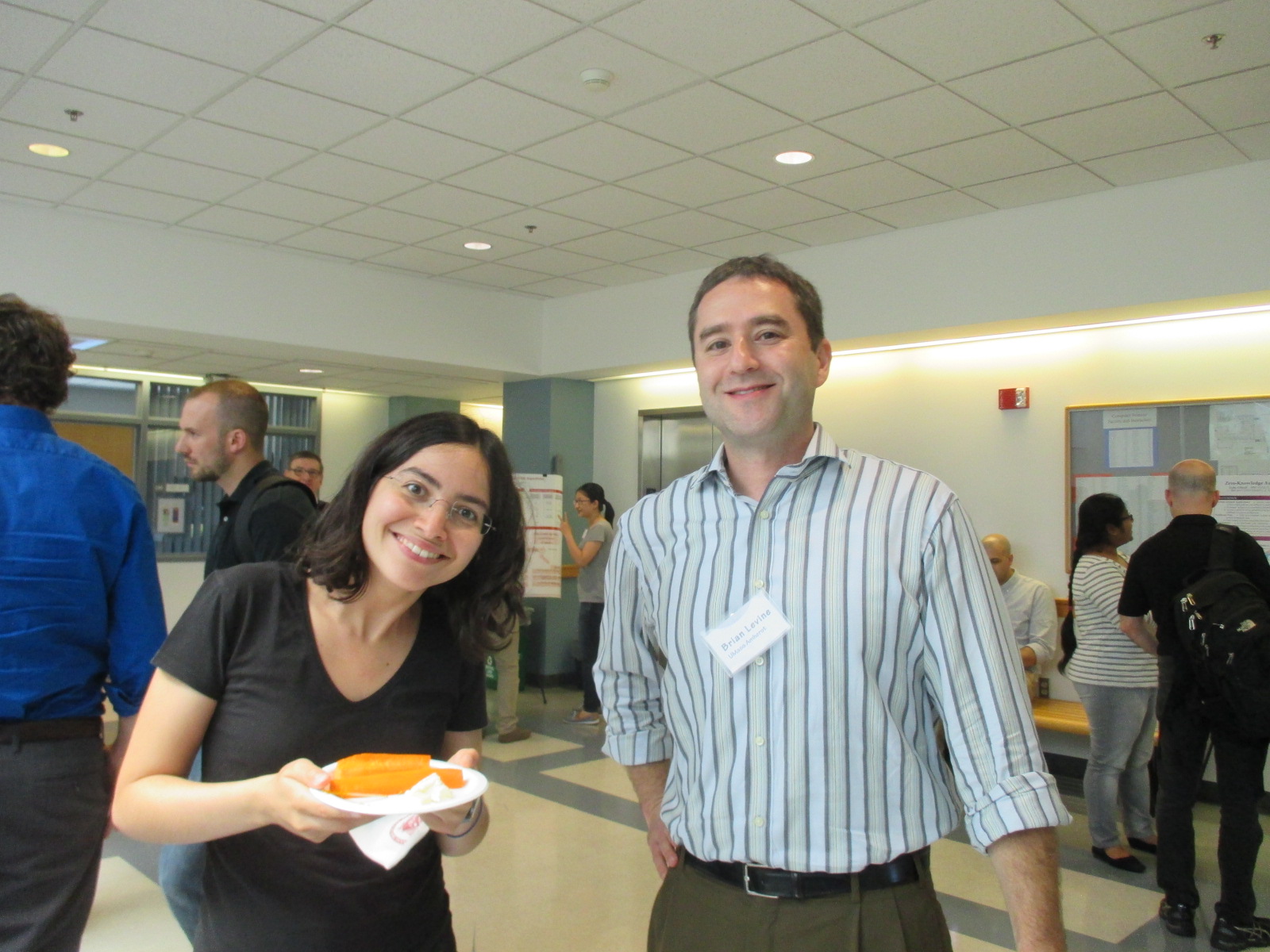
The day began with welcoming remarks by Dr. Brian Levine of Computer Science, who has been spearheading cybersecurity initiatives at UMass, and by our Povost, Dr. Katherine Newman.

 The keynote by Jeremy Epstein was simply fabulous. It was not only very informative but also delivered with a great sense of humor. The importance of cybersecurity research as well as the challenges associated with multidisciplinary research were highlighted.


 He also noted the importance of the NSF EAGER program, which I was delighted to hear about since my colleague, Professor Tilman Wolf, and I, with collaborators from the University of Kentucky recently received an EAGER grant. Epstein is a rotator at NSF, has had the position for 4 years, and is stepping down in January. His will be big shoes to fill.
There were 115 registrants for NESD and faculty and students came not only from many New England academic institutions (including Harvard, Dartmouth, WPI, Brown University, UConn, UMass Lowell, Northeastern) but also from New York (SUNY Stony Brook) and New Jersey (Rutgers and Stevens Institute of Technology). This speaks to the timeliness and importance of cybersecurity research.
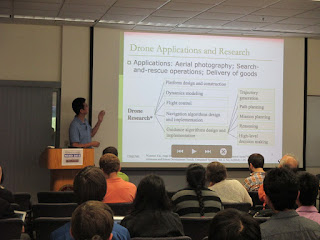
Below are photos of the speakers this morning and of the audience.



 Lunch was provided and was delicious.
Dr. Susan Landau of WPI was the first speaker in the afternoon.


 All the talks were great and it was nice to see female speakers as well as many female students. Several told me that they were so impressed by the number of females in attendance.


The refreshments were also perfect - Atkins cider donuts, fresh fruit, veggies, and cheese and crackers.
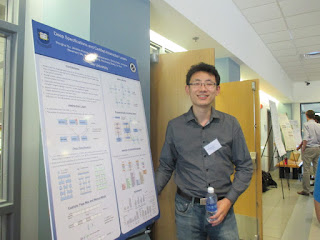
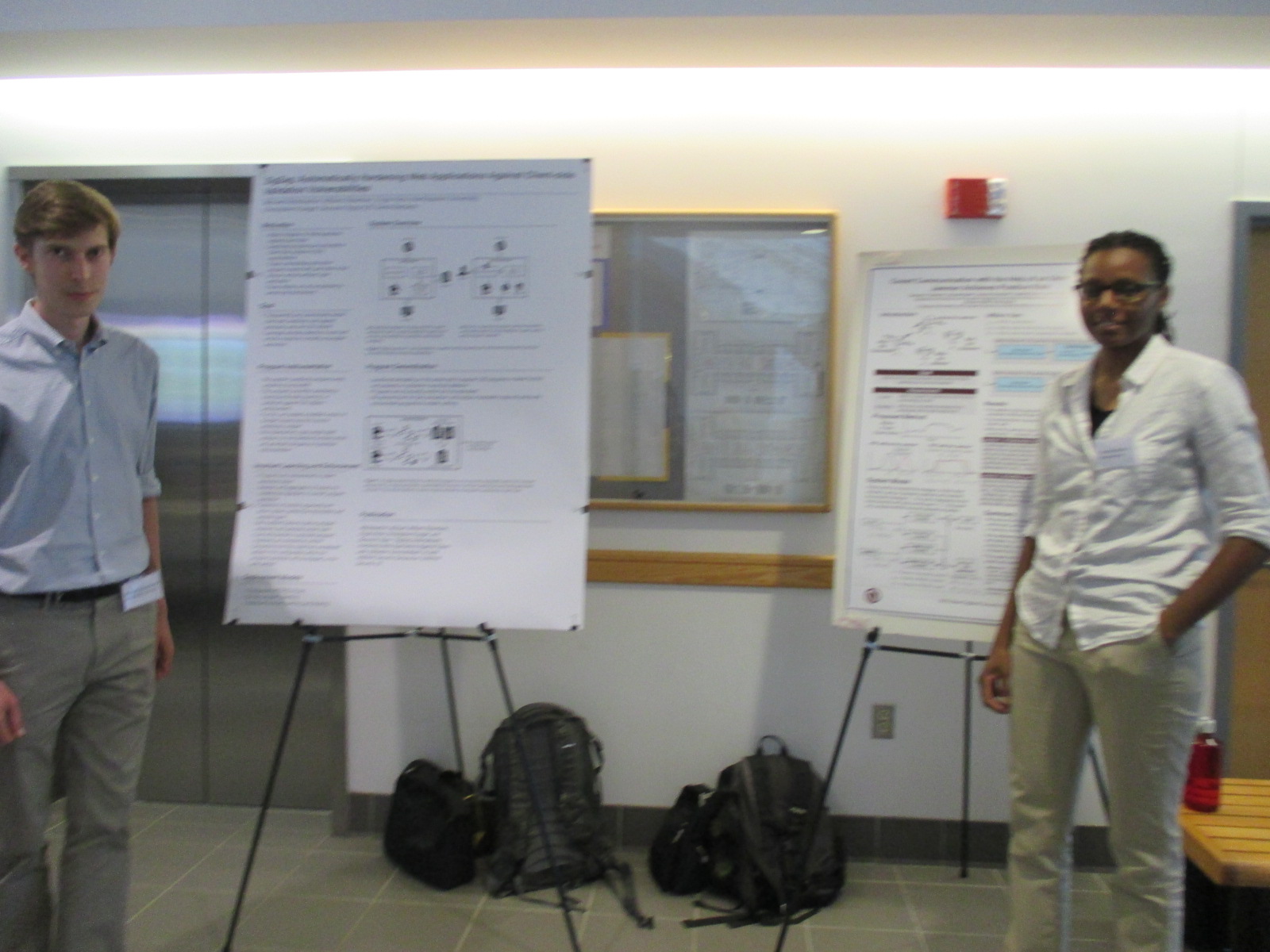
 The poster session was also very interesting and a great opportunity for networking. I was very happy that my doctoral students, Shivani Shukla and Sara Saberi, presented posters and, speaking of serendipity, the poster that Shivani presented was based in part on a paper of ours just published today in the new book, Computation, Cryptography, and Network Security, edited by N.J. Daras and M.T. Rassias. Dr. Rassias co-edited another book with John Nash, which will be John Nash's last book.
 I enjoyed talking with 2 PhD students in Computer Science from Brown University, my alma mater.




 One of the best aspects of today's event was not only the exchange of ideas but the conversations and the meeting of new colleagues. I can foresee new collaborations because of this event. It was also terrific to work over the summer with colleagues from Computer Science, the Isenberg School, the Department of Electrical and Computer Engineering, and Math/Stats to make this event happen.


 Kudos also to those in the last session, which still had a big audience because the topics were so interesting.


 A huge thank you to Professor Brian Levine for bringing us all together for the terrific New England Security Day. Based on the response and interest, I suspect that such an event will be held not once but, possibly, twice a year.
 Thanks to everyone for a very stimulating and energizing day! Special thanks to Michelle Roberts for the flawless logistics and smooth operation.
Today, after teaching my Transportation and Logistics class at the Isenberg School, I was off to the College of Information and Computer Sciences (newly named) to take part in the New England Security Day (NESD 2015). The program was fantastic with individual talks, a keynote by Jeremy Epstein of the National Science Foundation, and several panels. Plus, in the afternoon, there was a poster session.
The day began with welcoming remarks by Dr. Brian Levine of Computer Science, who has been spearheading cybersecurity initiatives at UMass, and by our Povost, Dr. Katherine Newman.


There were 115 registrants for NESD and faculty and students came not only from many New England academic institutions (including Harvard, Dartmouth, WPI, Brown University, UConn, UMass Lowell, Northeastern) but also from New York (SUNY Stony Brook) and New Jersey (Rutgers and Stevens Institute of Technology). This speaks to the timeliness and importance of cybersecurity research.
Below are photos of the speakers this morning and of the audience.


Dr. Susan Landau of WPI was the first speaker in the afternoon.


The refreshments were also perfect - Atkins cider donuts, fresh fruit, veggies, and cheese and crackers.






Thursday, April 10, 2014
Design and Analysis of a Content-oriented Internet
Yesterday, I marched down the hill from the Isenberg School of Management with my three doctoral students to attend the Distinguished Faculty Lecture given by Professor James Kurose of the Computer Science Department at UMass Amherst.
The title of his lecture, which was given in the Massachusetts Room of the Mullins Center to a standing room audience, was "Design and Analysis of a Content-oriented Internet."
 Professor Kurose was introduced by Provost James Staros and Dean Steven Goodwin and our Chancellor, Dr. Subbaswamy, was in attendance as well as our VCRE Mike Malone.
Professor Kurose began his lecture by saying that he is "A Teacher" and provided us with an overview of the major developments in communications from the telephone to packet switching to the Internet. He emphasized that the Internet is a Network of Networks and, since I founded and direct the Supernetwork Center at UMass, I liked hearing this very much. Supernetworks are networks of networks and our research at the center has advanced both methodologies and the modeling and solution of applications ranging from multimodal transportation networks to complex supply chains and to now envisioning a Future Internet Architecture (FIA), which is funded by the National Science Foundation (NSF), and which we are working on with Co-PIs at multiple universities. Our FIA is known as ChoiceNet.
Professor Kurose emphasized that "Content is King" and stated that Cisco is predicting that, by 2017, 80-90% of the Internet traffic will be for videos, TV streaming, peer to peer, etc. He noted that consumers don't care where the content comes from as long as we get it.
Everything used to be wired but now there are more wireless devices than wired ones connected to the Internet. There are also millions of access networks - for example, at UMass we would first be connected to that network.
He also spoke about the challenges that Netflix faces and that researchers in the Computer Science Department are working on. Some of my students and I had had a preview of this topic just the day before in my Management Science doctoral seminar on Variational Inequalities, Networks, and Game Theory, since a Computer Science professor and one of his doctoral students have been sitting in this course of mine and it has been terrific to have them. We had heard the day before about how Netflix is unsure of where to position movies (store them) and makes multiple copies in multiple locations - this may reduce the speed of delivery and also add to network congestion plus storage costs - topics I have spoken about.
Afterwards there were great questions, even from our Chancellor - not surprising since he is a physicist!
I commented that the Netflix problem reminded me of a problem in humanitarian logistics (another course that I am teaching this semester) in terms of the positioninng of supplies and also mentioned our FIA project ChoiceNet, which will allow consumers to select not only content but the mode of delivery which could include less congested paths with consumers willing to pay for such enhanced services as we say "pay with their wallets."
Indeed, in our ChoiceNet project, which we already have multiple papers on, we draw comparisons with supply chain networks and freight delivery systems and recognize the importance of network economics, game theory, and operations research. Professor Kurose, after my comments, did note that I was in OR and mentioned "facility location." I have a good idea as to how to model the Netflix problem and solve it. He also mentioned that 2 out of the 5 NSF FIA [projects had UMass Amherst contributors, which is wonderful!
After his fabulous talk - clear why he has received multiple teaching awards research recognitions, I took the photo below of him with my doctoral students.
 We essentially closed up the reception since there were so many interesting faculty and graduate students to talk to from Computer Science, Electrical and Computer Engineering, and even Political Science!
Professor Kurose has been at UMass Amherst for 30 years and over the next 30 we can continue to ask him many questions that his talk inspired.
I remember, back in 2005, sharing the stage with him at the Bowker Auditorium, when both of us were amongst the 12 faculty being recognized with a new award, which is now given annually - the Award for Outstanding Accomplishments in Research and Creative Activity.
Great to have the opportunity for my doctoral students in Management Science to meet him yesterday!
The title of his lecture, which was given in the Massachusetts Room of the Mullins Center to a standing room audience, was "Design and Analysis of a Content-oriented Internet."
Professor Kurose began his lecture by saying that he is "A Teacher" and provided us with an overview of the major developments in communications from the telephone to packet switching to the Internet. He emphasized that the Internet is a Network of Networks and, since I founded and direct the Supernetwork Center at UMass, I liked hearing this very much. Supernetworks are networks of networks and our research at the center has advanced both methodologies and the modeling and solution of applications ranging from multimodal transportation networks to complex supply chains and to now envisioning a Future Internet Architecture (FIA), which is funded by the National Science Foundation (NSF), and which we are working on with Co-PIs at multiple universities. Our FIA is known as ChoiceNet.
Professor Kurose emphasized that "Content is King" and stated that Cisco is predicting that, by 2017, 80-90% of the Internet traffic will be for videos, TV streaming, peer to peer, etc. He noted that consumers don't care where the content comes from as long as we get it.
Everything used to be wired but now there are more wireless devices than wired ones connected to the Internet. There are also millions of access networks - for example, at UMass we would first be connected to that network.
He also spoke about the challenges that Netflix faces and that researchers in the Computer Science Department are working on. Some of my students and I had had a preview of this topic just the day before in my Management Science doctoral seminar on Variational Inequalities, Networks, and Game Theory, since a Computer Science professor and one of his doctoral students have been sitting in this course of mine and it has been terrific to have them. We had heard the day before about how Netflix is unsure of where to position movies (store them) and makes multiple copies in multiple locations - this may reduce the speed of delivery and also add to network congestion plus storage costs - topics I have spoken about.
Afterwards there were great questions, even from our Chancellor - not surprising since he is a physicist!
I commented that the Netflix problem reminded me of a problem in humanitarian logistics (another course that I am teaching this semester) in terms of the positioninng of supplies and also mentioned our FIA project ChoiceNet, which will allow consumers to select not only content but the mode of delivery which could include less congested paths with consumers willing to pay for such enhanced services as we say "pay with their wallets."
Indeed, in our ChoiceNet project, which we already have multiple papers on, we draw comparisons with supply chain networks and freight delivery systems and recognize the importance of network economics, game theory, and operations research. Professor Kurose, after my comments, did note that I was in OR and mentioned "facility location." I have a good idea as to how to model the Netflix problem and solve it. He also mentioned that 2 out of the 5 NSF FIA [projects had UMass Amherst contributors, which is wonderful!
After his fabulous talk - clear why he has received multiple teaching awards research recognitions, I took the photo below of him with my doctoral students.
Professor Kurose has been at UMass Amherst for 30 years and over the next 30 we can continue to ask him many questions that his talk inspired.
I remember, back in 2005, sharing the stage with him at the Bowker Auditorium, when both of us were amongst the 12 faculty being recognized with a new award, which is now given annually - the Award for Outstanding Accomplishments in Research and Creative Activity.
Great to have the opportunity for my doctoral students in Management Science to meet him yesterday!
Wednesday, February 19, 2014
Fabulous Optimization Conference in Florida Plus a Too Exciting Plane Landing
I returned from Gainesville, Florida this morning about 1:30AM on a two-legged flight through Charlotte to Bradley airport in Hartford/Springfield and was greeted with more snow. The flight from Gainesville to Charlotte on a puddle jumper plane was rather exciting since the pilot announced that our wingflaps would not go down (this was a first for me and I have written about various flying adventures on this blog). We were to land going very fast, he announced, and, as we were landing, I could see the pageant of firetrucks that were there to welcome us. As we taxied I was amazed at the number of fire trucks that were on both sides of us with flashing lights. I was waiting to smell smoke but that did not happen. We were asked whether we needed "Customer Service" after the experience and when the pilot exited the cockpit I thought that he could be one of my undergraduates at the Isenberg School. Great job - we made it safely and that is what counts. My flight from Charlotte to Bradley was uneventful and I enjoyed speaking with a UConn student who was returning from a med school interview.
I had been in Florida for two days to attend and speak at the Learning and Intelligent Optimization (LION 8) Conference that was organized by Professor Panos M. Pardalos of the University of Florida and Dr. Mauricio Resende of AT&T Labs Research with great support provided by Dr. Pardalos' doctoral students.
Panos, as some of you may have heard, was recently appointed a Preeminent Chair at the University of Florida for his work in Big Data. Bravo, bravo, bravissimo. Coincidentally, just one year ago, I was with Panos and other luminaries at the AAAS Symposium Dynamics of Disasters in very cold Boston.
Speakers and participants came to the optimization conference in Gainesville from Japan, Russia, Singapore, China, Sweden, Italy, Germany, Franc, Ireland, Australia, Greece, Colombia, Canada, Spain, and the U.S.
The venue was lovely and warm and it was great to get away from the white stuff (snow), albeit for only two days. The audience consisted primarily of operations researchers, computer scientists, and engineers, with papers ranging from models to algorithms with interesting directions such as portfolios of algorithms and configuration optimization for solvers.
On Monday I enjoyed the first (invited) talk given by Dr. Vijay Vazirani of Georgia Tech who spoke on Linear Complementarity Problems and Walrasian equilibria. I do find the continuing interplay among economics, operations research, and computer science exciting and intriguing. I brought to his attention the work of Dafermos and others in variational inequalities and the computation of equilibria, which has been a very active field over the past 20 years. Conferences such as this are so important for communication!
Many of the presentation slides are being made available by the authors and are being posted on the conference website, which is great.
I enjoyed giving my presentation on joint work with one of my doctoral students, Dong "Michelle" Li, entitled: "Equilibria and Dynamics of Supply Chain Network Competition with Information Asymmetry in Quality and Minimum Quality Standards." Given last Friday's article in The New York Times on the global manufacturing of medicines and quality issues, the talk, I thought, was quite timely.
The photos below were taken at the conference. It was great to engage the mind and also the soul with the warmth and beauty of the surroundings. We had lunches and the conference dinner outside. I see why people move to Florida, given this winter in the Northeast.


 The food was fabulous, too.

 As was the ambience both inside and outside.

 Some had to sleep in the Atlanta airport, given the 10,000 flight cancellations last week in the U.S., because of the snow and ice, but everyone made it to the conference. One of our Russian colleagues, did laps in the pool above at 7AM.
Although the Springer books and journals arrived yesterday, it was so nice to see our book, Networks Against Time: Supply Chain Analytics for Perishable Products, that I co-authored with Dr. Min Yu, Dr. Amir H. Masoumi (both my former doctoral students), and the other "Professor Nagurney," Dr. Ladimer S. Nagurney, on display. It was also wonderful to meet Ramzia Amad from Springer, who was a Math major in college and was also attending the conference. Our book survived Superstorm Sandy last year and was emailed and then the Springer offices closed. But we are resilient!

 Thanks to the organizers for bringing researchers from around the globe with a passion for models, algorithms, and computations together!
I had been in Florida for two days to attend and speak at the Learning and Intelligent Optimization (LION 8) Conference that was organized by Professor Panos M. Pardalos of the University of Florida and Dr. Mauricio Resende of AT&T Labs Research with great support provided by Dr. Pardalos' doctoral students.
Panos, as some of you may have heard, was recently appointed a Preeminent Chair at the University of Florida for his work in Big Data. Bravo, bravo, bravissimo. Coincidentally, just one year ago, I was with Panos and other luminaries at the AAAS Symposium Dynamics of Disasters in very cold Boston.
Speakers and participants came to the optimization conference in Gainesville from Japan, Russia, Singapore, China, Sweden, Italy, Germany, Franc, Ireland, Australia, Greece, Colombia, Canada, Spain, and the U.S.
The venue was lovely and warm and it was great to get away from the white stuff (snow), albeit for only two days. The audience consisted primarily of operations researchers, computer scientists, and engineers, with papers ranging from models to algorithms with interesting directions such as portfolios of algorithms and configuration optimization for solvers.
On Monday I enjoyed the first (invited) talk given by Dr. Vijay Vazirani of Georgia Tech who spoke on Linear Complementarity Problems and Walrasian equilibria. I do find the continuing interplay among economics, operations research, and computer science exciting and intriguing. I brought to his attention the work of Dafermos and others in variational inequalities and the computation of equilibria, which has been a very active field over the past 20 years. Conferences such as this are so important for communication!
Many of the presentation slides are being made available by the authors and are being posted on the conference website, which is great.
I enjoyed giving my presentation on joint work with one of my doctoral students, Dong "Michelle" Li, entitled: "Equilibria and Dynamics of Supply Chain Network Competition with Information Asymmetry in Quality and Minimum Quality Standards." Given last Friday's article in The New York Times on the global manufacturing of medicines and quality issues, the talk, I thought, was quite timely.
The photos below were taken at the conference. It was great to engage the mind and also the soul with the warmth and beauty of the surroundings. We had lunches and the conference dinner outside. I see why people move to Florida, given this winter in the Northeast.
Although the Springer books and journals arrived yesterday, it was so nice to see our book, Networks Against Time: Supply Chain Analytics for Perishable Products, that I co-authored with Dr. Min Yu, Dr. Amir H. Masoumi (both my former doctoral students), and the other "Professor Nagurney," Dr. Ladimer S. Nagurney, on display. It was also wonderful to meet Ramzia Amad from Springer, who was a Math major in college and was also attending the conference. Our book survived Superstorm Sandy last year and was emailed and then the Springer offices closed. But we are resilient!
Subscribe to:
Posts (Atom)

 Posts