Showing posts with label cybersecurity. Show all posts

Thursday, February 13, 2020

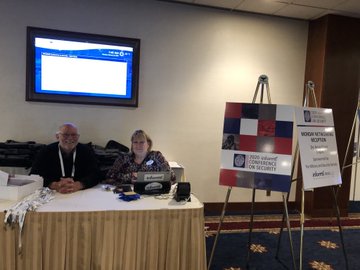
Outstanding Inaugural INFORMS Security Conference in Beautiful Monterey, California

I arrived back in Amherst at 1AM this morning, having flown from Monterey, California to Denver, Colorado and then to my "local" airport - Bradley.

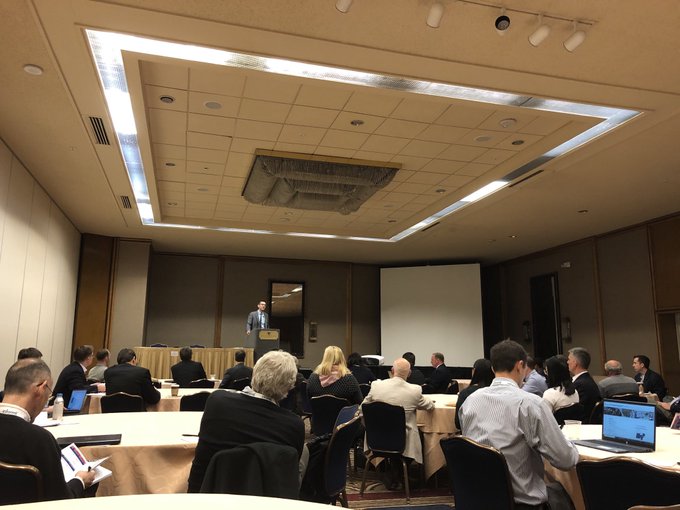
I had been in beautiful Monterey to take part in INFORMS' inaugural Conference on Security and it was outstanding.  The official dates of the conference were February 9-11, 2020.  Luckily, I am on sabbatical this semester, so this was manageable for me and I was very much looking forward to presenting at this conference. It was also quite nostalgic, since the first talk I ever gave at a conference was at the Naval Postgraduate School in Monterey (which was also heavily involved in this conference) at an MIT/ONR conference organized by Professor Michael Athans of MIT. I was then working in the defense sector, focusing on the navy, in Newport, Rhode Island, while pursuing my Master's at Brown University. I was the only female presenter at that conference.

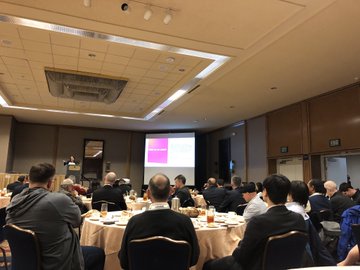
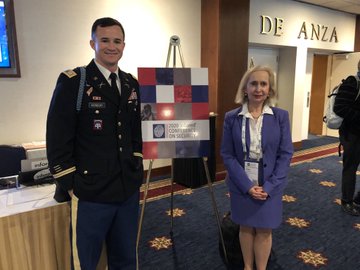
First, I would like to congratulate the organizers of the INFORMS Security Conference: Mr. Harrison Schramm, Captain Brian Morgan, and Dr. Paul Nicholson, on its success! The format was excellent - 50 minute presentations (8 or so parallel sessions), with lunch and coffee provided, and ample time for discussion. Everyone was very gracious and friendly.  One "marker of the success" of this conference was the number of INFORMS Fellows in attendance, including: Gerry Brown, Stephen Robinson, Vicki Bier, Michael Fu, Sheldon Jacobson, and me :) If I missed someone, do let me know! Attendance was about 100 (I was told) and consisted of faculty, military, practitioners from various companies, government, and even some students that I met.

The plenary talks were great as well as a risk analysis panel conducted by Gerry Brown and Sam Savage. 
Image

It was thrilling to even see Stefan Pickl, who traveled all the way from Germany for the conference. He had been a participant in the latest Dynamics of Disasters conference that I co-organized with Panos M. Pardalos and Ilias S. Kotsireas, and which took place last summer in Kalamata, Greece. We are now co-editing a new volume, to be published by Springer.
Image
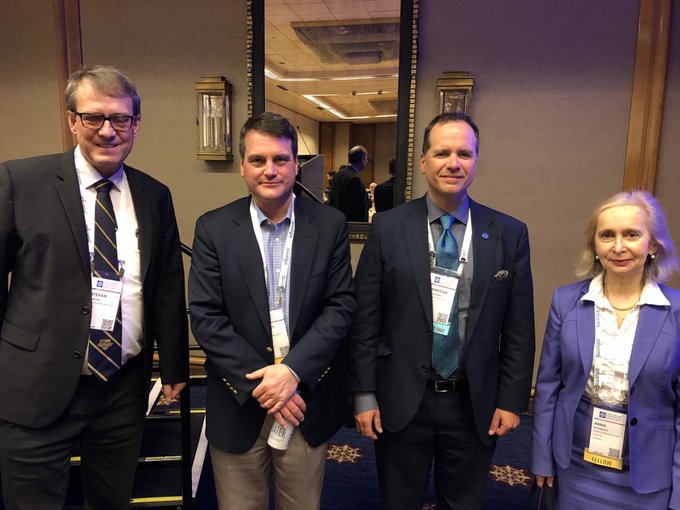
In the above photo I am standing with Stefan Pickl, Rob Dell, who gave one of the plenary talks, and Conference Chair Harrison Schramm.

I had the pleasure of presenting Monday morning on Game Theory Network Models for Disaster Relief. Special thanks to Nathaniel Bastian for being an outstanding stream chair of our stream: Interdisciplinary Applications - Frontiers. He had all of our presentations ready for projecting on his laptop.
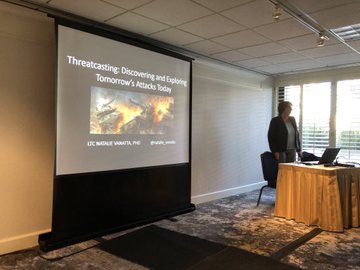
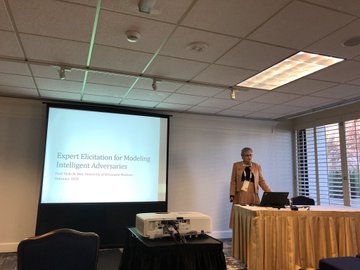
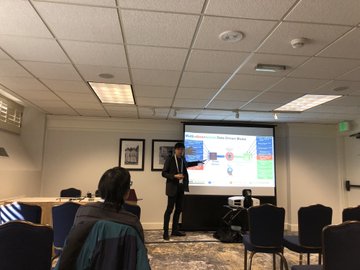
Below are some photos from the delivered talks and of one of the great lunches! Many thanks for the wonderful presenters. Special to also hear from Jun Zhang and James Minas.
Image

Image
Image
Image
Image
Image
Image
The venue was extraordinary - the hotel is located in downtown Monterey with hiking/biking trails in proximity and views of the Pacific.

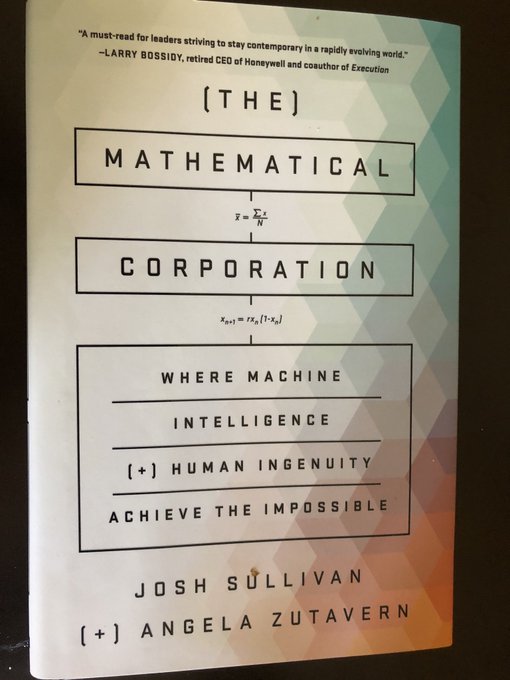
And, at its best, a conference generates new research ideas, new collaborations, reconnecting with colleagues, and growing your network. The INFORMS Conference on Security delivered on all counts and at a location that would be hard to improve upon.  I was even presented with a book by Booz Allen Hamilton consultants. Interestingly, I had had an offer from this company when I was finishing up my PhD.
Image
Image
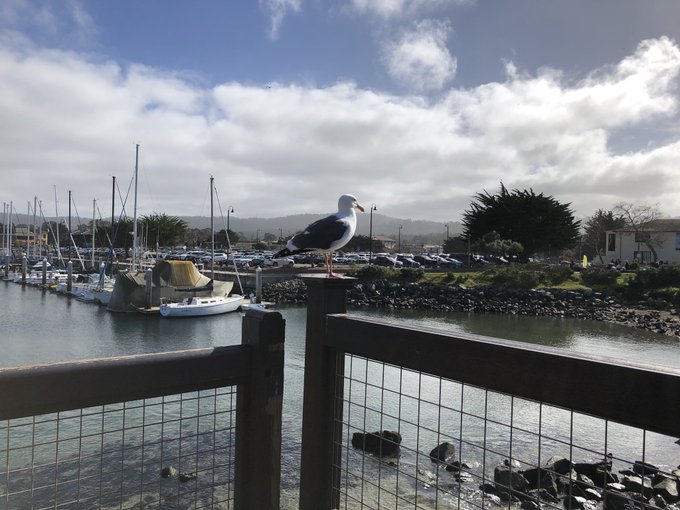
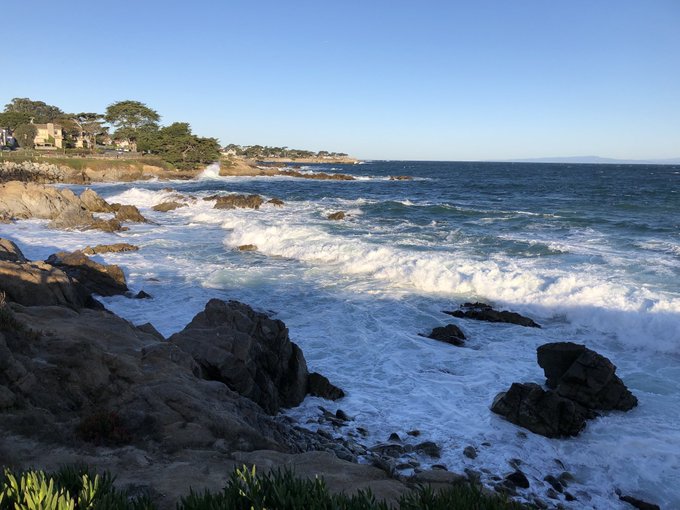
Below I have posted a few photos of the beauty of the natural environment of Monterey.
Image
Image
Image
Image
I am looking forward to the next INFORMS Conference on Security but, in the mean time, there is a lot of important research to be done by our community!

Sunday, October 27, 2019

Supernetwork Center Associates Shine at INFORMS Conference in Seattle

In my previous blogpost, I wrote about the fascinating experiences I had in delivering the opening keynote at the recent Operations Research Conference in Mexico City. However, since I am also teaching this semester, I could not attend the INFORMS Conference in Seattle, because it would not be right to miss classes over a two week period. Moreover, I believed it important to support the Mexican OR Society. This was one of only two Annual INFORMS conferences that I have not been at in over two decades. I appreciate all the messages that I have been receiving that I was missed - thank you very much!

However, our research was presented at INFORMS Seattle and also very special recognitions received by several Supernetwork Center Associates.

In particular, three of my joint papers were presented:
The above talks can be downloaded from the Supernetwork Center site at the Isenberg School of Management and are based on papers recently published in the journals: Transportation Research E, International Journal of Production Economics, and the European Journal of Operational Research. Many thanks to the organizers of the sessions that the above first and third presentations appeared in! Below are photos of the two presenters of those talks.
Usually, at every INFORMS Conference, I host a dinner for Supernetwork Center Associates, many of which are my present or former doctoral students, who are now very successful professionally. Although this year I could not, it was wonderful to receive the photo below.

In the above photo (l-r) are: the females in the front row: Professor Min Yu of the University of Portland, Professor Ke Ke of Central Washington University, Professor Pritha Dutta of Pace University, my PhD student Deniz Besik, and Professor Sara Saberi of WPI. And, in the back row (l-r) are the males: my PhD student Mojtaba Salarpour, Professor Jose Cruz of UConn, and Professor Patrick Qiang of Penn State. Professor Shivani Shukla of the University of San Francisco presented on our cybersecurity research but is not in the photo. Professor Dmytro Matsypura of the University of Sydney also did not make it to the photo (but more on his award follows).

I was delighted to hear that Dr. Matsypura (who was my PhD student at Isenberg) received the INFORMS ENRE (Energy, Natural Resources and the Environment) Best Publication Award in Environment and Sustainability at the conference for his paper on wildfire fuel management, co-authored with Professor Oleg Prokopyev of the University of Pittsburgh  and with Matsypura's student, Aizat Zahar, and published in EJOR, . The paper can be accessed here.  Below is the photo of the awardees, forwarded to me by Professor Matsypura.
Also, I was thrilled that my doctoral student, Deniz Besik, received the Bayer - Women in OR Scholarship and was recognized at the Analytics Society Business meeting at INFORMS Seattle. I had nominated Deniz for this award. Deniz, amazingly, already has 6 published journal articles and will be received her PhD in May 2020. She also took part in this year's Doctoral Student Colloquium immediately before the INFORMS Conference.

Thanks to Dr. Polly Mitchell-Guthrie for her tweet with the image below.

And, Professor Jose Cruz of UConn organized a session on Sustainable and Responsible Supply Chain Management in which multiple Supernetwork Associates spoke.

I was Chair of the 2019 INFORMS Volunteer Service Award Committee, having served on this committee also the two previous years (and was honored to also be a recipient of this award in 2016). Congratulations to Dr. Scott Nestler and Dr. Stefan Karisch for receiving this award this year. Dr. Sadan Kulturel-Konak, a member of this year's committee, presented this award in Seattle in my place.

It was also very gratifying that there were two additional recipients of major awards at INFORMS in Seattle, both of whom I had written letters for.

Plus, even before I flew to Mexico, as the Faculty Advisor to the UMass Amherst INFORMS Student Chapter, I supported the students who practiced their talks in our UMass Amherst INFORMS Tune-Up!
Many thanks to all the companies, universities, publishers, and societies for personal invitations to attend even brunches and meetings at INFORMS Seattle! These were all very much appreciated.

And, in closing, congratulations to all the award recipients and thanks to all the volunteers that help to make INFORMS such a fabulous professional society!

You can find many photos, courtesy of INFORMS, posted on its Flickr page.

Tuesday, March 5, 2019

Information Security at a Research University

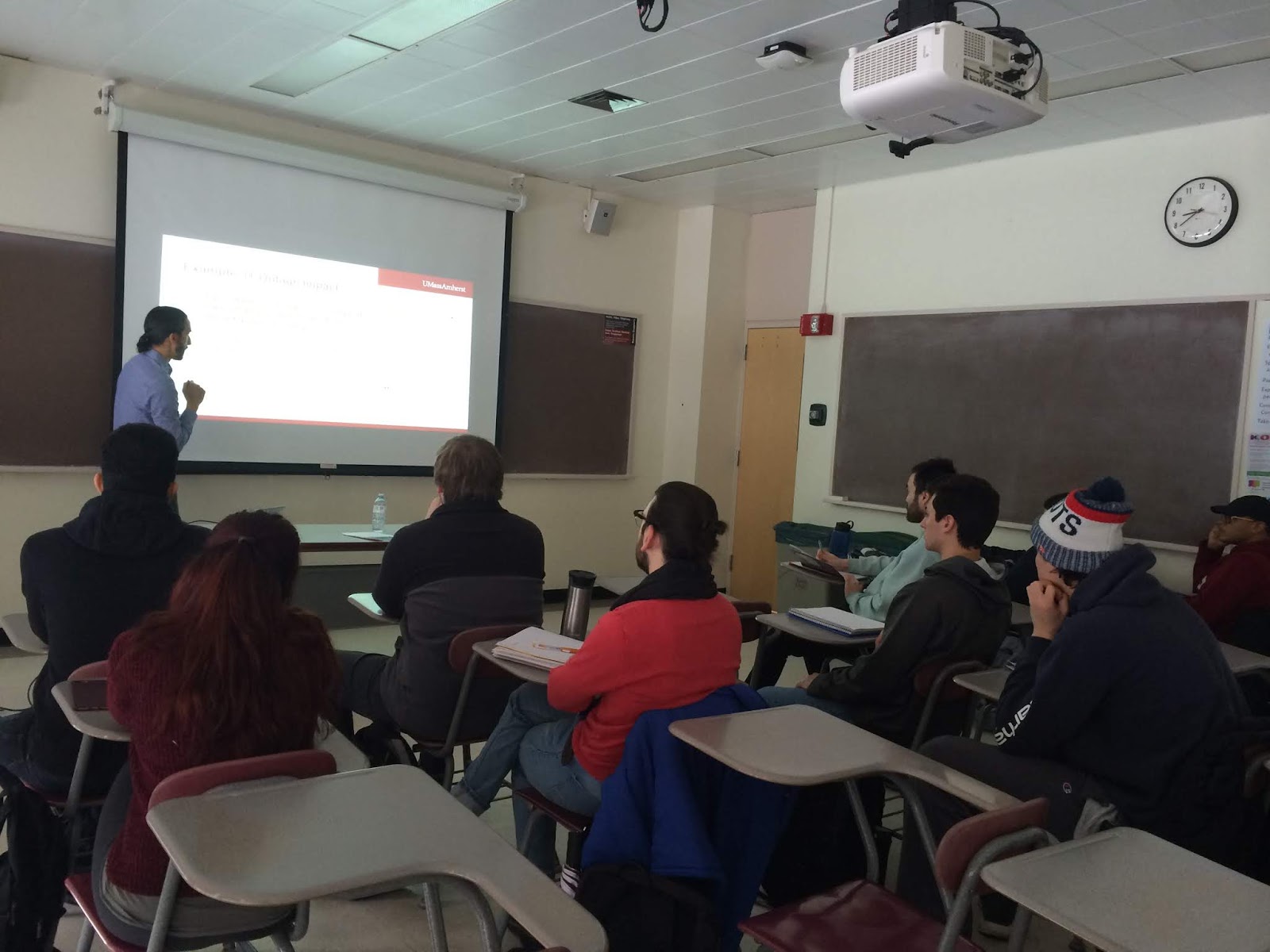
Last Thursday, the students in my Humanitarian Logistics and Healthcare class and I had the honor of hearing Chris Misra, the Interim Vice Chancellor for Information Technology and CIO at UMass Amherst, deliver a guest lecture. 

We had had a joint project on cybersecurity with my Isenberg School colleagues, Senay Solak and Mila Sherman, and Wayne Burleson of the College of Engineering at UMass that was funded by the Advanced Cyber Security Center (ACSC) . You can read more about our project and see a presentation here, thanks to INFORMS. Cybersecurity is also a topic that my Supernetwork Team has been conducting research on and we have a stream of papers of the subject, with more to come.

Given  that information security is essential to enterprises, both profit and nonprofit ones, I thought that having Chris Misra speak on Information Security at a University would be very timely and fascinating and, indeed, his lecture was! I had communicated with him early that morning around 6AM, and told him that I would be waiting for him in the Isenberg School atrium. When I did not see him shortly before the class was to start, I emailed him and found out that he was waiting for me in the atrium of our new $62 million addition! Ironically (and the first time this semester), there were some issues with the technology in my classroom, but soon those were addressed, thanks to our TSS staff! Luckily, also, the university did not have a delayed start time, given the snow forecast.

Mr. Misra began his lecture with an overview of how Amherst College, a neighboring elite, very well-endowed liberal arts college, recently experienced a "technical mishap that left the campus without access to online services -- for five days".  Faculty, students, and staff at Amherst College were without access to Wi-Fi, email, and a variety of student support and other services; in effect, any content hosted by the college's website was not accessible. The cause was ultimately attributed to a network outage (and not a cyberattack)  and I heard from Chris Misra that Cisco came to the rescue.

Running an enterprise network for a university of the size of UMass Amherst is a major operation/ endeavor with both network engineering and network operations being essential and with the former also involving switches, routers, and even long haul networks to the other UMass campuses. Misra emphasized that there is a lot of complexity that you don't see, including the copper and fiber cabling. There is builtin redundancy to mitigate risk and there is a separate control domain from transport with 50,000-70,000 devices. Clearly, a very complex system to manage and to maintain.

I was so impressed that Chris Misra had even looked at the course syllabus and remarked that the course looked so interesting (yes, I love teaching this course because of the dynamism of the subject). 

He noted that "security is a negative deliverable - you don't know when you have it - only when you lose it." Clearly, similar to critical infrastructure. And, when it comes to information security, the three primitives are: confidentiality, integrity, and the availability of information, which I think the students very much appreciated. Regarding confidentiality, you want the information concealed across transmission, storage, and processing. As for integrity, one cares about the trustworthiness of the information or resources, and availability ensures the ability to access the information - extremely important in a university environment.
Chris highlighted security measures of training and education, policy and practice, and also technology. He even mentioned budgeting in the context of how much should a university spend to achieve a desired level of risk management (bringing down risk to an acceptable risk) since IT resources are critical assets. It was great to hear how the IT governance at UMass Amherst emphasizes transparent decision-making and priority setting and taking action.

Information security  also involves environmental controls, physical and logical access management, and "technical" change management. Every user holds some responsibility for information security. 

Mr. Misra also discussed disaster recovery under various scenarios and hazard events and noted that the planning for outages could include: loss of connectivity, loss of email functions, teaching/learning technology unavailable, student payroll, billing, etc. unavailable, and research grant processing disrupted. Also, UMass Amherst IT is responsible for our IT at the University Health Services, adding another layer of critical assets and private medical information.

We had some time after the fabulous lecture for Q&A, which my students always prepare very well for.

Absolutely stunning was the evolution of the types of actors engaged in cyber attacks against the university over the past decade! We could have discussed for hours the topic of information security at a research university!

We presented Mr. Misra with a gift from Isenberg and I took a group photo, followed by a formal  thank you letter, which I copied to top level administrators. He was an amazing Professor for a Day and we are lucky at UMass Amherst to have someone with such expertise and skills at the helm of IT!


Saturday, May 12, 2018

A PhD Graduation to Treasure - that of My 20th PhD Student

This is truly an exceptional time of the year in academia - filled with college graduations and celebrations. Tomorrow is also Mother's Day and although I am flying to Switzerland to give a plenary talk and have not yet even started to pack (but my talk is done) I had to write this blogpost.

The special celebrations began on Thursday evening. The Isenberg School PhD Program Director, Dr. George Milne, 3 years ago started a robing ceremony in which PhD advisors get to speak about their PhD student(s) that are graduating and get to "robe" them. The Isenberg School graciously purchases the lovely maroon robes for our PhD graduates.

This year eight PhD recipients took part in the robing ceremony with the program below.
The ceremony took place in the Flavin auditorium at the Isenberg School. I was there to robe my 20th PhD student, Dr. Shivani Shukla, who had traveled from California, where she is now an Assistant Professor of Business Analytics at the University of San Francisco and absolutely loves teaching and conducting research there.

My present doctoral students came to support her and Dr. Milne began the evening with opening remarks and was a fabulous master of ceremonies!
As part of the ceremony, each PhD graduate's dissertation advisor gets an opportunity to give a speech about the graduate. It was a pleasure to speak about Shivani (Dr. Shukla), who excelled in all dimensions of research, teaching, and service as a doctoral student and is now thriving as an academic. She not only was elected President of the award-winning UMass Amherst INFORMS Student Chapter, and her thesis: Game Theory for Security Investments in Cyber and Supply Chain Networks, has resulted in multiple top journal publications and a book chapter, but, in 2016, she was recognized for her exceptional teaching, over multiple semesters, of the required undergraduate statistics course for all business majors at the Isenberg School, with the Outstanding Doctoral Student Teaching Award.
We took a few group photos and then proceeded to the Integrated Learning Center where there was a fabulous and very delicious reception for all the Isenberg grads who were receiving graduate degrees!
I enjoyed taking the photo below of Dr. Shivani Shukla and we sampled the exquisite desserts.
The next morning it was time for the UMass Amherst gala graduation at the Mullins Center in which PhD students get "hooded" by their PhD advisors.
Close to 200 received their PhDs and there were over 1,000 Master's degree recipients.
UMass Amherst took the above very special photo, which is a very special remembrance and for which I am very grateful.

After the graduation ceremonies, there was a reception, at which we saw many friends and their PhD advisors.
In the photo above are: Professor Ana Muriel, Rodrigo Mercado, Dr. Shivani Shukla, Deniz Besik, Pritha Dutta, Dr. Michael Prokle (Professor Muriel's student), and yours truly. Dr. Prokle was also a former President of the UMass Amherst INFORMS Student Chapter. Deniz was this year's President and Pritha, the year before.

And, as we continued to enjoy the refreshments and conversations, we saw more friends and graduates, including Katerina Delaili, who received her Master's in Engineering. Coincidentally, all the students below have taken my Humanitarian Logistics and Healthcare class and all have been outstanding contributors to the UMass Amherst INFORMS Student Chapter, which I have served as a Faculty Advisor now for 14 years.
And, in an extraordinary gesture of kindness and thoughtfulness, I received a letter from Dr. Shukla's parents in India, with words of exceptional gratitude that I hope that I can continue to live up to.

Congratulations to all the graduates, including the Isenberg School undergraduate class of 2018, the ceremony for which I attended this morning, again in a jam-packed Mullins Center!

So honored and grateful to be a professor and to have students, who make a difference, and who continue the lineage of education and research.

Saturday, April 21, 2018

Fascinating Lecture on Uncovering Insight from Patent Data Using Text Mining with Applications to Cybersecurity

Yesterday, Dr. Davit Khachatryan, who is an Isenberg School PhD alum in Management Science, and now is a Professor at Babson College, gave a captivating lecture in our UMass Amherst INFORMS Speaker Series. The title of his talk was: Uncovering Insight from Patent Data Using Text Mining.

Prior to joining the faculty at Babson College, Davit was a Senior Associate at the top consulting company, PWC. It was a pleasure to welcome a very successful alum back to campus! Davit was the 8th and final guest speaker in our series for the 2017-2018 year. This year we had the pleasure of hosting Professor Renata Konrad of WPI, Professors Shannon Roberts and Hari Balasubramanian of UMass Amherst, Professor Dmytro Matsypura (also an Isenberg School PhD alum and my former doctoral student) from the University of Sydney in Australia, Dr. Les Servi of MITRE, Professor Jim Orlin of MIT, and Professor Burcu Balcik of Ozyegin University in Turkey. As the Faculty Advisor to the award-winning UMass Amherst INFORMS Student Chapter, I help the students to organize this Speaker Series, which adds tremendously to the intellectual life of the Isenberg School and UMass Amherst and also provides leadership and networking opportunities for the students. After each talk, I host a lunch at the UMass Amherst University Club so that we get to know the speaker(s) in a relaxing manner and continue the discussions.

Deniz Besik, the President of the Student Chapter this year, introduced Professor Khachatryan and then he began his lecture.
He provided us with a fascinating introduction to the patenting process in the US, dating back to President George Washington and noted that the first patent in the US was issued in 1790 to Samuel Hopkins and it was signed by Washington. The first business processing patent was given to Herman Hollerith in 1889 and then the company was renamed as IBM.

There were more than 100 million patents issued worldwide by 2016. In effect, a patent is a government-sanctioned right for a short-term monopoly to exclude others for 20 years, Davit said. However, a patent is public knowledge.

He provided us with a list of what can't be patented:
  • laws of nature
  • natural phenomena
  • abstract ideas
and what can be - subject matter that is:
  • novel
  • non-obvious
  • useful
  • enabled. 
He provided us with an example of a patent:
and noted that a patent could be challenged for validity, once it is granted, and he singled out the Cisco vs. Cirrex Systems case, which Cisco won. He emphasized why validity matters - a patent not only needs to be granted but should stay granted. His research involves, in part, identifying the "drafting quality" of a patent and seeing, through text mining and statistics, whether the specifications in a patent application and the claims align.

The application that he described was for patents for cybersecurity for business data processing, a topic of great interest to me, since our supernetwork team has been doing a lot of research and publishing in cybersecurity. Even my most recent talk, which was just last Monday at the INFORMS Analytics Conference in Baltimore, was on cybersecurity. Davit defined a novel measure of  "drafting alignment" for the assessment of consistency between specifications and claims in a patent. His framework, done with a co-author at Babson, was represented in the following chart:
And, intriguingly, he identified all business processing cybersecurity patents since November 29, 2000, using a NIST keyword glossary and arrived at 2,379 such patents, and displayed a slide with those who are responsible for such patents, which include many company household names.
His approach makes use of LDA - Latent Dirichlet Allocation, based on the work of Blei et al. (2003). Each document is a probabilistic mixture of topics and he identified 300 cybersecurity topics in the patent data. He discussed text mining issues such as the preprocessing of data (the removal of Greek letters, for example), the removal of common, patent-related language, stemming, tokenization to unigrams - a vector of words and the construction of a document-term matrix. I very much appreciated his measure with credit given also to Hellinger to construct a single number for each patent document.

The lecture was outstanding and members in the audience were from the Isenberg School,  the Department of Mechanical and Industrial Engineering, as well as the Department of Civil and Environmental Engineering, among other departments at UMass Amherst. I was delighted that the announcement for his talk made the UMass Amherst homepage!
After a lot of applause, we took a group photo of some members of the audience with the speaker and then headed off to lunch.
The conversations at lunch were fabulous and ranged from updates on what is happening in the Isenberg School and UMass to GE and even Armenia, the country where Professor Khachatryan was born. And, as is our tradition, we topped off the delicious lunch at the University Club with dessert.
After, dessert, Professor Khachatryan was interviewed for the chapter's youtube channel and I will let you know when the interview gets posted.

We thank our guest speaker, Professor Davit Khachatryan, for such an illuminating and fascinating lecture! I must admit our Isenberg School of Management Management Science PhD alums are incredible educators and role models.