Showing posts with label Fellow. Show all posts

Monday, June 3, 2019

A Very Special Network Science Conference in Beautiful Burlington, Vermont

The wonderful message arrived on March 30, 2019. It was from Dr. Adilson E. Motter, the Morrison Professor of Physics and Astronomy at Northwestern University.

He was writing to inform me that I was elected a Fellow of the Network Science Society, Class of 2019, and that the award ceremony would be taking place at a banquet during the International Conference on Network Science, in Burlington, Vermont, May 29-31, 2019.  Would I be able to come?

I checked my schedule, and, luckily, I was available, and, given that Burlington is about a 4 hour drive from Amherst through beautiful landscapes, I accepted the invitation.

There was a news blackout on this good news until the award was officially announced on May 29.

Last week I had the wonderful experience of taking part in the conference, which attracted over 600 conferees from around the globe to the venue at the University of Vermont (UVM) in Burlington. The Conference Chairs were: Professors Laurent Hebert-Dufresne and Peter S. Dodds of UVM, with Juniper Lovato, of the UVM Complex Systems Center, serving as the superb lead conference organizer. 

The drive up took place last Tuesday, on a cold, rainy day, but once we arrived in Burlington, the weather soon improved and it was absolutely lovely. The view from the hotel room of Lake Champlain was magnificent.

The building for the conference presentations was stunning.
I thoroughly enjoyed keynote talks by Drs. Duncan Watts, Mark E. Newman, Tina Eliassi, Michelle Girvan, and several others, with even the banquet keynote given by Dr. Emily Bernard. 
It was also very special to meet, face to face, such incredible network scientists as Dr. Vittoria Colizza, Dr. Guido Caldarelli, Dr. Raissa D'Souza, as well as Dr. Yamir Moreno, the President of the Network Science Society. Below I am standing with Professor Moreno.
This conference was especially timely for me, since for many weeks I have been working on an invited article for a special issue of the journal Networks, marking the 50th anniversary of its inception, and in the article I had integrated research from many disciplines, focusing on economic and financial networks. This paper has grown to 45 pages.

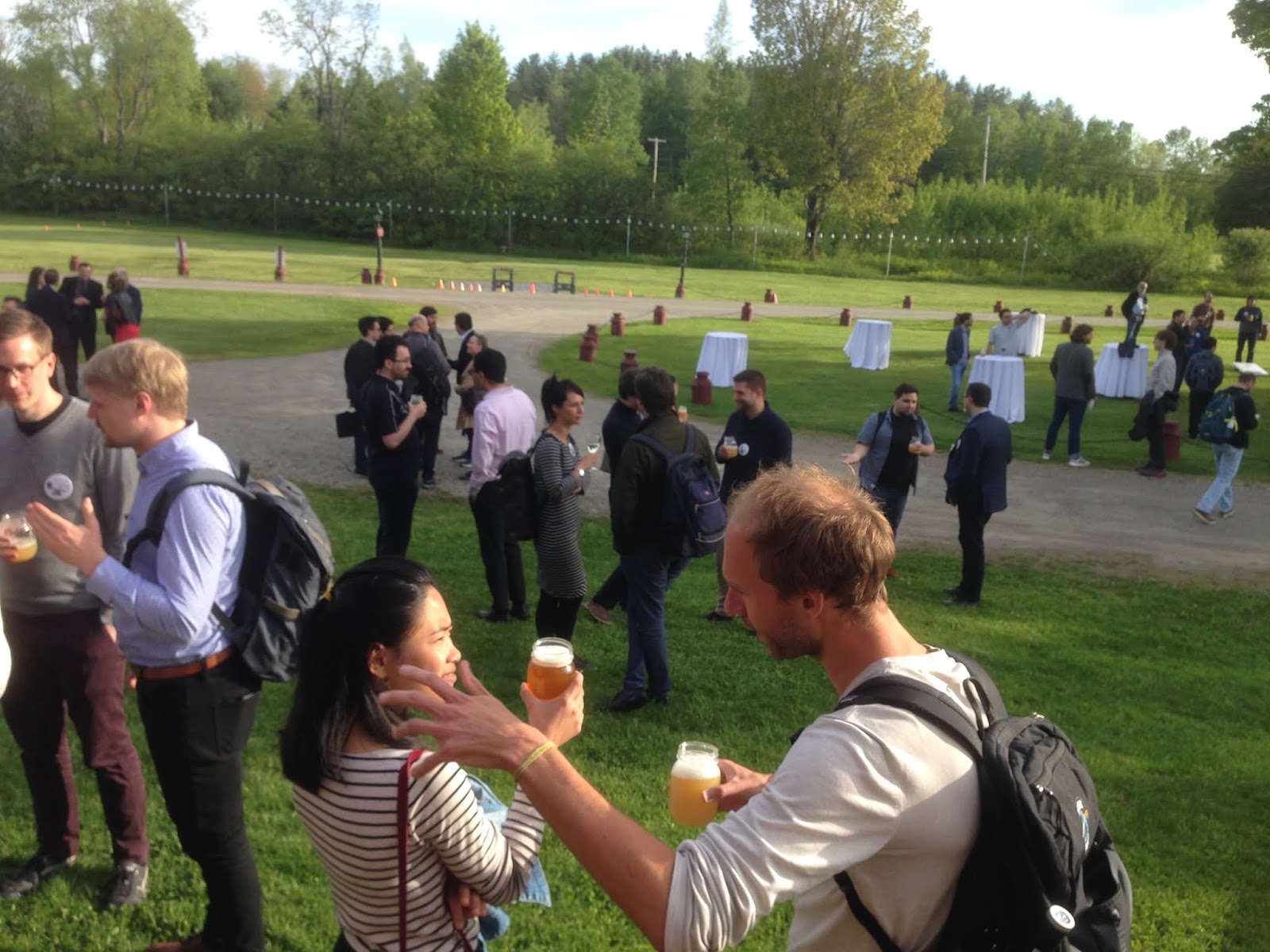
A clear highlight was the banquet last Wednesday night. We drove, but buses were arranged for those who needed a ride to the banquet location, which was the Mansfield Barn in Jericho, Vermont. Many conferees enjoyed being on a school bus, some for the very first time!
 
 Our conference was marked with a milk jug, a nice rustic touch.

At the banquet, Professor Claudia Wagner sat next to me. She had just been to UMass Amherst for a conference organized by my Computer Science colleague, Professor Andrew McCallum, having traveled from Cologne, Germany.  What a wonderful, small academic world it is. We had a lovely conversation since she is originally from Austria, and I had lived in Innsbruck with my family while on a Distinguished Fulbright.


The banquet food was delicious (impossible to get a bad meal in Burlington) and I was so honored and thrilled to be recognized with the Fellows Award.
More background on the Fellows Award, including the list of the inaugural Fellows, many of whom I am sure you will recognize, can be found here.

It was extra special receive the Fellow plaque from Professors Motter and Moreno.
The citation above reads: "For sustained contributions to network science, including the formulation, analysis, and computation of solutions to engineered network systems, from congested urban transportation to supply chains, under varied decision-making behaviors."

Also, so deservedly recognized at the banquet was Professor Albert-Laszlo Barabasi, the Founder of the Network Science Society.
The wonderful scientific talks, discussions, and the beauty of the location as well as the hospitality will stay with me. It's also terrific to have some NetSci2019 souvenirs!

Congratulations to the NetSci2019 conference organizers, the speakers, and to all the award recipients. NetSci2019 was truly special and I am very grateful. The love of networks is bringing many scientific disciplines and its researchers closer together for even more impactful contributions!

Saturday, July 15, 2017

Serendipity of Academic Travel

As an academic I travel a lot from conferences to giving invited seminars to living abroad in various countries when an exciting opportunity arises.

Travel helps to sustain that sense of wonder, which I believe is very important to overall creativity, including research, and to the enjoyment of life.

Of course, when one goes to conferences, gives talks, and holds visiting appointments at various universities, one gets to see people that one would expect to and this is in itself wonderful.

However, this blogpost is about the unexpected meetings, which make for pleasant conversations as well as memories, and help to make the world smaller and people closer.

For example, as readers of this blog know, for the past two weeks I have been in conferences in Europe.

One morning, while strolling for breakfast in Vienna, Austria, where I was attending and speaking at the EURO Humanitarian Operations (HOpe) conference, I came across the gentleman below.
Since I am a faculty member at the Isenberg School of Management at UMass I had to stop to talk to him. He is from Silicon Valley and his son had just graduated in May 2017 with his MBA from the Isenberg School. The Dad was proudly wearing his Isenberg garb that his son had given him. We chatted pleasantly about his son's experiences in our program and even about his favorite professors and activities while enrolled. The meeting made for a wonderful day being even brighter.

That weekend, when between a followup visit to the Vienna University of Economics and Business (which had been the venue for the EURO HOpe conference) and travels to the next conference in Kalamata, Greece (which I had co-organized), it was time to visit a new country. A short train ride from Vienna and we were in Bratislava, Slovakia, where my husband and I enjoyed the eastern European cuisine, crossed the New Bridge over the Danube by foot and then headed to climb up to the castle in the photo below.
At the castle, we were stopped by a gentleman who had noticed my husband's college cap.
He had also graduated from my husband's alma mater, Lafayette College, and was on a European holiday with his family. He works at the SEC. We exchanged business cards.

Now back at the Radcliffe Institute for Advanced Study at Harvard University, where I am a Summer Fellow (and had been a Science Fellow in 2005-2006), I had the pleasure of seeing another Summer Fellow - Dr. Elaine Chew. She and I, we believe, are the only two Radcliffe Fellows ever  to have PhDs with a specialty in Operations Research. Moreover, she and I are academic relatives in that her doctoral dissertation advisor at MIT, Professor Georgia Perakis, had the same dissertation advisor at Brown University as I did - Professor Stella Dafermos, so, technically, I am Elaine's academic aunt.
Amazingly, last year, at this time, which is the Trinity Term, I was a Visiting Fellow at All Souls College in beautiful Oxford, England. There were about a dozen Visiting Fellows at that time, representing different fields, including Dr.  Su Fang Ng, who was a Fellow with me at Radcliffe in 2005-2006! The photo below was taken in the garden at Oxford outside our offices.

And, the other evening, while taking a walk with my husband in the Harvard Square area, we were greeted by a big Hello! It was a neighbor of ours, whose family lives on the same street in Amherst, MA, as we do. He is now a postdoc at Harvard University. It was wonderful to catch up since we had not spoken with him since he began his doctoral studies at Dartmouth!
This week, we will be off to the IFORS conference in Quebec City, Canada, where thousands of operations researchers from around the globe will be presenting their latest work. We will see whom we meet because of the serendipity of academic travel.

Sunday, December 14, 2014

Getting Great News While on the Train - You are a Fellow!

When one gets some very good news (or bad), one remembers that very moment - from what you were doing when you heard the news to where you were when you received it.

Nowadays, much good news comes via email and, with smartphones, the messages can be received almost anywhere.

While on a recent trip to NYC, via the MetroNorth train from New Haven, I was engrossed in my New York Times and enjoying the journey. I love riding trains. My husband reached for my smartphone and decided to check my email and said, "You have a message from Oxford University."

I suspected that this was a decision on my application to be a Visiting Fellow at Oxford, a dream I had harbored for a while.

And indeed, it was!  The message said that a letter inviting me to take up a Visiting Fellowship had been posted and the sender stated that "I take great pleasure in attaching a pdf copy."

The letter, a hardcopy of which I also subsequently received via Royal Mail,  stated that I had been offered the fellowship for the 2015-2016 year for the trinity term, which is the term that I had requested.
I will be a Fellow at All Souls College at Oxford and will be researching supply chains and quality, a topic that I a very passionate about since it impacts so many products that affect consumers from pharmaceuticals and food to high tech and durable products.  Almost every day, one reads about quality failures of suppliers, some with devastating effects on human lives.

According to the letter, I will be provided with a workroom in the college, will have free accommodation at Oxford, and will have meals at Common Table (yes, capitalized). The atmosphere and support will be incredible.

One can become a Fellow of a professional society (for example, I was so honored to become a Fellow of INFORMS and also RSAI). One can also be a Visiting Fellow, as at Oxford, and other universities that have such programs, as well as at Institutes. For example, in 2005-2006 I was a Science Fellow at the Radcliffe Institute for Advanced Study at Harvard University, one of the best experiences that I have ever had, and where I wrote my Supply Chain Network Economics book.

I am so honored to have this great opportunity at one of the greatest universities in the world!

And, amazingly, On December 4, 2014, at our wonderful tribute to Gene Isenberg, after whom our School of Management at UMass Amherst is named, I had the pleasure of speaking with one of the grandsons, Stefan, who had recently graduated from Oxford! He told me about the unique place that All Souls College has at Oxford and its exceptional library. I know that I will be inspired tremendously and will do my utmost to contribute to research and the life of the college while I am there and afterwards. Also, Stefan told me that he has appeared in several recent episodes of the PBS Masterpiece Mystery Inspector Lewis series (a followup on the Inspector Morse series), which takes place in Oxford, with many of the characters affiliated (fictionally) with Oxford University,  I became captivated by this program while being a Visiting Professor in Gothenburg (the Swedes show a lot of British TV programs).

A list of the Visiting Fellows this year is comprised of an economist, lawyers, literature scholars, and an astronomer, to start, with renowned universities such as Harvard and Stanford represented. I thrive in interdisciplinary settings such as Radcliffe, so am so looking forward to experiences that I know will be truly special.


Saturday, November 2, 2013

A Brilliant Talk on Social Media Analytics + Sports by Dr. Les Servi of Mitre

Yesterday, at the Isenberg School of Management, we had the distinct pleasure of hosting Dr. Les Servi of MITRE, who is an INFORMS Fellow (and whom I have known since our days at Brown University as undergraduate students). Dr. Servi delivered a brilliant talk on his latest research on the topic: Analyzing Social Media Data Having Discontinuous Underlying Dynamics.

Dr. Servi's presentation was part of the UMass Amherst INFORMS Speakers Series, which the Student Chapter helps me to organize and to host.

His talk was on his paper in Operations Research Letters, just hot off the press, and published in the November issue.

The paper begins with the statement, which immediately captures your interest (as did his talk): Although physical objects follow well understood Newtonian physics and are free of discontinuous dynamics, emotional intensity dynamics evolve continuously with unknown dynamics until a tipping point or external event triggers a discontinuity. 

In his presentation, Dr. Servi asked whether anger has dynamics (the same about sadness and positive emotions). Is there a formula that can capture the anger of citizens and is there a  momentum associated with anger? He concluded that sadness (and other emotions) follow dynamics that are different from those of rockets since there are discontinuities. His paper not only presents a model for a more nuanced dynamic for emotions but also a dynamic programming  algorithm to solve the associated optimization problem that identifies times of emotional discontinuities. He then illustrated the new method for the  analysis of mood shifts reflected in 380,000 Twitter messages related to one of the world’s most popular soccer teams, Manchester United, during their 2011–12 season.  He was impressed that so many in the audience at the Isenberg School knew of this team and its sport (a finance audience at a talk he gave in Boston did not recognize the team).

And what Dr. Servi discovered through analyzing the data was fascinating and not what one would expect immediately. The figure below displays the Mood Shift Analysis of the Twitter messages showing a breakpoint on 2/6/2012 and 5/14/2012.

The discontinuities in mood associated with certain dates were not due to wins or losses of one of the world's most popular sport franchises (and one student in the audience had been to Manchester games) but one marked the anniversary of the following event: the tipping point found on February 6, 2012, might be due, according to Dr. Servi,  to it being the 54th anniversary of an airplane crash in Munich which killed 8 Manchester United players and 3 staff and injured 9 other players as well as the team manager. Among serious Manchester United fans this event and date are well known despite it happening so long ago.
 
With a great talk such as this, our minds just percolated with ideas and questions. I asked whether MITRE had applied for a patent since the possible applications from finance to politics were simply stunning and the answer was ,"Yes," --  see here.   One of my colleagues, Dr. Ryan Wright,  asked a question about acceleration, which I thought was really interesting -- for example, could the model and algorithm track herding/crowding behavior? Dr. Rod Warnick of our great Hospitality and Tourism Management Department also asked a great question about seasonality with reference to Google as did several of the students. My colleague, Dr. Senay Solak, continued the conversations.


The discussions lasted as time just flew by until close to 4 o'clock and I think the students from the Isenberg School and the College of Engineering that came as well as the faculty will never forget this talk. We thank Dr. Les Servi for the clarity and brilliance of his talk! The previous time that Dr. Servi spoke in our series was in the Fall of 2006 when he talked about tracking pirates (and that was even before such activities hit the news).

 
Special thanks also to Dr. Bruce Weinberg, the Chair of the Marketing Department at the Isenberg School, and a social media star,  and to Dr. Weibo Gong of the Department of Electrical and Computer Engineering at UMass Amherst, whose PhD advisor at Harvard University was Professor Larry Ho (also Servi's advisor), who joined Dr. Servi and me for lunch at the University Club.

After lunch, Dr. Servi and many others joined us in a celebration of the  3 awards that we received at the INFORMS conference in Minneapolis. The cake was delicious and the company simply wonderful with even Dr. Amir Masoumi joining us from Manhattan College.
 
What a great time to be an Operations Researcher living in an era with a proliferation of data. What information will the data reveal and what new discoveries?! And as Dr. Les Servi said, Philip Morse, a pioneer of Operations Research, would be very pleased.
 

Wednesday, February 27, 2013

Congratulations to the Newly Elected 2013 RSAI Fellows!

I was delighted to receive the great news below, which is also posted now on the RSAI (Regional Science Association International) website. The Fellows Award recognizes distinguished scholars in Regional Science. I know each of the scholars below and saw Professor Capello and Professor Thill at the NARSC meeting in Ottawa, back in November. Professor Puu I have known through his work with Professor Martin Beckmann, who was on my doctoral dissertation committee at Brown University, and is renowned for his book, "Studies in the Economics of Transportation," and other research. At the INFORMS National Meeting in San Francisco in 2005, I organized two sessions to mark the 50th anniversary of the publication of this great book and the presentations and many photos can be accessed here.

I had met Professor Puu in Umea in Sweden years ago. Professor Kobayashi and I had spent, along with several others, including Professors Geoff Hewings, Takayama, Johansson, a magical few weeks in Mallacootta, Australia at a regional science workshop.

As for Professor Thill -- he did some behind the scenes work, I was told by Professor David E. Boyce, to arrange the schedule at the NARSC Ottawa meeting so that I would be at the awards luncheon at which my receipt of the 2012 Walter Isard Award for Scholarly Achievement was announced. I had no idea that I would be the recipient and, coincidentally, Professor Bill Anderson of the University of Windsor in Ontario (I was born in Windsor) gave me this award and he had been in Umea when it was announced that Professor Jacques Thisse and I were the recipients of the Kempe Prize (also a complete shock to me and I fainted).

I look forward to celebrating with the 2013 Fellows at the 60th NARSC Conference next Fall in Atlanta!

2013 elected RSAI Fellows

RSAI is pleased to announce the election of the following Fellows in 2013:

Roberta Capello, Polytechnic Milano, ITALY

Roberta Capello is professor in Regional and urban economics at the Politecnico of Milan. Past-President of the Regional Science Association International (RSAI). Editor in chief of the Italian Journal of Regional Science and co-editor of Letters in Spatial and Resource Science (Springer Verlag). Editor in chief of Papers in Regional Science from RSAI. Author of many scientific papers and a textbook in Regional Economics, published in Italian and English.

Kiyoshi Kobayashi, Kyoto University, JAPAN

Kobayashi is the recipient of several awards and prizes for his research including the Hinomaru Prize in 1988, the JSCE (Japan Society of Civil Engineers) Research Prize in 1993, 2001 and 2007. In 2007 he was included in the Top 50 City Creators and Urban Experts of the Ministry of the Environment of Denmark. From 1978-1986, Kobayashi was a Research Associate in Graduate School of Engineering of Kyoto University. In 1987 he became an Associate Professor at the Department of Social Systems Engineering at Tottori University, where in 1990 he became a full time Professor. In 1996 he returned to Kyoto University as a full time Professor at the Graduate School of Engineering. In 2007 he became the Vice Dean of the Graduate School of Management of Kyoto University and in 2009 he became the Dean.


Tönu Puu, University of Umeå, SWEDEN


Tönu Puu, born in 1936 in Tallinn, was Professor of Economics at Umeå University from 1971 to 2001. Afterwards he worked at the Centre for Regional Studies (Cerum) for ten years. In total, he has published twenty books and 130 scholarly articles in economics, mathematics and philosophy.

Jean-Claude Thill, University of North Carolina at Charlotte, USA


Jean-Claude is Professor of Public Policy, University of North Carolina at Charlotte, USA. He has previously held positions at SUNY - Buffalo, the University of Georgia, Florida Atlantic University and the Université Catholique de Louvain in Belgium. He has also served NARSC superbly for many years in many administrative capacities. His research has centered on the spatial dimension of mobility systems and their consequences on how space is used and organized in modern societies; statistical and computational methods of spatial analysis; and most recently urban land-use dynamics.


Sunday, November 18, 2012

Congrats to the New Fellows of the Radio Club of America and Other Awardees and a Thank You

We recently returned from NYC where, this past Friday, my husband and I attended the 103rd Anniversary Awards Banquet of the Radio Club of America at the New York Athletic Club on Central Park South.
 

The evening was truly special, with the recognition of individuals who have contributed in a multiplicity of ways to radio communications and broadcasting, education, and even to engineering and the manufacturing of radio communications equipment.

Among the honorees was Ms. Carole J. Perry, who received The President's Award for her outstanding development and advancement of the Amateur Radio Youth Program. Ms. Perry is from Staten Island, and in her acceptance speech, she, as did several others, spoke of the devastation wrought by Superstorm Sandy. She noted that even though some still do not have power they still have strength! Ms. Erin King, who is a freshman at MIT, received the Young Achiever Award. David Buchanan received an award for his contributions to public safety.

I was at the banquet since my husband, Lad Nagurney (the other Professor Nagurney), was one of the five recipients of the Fellow Award.  Glenn Bischoff, the Publisher of Urgent Communications, was one of the other Fellow awardees, and I very much enjoyed talking with him about disaster communications and humanitarian logistics.
                                    
The keynote speaker was David Sumner, the Chief Executive Officer and Secretary of the American Radio Relay League (ARRL). He had recently returned from Vietnam. He was the contact person who had suggested, when I was organizing, under the auspices of the Rockefeller Foundation's Bellagio Center Programs,  the conference on Humanitarian Logistics: Networks for Africa, that I have Dr. Cosmas Zavazava of the International Telecommunications Union of the United Nations, speak.

David Sumner spoke brilliantly on the importance of communications, especially robust radio communications, in saving people's lives. Brian Williams had been the keynote speaker at last year's banquet, and Walter Cronkite, the year before he passed away..

We had a wonderful group of fascinating people at our banquet table, including Andrew Conte, and his wife, who had spent a year at UMass Amherst on an exchange program from Rutgers. Mr. Conte received the Jack Poppele Award, named after the founder of the radio station WOR and Director of the Voice of America under President Eisenhower.
                                        
Below, I have posted some additional photos taken at the New York Athletic Club and of those who attended

Congratulations to all the award recipients and thanks for all that the members have done over one century in communications and in education!