Showing posts with label disaster communications. Show all posts

Thursday, May 5, 2022

Thanking the Fabulous Guest Speakers in my Humanitarian Logistics and Healthcare Class

Now that the Spring 2022 semester has come to a close (except for some grading), I thought it important to publicly thank and recognize the outstanding guest speakers in my Humanitarian Logistics and Healthcare class this term.  In this class, we cover many relevant topics in disaster management, as well as applications to current events, and having experts, who are very knowledgeable in terms of practice, speak to my students, provides for a transformative educational experience.

The class met Tuesdays and Thursdays at the Isenberg School of Management at 8:30AM. Amazingly, and this speaks to the interest of the students in the class, there were several students who would arrive before me, shortly after 8:00AM, which I found very inspiring.

On February 17, 2022, we had the honor of having Mr. Vince Mullen, who is a Major in the Massachusetts National Guard, and who is also the VP of Operations at JP Morgan in Boston, as our first guest speaker. He traveled about 2 hours from eastern MA, and appeared in military dress to speak to my students. The topic of his presentation was: "The Military and Humanitarian Logistics and Healthcare." He spoke about his experiences responding to the earthquake that hit Haiti in 2010 and the logistical and other challenges encountered in the relief efforts. He also discussed how his experiences in the army and the National Guard have helped him as an Executive in a financial services firm, including having very logical thinking skills and being able to adapt to dynamic, evolving situations. Major Mullen also shared with us information about his participation in Phases I and III of the National Guard's COVID response operations. Soldiers’ mission included handling medical supplies, swabbing, transportation, and driving school buses. The constraints included: a lack of vaccines at the time, a lack of organization, non-medical training background of soldiers, and addressing the fundamental question: Where is the need? In Massachusetts alone, the Guard's COVID response has included the logistical issues of handling 1000 soldiers, 69 hospitals, 40 nursing homes, 12 ambulances, 13 dialysis centers, 95000 shift hours, 64000 observed patients, 4500 transported EMS, and 74000 delivered meals.

I found it profoundly moving, as did the students, how much Major Mullen cared about helping disaster victims. I am so grateful for his exceptional service for many years!


The second guest speaker was Dr. Denise Sumpf, who is the highest ranking UN official in Armenia. Her guest lecture took place on February 24, 2022, which, you may recall, is the date of the latest invasion of Ukraine, a sovereign country, by Russia. Dr. Sumpf had taken part in a UN Security Council meeting just hours before her guest presentation, in which she spoke virtually to my class from Yerevan, Armenia. She spoke about the situation between Armenia and Azerbaijan and the many challenges associated with Nagorno-Karabakh. She also discussed the UN cluster approach, which was great, since this reinforced some of the material I had covered in my lectures. Dr. Sumpf also continued to bring up the invasion of Ukraine by Russia. And, clearly, our world has, sadly, dramatically changes since February 24, 2022.

I had hosted Dr. Sumpf a while back in our UMass Amherst INFORMS Speaker Series, when she was based in NYC with the United Nations. She contributed a very interesting co-authored chapter, "The Impact of the Syria Crisis on Lebanon," to the first Dynamics of Disasters volume that I co-edited with Professors Ilias S. Kotsireas and Panos M. Pardalos. It was very special to have her speak to my class.

On March 10, 2022, Ms. Lauren Ulrich, the Executive Director, Operations Management & Logistics, American Red Cross, spoke to my class virtually.  She leads the teams necessary to carry out the key functions for major Red Cross relief operations including incident command, operations management, planning, logistics, finance, and external relations. They have the responsibility for the readiness, planning, resourcing, and implementation of scalable response operations to meet the needs of disaster clients for large-scale Red Cross domestic disaster operations, including across all U.S. States, Territories, and Commonwealths. In her amazing career (she had also been a Marine), Ms. Ulrich has taken part in  multitude operations ranging from Operations Enduring and Iraqi Freedom; to international disaster response operations, including the Haiti Earthquake, Typhoon Haiyan, and Alberta Floods; to domestic disaster response operations, including Hurricane Sandy, Michigan Water Crisis, Hurricane Harvey, and the California Wildfires! Support, according to Ms. Ulrich, must be repeatable and scalable with the disaster response necessitating speed to market and speed to scale. Speed to market means having access to the required assets for help and shelter, and speed to scale means scaling from  a single home to tens of thousands of homes in 72 hours. Holistically, the logistics team’s mission is to have the required assets to get the volunteers on the ground in 2 hours and to hold the ground for 72 hours while quickly scaling up. She also shared with us the challenges associated with disaster response in the COVID pandemic and how she and her boss were very well-prepared in terms of PPEs, since the Red Cross was closely following the spread of the coronavirus globally, already in January 2020. Her lecture was incredibly engaging and informative.
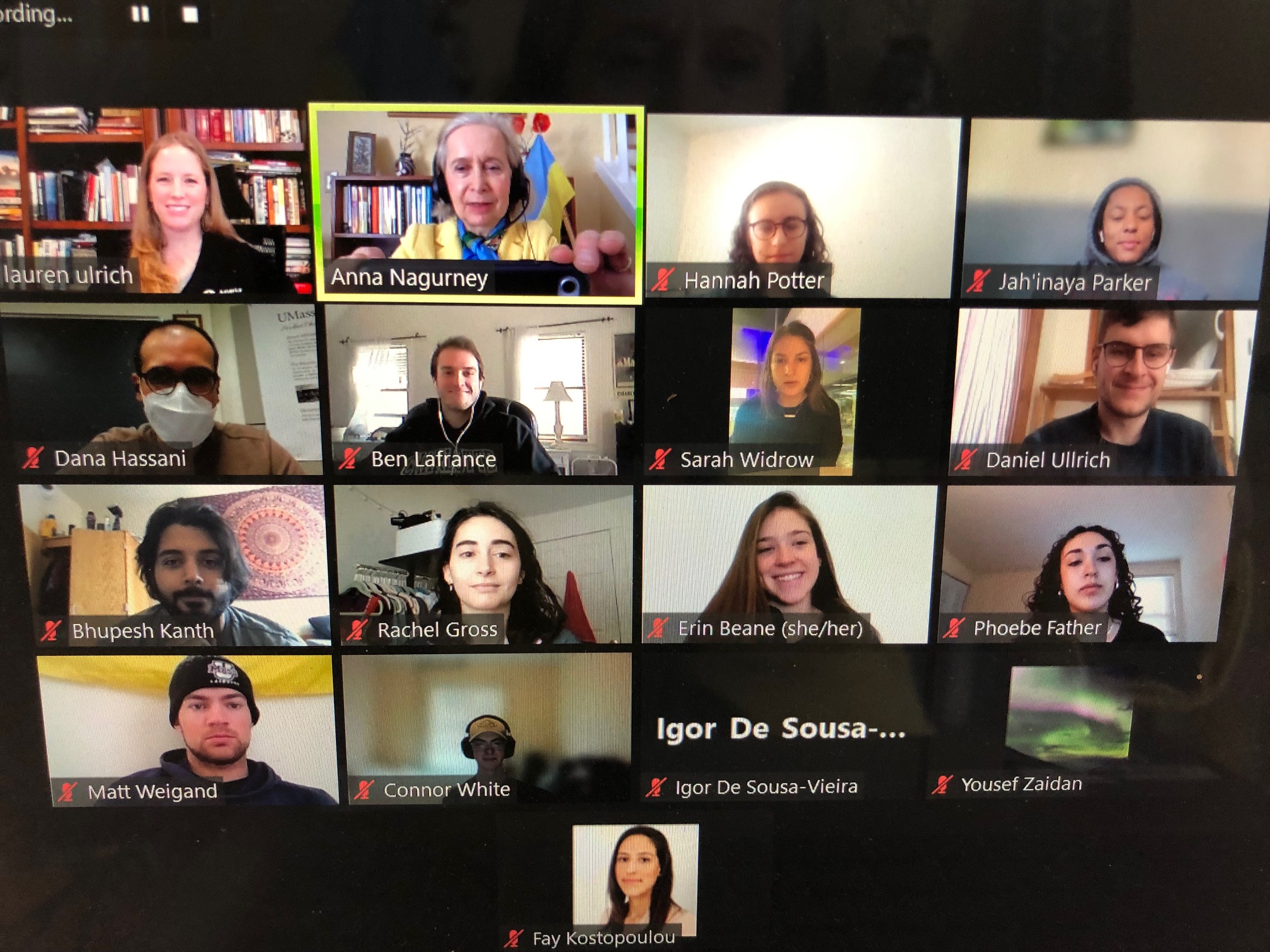
The fourth guest speaker was UMass Amherst's very own Dr. Peter Reinhart! Dr. Reinhart is the founding Director of the Institute for Applied Life Science (IALS) at UMass Amherst and has more than 25 years of R&D management experience in academia (Duke University), biotechnology (Cogent Neuroscience, Proteostasis Therapeutics), and large pharma (Wyeth, Pfizer). He  came to the University of Massachusetts Amherst from the Cambridge MA biotechnology company, Proteostasis Therapeutics (PTI), where he was President and Chief Scientific Officer. Dr. Reinhart shared with us how the incredibly effective and, frankly, life-saving, in my opinion, COVID-19 Testing Center at UMass was founded from scratch. As of April 2020, when UMass shut down and reverted to online teaching, 750 scientists in the Applied Life Sciences building had to stay at home. That was when he thought that they could use these human resources and talent to form the Testing Center. He made the idea into a “white paper” and handed it to be reviewed by Chancellor Subbaswamy.  After a month, Chancellor permitted Dr. Reinhart to start the project, who came up with a timeline to make it functional in 100 days, from the preliminary processes and operational foundations to the beginning of the testing. This required exceptional logistics, team work, planning, scientific expertise, legal interventions, and even the assistance of Massachusetts Governor Charlie Baker. Thousands of students, faculty, and staff and members of our community have benefited from the exceptional convenience and turn around time and accuracy of the UMass Amherst COVID Testing Center. We are all so proud of this truly exceptional achievement in the service of our community during the pandemic and so grateful!


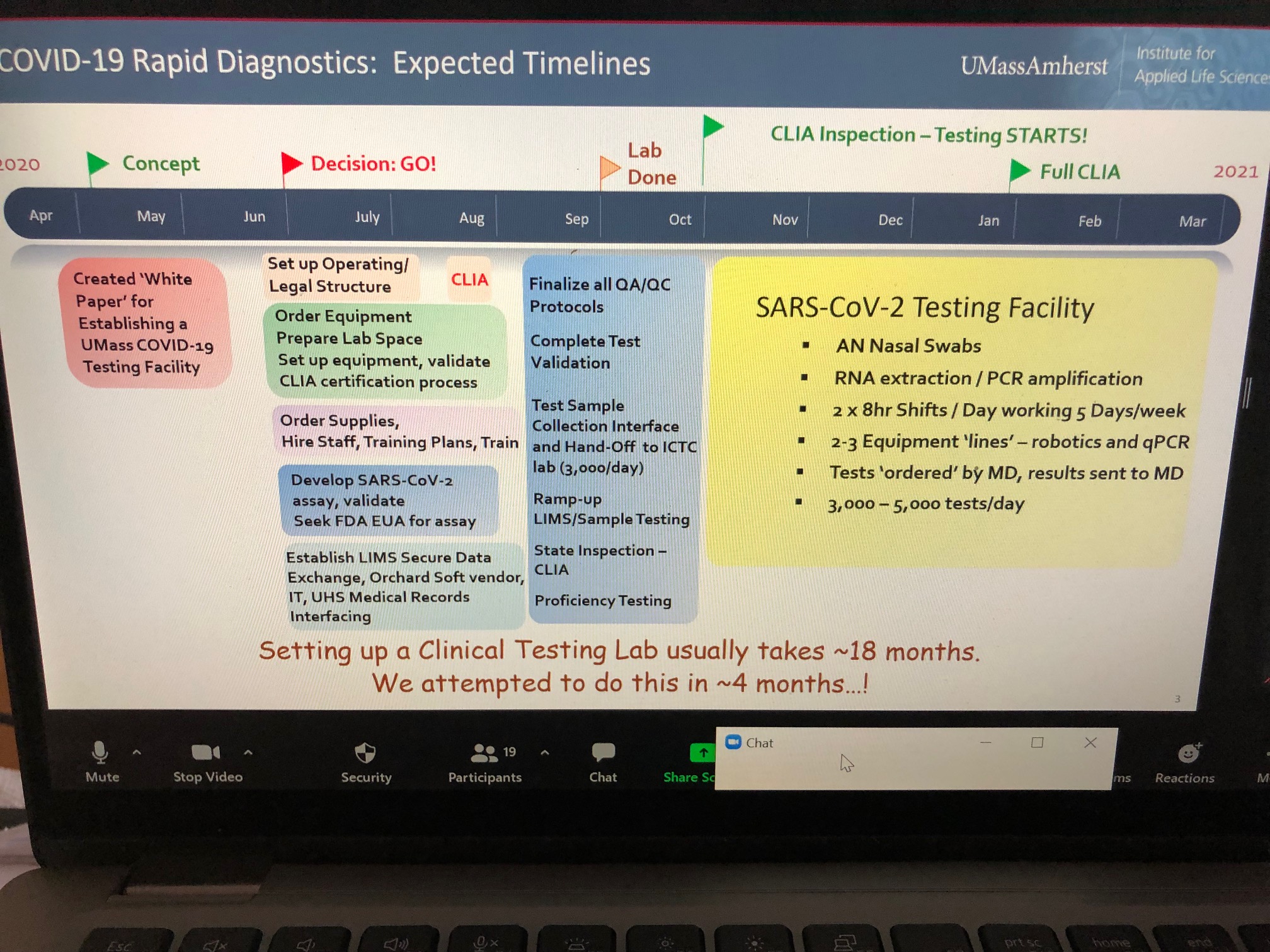

The fifth and final guest speaker was Professor Ladimer S. Nagurney of the University of Hartford, who spoke in person on April 26, 2022. The topic of his guest lecture was: "Disaster Communications." He even brought hardware to demonstrate to the students. The slide deck of his lecture can be downloaded here.

He discussed many interesting topics with some of the highlights being the disruptions to communications after the volcanic eruption in Tonga (and the restoration efforts) and the importance of communications to the war efforts of  Ukraine against the Russian aggressors.


Many thanks to these outstanding guest speakers, who took the time from their very busy schedules to share their important insights and experiences with my Humanitarian Logistics and Healthcare class!

Wednesday, April 26, 2017

Disaster Communications

Yesterday,  we were treated to a guest lecture on Disaster Communications in my Humanitarian Logistics and Healthcare class.

Hard to believe that May 2 will be the last class of this semester (and academic year)! It has been a great experience teaching this class and a very important feature of the class has been the experts that I have brought in as guest speakers.

The guest lecture on Disaster Communications was given by the "other" Professor Nagurney.

There is so much happening in terms of technology and disaster communications that the students and I enjoyed the lecture very much. In particular, with the contract given to AT&T to the tune of $7 billion for FirstNet, it will be very interesting to see how many states adopt this broadband network for public safety.

I am delighted that the lecture slides have been made available so that anyone interested can benefit. There is still a tremendous amount that can be done in this area - note that the US and several other countries have yet to ratify the Tampere Convention, for example.

Below are a few photos posted from the lecture.
Thanks to Dr. Ladimer S. Nagurney, Professor of Electrical an Computer Engineering, for sharing knowledge about disaster communications with the class!

Now I am looking forward to the students' team project presentations in the next two classes on topic ranging from electric power restoration post disasters to the Syrian crisis to the cold chain in disaster relief and even food distribution.


Thursday, January 8, 2015

Looking Forward to Teaching My Humanitarian Logistics and Healthcare Course at Isenberg

I have been enjoying working on my lectures for my SCH-MGMT 597LG - Humanitarian Logistics and Healthcare course during this winter break. I will be offering this course for the third time at the Isenberg School of Management (and have even taught a very condensed version of it at the Vienna University of Economics and Business while I was on sabbatical).

Some of the topics that I will be covering are:
  • Commercial vs. Humanitarian Supply Chains
  • Disaster Management Phases from Preparedness to Recovery
  • Supply Chain Risk Management
  • Fundamental Issues in Humanitarian Logistics
  • Network Performance, Robustness, and Resiliency
  • Learning from Disasters – Business and Humanitarian Ones
  • An Integrated Disaster Relief Model
  • Perishable Product Supply Chains in Healthcare
  • Earmarking and Financial Funds
  • Critical Needs Supply Chains Under Disruptions. 
The course attracts students from the Isenberg School of Management, the School of Public Health, and the College of Engineering.  Experts who are practitioners in the subject domain provide the students (and me) with deep insights and personal experiences. Last year, we benefited from lectures by Mr. Rick Lee of the Red Cross, who has since retired, and who made a lasting impact on this organization and numerous people through his 30 years with this organization, and from Dr. Pierre Rouzier, our UMass sports team physician, who spoke on his efforts during the Boston Marathon bombing to save lives and post the Haitian earthquake. We also had the pleasure of hearing from Mr. Jeff Hescock, the Director of  University Emergency Management and Business Continuity, We heard from Mr. Dave Madsen, a renowned news broadcaster in western MA with over 40 years of experience. In addition, my husband, Professor Ladimer S. Nagurney, spoke on disaster communications.

I have done a lot of research in this area with several members of my supernetworks team so the lectures are always being updated and are very current. And, hot off the press, is our paper, 
An Integrated Disaster Relief Supply Chain Network Model with Time Targets and Demand Uncertainty, Anna Nagurney, Amir H. Masoumi, and Min Yu, in Regional Science Matters: Studies Dedicated to Walter Isard, P. Nijkamp, A. Rose, and K. Kourtit, Editors, Springer International Publishing Switzerland (2015), pp 287-318. This book volume also contains a paper by the Nobel laureate in Economics, Professor Paul Krugman.

We were so inspired by the speakers and the value that they added to the course and the students' knowledge that I wrote a Guest Editorial about these "Hometown Heroes." 

This year, we will also be covering the Ebola crisis in western Africa, and the lessons learned. 

I'll be periodically blogging about this course and the speakers this year, so do stay tuned and stay warm!

Wednesday, March 26, 2014

Hometown Heroes and Why I Wrote a Guest Editorial

Tomorrow morning, one of my Operations & Information Management students, who is in my Humanitarian Logistics and Healthcare class that I am teaching this semester, will be attending with me the Hometown Heroes event at the Mass Mutual Center in Springfield, MA.

We will be the guests of Mr. Rick Lee, the Executive Director of the Pioneer Valley Chapter of the American Red Cross, who spoke in my class in February.

The Pioneer Valley Chapter of the American Red Cross provides emergency response in Hampden, Hampshire and Franklin counties in western Massachusetts and is also behind a model call center for servicemen.

According to a lovely article in The Springfield Republican: The chapter created the Hometown Heroes program in the wake of the terrorist attacks of Sept. 11, 2001, Lee said. The idea was partially to help bridge gaps in funding left when so much charitable giving went to causes related to those attacks.
But the larger reason was, and remains, giving the community a way to honor people who go above and beyond to help others.

And in the beautiful words of Mr. Rick Lee:
"We are celebrating one of the most beautiful aspects of the human heart, which is kindness," Lee said.

This year 9 Hometown Heroes will be honored.

In addition to Mr. Rick Lee, this semester, we have hosted Mr. Jeff Hescock of UMass Amherst, Dr. Pierre Rouzier of UHS at UMass Amherst, Mr. Dave Madsen of WGGB, and even the other Dr. Nagurney, my husband, who gave a guest lecture on Disaster Communications.  The students and I were so inspired by these remarkable individuals that I wrote a Guest Editorial, Community Experts Enhance Disaster Management Education as Guest Speakers at the Isenberg School of Management at UMassabout their talks (with the exception of my husband's since he was guest lecturing when I was out of town), which was published the other day on masslive.com.

I had to thank these very special people in a public way and that is why I wrote the Guest Editorial, which also features a photo of Mr. Rick Lee with the students in my class.

In addition, the Isenberg School of Management posted a two-part series on this course focusing on the presentation of Dr. Rouzier and also that of Mr. Madsen. Many thanks to the Communications Department and especially to Mr. Lou Wigdor who attended these lectures and wrote them up so eloquently.

We have amazing people in our midst, which deserve special honors and recognition and among those I include the above individuals.

We look forward to seeing Mr. Lee of the Red Cross again tomorrow and honoring this year's Hometown Heroes for their exceptional courage!  Even two UPS drivers will be honored (perfect humanitarian logistics example!)

Sunday, November 18, 2012

Congrats to the New Fellows of the Radio Club of America and Other Awardees and a Thank You

We recently returned from NYC where, this past Friday, my husband and I attended the 103rd Anniversary Awards Banquet of the Radio Club of America at the New York Athletic Club on Central Park South.
 

The evening was truly special, with the recognition of individuals who have contributed in a multiplicity of ways to radio communications and broadcasting, education, and even to engineering and the manufacturing of radio communications equipment.

Among the honorees was Ms. Carole J. Perry, who received The President's Award for her outstanding development and advancement of the Amateur Radio Youth Program. Ms. Perry is from Staten Island, and in her acceptance speech, she, as did several others, spoke of the devastation wrought by Superstorm Sandy. She noted that even though some still do not have power they still have strength! Ms. Erin King, who is a freshman at MIT, received the Young Achiever Award. David Buchanan received an award for his contributions to public safety.

I was at the banquet since my husband, Lad Nagurney (the other Professor Nagurney), was one of the five recipients of the Fellow Award.  Glenn Bischoff, the Publisher of Urgent Communications, was one of the other Fellow awardees, and I very much enjoyed talking with him about disaster communications and humanitarian logistics.
                                    
The keynote speaker was David Sumner, the Chief Executive Officer and Secretary of the American Radio Relay League (ARRL). He had recently returned from Vietnam. He was the contact person who had suggested, when I was organizing, under the auspices of the Rockefeller Foundation's Bellagio Center Programs,  the conference on Humanitarian Logistics: Networks for Africa, that I have Dr. Cosmas Zavazava of the International Telecommunications Union of the United Nations, speak.

David Sumner spoke brilliantly on the importance of communications, especially robust radio communications, in saving people's lives. Brian Williams had been the keynote speaker at last year's banquet, and Walter Cronkite, the year before he passed away..

We had a wonderful group of fascinating people at our banquet table, including Andrew Conte, and his wife, who had spent a year at UMass Amherst on an exchange program from Rutgers. Mr. Conte received the Jack Poppele Award, named after the founder of the radio station WOR and Director of the Voice of America under President Eisenhower.
                                        
Below, I have posted some additional photos taken at the New York Athletic Club and of those who attended

Congratulations to all the award recipients and thanks for all that the members have done over one century in communications and in education!


Sunday, March 18, 2012

Disaster Communications and Humanitarian Logistics


Last week, the students in my Humanitarian Logistics and Healthcare course at the Isenberg School of Management at UMass Amherst had a guest lecture on Disaster Communications.

I had told the students, before I left for Gothenburg, Sweden, that there would be a surprise guest lecturer on March 13, who would be speaking to them on Disaster Communications.

The surprise guest speaker was my husband, Professor Lad Nagurney, who is an expert on computer engineering and communications, among other topics related to hardware. He has also been a ham radio operator for many years.

Throughout the semester, the theme of communications, and the importance of communications in emergency preparedness and response has been resonating.

To-date, the class has heard from such experts as: Mr. Tom O'Regan, emergency preparedness and business continuity manager at UMass Amherst, Mr. Rick Lee of the Red Cross, and Lt. Col. James Sahady of the National Guard.

The presentation on Disaster Communications has now been posted. It discusses trade-offs among different modes of communications and their resilience (or lack thereof) in disasters, along with the Tampere Convention, which the US as well as Russia have yet to ratify.

During the Bellagio Center workshop, Humanitarian Logistics: Networks for Africa, that I organized, under the auspices of the Rockefeller Foundation, the participants had the privilege of hearing Dr. Cosmas Zavazava of the International Telecommunications Union speak on Bridging the Last mile gap through Telecommunications/ICT in Disaster Management. My husband had actually suggested Dr. Zavazava, since he was well-aware of his leadership in this area, and his presentation was outstanding. This workshop, which took place in May 2008 at Lake Como, Italy, was sandwiched between the cyclone that hit Myanmar/Burma and the Sichuan earthquake in China (obviously I had not planned the workshop this way).

Resilient communications assist in a more timely response and enable the flow of critical needs supplies to the victims at points of demand. They are also extremely important in recovery operations and in reestablishing connections among family members and in getting the news out.

Without communications, disaster relief operates in a complete vacuum.