Showing posts with label Montreal. Show all posts

Friday, May 17, 2019

A Big Thank You and Congratulations to the Montreal Operations Research Student Chapter

The invitation arrived on April 22, 2019 - towards the end of the Spring semester.

The event that I was invited to speak at was to take place on May 15, 2019, as part of the Optimization Days conference in Montreal, Canada. The conference was at HEC.
Although the date was just a few days past the UMass Amherst graduation ceremonies as well as the POMS conference in Washington DC, I accepted quickly, since it was to celebrate the 3rd anniversary of the Montreal Operations Research Student Chapter. I am a big proponent and supporter of INFORMS Student Chapters and have been the Faculty Advisor to the UMass Amherst one for 15 years (that translates to 30 semesters of activities, including hosting of speakers). The Montreal Chapter has over 270 members across multiple universities in the area. It was co-founded by a group of students, including  Hyame Alameddine and (now) Dr. Carlos Zetina, both from Concordia University. Dr. Zetina was the recipient of the INFORMS Judith B. Liebman Award.

The invitation, which came from Hyame Alameddine, the Chapter's Vice President, said, in part:

Dear Prof. Nagurney,

On behalf of the Montreal Operations Research Student Chapter (MORSC), we would like to invite you to Optimization Days <https://symposia.cirrelt.ca/JOPT2019/en/home>  2019, Montreal on May 15, 2019, to deliver the keynote addressing a topic of your choice for our third-anniversary event which we will celebrate during Optimization Days. Given your pioneering work in operations research; we hope you can honor us with your presence and words as we present our chapter's achievements and list of upcoming events to our members, industry partners, well-known Montreal researchers and representatives of our umbrella institutions. Our organization would be happy to cover the costs associated with your travel and accommodation.

Established in May 2016, MORSC is a multi-university, multidisciplinary, graduate student association chartered under the Canadian Operations Research Society (CORS) and the Institute for Operations Research and the Management Sciences (INFORMS). Our mission is to create a collaborative community of Montreal graduate students working on Operations Research topics. Our emphasis is on knowledge sharing and networking among members from various disciplines. We organize tutorials, workshops and panel discussions for students to stay up to date on the field. We also organize student research seminars in collaboration with GERAD and CIRRELT for students to showcase their work and a speaker series for members to learn from highly respected experts in the field. We have created our website (www.mtl-students.com>) that serves as a reference for upcoming events and as an online library of materials on Operations Research (www.mtl-students.com/archive>). In 2017, MORSC received the INFORMS 2017 Student Chapter Annual Award at the cum laude level  and in 2018, it received the INFORMS 2018 Student Chapter Annual Award at the Magna cum laude level.

 
I offered several topics that I could speak on and they selected the following:
My presentation can be downloaded here. Speaking to this group, which has achieved an immense amount during 3 years, was a great honor, and I wanted to congratulate them and to offer my support. Coincidentally, the first conference that I ever attended as a PhD student was in Montreal and it was with my Brown University PhD dissertation advisor, Dr. Stella Dafermos. And, amazingly, I got to stay in the very same hotel, The Terrasse Royale!

The attention to detail was extraordinary, with posters disseminated about my talk, a delicious cake prepared, and even a request for questions from me about my presentation, with prizes!

 My questions to the audience (I was delighted that even undergraduates came):

 1. What city was the venue of the first conference that Anna Nagurney attended as a PhD student?

2. Which of the following are NOT part of the math academic genealogy of Stella Dafermos and Anna Nagurney:

Maxwell, Galileo, Laporte, Newton?

3. The famous Braess paradox (1968) paper was written in what language?

4. Name TWO perishable products in healthcare.

5. What was the name of the best selling cholesterol reducing drug sold by Pfizer that lost its patent rights in 2011?

Bonus question:

What brand of European chocolates are sold at the nearby Royal Terrasse Hotel in Montreal?


After my presentation, I presented the Chapter with a birthday card and certificate and they presented me with a lovely plaque (so thoughtful and so appreciated).


Also, at the event, many students were recognized for their great writing and papers!
Above I am standing with the Chapter Officers as well as the Chapter's Faculty Advisor, Professor Daria Terekhov. Very cool that, among the officers, is a former classmate of my PhD student, Deniz Besik - Başak Tozlu.

The cake was as delicious as it was beautiful!
Many thanks also to the excellent photographers! The group photo is a very special memento. I remember fondly many selfies taken with the expert - Dr. Carlos Zetina at INFORMS conferences!
Also, it was a delightful surprise to see  Dr. Alelsandr Kazachkov there (the recipient of the 2018 ICS Best Student Paper Prize, whose committee I chaired), Professor Michel Gendreau, and a University of Maryland  Smith School colleague - Professor Raghavan. I also saw Professor Gilbert Laporte's photo on a nice screen - he was recently elected to the National Academy of Engineering. Sorry to have missed Professor Hani Mahmassani, who was a plenary speaker.

And, of course, I had to purchase Leonidas (Belgian) chocolates in the shop at my hotel to being back to Amherst!
Also, I had some lovely long walks in the area.

Congratulations to the MORSC Chapter Officers and members on all of your achievements and thank you for the outstanding hospitality - you set new standards! Wishing you all much continuing professional and personal success.

Sunday, April 1, 2018

Outstanding Lecture by Humanitarian Logistics Professor and Operations Researcher Burcu Balcik


There are so many wonderful aspects to being an operations researcher, and one of my favorites is the fabulous researchers that we get to meet from around the world. Also, there is always some serendipity (and luck) when it comes to inviting speakers whose research is especially timely.

Since 2004, when we established the UMass Amherst INFORMS Student Chapter, I have been helping the students host the Speaker Series, and we have brought many amazing luminaries to UMass Amherst to deliver a seminar. This semester I am teaching two courses and also giving a lot of invited talks both in the US and abroad so scheduling of speakers is sometimes a bit of a challenge but we do make it work.

Propitiously, Dr. Burcu Balcik, who is the author of several papers that my students in the Humanitarian Logistics and Healthcare class that I am teaching at the Isenberg School of Management this semester, has been on sabbatical in Montreal this year. She is an Associate Professor at the Ozyegin University'sIndustrial Engineering Department in Turkey. When she reached out to me a few months ago I knew that we had to bring her down to give a talk. And that we did! Last Thursday, she flew in from Montreal to Boston Logan, then made it to Amherst.

I had the pleasure of having dinner with her at Judie's restaurant in downtown Amherst on Thursday.


We had advertised her talk widely and the announcement even made the UMass Amherst homepage on Friday!  The title of her talk was: Site Selection and Route Planning for Post-Disaster Rapid Needs Assessment Operations.
I have known Burcu for a decade now and have enjoyed most recently conferences with her in Vienna, Austria on Humanitarian Operations (which was organized by my former Isenberg School PhD student, Tina Wakolbinger, who is now a Professor at the Vienna University of Economics and Business)  and also INFORMS in Houston.

Her lecture was simply outstanding - delivered with great clarity and generated many questions from the audience, which always demonstrates interest! I was delighted to see faculty and students from both the Isenberg School and the College of Engineering in attendance (even though it was just before an Easter and Passover weekend) and even students from my class came. We counted 12 different countries represented by the attendees in the audience!

I had the pleasure of welcoming her and the UMass Amherst INFORMS Student Chapter President, Deniz Besik, also gave introductory remarks.
Professor Balcik gave an excellent overview of the work that she has done in humanitarian logistics along with the methodologies that she has applied from two-stage stochastic programming to robust optimization. She also noted, on the practical side, what kind of organizations she has worked with, which have included: the Red Cross of Turkey, World Vision, the World Food Program, and when she was a postdoc at Northwestern, working with Professor Karen Smilowitz, the Chicago food bank.

She spoke on needs assessment, post a disaster, both short-term (within 72 hours) and long-term, and emphasized how different community groups may need different items from different sectors, such as shelter, food, medicines, hygiene, etc.  Needs assessments are critical since then one can have more accurate appeals to donors as well as prioritization. She mentioned that Field Assessment Coordination Teams (FACT) of the IFRC do needs assessments and deploy within 12-24 hours.

Although there are documents and practitioner-type studies on needs assessment, there is only limited scholarly research on the subject (besides the work that Burcu is doing and has done).  Of course, a team cannot visit all affected areas and there is a trade-off between doing sampling and timeliness. Purposive sampling provides one with initial understanding of the scope and needs.

I was delighted to see that when she listed literature on the topic she included as a first reference the paper that she wrote  and which appears in the Dynamics of Disasters volume that I co-edited and was published by Springer in 2016.

Professor Balcik spoke about needs assessment as including:

1. identification of community groups (including social and cultural aspects)

2. mapping of the sites and using a mapping matrix

3. site selection (and here efficiency does matter)

4. logistic (route) planning and the importance of checking resources to implement the site selection plan.

She described the mathematical models that she has developed with practical solution approach, involving heuristics, since many NGOs have no advanced computational resources. Her present research involves rapid needs assessment with uncertain travel times. This very much resonated with my students who have been learning about disasters and impacts on critical infrastructure. She described how to use robust optimization to model uncertain travel times and also discussed different tractable robust counterparts. The challenges include that probability distribution are not available although one might have estimates of lower and upper bound travel times associated with different links. She also presented computational results and many vivid illustrations of networks. Future research will include the modeling of uncertainty associated with the location of community groups and coordinated needs assessment and relief distribution.

After many questions and great discussions, Professor Balcik was presented with a gift from the Isenberg School (an umbrella, which was perfect, given the weather) and we took a group photo as a remembrance of her terrific talk!

 
I then hosted the lunch at the University Club  to continue the conversations.
And, as is our tradition, we shared desserts.

After the lunch, Professor Balcik spent some time at the Supernetworks Lab at the Isenberg School with my doctoral students. She presented me with a lovely t-shirt, compliments of Carlos Wachzetina and the Montreal INFORMS Student Chapter, and also maple syrup from Canada (where I was born)! It is truly special how Operations Research has no boundaries and the community that it supports around the globe is flourishing from students to faculty to practitioners!

She was also interviewed for the UMass Amherst INFORMS Student Chapter youtube channel. I will let you know when the interview airs.

We thank Professor Balcik for traveling to UMass Amherst to share with us her truly fascinating and very important research!

And, her next invited seminar will be at the University of Alabama, where she will be hosted by Professors Burcu Keskin and Emmet Lodree.  I was there last Fall to speak and told her that she will love it! And to further emphasize a great, wonderful wORld: Dr. Keskin and Dr. Wakolbinger both received the Judith Liebman Award from INFORMS and co-authored guidelines on how to run a successful student chapter. Plus, Dr. Lodree also had a chapter in our Dynamics of Disasters book!

Saturday, May 4, 2013

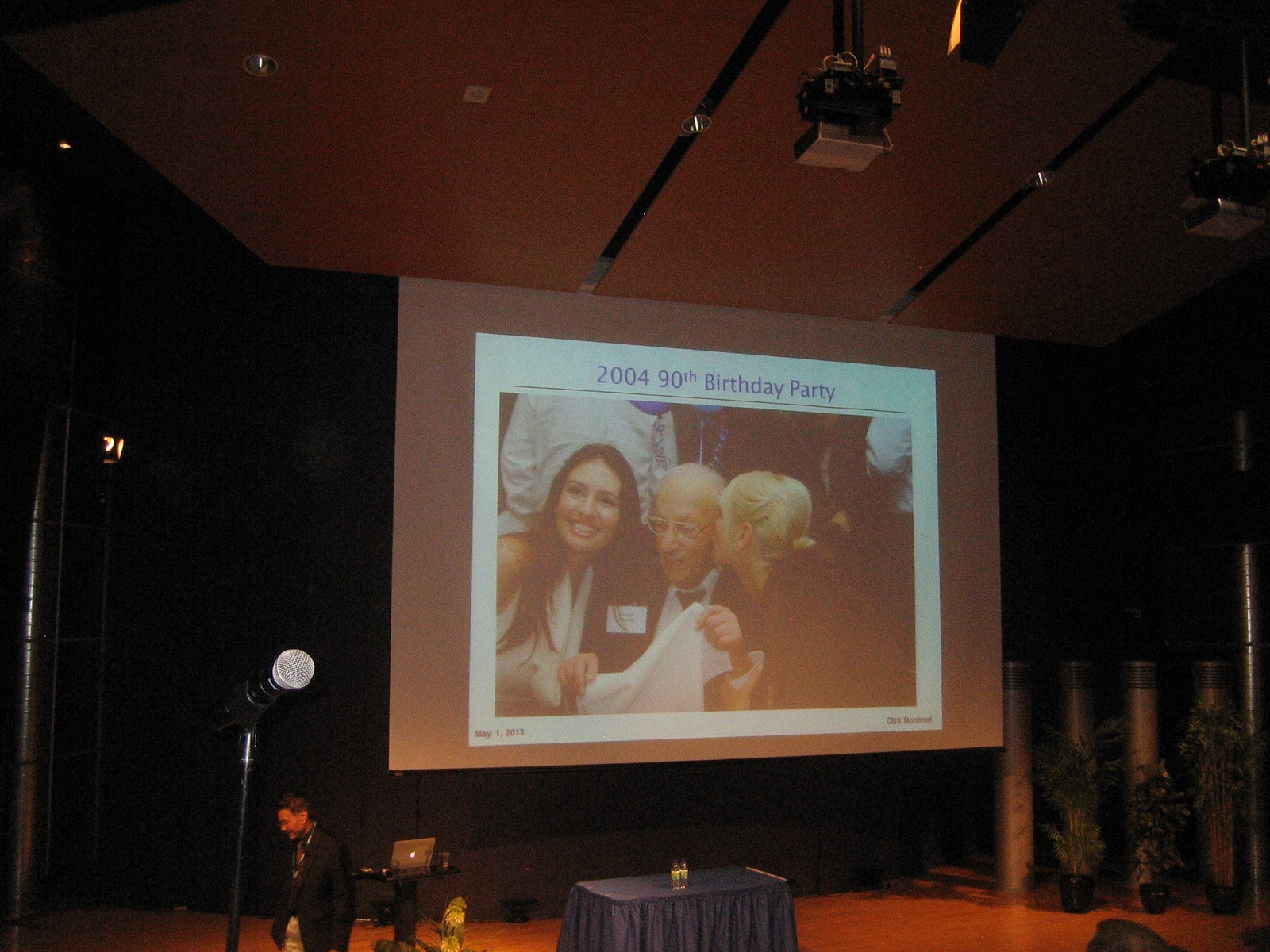
Photos from the Great Computational Management Science Conference In Montreal

I made it back from Montreal via Air Canada and for a while there I thought that I would be the only passenger on the flight on the 18 seater airplane. Then 3 other passengers arrived (after the gate change was announced).

I wrote two blogposts about the 10th Computational Management Science Conference , which took place May 1-3, 2013 in Montreal, Canada. The first post was about Professor Yingyu Ye's plenary talk and reminiscences about Professor George Dantzig and the second one was on the hot topics at the conference.

Below I share with you some photos that I took at the conference.

The conference was fabulous and I think the photos below capture some of the presentation highlights, social events, and venue.

Many thanks to the organizers and especially to Professor Georges Zaccour, for such a pleasant and rewarding conference.


Wednesday, August 10, 2011

Photos from the Integrated Risk Management in Operations and Global Supply Chains Conference in Montreal


Above are some photos taken at the INTRIM (Integrated Risk Management in Operations and Global Supply Chains) Conference that took place at lovely McGill University in Montreal, Canada recently.

I had the pleasure of speaking on our research on Medical Nuclear Supply Chain Design at this conference.

Many thanks to the organizers for putting together such an interesting set of presentations, all delivered in a single track, along with delicious coffee breaks, lunches, etc.

I especially enjoyed the originality of the problems that are being tackled and the challenges faced by industries in capturing system-wide risk.

As for photos of Montreal taken while I was there, click here.

Tuesday, July 12, 2011

Looking Forward to the Integrated Risk Management in Operations and Global Supply Chains Conference

Information about the Integrated Risk Management in Operations and Global Supply Chains (INTRIM) Conference that will take place at McGill University in Montreal, Canada is now online.

This conference has no parallel sessions so the audience hears all of the talks together, which is a plus, and there is ample time for discussion.

I am very much looking forward to this focused conference at which I will be presenting our latest paper, Medical Nuclear Supply Chain Design: A Tractable Network Model and Computational Approach, co-authored with the "other" Professor Nagurney.

Recently, we also co-authored an Op-Ed piece, Viewpoint: Passage of American Medical Isotope Production Act of 2011 will help ensure U.S. nuclear medicine supply chain, which focused on the vulnerability of our medical nuclear supply chains.